


Community hub
Recent from talks
Contribute something
Nothing was collected or created yet.
Zennor
View on Wikipedia
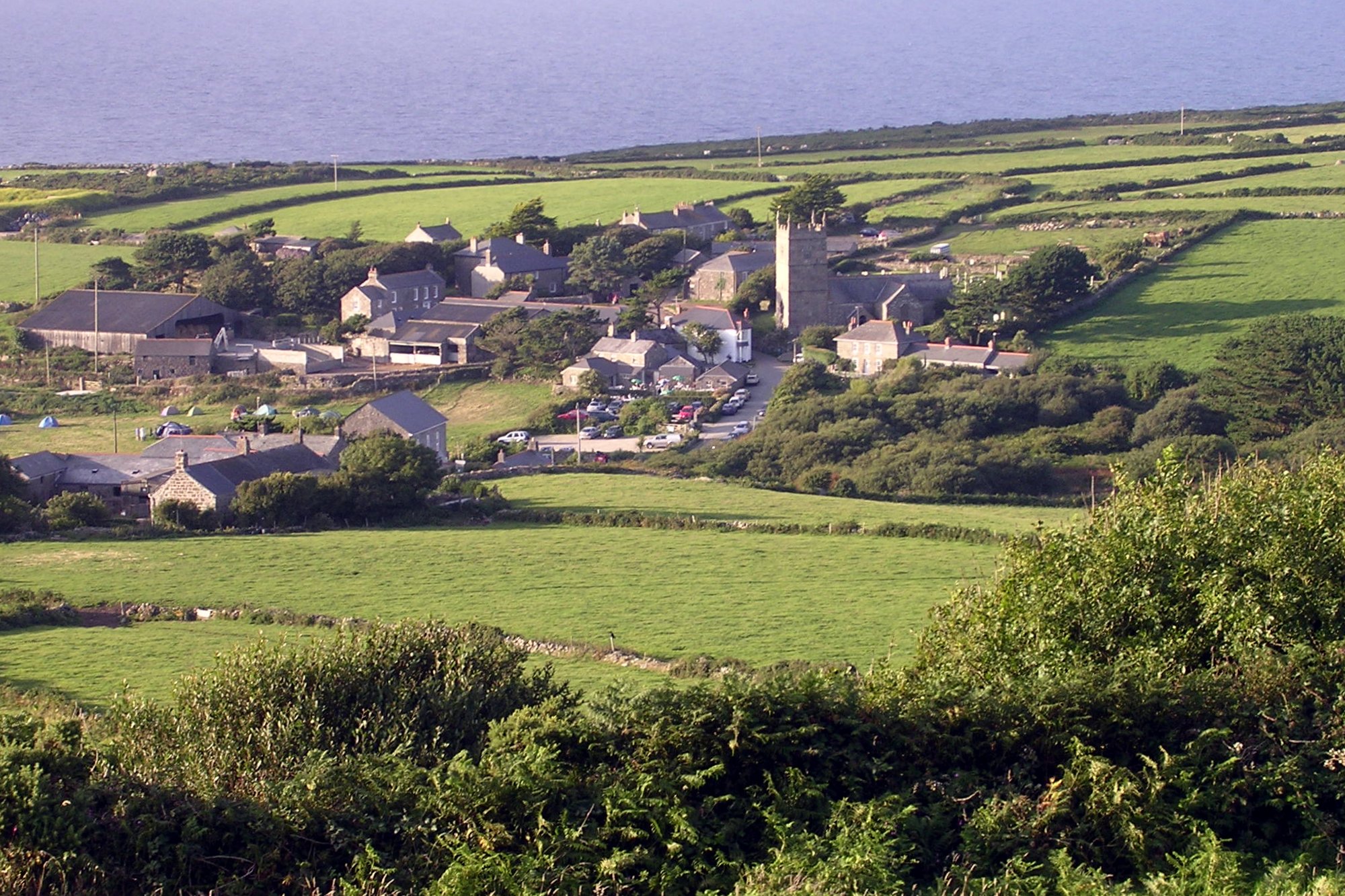
Zennor (/ˈzɛnər/; Cornish: Eglossenar (village) or Pluw Senar (parish))[1] is a village and civil parish in Cornwall, England, United Kingdom. The parish includes the villages of Zennor, Boswednack and Porthmeor and the hamlet of Treen. Zennor lies on the north coast, about 6 miles (10 km) north of Penzance,[2] along the B3306 road which connects St Ives to the A30 road. Alphabetically, the parish is the last in Britain. Its name comes from the Cornish name for the local saint, Saint Senara.[3]
Key Information


Zennor Head is a coastal promontory north of the village. The cliffs rise over 60 metres (200 ft) from the sea and the highest point of the headland is 96 metres (314 ft) above sea level.[2] The village itself is at an elevation of around 110 metres (360 ft).
Zennor lies within the Cornwall Area of Outstanding Natural Beauty (AONB). Almost a third of Cornwall has AONB designation, with similar status and protection as a National Park.
Frank Baker's 1956 novel Talk of the Devil is set in Zennor and deals with fictionalised versions of Aleister Crowley and some of his associates. Helen Dunmore's 1993 novel Zennor in Darkness is set in and around the village in 1917 when D. H. Lawrence lived nearby. Zennor is also mentioned in the Ulysses Moore series of books, written by Pierdomenico Baccalario; in fact, near Zennor and St Ives there would be the mysterious hamlet of Kilmore Cove, the place where the series is mainly set.
Local government
[edit]For the purposes of local government Zennor elects a parish council of seven members every three years.[4] Higher functions are exercised by Cornwall Council. Until March 2009 the parish was included in the former Penwith Council District.
History and antiquities
[edit]Antiquities include the megalithic burial chambers Zennor Quoit and Sperris Quoit, 400 yards (370 m) apart, about 1 mi (1.6 km) east of the village.[5] There is a prehistoric entrance grave at Pennance known as the Giant's House and not far away are four round barrows. Gurnard's Head, or Trereen Dinas, is an Iron Age promontory fort (or cliff castle) with five lines of fortification, and a mile to the west is Bosigran, close to Treen (Cornish: Tredhin), a second promontory fort along with a surviving field system,[6] suggested by Henry Jenner to mean 'the Dwelling of Igerna', King Arthur's mother in Arthurian legend.[7]
Between 1915 and 1917, writer D. H. Lawrence lived near the village with his new wife Frieda. It was during this time that he finished Women in Love. The couple were later accused of spying and signalling to German submarines off the Cornish coast and in late 1917, after constant harassment by the armed forces authorities, Lawrence was forced to leave Cornwall at three days' notice under the terms of the Defence of the Realm Act 1914 (DORA). This persecution was later described in an autobiographical chapter of his Australian novel Kangaroo, published in 1923. In September 2016 events were held to celebrate the centenary of Lawrence's connection with Zennor.[8]
In 1943, the middle of World War II, No. 4 Commando were involved in a mock seaborne raid codenamed "Exercise Brandyball", which took place on the 300-foot (91 m) cliffs, near Bosigran, known as the 'Brandys'.[9] The training exercise was deemed one of the most hazardous and challenging of the war,[10] beginning with a seaborne landing,[9] followed by a climb up the vertical cliffs with full kit to destroy the target, an old disused tin mine. On the rehearsal day of 6 June, the weather was not good and one of the boats sank with the loss of two commandos. These events were filmed by Allied officers,[9] as observers from all the services were present, including General Bernard Montgomery. The archives are now held in the Imperial War Museum.[9] The following day the men decided the operation should continue, and it was successfully completed on 7 June.[9][11]
Parish Church of St Senara
[edit]
The Church of St Senara is partly Norman and partly of the 13th and 15th centuries (the north aisle 15th century). There is a west tower and the octagonal font may be from the 13th century. One of only two remaining bench ends portrays the Mermaid of Zennor. Little is known of St Senara, although legend connects her to Princess Asenora of Brittany.[12][13]
There are three Cornish crosses in the parish: one is in the vicarage garden and two are in the churchyard. Those in the churchyard are fixed on the tombstone of the Rev. William Borlase, Vicar of Zennor (died 1888).[14]
Special Operations Executive intelligence officer Vera Atkins was cremated after her death and the ashes scattered in the churchyard. Her memorial plaque, shared with her brother Guy, has the inscription: "Vera May Atkins, CBE Légion d'Honneur Croix de Guerre".[15]
Culture and amenities
[edit]Late Cornish language use
[edit]The village of Boswednack was home to a small community of Cornish speakers during the 19th century. These included John Davey Jnr., 1812–1891 and his father, as well as Anne Berryman (1766–1854), and John Mann (1834–1914). John Mann recalled in an interview that, when a child, he and several other children always conversed in Cornish while at play together.[16][17] It is from John Davey that we know the Cranken Rhyme, probably the last recorded piece of traditional late Cornish verse.
The mermaid of Zennor
[edit]
The legend of the mermaid of Zennor concerns a mermaid that visits St Senara's Church and entices local parish singer Mathey Trewella away. The legend was probably inspired by a 15th-century carved bench-end in the church that shows a mermaid.[18]
In its turn, the legend has inspired Vernon Watkins' poem "The Ballad of the Mermaid of Zennor",[19] Sue Monk Kidd's novel The Mermaid Chair, Cornish poet Charles Causley's book The Merrymaid of Zennor, the song "Mermaid" by Cornish folk singer Brenda Wootton,[20] the song "The Mermaid of Zennor" by English singer-songwriter Paul William Gibson, and Helen Dunmore's Ingo Chronicles.
Amenities
[edit]As well as a public house, the Tinner's Arms, next to it is a guesthouse[21][22]
Carne Cottage
[edit]Carne Cottage is one of a number of abandoned buildings in the area. It is claimed that the cottage used to belong to the occultist Aleister Crowley in the 1930s, although there is no evidence that Crowley ever owned the cottage, or ever even visited it.[23] It is claimed that the death of Katherine Laird Cox, on 23 May 1938, was connected with Crowley and the cottage, but again, there is a lack of evidence to support this and it is likely to be an urban myth.[23]
Additionally, this story – which includes the claim that Gerald Vaughan had gone mad – is disputed. As Antoni Diller has pointed out, whilst Gerald's wife Ellaline was known to suffer from hallucinations, there is no evidence that Gerald went mad. In fact, he went on to become an editor of Freedom, an anarchist newspaper based in London.[24]
Patrick Heron
[edit]Patrick Heron lived in Cornwall until the age of nine and he returned in 1956 to live at "Eagle's Nest", overlooking the cliffs near Zennor.
Many of the sharp-edged shapes in his artistic works are reminiscent of the aged Cornish coastline, while the rounded shapes recall the granite boulders in his own garden. He died peacefully at his home in Zennor in March 1999, at the age of 79, and many of his works are displayed at the Tate St Ives art gallery.[25]
Gallery
[edit]-
 Zennor Church
 -
 Zennor Church from the northeast
 -
 Zennor Church (interior, with Mermaid Chair)
 -
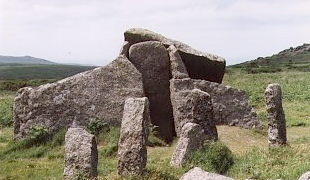 Zennor Quoit, about a mile southeast of Zennor village
 -
 View to the east from Zennor Head
 -
 View to the west from Zennor Head
 -
 Zennor Head in the evening
 -
 The pine, the pub sign and the church


_(9612120).jpg)


Notable people
[edit]
- Henry Quick (1792–1857), poet who wrote about rural life in Cornwall.
- John Davey (1812–1891), farmer who was one of the last people with knowledge of the Cornish language.
- Susanna Heron (born 1949) a site-specific artist in stone relief, grew up locally
References
[edit]- ^ "Akademi Kernewek - Henwyn Tyller". Archived from the original on 29 April 2020. Retrieved 19 January 2025.
- ^ a b Ordnance Survey: Landranger map sheet 203 Land's End ISBN 978-0-319-23148-7
- ^ Warlinnen – The Cornish Language Online Archived 18 October 2006 at the Wayback Machine
- ^ "Zennor Parish Council". www.cornwall.gov.uk. cornwall council. Archived from the original on 12 September 2015. Retrieved 6 September 2015.
- ^ "Local information guide" (PDF). Archived from the original (PDF) on 23 September 2015. Retrieved 6 September 2015.
- ^ Nicholas Johnson and Peter Rose (1990). Cornwall's Archaeological Heritage. Truro: Cornwall Archaeological Unit. ISBN 0-906294-21-5.
- ^ Jenner, Henry (1922). "Castle-an-Dinas and King Arthur". Annual Report of the Royal Cornwall Polytechnic Society. New Series. 4. Plymouth and Falmouth: 100–101.
- ^ "Centenary events will celebrate DH Lawrence's time in Zennor". westbriton.co.uk. 5 September 2016. Retrieved 11 September 2016.[permanent dead link]
- ^ a b c d e Johnston, John Norman (7 June 1943). "Exercise Brandyball (film)". Imperial War Museum. Retrieved 27 October 2012.
- ^ Will Fowler (2012). Allies at Dieppe: 4 Commando and the US Rangers: Operation Cauldron. Osprey Publishing. pp. Appendix 2. ISBN 978-1-78096-596-3.
- ^ Dunning, James (2003). The Fighting Fourth : No. 4 Commando at war 1940–45 (First ed.). Stroud, [England] : Sutton, 2003. p. 109. ISBN 978-0-7509-3095-6. OCLC 630147678.
- ^ St. Senara's Church at zennor.org Archived 23 March 2012 at the Wayback Machine
- ^ Bede, Eccl. Hist. Book 3, chapter 23.
- ^ Langdon, A. G. (1896) Old Cornish Crosses. Truro: Joseph Pollard; pp. 105–06, 135–36, 146–47.
- ^ Helm, Sarah (May 2005). A Life in Secrets: The Story of Vera Atkins and the Lost Agents of SOE. London, UK: Little, Brown. p. 440. ISBN 0-316-72497-1.
- ^ Rod Lyon, Cornish – the Struggle for Survival, 2001
- ^ Legend Dolly Pentreath outlived native tongue Archived 7 February 2012 at the Wayback Machine; Thisiscornwall
- ^ Pritchard, George. "The Mermaid of Zennor". Cornish Legends Saints, Mermaids & Phoenicians. Retrieved 14 June 2012.
- ^ Watkins, Vernon (1962). Affinities (PDF). London: Faber and Faber. Archived from the original (PDF) on 15 December 2013. Retrieved 14 June 2012.
- ^ Boy Jan ... Cornishman, (1980), Burlington Records, BURL 005, sleeve notes
- ^ "Zennor Chapel Cafe Guesthouse". zennorchapelguesthouse.com. Retrieved 1 May 2016.
- ^ "Tinners Arms website". tinnersarms.com. tinners arms. Retrieved 1 May 2016.
- ^ a b Martin, Greg (21 October 2018). "Inside the abandoned Cornwall house full of dark secrets". CornwallLive. Local World. Retrieved 19 January 2021.
- ^ Diller, Antoni. "The So-called Tregerthen Horror | Antoni Diller". www.cantab.net. Antoni Diller. Retrieved 19 January 2021.
- ^ Patrick Heron, St Ives painter Archived 16 April 2009 at the Wayback Machine
- The Mermaid of Zennor; Cornishculture
Further reading
[edit]- Symons, Alison (1992) Tremedda Days: a view of Zennor, 1900–44. Tabb House
External links
[edit]
- Cornwall Record Office Online Catalogue for Zennor
- Zennor at genuki.org.uk
- parish council website Archived 12 September 2015 at the Wayback Machine


| International | |
|---|---|
| National | |
| Other | |

Zennor
View on GrokipediaGeography
Location and Topography
Zennor is a coastal village and civil parish situated on the north coast of the Penwith peninsula in Cornwall, England. It lies approximately 6 miles (10 km) southwest of St Ives and 7 miles (11 km) north of Penzance, with primary access provided by the B3306 road that runs along the coastal route.[6][7] The parish encompasses an area of 17.62 km² (6.80 sq mi) and includes the hamlets of Boswednack, Porthmeor, and Treen within its boundaries.[8][3] The village itself is positioned at an elevation of about 110 meters (360 ft) above sea level, overlooking the Atlantic Ocean. Surrounding the settlement are rugged granite cliffs that rise over 60 meters (200 ft) along the coastline, characteristic of the West Penwith landscape. Inland, the terrain transitions to moorland dotted with granite outcrops and boulder-strewn hills, reflecting the region's underlying geology dominated by the Land's End granite intrusion, part of the larger South West Batholith.[9][10][11] Prominent among the area's topographical features is Zennor Head, a promontory extending into the Atlantic about 1 km northwest of the village, reaching a height of 96 meters (315 ft) at its highest point. This headland, with its sheer granite cliffs, forms a dramatic natural boundary and exemplifies the parish's exposed, windswept coastal topography. Zennor lies within the Cornwall National Landscape, enhancing its scenic and geological significance.[10][12]Environment and Conservation
Zennor is encompassed entirely by the West Penwith section of the Cornwall National Landscape, a nationally protected landscape designated in 1959 under the National Parks and Access to the Countryside Act 1949, which prioritizes the conservation of its dramatic coastal cliffs, granite moorlands, and open heathlands.[13][14] This section spans 13,762 hectares, forming 14.3% of the overall National Landscape that covers 96,403 hectares or 27% of Cornwall's land area, with management focused on sustaining the wild, Atlantic-influenced character of the terrain while addressing threats like coastal erosion and climate change.[13] The parish's coastal environment features rugged headlands and cliffs that host diverse habitats, including maritime heathlands and grasslands teeming with wildflowers, seabirds such as peregrine falcons, and marine mammals like grey seals that haul out on rocky shores.[13] The South West Coast Path, a 630-mile National Trail, runs through Zennor, offering public access to these features while promoting sustainable recreation amid chasms, coves, and exposed granite outcrops.[10] These topographical elements enhance the area's ecological value, supporting species adapted to the harsh, wind-swept conditions.[13] Conservation initiatives in Zennor are coordinated by Cornwall Council and Natural England via the National Landscape Partnership, guided by the 2022-2027 Management Plan that enforces strict development restrictions to safeguard granite moorlands, prevent soil erosion, and foster habitat connectivity.[13] The parish plays a key role in the broader Penwith biodiversity network, particularly through the West Penwith Moors and Downs Site of Special Scientific Interest (SSSI), notified in 2022 and confirmed in 2023, which protects lowland heath, a key priority habitat where such habitats together comprise about 25% of National Landscape land, and rare flora such as the Cornish heath (Erica vagans).[15][13][16] Efforts include biodiversity net gain policies, invasive species control, and community-led nature recovery projects to bolster resilience against environmental pressures.[13]Administration and Demographics
Local Government
Zennor is a civil parish governed under the unitary authority of Cornwall Council, established on 1 April 2009 through the abolition of the previous two-tier system comprising Cornwall County Council and six district councils, including Penwith District Council, within which Zennor was situated. This structural change consolidated responsibilities for services such as education, highways, and social care at the county level, while preserving parish councils for hyper-local administration. The Zennor Parish Council operates as the lowest tier of local government, comprising seven volunteer councillors elected every four years or co-opted as needed, who focus on parish-level decision-making.[17] It manages key local affairs, including responding to planning applications, maintaining public amenities like footpaths and playgrounds, and supporting community events such as farmers' markets and emergency preparedness initiatives.[18] The council collaborates with Cornwall Council on broader issues, such as reporting planning breaches or anti-social behaviour, to ensure coordinated service delivery.[18] Meetings of the Zennor Parish Council are convened on the second Tuesday of each month at 7:00 PM in Zennor Village Hall, with agendas published in advance and sessions open to the public and press for transparency.[19] These gatherings allow residents to voice concerns and participate in discussions on local priorities. Electoral representation at higher levels places Zennor within the Ludgvan, Madron, Gulval and Heamoor division for Cornwall Council elections, currently represented by Councillor Juliet Line of the Liberal Democrats.[20] Nationally, the parish forms part of the St Ives parliamentary constituency in the UK House of Commons. Prior to the 2009 reorganisation, Zennor's governance involved both Penwith District Council for district services and Cornwall County Council for county-wide functions.Population and Demographics
The population of Zennor parish stood at 196 residents in the 2011 United Kingdom Census, rising modestly to 203 in the 2021 Census—a growth of 3.6% over the decade. This equates to a population density of approximately 11.5 people per square kilometre across the parish's 17.62 km² area, underscoring its sparse, rural settlement pattern. Historically, Zennor's population exceeded 1,000 during the peak of 19th-century tin and copper mining in the 1840s, but it declined sharply thereafter due to industry collapse; by 1861, it had fallen to 933 residents. Demographically, Zennor remains overwhelmingly White British, mirroring Cornwall's composition where 96.8% of the population identified as White in 2021. The community is aging, with 30.5% of residents aged 65 and over, 51.7% aged 18–64, and 18.2% under 18, resulting in a median age of around 50 years. Household structures emphasize stability, with a high share of owner-occupied dwellings typical of rural Cornish parishes. Socioeconomic indicators point to a low-unemployment locale, with rates below 2% in recent assessments, consistent with Cornwall's 2021 Census figure of 2.0%. Residents often depend on part-time and seasonal employment opportunities, shaped by the area's limited industrial base post-mining era.History
Prehistoric and Ancient Antiquities
Zennor's prehistoric landscape features prominent Neolithic monuments, including Zennor Quoit, a well-preserved portal dolmen or cromlech dating to approximately 3500–2500 BCE. This chambered tomb consists of five large granite slabs supporting a massive capstone, forming a rectangular burial chamber about 2 meters by 1.2 meters internally, likely used for ritual interments of cremated remains and bones.[21] Nearby, Sperris Quoit, another Neolithic chambered tomb from the same period, survives in a collapsed state with only a single standing stone and scattered slabs amid the moorland, indicating similar funerary or ceremonial functions.[22] These structures reflect early communal rituals tied to territorial boundaries and resource management in the region's open moorlands.[23] The Romano-British period (c. 43–410 CE) is evidenced by settlements such as courtyard houses at Foage, near Zennor, featuring enclosed structures with associated field systems. Excavations have uncovered Roman coins, including one of Marcus Aurelius, and pottery sherds, suggesting occupation and trade links continuing from Iron Age traditions into the Roman era.[24] [25] Transitioning to the Bronze and Iron Ages, sites such as the possible fogou near Carn Galver—an underground dry-stone passage potentially dating to the late Bronze Age or Iron Age (c. 1000–400 BCE)—suggest continued ritual or storage uses, though its exact purpose remains debated due to limited excavation.[26] At Gurnard's Head, the Iron Age promontory fort known as Trereen Dinas (c. 800–400 BCE) features two stone ramparts and ditches enclosing a headland settlement, with excavations in 1939 uncovering Iron Age pottery and hut circles indicative of defensive and domestic activity.[27] These monuments integrate with the granite tors and coastal cliffs, evidencing a shift toward fortified communities.[28] Archaeological evidence from pollen analysis and limited digs across Zennor reveals early farming practices from the Neolithic onward, with cereal pollen (e.g., Hordeum type) and grazing indicators pointing to mixed pastoralism and sporadic cultivation on herb-rich grasslands, alongside ritual uses in tor enclosures like Carn Galva for communal gatherings.[23] Tools, pottery shards, and burial urns from Bronze Age contexts, such as those near Carn Galver, underscore small-scale settlements focused on dairying and arable farming.[29] Many sites, including Gurnard's Head and the quoits, are protected and managed by Historic England and the National Trust, with local groups like the Cornish Ancient Sites Protection Network aiding preservation through monitoring and minimal interventions to avoid further disturbance.[30]Medieval to Modern History
The parish of Zennor emerged as a distinct entity in the medieval period, with its church first documented in 1150 when Robert Fitzwilliam confirmed its dedication to St. Senara and its grant to Tywardreath Priory.[31] By 1270, the church had been appropriated to Glasney College, marking the formal organization of ecclesiastical and local administration under feudal structures.[31] Land holdings in the area fell under manors such as Ludgvan Lese, where tenants operated within a system of customary rights and obligations typical of Cornish feudal estates, as recorded in surviving manorial documents from the late medieval era.[31] Tin extraction in Zennor began modestly during the medieval period through stream working, where alluvial deposits were panned from local watercourses, contributing to Cornwall's early role as a key supplier of tin to European markets.[32] This primitive method laid the groundwork for later industrial development but remained small-scale, integrated with agrarian life under feudal oversight.[32] The 19th century brought a dramatic industrial transformation to Zennor, driven by a boom in copper and tin mining that peaked in the 1840s. Mines such as Wheal Galver, operating as part of the Morvah and Zennor United Tin Mines, exemplified this expansion, employing over 116 workers in 1838 and producing 195 tons of black tin between 1837 and 1839.[33] This influx fueled a population surge to over 1,000 residents by the mid-century, with mining providing the primary economic driver and shaping community demographics through influxes of skilled laborers.[2] However, the global depression in metal prices led to widespread closures after the 1890s, triggering economic contraction and emigration; Zennor's population plummeted from a 1861 peak of 933 to 294 by 1911 as mines like those in the Wheal Galver sett shut down.[34] In the early 20th century, Zennor served as a temporary refuge for cultural figures amid broader turmoil. Author D.H. Lawrence and his wife Frieda resided at Higher Tregerthen Cottage from late 1915 to October 1917, seeking respite from World War I's industrial strife; during this time, Lawrence completed parts of Women in Love while navigating local suspicions over Frieda's German heritage, which contributed to their eventual expulsion under wartime regulations.[35] The war's later phases saw Zennor repurposed for military training, including a 1943 mock seaborne raid by No. 4 Commando at Bosigran Castle cliffs, codenamed "Exercise Brandyball," which simulated amphibious assaults on coastal defenses and highlighted the area's rugged terrain for commando preparation.[36] Postwar recovery in Zennor was marked by continued depopulation and a pivot to agriculture, as mining's collapse left few alternatives; the parish's numbers fell to around 200 by the late 1940s, with small-scale farming and fishing sustaining the remaining households amid broader rural decline in West Cornwall.[37] This shift emphasized subsistence crops and livestock on fragmented holdings, reflecting national trends in agricultural adaptation following industrial contraction. In recent decades, Zennor integrated into Cornwall's unitary authority structure with the establishment of Cornwall Council in 2009, which consolidated local governance and services previously divided among district councils, enhancing regional coordination for rural areas like Penwith.[38] The 2020s have brought minor disruptions to Zennor's tourism-dependent economy from global events, including the COVID-19 pandemic's travel restrictions and ensuing inflationary pressures, though the parish's appeal as a cultural and natural retreat has supported gradual recovery.Cultural and Religious Heritage
Parish Church of St Senara
The Parish Church of St Senara, located in the village of Zennor on Cornwall's north coast, serves as the primary religious site for the parish and is dedicated to the 6th-century saint Senara, a figure from Breton legend who is said to have arrived by sea and established early Christian worship in the area.[39] The church's origins trace back to at least the 12th century, with the first documentary reference appearing in 1150 when it was granted to Tywardreath Priory by Ralph de Sicca Villa, though archaeological evidence suggests a possible Saxon or earlier foundation on the site, potentially over 1,000 years old.[40][39] Constructed primarily from local granite moorstone with ashlar dressings and featuring a slate roof, the church exemplifies Cornish ecclesiastical architecture with Perpendicular Gothic elements, including 19th-century windows and intersecting tracery in the south transept possibly dating to the 13th century.[41] The structure includes a chancel, nave, north aisle added in the 15th century, south transept from the 13th or 14th century, and a three-stage embattled west tower also from the 15th century, along with a south porch of the same period; parts of the south wall may retain 12th- or 13th-century fabric.[41] The interior features 19th-century waggon roofs on granite corbels, a six-bay 15th-century arcade with octagonal piers between the nave and north aisle, and walls stripped of plaster in the 19th century to reveal the stonework.[41] The chancel features a window depicting St. Senara holding the church.[39] A 13th-century octagonal font with a central shaft and four corner shafts stands as a key early feature, while 15th-century bench ends include notable carvings, such as one depicting a mermaid that briefly references the local legend of a sea creature enchanted by a chorister's song.[41][39] The churchyard contains three medieval wheel-headed wayside crosses, relocated from nearby sites and dating between the 9th and 15th centuries, with one featuring a Christ figure on the west face and an equal-limbed cross on the east, another with similar motifs, and a third showing Latin crosses on both faces; these granite monuments, scheduled as a group, illustrate early Cornish Christian sculptural traditions and were likely used as route markers.[42] Among the memorials is a shared plaque for Vera Atkins, a Special Operations Executive agent during World War II who died in 2000 and is buried in the churchyard alongside her brother Guy, honoring her contributions to intelligence efforts.[41][39][43] Other elements include a granite coffin lid from 1784 and a 1737 sundial by Paul Quick on the south wall, decorated with crossed bones.[41][39] As a Grade I listed building since 1954, the church is maintained by the Church of England within the Diocese of Truro, supported by local community efforts and funds amid a small parish population of around 200, ensuring its role in baptisms, weddings, funerals, and worship while preserving its historical and cultural centrality to Zennor.[41][39]Folklore and Legends
Zennor's folklore is dominated by the legend of the Mermaid of Zennor, a tale first recorded in written form in 1873 by William Bottrell, a collector of Cornish traditions, though oral versions likely date to the 15th century.[44] In the story, a beautiful woman with long golden hair and sea-green eyes begins attending services at St Senara's Church, where she is enchanted by the voice of young chorister Mathey Trewella during his hymns.[4] One Sunday, she invites him to her home in Pendour Cove; upon reaching the cove, she sheds her cloak to reveal her mermaid form, complete with a shimmering tail, and lures him into the sea to live with her beneath the waves.[45] The mermaid is said to return every seven years to the cove, listening for the church bells, symbolizing the perilous allure of the ocean and the dangers faced by coastal communities.[44] This narrative has no historical corroboration but serves as a cautionary emblem of the sea's treacherous beauty, with the mermaid briefly referenced in a 15th-century church bench-end carving depicting her holding a comb and mirror.[4] The parish's patron saint, Senara (also known as Asenora), features prominently in local legends as a survivor of maritime peril, tying into Zennor's seafaring heritage. According to tradition, Senara was a 6th-century Breton princess and devout Christian married to King Goello, who, deceived by rivals, accused her of infidelity during her pregnancy and set her adrift in a chest or barrel on the stormy seas.[46] Miraculously, she washed ashore near Zennor, where she gave birth to her son, founded the original church, and converted the local pagan population before returning to Brittany.[47] This hagiographic tale, preserved in medieval Cornish lore, underscores themes of divine protection and resilience against shipwreck, reflecting the frequent perils of navigation along Cornwall's rugged coast.[46] Beyond these aquatic myths, Zennor's folklore encompasses tales of piskies—mischievous fairy-like beings inhabiting the surrounding moorlands—and ancient customs rooted in Celtic traditions. One such story, "Cherry of Zennor," recorded in 19th-century collections, recounts how a discontented teenage girl named Cherry is enticed by a finely dressed stranger (implied to be a pisky king) from her impoverished home to a hidden fairy realm of luxury and revelry, only to escape after glimpsing its otherworldly nature.[46] Piskies, known in Cornish lore for leading travelers astray with their "piskie lights" or dancing rings, are said to frequent the moors around Zennor, embodying the region's wild, untamed landscapes.[48] Local customs, such as midsummer bonfires lit on hilltops like Burns Down above Zennor, trace to pre-Christian Celtic rituals honoring the solstice and warding off evil spirits, later Christianized as St John's Eve celebrations; these fires, kindled from gathered gorse and wood, fostered community gatherings and symbolized renewal amid the summer's peak.[49] The Mermaid legend, in particular, has enduring cultural resonance, inspiring literary works like Charles Causley's 20th-century "Ballad of the Mermaid of Zennor," which poeticizes the tale's themes of enchantment and loss, and contributing to Zennor's identity through tourism and storytelling events that retell these myths for visitors.[50] While lacking empirical evidence, such folklore reinforces Zennor's symbolic connection to Cornwall's Celtic past and the sea's dual role as nurturer and destroyer, preserving communal warnings about isolation and temptation in a harsh environment.[45]Late Use of the Cornish Language
Zennor served as a notable late stronghold for the Cornish language, where traditional usage persisted into the early 19th century, longer than in many eastern parts of Cornwall. While the last fluent native speakers in nearby parishes like Mousehole were documented in the late 18th century, evidence from Zennor and adjacent Boswednack indicates sporadic spoken Cornish among families into the 1800s, often limited to phrases, place names, and rhymes passed down orally.[51][52] A key figure in this late phase was John Davey (1812–1891), a farmer and former schoolmaster from Boswednack in Zennor, who retained hereditary knowledge of Cornish from his father and grandfather. Davey could recite traditional rhymes, count in Cornish up to 20, and explain local place-name etymologies, though he lacked full conversational fluency. His dialect was documented in 19th-century surveys, including notes by local antiquarians, contributing early insights to revival scholars like Robert Morton Nance. A memorial plaque in Zennor Church, erected in 1930 by the St. Ives Old Cornwall Society, honors Davey as one of the last with such traditional fluency.[51][53] The decline of Cornish in Zennor accelerated after 1800, driven by the influx of English-speaking workers into the local mining industry and mandatory English-medium schooling under the 1870 Education Act, which penalized non-English speakers. These factors increased linguistic competition and social pressure, reducing Cornish to isolated family usage by mid-century. Today, Cornish is a revived minority language with approximately 563 speakers across Cornwall as per the 2021 UK Census, none native but many conversationally fluent.[52] Revival efforts from the 20th century onward have bolstered Cornish in Zennor as part of broader Celtic identity initiatives. Standardization through forms like Unified Cornish, proposed by Nance in the 1920s, facilitated its reintroduction via signage on local roads and businesses, occasional church services at St. Senara's, and educational programs in Penwith schools. Zennor's participation in the Celtic Congress, established in 1904 with Cornwall's inclusion, has further promoted the language through cultural events emphasizing its ties to other Brythonic tongues.[54][55]Arts and Amenities
Artistic Associations
Zennor's rugged coastal landscape and mystical aura have drawn artists and writers throughout history, fostering a rich tradition of creative expression tied to its natural and cultural heritage. In literature, D.H. Lawrence resided at Higher Tregerthen farm near Zennor from 1915 to 1917, a period during which he completed the manuscript of his novel Women in Love and explored themes of Cornish mysticism and blood-consciousness in his writings and letters, inspired by the local granite tors and ancient Celtic influences.[56][5][57] Earlier, the local poet Henry Quick (1792–1857), born and raised in Zennor to a miner's family, chronicled rural Cornish life, crimes, and calamities in his dialect verse, capturing the hardships and folklore of the Penwith peninsula.[58][59] The visual arts flourished in Zennor during the mid-20th century, particularly through the work of abstract painter Patrick Heron (1920–1999), who relocated to Eagles Nest in Zennor in 1956 and drew inspiration from the area's luminous coastline and shifting light to develop his vibrant, non-figurative style.[60][61] His daughter, Susanna Heron (born 1949), grew up in the Zennor household and emerged as a site-specific sculptor and environmental artist, creating stone reliefs and installations that echo the interplay of form and landscape, as seen in her photographic series Shima: Island and Garden documenting the family garden at Eagles Nest.[62][63] Zennor contributed to the broader 20th-century artists' colony in the St Ives region, where post-war modernists sought refuge and innovation amid Cornwall's elemental scenery, though the village itself lacked a formal gallery and instead hosted private studios and collections.[64] The enduring mermaid legend of Pendour Cove, depicting a sea creature enchanted by a local chorister, has permeated modern artistic interpretations, inspiring paintings and literary works that evoke Zennor's folklore.[65] Today, Zennor artists engage in contemporary events such as Cornwall Open Studios, opening private workspaces to the public during annual arts festivals to showcase local creativity. Zennor's legacy in post-war British modernism endures through figures like Heron, whose presence amplified the area's influence on abstract and color-driven experimentation.[66]Local Facilities and Economy
Zennor's local facilities are limited, reflecting its small, rural character, with essential services centered around community and hospitality venues. The Tinners Arms, a Grade II-listed pub built in 1271 to house masons constructing the nearby St Senara's Church, serves as the village's primary social hub and is recognized as one of Cornwall's oldest continuously operating inns.[67][68] The Zennor Chapel Guesthouse, housed in a former Wesleyan chapel, provides accommodation alongside a café offering home-cooked meals and a gift shop featuring local crafts.[69] Zennor lacks its own primary school, with children typically attending nearby institutions such as St Ives School or St Uny C of E Academy, which includes a dedicated Zennor class for older pupils.[70][71] The Zennor Village Hall functions as a key community space, hosting events like art workshops, council meetings, and cultural gatherings such as painting sessions and exhibitions.[72][73] The local economy has transitioned from a 19th-century reliance on tin mining—where over half of Zennor's male population was employed in local mines by 1861—to small-scale farming, fishing, and predominantly tourism.[34] Today, with no major industries present, the economy emphasizes eco-tourism, which supports a significant portion of employment through activities like coastal walks along the South West Coast Path and guided tours of local legends.[74] Tourism drives approximately 15% of Cornwall's overall economy, though in rural areas like Zennor, it forms an even larger share by sustaining bed-and-breakfast accommodations and seasonal visitor services.[75] Key tourism attractions include St Senara's Church, the prehistoric Zennor Quoit, and segments of the South West Coast Path offering dramatic cliff views and wildlife spotting, such as the 5-mile Zennor Circular Walk.[76] Annual mermaid-themed events, drawing on the folklore of the Mermaid of Zennor legend, further boost visitor interest, with gatherings like storytelling sessions held in spring and the Minack Theatre production in April 2025.[77][78] Accommodation options remain limited to a handful of B&Bs, including those at the Tinners Arms and Zennor Chapel, promoting low-impact stays aligned with sustainability efforts such as maintained, eco-friendly trails that minimize environmental disturbance.[10] Recent economic challenges stem from the 2023–2025 UK cost-of-living crisis, which contributed to a 10–12% decline in Cornwall's visitor numbers in 2024 alone, affecting Zennor's tourism-reliant businesses through reduced staycations and overseas trips.[79][80] Post-2020 modern developments include broadband enhancements via providers like Wildanet, which have improved connectivity in rural Zennor, enabling remote work and digital access for residents amid the shift to hybrid employment.[81]References
- https://en.wikisource.org/wiki/Dictionary_of_National_Biography%2C_1885-1900/Quick%2C_Henry