



Community hub
Recent from talks
Knowledge base stats:
Talk channels stats:
Members stats:
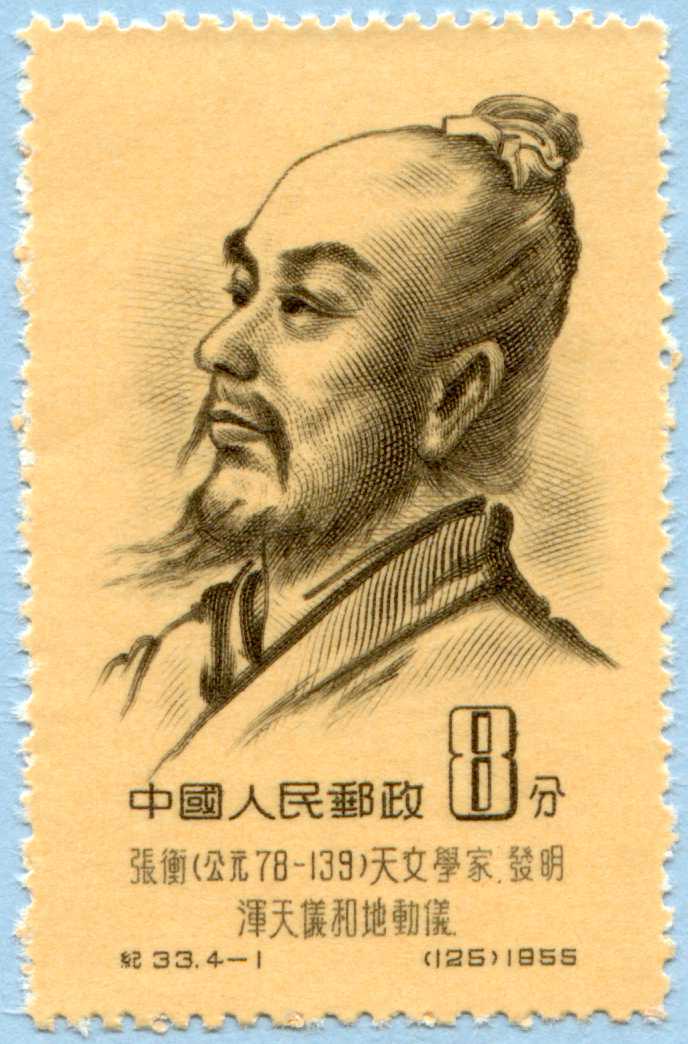
Zhang Heng
Zhang Heng (Chinese: 張衡; AD 78–139), courtesy name Pingzi, formerly romanized Chang Heng, was a Chinese polymathic scientist and statesman who lived during the Eastern Han dynasty. Educated in the capital cities of Luoyang and Chang'an, he achieved success as an astronomer, mathematician, seismologist, hydraulic engineer, inventor, geographer, cartographer, ethnographer, artist, poet, philosopher, politician, and literary scholar.
Zhang Heng began his career as a minor civil servant in Nanyang. Eventually, he became Chief Astronomer, Prefect of the Majors for Official Carriages, and then Palace Attendant at the imperial court. His uncompromising stance on historical and calendrical issues led to his becoming a controversial figure, preventing him from rising to the status of Grand Historian. His political rivalry with the palace eunuchs during the reign of Emperor Shun (r. 125–144) led to his decision to retire from the central court to serve as an administrator of Hejian Kingdom in present-day Hebei. Zhang returned home to Nanyang for a short time, before being recalled to serve in the capital once more in 138. He died there a year later, in 139.
Zhang applied his extensive knowledge of mechanics and gears in several of his inventions. He invented the world's first water-powered armillary sphere to assist astronomical observation; improved the inflow water clock by adding another tank; and invented the world's first seismoscope, which discerned the cardinal direction of an earthquake 500 km (310 mi) away. He improved previous Chinese calculations for pi. In addition to documenting about 2,500 stars in his extensive star catalog, Zhang also posited theories about the Moon and its relationship to the Sun: specifically, he discussed the Moon's sphericity, its illumination by reflected sunlight on one side and the hidden nature of the other, and the nature of solar and lunar eclipses. His fu (rhapsody) and shi poetry were renowned in his time and studied and analyzed by later Chinese writers. Zhang received many posthumous honors for his scholarship and ingenuity; some modern scholars have compared his work in astronomy to that of the Greco-Roman Ptolemy (AD 86–161).
Born in the town of Xi'e in Nanyang Commandery (north of the modern Nanyang City in Henan), Zhang Heng came from a distinguished but not affluent family. His grandfather Zhang Kan (張堪) had been governor of a commandery and one of the leaders who supported the restoration of the Han by Emperor Guangwu (r. 25–57), following the death of the usurping Wang Mang of the Xin (AD 9–23). When he was ten, Zhang's father died, leaving him in the care of his mother and grandmother.
An accomplished writer in his youth, Zhang left home in the year 95 to pursue his studies in the capitals of Chang'an and Luoyang. While traveling to Luoyang, Zhang passed by a hot spring near Mount Li and dedicated one of his earliest fu poems to it. This work, entitled "Fu on the Hot Springs" (Wēnquán fù 溫泉賦), describes the throngs of people attending the hot springs, which later became famous as the "Huaqing Hot Springs", a favorite retreat of imperial concubine Yang Guifei during the Tang dynasty. After studying for some years at Luoyang's Taixue, he was well-versed in the classics and friends with several notable persons, including the mathematician and calligrapher Cui Yuan (78–143), the official and philosophical commentator Ma Rong (79–166), and the philosopher Wang Fu (78–163). Government authorities offered Zhang appointments to several offices, including a position as one of the Imperial Secretaries, yet he acted modestly and declined.
At age 23, Zhang returned home with the title "Officer of Merit in Nanyang", serving as the master of documents under the administration of Governor Bao De (in office from 103 to 111). As he was charged with composing inscriptions and dirges for the governor, he gained experience in writing official documents. As Officer of Merit in the commandery, he was also responsible for local appointments to office and recommendations to the capital of nominees for higher office. He spent much of his time composing rhapsodies on the capital cities. When Bao De was recalled to the capital in 111 to serve as a minister of finance, Zhang continued his literary work at home in Xi'e. Zhang Heng began his studies in astronomy at the age of 30 and began publishing his works on astronomy and mathematics.
In 112, Zhang was summoned to the court of Emperor An (r. 106–125), who had heard of his expertise in mathematics. When he was nominated to serve at the capital, Zhang was escorted by carriage—a symbol of his official status—to Luoyang, where he became a court gentleman working for the Imperial Secretariat. He was promoted to Chief Astronomer for the court, serving his first term from 115 to 120 under Emperor An and his second under the succeeding emperor from 126 to 132. As Chief Astronomer, Zhang was a subordinate of the Minister of Ceremonies, one of Nine Ministers ranked just below the Three Excellencies. In addition to recording heavenly observations and portents, preparing the calendar, and reporting which days were auspicious and which ill-omened, Zhang was also in charge of an advanced literacy test for all candidates to the Imperial Secretariat and the Censorate, both of whose members were required to know at least 9,000 characters and all major writing styles. Under Emperor An, Zhang also served as Prefect of the Majors for Official Carriages under the Ministry of Guards, in charge of receiving memorials to the throne (formal essays on policy and administration) as well as nominees for official appointments.
When the government official Dan Song proposed the Chinese calendar should be reformed in 123 to adopt certain apocryphal teachings, Zhang opposed the idea. He considered the teachings to be of questionable stature and believed they could introduce errors. Others shared Zhang's opinion and the calendar was not altered, yet Zhang's proposal that apocryphal writings should be banned was rejected. The officials Liu Zhen and Liu Taotu, members of a committee to compile the dynastic history Dongguan Hanji (東觀漢記), sought permission from the court to consult Zhang Heng. However, Zhang was barred from assisting the committee due to his controversial views on apocrypha and his objection to the relegation of the Gengshi Emperor's (r. 23–25) role in the restoration of the Han dynasty as lesser than Emperor Guangwu's. Liu Zhen and Liu Taotu were Zhang's only historian allies at court, and after their deaths Zhang had no further opportunities for promotion to the prestigious post of court historian.
Hub AI
Zhang Heng AI simulator
(@Zhang Heng_simulator)
Zhang Heng
Zhang Heng (Chinese: 張衡; AD 78–139), courtesy name Pingzi, formerly romanized Chang Heng, was a Chinese polymathic scientist and statesman who lived during the Eastern Han dynasty. Educated in the capital cities of Luoyang and Chang'an, he achieved success as an astronomer, mathematician, seismologist, hydraulic engineer, inventor, geographer, cartographer, ethnographer, artist, poet, philosopher, politician, and literary scholar.
Zhang Heng began his career as a minor civil servant in Nanyang. Eventually, he became Chief Astronomer, Prefect of the Majors for Official Carriages, and then Palace Attendant at the imperial court. His uncompromising stance on historical and calendrical issues led to his becoming a controversial figure, preventing him from rising to the status of Grand Historian. His political rivalry with the palace eunuchs during the reign of Emperor Shun (r. 125–144) led to his decision to retire from the central court to serve as an administrator of Hejian Kingdom in present-day Hebei. Zhang returned home to Nanyang for a short time, before being recalled to serve in the capital once more in 138. He died there a year later, in 139.
Zhang applied his extensive knowledge of mechanics and gears in several of his inventions. He invented the world's first water-powered armillary sphere to assist astronomical observation; improved the inflow water clock by adding another tank; and invented the world's first seismoscope, which discerned the cardinal direction of an earthquake 500 km (310 mi) away. He improved previous Chinese calculations for pi. In addition to documenting about 2,500 stars in his extensive star catalog, Zhang also posited theories about the Moon and its relationship to the Sun: specifically, he discussed the Moon's sphericity, its illumination by reflected sunlight on one side and the hidden nature of the other, and the nature of solar and lunar eclipses. His fu (rhapsody) and shi poetry were renowned in his time and studied and analyzed by later Chinese writers. Zhang received many posthumous honors for his scholarship and ingenuity; some modern scholars have compared his work in astronomy to that of the Greco-Roman Ptolemy (AD 86–161).
Born in the town of Xi'e in Nanyang Commandery (north of the modern Nanyang City in Henan), Zhang Heng came from a distinguished but not affluent family. His grandfather Zhang Kan (張堪) had been governor of a commandery and one of the leaders who supported the restoration of the Han by Emperor Guangwu (r. 25–57), following the death of the usurping Wang Mang of the Xin (AD 9–23). When he was ten, Zhang's father died, leaving him in the care of his mother and grandmother.
An accomplished writer in his youth, Zhang left home in the year 95 to pursue his studies in the capitals of Chang'an and Luoyang. While traveling to Luoyang, Zhang passed by a hot spring near Mount Li and dedicated one of his earliest fu poems to it. This work, entitled "Fu on the Hot Springs" (Wēnquán fù 溫泉賦), describes the throngs of people attending the hot springs, which later became famous as the "Huaqing Hot Springs", a favorite retreat of imperial concubine Yang Guifei during the Tang dynasty. After studying for some years at Luoyang's Taixue, he was well-versed in the classics and friends with several notable persons, including the mathematician and calligrapher Cui Yuan (78–143), the official and philosophical commentator Ma Rong (79–166), and the philosopher Wang Fu (78–163). Government authorities offered Zhang appointments to several offices, including a position as one of the Imperial Secretaries, yet he acted modestly and declined.
At age 23, Zhang returned home with the title "Officer of Merit in Nanyang", serving as the master of documents under the administration of Governor Bao De (in office from 103 to 111). As he was charged with composing inscriptions and dirges for the governor, he gained experience in writing official documents. As Officer of Merit in the commandery, he was also responsible for local appointments to office and recommendations to the capital of nominees for higher office. He spent much of his time composing rhapsodies on the capital cities. When Bao De was recalled to the capital in 111 to serve as a minister of finance, Zhang continued his literary work at home in Xi'e. Zhang Heng began his studies in astronomy at the age of 30 and began publishing his works on astronomy and mathematics.
In 112, Zhang was summoned to the court of Emperor An (r. 106–125), who had heard of his expertise in mathematics. When he was nominated to serve at the capital, Zhang was escorted by carriage—a symbol of his official status—to Luoyang, where he became a court gentleman working for the Imperial Secretariat. He was promoted to Chief Astronomer for the court, serving his first term from 115 to 120 under Emperor An and his second under the succeeding emperor from 126 to 132. As Chief Astronomer, Zhang was a subordinate of the Minister of Ceremonies, one of Nine Ministers ranked just below the Three Excellencies. In addition to recording heavenly observations and portents, preparing the calendar, and reporting which days were auspicious and which ill-omened, Zhang was also in charge of an advanced literacy test for all candidates to the Imperial Secretariat and the Censorate, both of whose members were required to know at least 9,000 characters and all major writing styles. Under Emperor An, Zhang also served as Prefect of the Majors for Official Carriages under the Ministry of Guards, in charge of receiving memorials to the throne (formal essays on policy and administration) as well as nominees for official appointments.
When the government official Dan Song proposed the Chinese calendar should be reformed in 123 to adopt certain apocryphal teachings, Zhang opposed the idea. He considered the teachings to be of questionable stature and believed they could introduce errors. Others shared Zhang's opinion and the calendar was not altered, yet Zhang's proposal that apocryphal writings should be banned was rejected. The officials Liu Zhen and Liu Taotu, members of a committee to compile the dynastic history Dongguan Hanji (東觀漢記), sought permission from the court to consult Zhang Heng. However, Zhang was barred from assisting the committee due to his controversial views on apocrypha and his objection to the relegation of the Gengshi Emperor's (r. 23–25) role in the restoration of the Han dynasty as lesser than Emperor Guangwu's. Liu Zhen and Liu Taotu were Zhang's only historian allies at court, and after their deaths Zhang had no further opportunities for promotion to the prestigious post of court historian.