


Community hub
Recent from talks
Contribute something
Nothing was collected or created yet.
Hydraulic engineering
View on Wikipedia


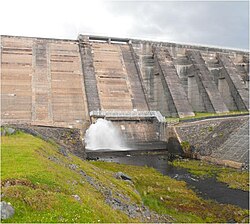
Hydraulic engineering as a sub-discipline of civil engineering is concerned with the flow and conveyance of fluids, principally water and sewage. One feature of these systems is the extensive use of gravity as the motive force to cause the movement of the fluids. This area of civil engineering is intimately related to the design of bridges, dams, channels, canals, and levees, and to both sanitary and environmental engineering.
Hydraulic engineering is the application of the principles of fluid mechanics to problems dealing with the collection, storage, control, transport, regulation, measurement, and use of water.[1] Before beginning a hydraulic engineering project, one must figure out how much water is involved. The hydraulic engineer is concerned with the transport of sediment by the river, the interaction of the water with its alluvial boundary, and the occurrence of scour and deposition.[1] "The hydraulic engineer actually develops conceptual designs for the various features which interact with water such as spillways and outlet works for dams, culverts for highways, canals and related structures for irrigation projects, and cooling-water facilities for thermal power plants."[2]
Fundamental principles
[edit]A few examples of the fundamental principles of hydraulic engineering include fluid mechanics, fluid flow, behavior of real fluids, hydrology, pipelines, open channel hydraulics, mechanics of sediment transport, physical modeling, hydraulic machines, and drainage hydraulics.
Fluid mechanics
[edit]Fundamentals of Hydraulic Engineering defines hydrostatics as the study of fluids at rest.[1] In a fluid at rest, there exists a force, known as pressure, that acts upon the fluid's surroundings. This pressure, measured in N/m2, is not constant throughout the body of fluid. Pressure, p, in a given body of fluid, increases with an increase in depth. Where the upward force on a body acts on the base and can be found by the equation:

where,
- ρ = density of water
- g = specific gravity
- y = depth of the body of liquid
Rearranging this equation gives you the pressure head . Four basic devices for pressure measurement are a piezometer, manometer, differential manometer, Bourdon gauge, as well as an inclined manometer.[1]

As Prasuhn[1] states:
- On undisturbed submerged bodies, pressure acts along all surfaces of a body in a liquid, causing equal perpendicular forces in the body to act against the pressure of the liquid. This reaction is known as equilibrium. More advanced applications of pressure are that on plane surfaces, curved surfaces, dams, and quadrant gates, just to name a few.[1]
Behavior of real fluids
[edit]Real and Ideal fluids
[edit]The main difference between an ideal fluid and a real fluid is that for ideal flow p1 = p2 and for real flow p1 > p2. Ideal fluid is incompressible and has no viscosity. Real fluid has viscosity. Ideal fluid is only an imaginary fluid as all fluids that exist have some viscosity.
Viscous flow
[edit]A viscous fluid will deform continuously under a shear force by the pascles law, whereas an ideal fluid does not deform.
Laminar flow and turbulence
[edit]The various effects of disturbance on a viscous flow are a stable, transition and unstable.
Bernoulli's equation
[edit]For an ideal fluid, Bernoulli's equation holds along streamlines.

As the flow comes into contact with the plate, the layer of fluid actually "adheres" to a solid surface. There is then a considerable shearing action between the layer of fluid on the plate surface and the second layer of fluid. The second layer is therefore forced to decelerate (though it is not quite brought to rest), creating a shearing action with the third layer of fluid, and so on. As the fluid passes further along with the plate, the zone in which shearing action occurs tends to spread further outwards. This zone is known as the "boundary layer". The flow outside the boundary layer is free of shear and viscous-related forces so it is assumed to act as an ideal fluid. The intermolecular cohesive forces in a fluid are not great enough to hold fluid together. Hence a fluid will flow under the action of the slightest stress and flow will continue as long as the stress is present.[3] The flow inside the layer can be either vicious or turbulent, depending on Reynolds number.[1]
Applications
[edit]Common topics of design for hydraulic engineers include hydraulic structures such as dams, levees, water distribution networks including both domestic and fire water supply, distribution and automatic sprinkler systems, water collection networks, sewage collection networks, storm water management, sediment transport, and various other topics related to transportation engineering and geotechnical engineering. Equations developed from the principles of fluid dynamics and fluid mechanics are widely utilized by other engineering disciplines such as mechanical, aeronautical and even traffic engineers.
Related branches include hydrology and rheology while related applications include hydraulic modeling, flood mapping, catchment flood management plans, shoreline management plans, estuarine strategies, coastal protection, and flood alleviation.
History
[edit]Antiquity
[edit]Earliest uses of hydraulic engineering were to irrigate crops and dates back to the Middle East and Africa. Controlling the movement and supply of water for growing food has been used for many thousands of years. One of the earliest hydraulic machines, the water clock was used in the early 2nd millennium BC.[4] Other early examples of using gravity to move water include the Qanat system in ancient Persia and the very similar Turpan water system in ancient China as well as irrigation canals in Peru.[5]
In ancient China, hydraulic engineering was highly developed, and engineers constructed massive canals with levees and dams to channel the flow of water for irrigation, as well as locks to allow ships to pass through. Sunshu Ao is considered the first Chinese hydraulic engineer. Another important Hydraulic Engineer in China, Ximen Bao was credited of starting the practice of large scale canal irrigation during the Warring States period (481 BC–221 BC), even today hydraulic engineers remain a respectable position in China.

In the Archaic epoch of the Philippines, hydraulic engineering also developed specially in the Island of Luzon, the Ifugaos of the mountainous region of the Cordilleras built irrigations, dams and hydraulic works and the famous Banaue Rice Terraces as a way for assisting in growing crops around 1000 BC.[6] These Rice Terraces are 2,000-year-old terraces that were carved into the mountains of Ifugao in the Philippines by ancestors of the indigenous people. The Rice Terraces are commonly referred to as the "Eighth Wonder of the World".[7][8][9] It is commonly thought that the terraces were built with minimal equipment, largely by hand. The terraces are located approximately 1500 metres (5000 ft) above sea level. They are fed by an ancient irrigation system from the rainforests above the terraces. It is said that if the steps were put end to end, it would encircle half the globe.[10]
Eupalinos of Megara was an ancient Greek engineer who built the Tunnel of Eupalinos on Samos in the 6th century BC, an important feat of both civil and hydraulic engineering. The civil engineering aspect of this tunnel was that it was dug from both ends which required the diggers to maintain an accurate path so that the two tunnels met and that the entire effort maintained a sufficient slope to allow the water to flow.
Hydraulic engineering was highly developed in Europe under the aegis of the Roman Empire where it was especially applied to the construction and maintenance of aqueducts to supply water to and remove sewage from their cities.[3] In addition to supplying the needs of their citizens they used hydraulic mining methods to prospect and extract alluvial gold deposits in a technique known as hushing, and applied the methods to other ores such as those of tin and lead.
In the 15th century, the Somali Ajuran Empire was the only hydraulic empire in Africa. As a hydraulic empire, the Ajuran State monopolized the water resources of the Jubba and Shebelle Rivers. Through hydraulic engineering, it also constructed many of the limestone wells and cisterns of the state that are still operative and in use today. The rulers developed new systems for agriculture and taxation, which continued to be used in parts of the Horn of Africa as late as the 19th century.[11]
Further advances in hydraulic engineering occurred in the Muslim world between the 8th and 16th centuries, during what is known as the Islamic Golden Age. Of particular importance was the 'water management technological complex' which was central to the Islamic Green Revolution.[12] The various components of this 'toolkit' were developed in different parts of the Afro-Eurasian landmass, both within and beyond the Islamic world. However, it was in the medieval Islamic lands where the technological complex was assembled and standardized, and subsequently diffused to the rest of the Old World.[13] Under the rule of a single Islamic caliphate, different regional hydraulic technologies were assembled into "an identifiable water management technological complex that was to have a global impact." The various components of this complex included canals, dams, the qanat system from Persia, regional water-lifting devices such as the noria, shaduf and screwpump from Egypt, and the windmill from Islamic Afghanistan.[13] Other original Islamic developments included the saqiya with a flywheel effect from Islamic Spain,[14] the reciprocating suction pump[15][16][17] and crankshaft-connecting rod mechanism from Iraq,[18][19] and the geared and hydropowered water supply system from Syria.[20]
Modern times
[edit]In many respects, the fundamentals of hydraulic engineering have not changed since ancient times. Liquids are still moved for the most part by gravity through systems of canals and aqueducts, though the supply reservoirs may now be filled using pumps. The need for water has steadily increased from ancient times and the role of the hydraulic engineer is a critical one in supplying it. For example, without the efforts of people like William Mulholland the Los Angeles area would not have been able to grow as it has because it simply does not have enough local water to support its population. The same is true for many of our world's largest cities. In much the same way, the central valley of California could not have become such an important agricultural region without effective water management and distribution for irrigation. In a somewhat parallel way to what happened in California, the creation of the Tennessee Valley Authority (TVA) brought work and prosperity to the South by building dams to generate cheap electricity and control flooding in the region, making rivers navigable and generally modernizing life in the region.
Leonardo da Vinci (1452–1519) performed experiments, investigated and speculated on waves and jets, eddies and streamlining. Isaac Newton (1642–1727) by formulating the laws of motion and his law of viscosity, in addition to developing the calculus, paved the way for many great developments in fluid mechanics. Using Newton's laws of motion, numerous 18th-century mathematicians solved many frictionless (zero-viscosity) flow problems. However, most flows are dominated by viscous effects, so engineers of the 17th and 18th centuries found the inviscid flow solutions unsuitable, and by experimentation they developed empirical equations, thus establishing the science of hydraulics.[3]
Late in the 19th century, the importance of dimensionless numbers and their relationship to turbulence was recognized, and dimensional analysis was born. In 1904 Ludwig Prandtl published a key paper, proposing that the flow fields of low-viscosity fluids be divided into two zones, namely a thin, viscosity-dominated boundary layer near solid surfaces, and an effectively inviscid outer zone away from the boundaries. This concept explained many former paradoxes and enabled subsequent engineers to analyze far more complex flows. However, we still have no complete theory for the nature of turbulence, and so modern fluid mechanics continues to be combination of experimental results and theory.[21]
The modern hydraulic engineer uses the same kinds of computer-aided design (CAD) tools as many of the other engineering disciplines while also making use of technologies like computational fluid dynamics to perform the calculations to accurately predict flow characteristics, GPS mapping to assist in locating the best paths for installing a system and laser-based surveying tools to aid in the actual construction of a system.
See also
[edit]- Civil engineering – Engineering discipline focused on physical infrastructure
- Eupalinos – Engineer in Ancient Greece
- HEC-RAS – Software for simulating water flow within rivers
- Henri Pitot – French hydraulic engineer (1695–1771)
- Hydrology – Science of the movement, distribution, and quality of water on Earth
- Hydrology (agriculture) – Study of agricultural water management, especially irrigation and drainage
- Hydraulic jack – Mechanical, hydraulic, or pneumatic, lifting device
- Hydraulic mining – Mining technique using high-pressure water jets to carve away minerals
- Hydraulic structure
- International Association for Hydro-Environment Engineering and Research
- Irrigation – Agricultural artificial application of water to land
- Significant modern floods – Water overflow submerging usually-dry land
- Naval engineering – Engineering discipline of marine vessels
- Sunshu Ao – Chinese hydraulic engineer and politician
- Ximen Bao – 4th-century BC Chinese philosopher and engineer
References
[edit]- ^ a b c d e f g Prasuhn, Alan L. Fundamentals of Hydraulic Engineering. Holt, Rinehart, and Winston: New York, 1987.
- ^ Cassidy, John J., Chaudhry, M. Hanif, and Roberson, John A. "Hydraulic Engineering", John Wiley & Sons, 1998
- ^ a b c E. John Finnemore, Joseph Franzini "Fluid Mechanics with Engineering Applications", McGraw-Hill, 2002
- ^ "Clepsydra". Encyclopedia Britannica.
- ^ "Qanats" Water History. From 2001, ongoing. http://www.waterhistory.org/histories/qanats/
- ^ "Archived copy". www.geocities.com. Archived from the original on 1 December 2007. Retrieved 11 January 2022.
{{cite web}}: CS1 maint: archived copy as title (link) - ^ Filipinasoul.com.‘The Best’ of the Philippines – its natural wonders Archived 2014-11-05 at the Wayback Machine
- ^ National Statistical Coordinating Body of the Philippines. Facts & Figures: Ifugao Province Archived 2012-11-13 at the Wayback Machine
- ^ About Banaue > Tourist Attractions Archived 2008-12-14 at the Wayback Machine
- ^ Department of Tourism: Ifugao Province Archived 2009-03-02 at the Wayback Machine. Accessed September 04, 2008.
- ^ Njoku, Raphael Chijioke (2013). The History of Somalia. p. 26. ISBN 978-0313378577. Retrieved 2014-02-14.
- ^ Edmund Burke (June 2009), "Islam at the Center: Technological Complexes and the Roots of Modernity", Journal of World History, 20 (2), University of Hawaii Press: 165–186 [174], doi:10.1353/jwh.0.0045, S2CID 143484233
- ^ a b Edmund Burke (June 2009), "Islam at the Center: Technological Complexes and the Roots of Modernity", Journal of World History, 20 (2), University of Hawaii Press: 165–186 [168 & 173], doi:10.1353/jwh.0.0045, S2CID 143484233
- ^ Ahmad Y Hassan, Flywheel Effect for a Saqiya Archived 2010-10-07 at the Wayback Machine.
- ^ Donald Routledge Hill, "Mechanical Engineering in the Medieval Near East", Scientific American, May 1991, pp. 64–69. (cf. Donald Routledge Hill, Mechanical Engineering Archived 2007-12-25 at the Wayback Machine)
- ^ Ahmad Y Hassan. "The Origin of the Suction Pump: Al-Jazari 1206 A.D." Archived from the original on 2008-02-26. Retrieved 2008-07-16.
- ^ Donald Routledge Hill (1996), A History of Engineering in Classical and Medieval Times, Routledge, pp. 143 & 150–152
- ^ Sally Ganchy, Sarah Gancher (2009), Islam and Science, Medicine, and Technology, The Rosen Publishing Group, p. 41, ISBN 978-1-4358-5066-8
- ^ Ahmad Y Hassan, The Crank-Connecting Rod System in a Continuously Rotating Machine Archived 2013-03-12 at the Wayback Machine.
- ^ Howard R. Turner (1997), Science in Medieval Islam: An Illustrated Introduction, p. 181, University of Texas Press, ISBN 0-292-78149-0
- ^ Fluid Mechanics
Further reading
[edit]- Vincent J. Zipparro, Hans Hasen (Eds), Davis' Handbook of Applied Hydraulics, Mcgraw-Hill, 4th Edition (1992), ISBN 0070730024, at Amazon.com
- Classification of Organics in Secondary Effluents. M. Rebhun, J. Manka. Environmental Science and Technology, 5, pp. 606–610, (1971). 25.
- Viollet, Pierre-Louis (2017). Water Engineering in Ancient Civilizations: 5,000 Years of History. Translated by Holly, Forrest M. (2nd ed.). CRC Press. ISBN 9781138474475.
External links
[edit]
- Hydraulic Engineering in Prehistoric Mexico Archived 2015-04-30 at the Wayback Machine
- Hydrologic Engineering Center
- Chanson, H. (2007). Hydraulic Engineering in the 21st Century : Where to ?, Journal of Hydraulic Research, IAHR, Vol. 45, No. 3, pp. 291–301 (ISSN 0022-1686).


Hydraulic engineering
View on GrokipediaFundamental Principles
Properties of Fluids
Fluids are substances that deform continuously under applied shear stress, no matter how small, distinguishing them from solids that resist deformation up to a yield point. In hydraulic engineering, the primary fluids of interest are liquids, particularly incompressible ones like water, which maintain nearly constant volume under pressure changes typical of civil and environmental applications. Gases, while also fluids, are less common in standard hydraulic systems due to their high compressibility, though they appear in contexts like air-entrained flows.[6][7] Density, denoted as , is defined as mass per unit volume and serves as a fundamental property influencing hydrostatic pressure and buoyancy in hydraulic designs. For water at 4°C, the standard reference density is 1000 kg/m³ (or 1.94 slugs/ft³ in English units), while specific gravity is the ratio of a fluid's density to that of water at the same temperature, providing a dimensionless measure for comparisons; for example, mercury has . Specific weight , where is gravitational acceleration, quantifies the weight per unit volume, with water at standard conditions yielding N/m³ (or 62.4 lb/ft³). These properties are crucial for calculating forces in static fluid bodies, such as reservoirs or dams.[6][7][8] Viscosity quantifies a fluid's internal resistance to flow, arising from intermolecular forces, and is expressed in two forms: dynamic viscosity , which measures shear stress per unit velocity gradient, and kinematic viscosity , which incorporates density and is useful in analyses involving inertia. For Newtonian fluids like water, Newton's law of viscosity states that shear stress is proportional to the velocity gradient: , where is velocity and is the spatial coordinate perpendicular to flow. Dynamic viscosity decreases with increasing temperature for liquids (e.g., water's at 20°C is about 1.0 × 10^{-3} Pa·s, dropping to 0.55 × 10^{-3} Pa·s at 50°C), while it increases for gases; this temperature dependence affects hydraulic efficiency in varying climates. Units for are Pa·s (or N·s/m²) in SI and lb·s/ft² in English, with in m²/s or ft²/s. Viscosity is measured using viscometers, such as capillary tube devices for low-viscosity fluids like water or rotational types for higher viscosities.[6][7][8] Compressibility reflects a fluid's volume change under pressure, quantified by the bulk modulus of elasticity , where is pressure and is volume; for water at 20°C, Pa, indicating low compressibility suitable for assuming incompressibility in most low-speed hydraulic flows. Surface tension , the cohesive force per unit length at a fluid interface (e.g., 0.072 N/m for water-air at 20°C), influences phenomena like capillary rise but plays a minor role in large-scale hydraulic engineering applications involving water, such as channels or pipes, where gravitational and viscous forces dominate. These properties are typically evaluated from standard tables or empirical correlations for design purposes.[6][7][8]Fluid Statics
Fluid statics addresses the behavior of fluids at rest, where gravitational forces and pressure gradients maintain equilibrium without motion. In hydraulic engineering, this principle is essential for analyzing pressure distributions in reservoirs, pipelines, and structural components like dams and gates. The core concept derives from the balance of forces on infinitesimal fluid elements, leading to uniform pressure transmission in confined spaces and predictable buoyant forces on immersed objects. Hydrostatic pressure arises from the weight of the fluid column above a point, expressed as , where is fluid density, is gravitational acceleration, and is depth below the free surface. This formula emerges from a force balance on a small fluid element of height : the pressure difference across the element equals the weight , yielding the hydrostatic equation . In engineering contexts, pressure is often measured as gauge pressure, which is the difference relative to atmospheric pressure (), while absolute pressure includes atmospheric contributions (); gauge readings suffice for most open-water systems like reservoirs, but absolute values are critical in sealed hydraulic circuits to avoid cavitation. Pascal's law states that a pressure change applied to an enclosed, incompressible fluid transmits undiminished to every point within the fluid and container walls. This follows from the equilibrium condition in static fluids, where any applied force over area creates , propagated uniformly. In hydraulic engineering, this enables devices like the hydraulic press, where a small input force on a narrow piston generates a larger output force on a wider piston via ; for instance, a 100 N input on a 1 cm² area can produce 500 N on a 5 cm² area, amplifying force for lifting heavy loads in construction equipment. Buoyancy, governed by Archimedes' principle, asserts that the upward buoyant force on a submerged or floating object equals the weight of the displaced fluid, , where is fluid density and is displaced volume. This force acts through the centroid of the displaced volume, the center of buoyancy. For floating structures like barges or pontoon bridges in hydraulic systems, stability requires the object's center of gravity to lie below the center of buoyancy; tilting shifts the buoyancy center, creating a restoring moment if metacentric height is positive, preventing capsizing under wave loads. Manometers provide precise measurement of pressure differences in static fluids using liquid columns. A U-tube manometer consists of a bent tube partially filled with a manometric fluid (e.g., mercury or water), with open ends connected to pressure sources; the height difference between liquid levels relates to pressure differential via , where is the manometric fluid density. Inclined U-tube variants enhance sensitivity for low pressures by measuring along the tube length adjusted by , commonly used in hydraulic labs to calibrate gauges or verify pressure heads in pipelines. Forces on submerged surfaces in hydraulic engineering, such as gates or dam faces, result from integrating hydrostatic pressure over the area. The total force magnitude is , where is the depth to the surface centroid and is area, acting perpendicular to the surface through the center of pressure, located at from the centroid, with as the second moment of area. For vertical gates, this yields horizontal thrust; for inclined dam sections, components include vertical buoyancy on the wetted volume. In a typical sluice gate (e.g., 6 m high, 1 m wide), force increases quadratically with water depth, informing hinge designs to resist overturning.Fluid Dynamics
Fluid dynamics in hydraulic engineering examines the motion of fluids under the influence of forces, providing the foundational principles for analyzing flow in channels, pipes, and open systems essential to water conveyance and control. Unlike fluid statics, which deals with fluids at rest, fluid dynamics incorporates velocity, acceleration, and time-dependent behaviors to predict how fluids respond to pressure gradients, gravity, and other influences in engineering applications such as pipelines and rivers. This branch relies on conservation laws to model mass and momentum transport, enabling engineers to design systems that manage flow rates and prevent inefficiencies like excessive energy losses. The continuity equation expresses the principle of mass conservation in fluid flow, stating that the mass flow rate must remain constant along a streamline for steady flow. For incompressible fluids, commonly encountered in hydraulic engineering like water in pipes or channels, this simplifies to , where is the cross-sectional area and is the average velocity at two points along the flow path. This relation ensures that a reduction in area, such as in a pipe constriction, increases velocity to maintain constant mass flux, a critical consideration in designing nozzles and transitions in hydraulic structures. In open channels, the equation adapts to include depth variations, aiding in the prediction of flow depths and velocities during flood routing. The momentum equation governs the forces acting on a moving fluid parcel, particularly in inviscid approximations suitable for high-speed or low-viscosity flows in hydraulics. Euler's equation for inviscid flow, derived from Newton's second law, is given by , where is the velocity vector, is density, is pressure, is gravity, and is elevation. This vector form captures the balance between inertial acceleration, pressure gradients, and gravitational body forces, allowing engineers to compute force requirements on gates or weirs without viscous complications. In hydraulic applications, it forms the basis for analyzing unsteady flows, such as surges in conduits. Flow regimes in hydraulic systems are predicted using the Reynolds number, , a dimensionless parameter that compares inertial to viscous forces, where is fluid density, is characteristic velocity, is a representative length (e.g., pipe diameter), and is dynamic viscosity. Introduced by Osborne Reynolds in his 1883 experiments on pipe flow, low Reynolds numbers (Re < 2000) indicate laminar flow dominated by viscosity, while high values (Re > 4000) signify turbulent flow where inertia prevails, with transitional behavior in between. This metric guides the selection of pipe materials and sizes in water distribution networks to avoid undesirable turbulence that could increase head losses. Laminar flow features smooth, orderly motion in parallel layers, with a parabolic velocity profile in pipes where the maximum velocity at the centerline is twice the average, resulting from viscous shear dominating across the cross-section. In contrast, turbulent flow exhibits chaotic, irregular eddies and mixing, producing a nearly uniform velocity profile except near walls, which enhances momentum transfer but amplifies energy dissipation in hydraulic conduits. These characteristics influence design choices, such as favoring laminar conditions in precision metering systems while accommodating turbulence in large-scale irrigation channels for better sediment transport. In real fluids, viscous effects manifest in boundary layers—thin regions near solid surfaces where velocity gradients create shear stresses—and contribute to drag forces, primarily through skin friction. The boundary layer thickness grows with distance along the surface, transitioning from laminar to turbulent profiles that increase frictional resistance, as observed in pipe walls or channel beds. Skin friction drag, arising from tangential shear in this layer, accounts for a significant portion of total resistance in hydraulic flows, necessitating surface treatments like smoothing to minimize losses in efficient systems.Bernoulli's Equation
Bernoulli's equation represents the conservation of mechanical energy for steady, incompressible flow of an ideal fluid along a streamline, expressing the balance between pressure, kinetic, and gravitational potential energies per unit mass. It is derived by applying the work-energy principle to a fluid element moving between two points (1 and 2) along the streamline. The net work done by pressure forces is , where is the cross-sectional area and is the displacement, and since the volume is constant for incompressible flow, this simplifies to . The work done by gravity is per unit mass. This total work equals the change in kinetic energy , yielding the equation: or, in constant form along the streamline, [9][10] The derivation assumes steady flow (no time variation), incompressible fluid (constant density), inviscid conditions (negligible viscosity, as the effects of fluid viscosity outlined in Properties of Fluids are ignored), flow along a single streamline, and no shaft work (such as from pumps or turbines).[9][10] These assumptions limit the equation's direct applicability to real fluids, as it does not account for energy dissipation through head losses, requiring modifications for viscous or turbulent flows.[10] In hydraulic engineering, Bernoulli's equation is essential for analyzing energy balances in open channels, pipes, and free-surface flows, often combined with the continuity equation from Fluid Dynamics to relate velocities at different sections via . Key applications include devices that exploit pressure-velocity trade-offs. For a Venturi meter, which measures flow rates in closed conduits by constricting the cross-section to increase velocity and decrease pressure, the pressure drop is given by . For water () flowing at in a 10 cm diameter pipe narrowing to 5 cm (so by continuity), the pressure drop is (or 0.3 bar), enabling flow rate estimation from measured .[11][12] A Pitot tube applies Bernoulli's equation to measure local fluid velocity by capturing the stagnation pressure where flow stops (), contrasting it with static pressure. The velocity is . For air () with a measured stagnation pressure 248 Pa above static, the velocity is , a principle used in hydraulic flow profiling and aircraft speed indicators.[9][11] Siphons demonstrate the equation in free-surface flows, where liquid rises over a barrier and discharges below the source level due to elevation differences. Applying Bernoulli between the reservoir surface (point 1: , , ) and outlet (point 2: , ), the exit velocity is . For a 2 m height difference, ; the pressure at the siphon crest (z = 1.5 m above z_1) drops to , potentially reaching partial vacuum if V is small, illustrating suction limits.[11][13] To incorporate devices like pumps or turbines, the equation extends to include added or extracted head. For a pump increasing energy from section 1 to 2, the pump head satisfies representing the energy input per unit weight to overcome differences in pressure, velocity, and elevation heads; turbines use negative head for energy extraction.[10] The hydraulic grade line (HGL) and energy grade line (EGL) provide graphical interpretations of Bernoulli's equation for visualizing energy distribution. The EGL plots the total head versus position along the flow, remaining horizontal for ideal flow but sloping downward with losses. The HGL, plotting the piezometric head , lies below the EGL by the velocity head and represents the water surface level in an open channel or piezometer reading; in pressurized systems, the HGL indicates potential free-surface height if the system were opened. These lines aid in identifying energy minima, such as cavitation risks where HGL drops below vapor pressure head.[14]Design and Analysis in Hydraulic Engineering
Hydraulic Modeling Techniques
Hydraulic modeling techniques primarily involve the construction and testing of physical scale models to simulate and predict the behavior of hydraulic systems, such as rivers, channels, and structures, before full-scale implementation.[15] These models rely on principles of similitude to ensure that the scaled representation accurately replicates the prototype's hydraulic phenomena, allowing engineers to assess flow patterns, sediment transport, and structural performance under controlled conditions.[16] Physical models are particularly valuable for complex free-surface flows where gravity dominates, providing insights that validate designs and mitigate risks like erosion or flooding.[17] Central to these techniques is hydraulic similitude, which encompasses geometric, kinematic, and dynamic similarity. Geometric similarity requires that all linear dimensions in the model are scaled proportionally to the prototype, typically using a length scale factor λ_L (e.g., 1:50).[18] Kinematic similarity extends this by ensuring that flow velocities and streamlines correspond between model and prototype, maintaining the same ratios of velocities at homologous points.[19] Dynamic similarity is achieved when the ratios of all relevant forces—such as gravity, inertia, viscosity, and friction—are identical, enabling the model to replicate the prototype's force interactions accurately.[20] In open-channel flows, where gravitational forces predominate, physical models commonly employ Froude scaling to satisfy dynamic similarity based on the Froude number (Fr = V / √(gL), where V is velocity, g is gravity, and L is length).[21] Under Froude similarity, the velocity scale is λ_V = λ_L^{1/2}, ensuring that wave propagation and free-surface effects are properly represented; for instance, time scales as λ_t = λ_L^{1/2}.[22] This approach is ideal for simulating rivers, spillways, and coastal structures but often conflicts with Reynolds scaling, leading to scale effects from unmodeled viscosity.[17] For closed conduits, where viscous and inertial forces are key, Reynolds scaling is applied using the Reynolds number (Re = VL/ν, where ν is kinematic viscosity), aiming to match Re between model and prototype to capture turbulence and friction accurately.[16] However, achieving both Froude and Reynolds similarity simultaneously is typically impossible in water-based models due to scale incompatibilities, so Froude is prioritized for open systems and Reynolds for pressurized pipes, with high model Reynolds numbers (>10^5) minimizing viscous distortions.[23] Distorted models address practical challenges in modeling elongated systems like rivers, where uniform scaling would require impractically large or small models.[24] These models use different horizontal (λ_H) and vertical (λ_V) scales, with vertical exaggeration (λ_H > λ_V, e.g., distortion ratio of 10:1) to balance geometric feasibility and flow representation while preserving Froude similarity in the vertical plane.[15] Such distortion allows for realistic simulation of bed slopes and depths without excessive model size, though it requires careful calibration to avoid inaccuracies in velocity distributions or sediment transport.[25] Physical models are constructed from durable, workable materials selected for accuracy and observability; plexiglass (acrylic) is frequently used for transparent walls to enable visual flow observation and laser-based measurements without distortion.[26] Other common materials include wood, concrete, or fiberglass for structural components, ensuring scalability and resistance to water erosion.[27] Instrumentation is essential for data collection, with electromagnetic flow meters measuring discharge and velocities in channels, and capacitance or ultrasonic wave gauges capturing surface elevations and wave heights in dynamic tests.[28] These tools, often integrated with data acquisition systems, provide precise quantification of pressures, flows, and forces for model-prototype validation.[15] Case studies illustrate the efficacy of these techniques; for example, a 1:36 scale Froude model of Crystal Dam's spillway in the United States validated flow capacities and plunge pool scour.[29] Similarly, distorted-scale models of harbor designs, such as those for small-boat facilities, have optimized breakwater layouts by simulating wave agitation and currents, reducing sedimentation issues observed in prototypes through iterative testing.[30] These validations underscore how physical models bridge theoretical similitude with real-world hydraulic challenges, enhancing design reliability.[31]Computational and Experimental Methods
Computational methods in hydraulic engineering primarily involve numerical simulations to solve the governing equations of fluid motion, such as the Navier-Stokes equations derived from conservation of momentum, enabling predictions of flow behavior in complex systems like rivers and channels.[32] These approaches discretize the continuous domain into computational grids, allowing engineers to model unsteady flows, turbulence, and interactions with structures without relying on physical prototypes.[33] Finite difference methods (FDM) approximate derivatives by differences on structured grids, suitable for simple geometries in hydraulic flows, while finite volume methods (FVM) integrate conservation laws over control volumes, ensuring mass and momentum balance and handling irregular boundaries common in hydraulic applications.[34] FVM, in particular, is widely adopted for solving the Reynolds-averaged Navier-Stokes (RANS) equations in computational fluid dynamics (CFD) simulations of hydraulic phenomena, such as free-surface flows over spillways.[35] Commercial software like ANSYS Fluent implements FVM to simulate three-dimensional turbulent flows in hydraulic structures, incorporating multiphase models for air-water interactions and turbulence closures like k-ε or k-ω for accurate velocity and pressure predictions.[36] For instance, Fluent has been used to analyze energy dissipation in stepped spillways, validating results against experimental data to optimize designs for flood control.[37] In river hydraulics, one-dimensional (1D), two-dimensional (2D), and three-dimensional (3D) modeling approaches balance computational efficiency with detail; 1D models assume flow perpendicular to the channel, ideal for long reaches, while 2D and 3D capture lateral and vertical variations in unsteady flows.[38] The Hydrologic Engineering Center's River Analysis System (HEC-RAS), developed by the U.S. Army Corps of Engineers, supports these dimensions for unsteady flow simulations, solving the Saint-Venant equations in 1D/2D modes to predict flood propagation and inundation extents with time-varying boundary conditions.[39] Experimental methods complement computations by providing validation data through controlled laboratory setups. Water tunnels, adapted from wind tunnel designs with transparent test sections and recirculation pumps, enable visualization of three-dimensional flows around hydraulic models like gates or weirs at controlled Reynolds numbers.[40] Particle image velocimetry (PIV) is a non-intrusive optical technique that tracks seeded particles in double-exposed images to map instantaneous velocity fields in open-channel flows, revealing turbulence structures and shear layers critical for scour prediction.[41] In hydraulic experiments, PIV systems use laser sheets to illuminate the flow plane, with high-speed cameras capturing data at rates up to thousands of frames per second, achieving spatial resolutions down to millimeters for detailed analysis of velocity gradients.[42] Calibration of computational models involves adjusting parameters like roughness coefficients or turbulence models to match experimental or field data, while uncertainty analysis quantifies errors to ensure reliability in design decisions. Discretization errors in CFD arise from grid resolution, where coarser meshes introduce truncation inaccuracies in approximating derivatives, potentially overestimating velocities by 5-10% in hydraulic simulations; grid refinement studies, following Richardson extrapolation, estimate these errors to achieve grid-independent solutions.[43] Iterative convergence errors from solver tolerances and round-off from numerical precision further contribute to uncertainties, often addressed through verification procedures that report overall simulation uncertainty within 1-5% for validated hydraulic cases.[44] Integration of geographic information systems (GIS) enhances computational hydraulic modeling by incorporating spatial data for watershed-scale analysis, such as terrain elevation and land use to delineate sub-basins and route flows. Tools like ArcGIS couple with models like HEC-RAS to preprocess topographic data via digital elevation models (DEMs), enabling automated hydraulic computations over large areas and improving predictions of runoff and sediment transport.[45] This synergy allows for spatially distributed inputs, reducing manual data entry and facilitating scenario analyses for climate-impacted watersheds.[46] Recent advances as of 2024-2025 include the increasing popularity of 3D CFD for detailed hydraulic structure modeling and the integration of artificial intelligence (AI) and machine learning techniques to optimize simulations, predict complex flows, and enhance design efficiency in areas like coastal engineering.[47][48]Applications of Hydraulic Engineering
Water Resource Management
Water resource management in hydraulic engineering involves the strategic planning, development, and optimization of systems to ensure reliable water supply for urban and rural needs, balancing supply with demand while minimizing losses and environmental impacts. This discipline integrates hydrologic data, engineering design, and operational strategies to sustain water availability amid varying climatic conditions and growing populations. Key aspects include storage facilities, conveyance networks, subsurface extraction, and quality control measures, all aimed at achieving equitable and efficient distribution. Reservoir design is a cornerstone of water resource management, where sizing is determined using yield-runoff models that estimate the reliable output from inflow variability over time. These models, such as the sequent peak algorithm, account for historical streamflow data to define active storage capacity needed to meet demands during dry periods. Evaporation losses, which can constitute up to 15.8% of a reservoir's storage capacity in arid regions, are quantified through mechanistic frameworks incorporating meteorological factors like wind speed and temperature. Sedimentation, another critical factor, reduces usable volume over time; mitigation strategies, including sediment traps and watershed management, are incorporated to extend reservoir lifespan, as outlined in engineering manuals for hydrologic investigations. Aqueducts and pipelines form the backbone of water conveyance systems, with design relying on demand forecasting models that project future consumption based on population growth, industrial needs, and per capita usage patterns. Leakage reduction is achieved through hydraulic simulations using EPANET software, a widely adopted tool developed by the U.S. Environmental Protection Agency for modeling distribution networks. EPANET enables scenario analysis to identify high-loss zones, optimizing pipe sizing and pressure management to cut non-revenue water losses by up to 30% in district-metered areas. Groundwater hydraulics underpins extraction from aquifers, governed by Darcy's law, which states that the flow rate through a porous medium is proportional to the hydraulic gradient:where is the hydraulic conductivity, is the cross-sectional area, and is the head loss per unit length. This equation is applied to calculate well yields during pumping tests, where steady-state drawdown data help determine aquifer transmissivity and storage coefficients. Aquifer testing methods, such as step-drawdown and constant-rate tests, validate these parameters to ensure sustainable extraction rates without depleting reserves. Water quality integration in resource management considers how flow rates influence mixing and treatment processes in distribution and storage systems. Higher velocities in pipelines enhance turbulent mixing, reducing stagnation and pathogen growth, while controlled rates in reservoirs prevent short-circuiting that could bypass treatment. Hydraulic models simulate these dynamics to optimize disinfection contact times and minimize disinfection byproducts, ensuring compliance with standards like those from the World Health Organization. Sustainability metrics in water resource management employ water balance equations to evaluate efficient allocation, expressed as:
where inflows include precipitation and upstream contributions, outflows encompass demands and spills, and losses cover evaporation and leakage. This framework assesses hydrological sustainability by comparing available resources against usage, guiding policies for equitable distribution and conservation, such as reallocating 10-20% of supply to environmental flows in overexploited basins.
Flood Control and Drainage Systems
Flood control and drainage systems in hydraulic engineering encompass a range of engineered solutions designed to mitigate the impacts of excessive water flows, protect infrastructure, and manage stormwater in both natural and urban environments. These systems address flood risks from rivers, rainfall, and coastal surges by controlling water levels, diverting flows, and facilitating safe drainage, often integrating principles from fluid dynamics to ensure structural integrity and efficiency. Levees and embankments serve as primary barriers to contain riverine floods, constructed from compacted earth, clay cores, or reinforced materials to withstand water pressure and prevent breaching. Design considerations include resistance to overtopping, where crest elevations are set above the probable maximum flood level, and seepage control, governed by Darcy's law, which quantifies flow through porous media as , with hydraulic conductivity determining filter requirements to avoid piping failure. For instance, the U.S. Army Corps of Engineers' guidelines emphasize zoned cross-sections with impervious cores to minimize seepage gradients below 1:5 for stability. Spillways and weirs are critical outlets in dams and reservoirs to safely release surplus water during high-flow events, preventing catastrophic overtopping. Ogee spillways, shaped to match the natural flow profile over a sharp-crested weir, optimize discharge capacity while minimizing negative pressures, with crest design based on equations like , where is the discharge coefficient. Energy dissipation downstream is achieved through stilling basins, which use hydraulic jumps to convert kinetic energy to turbulence; the USBR Type III basin, for example, employs chute blocks and baffle piers to ensure jump formation for Froude numbers greater than 4.5, reducing scour at the toe. In urban settings, drainage systems manage stormwater runoff to prevent localized flooding, employing networks of pipes, channels, and retention basins. The rational method estimates peak runoff as , where is the runoff coefficient (e.g., 0.9 for impervious surfaces), is rainfall intensity, and is the catchment area, guiding culvert and inlet sizing to handle design storms like the 10-year event. Culvert design follows hydraulic criteria from the Hydraulic Design of Highway Culverts manual, ensuring headwater and tailwater elevations avoid submergence, with Manning's equation for flow capacity in non-pressurized conditions. Coastal defenses protect against storm surges and wave action through structures like breakwaters and surge barriers, which attenuate energy and limit inundation. Breakwaters, often rubble-mound or vertical types, are designed using wave runup formulas such as the Van der Meer equation for overtopping discharge, , where is crest freeboard and is significant wave height, to ensure minimal leakage. The Thames Barrier in London exemplifies a surge barrier system, comprising rising sector gates that close during tidal floods, with hydraulic modeling confirming its capacity to withstand 1-in-1000-year events based on surge height predictions. Risk assessment in flood control integrates probabilistic methods to evaluate system reliability under uncertain hydrological conditions. Unit hydrograph theory models flood routing by convolving excess rainfall with a unit response function, typically derived from observed hydrographs, to predict peak attenuation in channels or reservoirs. Probabilistic approaches, as outlined in FEMA's flood insurance studies, incorporate Monte Carlo simulations of rainfall variability and incorporate factors like return periods, yielding risk curves that inform design standards, such as a 1% annual exceedance probability for critical infrastructure protection.Hydropower and Irrigation
Hydraulic engineering plays a pivotal role in hydropower generation by harnessing the potential energy of water through dams and associated infrastructure to drive turbines for electricity production. In these systems, water is stored in reservoirs behind dams, creating a significant head that propels flow through penstocks to turbines, where kinetic and pressure energy is converted into mechanical power. This process integrates precise flow control to maximize energy output while minimizing losses, with global hydropower contributing approximately 14% of the world's electricity as of 2024 from thousands of facilities, with an installed capacity exceeding 1,400 GW; in 2024, global capacity grew by 24.6 GW, including pumped storage.[49][50] Turbine selection in hydropower installations depends on site-specific head and flow conditions, guided by the specific speed parameter , where is rotational speed in rpm, is power in horsepower, and is head in feet; this dimensionless index helps match turbine geometry to hydraulic conditions for optimal efficiency. Pelton turbines, impulse types suited for high heads exceeding 300 meters and low flow rates, feature buckets on a wheel struck by high-velocity jets, achieving efficiencies up to 90% at specific speeds of 10 to 35 (U.S. customary units). Francis turbines, reaction types for medium heads of 30 to 300 meters, use a mixed-flow runner with fixed vanes where water enters radially and exits axially, offering efficiencies of 90-95% across specific speeds of 70 to 500. Kaplan turbines, axial-flow propeller types with adjustable blades for low heads below 30 meters and high flows, provide efficiencies over 90% at specific speeds above 300, enabling variable load operation in run-of-river plants.[51][50][52] Dams and penstocks form the backbone of hydropower conveyance, with penstocks—typically steel pipes—designed to withstand transient pressures from surge events analyzed via the water hammer equations. The governing wave equation is , where is pressure head, is time, is distance along the pipe, and wave speed with as fluid bulk modulus and as density; this models pressure oscillations from sudden valve closures or load changes, potentially reaching 50-100% of static head. Surge analysis incorporates surge tanks to dampen these waves, reducing maximum upsurge by providing storage and ensuring penstock wall thicknesses account for hoop stresses up to 2.5 times operating pressure in emergency scenarios.[53][54] Irrigation networks in hydraulic engineering distribute water for agriculture via surface or pressurized methods, designed to meet crop demands while minimizing waste. Furrow systems involve channeling water along small parallel ditches between crop rows, suitable for row crops like cotton or maize, where advance and recession times control infiltration to achieve application efficiencies of 60-80%. Sprinkler systems, including center-pivot and solid-set configurations, simulate rainfall by pressurizing water through nozzles, ideal for uneven terrain and offering efficiencies up to 85% when uniformity is prioritized. Uniformity coefficients, such as the Christiansen coefficient , quantify distribution evenness, with designs targeting CU ≥ 85% to avoid over- or under-watering; low uniformity increases leaching requirements by 10-20%. Evapotranspiration-based design estimates crop water needs as , where is reference evapotranspiration from weather data and is the crop coefficient, ensuring irrigation scheduling matches peak demands during growth stages.[55][56] Canal lining in irrigation infrastructure reduces seepage losses—up to 50% in unlined earthen channels—using materials like concrete or geomembranes to enhance conveyance efficiency. Flow in lined canals is computed with Manning's equation , where is mean velocity, is roughness coefficient (e.g., 0.012 for smooth concrete), is hydraulic radius, and is bed slope; this ensures non-erosive velocities of 0.6-2.4 m/s while minimizing evaporation and weed growth.[57][58] Efficiency optimization in both hydropower and irrigation focuses on maximizing output relative to input, with hydropower power given by , where is water density (1000 kg/m³), is gravity (9.81 m/s²), is discharge, is net head, and is overall efficiency (typically 85-90% for large plants). Net head represents gross head minus hydraulic losses in intake, penstock friction, and turbine passages, often 5-10% below gross, directly impacting output; for instance, a 1% head loss reduces power proportionally. In irrigation, similar principles apply through conveyance efficiency , targeting >90% via lined canals to sustain crop yields under variable demands.[59][60]Historical Development
Ancient and Classical Eras
Hydraulic engineering in ancient civilizations emerged through empirical innovations to manage water for agriculture, sanitation, and urban needs, predating formal scientific principles. In ancient Egypt around 3000 BCE, during the Early Dynastic period, basin irrigation systems harnessed the Nile River's annual floods to transform the floodplain into fertile agricultural land. These systems involved constructing earthen levees and dikes to create basins averaging 35 square kilometers, which retained floodwaters from mid-August to late November, enabling the cultivation of winter crops like wheat and barley. Nilometers, simple graduated pillars or wells placed at key points along the Nile, measured flood heights to predict inundation levels and inform agricultural planning and taxation, with 63 annual measurements from the Early Dynastic Period and Old Kingdom indicating a gradual decline in flood levels, reflecting discharge.[61] By approximately 2500 BCE, the Indus Valley Civilization developed advanced urban water management in cities like Mohenjo-daro and Harappa, featuring sophisticated drainage and supply systems constructed with standardized baked bricks. Houses and public structures included private wells and bathrooms connected to covered brick-lined drains that emptied into main street channels, preventing water stagnation and facilitating sanitation for populations exceeding 30,000. These systems incorporated corbel-arched drains and manholes for maintenance, demonstrating an understanding of gravity flow and waterproofing through baked brick linings, which supported dense urban living without evident centralized authority.[62] In Mesopotamia around 800 BCE, qanats represented an early solution for groundwater extraction in arid regions, with underground tunnels dug gently sloping from aquifers in mountainous areas to surface outlets in plains. Originating likely in Persia but adopted in Mesopotamian contexts, such as Assyrian King Sennacherib's irrigation works near Nineveh (705–681 BCE), qanats featured vertical shafts spaced 20–30 meters apart for excavation, ventilation, and maintenance, allowing sustainable water transport over kilometers without evaporation losses. These hand-dug galleries, just wide enough for workers, distributed water via surface canals for agriculture, influencing later Persian and Islamic engineering.[63] Greek contributions around 250 BCE advanced water-lifting and conveyance technologies, notably through the Archimedes' screw, a helical device within a wooden cylinder that raised water by rotation, traditionally attributed to the Syracusan engineer Archimedes during his time in Egypt. This innovation, possibly inspired by earlier Assyrian water screws from the 7th century BCE, facilitated irrigation in low-lying areas and complemented Greek aqueducts, which employed siphon principles to navigate valleys using inverted U-shaped pipes of terracotta or lead. Siphons operated on communicating vessels, where water pressure allowed descent and ascent over obstacles up to 200 meters deep, as seen in Hellenistic systems like the Madradag aqueduct, though limited by material strength and watertightness challenges.[64][65] Roman hydraulic engineering peaked in the classical era with monumental infrastructure, including the Cloaca Maxima sewer constructed around 600 BCE under King Tarquinius Superbus to drain the Forum valley and mitigate Tiber River flooding. This vaulted channel, initially open and later covered with stone and concrete, spanned several kilometers with a main trunk up to 4.5 meters high and 3.7 meters wide, channeling stormwater and waste to the Tiber via gravity flow and periodic cleaning. Complementing this, aqueducts like the Pont du Gard, built in the 1st century CE as part of the Nîmes aqueduct system (late 1st century BCE to early 1st century CE), exemplified precise surveying and construction, with its 50-kilometer length crossing the Gardon River via a three-tiered, 49-meter-high bridge of unmortared limestone blocks weighing up to 6 tons each. These works supported urban populations by delivering spring water at gradients as low as 1:3000, integrating basic statics for stability without advanced theory.[66][67]Industrial and Modern Periods
The Industrial and Modern Periods marked a shift from empirical practices to scientifically grounded hydraulic engineering, beginning with Daniel Bernoulli's Hydrodynamica published in 1738, which introduced principles of fluid dynamics that profoundly influenced the design of canals and other water conveyance systems by providing a rational basis for predicting flow behavior.[68] These foundational ideas, including the Bernoulli equation relating pressure, velocity, and elevation—detailed in dedicated analyses of fluid principles—enabled engineers to optimize open-channel flows for efficient navigation and irrigation.[69] The Industrial Revolution accelerated mechanization in hydraulic applications, with James Watt's refinements to the steam engine in the 1770s producing reliable steam pumps that facilitated large-scale water extraction from mines and supported early industrial water supply systems.[70] A landmark project was the Thames Tunnel, engineered by Marc Isambard Brunel from 1818 to 1843, which employed a pioneering cast-iron tunneling shield to manage groundwater pressure and flooding risks, achieving the first successful subaqueous tunnel under a major navigable river.[71] Nineteenth-century theoretical progress refined hydraulic calculations for both closed and open systems. Henry Darcy's 1857 experiments, building on Julius Weisbach's earlier work, yielded the Darcy-Weisbach equation for estimating friction-induced head losses in pipes, offering a dimensionally consistent alternative to prior empirical formulas and improving designs for water distribution networks.[72] Complementing this, Irish engineer Robert Manning's 1890 formula for uniform flow in open channels and rivers incorporated a roughness coefficient to link velocity, slope, and cross-sectional geometry, proving invaluable for assessing river hydraulics and canal capacities.[73] Early twentieth-century infrastructure highlighted the integration of these theories in multipurpose projects. The Hoover Dam, dedicated in 1936 and rising 221 meters high, harnessed the Colorado River for flood mitigation, irrigation expansion, and hydropower generation, embodying advanced concrete arch-gravity design principles.[74] Similarly, the Tennessee Valley Authority, created by act of Congress in 1933, coordinated dam construction across the Tennessee River basin for integrated flood control, navigation enhancement, and electricity production, fostering regional economic revitalization.[75] In Europe, the Aswan Low Dam, completed in 1902, stored Nile floodwaters to stabilize seasonal irrigation for vast agricultural lands in Egypt, marking a key step in river basin management.[76]Contemporary Advances
The rise of computational hydraulics in the post-1950 era began in the 1970s with the application of finite element methods (FEM) to fluid dynamics problems, pioneered by researchers like J.T. Oden, who developed solutions for complex flow simulations in hydraulic systems.[77] These methods enabled more accurate modeling of unsteady flows in rivers and channels, transitioning from earlier analytical approaches to numerical simulations that could handle irregular geometries and nonlinear behaviors. By the 2020s, advancements in artificial intelligence, particularly neural networks, have optimized hydraulic designs, with hybrid AI models improving flood prediction accuracy by 4-6 times compared to traditional national water models, allowing for real-time forecasting and better resource allocation in vulnerable regions.[78] Sustainable practices in hydraulic engineering have gained prominence since the early 2000s, emphasizing green infrastructure to mitigate environmental impacts. Permeable pavements, introduced widely post-2000, allow water infiltration through porous surfaces, reducing urban runoff volumes by 50-90% depending on design and site conditions, thereby decreasing flood risks and improving groundwater recharge.[79] This approach integrates with broader low-impact development strategies, minimizing impervious surface effects in urban areas and supporting ecosystem health by filtering pollutants before they enter waterways.[80] Adaptations to climate change, particularly sea level rise, have driven significant upgrades to hydraulic infrastructure. The Netherlands' Delta Works, constructed from 1958 to 1997 as a comprehensive system of dams, sluices, and barriers to protect against [North Sea](/page/North Sea) floods, has undergone ongoing enhancements through the Delta Programme, which since the 2010s—and intensified in the 2020s—incorporates adaptive measures like reinforced dikes and nature-based solutions to counter projected sea level increases of up to 1 meter by 2100.[81] These upgrades emphasize resilient, multi-functional designs that balance flood defense with spatial planning and biodiversity.[82] Iconic global projects exemplify contemporary hydraulic engineering's scale and challenges. The Three Gorges Dam in China, completed in 2003, features an installed capacity of 22.5 gigawatts, making it the world's largest hydroelectric facility and generating over 1,600 terawatt-hours in its first 20 years of operation.[83] However, it has sparked controversies over ecological impacts, including altered hydrology in the Yangtze River basin, reduced fish populations due to blocked migration routes, and increased landslide risks in the reservoir area.[84] Emerging technologies are enhancing monitoring and maintenance in hydraulic systems. Since the 2010s, unmanned aerial vehicles (UAVs) have enabled real-time data collection for hydrology, capturing high-resolution imagery of water levels, bathymetry, and surface velocities in rivers and reservoirs, which supports rapid response to dynamic conditions like floods.[85] Complementing this, nanotechnology-based coatings for pipes, developed in the 2010s and refined into the 2020s, provide superior corrosion resistance by forming impermeable barriers on metal surfaces, extending pipeline lifespans in water distribution networks and reducing maintenance costs in harsh environments.[86]References
- https://coastalwiki.org/wiki/Scaling_Issues_in_Hydraulic_Modelling