Hubbry Logo
Α-CyclodextrinΑ-CyclodextrinMain
Open search
Α-Cyclodextrin
Community hub
Α-Cyclodextrin
logo
8 pages, 0 posts
0 subscribers
Be the first to start a discussion here.
Α-Cyclodextrin
Α-Cyclodextrin
from Wikipedia
Α-Cyclodextrin
Names
IUPAC name
cyclomaltohexaose
Systematic IUPAC name
cyclohexakis-(1→4)-α-D-glucopyranosyl
Other names
Cyclohexaamylose
Cyclohexadextrin
Cyclomaltohexose
α-Cycloamylose
α-Dextrin
Identifiers
3D model (JSmol)
ChEBI
ChEMBL
ChemSpider
DrugBank
ECHA InfoCard 100.029.995 Edit this at Wikidata
EC Number
  • 233-007-4
KEGG
UNII
  • InChI=1S/C36H60O30/c37-1-7-25-13(43)19(49)31(55-7)62-26-8(2-38)57-33(21(51)15(26)45)64-28-10(4-40)59-35(23(53)17(28)47)66-30-12(6-42)60-36(24(54)18(30)48)65-29-11(5-41)58-34(22(52)16(29)46)63-27-9(3-39)56-32(61-25)20(50)14(27)44/h7-54H,1-6H2/t7-,8-,9-,10-,11-,12-,13-,14-,15-,16-,17-,18-,19-,20-,21-,22-,23-,24-,25-,26-,27-,28-,29-,30-,31-,32-,33-,34-,35-,36-/m1/s1
    Key: HFHDHCJBZVLPGP-RWMJIURBSA-N
  • C([C@@H]1[C@@H]2[C@@H]([C@H]([C@H](O1)O[C@@H]3[C@H](O[C@@H]([C@@H]([C@H]3O)O)O[C@@H]4[C@H](O[C@@H]([C@@H]([C@H]4O)O)O[C@@H]5[C@H](O[C@@H]([C@@H]([C@H]5O)O)O[C@@H]6[C@H](O[C@@H]([C@@H]([C@H]6O)O)O[C@@H]7[C@H](O[C@H](O2)[C@@H]([C@H]7O)O)CO)CO)CO)CO)CO)O)O)O
Properties
C36H60O30
Molar mass 972.846 g·mol−1
Appearance white solid
Melting point 507 °C (945 °F; 780 K) at fast heating rates, decomposition below 300 °C for conventional heating [1]
14.5 g/100 mL
Except where otherwise noted, data are given for materials in their standard state (at 25 °C [77 °F], 100 kPa).

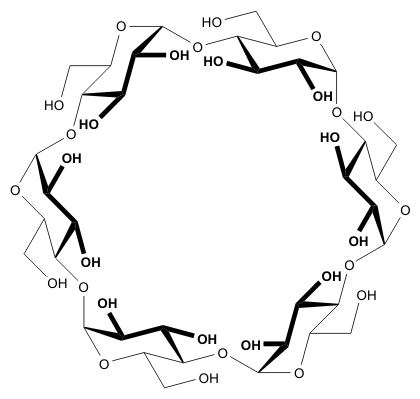
α-Cyclodextrin (alpha-cyclodextrin), sometimes abbreviated as α-CD, is a hexasaccharide derived from glucose. It is related to the β- (beta) and γ- (gamma) cyclodextrins, which contain seven and eight glucose units, respectively. All cyclodextrins are white, water-soluble solids with minimal toxicity. Cyclodextrins tend to bind other molecules in their quasi-cylindrical, lipophilic interiors. The compound is of wide interest because it exhibits host–guest properties, forming inclusion compounds.[2] This inclusion (and release) behavior leads to applications in medicine.[3]

Structure

[edit]

In α-cyclodextrin, the six glucose subunits are linked end to end via α-1, 4 linkages. The result has the shape of a tapered cylinder, with six primary alcohols on one face and twelve secondary alcohol groups on the other. The exterior surface of cyclodextrins is somewhat hydrophilic whereas the interior core is hydrophobic.

Three representations of α-cyclodextrin.

Applications

[edit]

α-Cyclodextrin is marketed for a range of medical, healthcare, and food and beverage applications. For drug delivery, this cyclodextrin confers aqueous solubility to hydrophobic drugs and stability to labile drugs.[4]

Crystal structure of a rotaxane with an α-cyclodextrin macrocycle.[5]

Synthesis

[edit]

Cyclodextrins are natural starch-conversion products. For industrial use, they are manufactured by enzymatic degradation from vegetable raw materials, such as corn or potatoes. First, the starch is liquified either by heat treatment or using α-amylase. Then cyclodextrin glycosyltransferase (CGTase) is added for enzymatic conversion. CGTases produce diverse cyclodextrins. The selectivity of the synthesis can be improved by the addition of specific guests.[3]

See also

[edit]

References

[edit]
Revisions and contributorsEdit on WikipediaRead on Wikipedia
from Grokipedia
α-Cyclodextrin (α-CD) is a cyclic composed of six α-D-glucopyranose units connected by α-1,4 glycosidic bonds, resulting in a non-reducing, toroidal structure with a hydrophobic inner cavity (approximately 4.7–5.3 in diameter) and a hydrophilic exterior surface lined with primary and secondary hydroxyl groups. This unique truncated cone-shaped architecture enables α-CD to form host-guest inclusion complexes with hydrophobic molecules, enhancing their , stability, and in aqueous environments. Produced enzymatically from using glycosyltransferase, α-CD is highly water-soluble (14.5 g/100 mL at 25°C), odorless, tasteless, and thermally stable up to 200°C, while exhibiting resistance to hydrolysis by human salivary and pancreatic amylases, which contributes to its prebiotic effects in the gut. In terms of physical and chemical properties, α-CD has a molecular weight of 972 Da, a height of about 7.9 , and an outer diameter of 14.6 , with its cavity volume of 174 ³ allowing it to encapsulate small non-polar guests like or certain pharmaceuticals through hydrophobic interactions and hydrogen bonding. It demonstrates high stability under neutral to alkaline conditions (pKa 12.1–13.5) but is susceptible to acid at low , and its highly negative LogP value underscores its strong hydrophilic character. Compared to β- and γ-cyclodextrins, α-CD's smaller cavity size limits its complexation to linear or smaller molecules, but it offers superior water solubility and weaker inhibition of amylases, making it particularly suitable for and nutritional applications. α-Cyclodextrin finds widespread use across industries due to its , biodegradability, and low toxicity. In the sector, it serves as a soluble , fat replacer, emulsifier, and stabilizer for flavors and colors, while also reducing postprandial glucose spikes and supporting by lowering triglycerides and improving insulin sensitivity. In pharmaceuticals, it improves the of poorly water-soluble drugs, such as 4-phenylbutyrate, and aids in controlled release formulations. Additional applications include for fragrance encapsulation, textiles for odor control, and environmental remediation for removal. Recognized as generally safe (GRAS) by regulatory bodies like the FDA for specific uses, α-CD's versatility stems from its ability to modulate the properties of encapsulated compounds without altering their inherent bioactivity.

Structure and Properties

Molecular Structure

α-Cyclodextrin is a non-reducing cyclic composed of six α-D-glucopyranose units linked by α-1,4-glycosidic bonds, resulting in a macrocyclic structure. This arrangement forms a symmetrical, toroidal with a rigid, cone-shaped or truncated cylinder geometry, where the primary hydroxyl groups are positioned at one end (the wider rim) and the secondary hydroxyl groups at the narrower rim. The molecular of α-cyclodextrin is \ceC36H60O30\ce{C_{36}H_{60}O_{30}}. The defining feature of α-cyclodextrin's is its central hydrophobic cavity, which is accessible from both rims but non-polar in nature due to the electron-rich glycosidic oxygen atoms and the non-polar C-H bonds lining the interior. The exterior surface, in contrast, is hydrophilic, adorned with 18 hydroxyl groups that enable hydrogen bonding with and other polar solvents. Key dimensions include an inner cavity of approximately 4.7–5.3 , an outer of 14.6 , a height (or depth) of 7.9 , and a cavity volume of about 174 ³, making it suitable for encapsulating small hydrophobic molecules. Compared to the other primary natural cyclodextrins, α-cyclodextrin has the smallest cavity size; β-cyclodextrin (seven glucose units) features a larger cavity of 6.0–6.5 in diameter, while γ-cyclodextrin (eight units) has an even more expansive one at 7.5–8.3 . This compact, tapered cylindrical architecture of α-cyclodextrin facilitates the formation of inclusion complexes by allowing guest molecules to thread into the hydrophobic cavity, stabilized by van der Waals interactions and hydrophobic effects.

Physical Properties

α-Cyclodextrin appears as a white, odorless, fine crystalline powder. Its is 972.85 g/mol. The compound exhibits moderate in water, approximately 14.5 g per 100 mL at 25°C, while it is poorly soluble in organic solvents such as and acetone. Under conventional heating, α-cyclodextrin decomposes at around 250–260°C without melting, though rapid heating conditions allow sublimation near 507°C. The specific optical rotation is [α]_D = +150.5° (in water). Its density is approximately 1.521 g/cm³. α-Cyclodextrin is hygroscopic and requires storage in a cool, dry environment to prevent moisture absorption. It remains stable in aqueous solutions over a pH range of 3.5 to 9.5.

Chemical Properties

α-Cyclodextrin demonstrates high chemical stability under neutral aqueous conditions, where it resists and remains intact at physiological levels, making it suitable for various applications without degradation. In strong acidic environments, however, the glycosidic bonds are susceptible to , resulting in ring opening and breakdown into linear maltooligosaccharides and glucose units. Under alkaline conditions, it exhibits greater stability, attributed to the weakly acidic of its hydroxyl groups, though extreme basic conditions can promote and potential modifications. Thermally, α-cyclodextrin maintains structural integrity up to approximately 300°C in an inert atmosphere, with initial of bound water occurring around 260–270°C, followed by of the cyclic ring structure between 252–400°C. The reactivity of α-cyclodextrin is largely dictated by its 18 hydroxyl groups, with the six primary hydroxyls at the C6 positions on the narrow rim being the most accessible and reactive for derivatization due to reduced steric hindrance compared to the secondary hydroxyls at C2 and C3. This enables precise chemical modifications at the primary sites. Furthermore, α-cyclodextrin readily forms inclusion complexes with hydrophobic guest molecules, which are encapsulated within its lipophilic cavity primarily through non-covalent interactions, including van der Waals forces that provide hydrophobic stabilization and hydrogen bonding that enhances complex integrity, particularly with polar guests. The secondary hydroxyl groups exhibit a pKa of approximately 12.3, reflecting their low acidity and limiting reactivity to strongly basic environments. Derivatization of α-cyclodextrin targets its hydroxyl groups to improve solubility and functionality, with common methods including methylation using methyl iodide or dimethyl sulfate under basic catalysis, hydroxypropylation through nucleophilic attack on propylene oxide in alkaline aqueous solution, and sulfobutylether substitution via reaction with butane sultone in basic media. These substitutions, often focusing on the reactive primary hydroxyls, yield derivatives like randomly methylated α-cyclodextrin or 2-hydroxypropyl-α-cyclodextrin, which exhibit markedly enhanced water solubility compared to the parent compound. A representative basic esterification involves the reaction of a hydroxyl group with an acyl chloride in the presence of a base, as shown: \ceCDOH+RCOCl>[base]CDOCOR+HCl\ce{CD-OH + R-COCl ->[base] CD-O-CO-R + HCl} This process acylates the hydroxyl, producing ester derivatives that alter the molecule's polarity and interaction potential. In vivo, α-cyclodextrin is biodegradable via enzymatic action of α-amylases, such as those produced by Aspergillus oryzae or human intestinal microbiota, which cleave the α-1,4-glycosidic bonds to generate maltooligomers from maltose (degree of polymerization 2) to maltooctaose (degree of polymerization 8), facilitating complete metabolic breakdown without toxic accumulation.

History and Discovery

Early Discovery

The discovery of α-cyclodextrin traces back to 1891, when French pharmacist and chemist Antoine Villiers isolated crystalline substances, which he termed "cellulosine," from the bacterial digestion of potato starch. Villiers employed Bacillus amylobacter (now classified as Bacillus macerans) to hydrolyze starch under anaerobic conditions, observing the formation of these crystalline precipitates alongside lactic acid fermentation products. These dextrins were noted for their ability to form during partial starch breakdown, yielding reduced sugar content compared to complete hydrolysis, which distinguished them from typical linear oligosaccharides. This initial finding emerged within the broader context of late 19th-century microbiological studies on degradation, where researchers explored enzymes' roles in converting complex carbohydrates into simpler forms for industrial and scientific applications. Villiers' work highlighted how certain could produce crystalline byproducts without fully saccharifying , sparking interest in enzymatic processes akin to those in and . Building on Villiers' observations, Austrian chemist and bacteriologist Franz Schardinger advanced the field between 1903 and 1911 by systematically isolating and characterizing two distinct crystalline dextrins from digests. Using Bacillus macerans, Schardinger treated to generate these compounds, naming them "dextrin-α" (corresponding to α-cyclodextrin) and "dextrin-β" (β-cyclodextrin). His experiments demonstrated their precipitation in alcohol and resistance to further enzymatic breakdown, establishing them as unique products of bacterial action on and laying the foundational principles of cyclodextrin chemistry. Schardinger's contributions were integral to early 20th-century enzymology, emphasizing microbial pathways in .

Structural Elucidation

In the 1930s and 1940s, Karl Freudenberg's research group at the University of advanced the understanding of α-cyclodextrin's structure through chemical degradation techniques. Methylation analysis of the compound revealed that exhaustive methylation followed by produced only 2,3,6-tri-O-methyl-D-glucose, indicating a cyclic arrangement of glucose units linked solely by α-1,4-glycosidic bonds without reducing or non-reducing ends. oxidation experiments further supported this cyclic model, as α-cyclodextrin consumed significantly less and produced no compared to linear s of similar size, confirming the absence of free hydroxyl groups at chain termini. These findings led Freudenberg to propose in 1936 that α-cyclodextrin is a cyclic composed of six D-glucose units, marking a pivotal shift from earlier linear degradation product hypotheses. Landmark X-ray crystallography studies in 1948, including those by Dexter French and analysis by Freudenberg of data from Borchert, confirmed the toroidal, doughnut-shaped conformation with a hydrophobic cavity formed by the six glucose units in a chair configuration, connected via α-1,4 linkages, and hydrophilic exteriors due to hydroxyl groups. This structural insight, detailed in their 1953 by Freudenberg, Cramer, and Plieninger for inclusion complexes, established the basis for understanding the compound's host-guest chemistry and distinguished α-cyclodextrin as the smallest member of the family. Subsequent advancements in the 1970s refined these early determinations using spectroscopic methods. (NMR) spectroscopy, particularly 1H and 13C NMR, confirmed the hexameric composition and precise cavity geometry, showing symmetric chair conformations stabilized by intramolecular hydrogen bonds. provided definitive molecular weight evidence for the C36H60O30 formula, solidifying the six-unit structure and enabling differentiation from larger cyclodextrins like β- and γ-forms. These techniques built on Freudenberg's foundational work, which was influenced by broader Nobel-recognized progress in carbohydrate chemistry, such as Hermann Staudinger's macromolecular theories that encouraged rigorous structural probing of polysaccharides. Key milestones included Freudenberg's 1948 isolation of γ-cyclodextrin (eight glucose units) via selective precipitation, which highlighted α-cyclodextrin's unique smallest-ring properties and spurred comparative structural studies across the family.

Synthesis and Production

Enzymatic Synthesis

The primary method for the enzymatic synthesis of α-cyclodextrin involves intramolecular transglycosylation catalyzed by (CGTase, EC 2.4.1.19), an typically sourced from such as stearothermophilus or . This cleaves α-1,4-glycosidic bonds in starch-derived substrates and facilitates the formation of cyclic oligosaccharides by rearranging the linear chains into ring structures. The reaction proceeds via a double-displacement mechanism, where a glycosyl-enzyme intermediate is formed, enabling the cyclization without net hydrolysis under optimal conditions. The substrate is typically starch from sources like corn or potato, which is first processed to make it accessible to CGTase. The synthesis begins with liquefaction of the starch using α-amylase to break down the polymer into soluble dextrins and reduce viscosity, followed by incubation with CGTase at 50–60°C and pH 5–7 for several hours to days, depending on enzyme concentration and substrate load. The overall reaction can be represented as: n (α-D-glucose)cyclohexaamylose (α-CD)+linear dextrinsn \ (\alpha\text{-D-glucose}) \rightarrow \text{cyclohexaamylose} \ (\alpha\text{-CD}) + \text{linear dextrins} This process yields a of cyclodextrins, with unoptimized α-CD production typically ranging from 10–20% of the total output relative to the substrate. To enhance selectivity for α-CD over larger rings like β- or γ-cyclodextrins, guest molecules such as n-decanol or are added during incubation; these agents form inclusion complexes preferentially with α-CD, shifting the equilibrium and improving its relative yield by up to several fold through . Such modifications exploit the smaller cavity size of α-CD (approximately 4.7–5.3 diameter), making it more amenable to certain hydrophobic guests compared to the β- (6–6.5 ) or γ-forms (7.5–8.3 ).

Commercial Production and Purification

Commercial production of α-cyclodextrin involves the large-scale enzymatic of , primarily , in bioreactors using cyclodextrin (CGTase), often immobilized on supports to enable reuse and efficient processing. The process begins with liquefaction using α-amylase to produce soluble dextrins, followed by CGTase-mediated cyclization to form α-cyclodextrin, with the enzyme sourced from bacteria like Paenibacillus macerans. This industrial method has been scaled up since the 1970s, when companies such as and Roquette began commercializing α-cyclodextrin, marketing it under names like CAVAMAX® W6. Global production of α-cyclodextrin is approximately 1,500 metric tons annually as of the early 2020s, representing about 15% of total output, which exceeds 10,000 tons per year overall. To optimize yields, of CGTase has been employed to enhance α-cyclodextrin specificity, such as through mutations at subsite −7 (e.g., R146A/D147P), increasing the α-cyclodextrin proportion from 63% to over 75% of total and achieving overall yields up to 50-60% based on substrate. Additionally, of linear byproducts back into the reaction improves resource efficiency and reduces waste. Purification of α-cyclodextrin from the reaction mixture, which contains linear dextrins and minor β- and γ-cyclodextrin impurities, typically employs with organic solvents like or decanol, where the solvent selectively complexes and precipitates α-cyclodextrin for easy separation. Subsequent steps include or to achieve high purity (>98%), with impurities removed via selective complexation using agents that preferentially bind β- and γ-cyclodextrins. Sustainability in α-cyclodextrin production is supported by the use of renewable feedstocks and biotechnological advances that minimize solvent use, such as solvent-free enzymatic processes, alongside effective management to handle and residues.

Applications

Pharmaceutical and Medical Applications

α-Cyclodextrin (α-CD) plays a key role in pharmaceutical formulations by forming inclusion complexes that enhance the aqueous of poorly water-soluble drugs, thereby improving their . The smaller hydrophobic cavity of α-CD, compared to β-cyclodextrin, is particularly suited for linear or smaller guest molecules, allowing effective encapsulation of lipophilic moieties while maintaining high water . For example, the inclusion complex of α-CD with econazole nitrate demonstrates increased and stability, facilitating better dissolution rates for applications. Similarly, complexes with 1,9-nonanediol highlight α-CD's utility in solubilizing aliphatic compounds relevant to . In drug delivery systems, α-CD is incorporated into advanced carriers such as nanoparticles and hydrogels to enable controlled release and targeted administration. Self-assembled nanoparticles combining PEG-carboxymethylcellulose and α-CD have been developed for sustained delivery of and 5-fluorouracil, showing improved encapsulation efficiency and reduced burst release. Branched polyrotaxane hydrogels formed by α-CD and Pluronic F127 triblock copolymers provide a biodegradable matrix for multi-drug release, with enhanced mechanical properties and for injectable applications. Additionally, α-CD-based systems support and ocular delivery; for instance, formulations with dexamethasone leverage α-CD to improve corneal permeation and posterior segment targeting in models. Medically, α-CD contributes to therapeutic interventions by binding bile acids and , promoting their fecal excretion and reducing serum lipid levels. of α-CD in clinical trials has demonstrated a 10% reduction in small LDL particle concentration after 12-14 weeks, alongside improvements in without notable adverse effects. In antiviral formulations, amphiphilic perfluoroalkyl α-CD nanoparticles enhance the delivery of acyclovir, increasing cellular uptake and efficacy against . Recent advancements in the 2020s include α-CD polyrotaxanes as non-viral vectors for , offering low toxicity and efficient plasmid DNA in cell lines, including 2024 developments for cytosolic delivery of Cas9 ribonucleoproteins in CRISPR-Cas9 . FDA-approved products exemplify α-CD's clinical utility, such as alprostadil α-CD (EDEX injection), where the complex stabilizes the labile , preventing degradation and enabling effective intracavernosal delivery for treatment. This formulation improves the stability of prostaglandins, which are prone to , extending shelf-life and maintaining potency during storage. Compared to β-cyclodextrin, α-CD exhibits lower for parenteral use, making it preferable for injectable therapies due to reduced renal accumulation and safer profiles in .

Food and Industrial Applications

In the , α-cyclodextrin serves as an emulsifying and stabilizer for oil-in-water emulsions, enabling its use in products such as , dressings, and low-fat spreads where it improves texture and prevents . Its GRAS status, affirmed by the FDA for general use in processed foods at levels up to 3% by weight, supports incorporation into low-fat formulations to mimic the of full-fat alternatives without adding calories. Additionally, α-CD complexes with dietary , promoting its fecal excretion and potentially reducing serum lipid levels when consumed. Beyond , α-cyclodextrin enhances product stability in by forming inclusion complexes with volatile fragrances, thereby prolonging scent release in and personal care items. In sunscreens, it improves the photostability of UV filters such as cinnamates, reducing degradation under exposure and maintaining over time. For odor control, α-cyclodextrin captures malodorous volatile compounds in textiles and formulations, providing sustained freshness by trapping molecules like amines and sulfides. In industrial applications, α-cyclodextrin aids by complexing phenolic pollutants, such as those from industrial effluents, promoting their oxidation and removal via processes with minimal byproduct formation. In , it is formulated into carriers for controlled release, enhancing and bioavailability of active ingredients like while minimizing environmental leaching. Recent developments in the have expanded α-cyclodextrin's role in sustainable applications, including biodegradable films where it encapsulates active compounds for effects and extends . In nutraceutical delivery, α-cyclodextrin encapsulates vitamins such as A and E, improving their stability against oxidation and enhancing in functional foods and supplements.

Safety and Regulatory Status

Toxicity and Safety Profile

α-Cyclodextrin exhibits low acute oral toxicity, with an LD50 exceeding 10,000 mg/kg in rats. Studies have demonstrated no genotoxic potential in assays such as the using typhimurium and the micronucleus test in . Similarly, no evidence of carcinogenicity has been observed, as long-term studies were deemed unnecessary given the compound's metabolic fate and lack of genotoxic effects. Following , α-cyclodextrin is largely resistant to by salivary and pancreatic α-amylase, with only approximately 2% absorbed intact in the . The majority is fermented by intestinal microflora in the , primarily in the caecum, yielding glucose, , and , with the unchanged form predominantly excreted via , particularly in germ-free models. Absorbed portions are rapidly eliminated in the . At high oral doses exceeding 15 g per day, such as 25 g in a single bolus under fasting conditions, α-cyclodextrin may cause mild gastrointestinal side effects including abdominal discomfort, , , and in humans. These effects are reversible and less severe when consumed with or at lower doses. Unlike β-cyclodextrin, which can lead to renal accumulation and due to its lower aqueous , α-cyclodextrin shows no significant renal accumulation and is considered less nephrotoxic at equivalent exposures. In vivo studies support the safety of parenteral administration of α-cyclodextrin up to 1 g/kg in rats, corresponding to the intravenous LD50, without systemic toxicity at sublethal doses, though higher levels can induce osmotic . Additionally, α-cyclodextrin has demonstrated anti-inflammatory properties in certain models, such as reducing progression and inflammatory markers in hyperlipidemic mice via modulation of and . α-Cyclodextrin is biodegradable in soil through microbial action, with degradation rates supporting its environmental persistence being low, and it exhibits low ecotoxicity, posing minimal hazard to ecosystems due to its non-toxic, fermentable nature.

Regulatory Approvals

α-Cyclodextrin received Generally Recognized as Safe (GRAS) status from the U.S. Food and Drug Administration (FDA) in 2004 for use as a direct food additive, specifically as a stabilizer, thickener, binder, or carrier at levels up to 3% in processed foods and up to 1.05% in certain beverages. It is also recognized by the FDA as a pharmaceutical excipient, with a monograph for alfadex (the USP name for α-cyclodextrin) in the United States Pharmacopeia (USP), specifying a purity of not less than 98.0% and not more than 101.0% on an anhydrous basis. In the European Union, α-cyclodextrin was authorized as a novel food ingredient under Commission Decision 2008/413/EC, for use as a dietary fiber or stabilizer in foods, in accordance with specifications and proposed uses evaluated by EFSA. The European Food Safety Authority (EFSA) has evaluated its safety, supporting an acceptable daily intake (ADI) of "not specified" due to its low toxicity profile when used within specified conditions. It is also approved in the EU for use in cosmetics as a stabilizer and in animal feeds under Regulation (EC) No 1831/2003. As of 2025, EFSA has extended approval for the production enzyme cyclomaltodextrin glucanotransferase, reaffirming no safety concerns. α-Cyclodextrin has been approved for food use in Japan since the 1970s as a natural food additive, produced via enzymatic methods, and is listed in Japan's Specifications and Standards for Food Additives for applications such as stabilization and flavor carrier. In China, it is permitted as a food additive under GB 2760-2014 and detailed in national standard GB 1886.351-2021, functioning as a stabilizer and thickener with purity requirements aligning with international pharmacopeial standards. For parenteral pharmaceutical applications, α-cyclodextrin is addressed in International Council for Harmonisation (ICH) guidelines on excipients (e.g., ICH Q3C for impurities), supporting its use in injectable formulations at doses up to 200 mg/kg body weight per day for short-term administration, given its high solubility and renal clearance. Recommended intakes for applications are generally below 10 g per day based on to minimize gastrointestinal effects, consistent with GRAS and evaluations.

References

Add your contribution
Related Hubs
User Avatar
No comments yet.