


Community hub
Recent from talks
Contribute something
Nothing was collected or created yet.
Ghouta chemical attack
View on Wikipedia
| Ghouta chemical attack | |
|---|---|
| Part of the siege of Eastern Ghouta | |
 Victims of the Ghouta chemical attack | |
 | |
| Location |
Ghouta, Syria |
| Date | 21 August 2013[2] |
Attack type | Chemical attack |
| Deaths | 281–1,729 killed (various estimates)[note 1] |
| Injured | 3,600 patients displaying neurotoxic symptoms in 3 hospitals supported by MSF[5] |
| Perpetrators |  Syrian Arab Republic[16][17][18][note 2] Syrian Arab Republic[16][17][18][note 2] |
| Charges | Bashar and Maher al-Assad and two other Syrian senior government officials charged with complicity in crimes against humanity and complicity in war crimes[19] |
| Litigation | French arrest warrants for the Assad brothers and the two other officials[19] |
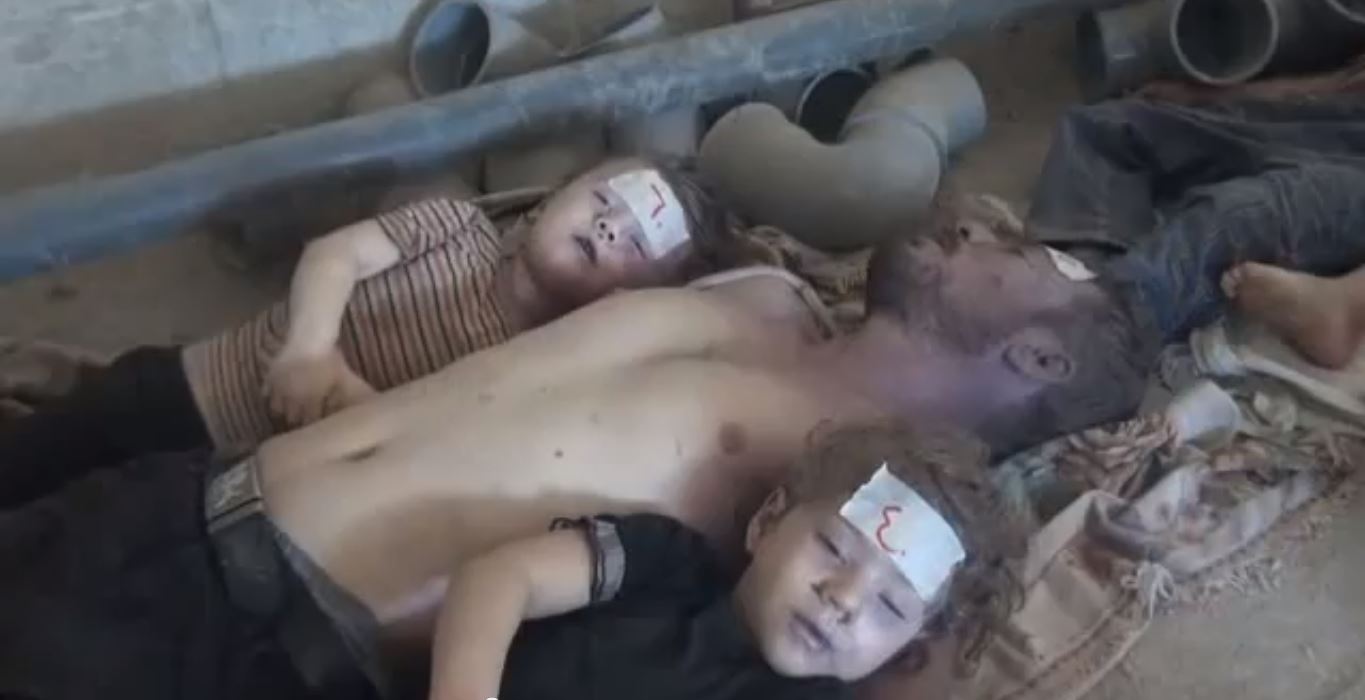
The Ghouta chemical attack was a chemical attack carried out by the forces of Syrian President Bashar al-Assad, in the early hours of 21 August 2013 in Ghouta, Syria during the Syrian civil war.[17] Two opposition-controlled areas in the suburbs around Damascus were struck by rockets containing the chemical agent sarin.[16] Estimates of the death toll range from at least 281 people[3] to 1,729.[15] The attack was the deadliest use of chemical weapons since the Iran–Iraq War.[20][21]
Evidence of the attack
[edit]Inspectors from the United Nations Mission already in Syria to investigate an earlier alleged chemical weapons attack[22]: 6 [23] requested access to sites in Ghouta the day after the attack[24][25][26][27] and called for a ceasefire to allow inspectors to visit the Ghouta sites.[24] The Syrian Ba'athist government granted the UN's request on 25 August,[28][29][30] and inspectors visited and investigated Moadamiyah in Western Ghouta the next day and Zamalka and Ein Tarma in Eastern Ghouta on 28 and 29 August.[22]: 6 [31][32]
The UN investigation team confirmed "clear and convincing evidence" of the use of sarin delivered by surface-to-surface rockets,[22][33] and a 2014 report by the UN Human Rights Council found that "significant quantities of sarin were used in a well-planned indiscriminate attack targeting civilian-inhabited areas, causing mass casualties. The evidence available concerning the nature, quality and quantity of the agents used on 21 August indicated that the perpetrators likely had access to the chemical weapons stockpile of the Syrian military, as well as the expertise and equipment necessary to safely manipulate large amount of chemical agents."[34] It also stated that the chemical agents used in the Khan al-Assal chemical attack earlier in 2013 "bore the same unique hallmarks as those used in Al-Ghouta".[35][34][36]
The Syrian opposition[37] as well as many governments, the Arab League and the European Union[38][39][40] stated the attack was carried out by forces of Syrian President Bashar al-Assad.[41] The Syrian and Russian governments blamed the opposition for the attack,[37] the Russian government calling the attack a false flag operation by the opposition to draw foreign powers into the civil war on the rebels' side.[42] Åke Sellström, the leader of the UN Mission, characterized government explanations of rebel chemical weapons acquisition as unconvincing, resting in part upon "poor theories".[43]
Several countries including France, the United Kingdom and the United States debated whether to intervene militarily against Syrian Ba'athist government forces.[44][45][46][47] On 6 September 2013, the United States Senate filed a resolution to authorize use of military force against the Syrian military in response to the Ghouta attack.[48] On 10 September 2013, the military intervention was averted when the Syrian government accepted a US–Russian negotiated deal to turn over "every single bit" of its chemical weapons stockpiles for destruction and declared its intention to join the Chemical Weapons Convention.[49][50]
In June 2018 the OPCW noted with concern that the Syrian Arab Republic had in reality neither declared nor destroyed all of its chemical weapons and chemical weapons production facilities.[51]
Background
[edit]
The Ghouta area is composed of densely populated suburbs to the east and south of Damascus, part of the province of Rif Dimashq.[52] Ghouta is a primarily conservative Sunni region.[53] Since early in the civil war, civilians in rebel-held Eastern Ghouta almost entirely sided with the opposition to Syria's government.[54][55] The opposition had controlled much of Eastern Ghouta since 2012, partly cutting off Damascus from the countryside.[52] Muadamiyat al-Sham in Western Ghouta had been under government siege since April 2013.[56] Ghouta had been the scene of continuing clashes for more than a year before the chemical attack, with government forces launching repeated missile assaults trying to dislodge the rebels. The week of the attack, the Syrian government launched an offensive to capture opposition-held Damascus suburbs.[55]
The attack came one year and one day after US President Barack Obama's 20 August 2012 "red line" remarks, in which he warned: "We have been very clear to the Assad regime, but also to other players on the ground, that a red line for us is we start seeing a whole bunch of chemical weapons moving around or being utilized. That would change my calculus. That would change my equation."[57][58][59] Syria was one of five non-signatories to the 1997 Chemical Weapons Convention at the time. After the "red line" remarks, and before the chemical attack in Ghouta, chemical weapons were suspected to have been used in four attacks in the country.[60]
Khan al-Assal chemical attack
[edit]The Khan al-Assal chemical attack occurred on 19 March 2013, when a government-controlled area of Khan al-Asal, a district of Aleppo in northern Syria, was struck by a rocket containing the nerve agent sarin. According to the Syrian Observatory for Human Rights the attack resulted in at least 26 fatalities, including 16 government soldiers and 10 civilians.[61] The Syrian government later reported to the United Nations that one soldier and 19 civilians died and that 17 soldiers and 107 civilians were injured.[2]: 32 A medic at the local civilian hospital said he personally had witnessed Syrian army soldiers helping the wounded and dealing with fatalities at the scene.[62]
It was later found that the sarin used in the Khan al-Assal attack "bore the same unique hallmarks" as the sarin used in the Ghouta attack.[35][34]: 19
Independent International Commission of Inquiry
[edit]The United Nations Human Rights Council established the Independent International Commission of Inquiry on the Syrian Arab Republic on 22 August 2011 to investigate human rights violations during the Syrian civil war. One of the topics the commission investigated was possible use of chemical weapons. In early June 2013, the Fifth Report of the Commission of Inquiry stated that there were reasonable grounds to believe that toxic chemicals were used in four attacks, but more evidence was needed "to determine the precise chemical agents used, their delivery systems or the perpetrator".[63]: 21 [64][65] On 22 June, the head of the Commission of Inquiry, Paulo Pinheiro, said the UN could not determine who used chemical weapons in Syria based on evidence sent by the United States, Britain and France.[66]
Assessments prior to the attack
[edit]US assessment
[edit]US Secretary of Defense Chuck Hagel stated on 25 April that US intelligence showed the Assad government had likely used sarin on a small scale.[67] However, the White House announced that "much more" work had to be done to verify the intelligence assessments.[68]
On 13 June 2013, the United States government publicly announced it had concluded that the Assad government had used limited amounts of chemical weapons on multiple occasions against rebel forces, killing 100 to 150 people. US officials stated that sarin was the agent used.[69] Deputy National Security Advisor Ben Rhodes did not say whether this showed that Syria had crossed the "red line" established by President Obama in August 2012. Rhodes stated: "The president has said that the use of chemical weapons would change his calculus, and it has."[70] The French government announced that its own tests confirmed US assertions.[71]
Russian assessment
[edit]Russian Foreign Minister Sergei Lavrov said "the accusations of Damascus using chemical weapons put forth by the United States are not backed by credible facts".[72] Lavrov further stated that the Syrian government had no motive to use chemical weapons since the government already maintained a military advantage over the rebel fighters.[73]
Attacks
[edit]The attacks affected two separate opposition-controlled districts in the Damascus suburbs, located 16 kilometres apart.[1]: 1
Eastern Ghouta attack
[edit]The first attack took place around 2:30 a.m. on 21 August 2013[74][75] in Eastern Ghouta, a rebel-held suburb to the east of Damascus.[76] The area was on a rebel weapons supply route from Jordan and had been under siege by the Syrian military and Hezbollah for months.[77][78]
At least 8, and possibly 12, rockets struck within a 1500 by 500-meter area in the Zamalka and nearby Ein Tarma neighborhoods.[note 3] The rockets were all of the same improvised type, each with an estimated capacity to carry 50–60 liters (11–13 imp gal; 13–16 U.S. gal) of sarin.[1]: 9 [22]: 24 The rocket engine was similar in type and parameters to a 122 mm GRAD unguided surface-to-surface rocket, while the chemical warhead and the stabilization fin was of an artisan-type.[1][79] One (or both) of the labs examining the environmental samples taken from Zamalka (and Ein Tarma[22]: 28–29 ) found at least traces of sarin in 14 of the 17 cases.[2]: 45–49 One of the labs described the sarin level as a "high level concentration" in 4 of the 17 samples.[2]: 45–49
Western Ghouta attack
[edit]The second attack took place in the Western Ghouta area around 5:00 in the morning on 21 August. On 22 August, a witness who works for Moadamiya media center said he had counted seven rockets that fell in two areas of Moadamiya during the early morning of 21 August. He said four rockets hit next to the Rawda Mosque and another three in the area between Qahweh Street and Zeytouneh Street, which he said was approximately 500 meters to the east of the Rawda Mosque. He said all the rockets were of the same type.[1]
While no chemical warhead was ever found in the Western Ghouta area, one rocket engine has been identified as a 140mm M-14 unguided surface-to-surface rocket. This type of rocket can be fitted with three types of warheads: high explosive-fragmentation, white phosphorus smoke, or a chemical warhead containing 2 liters (0.44 imp gal; 0.53 U.S. gal) of sarin.[1]: 5 None of the 13 environmental samples taken from Western Ghouta tested positive for sarin, although three had "degradation and/or by-products".[2]: 43–45
Chemical weapons capability
[edit]At the time of the attack, Syria was not a party to the Chemical Weapons Convention,[80] which prohibits the development, production, stockpiling, transfer and use of chemical weapons, although in 1968 it acceded to the 1925 Geneva Protocol for the Prohibition of the Use in War of Asphyxiating, Poisonous or Other Gases. In 2012 Syria publicly stated it possessed chemical and biological weapons and would use them if it faced a foreign attack.[81]
According to French intelligence, the Syrian Scientific Studies and Research Center (SSRC) is responsible for producing toxic agents for use in war. A group named "Branch 450" is allegedly responsible for filling munitions with chemicals and maintaining security of the chemical agent stockpiles.[82] As of September 2013, French intelligence estimated the Syrian stockpile at 1,000 tonnes, including mustard gas, VX and "several hundred tonnes of sarin".[82]
The UK's Joint Intelligence Committee publicly dismissed the possibility of rebel responsibility for the attack in Ghouta, stating that rebels are incapable of an attack of its scale.[83] The Committee stated that "there is no credible intelligence or evidence to substantiate the claims or the possession of CW by the opposition".[84]
Åke Sellström, a Swedish scientist who led the UN mission to investigate the attacks, said it was difficult to see how rebels could have weaponized the toxins,[85] but admitted that he did not know who the perpetrator was.[43] According to the Associated Press, "chemical and biological weapons experts have been relatively consistent in their analysis, saying only a military force with access to and knowledge of missile delivery systems and the sarin gas suspected in Ghouta could have carried out an attack capable of killing hundreds of people."[86]
Initial claims
[edit]Both the opposition and the Syrian government said a chemical attack was carried out in the suburbs around Damascus on 21 August 2013. Anti-government activists said the Syrian government was to blame for the attack, while the Syrian government said foreign fighters and their international backers were to blame.[75][87]
Opposition claims
[edit]On the day of the attack, George Sabra, the head of the Syrian National Council, said 1,300 people had been killed as shells loaded with poisonous gas rained down on the capital's eastern suburbs of Douma, Jobar, Zamalka, Arbeen and Ein Tarma.[88] A spokesman for the Free Syrian Army's Supreme Military Council, Qassim Saadeddine, said, "people are growing desperate as they watch another round of political statements and UN meetings without any hope of action".[76] Ahmad Jarba, who was the president of the Syrian National Coalition at the time of the attack, called on the UN investigators to travel to "the site of the massacre" and for an urgent United Nations Security Council meeting on the subject.[10] The Syrian Observatory for Human Rights said the attack was committed by the Syrian regime and called on Ban Ki-moon, Secretary-General of the United Nations, "to apply all pressure within his powers to pressure the Syrian regime".[89][90]
The next day, a spokesman for the Syrian National Coalition, Khaled al-Saleh, said at least six doctors died after treating victims, and that they didn't yet have the number of dead first responders.[91]
Government claims
[edit]Syria's Deputy Prime Minister for Economic Affairs, Qadri Jamil, said foreign fighters and their international backers were to blame for the attack.[87] Syrian state television, SANA, said the accusations were fabricated to distract a team of UN chemical weapons experts which had arrived three days before the attacks.[6] Syrian President Bashar al-Assad said the claims that his government had used chemical weapons would go against elementary logic and that "accusations of this kind are entirely political".[92] In September 2013, German newspaper Bild claimed to have spoken to a senior intelligence official who claimed Assad did not personally order the chemical attack and that Syrian brigade and division commanders have asked the presidential office for permission to use chemical weapons for more than four months, with permission being denied each time.[93]
UN investigation
[edit]On 19 March 2013, the Syrian government reported to the UN Security Council that the rebels had fired a rocket containing chemical materials into a government controlled part of Khan al-Asal, a district of Aleppo in northern Syria,[94] and requested a UN mission to investigate it.[95] As a response, the UN Secretary-General Ban Ki-moon created the "United Nations Mission to Investigate Alleged Uses of Chemical Weapons in the Syrian Arab Republic".[95][96] The Syrian government first refused to allow the UN mission to be expanded to places outside Khan al-Assal,[97] but agreed in July 2013 to also allow investigation of the alleged attack in Sheikh Maqsood on 13 April 2013 and the alleged attack in Saraqib on 29 April 2013.[98][2]: 7
On 23 April 2013, The New York Times reported that the British and French governments had sent a confidential letter to the UN Secretary-General, stating there was evidence that the Syrian government had used chemical weapons in Aleppo, Homs and perhaps Damascus. Israel also claimed that the Syrian government had used chemical weapons on 19 March near Aleppo and Damascus.[99] On 24 April, Syria blocked UN investigators from entering Syria, while UN Under-Secretary for Political Affairs Jeffrey Feltman said this would not prevent an inquiry from being carried out.[100]
On 18 August 2013, three days before the Ghouta attack, a UN mission headed by Åke Sellström[22] arrived in Damascus with permission from the Syrian government to investigate earlier alleged chemical weapons use.[101] On the day of the attack, UN Secretary-General Ban Ki-moon expressed "the need to investigate [the Ghouta incident as] soon as possible", hoping for consent from the Syrian government.[101] The next day, UN High Commissioner for Human Rights Navi Pillay urged government and opposition forces to allow an investigation[102] and Ban requested the government provide immediate access.[28][103] On 23 August, clashes between rebel and government forces continued in and around Ghouta, government shelling continued and UN inspectors were denied access for a second day.[26] White House officials were convinced that the Syrian government was trying to hide the evidence of chemical weapons use by shelling the sites and delaying their inspection.[28] Ban called for a ceasefire to allow the inspectors to visit the attack sites.[24] On 25 August the government and various rebel factions agreed to a ceasefire for five hours each day from 26 to 29 August.[104][105]
Early in the morning of 26 August several mortars hit central Damascus, including one that fell near the Four Seasons Hotel where the UN inspectors were staying.[106] Later in the day the UN team came under sniper fire en route to Moadamiyah in western Ghouta (to the southwest of central Damascus), forcing them to return to their hotel and replace one of their vehicles before continuing their investigation four hours later.[107][108] The attack prompted a rebuke from Ban toward the fighters.[109][110] After returning to Moadamiyah the UN team visited clinics and makeshift field hospitals, collected samples and conducted interviews with witnesses, survivors and doctors.[107] The inspectors spoke with 20 victims of the attacks and took blood and hair samples, soil samples, and samples from domestic animals.[110] As a result of the delay caused by the sniper attack, the team's time in Moadamiyah was substantially shortened, with the scheduled expiry of the daily cease-fire leaving them around 90 minutes on the ground.[105][110][111]
On 28 and 29 August the UN team visited Zamalka and Ein Tarma in Eastern Ghouta, east of central Damascus, for a total time of five-and-a-half hours.[22]: 6 On 30 August the team visited a Syrian government military hospital in Mazzeh and collected samples.[112] The mission left Syria early on 31 August,[113] over the objection of the Syrian government, promising to return to complete the original objective to investigate the previously alleged attack sites.[114]
UN Ghouta Area report
[edit]The UN report on the investigation into the Ghouta chemical attacks was published on 16 September 2013. The report stated: "the environmental, chemical and medical samples we have collected provide clear and convincing evidence that surface-to-surface rockets containing the nerve agent sarin were used in Ein Tarma, Moadamiyah and Zamalka in the Ghouta area of Damascus."[22]: 8 [33] UN Secretary-General Ban Ki-moon called the findings "beyond doubt and beyond the pale", and clear evidence of a war crime. "The results are overwhelming and indisputable", he said. Ban stated a majority of the blood samples, environmental samples and rockets or rocket fragments recovered tested positive for sarin.[115] The report, which was "careful not to blame either side", said that during the mission's work in areas under rebel control, "individuals arrived carrying other suspected munitions indicating that such potential evidence is being moved and possibly manipulated".[116] The UN investigators were accompanied by a rebel leader:
A leader of the local opposition forces ... was identified and requested to take 'custody' of the Mission ... to ensure the security and movement of the Mission, to facilitate the access to the most critical cases/witnesses to be interviewed and sampled by the Mission and to control patients and crowd in order for the Mission to focus on its main activities.[22]: 13
The British UN Ambassador stated that the report's lead author, Åke Sellström, said the quality of the sarin used in the attack was higher than that used by Iraq in the Iran–Iraq War,[117] implying a purity higher than the Iraqi chemical weapons program's low purity of 45–60%.[118]
Responses
[edit]According to Human Rights Watch, hundreds of kilograms of sarin were used in the attack, which it said suggested government responsibility, as opposition forces were not known to possess significant amounts of sarin.[119]
The Russian government dismissed the initial UN report after it was released, calling it "one-sided" and "distorted".[120] On 17 September, Russian Foreign Minister Sergei Lavrov reiterated his government's belief that the opposition carried out the attacks as a "provocation".[121] The United Nations High Representative for Disarmament Affairs Angela Kane said the inspection team would review Russia's objections.[114]
An August 2013 Scientific American article described difficulties that could arise when attempting to identify the manufacturer of sarin from soil or tissue samples.[122]
Final UN Mission report
[edit]The UN inspection team returned to Syria to continue investigations into other alleged chemical attacks in late September 2013. A final report on Ghouta and six other alleged attacks (including three alleged to have occurred after the Ghouta attack) was released in December 2013.[114] The inspectors wrote that they "collected clear and convincing evidence that chemical weapons were used also against civilians, including children, on a relatively large scale in the Ghouta area of Damascus on 21 August 2013". The conclusion was based on:
- Impacted and exploded surface-to-surface rockets, capable to carry a chemical payload, were found to contain sarin;
- Close to the rocket impact sites, in the area where patients were affected, the environment was found to be contaminated by sarin;
- The epidemiology of over fifty interviews given by survivors and health care workers provided ample corroboration of the medical and scientific results;
- A number of patients/survivors were clearly diagnosed as intoxicated by an organophosphorous compound;
- Blood and urine samples from the same patients were found positive for sarin and sarin signatures.[2]: 19
UN Human Rights Council report
[edit]The 7th Report of the Independent International Commission of Inquiry on the Syrian Arab Republic, a different group than the UN fact-finding mission, stated the sarin used in the Ghouta attack bore the "same unique hallmarks" as the sarin used in the Khan al-Assal attack. The report, dated 12 February 2014, also indicated that the perpetrators likely had access to the chemical weapons stockpile of the Syrian military. These conclusions were based on the fact-finding mission's evidence, as the Commission of Inquiry did not conduct its own investigation of either chemical attack.[34]
Aftermath
[edit]The continuous fighting has severely limited the quality of medical care for injured survivors of the attack. A month after the attack, approximately 450 survivors still required medical attention for lingering symptoms such as respiratory and vision problems.[123] By early October 2013, the 13,000 residents of Moadhamiya, one of the places targeted in the August attack, had been surrounded by pro-government forces and under siege for five months. Severe malnourishment and medical emergencies had become pressing as all supply lines had stopped.[124] Care for chronic symptoms of sarin exposure had become "just one among a sea of concerns".[123]
As countries such as the United States and the United Kingdom debated their response to the attacks, they encountered significant popular and legislative resistance to military intervention. In particular, British Prime Minister David Cameron's request to the House of Commons to use military force was declined by a 285–272 margin.[125][126] UK government policy subsequently focused on providing humanitarian assistance inside Syria and to refugees in neighboring countries.[127]
Within a month of the attacks, Syria agreed to join the Chemical Weapons Convention and allow all its stockpiles to be destroyed.[128] The destruction began under OPCW supervision on 6 October 2013.[129] On 23 June 2014, the last shipment of Syria's declared chemical weapons was shipped out of the country for destruction.[130] By 18 August 2014, all toxic chemicals were destroyed aboard the US naval vessel MV Cape Ray.[131]
Nine months after the attack, there was evidence that mothers from the affected areas were giving birth to children with defects and as stillborn.[132][133]
Reactions
[edit]Domestic
[edit]Information Minister Omran al-Zoubi was quoted by the official state news agency, Syrian Arab News Agency (SANA), as saying that the government did not and would not use such weapons, if in fact they even existed. Al-Zoubi said, "everything that has been said is absurd, primitive, illogical and fabricated. What we say is what we mean: there is no use of such things (chemical weapons) at all, at least not by the Syrian army or the Syrian state, and it's easy to prove and it is not that complicated."[134] SANA called the reports of chemical attacks as "untrue and designed to derail the ongoing UN inquiry". A Syrian military official appeared on state television denouncing the reports as "a desperate opposition attempt to make up for rebel defeats on the ground".[75] Deputy Foreign Minister Faisal Mekdad declared it a tactic by the rebels to turn around the civil war which he said "they were losing" and that, though the government had admitted to having stocks of chemical weapons, stated they would never be used "inside Syria".[135] Democratic Union Party leader Salih Muslim said he doubted that the Syrian government carried out the chemical attack.[136]
The National Coalition called the attack a "coup de grace that kills all hopes for a political solution in Syria".[137] In a statement on Facebook, the Coventry-based Syrian Observatory for Human Rights, an anti-government activist network, blamed the attack on the Syrian military and said of the incident that "we assure the world that silence and inaction in the face of such gross and large-scale war crimes, committed in this instance by the Syrian regime, will only embolden the criminals to continue in this path. The international community is thus complicit in these crimes because of its [polarisation], silence and inability to work on a settlement that would lead to the end of the daily bloodshed in Syria."[138]
International
[edit]The international community condemned the attacks. United States President Barack Obama said the US military should strike targets in Syria to retaliate for the government's purported use of chemical weapons, a proposal publicly supported by French President François Hollande, but condemned by Russia and Iran.[139][140] The Arab League stated it would support military action against Syria in the event of UN support, though member states Algeria, Egypt, Iraq, Lebanon, and Tunisia opposed it.[141]
At the end of August, the House of Commons of the United Kingdom voted against military intervention in Syria.[142] In early September, the United States Congress began debating a proposed authorisation to use military force, although votes on the resolution were indefinitely postponed amid opposition from many legislators[143] and tentative agreement between Obama and Russian President Vladimir Putin on an alternative proposal, under which Syria would declare and surrender its chemical weapons to be destroyed under international supervision.[144]
In contrast to the positions of their governments, polls in early September indicated that most people in the US, UK, Germany and France opposed military intervention in Syria.[145][146][147][148][149] One poll indicated that 50% of Americans could support military intervention with cruise missiles only, "meant to destroy military units and infrastructure that have been used to carry out chemical attacks".[150] In a survey of American military personnel, around 75% said they opposed air strikes on Syria, with 80% saying an attack would not be "in the U.S. national interest".[151]
Allegations of false flag attack
[edit]The attacks prompted some U.S. intelligence officials to speculate they were carried out by the opposition in order to draw the West into the war,[152] a concept dismissed by others.[153][154] Other experts and officials questioned whether the government was responsible based on the timing of the attack, just after the UN Mission had arrived in Damascus, and lack of motivation, since the government was advancing in the area.[155][156]
In December 2013, Seymour Hersh wrote in the London Review of Books (LRB) that a former intelligence official told him that in the days before and after the attack, sensors notifying U.S. intelligence agencies of Syrian chemical weapons deployment did not activate, and that a senior intelligence consultant told him that the U.S. president's Morning Report on 20–22 August contained no information about an impending government chemical weapons attack.[157] In the article, Hersh related that a former senior U.S. intelligence official told him that the U.S. government's published assessment of the incident included an account of the sequence the Syrian military would have followed for any chemical attack, rather than intercepts specifically relating to the Ghouta attacks.[157][158][159]
In April 2014 Hersh wrote an article, also published by the LRB, reporting that a former intelligence officer told him that the attacks were "covert action planned by Erdoğan's people to push Obama over the red line", speculating about Turkish government support for Al-Qaeda affiliate Al-Nusra Front's attempts to access sarin.[160][161][162][158][163][164] Hersh's argument received some support,[165][166][167] but was dismissed by other commentators.[168][169][170][171][172][173] The US and Turkish governments denied the accuracy of Hersh's article.[174]
Evidence
[edit]Witness statements and victim symptoms
[edit]Syrian human rights lawyer Razan Zaitouneh, who was present in Eastern Ghouta, stated, "Hours [after the shelling], we started to visit the medical points in Ghouta to where injured were removed, and we couldn't believe our eyes. I haven't seen such death in my whole life. People were lying on the ground in hallways, on roadsides, in hundreds."[175] Several medics working in Ghouta reported the administration of large quantities of atropine, a common antidote for nerve agent toxicity, to treat victims.[176][177]
Doctors Without Borders said the three hospitals it supports in Eastern Ghouta reported receiving roughly 3,600 patients with "neurotoxic symptoms" over less than three hours during the early morning of 21 August. Of those, 355 died.[178] The Local Coordination Committees of Syria claimed that of the 1,338 victims, 1,000 were in Zamalka, of which 600 bodies were transferred to medical points in other towns and 400 remained at a Zamalka medical center.[11] Some of the fatalities were rebel fighters.[179] The deadliness of the attack is believed to have been increased due to civilians reacting to the chemical attack as if it was typical government bombardment. For conventional artillery and rocket attacks, residents usually went to the basements of buildings, where in this case the heavier-than-air sarin sank into these below-ground, poorly ventilated areas.[180] Some of the victims died while sleeping.[76]
Abu Omar of the Free Syrian Army told The Guardian that the rockets involved in the attack were unusual because "you could hear the sound of the rocket in the air but you could not hear any sound of explosion" and no obvious damage to buildings occurred.[181] Human Rights Watch's witnesses reported "symptoms and delivery methods consistent with the use of chemical nerve agents".[23] Activists and local residents contacted by The Guardian said that "the remains of 20 rockets [thought to have been carrying neurotoxic gas] were found in the affected areas. Many [remained] mostly intact, suggesting that they did not detonate on impact and potentially dispersed gas before hitting the ground."[182]

Doctors Without Borders also reported seeing a "large number of victims arriving with symptoms including convulsions, excessive saliva, pinpoint pupils, blurred vision and respiratory distress".[185] Symptoms reported by Ghouta residents and doctors to Human Rights Watch included "suffocation, muscle spasms and frothing at the mouth".[23]
Witness statements to The Guardian about symptoms included "people who were sleeping in their homes [who] died in their beds", headaches and nausea, "foam coming out of [victims'] mouths and noses", a "smell something like vinegar and rotten eggs", suffocation, "bodies [that] were turning blue", a "smell like cooking gas" and redness and itching of the eyes.[181] Richard Spencer of The Telegraph summarised witness statements, stating, "The poison ... may have killed hundreds, but it has left twitching, fainting, confused but compelling survivors."[186]
On 22 August, the Center for Documentation of Violations in Syria published numerous testimonies. It summarised doctors' and paramedics' descriptions of the symptoms as "vomiting, foamy salivation, severe agitation, [pinpoint] pupils, redness of the eyes, dyspnea, neurological convulsions, respiratory and heart failure, blood out of the nose and mouth and, in some cases, hallucinations and memory loss".[187]
Analysis of symptoms
[edit]Dr. Amesh Adalja, a then-senior associate for the Center for Biosecurity at the University of Pittsburgh Medical Center, said the reported symptoms are a textbook case of nerve-agent poisoning.[185]
Médecins Sans Frontières director of operations Bart Janssens stated that MSF "can neither scientifically confirm the cause of these symptoms nor establish who is responsible for the attack. However, the reported symptoms of the patients, in addition to the epidemiological pattern of the events – characterised by the massive influx of patients in a short period of time, the origin of the patients, and the contamination of medical and first aid workers – strongly indicate mass exposure to a neurotoxic agent."[5]
Gwyn Winfield, editorial director at CBRNe World, analysed some videos from the day of the attack and wrote on the magazine's website: "It is difficult to define [an] agent by the signs and symptoms. Clearly respiratory distress, some nerve spasms and a half-hearted washdown (involving water and bare hands?!), but it could equally be a riot control agent as a [chemical warfare agent]."[188]
Rockets
[edit]
Human Rights Watch reported that two types of rockets were used: in Western Ghouta, a 140mm rocket made in the Soviet Union in 1967 and exported to Syria;[1]: 5 and in Eastern Ghouta, a 330mm rocket of unknown origin.[1]: 9 HRW also reported that at the time of the attack, Syrian rebels were not known to be in possession of the rockets used.[1]: 20 [190]
Seymour Hersh has suggested that the 330mm rockets may have been produced locally, and with a limited range.[157] Eliot Higgins has looked at the munitions linked to the attack and analysed footage of the putative launchers inside government territory.[191]
According to analysis conducted in January 2014 by Theodore Postol and Richard Lloyd, of the Massachusetts Institute of Technology, the rockets used in the attack had a range of about two kilometers, which, the authors claimed, meant that the munitions could not have been fired from the 'heart' or from the Eastern edge of the Syrian Government Controlled Area shown in the Intelligence Map published by the White House on 30 August 2013.[79][192][193] A response from Higgins and Kaszeta included an observation that the Russian-language news site ANNA News had posted videos showing a Syrian government military operation running from June to August 2013 to clear positions between Jobar and Qaboun, a strip of land about 2 km away from 21 August impact sites.[194]
Many of the munitions and their fragments had been moved; however, in two cases, the UN could identify the likely launch azimuths.[195] Triangulating rocket trajectories suggests that the origin of the attack may have been within government or rebel-held territory. Consideration of missile ranges influences calculations as to whether rockets originated from the government or rebel-held regions.[157][196]
Communications
[edit]Two purported intercepts of communications that appeared to implicate the Syrian government received prominent media coverage. One was a phone call allegedly between Syrian officials which Israel's Unit 8200 was said to have intercepted and passed to the US.[197] The other was a phone call which the German Bundesnachrichtendienst said it had intercepted, between a high-ranking representative of Hezbollah and the Iranian embassy, in which the purported Hezbollah official said that poison gas had been used and that Assad's order to attack with chemical weapons had been a "big mistake".[198][199]
On 29 August the Associated Press reported that, according to two U.S. intelligence officials and two other U.S. officials, the U.S. intercept was a conversation between "low-level" Syrian officials with no direct link to the upper echelons of the government or military.[152]
The Bild am Sonntag newspaper subsequently reported that German intelligence indicated that Assad had likely not ordered the attacks.[200] According to Bild, "intelligence interception specialists" relying on communications intercepted by the German vessel Oker said that Syrian military commanders had repeatedly been asking permission to launch chemical attacks for around four months, with permission always being denied from the presidential palace. The sources concluded that 21 August attack had probably not been approved by Bashar al-Assad.[200][201][202]
Video
[edit]Murad Abu Bilal, Khaled Naddaf and other Center for Documentation of Violations in Syria and Local Coordination Committees of Syria (LCC) media staff went to Zamalka soon after the attacks to film and obtain other documentary evidence. Almost all the journalists died from inhalation of the neurotoxins, except Murad Abu Bilal, who was the only Zamalka LCC media member to survive.[203][204] The videos were published on YouTube, attracting worldwide media attention.[205]
Experts who have analysed the first video said it shows the strongest evidence yet consistent with the use of a lethal toxic agent. Visible symptoms reportedly included rolling eyes, foaming at the mouth, and tremors. There was at least one image of a child suffering miosis, the pin-point pupil effect associated with the nerve agent Sarin, a powerful neurotoxin reportedly used before in Syria. Ralph Trapp, a former scientist at the Organisation for the Prohibition of Chemical Weapons, said the footage showed what a chemical weapons attack on a civilian area would look like, and went on to note "This is one of the first videos I've seen from Syria where the numbers start to make sense. If you have a gas attack you would expect large numbers of people, children and adults, to be affected, particularly if it's in a built-up area."[205]
Some experts, among them Jean Pascal Zanders, initially stated that evidence that sarin was used, as claimed by pro-rebel sources, was still lacking and highlighted the lack of second-hand contaminations typically associated with use of weapons-grade nerve agents: "I remain sceptical that it was a nerve agent like sarin. I would have expected to see more convulsions", he said. "The other thing that seems inconsistent with sarin is that, given the footage of first responders treating victims without proper protective equipment, you would expect to see considerable secondary casualties from contamination – which does not appear to be evident." However, after Zanders saw footage imminently after the attack, he changed his mind, saying: "The video footage and pictures this time are of a far better quality. You can clearly see the typical signs of asphyxiation, including a pinkish blueish tinge to the skin colour. There is one image of an adult woman where you can see the tell-tale blackish mark around her mouth, all of which suggests death from asphyxiation."[205] Zanders however cautioned that these symptoms covered a range of neurotoxicants, including some available for civilian use as pest control agents, and said that until the UN reported its analysis of samples, "I can't make a judgement. I have to keep an open mind."[206]
According to a report by The Daily Telegraph, "videos uploaded to YouTube by activists showed rows of motionless bodies and medics attending to patients apparently in the grip of seizures. In one piece of footage, a young boy appeared to be foaming at the mouth while convulsing."[88]
Hamish de Bretton-Gordon, a former commander of British Chemical and Biological counterterrorism forces,[207] told BBC that the images were very similar to previous incidents he had witnessed, although he could not verify the footage.[208]
Foreign government assessments
[edit]According to public statements, intelligence agencies in Israel,[209] the United Kingdom,[210] the United States,[13] France,[211] Turkey,[212] and Germany[213] concluded that the Syrian government was most likely responsible for the attacks. Western intelligence agencies agreed that video evidence is consistent with the use of a nerve agent, such as sarin. Laboratory tests showed traces of sarin, in blood and hair samples collected from emergency workers who responded to the attacks.[214]
Russia said there was no evidence tying the Syrian government to the attack and that it was likely carried out by an opposition group.[215]
France
[edit]On 2 September, the French government published a nine-page intelligence report blaming the Syrian government for the Ghouta attacks.[3][82][216] An unnamed French government official said that the analysis was carried out by the Directorate-General for External Security (DGSE) and Direction du renseignement militaire (DRM) based on satellite and video images, on-the-ground sources, and samples collected from two April attacks.[217] The report said analysis of samples collected from attacks in Saraqeb and Jobar in April 2013 had confirmed the use of sarin.[82]
The Guardian reported that French intelligence had images that showed rocket attacks on opposition neighborhoods from government-controlled areas to the east and west of Damascus. The report said that the government later launched conventional bombing of those neighborhoods in order to destroy evidence of a chemical attack.[218] Based on analysis of 47 videos, the report said at least 281 fatalities occurred. Using other sources and extrapolation a chemical attack model estimated the total number of death at approximately 1,500.[3]
Germany
[edit]The Bundesnachrichtendienst said it intercepted a phone call between a Hezbollah official and the Iranian Embassy in which the Hezbollah representative criticised Assad's decision to attack with poison gas, apparently confirming its use by the Syrian government.[198][199] German newspaper Der Spiegel reported on 3 September that BND President Gerhard Schindler told them that based on the agency's evidence, Germany now shared the United Kingdom, United States, and France's view that the attacks were carried out by the Syrian government. However, they also said the attack may have been much more potent than intended, speculating that there may have been an error in mixing the chemical weapons used.[219][220]
Israel
[edit]Without going into detail, Israeli Intelligence Minister Yuval Steinitz said on 22 August 2013 that Israel's intelligence assessment was that the Syrian government used chemical weapons in the Damascus area.[209] Defense Minister Moshe Ya'alon said the Syrian government had already used chemical weapons against the rebels on a smaller scale multiple times prior to the Ghouta attacks.[221] Fox News reported that Unit 8200 helped provide intelligence to the United States, Israel's closest international ally, implicating the Syrian government in the attacks.[222] Prime Minister Benjamin Netanyahu said at the General debate of the sixty-eighth session of the United Nations General Assembly that Syrian government used the chemical weapons against its own people.[223]
Russia
[edit]Russian officials said that there was no proof that the government of Syria had a hand in the chemical attacks. Russian Foreign Minister Sergei Lavrov described the American, British and French intelligence reports as "unconvincing"[224] and said at a joint news conference with his French counterpart Laurent Fabius after the release of the United Nations report in mid-September that he continued to believe the rebels carried out the attack.[215] Russian President Vladimir Putin said he wanted to see evidence that would make it "obvious" who used chemical weapons in Ghouta.[225]
In a commentary published in The New York Times on 11 September 2013, Putin wrote that "there is every reason to believe [poison gas] was used not by the Syrian Army, but by opposition forces, to provoke intervention by their powerful foreign patrons".[42] Lavrov said on 18 September that "new evidence" given to Russia by the Syrian government would be forthcoming.[226]
Turkey
[edit]The Turkish government-run Anadolu Agency published an unconfirmed report on 30 August 2013, pointing to the Syrian 155th Missile Brigade and the 4th Armored Division as the perpetrators of the two attacks. It said the attack had involved 15 to 20 missiles with chemical warheads at around 02:45 on 21 August, targeting residential areas between Douma and Zamalka in Eastern Ghouta. It claimed that the 155th Missile Brigade had used 9K52 Luna-M missiles, M600 missiles, or both, fired from Kufeyte, while other rockets with a 15- to 70-kilometer range were fired by the 4th Armored Division from Mount Qasioun. The agency did not explain its source.[227]
United Kingdom
[edit]A report on the attacks by the United Kingdom's Joint Intelligence Committee (JIC) was published on 29 August 2013 prior to a vote on intervention by the House of Commons of the United Kingdom. The report said at least 350 people were killed and that it was "highly likely" that the attacks had been carried out by the Syrian government, resting in part on the firm view that the Syrian opposition was not capable of carrying out a chemical weapons attack on this scale, and on the JIC view that the Syrian government had used chemical weapons in the Syrian civil war on a small scale on 14 previous occasions.[4] Analysis of the Ghouta attacks themselves was based largely on reviewing video footage and publicly available witness evidence. The report conceded problems with motivation for the attacks, saying there was "no obvious political or military trigger for regime use of CW on an apparently larger scale now".[83][228][229][230] British officials said they believe the Syrian military used chemical weapons, including the nerve agent sarin, on a small scale against the opposition on at least 14 times prior to the Ghouta attacks and described "a clear pattern of regime use" of the nerve agent since 2012.[231]
A vote in the House of Commons to approve UK participation in military action against Syria was narrowly rejected, with some MPs arguing that the case for Syrian government culpability was not sufficiently strong to justify approving action.[232][233] Prime Minister David Cameron, who advocated for the strike, said in the debate that "in the end there is no 100 percent certainty about who is responsible" but that his officials were "as certain as possible" that Assad's forces were to blame.[234]
United States
[edit]
A controversial "US government assessment of the Ghouta attacks" was published by the White House on 30 August 2013, with a longer classified version made available to members of Congress. The report blamed the chemical attacks on the Syrian government, saying rockets containing a nerve agent were fired from government-held territory into neighborhoods in the early morning, impacting at least 12 locations. It stated 1,429 people were killed, including at least 426 children. It dismissed the possibility that evidence supporting the US government's conclusion could have been manufactured by the opposition, stating it "does not have the capability" to fabricate videos, eyewitness accounts, and other information. The report also said that the US believed Syrian officials directed the attacks, based on "intercepted communications".[13] A major element, as reported by news media, was an intercepted telephone call between a Syrian Ministry of Defense official and a Syrian 155th Brigade chemical weapons unit commander in which the former demanded answers for the attacks.[235] According to an unnamed Mossad agent quoted in the German magazine Focus, this phone intercept was provided to the U.S. by Israeli Intelligence Corps Unit 8200.[197]
The U.S. government assessment suggested a motive for the attack, describing it as "a desperate effort to push back rebels from several areas in the capital's densely packed eastern suburbs". The report then states that evidence suggests "the high civilian death toll surprised and panicked senior Syrian officials, who called off the attack and then tried to cover it up".[236] Secretary of State John Kerry later announced that hair, blood, soil, and cloth samples collected from the attack sites had tested positive for sarin or its immediate breakdown products.[237]
Congressmen Alan Grayson and Tom Harkin (Democrats) and Michael Burgess (Republican) expressed skepticism about the US intelligence report, calling the evidence circumstantial and thin.[238][239][240][241] Grayson offered some details regarding the classified report, which he described as 12 pages long, and criticized both the four-page public summary and the classified report. Grayson said the unclassified summary relied on "intercepted telephone calls, 'social media' postings and the like, but not one of these is actually quoted or attached … (As to whether the classified summary is the same, I couldn't possibly comment, but again, draw your own conclusion.)" Grayson cited as a problematic example the intercepted phone call between a Syrian Ministry of Defense official and the Syrian 155th Brigade, the transcript of which was not provided in the classified report, leaving Grayson unable to judge the accuracy of a report in The Daily Caller that the call's implications had been misrepresented in the report.[240][241]
The AP quoted anonymous US intelligence officials as saying that the evidence presented in the report linking Assad to the attack was "not a slam dunk".[152] Jeffrey Goldberg also reported that James Clapper, the Director of National Intelligence, personally told President Obama that the case for the Syrian government's responsibility was strong but not a "slam dunk".[242] The AP later characterized the evidence released by the administration as circumstantial and said the government had denied its requests for more direct evidence, including satellite imagery and communications intercepts cited in the government assessment.[155]
On 8 September 2013, the then White House Chief-of-Staff, Denis McDonough said the administration lacks the "irrefutable, beyond-a-reasonable-doubt evidence", but that a "common-sense test" implicates Assad.[243]
Obama's request that Congress authorize military force was not put to a vote of either the House of Representatives or the Senate, and the president ultimately said that "I wouldn't say I'm confident" that he could convince Congress to support strikes against Syria.[244]
Legal status
[edit]Attack
[edit]At the time of the attack, Syria was not a member of the Chemical Weapons Convention. However, Human Rights Watch argues that the Ghouta chemical attack was illegal under a different international agreement:
Syria is a party to the 1925 Geneva Gas protocol, which bans the use in war of asphyxiating, poisonous or other gases, and of all analogous liquids, materials or devices. The use of chemical weapons is also prohibited as a matter of customary international humanitarian law, or the laws of war. The prohibition on the use of chemical weapons applies to all armed conflicts, including so-called non-international armed conflicts such as the current fighting in Syria. The International Criminal Tribunal for the former Yugoslavia, in the Tadic case, stated "there undisputedly emerged a general consensus in the international community on the principle that the use of [chemical] weapons is also prohibited in internal armed conflicts.[1]: 21
However, Ian Hurd, associate professor of political science at Northwestern University, stated:[245]
But the problem is that, legally, the Gas Protocol regulates only wars between states, not civil wars. It does not govern how a government behaves inside its own territory.
In other words, under its current obligations Syria is forbidden from using gas against its neighbours but not against its own people.
International Criminal Court referral
[edit]Human Rights Watch stated that the UN Security Council should refer the Syria situation to the International Criminal Court (ICC) "to ensure accountability for all war crimes and crimes against humanity".[177] Amnesty International also said that the Syria situation should be referred to the ICC because "the best way for the United States to signal its abhorrence for war crimes and crimes against humanity and to promote justice in Syria, would be to reaffirm its support for the Rome Statute establishing the International Criminal Court".[246] However, as the amendment to the Rome Statute of the International Criminal Court explicitly making it a war crime to use chemical weapons in an internal conflict has not been ratified by most states nor Syria, the legal situation is complex and reliant on the attack being a part of a wider war crime.[247] China and Russia have repeatedly used their status as members of the U.N. Security Council to block any attempt to bring Syria under the jurisdiction of the ICC;[248][249][250][251] by 2017, Russia had used its veto power at least seven times to prevent the U.N. Security Council from taking action.[252]
Legal investigations in Germany, France, and Sweden
[edit]After Russia and China blocked attempts to set up an international tribunal for Syria, survivors of the attack and human rights organizations have taken legal action in France, Germany, and Sweden. In October 2020, three human rights organizations submitted, on behalf of the victims of the attack, a criminal complaint and a dossier of evidence to Germany's federal public prosecutor in Karlsruhe;[253][254][255] the dossier includes testimony from at least 17 survivors of the attack and 50 defectors from the Syrian government with knowledge of the government's chemical weapons program or plans to carry out chemical attacks in Ghouta and Khan Shaykhun.[253][250]
In February 2021, lawyers representing victims of the attack and two international human rights groups filed with judges at a special war crimes unit in France's palace of justice a complaint regarding the Syrian government's use of chemical weapons.[250][256] The complaints were accepted in Sweden, Germany and France[257] and trigger a criminal investigation of Bashar al-Assad, his brother Maher, and other senior advisers and military officials.[250] The complaint is based on evidence compiled by the Syrian Archive, and includes testimonies from survivors and defectors, an analysis of the Syrian military chain of command, and hundreds of items of documentary evidence, including photos and videos.[251] In April 2021, lawyers representing victims of the attack filed a criminal complaint against members of the Syrian government, including Bashar al-Assad, with Swedish police, setting in motion a possible investigation into the role of Assad and other government officials.[258][259] On 15 November 2023, French judges issued arrest warrants for Bashar and Maher al-Assad, as well as two unidentified Syrian government officials, for their involvement in the attack.[19][260] On 25 July 2025, the French Court of Cassation annulled Bashar al-Assad's arrest warrant, saying that he enjoyed presidential immunity at the time of the attack, but allowed the investigations against him to continue and new warrants to be issued against him.[261]
Remembrance
[edit].JPG)
The Ghouta attack is marked annually by Syrians in opposition territories, Syrian Refugees and pro-revolution supporters in solidarity all across the world, and in 2025 also around Damascus and Rif Dimashq governorates.[262] The United States Holocaust Memorial Museum marked the ninth anniversary of Ghouta chemical attack, describing the event as "a new nadir" in the list of horrific atrocities of Bashar al-Assad.[263]
On 21 August 2022, US government issued a press release stating:
Nine years ago, early in the morning of 21 August 2013, the Assad regime released the nerve agent sarin on Syrian civilians in the Ghouta district of Damascus, killing more than 1,400 people – many of them children. Today, we recall with continuing horror this tragic event and we recommit ourselves to accountability for the perpetrators. The United States remembers and honors the victims and survivors of the Ghouta attack and the many other chemical attacks we assess the Assad regime has launched. We condemn in the strongest possible terms any use of chemical weapons anywhere, by anyone, under any circumstances... The United States strongly supports international and Syrian-led efforts to seek justice for the innumerable atrocities committed against the people of Syria, some of which rise to the level of war crimes and crimes against humanity.
— US Department of State Press Statement (21 August 2022), [264]
See also
[edit].svg)
- 2014 Kafr Zita chemical attack
- American-led intervention in the Syrian civil war
- Casualties of the Syrian civil war
- Chemical attack on Behbahan battalion
- Destruction of Syria's chemical weapons
- Douma chemical attack (2018)
- Foreign involvement in the Syrian civil war
- Halabja massacre
- History of chemical warfare
- Khan Shaykhun chemical attack
- List of massacres during the Syrian civil war
- List of unsolved murders (2000–present)
- Syria and weapons of mass destruction
- Tokyo subway sarin attack
- Use of chemical weapons in the Syrian civil war
Notes
[edit]- ^
- ^ See § Initial claims and § Russia for counter-claims by the Syrian and Russian governments, as well as other § Foreign government assessments
- ^ In their report Attacks on Ghouta, Human Rights Watch states: "Witness statements and information including GPS locations of rockets found in the area provided by local activists, as well as satellite imagery locations that match the location in the videos, have allowed Human Rights Watch to confirm at least four strike sites in Zamalka where at least eight 330mm rockets struck on August 21. This is unlikely to be a complete account of the number of rockets used in the attack."[1]: 7 A map labeled "Map of the 330mm chemical rocket impact locations in Zamalka neighborhood" shows 12 sites.[1]: VI The dimensions of the impact area was found by comparing the Human Rights Watch map to a scaled satellite image.
References
[edit]- ^ a b c d e f g h i j k l m Attacks on Ghouta: Analysis of Alleged Use of Chemical Weapons in Syria (PDF). Human Rights Watch. 2013. ISBN 978-1623130534. Archived (PDF) from the original on 26 March 2015. Retrieved 29 April 2015. Web version Archived 18 February 2016 at the Wayback Machine
- ^ a b c d e f g "Final report" (PDF). United Nations Mission to Investigate Alleged Uses of Chemical Weapons in the Syrian Arab Republic. 13 December 2013. Archived (PDF) from the original on 20 February 2019. Retrieved 15 April 2015.
- ^ a b c d "Syria/Syrian chemical programme – National executive summary of declassified intelligence" (PDF). France-Diplomatie – Ministry of Foreign Affairs and International Development. 3 September 2013. Archived (PDF) from the original on 6 March 2016. Retrieved 5 January 2014.
- ^ a b "Syria: Reported Chemical Weapons Use" (PDF). U.K. Joint Intelligence Organisation. 29 August 2013. Archived (PDF) from the original on 29 December 2017. Retrieved 8 May 2015.
- ^ a b c "Syria: Thousands suffering neurotoxic symptoms treated in hospitals supported by MSF". Médecins Sans Frontières. 24 August 2013. Archived from the original on 26 August 2013. Retrieved 24 August 2013.
- ^ a b "Activists report 1,300 are killed in Syria gas attack". Buenos Aires Herald. 21 August 2013. Archived from the original on 1 October 2013. Retrieved 24 August 2013.
- ^ Espo, David (31 August 2013). "Obama seeks Congressional OK for Syria strike". The Boston Globe. Associated Press. Archived from the original on 15 April 2015. Retrieved 14 April 2015.
- ^ "Syrian opposition claims chemical attack by Assad forces kills 635". Journal of Turkish Weekly. 21 August 2013. Archived from the original on 30 August 2013. Retrieved 24 August 2013.
- ^ "Latest Killed". The Violations Documenting Center in Syria. Archived from the original on 14 September 2014. Retrieved 14 April 2015.
- ^ a b "Syrian opposition: 1,300 killed in chemical attack on Ghouta region". Al Arabiya. 21 August 2013. Archived from the original on 24 August 2013. Retrieved 24 August 2013.
- ^ a b "Syria Today 21-8-2013". Local Coordination Committees of Syria. 21 August 2013. Archived from the original on 27 August 2013. Retrieved 22 August 2013.
- ^ "The Eighth Anniversary of the Largest Chemical Weapons Attack by the Syrian Regime against Syrian Citizens in the Two Ghoutas of Damascus, Still Without Accountability". 20 August 2021.
- ^ a b c d "Government Assessment of the Syrian Government's Use of Chemical Weapons on August 21, 2013". White House. 30 August 2013. Archived from the original on 24 February 2021. Retrieved 8 May 2015 – via National Archives.
- ^ Entous, Adam; Malas, Nour; Abushakra, Rima (22 November 2013). "As Syrian Chemical Attack Loomed, Missteps Doomed Civilians". The Wall Street Journal. Archived from the original on 15 July 2015. Retrieved 15 April 2015.
- ^ a b "Bodies still being found after alleged Syria chemical attack: opposition". The Daily Star. Lebanon. 22 August 2013. Archived from the original on 22 August 2013. Retrieved 24 August 2013.
- ^ a b "Attacks on Ghouta: Analysis of Alleged Use of Chemical Weapons in Syria". Human Rights Watch. 10 September 2013. Retrieved 12 March 2022.
Based on the available evidence, Human Rights Watch finds that Syrian government forces were almost certainly responsible for the August 21 attacks.
- ^ a b Eastern And Western Ghouta Sarin Attack (PDF) (Report). Civil Rights Defenders et al. April 2021.
Evidence collected in the immediate aftermath of the attacks, and over the last seven years, demonstrates that the Syrian government carried out the attacks.
- ^ "Victims of Syrian gov't chemical attacks file case in Sweden". Al Jazeera. 20 April 2021. Retrieved 12 March 2022.
- ^ a b c "France issues arrest warrant for Syria's President Assad". Reuters. 15 November 2023. Retrieved 15 October 2023.
- ^ S.B. (21 August 2013). "Syria's war: If this isn't a red line, what is?". The Economist. Archived from the original on 20 December 2014. Retrieved 15 April 2015.
- ^ "Syria gas attack: death toll at 1,400 worst since Halabja". The Week. 22 August 2013. Archived from the original on 25 August 2013. Retrieved 24 August 2013.
- ^ a b c d e f g h i Sellström, Åke; Cairns, Scott; Barbeschi, Maurizio (16 September 2013). "Report of the United Nations Mission to Investigate Allegations of the Use of Chemical Weapons in the Syrian Arab Republic on the alleged use of chemical weapons in the Ghouta area of Damascus on 21 August 2013" (PDF). United Nations. Archived from the original (PDF) on 18 September 2013. Retrieved 27 April 2015.
- ^ a b c Abrahams, Fred (22 August 2013). "Dispatches: The Longest Short Walk in Syria?". Human Rights Watch. Archived from the original on 22 August 2013. Retrieved 23 August 2013.
- ^ a b c "Use of chemical weapons in Syria would be 'crime against humanity' – Ban". United Nations News Centre. 23 August 2013. Archived from the original on 5 July 2015. Retrieved 15 April 2015.
- ^ Sengupta, Kim (22 August 2013). "'Chemical attack' in Syria: As Damascus buries its dead, the world demands answers". The Independent. London. Archived from the original on 25 September 2015. Retrieved 15 April 2015.
- ^ a b Chulov, Martin; Mahmood, Mona (23 August 2013). "Syrian victims of alleged gas attack smuggled to Jordan for blood tests". The Guardian. Archived from the original on 14 June 2015. Retrieved 15 April 2015.
- ^ "Syria forces keep bombing area of alleged chemical weapons attack". CBS News. Association Press. 22 August 2013. Archived from the original on 24 September 2015. Retrieved 15 April 2015.
- ^ a b c Entous, Adam; Dagher, Sam; Gorman, Siobhan (27 August 2013). "U.S., Allies Prepare to Act as Syria Intelligence Mounts". The Wall Street Journal. Archived from the original on 28 March 2015. Retrieved 28 August 2013.
- ^ "Statement Attributable to the Spokesperson for the Secretary-General on alleged use of chemical weapons in Syria". United Nations Secretary-General. 25 August 2013. Archived from the original on 25 August 2013. Retrieved 25 August 2013.
- ^ "Syria to allow UN to inspect 'chemical weapons' site". BBC News. 25 August 2013. Archived from the original on 25 August 2013. Retrieved 25 August 2013.
- ^ "Syria: UN chemical weapons team reaches inspection site after convoy hit with sniper fire". United Nations News Service. 26 August 2013. Archived from the original on 30 August 2013. Retrieved 5 September 2013.
- ^ Berthiaume, Lee (27 August 2013). "U.S. lays groundwork for strike against Syria as Kerry claims chemical attack was a 'moral obscenity'". National Post. Archived from the original on 31 August 2013. Retrieved 5 September 2013.
- ^ a b Ban, Ki-moon (16 September 2013). "Secretary-General's remarks to the Security Council on the report of the United Nations Missions to Investigate Allegations of the Use of Chemical Weapons on the incident that occurred on 21 August 2013 in the Ghouta area of Damascus". United Nations. Archived from the original on 23 April 2015. Retrieved 16 April 2015.
- ^ a b c d "7th Report of Commission of Inquiry on Syria – A/HRC/25/65" (PDF). United Nations Human Rights Council. 12 February 2014. p. 19. Archived from the original on 17 April 2016. Retrieved 1 April 2016.
- ^ a b "Chemical weapons used in Syria appear to come from army stockpile -UN". Reuters. 5 March 2014. Archived from the original on 5 March 2014. Retrieved 15 April 2015.
- ^ Chulov, Martin (5 March 2014). "Sarin gas in attack on Syrian civilians probably government's, says UN". The Guardian. Archived from the original on 4 March 2016. Retrieved 11 December 2016.
- ^ a b "Syria crisis: Russia and China step up warning over strike". BBC News. 27 August 2013. Archived from the original on 27 August 2013. Retrieved 27 August 2013.
- ^ Elizabeth Dickinson. "Arab League says Assad crossed 'global red line' with chemical attack". The National. Abu Dhabi. Archived from the original on 20 September 2013. Retrieved 17 September 2013.
- ^ "Arab League blames Syria's Assad for chemical attack". Reuters. 27 August 2013. Archived from the original on 30 August 2013. Retrieved 9 September 2013.
- ^ Hudson, Alexandra (8 September 2013). "Syrian forces may have used gas without Assad's permission". Reuters. Archived from the original on 24 September 2015. Retrieved 1 April 2016.
- ^ Blake, Aaron (6 September 2013). "White House lists 10 countries supporting action on Syria". The Washington Post. Archived from the original on 21 September 2013. Retrieved 17 September 2013.
- ^ a b Putin, Vladimir V. (11 September 2013). "A Plea for Caution From Russia". The New York Times. Archived from the original on 12 September 2013. Retrieved 15 April 2015.
- ^ a b Winfield, Gwyn (February 2014). "Modern Warfare" (PDF). CBRNe World. Archived from the original (PDF) on 21 February 2014. Retrieved 28 April 2015.
- ^ "British Parliament votes against possible military action in Syria". NBC News. 30 August 2013. Archived from the original on 5 September 2015. Retrieved 16 April 2015.
- ^ "Réforme pénale, Syrie, pression fiscale... Hollande s'explique dans "Le Monde"". Le Monde (in French). 30 August 2013. Archived from the original on 21 September 2013. Retrieved 18 September 2013.
- ^ "Stephen Harper: Canada has no plans to join Syria military mission". Toronto Sun. 29 August 2013. Archived from the original on 21 September 2013. Retrieved 20 September 2013.
- ^ "Turkey's Military on Alert Over Possible Syria Strike". HuffPost. 28 August 2013. Archived from the original on 26 September 2013. Retrieved 20 September 2013.
- ^ Cox, Ramsey (6 September 2013). "Reid files resolution to authorize force against Syria". Archived from the original on 14 July 2014. Retrieved 9 September 2013.
- ^ Gordts, Eline (10 September 2013). "Syria Will Sign Chemical Weapons Convention, Declare Arsenal, Foreign Ministry Says". HuffPost. Archived from the original on 12 September 2013. Retrieved 18 September 2013.
- ^ Borger, Julian; Wintour, Patrick (9 September 2013). "Russia calls on Syria to hand over chemical weapons". The Guardian. Archived from the original on 17 May 2015. Retrieved 9 May 2015.
- ^ OPCW (27 June 2018). "Decision Addressing the Threat from Chemical Weapons Use" (PDF). p. 3. Archived (PDF) from the original on 4 August 2019. Retrieved 3 July 2019.
- ^ a b "Veneer of peace over cradle of horror in Damascus, Syria". The Australian. Associated Press. 28 August 2013. Archived from the original on 1 February 2014. Retrieved 18 May 2015.
- ^ Kessler, Oren (30 January 2012). "US urges UNSC to end 'neglect', act on Syria". The Jerusalem Post. Reuters. Archived from the original on 5 May 2015. Retrieved 18 May 2015.
- ^ Stephen Starr (11 September 2013). "War of Words". The Majalla. Archived from the original on 27 September 2013. Retrieved 11 September 2013.
- ^ a b Dagher, Sam; Fassihi, Farnaz (22 August 2013). "Syria Presses Offensive, Shrugs Off Gas Attack Claims". The Wall Street Journal. Archived from the original on 27 June 2015. Retrieved 27 April 2015.
- ^ Dagher, Sam (2 October 2013). "Syrian Regime Chokes Off Food to Town That Was Gassed". The Wall Street Journal. Archived from the original on 9 March 2015. Retrieved 27 April 2015.
- ^ "Obama warns Syria not to cross 'red line'". CNN. 20 August 2012. Archived from the original on 2 July 2015. Retrieved 29 June 2015.
- ^ Ball, James (20 August 2012). "Obama issues Syria a 'red line' warning on chemical weapons". The Washington Post. Archived from the original on 2 July 2015. Retrieved 29 June 2015.
- ^ "Remarks by the President to the White House Press Corps". White House. 20 August 2012. Archived from the original on 4 February 2017. Retrieved 29 June 2015 – via National Archives.
- ^ Ahuja, Masuma (21 August 2013). "A partial list of Syria's suspected chemical weapons attacks this year". The Washington Post. Archived from the original on 11 May 2015. Retrieved 9 May 2015.
- ^ Barnard, Anne (19 March 2013). "Syria and Activists Trade Charges on Chemical Weapons". The New York Times. Archived from the original on 8 April 2017. Retrieved 18 March 2017.
- ^ "Syria chemical weapons: finger pointed at jihadists". The Daily Telegraph. 23 March 2013. Archived from the original on 27 October 2014. Retrieved 3 April 2018.
- ^ "5th Report of Commission of Inquiry on Syria – A/HRC/23/58" (PDF). United Nations Human Rights Council. 4 June 2013. Archived (PDF) from the original on 22 August 2015. Retrieved 5 May 2015. Final version dated 18 July 2013 found on this page. A/HRC/23/58 Archived 11 June 2015 at the Wayback Machine
- ^ "France's foreign minister says military options on the table after confirmation of Syria sarin gas use". Fox News. 4 June 2013. Archived from the original on 19 May 2015. Retrieved 5 May 2015.
- ^ "Russia claims Syria rebels used sarin at Khan al-Assal". BBC News. 9 July 2013. Archived from the original on 3 July 2015. Retrieved 29 June 2015.
- ^ "No proof who used chemical weapons: UN". The Australian. 22 June 2013. Retrieved 29 June 2015.
- ^ "Media Availability with Secretary Hagel in Abu Dhabi, United Arab Emirates". U.S. Department of Defense. 25 April 2013. Archived from the original on 14 April 2016. Retrieved 1 April 2016.
- ^ Dorning, Mike; Lerman, David (29 April 2013). "Carney Says More Work Needed to Verify Syria Chemical Use". Bloomberg News. Archived from the original on 2 May 2013. Retrieved 1 May 2013.
- ^ Mazzetti, Mark; Gordon, Michael R.; Landler, Mark (13 June 2013). "Syria Has Used Chemical Arms on Rebels, U.S. and Allies Find". The New York Times. Archived from the original on 15 June 2013. Retrieved 5 May 2015.
- ^ "US claims proof Syria using chemical weapons, offers 'military support' to rebels". Australian Broadcasting Corporation. 14 June 2013. Archived from the original on 25 August 2013. Retrieved 27 August 2013.
- ^ "French tests confirm Syrian regime used chemical weapons". The Hindu. Chennai, India. 5 June 2013. Archived from the original on 10 August 2013. Retrieved 1 August 2013.
- ^ Richter, Paul; Parsons, Christi; Cloud, David S. (14 June 2013). "Getting U.S. weapons to Syria rebels will take weeks". Los Angeles Times. Archived from the original on 22 June 2015. Retrieved 27 April 2015.
- ^ "Russia expresses doubts on Syria's chemical weapons use". Deutsche Welle. 15 June 2013. Archived from the original on 17 June 2013. Retrieved 1 August 2013.
- ^ Kendall, Bridget (23 August 2013). "Syria 'chemical attack': Distressing footage under analysis". BBC News. Archived from the original on 23 August 2013. Retrieved 23 August 2013.
- ^ a b c McDonnell, Patrick J.; Bengali, Shashank (21 August 2013). "Syrian rebels allege new gas attack by government". Los Angeles Times. Archived from the original on 27 September 2013. Retrieved 8 May 2015.
- ^ a b c "Syrian forces bombard Damascus suburbs after rebels say gas attack kills hundreds". Reuters. 21 August 2013. Archived from the original on 24 August 2013. Retrieved 24 August 2013.
- ^ Black, Ian; Siddique, Haroon (21 August 2013). "Syria chemical weapons claims: UN to hold emergency meeting". The Guardian. Archived from the original on 11 April 2015. Retrieved 13 May 2015.
- ^ Hubbard, Ben; Mazzetti, Mark; Landler, Mark (26 August 2013). "Blasts in the Night, a Smell, and a Flood of Syrian Victims". The New York Times. Archived from the original on 27 August 2013. Retrieved 13 May 2013.
- ^ a b Lloyd, Richard; Postol, Theodore A. (14 January 2014). "Possible Implications of Faulty US Technical Intelligence in the Damascus Nerve Agent Attack of August 21, 2013" (PDF). MIT Science, Technology, and Global Security Working Group. Archived (PDF) from the original on 26 January 2014. Retrieved 26 January 2014. HTML version Archived 26 March 2015 at the Wayback Machine
- ^ "Member State – Syria". Organisation for the Prohibition of Chemical Weapons. Archived from the original on 5 May 2015. Retrieved 6 May 2015.
- ^ "Syria says it will use chemical weapons if attacked". USA Today. Associated Press. 23 July 2012. Archived from the original on 27 April 2015. Retrieved 28 April 2015.
- ^ a b c d Willsher, Kim (2 September 2013). "Syria crisis: French intelligence dossier blames Assad for chemical attack". The Guardian. Archived from the original on 22 December 2015. Retrieved 8 May 2015.
- ^ a b Black, Ian; Sample, Ian (29 August 2013). "UK report on chemical attack in Syria adds nothing to informed speculation". The Guardian. Archived from the original on 8 April 2016. Retrieved 1 April 2016.
- ^ Smith, Matt; Carter, Chelsea J.; Pleitgen, Frederik (30 August 2013). "Official: U.S. may take unilateral action against Syria". CNN. Archived from the original on 4 March 2016. Retrieved 1 April 2016.
- ^ Borger, Julian (24 April 2014). "Syria to hand over chemical weapons but doubts linger over full arsenal". The Guardian. Archived from the original on 4 March 2016. Retrieved 1 April 2016.
- ^ Reals, Tucker (30 August 2013). "Syria chemical weapons attack blamed on Assad, but where's the evidence?". CBS News. Associated Press. Archived from the original on 6 November 2013. Retrieved 1 April 2016.
- ^ a b "Syria blames rebels for alleged chemical attack". Canadian Broadcasting Corporation. Associated Press. 22 August 2013. Archived from the original on 13 April 2016. Retrieved 1 April 2016.
- ^ a b Strange, Hannah (21 August 2013). "Syrian opposition claims 1,300 killed in chemical attack". The Telegraph. London. Archived from the original on 24 August 2013. Retrieved 24 August 2013.
- ^ Said, Samira; Fantz, Ashley (21 August 2013). "Syrian activists: Videos show chemical weapons used". CNN. Retrieved 1 November 2022.
- ^ Lister, Tim (21 August 2013). "Suffering in Syria is clear, but cause and culprits are murky". CNN. Archived from the original on 19 May 2015. Retrieved 11 May 2015.
- ^ Oren Dorell (23 August 2013). "Rebels: Syrian medics die after treating attack victims". USA Today. Archived from the original on 25 August 2013. Retrieved 24 August 2013.
- ^ "Bashar al-Assad: "All contracts concluded with Russia fulfilled"". Izvestia. 26 August 2013. Archived from the original on 31 July 2015. Retrieved 21 August 2015. Original Russian version Archived 14 July 2015 at the Wayback Machine
- ^ https://www.theguardian.com/world/2013/sep/08/syria-chemical-weapons-not-assad-bild
- ^ "Letter from the Syrian Arab Republic to the United Nations". United Nations. 19 March 2013. Archived from the original on 14 December 2013. Retrieved 8 February 2014.
- ^ a b "Secretary-General's Press Encounter on Syrian Government Request". New York: United Nations. 21 March 2013. Archived from the original on 21 March 2016. Retrieved 28 June 2017.
- ^ "UN chief announces independent probe into allegations of chemical attack in Syria". New York: United Nations. 21 March 2013. Archived from the original on 24 July 2017. Retrieved 8 April 2014.
- ^ Haroon Siddique (9 April 2013). "Syria rejects extended chemical weapons probe". The Guardian. London. Archived from the original on 4 August 2013. Retrieved 29 May 2013.
- ^ "UN chemical weapons inspectors arrive in Syria". BBC. 18 August 2013. Archived from the original on 3 December 2017. Retrieved 20 June 2018.
- ^ Sanger, David E.; Rudoren, Jodi (24 April 2013). "Israel Says Syria Has Used Chemical Weapons". The New York Times. Archived from the original on 9 April 2017. Retrieved 18 March 2017.
- ^ "Syria crisis: UN to study soil samples for proof of sarin gas". The Guardian. 24 April 2013. Archived from the original on 21 December 2016. Retrieved 11 December 2016.
- ^ a b "Syria: UN chief 'shocked' by new allegations of chemical weapons use". UN News Center. 21 August 2013. Archived from the original on 21 September 2013. Retrieved 8 September 2013.
- ^ "Pillay says Syrian chemical weapons allegations 'exceptionally grave', investigation essential". U.N. Human Rights News. 22 August 2013. Archived from the original on 21 September 2013. Retrieved 8 September 2013.
- ^ "Syria: Ban sending official request to allow UN probe of alleged chemical weapons use". UN News Centre. 22 August 2013. Archived from the original on 27 August 2013. Retrieved 8 September 2013.
- ^ Frederik Pleitgen; Josh Levs; Hamdi Alkhashali (26 August 2013). "U.S. official: Almost no doubt Assad regime used chemical weapons". CNN. Archived from the original on 21 September 2013. Retrieved 8 September 2013.
- ^ a b Sample, Ian (16 September 2013). "UN inspectors in Syria: under fire, in record time, sarin is confirmed". The Guardian. Archived from the original on 28 October 2015. Retrieved 28 April 2015.
- ^ "At least two mortar bombs hit Damascus near U.N. team's hotel". Reuters. 26 August 2013. Archived from the original on 6 April 2015. Retrieved 28 April 2015.
- ^ a b "Syria: UN chemical weapons team reaches inspection site after convoy hit with sniper fire". UN News Centre. 26 August 2013. Archived from the original on 30 August 2013. Retrieved 8 September 2013.
- ^ BBC, 26 August 2013, Syria crisis: UN inspectors' convoy hit by sniper fire Archived 15 July 2018 at the Wayback Machine
- ^ "U.N. Inspectors Fired on in Syria, as Cameron Pushes Obama to Act". The Atlantic. 26 August 2013. Archived from the original on 29 August 2013. Retrieved 28 August 2013.
- ^ a b c "U.N. inspectors told to leave reputed chemical weapons attack zone". United Press International. 26 August 2013. Archived from the original on 29 August 2013. Retrieved 28 August 2013.
- ^ "Syria: US secretary of state John Kerry calls chemical attack 'cowardly crime' – as it happened". The Guardian. 26 August 2013. Archived from the original on 27 August 2013. Retrieved 28 August 2013.
- ^ "U.N. inspectors wrap up work in Damascus". Daily Star. Lebanon. 31 August 2013. Archived from the original on 17 March 2015. Retrieved 28 April 2015.
- ^ Lucas, Ryan (31 August 2013). "UN Experts Enter Lebanon After Leaving Syria". HuffPost. Associated Press. Archived from the original on 24 September 2015. Retrieved 15 April 2015.
- ^ a b c Gladstone, Rick; Sengupta, Somini (2 October 2013). "Missed Opportunity in Syria Haunts U.N. Official". The New York Times. Archived from the original on 3 October 2013. Retrieved 3 October 2013.
- ^ Lynch, Colum; DeYoung, Karen (16 September 2013). "In Syria, U.N. inspectors find 'clear and convincing' evidence of chemical attack". The Washington Post. Archived from the original on 12 October 2013. Retrieved 7 May 2015.
- ^ Lederer, Edith M. (16 September 2013). "UN finds 'convincing evidence' of chemical weapons used in Syria but assesses no blame". Star Tribune. Associated Press. Archived from the original on 4 May 2015. Retrieved 28 April 2015.
- ^ Charbonneau, Louis; Nichols, Michelle (16 September 2015). "U.N. confirms sarin used in Syria attack; U.S., UK, France blame Assad". Reuters. Archived from the original on 25 March 2015. Retrieved 7 May 2015.
- ^ UNMOVIC. "Annex – Overview of the chemical munitions recently found in Iraq" (PDF). United Nations. Archived from the original (PDF) on 23 October 2014.
- ^ Bouckaert, Peter (16 September 2013). "Sarin attack joins a long list of crimes in Syria, whose people cry out for justice". The Guardian. Archived from the original on 27 December 2015. Retrieved 7 May 2015.
- ^ Myers, Steven Lee; Gladstone, Rick (18 September 2013). "Russia Calls U.N. Chemical Report on Syria Biased". The New York Times. Archived from the original on 12 June 2015. Retrieved 28 April 2015.
- ^ Lichfield, John (17 September 2013). "Syria crisis: Regime has given Russia 'proof' of rebel chemical weapon use". The Independent. London. Archived from the original on 8 August 2017. Retrieved 28 August 2017.
- ^ Fine Maron, Dina (3 September 2013). "Who Made the Sarin Used in Syria?". Scientific American. Archived from the original on 14 December 2013. Retrieved 7 May 2015.
- ^ a b Morris, Loveday; Luck, Taylor (20 September 2013). "A month after chemical attacks, Syrian residents of Ghouta struggle to survive". The Washington Post. Archived from the original on 10 October 2013. Retrieved 13 October 2013.
- ^ "Syria massacre: troops 'starve gas attack town' – video". Channel 4 News. 6 October 2013. Archived from the original on 17 March 2015. Retrieved 29 April 2015.
- ^ Faiola, Anthony (29 August 2013). "British Prime Minister David Cameron loses parliamentary vote on Syrian military strike". The Washington Post. Archived from the original on 8 May 2015. Retrieved 29 April 2015.
- ^ Chu, Henry (29 August 2013). "British lawmakers reject reprisal strike against Syria". Los Angeles Times. Archived from the original on 2 July 2015. Retrieved 29 April 2015.
- ^ "UK to press United Nations on Syria aid". The Guardian. Press Association. 27 June 2014. Archived from the original on 2 July 2015. Retrieved 29 April 2015.
- ^ Atlas, Terry (19 September 2013). "Assad Pledges Quick Moves on Chemical Weapons Elimination". Bloomberg News. Archived from the original on 23 October 2013. Retrieved 29 April 2015.
- ^ Karouny, Mariam (6 October 2013). "Destruction of Syrian chemical weapons begins: mission". Reuters. Archived from the original on 7 October 2013. Retrieved 9 May 2015.
- ^ "Last of Syria's chemical weapons shipped out". BBC News. 23 June 2014. Archived from the original on 24 June 2014. Retrieved 9 May 2015.
- ^ Rappeport, Alan (18 August 2014). "Syria's Chemical Arsenal Fully Destroyed, U.S. Says". The New York Times. Archived from the original on 23 August 2014. Retrieved 9 May 2015.
- ^ McElroy, Damien; Samaan, Magdy (14 May 2014). "Deformed babies born in Syria after Ghouta gas attack". The Daily Telegraph. Archived from the original on 18 May 2015. Retrieved 7 May 2015.
- ^ Alabaster, Olivia; Saad, Diana (14 May 2014). "Gas attack legacy: deformed babies". Daily Star. Lebanon. Archived from the original on 18 May 2015. Retrieved 7 May 2015.
- ^ Said, Samira; Fantz, Ashley (22 August 2013). "Syrian activists: Videos show chemical weapons used". CNN. Archived from the original on 19 May 2015. Retrieved 30 June 2015.
- ^ "Syria chemical attacks: What we know". BBC. 5 September 2013. Archived from the original on 9 September 2013. Retrieved 9 September 2013.
- ^ "Assad is not to blame for Syria chemical attacks, says Kurdish party leader". Mail & Guardian. 26 August 2013. Archived from the original on 28 August 2013. Retrieved 28 August 2013.
- ^ "Syrian Rebels: '1,300 Killed in Gas Attack'". BSkyB. 21 August 2013. Archived from the original on 28 August 2013. Retrieved 4 September 2013.
- ^ "Syrian activists: Videos show chemical weapons used". CNN. 21 August 2013. Archived from the original on 22 September 2013. Retrieved 20 September 2013.
- ^ "France could act on Syria without Britain, says François Hollande". The Guardian. 30 August 2013. Archived from the original on 10 September 2013. Retrieved 31 August 2013.
- ^ "Iran to Work With Russia to Stop Strike on Syria". United States: ABC News. 29 August 2013. Archived from the original on 4 September 2013. Retrieved 31 August 2013.
- ^ "Arab League urges UN-backed action in Syria". 3 September 2013. Archived from the original on 4 September 2013. Retrieved 5 September 2013.
- ^ "Syria crisis: Cameron loses Commons vote on Syria action". BBC News. 30 August 2013. Archived from the original on 6 September 2013. Retrieved 18 September 2013.
- ^ Davis, Susan (10 September 2013). "Senate delays Syria vote as Obama loses momentum". USA Today. Archived from the original on 13 June 2015. Retrieved 7 May 2015.
- ^ Gordon, Michael R. (14 September 2013). "U.S. and Russia Reach Deal to Destroy Syria's Chemical Arms". The New York Times. Archived from the original on 17 September 2013. Retrieved 18 September 2013.
- ^ David Fahrenthold; Paul Kane (3 September 2013). "On Syria, Obama faces a skeptical public". The Washington Post. Archived from the original on 5 September 2013. Retrieved 5 September 2013.
- ^ Vidalon, Dominique (31 August 2013). "Most French oppose attack on Syria and don't trust Hollande to do it: poll". Reuters. Archived from the original on 6 September 2013. Retrieved 5 September 2013.
- ^ Helm, Toby (31 August 2013). "Poll finds 60% of British public oppose UK military action against Syria". The Independent. London. Archived from the original on 3 September 2013. Retrieved 5 September 2013.
- ^ Sullivan, Andy (3 September 2013). "U.S. public opposes Syria intervention as Obama presses Congress". Reuters. Archived from the original on 5 September 2013. Retrieved 5 September 2013.
- ^ Pawlak, Justyna; Adrian Croft (7 September 2013). "EU blames Assad for chemical attack in nuanced message". Reuters. Archived from the original on 24 September 2015. Retrieved 20 May 2015.
- ^ Good, Chris (30 August 2013). "Polls: Americans Don't Want to Attack Syria, but Could Support Limited Action That Did Not Risk American Lives". United States: ABC News. Archived from the original on 4 September 2013. Retrieved 5 September 2013.
- ^ Andrew Tilghman (12 September 2013). "Troops oppose strikes on Syria by 3–1 margin". Military Times. Archived from the original on 17 September 2013. Retrieved 17 September 2013.
- ^ a b c Dozier, Kimberly; Apuzzo, Matt (29 August 2013). "AP sources: Intelligence on weapons no 'slam dunk'". Associated Press. Archived from the original on 4 May 2015. Retrieved 4 May 2015.
- ^ Ahmad, Muhammad (11 September 2013). "The New Truthers: Americans Who Deny Syria Used Chemical Weapons". The New Republic. Archived from the original on 4 March 2016. Retrieved 22 February 2016.
- ^ Cole, Juan (27 August 2013). "Kerry signals US Intervention in Syria, but to What End?". Informed Comment. Juan Cole. Archived from the original on 10 February 2016. Retrieved 22 February 2016.
- ^ a b Karam, Zeina; Dozier, Kimberly (8 September 2013). "Doubts linger over Syria gas attack evidence". The Times of Israel. Associated Press. Archived from the original on 22 August 2016. Retrieved 25 June 2016.
- ^ Sengupta, Kim (30 August 2013). "Beyond reasonable doubt? Evidence on Syrian chemical atrocity fails to make a case for war". Independent (U.K.). Archived from the original on 3 January 2017. Retrieved 14 April 2017.
- ^ a b c d Hersh, Seymour M. (19 December 2013). "Whose sarin?". London Review of Books. 35 (24). Archived from the original on 9 December 2013. Retrieved 29 April 2015.
- ^ a b Fisher, Max (11 May 2015). "The many problems with Seymour Hersh's Osama bin Laden conspiracy theory". Vox. Retrieved 13 July 2021.
- ^ Calderone, Michael (9 December 2013). "New Yorker, Washington Post Passed on Seymour Hersh Syria Report". HuffPost. Retrieved 13 July 2021.
- ^ Hersh, Seymour (6 April 2014). "The Red Line and the Rat Line". London Review of Books. Archived from the original on 7 April 2014. Retrieved 7 April 2014.
- ^ "Is Assad to blame for the chemical weapons attack in Syria?". Deutsche Welle. 6 April 2017. Retrieved 13 July 2021.
- ^ Moukalled, Diana (14 April 2014). "To Believe or not to believe? Seymour Hersh's Syria allegations". Al Arabiya. Archived from the original on 24 April 2014. Retrieved 25 April 2014.
- ^ "A History of Sarin Use in the Syrian Conflict". bellingcat. 6 September 2017. Retrieved 13 July 2021.
- ^ Gray, Rosie (8 December 2013). "Report: Obama Administration Knew Syrian Rebels Could Make Chemical Weapons". BuzzFeed News. Retrieved 13 July 2021.
- ^ Fisk, Robert (10 April 2014). "Has Recep Tayyip Erdogan gone from model Middle East 'strongman' to tin-pot dictator?". The Independent. Archived from the original on 22 December 2015. Retrieved 20 December 2015.
- ^ Cockburn, Patrick (14 April 2014). "CIA, MI6 and Turkey's rogue game in Syria: Claims Ankara worked with US and UK to smuggle Gaddafi's weapons to jihadi fighters, and Jabhat al-Nusra aided by Turkish intelligence in sarin gas attacks". Belfast Telegraph. Archived from the original on 22 December 2015. Retrieved 20 December 2015.
- ^ Eamonn McCann (30 April 2014). "A Hersh lesson from Syria for hawks in the US". Belfast Telegraph. Retrieved 13 July 2021.
- ^ Higgins, Eliot (9 December 2013). "Sy Hersh's Chemical Misfire". Foreign Policy. Retrieved 13 July 2021.
- ^ Akyol, Mustafa (22 April 2014). "Turkey was inept, not evil, in Syria". The New York Times. Archived from the original on 22 April 2014. Retrieved 22 April 2014.
- ^ Stein, Aaron. "Turkey's Syria Policy: Why Seymour Hersh Got It Wrong". Arms Control Wonk. Jeffrey Lewis. Archived from the original on 20 February 2016. Retrieved 23 February 2016.
- ^ Higgins, Eliot; Kaszeta, Dan (22 April 2014). "It's clear that Turkey was not involved in the chemical attack on Syria". The Guardian. Retrieved 15 March 2023.
- ^ Peled, Daniella (22 July 2018). "Why hasn't Seymour Hersh's Syria war crimes denial ended his career? – U.S. News". Haaretz. Retrieved 13 July 2021.
- ^ Ahmad, Muhammad Idrees (12 July 2017). "Syria and the case for editorial accountability – Freedom of the Press". Al Jazeera. Retrieved 13 July 2021.
- ^ "Turkey, US dismiss Seymour Hersh report". Hürriyet Daily News. 7 April 2014. Archived from the original on 25 May 2015. Retrieved 8 May 2015.
- ^ Goodman, Amy (23 August 2013). "Syrian Activist on Ghouta Attack: "I Haven't Seen Such Death in My Whole Life"". Democracy Now. Archived from the original on 25 August 2013. Retrieved 24 August 2013.
- ^ "A Statement from Jobar's Medical Point regarding the Chemical Attack". 21 August 2013. Archived from the original on 29 October 2013. Retrieved 28 October 2013.
- ^ a b "Syria: Witnesses Describe Alleged Chemical Attacks". Human Rights Watch. 21 August 2013. Archived from the original on 2 April 2015. Retrieved 28 April 2015.
- ^ Mroue, Bassem; Aji, Albert (24 August 2013). "Doctors Without Borders in Syria Confirm 355 Dead, Thousands Treated For 'Neurotoxic Symptoms' After Suspected Chemical Attack". HuffPost. Associated Press. Archived from the original on 18 May 2015. Retrieved 9 May 2015.
- ^ "Violations Documentation Center in Syria". Archived from the original on 4 March 2016. Retrieved 9 May 2015.
- ^ Pomegranate The Middle East (23 August 2013). "Syria's war: Chemical mystery". The Economist. Archived from the original on 26 August 2013. Retrieved 26 August 2013.
- ^ a b Mahmood, Mona; Martin Chulov (22 August 2013). "Syrian eyewitness accounts of alleged chemical weapons attack in Damascus". The Guardian. Archived from the original on 22 August 2013. Retrieved 23 August 2013.
- ^ Chulov, Martin (24 August 2013). "Syria crisis: US deploys warship as hospitals report poison gas symptoms". The Guardian. Archived from the original on 24 August 2013. Retrieved 25 August 2013.
- ^ "Syria: Government Likely Culprit in Chemical Attack". Human Rights Watch. 10 September 2013. Archived from the original on 20 April 2015. Retrieved 29 April 2015.
- ^ "8–21". Archived from the original on 10 April 2017. Retrieved 9 October 2013 – via YouTube.
- ^ a b Borenstein, Seth (27 August 2013). "The 411 on nerve agents like sarin". The Denver Post. Associated Press. Archived from the original on 24 September 2015. Retrieved 1 May 2015.
- ^ Spencer, Richard (22 August 2013). "My breath seized up... I lost control of my body". The Daily Telegraph. London. Archived from the original on 22 August 2013. Retrieved 23 August 2013.
- ^ "Special Report on Use of Chemical Weapons in Damascus Suburbs in Eastern Gotas". Center for Documentation of Violations in Syria. 22 August 2013. Archived from the original on 28 August 2013. Retrieved 20 May 2015.
- ^ Winfield, Gwyn (21 August 2013). "Attack in Ghouta?". CBRNe World. Archived from the original on 31 March 2017. Retrieved 11 May 2015.
- ^ Joe Pappalardo, Popular Mechanics, 17 September 2013, The Story of Syria's Chemical Artillery Archived 21 September 2013 at the Wayback Machine
- ^ Julian Borger (10 September 2013). "Syria: chemical attack evidence points to Assad, claims human rights group". The Guardian. Archived from the original on 11 September 2013. Retrieved 17 September 2013.
- ^ Higgins, Eliot (9 December 2013). "Sy Hersh's Chemical Misfire". Foreign Policy. Archived from the original on 11 November 2014. Retrieved 28 April 2015.
- ^ Schofield, Matthew (15 January 2014). "New analysis of rocket used in Syria chemical attack undercuts U.S. claims". McClatchy DC. Archived from the original on 16 June 2015. Retrieved 1 May 2015.
- ^ Chivers, C. J. (28 December 2013). "New Study Refines View of Sarin Attack in Syria". The New York Times. Archived from the original on 28 April 2015. Retrieved 28 April 2015.
- ^ Higgins, Eliot; Kaszeta, Dan (22 April 2014). "It's clear that Turkey was not involved in the chemical attack on Syria". The Guardian. Archived from the original on 2 May 2017. Retrieved 1 May 2015.
- ^ "Syria chemical attack: Key UN findings". BBC. 17 September 2013. Archived from the original on 19 April 2018. Retrieved 20 June 2018.
- ^ Lyons, Josh (17 September 2013). "Dispatches: Mapping the Sarin Flight Path". Human Rights Watch. Archived from the original on 3 May 2015. Retrieved 1 May 2015.
- ^ a b Sherwood, Harriet (28 August 2013). "Israeli intelligence 'intercepted Syrian regime talk about chemical attack'". The Guardian. Archived from the original on 8 May 2015. Retrieved 1 May 2015.
- ^ a b Vasagar, Jeevan (3 September 2013). "Syria crisis: 'chemical weapons use a big mistake, Hizbollah told Iran'". The Daily Telegraph. London. Archived from the original on 6 September 2013. Retrieved 8 September 2013.
- ^ a b "BND fängt Beleg für Giftgaseinsatz durch Assad-Regime ab". Der Spiegel. 2 September 2013. Archived from the original on 5 September 2013. Retrieved 8 September 2013.
- ^ a b Simon Tisdall; Josie Le Blond (8 September 2013). "Syria chemical weapons attack not ordered by Assad, says German press". The Guardian. Archived from the original on 9 September 2013. Retrieved 9 September 2013.
- ^ Martin S. Lambeck, Kayhan Özgenc and Burkhard Uhlenbroich, Bild am Sonntag, 8 September 2013, Assad-Kommandeure wollten seit Monaten Giftgas einsetzen Archived 9 September 2013 at the Wayback Machine
- ^ "Assad may not be responsible for Syria chemical attack: German paper". Xinhua News Agency. 9 September 2013. Archived from the original on 13 September 2013. Retrieved 9 September 2013.
- ^ Usborne, David (30 August 2013). "Syria crisis: America tells the world 'We have the evidence – now we HAVE to punish Assad'". The Independent. London. Retrieved 31 August 2013.
- ^ "The Weekly Report on Dignity Revolution's Martyrs". Center for Documentation of Violations in Syria. 28 August 2013. Archived from the original on 25 September 2013. Retrieved 1 September 2013.
- ^ a b c Beaumont, Peter; Sample, Ian (21 August 2013). "Chemical weapons experts say strike near Damascus fits with lethal toxin use". The Guardian. Archived from the original on 16 July 2015. Retrieved 30 June 2015.
- ^ Huffington Post, 30 August 2013, Syria: Chemical Weapons Expert Jean Pascal Zanders Says Gas Might Not Be Sarin, Urges Caution Archived 4 September 2013 at the Wayback Machine
- ^ "Hamish de Bretton-Gordon OBE – Military Speakers". Archived from the original on 18 October 2014. Retrieved 25 October 2014.
- ^ "Syria video 'consistent with chemical attack'". BBC News. 21 August 2013. Archived from the original on 21 August 2013. Retrieved 22 August 2013.
- ^ a b "Israeli intelligence backs reports of latest chemical weapons attack in Syria". Haaretz. 22 August 2013. Archived from the original on 3 May 2015. Retrieved 7 May 2015.
- ^ "Syria: UK intelligence blames Assad regime for chemical attacks". The Guardian. 29 August 2013. Archived from the original on 30 August 2013. Retrieved 2 September 2013.
- ^ Irish, John (2 September 2013). "French intelligence: Syria's Assad behind chemical attack". Reuters. Archived from the original on 5 September 2013. Retrieved 2 September 2013.
- ^ "Turkey says intelligence analysis shows Syrian government behind chemical attack". Fox News. 30 August 2013. Archived from the original on 1 September 2013. Retrieved 2 September 2013.
- ^ "Syrien-Krise: BND fängt Beleg für Giftgaseinsatz durch Assad-Regime ab". Der Spiegel (in German). 2 September 2013. Archived from the original on 2 September 2013. Retrieved 2 September 2013.
- ^ Cameron, Darla; Kaphle, Anup (5 September 2013). "How the intelligence on Syria stacks up". The Washington Post. Archived from the original on 5 March 2016. Retrieved 8 May 2015.
- ^ a b "Russia, France at loggerheads over Syria report". Mail & Guardian. 17 September 2013. Archived from the original on 20 September 2013. Retrieved 20 September 2013.
- ^ "Programme chimique syrien" [Syrian chemical program] (PDF) (in French). Archived from the original (PDF) on 23 September 2015. Retrieved 8 May 2015.
- ^ "France releases intelligence report alleging Syrian chemical weapons use, while Assad warns against strike". Fox News. Associated Press. 4 September 2013. Archived from the original on 10 September 2013. Retrieved 10 September 2013.
- ^ Wintour, Patrick; Willsher, Kim (3 September 2013). "Syria crisis: Vladimir Putin under growing pressure". The Guardian. Archived from the original on 16 July 2015. Retrieved 8 May 2015.
- ^ Matthias Gebauer, Der Spiegel, 3 September 2013, Gas Attack: Germany Offers Clue in Search for Truth in Syria Archived 11 September 2013 at the Wayback Machine
- ^ Black, Ian (4 September 2013). "German intelligence: Syria chemical attack may have been an overdose". The Guardian. Archived from the original on 21 December 2016. Retrieved 11 December 2016.
- ^ "Defense Minister: Assad used chemical weapons multiple times in Syria". Haaretz. 22 August 2013. Archived from the original on 21 September 2013. Retrieved 21 September 2013.
- ^ "Israeli intelligence first confirmed Assad regime behind alleged chemical attack". Fox News. 28 August 2013. Archived from the original on 12 September 2013. Retrieved 21 September 2013.
- ^ "General Assembly OF THE UNITED NATIONS | General Debate of the 68th Session". United Nations. Archived from the original on 27 September 2012. Retrieved 13 October 2013.
- ^ Oliphant, Roland (2 September 2013). "US intelligence on Syria gas attack 'unconvincing', says Russia". The Daily Telegraph. London. Archived from the original on 21 September 2013. Retrieved 20 September 2013.
- ^ Levs, Josh (4 September 2013). "What's the evidence of Syrian chemical weapons attack?". CNN. Archived from the original on 28 June 2015. Retrieved 14 April 2015.
- ^ "Russia to provide evidence 'implicating Syrian rebels in chemical attacks'". The Guardian. 18 September 2013. Archived from the original on 19 September 2013. Retrieved 20 September 2013.
- ^ "Turkey's state agency obtains detailed information about chemical attacks in Syria". Hürriyet Daily News. 30 August 2013. Archived from the original on 1 September 2013. Retrieved 6 September 2013.
- ^ Sengupta, Kim (30 August 2013). "Beyond reasonable doubt? Evidence on Syrian chemical atrocity fails to make a case for war". The Independent. London. Archived from the original on 4 March 2016. Retrieved 1 April 2016.
- ^ Corera, Gordon (29 August 2013). "UK intelligence assessment on Syria under analysis". BBC News. Archived from the original on 19 February 2016. Retrieved 1 April 2016.
- ^ "Syria: reported chemical weapons use – Joint Intelligence Committee letter". UK Cabinet Office. 29 August 2013. Archived from the original on 4 March 2016. Retrieved 1 April 2016.
- ^ Sanger, David E.; Schmitt, Eric (3 September 2013). "Allies' Intelligence Differs on Details, but Still Points to Assad Forces". The New York Times. Archived from the original on 18 July 2017. Retrieved 18 March 2017.
- ^ The Guardian, 30 August 2013, Blow to Cameron's authority as MPs rule out British assault on Syria Archived 15 December 2016 at the Wayback Machine
- ^ "House of Commons debate on Syria". UK Parliament. 30 August 2013. Archived from the original on 8 December 2015. Retrieved 5 December 2015.
- ^ Associated Press, 29 August 2013, UK Prime Minister Cameron loses Syria war vote Archived 7 September 2013 at the Wayback Machine
- ^ "Exclusive: Intercepted Calls Prove Syrian Army Used Nerve Gas, U.S. Spies Say". Foreign Policy. 27 August 2013. Archived from the original on 21 September 2013. Retrieved 20 September 2013.
- ^ Joby Warrick (31 August 2013). "More than 1,400 killed in Syrian chemical weapons attack, U.S. says". The Washington Post. Archived from the original on 18 July 2017. Retrieved 4 September 2013.
- ^ Sample, Ian (5 September 2013). "Syrian chemical weapons: how lab tests uncover evidence of sarin gas". The Guardian. Archived from the original on 21 December 2016. Retrieved 11 December 2016.
- ^ Halper, Daniel (1 September 2013). "Harkin on Classified Syria Briefing: 'Frankly Raised More Questions Than It Answered'". The Weekly Standard. Archived from the original on 30 June 2015. Retrieved 30 June 2015.
- ^ Swanson, Ian (2 September 2013). "Texas Republican: Evidence that Assad used chemical weapons is 'thin'". The Hill. Archived from the original on 7 July 2015. Retrieved 30 June 2015.
- ^ a b Nelson, Steven (5 September 2013). "Rep. Alan Grayson: Syria Intelligence Manipulated". U.S. News & World Report. Archived from the original on 12 July 2015. Retrieved 30 June 2015.
- ^ a b Grayson, Alan (6 September 2013). "On Syria Vote, Trust, but Verify". The New York Times. Archived from the original on 4 May 2015. Retrieved 4 May 2015.
- ^ Goldberg, Jeffrey (April 2016). "The Obama Doctrine". Atlantic. Archived from the original on 18 September 2018. Retrieved 18 April 2016.
- ^ "Obama aide says U.S. lacks 'irrefutable' evidence Syria's Assad used chemical weapons". PennLive. Associated Press. 8 September 2013. Archived from the original on 9 October 2017. Retrieved 20 March 2017.
- ^ "Obama on the fence about Syria strike without Congress' approval". NBC News. 9 September 2013. Archived from the original on 21 September 2013. Retrieved 20 September 2013.
- ^ Ian Hurd (27 August 2013). "Saving Syria: International law is not the answer". Al Jazeera.
- ^ "Military Strikes in Syria Cannot Bring Justice". Amnesty International. 31 August 2013. Archived from the original on 17 March 2015. Retrieved 31 August 2013.
- ^ Dapo Akande (23 August 2013). "Can the ICC Prosecute for Use of Chemical Weapons in Syria?". European Journal of International Law. Archived from the original on 9 September 2013. Retrieved 8 September 2013.
- ^ "Russia, China veto UN move to refer Syria to ICC". Associated Press. 22 May 2014. Retrieved 10 July 2021.
- ^ Swart, Mia. "National courts lead the way in prosecuting Syrian war crimes". Al Jazeera. Retrieved 10 July 2021.
- ^ a b c d Simons, Marlise (2 March 2021). "Criminal Inquiries Loom Over al-Assad's Use of Chemical Arms in Syria". The New York Times. Retrieved 10 July 2021.
- ^ a b Irish, John (2 March 2021). "Syrian victims of chemical attacks file case with French prosecutors". Reuters. Retrieved 10 July 2021.
- ^ "Russia and China veto UN resolution to impose sanctions on Syria". The Guardian. Reuters in New York. 1 March 2017. Retrieved 10 July 2021.
- ^ a b Nasr, Joseph (6 October 2020). "Syrian victims of chemical attacks file case with German prosecutors". Reuters. Retrieved 11 July 2021.
- ^ "Criminal complaint submitted to German court over sarin gas attacks in Syria". The Guardian. 6 October 2020. Retrieved 10 July 2021.
- ^ "Syria chemical attacks: Germany says received suit names al-Assad". Al Jazeera. Retrieved 11 July 2021.
- ^ "Groups ask France to probe 2013 Syria chemical attacks". Associated Press. 20 April 2021. Retrieved 10 July 2021.
- ^ "Eight Years After Chemical Weapons Attacks at Ghouta, Investigations Have Been Opened in Three European Countries". Open Society Justice Initiative. 20 April 2021. Retrieved 24 March 2023.
- ^ "Victims of chemical attacks in Syria file complaint with Swedish police". Reuters. 19 April 2021. Retrieved 11 July 2021.
- ^ "Victims of Syrian gov't chemical attacks file case in Sweden". Al Jazeera. Retrieved 11 July 2021.
- ^ Willsher, Kim (15 November 2023). "French court issues arrest warrant for Bashar al-Assad for complicity in war crimes". The Guardian. Retrieved 15 November 2023.
- ^ "France's top court annuls arrest warrant against Syria's Assad". France 24. 25 July 2025. Retrieved 25 July 2025.
- ^ "مجزرة الكيماوي.. التكبيرات تصدح في دمشق وريفها زمان الوصل بدأت الآن في دمشق وريفها، الساعة الثانية بعد منتصف الليلة مراسم إحياء الذكرى الثانية عشرة لمجزرة الكيماوي في الغوطة، حيث تصدح مآذن الجوامع بالتكبيرات في مختلف مناطق العاصمة والريف الدمشقي. وتأتي هذه الفعاليات بدعوة من محافظتي دمشق وريف دمشق.. كما سيتم إطلاق مفرقعات نارية على طول خطوط الجبهة السابقة بين قوات النظام والثوار في الغوطة الشرقية. في اشارة الى محاولة التقدم واجتياح مدن الغوطة تلك الليلة بعد القصف الكيماوي". موقع نبض (in Arabic). 21 August 2025. Retrieved 26 August 2025.
- ^ Ashraf, Sareta (22 August 2022). "Nine Years Since Ghouta: Reflecting on the Use of Chemical Weapons in Syria". United States Holocaust Memorial Museum. Archived from the original on 22 August 2022.
- ^ "Ninth Anniversary of the Ghouta, Syria Chemical Weapons Attack". U.S. Department of State. 21 August 2022. Archived from the original on 26 May 2023.
Further reading
[edit]- "Syria's Chemical Weapons: Issues for Congress" (PDF). Congressional Research Service. 30 September 2013.
- "Special Report on Use of Chemical Weapons in Damascus Suburbs in Eastern Gotas". Center for Documentation of Violations in Syria. 22 August 2013. Archived from the original on 28 August 2013. Retrieved 20 May 2015.
- "Bellingcat archive relating to Ghouta attack". Bellingcat.

| Chemical attacks | |
|---|---|
| Investigations | |
| Reactions |
|
| See also |
|
Ghouta chemical attack
View on GrokipediaBackground
Syrian Civil War Context
The Syrian Civil War began in March 2011 as part of the broader Arab Spring protests, initiated by demonstrations in Daraa province after the arrest and reported torture of schoolboys for scrawling anti-government graffiti on a wall.[6] Syrian security forces responded with live ammunition against unarmed protesters, resulting in deaths that fueled nationwide unrest and demands for political reform under President Bashar al-Assad.[7] By July 2011, armed clashes emerged as army defectors and local militias formed opposition fighting groups, marking the shift from civil disobedience to insurgency amid the regime's deployment of tanks and heavy weaponry against population centers.[8] Rebel advances accelerated in 2012, with opposition forces—including the Free Syrian Army (FSA), formed by defectors in December 2011, alongside Islamist brigades such as Ahrar al-Sham and Jabhat al-Nusra—seizing control of Eastern Ghouta, a ring of suburbs and farmland encircling eastern Damascus, by November.[9] This territory, strategically vital for threatening the capital, enabled rebels to interdict government supply lines and launch rocket attacks into Damascus. The Assad regime, reinforced by Iranian Revolutionary Guards and Hezbollah fighters, retaliated with aerial bombings and encirclement tactics, initiating a formal siege of Eastern Ghouta in April 2013 to isolate rebels and induce starvation.[10] The Ghouta siege exemplified the war's urban attrition phase by mid-2013, where government forces aimed to reclaim encircled enclaves through blockade and bombardment, while rebels endured shortages of essentials—reports documented malnutrition and medical crises among over 100,000 civilians trapped inside.[11] Proxy dynamics exacerbated the stalemate: Gulf states like Saudi Arabia and Qatar funneled arms and funds to Sunni rebels, Turkey provided safe havens, and the United States offered limited non-lethal aid to vetted moderates, whereas Russia supplied the regime with weapons and vetoed UN resolutions, and Iran coordinated ground support.[6] In Eastern Ghouta, control fragmented among rival factions, with jihadist groups gaining prominence over the faltering FSA, complicating opposition unity against Assad's defenses.[7]Prior Chemical Incidents
The first reported allegation of chemical weapons use in the Syrian Civil War occurred on December 23, 2012, in the Khaldiyah neighborhood of Homs, where opposition activists claimed that Syrian government forces deployed a "poisonous gas," resulting in the deaths of seven civilians exhibiting symptoms such as convulsions, foaming at the mouth, and dilated pupils.[12] The opposition attributed the incident to the Assad regime's use of Agent 15, a riot control agent with potential chemical weapon characteristics, based on reports from local contacts.[13] However, U.S. officials assessed the evidence as inconclusive and downplayed the claims, noting insufficient verification amid the ongoing conflict.[14] No independent international investigation confirmed the use of prohibited agents at the time, though the incident heightened international concerns about Syria's undeclared chemical arsenal.[12] A more documented incident took place on March 19, 2013, in Khan al-Asal, a government-held area near Aleppo, where a surface-to-surface rocket carrying an unidentified chemical agent struck, killing at least 26 people—including Syrian government soldiers and civilians—and injuring over 80 others with symptoms including respiratory distress, blurred vision, and loss of consciousness consistent with nerve agent exposure.[15] The Syrian government immediately accused rebel forces of launching the rocket from a nearby opposition-controlled position, claiming it contained sarin or a similar substance smuggled or improvised by militants.[16] In contrast, opposition sources and some Western governments blamed Syrian Arab Army artillery, asserting the regime's exclusive access to such munitions.[17] The United Nations established a fact-finding mission to investigate, but access was delayed by ongoing fighting; a later UN report concluded there was "likely" use of chemical weapons involving an organophosphate compound, such as sarin, based on environmental samples, witness testimonies, and biomedical analysis, though it refrained from attributing responsibility due to chain-of-custody issues and conflicting narratives.[18][19] Subsequent smaller-scale allegations emerged in the following months, including reports of chlorine gas deployment in rebel-held areas like Saraqib in April 2013 and Adra in early August 2013, but these lacked the evidentiary depth of Khan al-Asal and were not conclusively verified by international bodies prior to the Ghouta events.[12] These prior incidents prompted the UN Security Council to authorize investigations and underscored Syria's non-compliance with international norms on chemical weapons, given its known stockpiles of sarin, mustard gas, and other agents declared only after Ghouta.[20] Conflicting attributions—government claims of rebel fabrication versus opposition assertions of regime escalation—highlighted challenges in forensic attribution amid civil war chaos, with no party denying chemical effects outright but disputing perpetrators.[18]Pre-Attack Assessments of Capabilities
Prior to August 21, 2013, multiple intelligence assessments affirmed that the Syrian government under Bashar al-Assad maintained a large and operational chemical weapons program, including production facilities, stockpiles of nerve agents such as sarin and VX, and blister agents like sulfur mustard. The U.S. intelligence community had evaluated Syria's arsenal as one of the world's largest, with stockpiling likely beginning in the 1970s and encompassing hundreds of tons of agents stored at multiple sites.[12] [21] French intelligence similarly described Syria's holdings as among the most significant globally, with a diversified program featuring binary munitions for sarin delivery via artillery shells, aerial bombs, and missiles including Scud variants with ranges up to 500 km.[22] Delivery systems assessed as capable included unguided rockets, multiple-launch rocket systems, and aircraft, enabling targeted dissemination over populated areas.[23] These capabilities were publicly acknowledged by Syrian officials in July 2012, when Foreign Ministry spokesman Jihad Makdissi confirmed possession of chemical weapons as a deterrent, stating they would not be used against internal threats but reserved for external aggression.[13] Pre-2013 evaluations, including from the Arms Control Association and SIPRI, noted Syria's agents included non-persistent nerve gases requiring stabilization for effective battlefield use, with production reliant on imported precursors due to limited indigenous synthesis capacity.[24] By early 2013, U.S. assessments had detected small-scale sarin use attributed to regime forces, reinforcing evaluations of operational readiness without evidence of large-scale deployment until Ghouta.[25] In contrast, pre-attack intelligence found no credible evidence that Syrian opposition groups or rebels possessed the infrastructure or expertise to produce or weaponize sarin at scale. Assessments emphasized that sarin synthesis demands specialized chemical engineering, secure laboratories, and precursor chemicals tightly controlled by the regime, capabilities absent from rebel-held territories.[26] However, in May 2013, Turkish authorities arrested Al-Nusra Front operatives attempting to acquire sarin precursors.[27] Claims of rebel sarin use, such as those raised by UN investigator Carla del Ponte in May 2013 based on victim testimony from earlier incidents, lacked forensic corroboration and were promptly disputed by U.S. officials, who stated there was no evidence of opposition chemical weapons employment.[28] [29] UN inquiries at the time similarly reported no conclusive proof of rebel chemical arms use, aligning with broader consensus that non-state actors in Syria could not replicate the regime's integrated production-delivery chain.[30] This disparity in capabilities underpinned pre-Ghouta red lines drawn by Western powers, focusing deterrence on the Assad regime's verified arsenal.[31]The Attacks
Eastern Ghouta Incident
On 21 August 2013, at approximately 2:30 a.m. local time, a series of unguided surface-to-surface rockets struck multiple locations in Eastern Ghouta, a rebel-held area east of Damascus, Syria. The primary impact sites included the towns of Zamalka, Ein Tarma, and Arbin, where rockets delivered the nerve agent sarin, leading to rapid onset of symptoms among civilians such as pinpoint pupils, convulsions, foaming at the mouth, respiratory failure, and death.[32][2] United Nations investigators collected environmental samples, including fragments of a rocket warhead containing sarin degradation products, and biomedical samples from victims in Eastern Ghouta, confirming exposure to sarin through laboratory analysis.[1] The munitions included at least one 330 mm rocket, consistent with Syrian government-manufactured systems, though rebels lacked documented access to equivalent large-scale delivery capabilities at the time.[32][33] Casualty estimates for the Eastern Ghouta strikes ranged from 1,000 to over 1,400 deaths, predominantly civilians including many children, with thousands more suffering acute sarin poisoning effects; precise counts remain uncertain due to the absence of systematic body recovery amid ongoing conflict.[31][34] Rocket trajectory analyses indicated launches from areas under government control approximately 9-10 km away, though some independent assessments have questioned the reliability of open-source impact site data and chain-of-custody for munitions remnants.[35][36] The attack occurred during intensified Syrian government offensives against rebel positions in Ghouta, following prior smaller-scale chemical incidents attributed variably to both sides, heightening suspicions of escalation in prohibited weapons use.[32] Immediate video evidence from local activists documented mass casualties in makeshift hospitals, with victims exhibiting classic organophosphate poisoning signs, corroborating eyewitness accounts of a nighttime barrage preceded by conventional artillery.[2] While sarin deployment was empirically verified, debates persist over operational responsibility, with mainstream investigations favoring state forces based on delivery system exclusivity, countered by claims of rebel-sourced sarin precursors and potential false-flag staging from dissenting intelligence analyses.[32][36]Western Ghouta Incident
The Western Ghouta incident occurred on August 21, 2013, targeting Moadamiya, a rebel-held suburb approximately 10 kilometers southwest of central Damascus.[32] Rockets struck residential areas around 3:30 a.m. local time, shortly after similar strikes in Eastern Ghouta, releasing a chemical agent that caused acute symptoms among civilians, including pinpoint pupils, muscle spasms, foaming at the mouth, and rapid respiratory arrest.[37] Videos recorded by local activists in the immediate aftermath documented dozens of victims in this condition, with bodies showing no external trauma consistent with conventional munitions.[32] United Nations investigators accessed Moadamiya on August 26, 2013, despite reported sniper fire, collecting environmental samples from impact sites and biomedical samples from survivors and victims.[1] Laboratory analysis confirmed sarin or a sarin-like nerve agent in these samples, marking it as a distinct but contemporaneous event to the Eastern Ghouta strikes.[1] [32] Physical evidence included remnants of at least one 140mm unguided surface-to-surface rocket, a type documented in Syrian government arsenals and capable of delivering a chemical payload of up to 2.2 kg.[38] Analysis of the rocket's orientation indicated a northwest trajectory, aligning with launch points from government-controlled territory approximately 3-9 km away.[35] The United Nations report observed that fragments and other possible evidence had clearly been handled or moved prior to the arrival of the investigation team, which may reduce the reliability of trajectory determinations based on those remnants.[1] Casualty figures specific to Moadamiya vary across reports, with opposition sources estimating dozens of deaths amid the broader Ghouta toll exceeding 1,400, though precise attribution remains challenging due to chaotic conditions and overlapping conventional bombardment.[31][32]Immediate Claims
Syrian Government Position
The Syrian government categorically denied responsibility for the chemical attack in the Ghouta suburbs of Damascus on August 21, 2013, asserting that no Syrian Arab Army units deployed chemical weapons during the operation and describing international accusations as "illogical and fabricated." Officials, including Foreign Ministry spokesman Jihad Makdissi, emphasized that the Syrian military adhered to international norms prohibiting such weapons and invited United Nations inspectors—who had arrived in Damascus days earlier to investigate prior alleged incidents—to examine the site, though access was delayed by ongoing clashes in the rebel-held area.[39][40] Damascus blamed "armed terrorist groups" affiliated with the opposition for staging the incident to provoke foreign military intervention and discredit the government, claiming the rockets carrying the agent originated from rebel-controlled territories within Ghouta, such as areas held by Liwa al-Islam. Syrian authorities argued that rebels possessed chemical agents, potentially smuggled from Libya or seized from government stockpiles in earlier clashes, and cited inconsistencies in opposition videos, including apparent reuse of child victims from prior footage and symptoms inconsistent with sarin exposure.[40][41] They referenced the earlier Khan al-Assal incident on March 19, 2013, where the government alleged rebel use of sarin against army positions, as evidence of opposition capabilities.[32] The regime contended there was no strategic rationale for employing banned weapons at that juncture, as government forces were making territorial gains in Damascus suburbs and the attack's timing—hours after UN inspectors' arrival—served only to undermine Syria's cooperation with the international probe. President Bashar al-Assad later reiterated in interviews that such claims were fabrications aimed at justifying aggression against Syria, aligning with the government's broader narrative of a foreign-backed insurgency employing prohibited tactics.[32] Syrian officials presented no independently verifiable forensic evidence supporting rebel culpability but maintained that the UN's eventual confirmation of sarin use did not attribute responsibility, urging focus on perpetrator trajectories and munitions origins.[18]Opposition and Rebel Claims
Syrian opposition activists and local councils in the Ghouta suburbs reported that multiple rockets carrying chemical agents struck opposition-controlled areas in Eastern and Western Ghouta shortly after 1:00 a.m. on August 21, 2013, attributing the attacks directly to Syrian government forces launching from nearby regime-held positions.[32][42] These claims were disseminated through videos uploaded to online platforms showing victims exhibiting symptoms such as foaming at the mouth, convulsions, pinpoint pupils, and respiratory distress, which activists described as indicative of nerve agent exposure, specifically sarin gas.[32][43] Casualty estimates from opposition sources varied but were consistently high; the UK-based Syrian Observatory for Human Rights, an opposition-aligned monitoring group, claimed at least 1,300 people killed, including over 1,000 civilians, based on reports from local activists and hospitals.[44] The Zamalka local council in Eastern Ghouta registered 734 deaths, while Médecins Sans Frontières reported treating 3,600 patients for neurotoxic symptoms across three hospitals in the first three hours.[32] In Western Ghouta’s Moadamiya, activists documented around 80 named fatalities, with two sources citing 103 total deaths.[32] Rebel factions controlling Ghouta, including Liwa al-Islam, denied any possession or use of chemical weapons, asserting that such capabilities were exclusive to the Syrian military and that the rocket types—such as 140mm unguided systems in Moadamiya and larger 330mm rockets in Zamalka—matched government stockpiles.[32][45] They presented remnants of the rockets at impact sites as evidence, claiming trajectories originated from regime artillery positions, and called for immediate international investigation while rejecting government counter-accusations of rebel fabrication.[32][42] The Syrian National Coalition, the main opposition umbrella group, echoed these attributions in initial statements, framing the incident as a regime escalation amid ongoing assaults on rebel enclaves.[44]Investigations
UN Fact-Finding Mission
The United Nations Mission to Investigate Allegations of the Use of Chemical Weapons in the Syrian Arab Republic, established by Secretary-General Ban Ki-moon on 21 March 2013 and led by Swedish scientist Åke Sellström, operated under a mandate to ascertain whether chemical weapons had been employed in reported incidents, without authority to attribute responsibility to any party.[46][47] The multidisciplinary team, comprising experts in chemistry, medicine, and ballistics from the United Nations, Organisation for the Prohibition of Chemical Weapons (OPCW), and World Health Organization (WHO), focused on fact-finding through site inspections, sample collection, witness interviews, and laboratory analysis.[1] For the Ghouta allegations, the mission faced delays in securing safe access amid ongoing hostilities; it entered Syria on 18 August but postponed Ghouta visits until 26 August due to security concerns, conducting inspections in Moadamiyah (Western Ghouta) on 26 August, Ein Tarma and Zamalka (Eastern Ghouta) on 28-29 August.[1][2] The investigation involved collecting over 100 environmental samples from impact sites, including soil, vegetation, and munitions fragments, as well as biomedical specimens from 36 survivors, such as blood and urine.[1] These were analyzed in designated laboratories in Europe and the United States following strict chain-of-custody protocols, with results cross-verified across multiple facilities.[1] The mission documented symptoms in victims consistent with nerve agent exposure, including miosis, convulsions, and respiratory failure, corroborated by medical records and survivor accounts.[2] Laboratory findings revealed sarin degradation products in environmental samples and sarin metabolites in 85 percent of blood specimens tested, alongside rocket remnants bearing chemical signatures indicative of sarin delivery.[2][1] The mission's report on the Ghouta incident, transmitted on 13 September 2013 and publicly released on 16 September, concluded with "clear and convincing evidence" that sarin had been used on a relatively large scale against civilians on 21 August 2013, resulting in numerous casualties.[1][2] It emphasized the attack's scale, estimating impacts across multiple sites via surface-to-surface munitions, but noted limitations including the five-day delay in site access, which complicated fresh sample recovery, and reliance on some third-party-provided specimens with partial chain-of-custody documentation, though the team implemented verification measures to mitigate risks.[1][48] A subsequent comprehensive report in December 2013 reaffirmed chemical weapons use in the Syrian conflict, incorporating Ghouta as a key case amid eight investigated incidents, including small-scale sarin attacks on Syrian Arab Army soldiers in Jobar on 24 August via improvised explosive devices and in Ashrafiat Sahnaya on 25 August via catapult-launched canisters; Syrian-provided blood samples from soldiers tested positive for sarin in both cases, with the UN mission confirming sarin in one sample from Jobar but finding none in Ashrafiat Sahnaya samples collected weeks later.[18]Independent Analyses and OPCW Involvement
The United Nations Mission to Investigate Allegations of the Use of Chemical Weapons in the Syrian Arab Republic, which incorporated experts designated by the OPCW, conducted the primary on-site and laboratory analysis following the August 21, 2013, incidents in Ghouta. Environmental samples from impact sites in Zamalka and Munqar al-Jam'iyah, as well as biomedical samples from victims, tested positive for sarin and its degradation products, including isopropyl methylphosphonic acid (IMPA) and sarin itself in urine specimens.[1] The mission's report, released on September 16, 2013, concluded there was "clear and convincing evidence" of sarin exposure causing neurotoxic deaths, though it did not attribute responsibility due to limited access and scope.[1] Chain-of-custody concerns were noted, as initial sample collection occurred under rebel control before transfer to the mission. The Ghouta attacks catalyzed Syria's accession to the Chemical Weapons Convention on September 14, 2013, prompting the establishment of the OPCW-UN Joint Mission in October 2013 to verify and eliminate declared chemical weapons stockpiles.[49] This effort oversaw the removal and destruction of over 1,300 metric tons of chemical agents and precursors by mid-2014, including sarin production equipment, under OPCW supervision at facilities in the United States, United Kingdom, Finland, and elsewhere.[49] Subsequent OPCW assessments identified undeclared sarin production capabilities and discrepancies in Syria's initial declarations, leading to ongoing verification challenges.[50] While the OPCW has confirmed sarin use in the Ghouta incidents as part of broader Syrian chemical weapons documentation, formal attribution of the 2013 attacks remains outside its Investigation and Identification Team's mandate, which focused on post-2014 cases.[50] Independent technical analyses have scrutinized the munitions and delivery evidence. In a January 2014 report, MIT professor Theodore Postol and independent rocket expert Richard Lloyd examined videos of a recovered sarin-filled rocket fragment identified by the UN mission, determining it matched an unguided, improvised "Volga/Domestic" type with a maximum range of 2.2 kilometers based on burn-time calculations and design constraints.[51] This range implied launch from within Eastern Ghouta rebel-held areas, contradicting U.S. intelligence claims of origination from Syrian government positions approximately 9.5 kilometers away using longer-range 330mm rockets.[51] Postol and Lloyd argued that the U.S. assessment relied on faulty video geolocation and ignored aerodynamic evidence, potentially indicating fabricated intelligence to support intervention.[51] Further independent scrutiny, including journalist Seymour Hersh's December 2013 analysis citing anonymous U.S. intelligence sources, questioned the sarin provenance, suggesting rebel factions or external actors like Turkey may have supplied or mishandled precursor chemicals, with U.S. DIA assessments predating the attack warning of possible non-state actor involvement.[36] Hersh reported that initial sarin samples showed impurities consistent with crude synthesis rather than state-grade production, though this was contested by laboratory confirmations of weaponized sarin.[36] These analyses highlight evidentiary gaps in attribution, including limited forensic access and reliance on opposition-sourced videos, but have been criticized for selective emphasis on munitions over corroborated victim toxicology and regime sarin stockpiles verified by OPCW.[50]Evidence Analysis
Chemical Agent Confirmation
The United Nations Fact-Finding Mission on the Alleged Use of Chemical Weapons in the Syrian Arab Republic, headed by Åke Sellström, concluded on September 16, 2013, that sarin, a nerve agent, was used in the attacks on the Ghouta area of Damascus on August 21, 2013, based on "clear and convincing evidence."[2] The mission's report detailed laboratory analyses of environmental samples collected from alleged impact sites, including soil, vegetation, and fragments of the munitions, which tested positive for sarin and its specific degradation products, such as 2-propyl methylphosphonic acid (2-PMPA) and isopropyl methylphosphonic acid (IMPA).[18] Biomedical samples from 11 alleged victims, including urine and blood, also showed elevated levels of sarin metabolites, confirming human exposure to the agent.[18] These findings were corroborated by multiple accredited laboratories designated by the Organisation for the Prohibition of Chemical Weapons (OPCW), which verified the presence of sarin signatures through gas chromatography-mass spectrometry techniques.[33] No evidence of other chemical agents, such as chlorine or mustard gas, was detected in the Ghouta samples analyzed by the mission.[18] Human Rights Watch's independent assessment of the incident similarly aligned with sarin use, citing consistent environmental traces and the absence of alternative explanations for the observed effects.[32] Although the UN mission's mandate focused solely on confirming the use of chemical weapons without addressing attribution or chain-of-custody issues in sample collection—samples were provided by Syrian authorities and biomedical specimens obtained via local clinics— the chemical identification itself has not been credibly disputed in subsequent peer-reviewed epidemiological studies of survivors, which presuppose sarin as the causative agent.[52][53] Claims suggesting impurities indicative of non-state production remain unsubstantiated by forensic reanalyses, with official assessments prioritizing the empirical detection of sarin markers.[31]Delivery Systems and Trajectories
The chemical weapons in the Ghouta attacks of 21 August 2013 were delivered using unguided surface-to-surface rockets launched from multiple rocket systems. United Nations investigators recovered fragments of two rocket types at impact sites in the eastern and western Ghouta suburbs: a 140 mm rocket, matching those typically fired from BM-21 Grad multiple launch rocket systems (MLRS) and identified as an M-14 variant, and a larger 330 mm rocket featuring a cylindrical warhead containing sarin residue.[1][32] Both munitions bore impact damage consistent with ground launches and were adapted for chemical payloads, with the 330 mm type exhibiting a propulsion system and fins for unguided flight over several kilometers.[1][32] Analyses of rocket trajectories have yielded conflicting conclusions regarding launch origins. Human Rights Watch examined video evidence and crater orientations from a 140 mm rocket in Zamalka (eastern Ghouta), estimating a northwest trajectory originating 2-3 km away in Syrian government-controlled territory, potentially from areas near the Iranian Embassy or a Syrian Social Nationalist Party base.[32] For a 330 mm rocket in Moadamiya (western Ghouta), HRW plotted a northern path from regime-held zones approximately 9 km distant, aligning with Syrian military capabilities for such munitions.[32] Counter-analyses by aerospace engineer Richard Lloyd and MIT Professor Theodore Postol, focusing on the Zamalka 140 mm rocket's design—including its short stabilizing fins and heavy sarin payload—calculated a maximum effective range of 2-2.5 km, far short of the 9.5 km claimed by U.S. intelligence for regime firing positions.[51][4] Their ballistic modeling, incorporating the rocket's crude aerodynamics and lack of spin stabilization, reconstructed the trajectory as originating from within rebel-held eastern Ghouta, roughly 2 km southeast of the impact site.[51][4] Open-source geospatial studies of multiple rocket remnants similarly triangulated seven trajectories converging on an opposition-controlled launch point about 2 km from the primary Zamalka and Ein Tarma impact clusters.[54] These technical discrepancies highlight ongoing debates over munitions provenance and firing feasibility, with official Western assessments favoring regime launch sites despite range limitations noted in independent engineering reviews.[51][32]Victim Symptoms and Forensic Data
Victims of the August 21, 2013, Ghouta chemical attack exhibited symptoms characteristic of exposure to a nerve agent, including shortness of breath, disorientation, eye irritation, blurred vision, nausea, vomiting, and general weakness, as reported by survivors and first responders.[2] Additional observations from medical personnel and video footage documented constricted or irregular breathing, involuntary muscle spasms, frothing at the mouth, excessive fluid from noses and eyes, convulsions, dizziness, red and irritated eyes, pinpoint pupils, and cyanosis—bluish discoloration of the face—in younger victims, indicative of asphyxiation and consistent with organophosphate poisoning such as sarin.[32] Forensic analysis by the United Nations Mission confirmed the presence of sarin through biomedical samples, with 85 percent of blood samples collected from victims in the Ghouta area testing positive for the nerve agent.[2] The UN team also analyzed urine and hair samples from survivors and deceased individuals, detecting sarin degradation products like isopropyl methylphosphonic acid (IMPA), further corroborating exposure to sarin or a sarin-like substance.[1] Environmental samples from rocket fragments and impact sites yielded traces of sarin, linking the agent to the delivery systems recovered at the scenes.[1] Limited autopsies conducted by local medical personnel in rebel-held areas reported internal findings such as pulmonary edema, frothy secretions in airways, and organ congestion, aligning with acute nerve agent intoxication rather than conventional trauma or other toxins.[32] Subsequent OPCW investigations affirmed these results, concluding that sarin was the toxic chemical responsible for the casualties based on the totality of biomedical and environmental evidence.[55] No contradictory forensic data from independent sources has overturned the sarin identification, though chain-of-custody concerns in conflict zones were noted in the UN report.[1]Attribution Debate
Arguments for Regime Responsibility
The United States government assessed with high confidence that the Syrian regime executed the August 21, 2013, chemical attack in Ghouta, citing multiple streams of intelligence including signals intercepts, geospatial imagery, and human sources indicating preparations by the Syrian Army's 155th Missile Brigade.[56] This assessment noted that regime forces had the previous day used artillery and airstrikes on rebel positions in Eastern Ghouta, followed by the chemical strike, with intercepted communications revealing orders consistent with chemical munitions deployment.[56] French intelligence corroborated this, reporting regime movements of sarin-filled rockets from bases like Al-Majaminet toward Damascus suburbs hours before the attack, based on electromagnetic intercepts and satellite imagery.[22] Analyses of munitions recovered from impact sites identified unguided surface-to-surface rockets, including a 330mm variant with a payload capacity matching the sarin dispersal observed, types associated exclusively with Syrian government forces rather than opposition groups lacking such heavy weaponry.[32] Trajectory modeling of these rockets, using crater azimuths and dimensions from Eastern Ghouta sites, indicated launch origins from regime-controlled territories approximately 9-10 kilometers away, converging on government military positions such as the 104th Brigade base.[35] The United Nations Mission's examination confirmed sarin delivery via munitions with chemical warheads, though it stopped short of attribution, while subsequent OPCW findings linked similar rocket types to Syria's declared chemical arsenal. The scale of the attack, resulting in at least 1,429 deaths including over 400 children, required industrial quantities of sarin—a nerve agent the regime had weaponized and stockpiled since the 1980s—beyond the demonstrated capabilities of rebel factions, who lacked evidence of precursor synthesis or filling operations.[56] Victim autopsies and environmental samples showed high-purity sarin consistent with state production, not improvised devices, with no chain of custody indicating opposition acquisition or production.[57] Proponents of regime responsibility emphasize that prior confirmed uses, such as smaller-scale sarin incidents in 2013, were traced to government units, establishing a pattern of escalation amid the regime's siege of Ghouta.[56]False Flag and Alternative Theories
Alternative theories posit that the Ghouta chemical attack on August 21, 2013, was staged by Syrian rebel groups, possibly with external support, to fabricate evidence implicating the Assad regime and incite Western military intervention. Proponents argue that the munitions and sarin employed were inconsistent with Syrian government capabilities or standard procedures, pointing instead to improvised rebel weaponry and homemade chemical agents derived from precursors smuggled via Turkey.[36] These claims draw on U.S. intelligence assessments circulated prior to the attack, which warned of jihadist factions acquiring sarin precursors and possessing the technical know-how to synthesize it, as evidenced by earlier incidents like the March 19, 2013, Khan al-Assal attack where similar homemade sarin signatures were detected.[36] A key element of these theories centers on the delivery systems: analyses of video footage and impact craters from the recovered rockets—identified as unguided M14-type 140mm systems—indicate launch points approximately 3.5 kilometers from the primary impact sites in Zamalka and Ein Tarma, areas under rebel control at the time rather than regime-held territory beyond typical firing ranges for such short-range improvised munitions.[58] MIT Professor Theodore Postol and arms expert Richard Lloyd, in their independent ballistic review, concluded that the rockets' design, payload capacity (limited to about 10-15 liters of agent), and dispersion patterns aligned with low-altitude, short-distance launches feasible for non-state actors, contradicting U.S. government assertions of regime-fired 330mm rockets from 9-10 kilometers away.[4] This positioning, they argued, placed origination within opposition-held suburbs, undermining chain-of-custody for samples collected in contested zones and raising doubts about regime foreknowledge or operational security lapses that would have allowed such an attack without immediate retaliation.[58] Investigative journalist Seymour Hersh, citing anonymous U.S. intelligence sources including Defense Intelligence Agency intercepts, reported that the Obama administration suppressed evidence suggesting Turkish facilitation of sarin transfers to Syrian rebels, motivated by NATO allies' desire to enforce Obama's "red line" on chemical weapons.[36] Hersh detailed how British intercepts of rebel communications referenced sarin use, and post-attack forensic traces of industrial additives like hexamine—used as a stabilizer in homemade sarin but absent in Syrian military stockpiles—matched rebel synthesis methods rather than declared regime formulations later verified by the OPCW.[36] Syrian and Russian officials echoed these narratives, asserting the attack was a provocation by foreign-backed militants, with Damascus providing UN investigators access to alleged staging sites and claiming video evidence of victims was manipulated, including discrepancies in child casualty footage recycled from prior events.[59] Critics of the regime-attribution narrative further highlight the absence of pre-attack regime chemical munitions movements detectable by U.S. surveillance, which instead tracked rebel acquisitions, and the tactical implausibility of Assad authorizing an attack in a rebel enclave under heavy international scrutiny just as UN inspectors arrived in Damascus. Belgian teacher Pierre Piccinin and Italian journalist Domenico Quirico, released from rebel captivity in September 2013, claimed to have overheard their captors admitting that opposition forces staged the Ghouta attack as a provocation to draw Western intervention, not the Assad regime.[60] These theories maintain that the event's timing aligned with rebel incentives to escalate foreign involvement, as evidenced by subsequent U.S. threats of airstrikes that were only averted by Russia's diplomatic intervention. While lacking direct perpetrator confessions, proponents substantiate their case through forensic inconsistencies, munitions forensics, and intercepted intelligence, urging scrutiny of samples' provenance amid rebel control over Ghouta access.[36][58]Critiques of Official Narratives
Analyses of the munitions recovered from impact sites in Ghouta have challenged claims of Syrian government responsibility. Rocket expert Richard Lloyd assessed the improvised M14 rocket, determining its maximum range to be about 2 kilometers when carrying a sarin payload, based on aerodynamic modeling and observed debris.[61] This range limitation implied launches from positions within or near rebel-held territories southeast of Damascus, rather than from the government's 144th Brigade base approximately 9.5 kilometers away, as alleged in U.S. assessments.[4] Co-author Theodore Postol, a MIT professor emeritus in science and national security, argued that the rocket's design precluded stable flight beyond short distances without advanced stabilization, contradicting official trajectory reconstructions.[62] The United Nations Mission led by Åke Sellström confirmed the use of sarin in the August 21, 2013, attack through environmental and biomedical samples but explicitly avoided attributing culpability.[2] The report's mandate focused solely on verifying chemical agent deployment, not delivery methods or perpetrator identification, leaving attribution to subsequent political interpretations by states like the U.S., UK, and France.[63] Critics noted this gap allowed governments to extrapolate blame without forensic linkage, as the mission arrived days after the event and relied on samples with potentially compromised chains of custody from opposition-controlled areas.[47] Investigative journalist Seymour Hersh, citing anonymous U.S. intelligence sources, contended in a 2013 London Review of Books article that sarin signatures matched rebel-synthesized precursors supplied via Turkey with Saudi backing, rather than regime stockpiles.[36] He alleged the Obama administration disregarded DIA intercepts and forensic discrepancies—such as amateurish munitions assembly inconsistent with Syrian military capabilities—to align with interventionist narratives, prioritizing geopolitical aims over evidence.[64] Hersh's claims, while contested by outlets favoring regime attribution, highlighted purported suppressions of dissenting technical reports, including those on rocket origins, echoing broader skepticism of politicized intelligence amid the Syrian conflict's proxy dynamics.[65]International Assessments
United States Intelligence
The United States Government Assessment, released by the White House on August 30, 2013, concluded with high confidence that the Syrian regime carried out a chemical weapons attack using the nerve agent sarin on August 21, 2013, in the Damascus suburbs of Eastern and Western Ghouta, resulting in approximately 1,429 deaths, including at least 426 children, based on preliminary analysis of open-source videos, witness accounts, and medical reports.[31] The assessment drew on multiple intelligence disciplines, including signals intelligence intercepts of Syrian military communications post-attack—such as senior officials ordering the use of chemical weapons—and geospatial imagery showing rocket launches from regime-controlled areas toward opposition-held Ghouta districts, with munitions assessed as consistent with Syrian army's 320mm unguided rockets filled with sarin.[31] Pre-attack indicators cited included human and signals intelligence revealing Syrian chemical weapons unit preparations at the 'Adra facility near Damascus, such as mixing chemicals, deploying gas masks to select units, and readying munitions in the days prior, alongside regime forces' shelling and air strikes to clear paths for the attack.[31] The report emphasized that Syrian opposition groups lacked the technical expertise, equipment, or access to produce and deliver sarin at scale, deeming alternative explanations, such as a regime accident or opposition fabrication, highly unlikely given the coordinated scale and regime's history of chemical weapons use.[31] Subsequent U.S. intelligence evaluations maintained this attribution, with the State Department in 2020 and 2022 reaffirming the Assad regime's responsibility for the Ghouta attack amid broader patterns of chemical weapons employment, supporting international efforts to dismantle Syria's stockpiles under OPCW oversight.[66][67] While the 2013 assessment acknowledged gaps in direct site access for forensic sampling—relying instead on remote analysis and Syrian defector reporting—U.S. officials asserted the convergence of evidence across sources provided robust corroboration, though some independent analysts later questioned the absence of chain-of-custody samples or potential intercepts' specificity.[31]Russian and Syrian Positions
The Syrian Arab Republic's government, under President Bashar al-Assad, categorically denied launching the chemical attack on Eastern Ghouta on August 21, 2013, asserting that opposition fighters staged the incident to fabricate evidence of regime culpability and incite foreign military intervention. Syrian officials claimed that "armed terrorist groups," a term used by the regime to describe rebels, had acquired sarin precursor chemicals through illicit channels, including from Libya, and deliberately released them in civilian areas while filming victims for propaganda purposes. On September 18, 2013, Syria provided Russian authorities with "new materials," including witness testimonies and forensic samples, purportedly demonstrating rebel involvement in producing and deploying the munitions. The regime emphasized that its military operations in the area targeted rebel positions with conventional artillery and did not involve prohibited weapons, pointing to prior incidents like the March 2013 Khan al-Assal attack—where Syria alleged rebels used sarin—as evidence of opposition possession of chemical agents.[68][69] Russia, as Syria's primary diplomatic ally and arms supplier, aligned closely with Damascus's narrative, rejecting Western attributions of blame to the Assad regime and insisting the Ghouta incident constituted a "provocation" orchestrated by anti-government forces. Russian Foreign Ministry spokesperson Alexander Lukashevich stated on September 18, 2013, that Moscow had received Syrian evidence supporting rebel responsibility, including details on the non-standard 140mm rockets recovered at impact sites, which Russia claimed resembled improvised devices not in the Syrian Arab Army's inventory but consistent with rebel manufacturing capabilities observed in other conflict zones. Russian analysts further argued that ballistic trajectories of the munitions originated from rebel-held territories southeast of Damascus, such as the Jobar district, rather than government-controlled areas, based on crater angles and fragment patterns that suggested shorter-range launches incompatible with regime artillery positions. Moscow also questioned the authenticity of opposition videos depicting the aftermath, citing discrepancies in timestamps and staging elements like synchronized victim symptoms, and provided the UN with soil samples from earlier rebel attacks allegedly containing sarin traces attributable to non-state actors. While acknowledging the UN Mission's September 16, 2013, confirmation of sarin use, Russia maintained the report's failure to identify perpetrators left room for alternative explanations, dismissing US and French intelligence claims as politically motivated without forensic backing. These positions facilitated Russia's brokering of the September 2013 US-Russia framework for Syria's chemical weapons disarmament, framed by Moscow as a confidence-building measure amid unresolved attribution disputes.[69][70][68]Assessments from France, UK, and Others
The French Directorate of Defense Intelligence and National Intelligence Service declassified a technical assessment on September 2, 2013, concluding that sarin nerve agent was used in the Ghouta attack and attributing responsibility to the Syrian regime, based on biomedical samples from victims showing sarin exposure, environmental samples from the site, and munitions debris consistent with regime stockpiles.[23][22] The report highlighted the regime's monopoly on industrial-scale sarin production, evidenced by intercepted precursors matching those from regime facilities, and noted the attack's tactical aim to relieve rebel pressure on Damascus by targeting opposition-held areas.[23] French intelligence emphasized that opposition forces lacked the capability for such a coordinated deployment of 140 liters of sarin via surface-to-surface munitions.[22] The United Kingdom's Joint Intelligence Committee issued an assessment on August 29, 2013, stating it was highly likely the Syrian regime conducted a chemical attack using the nerve agent sarin in Ghouta on August 21, citing the munitions' characteristics—such as a 140mm nosecone warhead filled with sarin, matching regime M-14 140mm artillery rockets—as evidence of government origin, since rebels lacked access to such specialized weapons.[71] Supporting signals intelligence indicated regime preparations, including mixing of chemical agents and unit movements from bases known to store munitions, in the hours before the attack; the assessment deemed it implausible for opposition groups to fabricate or deploy the agent at that scale without detection.[71] This position informed the UK government's legal case for potential military response, though Parliament ultimately voted against intervention on August 30, 2013. Assessments from other entities aligned with Western intelligence conclusions on regime culpability while focusing on agent confirmation. A United Nations inspection team, led by Åke Sellström, reported on December 13, 2013, that sarin was used in the Ghouta incident based on environmental samples from impact sites and biomedical tests from over 30 survivors, though its mandate precluded direct attribution.[18] Human Rights Watch's September 10, 2013, analysis of rocket trajectories and munitions remnants concluded the attacks originated from Syrian government-controlled territory, estimating two 140mm and one 330mm unguided rockets carried sarin payloads launched between 2:00 and 5:00 a.m. on August 21.[32] These findings, derived from open-source video, witness accounts, and physical evidence, reinforced that only regime forces possessed the rocket types and firing capabilities demonstrated.[32]Aftermath
Immediate Military and Diplomatic Responses
Following the August 21, 2013, chemical attack in Ghouta, the United States government rapidly assessed Syrian regime responsibility and prepared for potential military action. On August 30, the Obama administration released a public assessment stating with high confidence that the Syrian Armed Forces fired rockets carrying sarin nerve agent at opposition-held areas, killing over 1,400 people, based on signals intelligence intercepts, satellite imagery, and sample analysis from responders.[31] President Obama, who had warned in 2012 that chemical weapons use would constitute crossing a "red line," described the incident on August 23 as a "big event of grave concern" that demanded accountability, while emphasizing the need for verification.[72] By late August, U.S. naval assets, including four Arleigh Burke-class destroyers in the eastern Mediterranean, were positioned to launch Tomahawk cruise missiles at Syrian military targets if authorized, with plans for limited strikes aimed at degrading Assad's chemical capabilities without broader regime change.[73] Diplomatic efforts intensified alongside military posturing to avert escalation. On August 28, Obama publicly affirmed U.S. conclusions of regime culpability and signaled readiness for action, prompting Secretary of State John Kerry to demand Syria surrender its chemical arsenal—a statement initially rhetorical but later foundational to negotiations.[74] The United Kingdom's Parliament voted against military intervention on August 29, citing risks of unintended consequences and lack of conclusive UN evidence, effectively sidelining British involvement despite Prime Minister David Cameron's initial support for strikes.[75] France, under President François Hollande, pledged a "forceful response" and prepared airstrikes in coordination with the U.S., while urging UN Security Council action.[76] Russia, denying regime involvement and proposing alternative theories of rebel fabrication, vetoed a UN resolution condemning Syria on August 28 but engaged bilaterally; on September 9, Foreign Minister Sergey Lavrov suggested Syria accede to the Chemical Weapons Convention and allow destruction of its stockpile, a framework the U.S. accepted on September 14 to forestall congressional authorization for force, which Obama had requested on September 3.[12] The UN Security Council, deadlocked by Russian and Chinese opposition, passed Resolution 2118 on September 27, mandating Syria's chemical disarmament under OPCW supervision without Chapter VII enforcement initially, marking a diplomatic pivot from imminent strikes.[77] This agreement, while halting immediate military responses, relied on Syrian compliance verified by international inspectors who had arrived in Damascus on August 24 but faced delays accessing Ghouta sites until after initial U.S. assessments.[13] No kinetic action occurred, reflecting a U.S. shift toward coercion via diplomacy amid domestic wariness and allied divisions.Syrian Chemical Weapons Disarmament Process
In response to the Ghouta chemical attack on August 21, 2013, the United States and Russia negotiated a framework agreement on September 14, 2013, under which Syria committed to dismantling its chemical weapons program, leading to Syria's accession to the Chemical Weapons Convention (CWC) that same day.[78][79] The CWC entered into force for Syria on October 14, 2013, making it the 190th state party and subjecting its program to verification by the Organisation for the Prohibition of Chemical Weapons (OPCW).[79] On September 27, 2013, the OPCW Executive Council adopted a decision outlining the destruction timeline, endorsed unanimously by UN Security Council Resolution 2118, which demanded full compliance under Chapter VII enforcement powers.[57][80] Syria submitted its initial declaration of chemical weapons stockpiles on October 1, 2013, reporting approximately 1,300 metric tons of chemical agents (including sarin, VX, and mustard gas) and over 1,000 metric tons of precursors, along with production facilities and delivery systems.[81] The OPCW-UN Joint Mission, established in October 2013 and concluding in September 2014, oversaw inspections, verification, and the functional destruction of production equipment by January 31, 2014.[49][82] Between January and June 2014, 581 metric tons of priority chemicals (sarin and VX precursors) were shipped out of Syria to facilities in the United States, United Kingdom, Finland, and Germany for neutralization, with the process completed for declared agents by August 2014.[12] By mid-2016, OPCW-verified destruction of all declared chemical weapons material, equipment, and facilities was reported as complete.[83] Despite these milestones, significant challenges emerged regarding the program's completeness and Syria's compliance. OPCW investigations identified discrepancies in Syria's declarations, including undeclared sarin production capabilities and potential retention of binary precursors, with ongoing unresolved issues as of 2024, such as two new investigation files opened for insufficient information on chemical activities.[49][84] Subsequent chemical attacks, including chlorine and sarin incidents from 2014 onward, raised doubts about full disarmament, as Syria failed to account for all munitions and facilities amid the civil war's security constraints.[85] The OPCW has repeatedly censured Syria for non-cooperation, with persistent concerns over undeclared stockpiles verified in part by post-2013 evidence of regime use, undermining claims of total elimination.[86][80]Long-Term Civil War Impacts
The Ghouta chemical attack of August 21, 2013, catalyzed a diplomatic framework that significantly influenced the Syrian Civil War's trajectory by forestalling direct Western military intervention against the Assad regime. Following threats of U.S. airstrikes, a U.S.-Russia agreement on September 14, 2013, compelled Syria to accede to the Chemical Weapons Convention and declare its stockpiles for supervised destruction by the Organisation for the Prohibition of Chemical Weapons (OPCW), with over 1,300 metric tons of agents reportedly neutralized by mid-2014.[87] This outcome preserved the regime's military capacity for conventional operations, enabling it to regroup with intensified support from Russia and Iran, which facilitated subsequent offensives that reclaimed key territories and prolonged the conflict beyond initial expectations of rapid rebel advances.[6] Eastern Ghouta, the primary site of the attack, endured a protracted siege from 2013 to 2018, exacerbating civilian hardships and contributing to the fragmentation of opposition forces amid resource shortages and internal divisions. The regime's recapture of the area in April 2018 displaced approximately 40,000 fighters and civilians to Idlib province under evacuation deals, effectively neutralizing a major rebel enclave near Damascus and shifting the war's frontlines northward.[88] This consolidation strengthened Assad's hold on core urban centers, correlating with a decline in moderate rebel momentum and the ascendance of jihadist groups like Hayat Tahrir al-Sham, as international focus waned without enforcement of no-fly zones or safe areas.[89] Incomplete disarmament, evidenced by over 50 alleged chemical incidents post-2013—including chlorine and sarin uses—undermined deterrence norms and sustained low-level atrocities that eroded opposition morale and civilian support in contested zones. Survivors in Ghouta reported chronic respiratory issues, neurological damage, and widespread psychological trauma, with studies documenting persistent anxiety, panic disorders, and social withdrawal affecting thousands, thereby diminishing local resilience against regime sieges.[52] These factors collectively extended the war's duration, culminating in regime advances backed by Russian airpower from 2015 onward, until the opposition's collapse in late 2024.[90]Legal Developments
UN and ICC Efforts
The United Nations Mission to Investigate Allegations of the Use of Chemical Weapons in the Syrian Arab Republic, headed by Åke Sellström, conducted an on-site investigation into the Ghouta incident following allegations reported on August 21-23, 2013.[18] The mission's report, released on September 16, 2013 (S/2013/553), presented "clear and convincing evidence" that the nerve agent sarin was used in the Ghouta area of Damascus, based on environmental samples, biomedical analysis from victims, and rocket remnants consistent with sarin delivery systems.[2] However, the mission's mandate, established by UN Secretary-General Ban Ki-moon on August 29, 2013, explicitly excluded determination of responsibility for the attack, focusing solely on technical verification of chemical weapon use.[47] A follow-up report in December 2013 (S/2013/735) reiterated sarin deployment in Ghouta but maintained neutrality on attribution amid conflicting claims from Syrian government and opposition sources.[18] In response to the Ghouta findings, the UN Security Council adopted Resolution 2118 on September 27, 2013, unanimously demanding that Syria declare, relinquish, and destroy all chemical weapons stockpiles and production facilities under international supervision.[91] This resolution, binding under Chapter VII of the UN Charter, followed Syria's accession to the Chemical Weapons Convention on September 14, 2013, and established the OPCW-UN Joint Mission to oversee destruction, which verified the elimination of 97% of declared stockpiles by mid-2014, though gaps persisted due to incomplete declarations and ongoing conflict.[92] For accountability, the UN General Assembly created the International, Impartial and Independent Mechanism (IIIM) in December 2016 to collect and analyze evidence of international crimes in Syria since 2011, including chemical attacks like Ghouta, facilitating prosecutions elsewhere; by October 2025, IIIM had developed dedicated inquiries into chemical weapon use, preserving over 3 million documents and victim testimonies relevant to Ghouta.[93] Earlier, the Security Council's Joint Investigative Mechanism (JIM), operational from 2015-2017, attributed several chemical attacks to Syrian forces but was dissolved after Russian vetoes blocked its renewal, limiting broader UN-led probes into Ghouta responsibility.[94] Efforts to involve the International Criminal Court (ICC) faced jurisdictional barriers, as Syria is not a party to the Rome Statute and has not consented to ICC authority.[95] The UN Security Council could have referred the Syrian situation under Article 13(b), but repeated attempts, including a 2014 draft resolution, were vetoed by Russia, which cited insufficient evidence of government culpability and risks of politicization.[96] No ICC preliminary examination or investigation specifically targeting Ghouta perpetrators advanced, despite calls from human rights groups and Western states; instead, evidence from UN mechanisms like IIIM has supported universal jurisdiction cases in national courts, indirectly advancing accountability absent ICC involvement.[97] Post-2024 regime change in Syria has prompted renewed discussions on potential ad hoc tribunals or expanded IIIM roles, but no formal ICC referral for Ghouta has materialized as of October 2025.[98]National Prosecutions in Europe
In France, a criminal investigation into the Syrian government's responsibility for chemical weapons attacks, including the August 21, 2013, sarin attacks in Eastern Ghouta, was opened by Paris judges in March 2021 following a complaint filed by the Syrian Center for Media and Freedom of Expression (SCM) and survivors.[99] The probe targeted high-level officials, including President Bashar al-Assad, his brother Maher al-Assad, and others in the chain of command, under France's universal jurisdiction laws for crimes against humanity and war crimes.[100] In November 2023, French investigating judges issued international arrest warrants for Assad and six senior officials over the Ghouta attacks, alleging their direct involvement in ordering the sarin deployment that killed over 1,000 civilians.[101] However, Assad's personal immunity as a head of state was challenged; while the Paris Court of Appeal upheld the warrants in June 2024, France's Cour de Cassation in July 2025 partially affirmed his immunity for acts during his tenure but permitted prosecutions for war crimes, allowing the case to proceed against him post-tenure.[102] In Germany, a criminal complaint was submitted to the Federal Prosecutor's Office in Karlsruhe on October 6, 2020, by a coalition of NGOs including the European Center for Constitutional and Human Rights (ECCHR), SCM, and Open Society Justice Initiative, seeking investigation into the Ghouta sarin attacks under Germany's universal jurisdiction statute for murder, aiding murder, and war crimes.[103] The complaint presented forensic evidence, witness testimonies, and command structure analyses attributing responsibility to Syrian military intelligence and the 155th Missile Brigade, though no indictments specific to Ghouta perpetrators have resulted as of 2025, with proceedings integrated into broader Syrian war crimes probes.[104] Sweden initiated a preliminary investigation into the Ghouta attacks in 2021, prompted by similar NGO complaints, with Stockholm prosecutors examining evidence of sarin use and potential complicity by Syrian officials; Swedish judges issued international arrest warrants for unnamed suspects linked to the attacks' planning and execution.[104] These efforts reflect Europe's reliance on victim-initiated complaints and forensic documentation from groups like the Commission for International Justice and Accountability (CIJA), which has preserved Syrian regime documents seized from defectors, though challenges persist due to lack of custody over high-level accused and contested evidence attribution amid Syrian denials of responsibility.[105] No convictions directly tied to Ghouta have been secured in European national courts as of October 2025, with cases remaining investigatory amid ongoing jurisdictional hurdles.Post-Assad Accountability (2023-2025)
Following the ouster of Bashar al-Assad on December 8, 2024, when rebel forces seized Damascus and he fled to Russia, where he was granted political asylum on humanitarian grounds, Syrian transitional authorities initiated efforts to address regime-era atrocities, including the 2013 Ghouta chemical attack.[106][107] The Syrian Network for Human Rights (SNHR) immediately called on Russia to extradite Assad for trial in Syria, citing his responsibility for chemical weapons use among other crimes.[108] However, Russian officials have shown no indication of compliance, complicating direct accountability for Assad himself. In the transitional phase, the new Syrian leadership under Ahmed al-Sharaa established national commissions for transitional justice and missing persons on May 17, 2025, aimed at investigating war crimes and facilitating reparations, with chemical attacks like Ghouta explicitly referenced as priorities.[109] These bodies are tasked with documenting evidence from regime archives and survivor testimonies to support future prosecutions, though operations remain in early stages amid security challenges and reprisal killings against former regime affiliates.[110] International observers, including the Carnegie Endowment, noted groundwork for hybrid accountability mechanisms involving Syrian and foreign courts, but emphasized the need for verifiable evidence preservation to avoid politicized outcomes.[96] On August 24, 2025, Syria's interim president met with Ghouta survivors, vowing that the attack—responsible for over 1,400 deaths from sarin gas—would be fully investigated and perpetrators held accountable, framing it as a cornerstone of national reckoning.[111] This followed the twelfth anniversary commemoration on August 21, 2025, where SNHR highlighted Ghouta as the deadliest chemical incident, killing 1,246 civilians, and urged integration of victim documentation into transitional processes.[34] As of October 2025, no indictments or trials specific to Ghouta perpetrators have been announced, with efforts focused on securing chemical weapons remnants and lower-level regime officials rather than Assad, whose extradition remains stalled.[112] European nations continue parallel universal jurisdiction cases against Syrian officials for chemical crimes, but post-Assad momentum has shifted toward domestic mechanisms despite risks of incomplete justice due to evidentiary gaps and geopolitical barriers.[113]Reactions
Syrian Domestic Responses
The Syrian government under President Bashar al-Assad swiftly denied responsibility for the August 21, 2013, chemical attack in Ghouta, asserting that rebel forces had staged the incident using smuggled chemical agents to provoke Western military intervention. State-run Syrian Arab News Agency (SANA) reported the event as an assault by "armed terrorist groups" on civilians and security forces, with officials including Deputy Foreign Minister Faisal al-Miqdad claiming the opposition possessed chemical weapons obtained from Libya. The regime permitted limited UN inspector access to select sites but restricted broader investigations, maintaining that the allegations were a fabrication unsupported by evidence.[32] In contrast, the Syrian National Coalition, the primary political opposition umbrella group, attributed the attack directly to Assad's forces, describing it as the regime's most egregious chemical weapons deployment in over two decades and demanding UN Security Council referral for war crimes prosecution. Opposition activists in Ghouta suburbs like Zamalka and Ein Tarma rapidly disseminated video footage and survivor testimonies depicting mass casualties with symptoms indicative of sarin exposure, such as convulsions and foaming at the mouth, to underscore regime culpability and rally domestic support against government bombardment. Local rebel councils in affected areas heightened alerts and evacuation efforts amid ongoing shelling, framing the incident as escalation in the regime's scorched-earth tactics.[114][115] Among Syrian civilians, responses varied by control zones: in regime-held Damascus neighborhoods, state media narratives blaming rebels predominated, with limited public dissent due to security crackdowns, while in opposition enclaves, the attack spurred funerals for over 1,400 reported dead—predominantly civilians—and intensified anti-regime sentiment, including calls for intensified resistance and international no-fly zones. Eyewitness accounts from Ghouta residents highlighted improvised field hospitals overwhelmed by thousands of gasping victims, fostering widespread trauma and displacement, though empirical verification of casualty figures relied heavily satellite imagery and opposition logs amid contested access.[32]Global Political and Media Reactions
The United States government assessed with high confidence on August 30, 2013, that the Syrian regime under Bashar al-Assad conducted the chemical attack in Ghouta using the nerve agent sarin, killing at least 1,429 people, including over 400 children.[31] [116] President Barack Obama, who had previously warned in 2012 that chemical weapons use would constitute a "red line" triggering consequences, faced domestic and international pressure for military retaliation but ultimately sought congressional approval, which faltered amid opposition, leading to a diplomatic pivot toward Russia's proposal for Syrian chemical weapons disarmament.[117] [74] Western allies echoed U.S. condemnation; the United Kingdom and France advocated for targeted strikes, with British Prime Minister David Cameron recalling Parliament on August 29, 2013, though the motion failed by a 285-272 vote due to wariness over evidence and Iraq precedents. The United Nations Secretary-General Ban Ki-moon, following the UN Mission's September 16, 2013, report confirming sarin use via rocket delivery in Ghouta—marking the deadliest such incident since 1988—demanded accountability and urged the Security Council to act, though no binding resolution authorizing force passed.[2] [118] Russia and China, key Assad supporters, rejected Western attributions, with Moscow dismissing evidence as fabricated and proposing the disarmament deal that averted strikes, while blocking Security Council drafts implying regime guilt.[119] Iran warned on August 26, 2013, against Western military intervention, framing it as escalation risking regional war.[120] These divisions stalled punitive measures, culminating in UN Security Council Resolution 2118 on September 27, 2013, which mandated Syria's chemical arsenal destruction without Chapter VII enforcement threats.[121] International media coverage amplified outrage through graphic imagery of foaming victims and mass graves, dominating outlets like The Guardian, BBC, and Al Jazeera from August 21, 2013, onward, with reports estimating 281 to 1,729 deaths and attributing responsibility to Assad based on initial activist videos and U.S. intelligence.[122] [40] Human Rights Watch's September 10, 2013, analysis corroborated government culpability via munitions trajectories from regime-held areas, influencing public pressure for intervention despite later debates over chain-of-custody for samples and alternative rebel-perpetrated theories promoted by Russian state media.[32] Mainstream Western reporting prioritized UN and allied confirmations, often sidelining Assad's denials as propaganda, though some outlets noted inspection delays caused by shelling near sites.[123]Legacy
Remembrance Efforts
![Commemoration event in Hannover for Ghouta chemical attack victims][float-right]Annual commemorations of the Ghouta chemical attack, which occurred on August 21, 2013, and killed between 1,114 and 1,729 civilians primarily through sarin gas deployment, have been led by Western governments and international organizations. The United States has issued statements on multiple anniversaries, honoring victims and condemning the Assad regime's use of chemical weapons, as seen in declarations marking the ninth and tenth anniversaries.[124][125] Similarly, Canada and France have released official remembrances, emphasizing the regime's responsibility and supporting investigations by the Organization for the Prohibition of Chemical Weapons (OPCW).[126][127] Human rights organizations and advocacy coalitions have organized events to highlight the attack's scale, where nearly 80% of documented Syrian chemical weapons victims perished. The Syrian Network for Human Rights (SNHR) marked the twelfth anniversary in 2025 by documenting the human toll and advocating for accountability in Syria's transitional justice process.[34] The Chemical Weapons Convention (CWC) Coalition held remembrance activities for the eleventh anniversary in 2024, focusing on the Syrian victims of the sarin attack.[128] Following the fall of the Assad regime in late 2024, domestic remembrance efforts intensified in Syria. On the twelfth anniversary in 2025, mosques across Damascus held prayers for the over 1,114 victims, including more than 200 children, reflecting a shift toward public acknowledgment in formerly regime-controlled areas.[129] Vigils were also conducted to honor the deceased, underscoring ongoing demands for justice amid the regime's ouster.[130] Earlier international events, such as a 2015 gathering in Hannover, Germany, demonstrated diaspora and activist efforts to keep the memory alive through public demonstrations against the chemical attacks.[127] No permanent physical memorials in Ghouta have been widely documented, with efforts centered on annual observances and calls for survivor support.[131]