Community hub
Recent from talks
Contribute something
Nothing was collected or created yet.
4th G7 summit
View on Wikipedia| 4th G7 summit | |
|---|---|
 Schaumburg Palace in Bonn | |
| Host country | West Germany |
| Dates | 16–17 July 1978 |
| Participants | |
| Follows | 3rd G7 summit |
| Precedes | 5th G7 summit |
The 4th G7 Summit was held at Bonn, West Germany between 16 and 17 July 1978. The venue for the summit meeting was at the former official residence of the Chancellor of the Federal Republic of Germany in Bonn, the Palais Schaumburg.[1]
The Group of Seven (G7) was an unofficial forum which brought together the heads of the richest industrialized countries: France, West Germany, Italy, Japan, the United Kingdom, the United States, Canada (since 1976),[2] and the President of the European Commission (starting officially in 1981).[3] The summits were not meant to be linked formally with wider international institutions; and in fact, a mild rebellion against the stiff formality of other international meetings was a part of the genesis of cooperation between France's president Valéry Giscard d'Estaing and West Germany's chancellor Helmut Schmidt as they conceived the first Group of Six (G6) summit in 1975.[4]
Leaders at the summit
[edit]
The G7 is an unofficial annual forum for the leaders of Canada, the European Commission, France, West Germany, Italy, Japan, the United Kingdom and the United States.[3]
The 4th G7 summit was the last summit for British Prime Minister James Callaghan and Japanese Prime Minister Takeo Fukuda.
Participants
[edit]These summit participants are the current "core members" of the international forum:[5][1][6]
| Core G7 members Host state and leader are shown in bold text. | |||
| Member | Represented by | Title | |
|---|---|---|---|

|
Canada | Pierre Trudeau | Prime Minister |

|
France | Valéry Giscard d'Estaing | President |

|
West Germany | Helmut Schmidt | Chancellor |

|
Italy | Giulio Andreotti | Prime Minister |

|
Japan | Takeo Fukuda | Prime Minister |

|
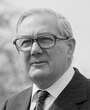
United Kingdom | James Callaghan | Prime Minister |

|
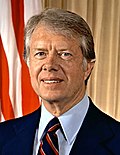
United States | Jimmy Carter | President |

|
European Community | Roy Jenkins | Commission President |
| Helmut Schmidt | Council President | ||
Issues
[edit]The summit was intended as a venue for resolving differences among its members. As a practical matter, the summit was also conceived as an opportunity for its members to give each other mutual encouragement in the face of difficult economic decisions.[4] This was the first summit where rather than simply issuing joint statements, participants committed themselves to policy decisions.
Gallery of participating leaders
[edit]_(cropped).jpg)
.jpg)
.jpg)



.jpg)
See also
[edit]Notes
[edit]- ^ a b Japan, Ministry of Foreign Affairs (MOFA): Summit Meetings in the Past.
- ^ Saunders, Doug. "Weight of the world too heavy for G8 shoulders," Archived 2008-10-11 at the Wayback Machine Globe and Mail (Toronto). July 5, 2008 -- n.b., the G7 becomes the Group of Eight (G7) with the inclusion of Russia starting in 1997.
- ^ a b Reuters: "Factbox: The Group of Eight: what is it?", July 3, 2008.
- ^ a b Reinalda, Bob and Bertjan Verbeek. (1998). Autonomous Policy Making by International Organizations, p. 205.
- ^ Rieffel, Lex. "Regional Voices in Global Governance: Looking to 2010 (Part IV)," Archived June 3, 2010, at the Wayback Machine Brookings. March 27, 2009; "core" members (Muskoka 2010 G-8, official site). Archived June 3, 2010, at the Wayback Machine
- ^ MOFA: Summit (8); European Union: "EU and the G8" Archived February 26, 2007, at the Wayback Machine
References
[edit]- Bayne, Nicholas and Robert D. Putnam. (2000). Hanging in There: The G7 and G8 Summit in Maturity and Renewal. Aldershot, Hampshire, England: Ashgate Publishing. ISBN 978-0-7546-1185-1; OCLC 43186692
- Reinalda, Bob and Bertjan Verbeek. (1998). Autonomous Policy Making by International Organizations. London: Routledge. ISBN 978-0-415-16486-3; ISBN 978-0-203-45085-7; OCLC 39013643
External links
[edit]- No official website is created for any G7 summit prior to 1995 -- see the 21st G7 summit.
- University of Toronto: G8 Research Group, G8 Information Centre