


Community hub
Recent from talks
Contribute something
Nothing was collected or created yet.
36th G8 summit
View on Wikipedia
| 36th G8 summit | |
|---|---|
 | |
 | |
| Host country | Canada |
| Dates | June 25–26, 2010 |
| Follows | 35th G8 summit |
| Precedes | 37th G8 summit |
The 36th G8 summit was held in Muskoka, Ontario, Canada, on June 25–26, 2010. In this year's meeting, the G8 leaders agreed in reaffirming the group's essential and continuing role in international affairs[1] and "assertions of new-found relevance".[2] The form and function of the G8 was reevaluated as the G20 summits evolved into the premier forum for discussing, planning and monitoring international economic cooperation.[3]
This was the fifth G8 Summit hosted by Canada since 1976,[4] the previous four being at Montebello, Quebec (1981); Toronto, Ontario (1988); Halifax, Nova Scotia (1995); and Kananaskis, Alberta (2002). The Canadian government picked Huntsville, a small town of 20,000, to host the annual summit and core meetings. Meetings took place at the Deerhurst Resort.[5] Facilities were built to ensure security and to handle the expected influx of media, protesters and others. Muskoka was deemed too small and a Toronto venue for the G20 summit was adopted.[6]
The late scheduling of a G20 summit in Toronto affected the G8 weekend in unanticipated ways. The meeting came to be framed in the press as a preliminary meeting.[7] The theme for this summit was "Recovery and New Beginning".[8] The G8 summit was an opportunity for a wide variety of non-governmental organizations, activists and civic groups to congregate and discuss a multitude of issues;[9] but the dramatic demonstrations at the G20 summit in Toronto eclipsed protests primarily focused on the conferring G8 leaders.[10]
Background
[edit]
The Group of Seven (G7) was an unofficial forum which brought together the heads of the richest industrialized countries: France, Germany, Italy, Japan, the United Kingdom, the United States and, Canada starting in 1976. The Group of Eight (G8), meeting for the first time in 1997, was formed with the addition of Russia.[11] In addition, the President of the European Commission has been formally included in summits since 1981.[12] The summits were not meant to be linked formally with wider international institutions; and in fact, a mild rebellion against the stiff formality of other international meetings was a part of the genesis of cooperation between France's president Valéry Giscard d'Estaing and West Germany's chancellor Helmut Schmidt as they conceived the initial summit of the Group of Six (G6) in 1975.[13]
The G8 summits during the 21st-century have inspired widespread debates, protests and demonstrations; and the two- or three-day event becomes more than the sum of its parts, elevating the participants, the issues and the venue as focal points for activist pressure.[14]
The current form of the G8 is being evaluated. Some reports attribute resistance to change among the smaller powers such as Italy, Canada, and Japan, who are said to perceive a dilution of their global stature. Alternately, a larger forum for global governance may be more reflective of the present multi-polar world.[15] The forum is in a process of transformation.[16]
Canada 2010
[edit]Anticipating the G8 summit, Prime Minister Stephen Harper explained that "Huntsville is a jewel in the Canadian Shield and an ideal location for this gathering of world leaders." When the G8 meets in Ontario in 2010, Harper said, "Our international guests will be charmed by the uniquely Canadian beauty of the region."[17] The summit was one of several events hosted by Canada, with several other international events taking place in the country in the same year, including the 2010 Winter Olympics and the 2010 G20 Toronto summit.[18] The summit was the second time it has occurred with an Olympic event in the same country. The 14th G7 summit was held Toronto and in the same year as the 1988 Winter Olympics in Calgary.
Planning
[edit]Budget
[edit]
In March 2009, summit manager Gérald Cossette projected: "Organizing a G8 event is like moving from a beast to a ballet. Now it's a beast; but by the time the summit unfolds, it's going to be a ballet."[20]
The Canadian government announced in February 2009 that it expected to invest $50 million in hosting the G8 summit.[21]
With the addition of a G20 summit in Toronto, the budget expanded. The total security cost was estimated at C$1 billion,[22] but more specific figures will not be known until the meetings have ended.
Local organizing plans
[edit]At early planning sessions and meetings with his constituents, Tony Clement (MP for Parry Sound-Muskoka) offered tentative ideas about the organizational structure for the area communities as preparations for the 2010 G8 summit in Huntsville begin to take shape. He said one goal was to minimize the footprint and impact of the security details on the local region.[23]
As the organizing process unfolded, some changes marked the evolution of this international event. For example, a wider emphasis on the Muskoka region is presented in the logo associated with the federal government's official website for the summit. Huntsville's G8 logo was selected in early 2009;[19] and some G8-related activities still feature the town's distinctive summit logo.[24]
Security
[edit]
The summit security was designed with the impact of the precautions on residents in mind. In February 2009, local residents and their representatives were working together to anticipate what it would be like to live through a period of heightened security. The RCMP and OPP were simultaneously conducting security reviews of the area and event.[25]
In the aftermath of the 1997 APEC summit in Vancouver, a Canadian judge concluded that protesters have the right to be seen and heard, which means that visiting leaders cannot be shielded from lawful protests. Canadian officials have determined that this means arrangements would have to be made so that protesters would be visible to those participating in the summit.[26]
Leaders at the summit
[edit]

The G8 is an unofficial annual forum for the leaders of Canada, the European Commission, France, Germany, Italy, Japan, Russia, the United Kingdom, and the United States.[12]
France anticipates enlarging the G8 to the G14, which would be the G8 plus the G5 (Brazil, India, China, South Africa and Mexico + 1 Muslim country);[27]
The summit included an "Africa outreach" session,[8][28][29][30][31][32][33][34][35] and an "Extended outreach" session.[36][37][38] In Huntsville, the G8 leaders met with the leaders of the seven African countries and with the leaders of Colombia, Haiti, and Jamaica.[39]
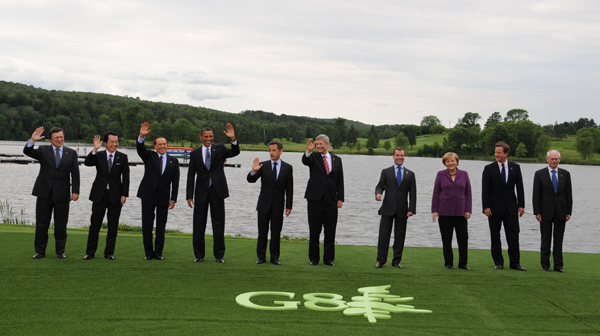
The 36th G8 summit was the first summit for British Prime Minister David Cameron, Japanese Prime Minister Naoto Kan, and President of the European Council Herman Van Rompuy.
Participants
[edit]These summit participants represent the current core members of the international forum:[40][41][42][43][44][45][46][47][48][49][50][51]


Agenda
[edit]Traditionally, the host country of the G8 summit sets the agenda for negotiations, which take place primarily amongst multi-national civil servants in the weeks before the summit itself, leading to a joint declaration which all countries can agree to sign. Harper explained at outset,
- "As hosts, our government will have considerable say over the agenda. It will be a tremendous opportunity to promote Canada's values and interests; to advocate for open markets and trade opportunities; to assist on global action against global warming; and to champion values like freedom, democracy and human rights and the rule of law."[52]
In early June, Harper was more specific. Canada wanted to focus on the economy, with emphasis placed on reforming the financial sector, and finding European support for plans to return to fiscal stability.[53]
The summit was intended as a venue for resolving differences among its members. As a practical matter, the summit was also conceived as an opportunity for its members to give each other mutual encouragement in the face of difficult economic decisions.[13]
Economy
[edit]Economic recovery from global recession and specifically the European debt crisis were at the forefront of negotiation.
- "Making growth compatible with fiscal consolidation is important not only for Japan, but for all the countries in the G8 .... The G8 showed some level of understanding for this." — Naoto Kan[54]
- "I have made it clear that we need sustainable growth, and that growth and intelligent austerity measures don't have to be contradictions. The discussion was not controversial; there was a lot of mutual understanding." — Angela Merkel[54]
- "No leader contested the need to cut deficits and debt, and to do it in a pragmatic way, taking into account the situation of each country." — Nicolas Sarkozy[54]
A tax on banking institutions, either to ultimately bailout the banks should they fail or as a so-called "Robin Hood tax", a transaction tax which would fuel international aid, was discussed and supported by European countries France and Germany but opposed by the US and Canada, although nothing binding was resolved.[55][56]
International relations
[edit]The nuclear programs of Iran and North Korea were criticized by leaders, who expressed concern that they might destabilize their regions. Israel too was criticized for its ongoing blockade of the Gaza Strip.[57] North Korea was also criticized for the sinking of a South Korean warship.
- "Iran is not guaranteeing a peaceful production of nuclear power. The members of the G8 are worried, and believe absolutely that Israel will probably react preemptively." — Silvio Berlusconi[54]
- "There have to be consequences for such irresponsible behaviour on the international stage." — Barack Obama, speaking about North Korea's alleged sinking of a South Korean warship[54]
Afghanistan was given five years to reduce corruption and increase security in the country.
- "Making progress this year, putting everything we have into getting it right this year, is vitally important." — David Cameron, speaking on the War in Afghanistan[54]
The leaders at the summit pledged $5 billion toward international aid, less than the predicted $50 billion that was promised for 2010 at the 2005 G8 summit.[58] This money is mostly destined for poorer countries in Africa and Asia. This reduction was seen as a consequence of increased deficits and tighter financial situations in richer countries. As part of the discussion, leaders from Haiti, Jamaica, Senegal, Algeria, Ethiopia, Malawi, Nigeria, South Africa, and Egypt were invited to talk.[56]
Response
[edit]Protesters and demonstrations
[edit]Prior to its start, protest groups and other activists were expected to make a showing at the summit.[5] At Huntsville, public protests were small.[59]
Oxfam staged a protest with people wearing giant papier mache heads of the G8 leaders. Oxfam's goal was to put the issue of extreme poverty on the summit agenda, but a spokesman described the Huntsville protests as something akin to "benign nuisance."[59]
Not all demonstrations originated from outside the local community. One 2008 letter to the editor of the Huntsville Forester suggested that the way in which local communities plan for 2010 could be seen as an "incredible opportunity to demonstrate for change in the world:"
- "The summit will bring a lot of activity and money .... So, how will we, as a network of communities, move into it? Will the money drive us? Or will we take a larger position by looking to create future-friendly businesses that will continue to thrive long after the summit is over? Will we choose greed or balance as the underlying intent? Intention matters. As the first plans and preparations are being laid, this might be a good time to take steps such as networking with outlying communities and forming focus groups to define some of these goals."[60]
A group of locals urged the G8 leaders to declare water a human right. The group organized a march through the town centre Friday morning.[59]
Independent documentary
[edit]In December 2008, two independent filmmakers from northern Germany began introducing themselves and interviewing people in Huntsville. Their plans included making a documentary on the preparations for the upcoming G8 summit. They also anticipated the impact and after-effects of the event. They hoped to screen the finished documentary at an international film festival[61]
Counter-conference
[edit]A religious counter-summit was planned to coincide with the G8 summit in 2010. The Canadian Council of Churches was organizing the event, anticipating that South Africa's Desmond Tutu, the Dalai Lama, and Prince Karīm al-Hussainī Aga Khan IV would be amongst the internationally known figures who plan to attend the multi-faith conference at the University of Winnipeg. Similar conferences have been held alongside the G8 summits since 2005. Groundwork for this event began when Canada's 2010 venue was announced in 2008 at the Hokkaido summit. Counter-summit organizers projected that it would be difficult for political leaders to ignore the admonitions of the world's religious leaders, even as they might tend to marginalize the protesters who battle police at each G8 meeting.[62]
Accomplishments
[edit]The G8 summit historically serves to draw international attention to difficult problems and to reach general agreements, not necessarily as a place to hammer out detailed solutions. Therefore, the accomplishments of the conference are unlikely to be final solutions.[63]
Muskoka infrastructure
[edit]Harper anticipated that "the 2010 G8 Summit will provide short and long-term economic benefits for the region and the province, and would be an exceptional opportunity for Canada to advance its values and interests on the world stage."[4] The real estate industry expected to benefit—for example, cottage owners in the area looked to capitalize by renting their properties to dignitaries. The local Huntsville-Lake of Bays Chamber of Commerce, believed the summit will produce economic spin-off and long-term benefits; but some residents were skeptical.[5]
Infrastructure Consortium for Africa
[edit]The Infrastructure Consortium for Africa (ICA) was established at the 31st G8 summit at Gleneagles (Scotland) in 2005. Since that time, the ICA's annual meeting is traditionally hosted by the country holding the Presidency of the G8—in 2010 in Canada.[64]
Gallery of participating leaders
[edit]


.jpg)


.jpg)
Notes
[edit]- ^ Was invited but was unable to attend.
Citations
[edit]- ^ "Group of Eight concludes Muskoka summit, reaffirms own essential role". People's Daily (Beijing). June 27, 2010. Archived from the original on September 25, 2022.
issuing a declaration about its shared views and approaches for major global challenges, and reaffirmed its own essential role in international affairs
- ^ Clark, Campbell (June 27, 2010). "The G8 risks becoming increasingly irrelevant". Globe and Mail (Toronto). Archived from the original on April 13, 2016.
- ^ Townsend, Ian (October 19, 2010). "G20 & the November 2010 Seoul summit" (SN/EP/5028)" (PDF). Parliament (UK). Archived from the original (PDF) on November 7, 2010.
Today, we designated the G-20 as the premier forum for our international economic cooperation
citing "Leaders' Statement The Pittsburgh Summit" (PDF). G20. September 25, 2009. Paragraph 50. Archived from the original (PDF) on June 12, 2010. - ^ a b "Prime Minister announces Canada to host 2010 G8 Summit in Huntsville", Archived January 29, 2009, at the Wayback Machine June 19, 2008.
- ^ a b c Andreatta, David (July 12, 2008). "Brace yourself, Huntsville. The G8 is coming". Globe and Mail. Archived from the original on March 23, 2009.
- ^ MacGregor, Roy (July 11, 2010). "In the tale of two summits, the happy ending was Huntsville's". Globe and Mail. Archived from the original on October 22, 2012.
- ^ Austen, Ian. "Dressed Up and Ready, Canada Town Is Stood Up", New York Times. June 24, 2010.
- ^ a b Ikokwu, Constance. "Jonathan Invited to G8 Meeting in Canada", Archived 2010-06-05 at the Wayback Machine This Day (Lagos). June 6, 2010.
- ^ Zablonski, Lukasz and Philip Seaton. "The Hokkaido Summit as a Springboard for Grassroots Initiatives: The 'Peace, Reconciliation & Civil Society' Symposium", The Asia-Pacific Journal: Japan Focus (e-journal). ID No. 2973.
- ^ Woo, Andrea. "G8 protesters in Vancouver march without incident: police", Vancouver Sun. June 27, 2010.
- ^ Saunders, Doug. "Weight of the world too heavy for G8 shoulders", Archived 2008-10-11 at the Wayback Machine Globe and Mail (Toronto). July 5, 2008.
- ^ a b Reuters: "Factbox: The Group of Eight: what is it?", July 3, 2008.
- ^ a b Reinalda, Bob and Bertjan Verbeek. (1998). Autonomous Policy Making by International Organizations, p. 205.
- ^ "Influencing Policy on International Development: G8", Archived 2012-05-13 at the Wayback Machine BOND (British Overseas NGOs for Development). 2008.
- ^ Kumar, Rajiv. "Tangible Results of Pittsburgh", Financial Chronicle. September 30, 2009; Carmichael, Kevin. "Harper has key role shaping G8’s future". Archived 2011-06-16 at the Wayback Machine The Globe and Mail. September 24, 2009.
- ^ Congressional Record Service, R40977: Nelson, Rebecca M. "Implications of the transition from G-7 to G20," pp. 22–26. The G-20 and International Economic Cooperation: Background and Implications for Congress, December 9, 2009.
- ^ "Muskoka to Host 2010 G8 Summit in Huntsville, Ontario", 400 Eleven. June 19, 2008. Accessed August 21, 2008.
- ^ Sainsbury, Macdonald. 2010 Organizing and the Tar sands: Inspiring the SPP and helping the Olympics, Archived August 4, 2008, at the Wayback Machine ZNet. Accessed July 17, 2008.
- ^ a b Last, Al and Lesley. "Parry Sound North Star reveals G8 logo", Archived 2011-07-06 at the Wayback Machine Huntsville Forrester. February 18, 2009.
- ^ Dash, Carlye Malchuk. "Moving from ‘a beast to a ballet’", Huntsville Forester. March 4, 2009.
- ^ Dash, Carlye Malchuk. "Huntsville getting G8 centre and second arena pad", Huntsville Forester. February 6, 2009.
- ^ Jordan, Pav. "Canada braces for 'G' summits with C$1 bln plan", Toronto Star. June 1, 2010.
- ^ Dash, Carlye Malchuk. "Local organizing committee for summit unveiled", Huntsville Forester. August 8, 2008.
- ^ "Town signs G8 contract with feds", Archived 2011-07-06 at the Wayback Machine Hunstville Forrester. April 28, 2010.
- ^ Dash, Carlye Malchuk. "Details on G8 security may come next month", Huntsville Forester. January 28, 2009.
- ^ Campion-Smith, Bruce. "Closed-door talks rile protesters", The Star (Toronto). August 17, 2007.
- ^ Alexandroff, Alan. "The 'Goldilocks' Solution to Global Governance", Archived 2011-06-16 at the Wayback Machine Centre for International Governance Innovation. September 24, 2009; Welch, David. "Canada has an opportunity to remake world summitry", Toronto Star. July 18, 2008.
- ^ Bouteflika (U Toronto site)
- ^ Mubarak (U Toronto site)
- ^ "G8 Muskoka Declaration – Recovery and New Beginnings", Government of Japan. Accessed July 1, 2023
- ^ "The G20 Leaders Make an Entrance; Heads of State are Greeted by Mounties as They Arrive for the Summit", Maclean's. June 25, 2010; Zenawi (U Toronto site)
- ^ "The G20 Leaders Make an Entrance; Heads of State are Greeted by Mounties as They Arrive for the Summit", Maclean's. June 25, 2010; Mutharika (U Toronto site)
- ^ "The G20 Leaders Make an Entrance; Heads of State are Greeted by Mounties as They Arrive for the Summit", Maclean's. June 25, 2010; Johnson (U Toronto site)
- ^ Wade (U Toronto site)
- ^ "The G20 Leaders Make an Entrance; Heads of State are Greeted by Mounties as They Arrive for the Summit", Maclean's. June 25, 2010; Zuma (U Toronto site)
- ^ "Presidente Uribe llegó a Canadá para participar en Cumbre del G8", El Espectador June 24, 2010; Uribe (U Toronto site)
- ^ Préval (U Toronto site)
- ^ Golding (U Toronto site)
- ^ Chan, Sewell and Jackie Calmes. "Policy Conflicts Seen as Obama Arrives in Toronto", New York Times. June 25, 2010.
- ^ Rieffel, Lex. "Regional Voices in Global Governance: Looking to 2010 (Part IV)", Archived June 3, 2010, at the Wayback Machine Brookings (US). 27 March 2009; retrieved 13 February 2011
- ^ Harper (U Toronto site); Harper (G8 official site) Archived 2010-06-25 at the Wayback Machine
- ^ Gubert, Romain. "Quatre Français pour rien," Le Point (Paris). June 26, 2010; Sarkozy (U Toronto site); Sarkozy (G8 official site) Archived 2010-06-25 at the Wayback Machine
- ^ "The G20 Leaders Make an Entrance; Heads of State are Greeted by Mounties as They Arrive for the Summit", Maclean's. June 25, 2010; Merkel (U Toronto site); Merkel (G8 official site) Archived 2010-06-25 at the Wayback Machine
- ^ "The G20 Leaders Make an Entrance; Heads of State are Greeted by Mounties as They Arrive for the Summit", Maclean's. June 25, 2010; Berlusconi (U Toronto site); Berlusconi (G8 official site) Archived 2010-06-25 at the Wayback Machine
- ^ "The G20 Leaders Make an Entrance; Heads of State are Greeted by Mounties as They Arrive for the Summit", Maclean's. June 25, 2010; Kan (U Toronto site); Kan (g8 official site) Archived 2010-06-25 at the Wayback Machine
- ^ "The G20 Leaders Make an Entrance; Heads of State are Greeted by Mounties as They Arrive for the Summit", Maclean's. June 25, 2010; Medvedev (U Toronto site); Medvedev (G8 official site) Archived 2010-06-25 at the Wayback Machine
- ^ "The G20 Leaders Make an Entrance; Heads of State are Greeted by Mounties as They Arrive for the Summit", Maclean's. June 25, 2010; Cameron (U Toronto site); Cameron (G8 official site) Archived 2010-06-25 at the Wayback Machine
- ^ "The G20 Leaders Make an Entrance; Heads of State are Greeted by Mounties as They Arrive for the Summit", Maclean's. June 25, 2010; Obama (U Toronto site); Obama (G8 official site) Archived 2010-06-25 at the Wayback Machine
- ^ "Differences on Economy Set to Play out in Toronto", The Hindu. June 25, 2010; Barroso (U Toronto site); Barosso (G8 official site); Archived 2010-06-25 at the Wayback Machine "EU and the G8" Archived February 26, 2007, at the Wayback Machine
- ^ Ward, Olivia. "Ban Ki-moon at G20 as 'defender of the defenceless'", Toronto Star. June 26, 2010.
- ^ Gubert, Romain. "Quatre Français pour rien," Le Point (Paris). June 26, 2010.
- ^ Learn, Rob. "Huntsville to serve as world stage in 2010", Huntsville Forester (Huntsville, Ontario). June 25, 2008.
- ^ Weese, Bryn. "Harper, Cameron Disagree on Bank Tax", The Sun (Toronto). June 3, 2010.
- ^ a b c d e f "G8 Leaders in Their Words", CBC News. June 25, 2010.
- ^ G20:Battles within and outside. Al Jazeera. June 28, 2010.
- ^ a b G8 makes 'cautious' aid pledge. Al Jazeera. June 28, 2010.
- ^ G8 criticizes N Korea and Iran. Al Jazeera. June 28, 2010.
- ^ Curry, Bill. "G20 to look at global poverty, leaked communiqué shows", Globe and Mail (Toronto). June 23, 2010.
- ^ a b c "Developing countries join G8 at Huntsville summit", CTV News. June 25, 2010.
- ^ Ramcharan, Cheryl. "Now is a good time to define our goals for the G8 Summit", Huntsville Forester. July 16, 2008.
- ^ Dash, Carlye Malchuk. "Filmmakers here for documentary on G8 Summit", Huntsville Forester. January 14, 2009.
- ^ Laidlaw, Stuart. "Religious heads to hold own summit during G8", The Star (Toronto). March 19, 2009.
- ^ Feldman, Adam. "What's Wrong With The G-8", Forbes (New York). July 7, 2008.
- ^ "Meeting to Discuss Crisis Impact in Africa's Infrastructure Development", Afrol News. March 2, 2009.
References
[edit]- Reinalda, Bob and Bertjan Verbeek. (1998). Autonomous Policy Making by International Organizations. London: Routledge. ISBN 978-0-415-16486-3; ISBN 978-0-203-45085-7; OCLC 39013643
External links
[edit]
- Canada's G8 website n.b., no official website is created for any G7 summit prior to 1995 -- see the 21st G7 summit.
- G7 Research Group - G7 Information Centre
- Globe and Mail - G8/G20 website
- Canadian Government - G8/G20 Twitter site
- G8 Special Report guardian.co.uk

36th G8 summit
View on GrokipediaBackground
Host Country Context
Canada held the rotating presidency of the G8 in 2010, with Prime Minister Stephen Harper of the Conservative Party leading the government since 2006 in a minority parliament.[3] The choice to host the summit reflected Canada's commitment to multilateral forums addressing global economic recovery following the 2008 financial crisis, alongside priorities such as maternal and child health in developing nations.[4] Economically, Canada experienced one of the mildest recessions among G7 nations, with real GDP contracting by 2.6% in 2009 before rebounding 3.3% in 2010, supported by a resilient banking sector that avoided major bailouts.[5] This stability, attributed to prudent fiscal policies under Harper's administration, positioned Canada to emphasize open markets, free trade, and sustainable growth during its G8 tenure.[6] The government also navigated domestic challenges, including ongoing involvement in Afghanistan and preparations for concurrent G8 and G20 summits, marking the first time Canada hosted both events.[7] The summit venue in Huntsville, Muskoka, Ontario—a region of lakes and forests—was selected after a Department of Foreign Affairs study for its natural security advantages, remoteness from urban centers, and potential to showcase Canada's scenic landscapes while providing economic stimulus to the local area through infrastructure investments.[8] This choice facilitated secure deliberations at the Deerhurst Resort in a town of approximately 20,000 residents, minimizing protest disruptions compared to larger cities.[9]Global Economic and Political Situation
The global economy in mid-2010 was in a fragile recovery phase following the 2008-2009 financial crisis, with advanced economies experiencing subdued growth amid high unemployment and fiscal strains, while emerging markets showed stronger rebound. World GDP growth was projected at around 3.8% for the year, up from a 0.6% contraction in 2009, but private capital flows to developing countries remained below pre-crisis levels at 2.7% of GDP, with risks of renewed volatility from sovereign debt pressures. In the United States, first-quarter GDP expanded by 3.0% annualized, supported by stimulus measures, yet unemployment hovered near 10%, constraining consumer spending and private investment.[10][11] The Eurozone debt crisis dominated concerns, triggered by Greece's revelation of a 12.7% budget deficit in late 2009—far exceeding EU limits—and escalating into a broader sovereign debt contagion risk by spring 2010. In May, the EU and IMF provided Greece with a €110 billion bailout, accompanied by austerity measures, while the European Central Bank began purchasing government bonds to stabilize markets; this was followed by a €750 billion rescue package for vulnerable euro area members to prevent default cascades in Ireland, Portugal, and Spain. Bond yields for Greek debt surged above 7%, signaling market distrust, and the crisis exposed structural imbalances like high public debt-to-GDP ratios (Greece at 127%) and competitiveness gaps, prompting debates on fiscal discipline versus growth strategies.[12][13][14] Politically, the crisis fueled tensions within Europe, with austerity sparking protests in Greece and Ireland, and strained transatlantic relations as U.S. leaders urged coordinated stimulus over rapid tightening. Globally, investor surveys highlighted political risk—such as policy uncertainty and regulatory shifts—as the primary barrier to investment in developing regions, surpassing economic downturns. Broader geopolitical stability persisted without major conflicts, though ongoing issues like the BP Deepwater Horizon oil spill (April 2010) underscored environmental and corporate governance vulnerabilities, while democratic backsliding in several nations reflected uneven institutional resilience amid economic stress. The G8 context emphasized multilateral coordination to avert a double-dip recession, with leaders facing domestic pressures for accountability on bailouts and trade imbalances.[15][16]Preparation and Logistics
Venue Selection and Local Organization
The Canadian government selected Huntsville in the Muskoka region of Ontario as the venue for the 36th G8 summit following a comprehensive study by Foreign Affairs and International Trade Canada.[17] This rural area, characterized by its lakes and forests, was chosen to offer a secure and picturesque setting for leaders' discussions, while stimulating economic activity in a community of approximately 20,000 residents.[18] The primary site was the Deerhurst Resort, a large convention facility equipped to host plenary sessions and accommodations for delegations.[19] The selection drew criticism from security officials, with an internal Royal Canadian Mounted Police (RCMP) review highlighting the venue's vulnerabilities due to its elevated, wooded terrain, which provided "ideal conditions" for potential sniper threats.[20][21] Despite these concerns, the location proceeded, necessitating extensive security adaptations including restricted airspace and perimeter controls. Local organization was coordinated through a dedicated local area leadership group and organizing committee, involving municipal officials, business leaders, and community representatives from Muskoka and Huntsville.[22] Preparations included infrastructure enhancements, such as highway expansions and facility upgrades, funded partly by federal allocations, which yielded lasting benefits like improved roadways for the region.[23] Specialized subcommittees addressed public health, emergency response, and logistics, ensuring coordinated support from local agencies during the June 25–26, 2010, event.[24] These efforts emphasized leveraging the summit for long-term economic and infrastructural gains beyond the immediate hosting period.[25]Budget and Cost Management
The total funding approved for the 2010 G8 and G20 summits combined reached C$1.1 billion, with the G8 portion in Muskoka estimated at C$305 million based on a 35:65 allocation ratio reflecting the event's relatively smaller scale and remote location.[26] This estimate, derived from analyses by the Parliamentary Budget Officer and the University of Toronto's G8 Research Group, encompassed security, operations, and infrastructure, though precise separation proved challenging due to integrated planning across both summits.[26] Initial budget planning commenced in April 2009 through the Summits Management Office of Foreign Affairs and International Trade Canada, which coordinated departmental contributions including from Public Safety Canada (allocated C$278.3 million overall, with administrative costs for security reimbursement).[27][28] Security dominated expenditures, totaling an estimated C$325.5 million for the G8, covering Royal Canadian Mounted Police operations, Canadian Forces support, and private contracts such as C$34 million for supplemental personnel amid shortages.[26][27] Specific line items included C$60.5 million for temporary police accommodations in the Muskoka region and capital equipment procurements, with overall security for both summits audited at C$930 million including C$507 million in RCMP operating expenses.[29][30] Operational budgets allocated approximately C$160 million combined for hospitality, infrastructure, food safety inspections (C$1.2 million), and staffing, while C$50 million from the G8 Legacy Infrastructure Fund supported local projects like roadway and facility upgrades in the Huntsville area to enhance summit readiness and long-term regional development.[26][31] Cost management emphasized centralized oversight via the Summits Management Office, which handled procurement, vendor contracts, and inter-agency reimbursements under Treasury Board guidelines, though post-event audits revealed inefficiencies such as overestimated projections and discretionary spending in the Legacy Fund concentrated in the host electoral district of Parry Sound—Muskoka.[27][32] The Auditor General's review criticized inadequate parliamentary reporting on total expenditures and value-for-money assessments, noting that while security threats justified robust measures, alternatives like greater military involvement could have reduced reliance on costlier police overtime and rentals.[27][33] Amid public scrutiny during economic recovery, these outlays—equivalent to roughly 0.07% of federal annual spending—prompted opposition calls for greater transparency, though officials maintained the investments ensured safe hosting in a wilderness setting distant from urban centers.[34][35]Security and Contingency Planning
The Royal Canadian Mounted Police (RCMP), through the Integrated Security Unit (ISU), held overall responsibility for coordinating security operations at the 36th G8 summit held June 25–26, 2010, at Deerhurst Resort in Huntsville, Ontario.[28] The ISU employed a phased planning approach, integrating federal, provincial, and local agencies, including the Canadian Forces, to address the event's demands amid concurrent preparations for the subsequent G20 summit in Toronto.[28] Planned security expenditures for the G8, estimated at approximately 65% of the combined G8/G20 total, reached around C$604 million, encompassing RCMP operations (C$507 million overall allocation), Public Safety Canada contributions, National Defence support (C$77.5 million), and a C$55 million contingency reserve for unforeseen needs.[36] Security measures included erecting kilometers of high steel fencing to establish a secure perimeter east of Huntsville, housing about 5,000 personnel in a makeshift compound near the resort, and monitoring Main Street with police presence.[37] Local businesses were instructed to secure outdoor displays, such as removing items like fur teddy bears that could serve as projectiles.[37] The venue's remote, lakeside setting with surrounding golf courses and trails complicated access control due to multiple land and water routes, while the hilly, wooded terrain created vulnerabilities, described in an internal RCMP review as providing "ideal conditions" for snipers and concealed intruder approaches.[20] Anticipated threats encompassed anti-globalization protests and potential terrorism, prompting alerts such as the discovery of a vehicle containing weapons near a summit site.[38] Protests in Huntsville remained limited and non-violent, featuring small gatherings with symbolic actions like hugs and clown performances, with no reported arrests or significant disruptions at the G8 venue itself—unlike the over 1,100 arrests during the Toronto G20 events.[39][20] Contingency protocols, such as Plan 32, authorized the removal of potential projectiles—including decorative rocks from streets—in escalating risk scenarios.[37] Public health response plans aligned with Ontario's Emergency Management and Civil Protection Act prepared for mass casualty or disease outbreaks, while the overall operation concluded without loss of life or serious injuries, though a post-event RCMP review highlighted deficiencies like inexperienced planners and inadequate information sharing.[40][20] The review deemed the Muskoka location "sub-optimal" from a security standpoint, attributing strains to the back-to-back summits 200 kilometers apart.[20]Participants
G8 Core Leaders
The 36th G8 summit featured the heads of state or government from the eight member countries—Canada, France, Germany, Italy, Japan, Russia, the United Kingdom, and the United States—along with representatives from the European Union. These leaders convened to address global economic recovery, development aid, and security challenges following the 2008 financial crisis.[41]| Country/Entity | Leader | Position |
|---|---|---|
| Canada | Stephen Harper | Prime Minister |
| France | Nicolas Sarkozy | President |
| Germany | Angela Merkel | Chancellor |
| Italy | Silvio Berlusconi | Prime Minister |
| Japan | Naoto Kan | Prime Minister |
| Russia | Dmitry Medvedev | President |
| United Kingdom | David Cameron | Prime Minister |
| United States | Barack Obama | President |
| European Union | Herman Van Rompuy | President of the European Council |
| European Union | José Manuel Barroso | President of the European Commission |
Invited Outreach Partners
The 36th G8 summit, hosted by Canada, extended invitations to leaders from seven African countries as outreach partners to facilitate discussions on continent-specific development challenges, including maternal and child health initiatives and infrastructure investment. These nations—Algeria, Egypt, Ethiopia, Malawi, Nigeria, Senegal, and South Africa—were selected to represent diverse African perspectives and to align with Canada's emphasis on fulfilling prior G8 commitments to Africa.[43][44] The attending leaders participated in dedicated outreach sessions with G8 heads of state and government on June 25, 2010, contributing input to agenda items like the Muskoka Initiative and African infrastructure pledges.[45][46] They were:- Algeria: President Abdelaziz Bouteflika[47]
- Egypt: President Hosni Mubarak[47]
- Ethiopia: Prime Minister Meles Zenawi[47]
- Malawi: President Bingu wa Mutharika[47]
- Nigeria: Acting President Goodluck Jonathan[47][46]
- Senegal: President Abdoulaye Wade[47]
- South Africa: President Jacob Zuma[47]