


Community hub
Recent from talks
Contribute something
Nothing was collected or created yet.
Advanced Precision Kill Weapon System
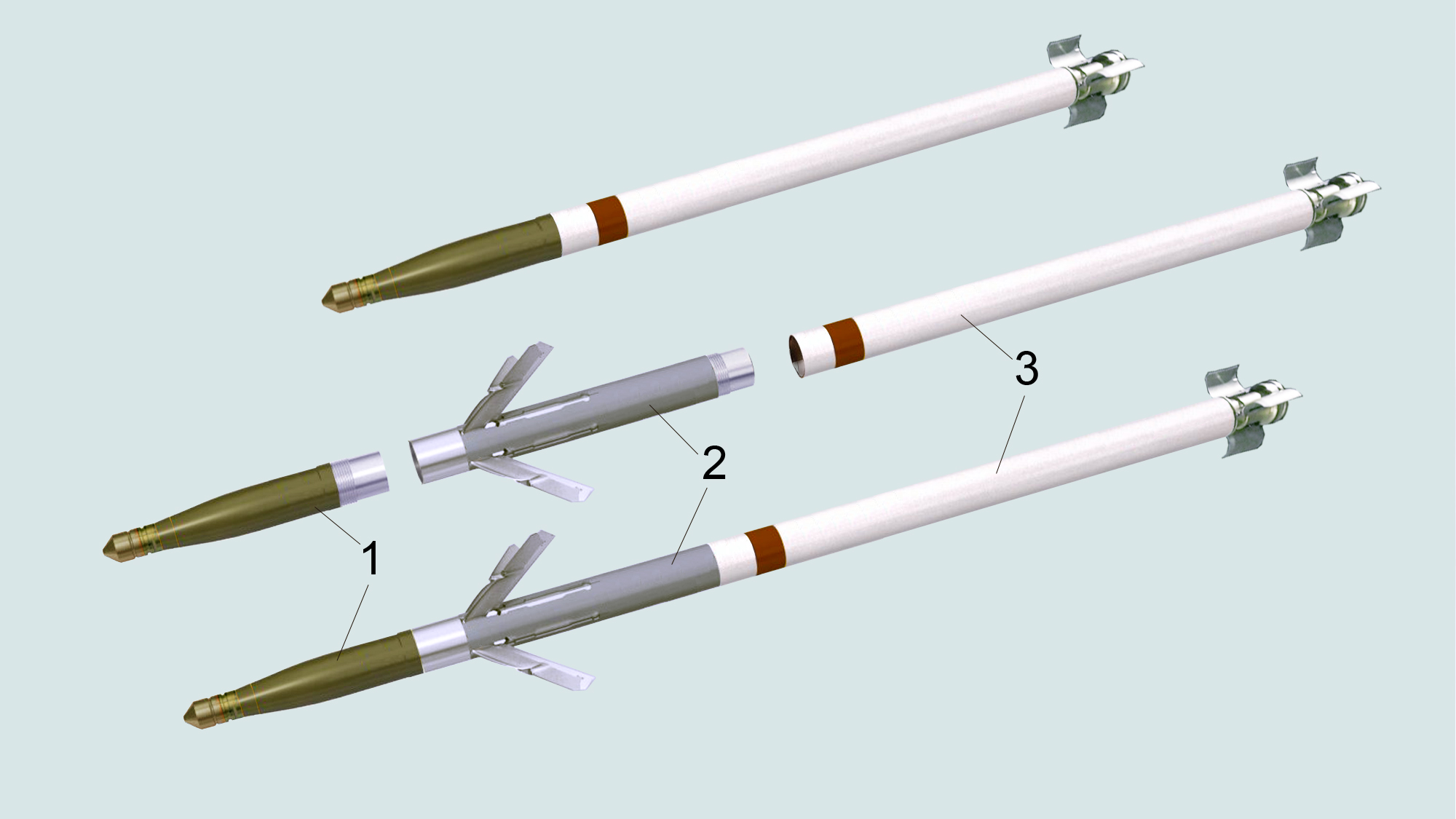
View on WikipediaThe AGR-20 Advanced Precision Kill Weapon System (APKWS) is a design conversion of Hydra 70 unguided rockets with a laser guidance kit to turn them into precision-guided munitions (PGMs).[7] APKWS is approximately one-third the cost and one-third the weight of the current[when?] inventory of laser-guided weapons, has a lower yield more suitable for avoiding collateral damage, and takes one quarter of the time for ordnance personnel to load and unload.
Key Information


Development
[edit]Where possible the system utilizes existing Hydra 70 components such as launchers, rocket motors, warheads and fuzes. The weapon bridges the gap between the Hydra 70 and AGM-114 Hellfire systems and provides a cost-effective method of engaging lightly armored point targets. APKWS is the U.S. government's only Program of Record for the semi-active, laser-guided 2.75 inches (70 mm) rocket.[8]
It converts the Hydra 70 unguided rocket into a precision guided munition through the addition of a mid-body guidance unit developed by BAE Systems. The APKWS has also been successfully tested in live fire exercises with the Forges de Zeebrugge unguided rocket, converting it into a precision guided munition and demonstrating the technology can be used on other rocket types than the Hydra 70.[8]
Design
[edit]The winning bidder for the APKWS contract was the team of BAE Systems, Northrop Grumman and General Dynamics,[9] beating the offerings from Lockheed Martin and Raytheon Systems.[10]
The APKWS uses the Distributed Aperture Semi-Active Laser Seeker (DASALS) technology. This system allows a laser seeker to be located in the leading edge of each of the forward control canards, working in unison as if they were a single seeker. This configuration allows existing warheads from the Hydra 70 system to be used without the need for a laser seeker in the missile nose.
The APKWS system is composed of the launch platform, rockets equipped with the WGU-59/B mid-body guidance unit, the lengthened 7-tube LAU-68 F/A rocket launcher, the SCS 7 aiming cue (not needed for attack helicopters), and Fastpack PA-140 and CNU-711/E storage kits for rockets and guidance kits, respectively, to ensure they are safe in the field. The WGU-59/B mid-body guidance unit is equipped with DASALS seeker optics which deploy 0.5 seconds after launch. They are attached in between the Mk 66 Mod 4 rocket motor and a warhead and fuze, which increases length by 18.5 in (47 cm) and weight by 9 lb (4.1 kg) over the legacy Hydra system.[5]
The firing range is 1,100–5,000 meters; at the minimum range, the target can be struck less than 5 seconds after launch.[5] Maximum range is constrained by use of the existing Hydra 70 motor, but since the seeker can see as far as 14 km (8.7 mi), a more powerful motor could extend range while retaining accuracy.[11] Nammo is working on a modified rocket motor that can extend range to 12–15 km (7.5–9.3 mi).[12]
A software upgrade of the APKWS was planned for late 2021; the upgrade increases range by 30% by means of an optimized flight trajectory to engage targets at a steeper angle of attack, while also being qualified on both fixed- and rotary-wing aircraft in a single variant and improving the surface danger zone logic for better training range options.[13][14]
In June 2021, BAE successfully tested the APKWS in a counter-unmanned aerial systems (C-UAS) role. An APKWS-equipped rocket was fitted with a proximity fuze and destroyed a Class 2 UAS. The proximity fuze enables it to intercept UAS at a lower cost than other methods, and due to the rocket's laser guidance that activates on launch it does not require locking on to the target before launch.[15][16]
In April 2025, a new dual-mode APKWS II variant with a full-scale mockup was revealed, featuring a passive infrared sensor as well as the original's laser-guidance, allowing the weapon to be fired with "anoint-and-shoot" capability (where the target is initially lased to orient the missile, but the lase is not maintained and the infrared sensor takes over for terminal guidance) to increase rate of fire, particularly against large numbers of cruise missile or unmanned aerial vehicle targets.[17] The addition of the nose-mounted infrared seeker necessitated moving the warhead to the mid-body of the rocket, which provides an improved blast- fragmentation pattern with no loss of lethality; however modifications increase the cost compared to the original.[17] Development is expected to be completed by the end of 2026.[17]
Specifications
[edit]- Length: 73.8 in (1.87 m)[3]
- Diameter: 2.75 in (70 mm)[4]
- Wingspan: 9.55 in (24.3 cm)[4]
- Weight: 32 lb (15 kg)[3]
- Speed: 1,000 m/s (3,600 km/h; 2,200 mph; Mach 2.9) at max[4]
- Range: 1,100–5,000 m (0.68–3.11 mi) (rotary wing); 2–11 km (1.2–6.8 mi) (fixed wing)[5][3]
- Guidance: Semi-active laser homing
- CEP: <0.5 meters[3]
- Motor: Existing Hydra 70 motors
- Warhead: Existing Hydra 70 warhead
Program status
[edit]- 2002: APKWS development test series begins.[18]
- April 2005: General Dynamics APKWS program cancelled due to poor test results.[19]
- September 2005: Successful flight test of BAE APKWS II.[20]
- October 2005: Competition reopened as APKWS II.[19]
- April 2006: BAE Systems selected as prime contractor for the APKWS II program.[21]
- February 2007: Funding for program withdrawn in proposed FY2008 budget.[22][23]
- May 2007: Successful flight test of BAE APKWS II in production-ready configuration.[24]
- November 2008: Transfer of contract from US Army to US Navy.[25]
Deployment
[edit]- March 2012: APKWS II achieves initial operating capability (IOC) and is sent to Afghanistan with the United States Marine Corps. Plans are to integrate it onto the MQ-8 Fire Scout.[26]
- July 2012: BAE Systems receives full-rate production contract for APKWS from the U.S. Navy. The first FRP deliveries were in October 2012 and the company expected the next FRP option to be awarded by the end of 2012.[27]
- September 2012: The Navy awards a contract to officially integrate the APKWS into the Fire Scout.[28]
- October 2012: BAE announces its intention to modify the APKWS II to be fired from fixed-wing tactical fighter platforms.[29]
- January 2013: Additional conversion kits ordered. No in flight failures during the 100 combat launches in Afghanistan to date.[30]
- February 2013: APKWS launched from an A-10 Thunderbolt II. Three sorties were conducted. The first sortie carried the rocket and launcher, and the second sortie fired an inert, unguided rocket to ensure the weapon would separate from the aircraft. Two armed rockets were fired during the third sortie from 10,000 and 15,000 feet. The second rocket launched into a 70 knot headwind, and both impacted within inches of the target. The Air Force is considering using the APKWS II operationally by 2015 if further testing is successful.[31]
- March 2013: APKWS is integrated onto the Bell 407GT.[32]
- April 2013: A UH-1Y Venom fired 10 APKWS rockets at stationary and moving small boat targets, scoring 100 percent accurate hits on single and multiple targets over water. The engagement ranged from 2–4 km using inert Mk152 high explosive and MK149 flechette warheads. The UH-1Y had the boats designated by an MH-60S.[33]
- October 2013: APKWS successfully fired from an AH-64 Apache. Eight rockets were fired with the helicopter flying at up to 150 kn (170 mph; 280 km/h) and up to 5 km (3.1 mi) from the target. Launch altitudes ranged from 300 ft to 1,500 ft. BAE wants airworthiness qualification on the Apache for international sales to AH-64 operators.[34]
- March 2014: LAU-61 G/A Digital Rocket Launcher (DRL) deployed with HSC-15.[35]
- July 2014: BAE reveals that the APKWS has reached Early Operational Capability (EOC) with one squadron of MH-60S helicopters. The MH-60R will be outfitted within "12-18 months."[36]
- August 2014: APKWS tested on Australian Army Eurocopter Tiger at Woomera Test Range. A helicopter was on the ground and fired seven rockets which successfully hit their targets. The rocket could enter Australian service by early 2015 on army Tigers and navy MH-60R helicopters.[37][8]
- November 2014: APKWS tested on Australian Army, 16 Aviation Brigade, Eurocopter Tigers, this time airborne, near Darwin. Tests included using APKWS to convert a Forges de Zeebrugge (FZ) unguided rocket into a laser precision-guided weapon. All 10 rockets struck within a metre of the laser spot.[8]
- October 2015: US Army AH-64 Apache helicopters to field weapon in Iraq and Afghanistan.[38]
- March 2016: First rocket variants for launch from fixed-wing aircraft shipped to Marine Corps Harriers.[39]
- June 2016: APKWS deployed on USAF F-16 and A-10 as part of an urgent operational requirement.[40][41]
- October 2016: Production rate increased to 5,000 a year.[42]
- June 2016-January 2017: 200 APKWS used against ISIL targets, including 60 during the Battle of Mosul.[43]
- February 2018: First operational deployment of APKWS on Marine Corps legacy F/A-18 Hornets.[44]
- December 2019: US Air Force demonstrates air-to-air capability of AGR-20A to cue off Sniper Advanced Targeting Pod and intercept low-flying cruise missiles.[45]
In December 2019, the 85th Test and Evaluation Squadron at Eglin AFB, Florida, conducted a test using APKWS rocket against a drone representing a cruise missile. By adapting the rocket for cruise missile defense, it can serve the same role as the much more expensive AIM-120 missile, according to an Air Force release. "The test was unprecedented and will shape the future of how the Air Force executes CMD," Col. Ryan Messer, commander of the 53d Wing at Eglin, said in a release. "This is a prime example of how the 53d Wing is using resources readily available to establish innovative ways that enhance combat capabilities for our combat units."[46]
In June 2020, BAE announced they had completed test firings of the APKWS from a ground launcher for the first time. Several rockets were fired from an Arnold Defense-built launcher called the Fletcher designed specifically for ground vehicles, demonstrating the weapon's ability to address a demand for standoff ground-to-ground precision munitions for small ground units.[47][48] In April 2024, the U.S. Navy ordered five Electronic Advanced Ground Launcher Systems (EAGLS) for rapid delivery in response to an urgent need to respond to UAS threats in the Middle East. EAGLS is a self-contained system consisting of a four-round APKWS launcher, a sensor turret with EO/IR cameras, and an RPS-40 radar.[49]
Foreign users
[edit] On 14 April 2014, the U.S. Navy signed an agreement with the Jordanian Air Force for the first international sale of the APKWS for use on the CN-235 gunship.[50] Jordan received 110 units in late November 2015.[51]
 In November 2014, the State Department approved the sale of up to 2,000 APKWS rockets to Iraq.[52]
 In June 2015, a deal to sell 6 A-29 Super Tucano light attack aircraft to the Lebanese Air Force was approved that included the sale of 2,000 APKWS rockets for use on the turboprops. The US$462 million sale was financed by Saudi Arabia.[53][54]
 In April 2018, the U.S. State Department approved the future sale of APKWS units to the Mexican Navy at the same time that they approved the sale of eight MH-60R helicopters.[55]
 Ukraine is being supplied with APKWS rockets following the Russian invasion of Ukraine.[56][57] As part of an aid package announced by the U.S. in August 2022, the L3Harris Vehicle-Agnostic Modular Palletized ISR Rocket Equipment (VAMPIRE) system was ordered to be sent to Ukraine. The system consists of a sensor ball and a four-barreled APKWS rocket launcher that can be mounted on trucks. While it can direct laser-guided rockets on ground targets, the Pentagon specified it as a counter-UAS system.[58] The company said the kit could be ready for delivery by May 2023.[59] L3Harris was formally given a $40 million purchase order in January 2023. The award was part of a U.S. Navy prototype contract that pre-dated the war; field testing had begun in 2021 and after the system was submitted to the DOD in April 2022, range and durability tests were conducted in the summer. 14 kits would be installed on vehicles the U.S. provided Ukraine, with four systems to be delivered by mid-2023 and 10 more by the end of the year.[60] Videos started appearing in May 2023 of Ukrainian-operated M1152 Humvees fitted with LGR4 four-shot launchers firing APKWS.[61] In September, the Pentagon confirmed the first four VAMPIREs had arrived in Ukraine in mid-2023.[62] All 14 systems were delivered by December 2023.[63][64] On 25 January 2025, reports emerged of a boat-mounted Vampire missile equipped with APKWS successfully shooting down a Russian Kh-59 cruise missile over the Black Sea.[65][66]
 In April 2023, the US government approved a $31.1 million deal to provide the United Kingdom with up to 768 APKWS-IIs, which will equip Apache AH-64E attack helicopters of the British Army.[67]
 In July 2023, the Czech Republic started taking deliveries of Bell AH-1Z Viper helicopters along with APKWS-II rockets.[68]
 In March 2025, the U.S. State Department approved the future sale of 2,000 APKWS units and spare sparts worth $100 million to the KSA.[69]


Launch platforms
[edit]
- Current rotary wing:[26][32]
- Current fixed-wing
- Planned rotary wing[32]
- OH-58 Kiowa (company funded)
- AH-6i[41][81][82]
- Planned fixed-wing[32]
- Vehicle-Agnostic Modular Palletized Intelligence, surveillance and reconnaissance (ISR) Rocket Equipment (VAMPIRE)[83]
- A portable kit that can be installed on most vehicles with a cargo bed for the launching of the APKWS II laser-guided rockets or other laser-guided munitions.[84]
See also
[edit]- Direct Attack Guided Rocket (DAGR) — system under development to provide plug-and-play compatibility with Hellfire launchers
- Fire Snake 70 (FS70) — Chinese guided rocket
- Guided Advanced Tactical Rocket (GATR)
- Low-Cost Guided Imaging Rocket (LOGIR) — South Korean Hydra 70 conversion kit for surface-to-ship role
- Martlet (LMM) — British lightweight multirole missile
- Roketsan Cirit — Turkish laser-guided 70mm missile system
- Ugroza — Russian laser-guidance conversion kit for unguided bombs
References
[edit]- ^ US DoD Contracts for June 27, 2018
- ^ APKWS Upgrade Extends Range By 30 Percent: BAE. Breaking Defense. 3 August 2021.
- ^ a b c d e f g "APKWS II Update" (PDF). Archived from the original (PDF) on 2016-12-15. Retrieved 2015-11-05.
- ^ a b c d Advanced Precision Kill Weapon System II (APKWS II) Goes to War - Defensemedianetwork.com, 9 July 2012
- ^ BAE Systems adapts rocket to provide soldiers with their own air support. New Atlas. 1 June 2020.
- ^ "APKWS Laser-Guided Rocket".
- ^ a b c d e Stevenson, Beth (13 April 2015). "APKWS hits 10-for-10 in rocket tests from Australian Tiger". Flightglobal.com. Retrieved 13 April 2015.
- ^ "U.S. Army Selects BAE Systems for APKWS II Contract". BAE Systems. Archived from the original on 2016-03-03. Retrieved 2011-10-27.
- ^ APKWS II: Laser-Guided Hydra Rockets in Production At Last
- ^ BAE Conducts First APKWS Flight Test on Aussie Helo; U.S. Army Contract Expected Soon - News.USNI.org, 27 April 2015
- ^ New rocket launcher for combat vehicles makes Middle East debut. Defense News. 10 May 2018.
- ^ Next-generation BAE Systems APKWS guidance kits improve rocket range and impact. Air Recognition. 3 August 2021.
- ^ "BAE Systems enhances APKWS II range by 30%". Jane's Information Group. 16 August 2021. Archived from the original on 18 August 2021.
- ^ BAE Systems successfully tests APKWS laser-guided rockets against UAS. Air Recognition. 12 October 2021.
- ^ BAE Looks to Adapt Rocket to Counter-UAS Mission. National Defense Magazine. 12 October 2021.
- ^ a b c Trevithick, Joseph (2025-04-09). "Infrared Seeker For APKWS Guided 70mm Rockets Unveiled". The War Zone. Retrieved 2025-04-10.
- ^ "APKWS II - Deagel". Archived from the original on 2006-09-28. Retrieved 2006-09-30.
- ^ a b Air-Launched 2.75-Inch Rockets - Designation Systems
- ^ BAE Systems 70mm Laser-Guided Rocket Achieves Two Direct Hits - BAE Archived October 15, 2006, at the Wayback Machine
- ^ "APKWS II "Hellfire Jr." Hydra Rockets Enter SDD Phase". Archived from the original on 2006-10-25. Retrieved 2006-09-30.
- ^ Army Proposes Major Weapons Cuts - military.com
- ^ "Descriptive Summaries For Program Elements of the Research, Development, Test and Evaluation, Army FY 2008/2009 Budget Estimate" (PDF). p. ii. Archived from the original (PDF) on 2007-06-24. Retrieved 2007-02-06.
- ^ "BAE Systems Conducts Successful Test of Advanced Precision Kill Weapon System". BAE Systems (Press release). Archived from the original on 2016-03-03. Retrieved 2007-07-15.
- ^ "BAE Systems Precision-targeted Weapon Development Program Now Led By U.S. Navy and Marine Corps". Archived from the original on 2016-03-03. Retrieved 2009-01-03.
- ^ a b Marine helicopters deploy with laser-guided rocket Archived 2012-10-03 at the Wayback Machine - NAVAIR.Navy.mil, 17 April 2012
- ^ Eshel, Tamir. "APKWS Enters Full Rate production." Defense Update, 13 August 2012.
- ^ BAE Systems to Integrate Advanced Precision Kill Weapon System on MQ-8B Fire Scout UAV - sUASNews.com, September 18, 2012
- ^ BAE to demonstrate APKWS on fixed-wing aircraft - Flightglobal.com, October 23, 2012
- ^ "BAE gets more work for laser-guided missiles." Archived 2016-03-03 at the Wayback Machine - Unionleader.com, 15 January 2013
- ^ A-10 Fires First-Ever Laser-Guided Rocket - AF.mil, April 3, 2013
- ^ a b c d BAE's APKWS rockets integrated on Bell's new Model 407GT - Flightglobal.com, March 5, 2013
- ^ BAE's APKWS rocket validates strike capabilities against maritime targets - Navy-Technology.com, April 10, 2013
- ^ APKWS Laser-Guided Rocket Successfully Qualified on US Army Apache Helicopters - Deagel.com, 22 October 2013
- ^ Scott, Richard (31 March 2014). "USN adds anti-FIAC capability to MH-60S to meet urgent operational need". www.janes.com. IHS Jane. Retrieved 2 April 2014.
- ^ Interest grows in APKWS - Shephardmedia.com, 17 July 2014
- ^ Australia tests BAE's Advanced Precision Kill Weapon System - UPI.com, 14 October 2014
- ^ "U.S. Army Acquires APKWS™ Laser-Guided Rockets for Immediate Deployment". www.baesystems.com. BAE. 13 October 2015. Retrieved 13 October 2015.
- ^ BAE's APKWS rockets go to war on AV-8B Harrier - Flightglobal.com, 31 March 2016
- ^ a b "U.S. Air Force Deploys APKWS Laser-Guided Rockets on F-16s". www.baesystems.com. BAE. 8 June 2016. Retrieved 8 June 2016.
- ^ a b APKWS deployed on USAF F-16 - Flightglobal.com, 9 June 2016
- ^ Stevenson, Beth (19 October 2016). "BAE to up the pace on APKWS production". www.flightglobal.com. RBI. Retrieved 19 October 2016.
- ^ US Forces Bank on New Weapon to Protect Civilians in Next Mosul Battle - Military.com, 1 February 2017
- ^ "F-16 downs drone during cruise missile defense testing". Air Force News Service. December 26, 2019. Retrieved December 30, 2019.
- ^ Everstine, Brian (2019-12-23). "F-16 Downs Drone With Rocket for Cruise Missile Defense Test". Air & Space Forces Magazine. Retrieved 2025-10-13.
- ^ BAE successfully tests ground-launched APKWS rockets for first time. Defense News. 1 June 2020.
- ^ BAE Systems completes first firing tests of ground-launched APKWS rockets. Army Recognition. 3 June 2020.
- ^ Laser Rocket Anti-Drone Systems Being Rushed To U.S. Forces In The Middle East. The War Zone. 15 April 2024.
- ^ a b Jordan Equips CN-235 Gunship with APKWS 2.75″ Guided Rockets - Defense-Update.com, 1 May 2014
- ^ Navy delivers first APKWS units to Jordan Archived December 8, 2015, at the Wayback Machine - NAVAIR.Navy.mil, 30 November 2015
- ^ Iraq orders 2,000 BAE Systems' Advanced Precision Kill Weapon Systems for its Air Force - Airrecognition.com, 13 November 2014
- ^ Lebanon Getting Armed Super Tucanos Despite Instability[permanent dead link]
- ^ US approves possible $462M A-29 Super Tucano sale to Lebanon - Flightglobal.com, 10 June 2015
- ^ https://navaltoday.com/2018/04/20 - April 2018, NavalToday
- ^ UK Goes For The Kill! Plans To Equip Ukraine With Lethal Anti-Ship Missiles To End Russian Naval Blockade. Eurasian Times. 8 April 2022.
- ^ Ukraine to receive thousands of APKWS II smart rockets from the United States.. Military Cognizance. 11 May 2022.
- ^ 'Vampire' to transform Ukraine pickups into deadly missile launchers. C4ISRNET. 25 August 2022.
- ^ "Ukrainian forces poised to be first to operate the L3Harris VAMPIRE". Janes Information Services. 26 August 2022. Archived from the original on 4 September 2022.
- ^ Pentagon awards $40M 'Vampire' contract for Ukraine's drone defenses. Defense News. 9 January 2023.
- ^ Laser Rocket Firing Humvees Spotted In Service With Ukraine. The Drive/The War Zone. 8 May 2023.
- ^ The 'Vampire' rocket system helping Ukraine shoot down Russia's kamikaze drones. The Independent. 4 September 2023.
- ^ "Navy to complete rapid delivery of new counter-UAS system to Ukraine". Seapower Magazine. 6 December 2023. Archived from the original on 8 December 2023.
- ^ "L3Harris' VAMPIRE System Helps U.S. Navy Fill Ukraine's Counter-UAS Gap with Speed and Agility". Seapower Magazine. 11 December 2023. Archived from the original on 16 December 2023.
- ^ "Ukrainian Navy Brings Down Kh-59 Missile with Ship-Mounted VAMPIRE SAM". Kyiv Post. 25 Jan 2025. Retrieved 26 Jan 2025.
- ^ Suchomimus (2025-01-25). VAMPIRE APKWS SAM System Mounted on a Boat Intercepts Cruise Missile--Cool Footage. Retrieved 2025-01-25 – via YouTube.
- ^ "US approves $31.2m APKWS-II rocket sale to Britain". UK Defence Journal. 28 April 2023. Retrieved 1 May 2023.
- ^ "První dva vrtulníky Viper jsou v ČR".
- ^ https://www.dsca.mil/press-media/major-arms-sales/kingdom-saudi-arabia-advanced-precision-kill-weapon-systems [bare URL]
- ^ Trimble, Stephen (10 November 2011). "BAE guided rocket clears tests with US Marine Corps UH-1Y helicopter". Flight Global. Retrieved 1 February 2025.
- ^ BAE, Raytheon Advance Laser Rocket Business - Ainonline.com, 8 May 2014
- ^ Osprey Fires Guided Rockets And Missiles In New Trials - Aviationweek.com, 8 December 2014
- ^ Vertical Mag
- ^ Navy outfitting more Seahawks with digital rocket launchers Archived September 4, 2016, at the Wayback Machine - NAVAIR.Navy.mil, 7 April 2015
- ^ Lebanon – A-29 Super Tucano Aircraft - Defense Security Cooperation Agency, 9 June 2015
- ^ "USMC Fields APKWS II Laser-Guided Rockets with its AV-8B Harriers Aircraft". Navy Recognition. 5 April 2016. Retrieved 2022-04-04.
- ^ Rogoway, Tyler (18 May 2016). "Those Old OV-10 Broncos Sent To Fight ISIS Were Laser Rocket-Slinging Manhunters". The Drive. Retrieved 2022-04-04.
- ^ "F-16 downs target drone with laser guided rocket in unprecedented test". Air Combat Command. 23 December 2019. Retrieved 2022-04-03.
- ^ [1]
- ^ Cenciotti, David (2025-05-30). "CENTCOM Releases Photo of F-15E with Counter-UAV Loadout in the Middle East". The Aviationist. Retrieved 2025-06-15.
- ^ Janes
- ^ Strategy Page
- ^ "L3Harris Receives VAMPIRE Contract for Ukrainian Security Defense Efforts". l3harris.com. L3Harris. Retrieved 12 January 2023.
- ^ Emma Helfrich; Tyler Rogoway (26 August 2022). "What The VAMPIRE Weapon System The U.S. Is Sending To Ukraine Can Actually Do". The Drive. Retrieved 12 January 2023.
External links
[edit]- APKWS - BAE
- Distributed Aperture Semi-Active Laser Seeker (DASALS) - BAE Systems
- Hydra-70 Rockets: From Cutbacks to the Future of Warfare - Defense Industry Daily Archived 2008-05-17 at the Wayback Machine
- Advanced Precision Kill Weapon System - Defense Update
- Laser Guided APKWS II Rockets for USMC Harrier, Air Combat Command's Warthog - Defense-Update
- Advanced Precision Kill Weapon System (APKWS) - Global Security
- BAE Systems' video of APKWS on YouTube
Advanced Precision Kill Weapon System
View on GrokipediaOrigins and Development
Conceptual Foundations
The Advanced Precision Kill Weapon System (APKWS) emerged from the strategic imperative to enhance the precision of existing 2.75-inch (70 mm) Hydra rockets, transforming unguided munitions into laser-guided weapons capable of engaging point targets with minimal collateral damage. This concept leverages a modular guidance kit that integrates a laser seeker, control surfaces, and electronics between the rocket motor and warhead, preserving compatibility with legacy rocket inventories and launch platforms without requiring extensive modifications. The design prioritizes semi-active laser homing, where ground or airborne designators illuminate targets, allowing the rocket to home in during terminal flight, achieving circular error probable accuracies under 1 meter under optimal conditions.[1][9] The foundational rationale for APKWS addressed a critical capability gap in close air support and armed reconnaissance missions: unguided Hydra rockets offered high volume fire at low unit cost—approximately $1,000 per round—but suffered from inherent inaccuracy, leading to excessive collateral risks in urban or populated environments, while precision missiles like the AGM-114 Hellfire provided accuracy at a prohibitive expense of over $100,000 each, limiting salvo sizes and operational tempo. By enabling precision strikes at roughly one-third the cost of Hellfire equivalents, APKWS facilitates multi-rocket engagements against fleeting or clustered threats, such as light armor, personnel, or small boats, thereby optimizing firepower projection for rotary-wing and fixed-wing aircraft in resource-constrained scenarios. This cost-effectiveness stems from utilizing proven Hydra 70 components, with the guidance section adding only about $20,000–$25,000 per rocket, allowing forces to expend munitions more liberally without depleting high-end inventories.[8][5][10] Conceptually, APKWS traces to U.S. Army initiatives in the mid-1990s seeking low-cost precision-guided alternatives to incumbent systems, evolving from the 1996 Low-Cost Precision Kill program that emphasized retrofitting unguided rockets for enhanced lethality against soft and lightly armored targets. BAE Systems initiated internal research and development in the early 2000s to demonstrate feasibility, focusing on a lightweight, all-digital guidance architecture that avoids the complexity and expense of inertial or GPS-based systems, instead relying on proven laser designation for reliability in contested environments. This approach aligned with broader doctrinal shifts toward network-centric warfare, where affordable precision enables distributed lethality and rapid target prosecution, influencing subsequent adoption by the U.S. Navy and Marine Corps after initial Army program fluctuations.[9][11][5]Key Program Milestones and Contracts
The APKWS program originated with the US Army in 2002 as an effort to develop a low-cost precision guidance kit for the 2.75-inch Hydra family of rockets.[10] In January 2005, the Army cancelled the initial APKWS effort following test failures attributed to issues with the BAE Systems guidance package.[12] The program was restructured under revised key performance parameters, leading to a new contract award to BAE Systems in April 2006 as prime contractor for APKWS II.[13] Funding challenges persisted, with the proposed FY2008 budget withdrawing support in February 2007. The US Navy assumed acquisition oversight in 2008 to advance the System Development and Demonstration phase.[4] Low-rate initial production commenced in September 2010, marking the transition toward operational testing and integration.[4] In February 2011, the Navy issued a contract initiating a two-year Joint Capability Technology Demonstration focused on adapting APKWS II for fixed-wing jets and unmanned aerial vehicles.[14] Key production contracts followed successful demonstrations. In December 2015, the US Army procured its initial lot of APKWS II rockets from BAE Systems for urgent deployment.[15] BAE received a three-year, up-to-$600 million indefinite-delivery/indefinite-quantity contract in October 2016 to sustain deliveries.[11] Full-rate production was authorized with a $2.68 billion contract awarded to BAE on October 7, 2019, covering lots 8 through 12 for guidance kits.[16] A subsequent $1.7 billion contract, awarded August 28, 2025, supports production of up to 55,000 APKWS II kits across lots 13 to 17 through December 2031, serving the US Navy, Army, and foreign military sales partners.[17]Technical Design
Guidance and Control Systems
The APKWS II guidance system utilizes semi-active laser homing, converting unguided 2.75-inch (70 mm) Hydra rockets into precision-guided munitions through a mid-body guidance section inserted between the rocket motor and warhead.[18][11] This section houses electronics, actuators, and a Distributed Aperture Semi-Active Laser Seeker (DASALS), which detects reflected laser energy from a target illuminated by an external designator, such as from the launch platform or ground forces.[19] The seeker optics are embedded in the leading edges of four forward control canards, distributed to function collectively as a single sensor array, enhancing field of view and reliability without a protruding dome.[20][19] Upon launch, the canards deploy roughly 0.5 seconds later, enabling aerodynamic control via servo-actuated deflection to correct the rocket's trajectory toward the laser spot.[19] This setup provides proportional navigation, with the rocket maintaining line-of-sight homing that requires continuous target illumination until impact, typically effective over ranges of 1.5 to 5.5 km.[11][21] Operational testing has demonstrated a circular error probable (CEP) of approximately 0.44 to 1 meter, allowing precise engagement of soft and lightly armored targets while reducing collateral damage compared to unguided rockets.[22][11] The control system's simplicity—lacking inertial or GPS augmentation in the baseline configuration—prioritizes low cost (under $25,000 per round) and resistance to electronic countermeasures that affect satellite-based systems, though it remains vulnerable to laser-specific jamming or obscurants.[18][11] This design supports rapid salvo fire from rotary- and fixed-wing platforms, with the guidance kit compatible with existing rocket pods without modification.[1]Physical Specifications and Warhead Options
The Advanced Precision Kill Weapon System II (APKWS II) integrates a mid-body laser guidance section with the standard Mk 66 rocket motor and compatible warheads of the 2.75-inch (70 mm) Hydra family, forming an all-up round measuring 73.77 inches (1.87 m) in length, with a diameter of 2.75 inches (70 mm), and a wingspan of 9.55 inches (24.3 cm).[1] The guidance section alone is 18.5 inches long and weighs 9.8 pounds (4.45 kg), while the complete rocket weighs approximately 15.8 kg (34.8 lb), varying slightly by warhead configuration.[1][23] This modular design maintains compatibility with existing unguided rocket inventories, enabling rapid conversion to precision-guided munitions without altering the propulsion or payload sections.[2]| Specification | Value |
|---|---|
| Length (all-up round) | 73.77 inches (1.87 m)[1] |
| Diameter | 2.75 inches (70 mm)[1] |
| Wingspan | 9.55 inches (24.3 cm)[1] |
| Weight (approximate, all-up) | 15.8 kg (34.8 lb)[23] |
| Guidance Section Weight | 9.8 lb (4.45 kg)[1] |
Operational Deployment
Initial Fieldings and Combat Introductions
The United States Marine Corps achieved initial operating capability for the APKWS II on the AH-1W Super Cobra and UH-1Y Venom helicopters in March 2012, following completion of initial operational test and evaluation.[13] Systems were rapidly deployed to Afghanistan shortly thereafter, marking the weapon's entry into combat operations against insurgent targets.[5] By August 2012, APKWS II had been employed successfully in multiple engagements, demonstrating enhanced precision over unguided Hydra 70 rockets while minimizing collateral damage in urban and populated areas.[5] Combat usage in Afghanistan continued through 2013, with over 100 APKWS II launches recorded by that point, primarily from Marine rotary-wing platforms supporting ground forces against Taliban positions and improvised explosive device threats.[26] The system's laser guidance enabled day-and-night operations with semi-active homing, proving effective in dynamic environments where GPS jamming or denial was a concern.[10] The U.S. Army integrated APKWS II for deployment on AH-64 Apache helicopters in October 2015 as an urgent operational requirement, with initial fielding aimed at enhancing close air support capabilities in ongoing Middle East operations.[27] The U.S. Air Force followed in June 2016, equipping F-16 Fighting Falcons and A-10 Thunderbolt IIs for precision strikes, achieving first combat employment from fixed-wing platforms in theater.[28] These early fixed-wing integrations expanded APKWS II's role beyond helicopters, supporting counter-insurgency and counter-terrorism missions with reduced logistical burdens compared to larger munitions.[3]Evolving Roles in Modern Conflicts
The Advanced Precision Kill Weapon System (APKWS) initially demonstrated its value in counter-insurgency operations, providing precision strikes against insurgent targets while minimizing collateral damage in urban environments. Deployed by the United States Marine Corps in Afghanistan in April 2012, APKWS enabled helicopters and fixed-wing aircraft to engage fleeting targets with laser-guided 70mm rockets, bridging the gap between unguided Hydra munitions and more expensive missiles.[10] In Iraq and Syria, APKWS supported operations against ISIS from bases like Incirlik Air Base in Turkey, where stockpiles were assembled for rapid deployment in close air support missions targeting militant positions and vehicle convoys.[29] This role emphasized cost-effective suppression of enemy air defenses and infantry, with the system's semi-active laser guidance allowing for high-volume fire in dynamic battlespaces. As conflicts shifted toward hybrid threats in the late 2010s and 2020s, APKWS adapted to broader precision strike demands, including integration on platforms like the AH-64 Apache and A-10 Thunderbolt II for operations in Yemen and against ISIS remnants.[30] By 2017, U.S. forces relied on APKWS for sustained engagements requiring munitions cheaper than Hellfire missiles but more accurate than rockets, particularly in resource-constrained theaters where logistics favored the system's commonality with existing 2.75-inch inventories.[29] In these scenarios, APKWS proved effective against mobile targets like technical vehicles and command posts, with reported hit probabilities exceeding 95% under optimal laser designation conditions, reducing the need for riskier low-altitude passes.[2] In recent years, APKWS has evolved into a counter-unmanned aerial system (UAS) asset, addressing drone swarms in high-intensity conflicts such as U.S. operations against Houthi forces in the Red Sea and responses to Iranian drone attacks. U.S. Air Force F-16s first employed APKWS II rockets to intercept Houthi drones in 2024, leveraging the weapon's low cost—approximately $20,000 per round versus over $1 million for air-to-air missiles—to enable economical defense against massed threats.[31] Following Iran's April 2024 drone and missile barrage on Israel, F-15E Strike Eagles were rapidly certified to carry up to 42 APKWS II rockets, transforming the platform into a high-capacity interceptor capable of engaging aerial targets at fractions of traditional missile costs.[32] This shift, validated in live-fire tests by September 2025, positions APKWS as a principal air-to-air tool for countering low-cost drones, with ongoing software upgrades enabling pseudo fire-and-forget modes via dual-mode seekers.[33] ![MH-60S firing APKWS][center] These adaptations have reshaped engagement economics in modern warfare, allowing sustained operations against proliferating drone threats without depleting expensive inventories. In Middle Eastern air campaigns over the past year as of October 2025, APKWS has been rearmed for rapid salvoes against UAVs and loitering munitions, enhancing platform survivability in contested airspace.[34] While early critiques noted limitations in all-weather performance due to laser dependency, field data from 2024-2025 intercepts underscore its reliability in clear conditions prevalent in desert and maritime theaters, prompting expansions like air-to-air variants for allies such as the Eurofighter Typhoon.[35] Overall, APKWS's progression from ground-attack staple to versatile anti-drone effector reflects causal demands for scalable precision amid asymmetric escalations.[30]Variants and Upgrades
Standard APKWS II Configuration
The standard APKWS II configuration employs a mid-body laser guidance kit that converts the unguided Hydra 70 (2.75-inch/70 mm) rocket into a semi-active laser-guided precision munition, retaining compatibility with existing rocket motors, warheads, and launchers.[1] The guidance section, which threads between the warhead and the Mk 66 Mod 4 rocket motor, incorporates a distributed aperture semi-active laser seeker (DASALS), folding fins with wing assemblies, a micro-electro-mechanical systems (MEMS) inertial measurement unit for stability, advanced digital signal processing, and control actuators for steering via canard surfaces.[10] This setup enables point-and-shoot operation against stationary or moving targets, with illumination provided by external designators, achieving low collateral damage through terminal laser homing without reliance on GPS for the baseline variant.[1] Key physical specifications of the all-up round in standard configuration include a total length of 73.77 inches, diameter of 2.75 inches, wingspan of 9.55 inches, and weight of 32.6 pounds, with the guidance section itself measuring 18.5 inches long and weighing 9.8 pounds.[1] Compatible warheads are typically the 10-pound high-explosive M151 or Mk 152, paired with fuzes such as the M423 or Mk 435, though multipurpose options like the M282 high-explosive incendiary penetrator can be substituted for varied target effects.[10] The system supports launch from rotary- and fixed-wing aircraft at altitudes up to 15,000 feet and speeds up to 348 knots, with a maximum velocity exceeding 1,000 meters per second post-launch.[1][10]| Component | Description | Specifications |
|---|---|---|
| Guidance Section | Laser seeker, IMU, processors, actuators | Length: 18.5 in; Weight: 9.8 lb; Semi-active laser homing |
| Rocket Motor | Mk 66 Mod 4 (standard Hydra 70) | Provides propulsion; compatible with unguided variants |
| Warhead/Fuze | M151/Mk 152 HE or M282 multipurpose; M423/Mk 435 fuze | 10 lb explosive fill; selectable detonation modes |
Emerging Multi-Mode and Air-to-Air Variants
In April 2025, BAE Systems introduced a dual-mode guidance kit for the APKWS II, integrating a passive infrared (IR) seeker with the existing semi-active laser system to enable fire-and-forget targeting without continuous illumination.[36] This upgrade addresses limitations in obscured or dynamic environments, allowing the rocket to autonomously home on heat signatures after initial laser cueing or independently via IR lock-on.[37] The IR addition supports multi-mode operation, combining precision against designated ground targets with passive detection for fleeting aerial threats, while maintaining compatibility with existing 70mm Hydra rocket motors.[38] Parallel efforts focus on air-to-air adaptations, with the U.S. Navy awarding contracts in August 2025 for software enhancements to optimize APKWS kinematics, seeker algorithms, and fusing for engaging maneuvering airborne targets like drones.[39] These modifications include proximity detonation options to counter evasive or clustered unmanned systems, building on operational use of standard laser-guided APKWS as a low-cost ($25,000–$40,000 per round) alternative to pricier missiles like AIM-9X.[37] Testing on platforms such as the F-15E has demonstrated up to 42-round loads for layered drone intercepts, increasing sortie capacity sevenfold over traditional air-to-air ordnance.[19] The dual-mode IR variant specifically bolsters air-to-air viability by enabling beyond-visual-range acquisition in low-signature scenarios, with demonstrations including launches from uncrewed systems against simulated aerial threats.[40] International interest, such as integration assessments for the Eurofighter Typhoon, underscores the variant's potential to proliferate affordable counter-UAS capabilities amid rising drone proliferation.[35] These developments preserve APKWS's core advantages—rapid integration and minimal platform alterations—while extending its lethality to contested airspace, though full operational fielding awaits further validation against electronic countermeasures.[39]Integration and Platforms
US Military Launch Systems
The Advanced Precision Kill Weapon System II (APKWS II) integrates with standard 70mm rocket launchers on multiple U.S. military platforms, enabling precision strikes from both rotary-wing and fixed-wing aircraft across the Navy, Marine Corps, Army, and Air Force.[2] Initial operational capability was achieved in March 2012 with the U.S. Marine Corps, followed by broader fielding.[1] In the U.S. Navy and Marine Corps, APKWS II was successfully integrated on MH-60S and MH-60R helicopters by March 2014, supporting maritime and close air support missions.[1] Marine platforms include the AH-1Z Viper and UH-1Y Venom utility helicopters, with early testing on the AH-1W Super Cobra dating to September 2007.[10] Fixed-wing integration encompasses the AV-8B Harrier II, fielded in 2016, and F/A-18 Hornets.[1][41] The U.S. Army employs APKWS II primarily on AH-64 Apache attack helicopters, achieving fielding for operations in Iraq and Afghanistan by October 2015.[2] It also supports UH-60 Black Hawk variants for enhanced precision in ground attack roles.[41] U.S. Air Force platforms received APKWS II on A-10 Thunderbolt II close air support aircraft and F-16 Fighting Falcons by 2016, with rapid integration on F-15E Strike Eagles commencing in May 2025 for counter-drone operations.[1][32] These systems utilize existing Hydra 70 rocket pods, such as the LAU-61 series, minimizing logistical demands while providing semi-active laser guidance.[2]Adaptations for International and Non-Standard Platforms
The APKWS II guidance kit has been integrated into several non-U.S. platforms through foreign military sales (FMS) and collaborative efforts, enabling precision strikes on platforms not originally designed for U.S. rotary- or fixed-wing systems. In November 2015, the U.S. Navy delivered 110 APKWS units to Jordan for adaptation onto CASA CN-235 maritime patrol aircraft, a fixed-wing transport platform unconventional for rocket armaments, to enhance anti-surface and counter-smuggling operations.[42] This integration demonstrated APKWS compatibility with lighter, non-combat airframes lacking standard Hydra 70 rocket pods, requiring custom mounting and fire-control modifications. Subsequent FMS approvals expanded APKWS to Middle Eastern allies with mixed U.S. and indigenous fleets. Iraq received approval for up to 2,000 APKWS rockets in November 2014, integrated primarily on U.S.-supplied AH-64 Apache helicopters but tested on non-standard Mi-17 variants for rapid field deployment against ISIS targets. Egypt's $8 million FMS case in December 2024 included 216 APKWS for AH-64D platforms, with adaptations for local avionics interfaces to address compatibility gaps in hybrid fleets.[43] Saudi Arabia's March 2025 approval for 2,000 APKWS supported integration on AH-64E Apaches and potential fixed-wing trials, emphasizing low-cost precision over legacy unguided rockets.[44] The UAE pursued 20,004 APKWS II kits under a proposed FMS, adapting them for multi-role helicopters in desert environments where non-standard pod configurations mitigate overheating risks.[45] In Europe, BAE Systems integrated APKWS onto the TRV150 loyal wingman UAV during July 2025 trials, converting unguided rockets for autonomous precision strikes and showcasing adaptability to unmanned, non-traditional launchers without pilot-designated laser illumination.[46] The air-to-air APKWS variant is under evaluation for Eurofighter Typhoon fighters, involving pod modifications and seeker upgrades for drone interception, as proposed in September 2025 assessments to leverage existing NATO-standard interfaces.[35] Ukraine has fielded U.S.-supplied APKWS on Soviet-era Mi-8/17 helicopters and Western-donated platforms like Bayraktar TB2 UAVs, with 2025 upgrades enabling fire-and-forget modes via inertial navigation backups, addressing laser-designator vulnerabilities in contested airspace.[38] These adaptations prioritize modular electronics for diverse avionics, reducing integration costs by 40-50% compared to full missile systems while maintaining semi-active laser homing efficacy.[2]Performance and Strategic Value
Proven Effectiveness in Precision Strikes
The Advanced Precision Kill Weapon System II (APKWS II) has achieved a combat hit rate exceeding 93 percent across diverse fixed- and rotary-wing platforms, demonstrating reliable precision in operational environments.[47] Its semi-active laser guidance provides an 80 percent probability of impact within 2 meters of the laser spot on stationary or moving targets at ranges from 1.5 to over 5 kilometers.[47] Initial combat deployments began in 2012, with the U.S. Marine Corps firing over 100 APKWS rockets from AH-1 Cobra and UH-1 Huey helicopters in Afghanistan, effectively engaging soft and lightly armored targets with accuracy measured in tens of centimeters and minimal collateral damage suited to urban and asymmetric warfare.[15] Successful engagements from rotary-wing aircraft also supported operations in Iraq, highlighting the system's versatility in close air support roles where unguided rockets would risk higher civilian exposure.[48] In recent applications, APKWS II has proven instrumental against unmanned aerial systems; U.S. Air Force F-16 Fighting Falcons downed scores of hostile drones in the Middle East starting in 2024 using the AGR-20F variant equipped with proximity fuzes, establishing it as the preferred low-cost, precision munition for counter-unmanned aerial vehicle missions amid heightened threats from groups like the Houthis.[37] This shift underscores APKWS II's adaptability beyond traditional ground strikes, filling capability gaps between machine guns and costlier air-to-air missiles while maintaining high lethality against agile aerial targets.[49]Cost-Benefit Analysis and Comparative Advantages
The Advanced Precision Kill Weapon System (APKWS) provides a cost-effective precision strike capability by integrating a laser guidance kit onto existing 70 mm Hydra rockets, with unit costs for the complete rocket ranging from approximately $22,000 to $35,000 as of 2025 procurement contracts.[40][37][50] This pricing reflects economies from leveraging surplus unguided rocket inventories, where the guidance section alone costs $15,000 to $20,000, adding minimal expense to the base rocket motor and warhead valued at a few thousand dollars.[37] In contrast, comparable precision-guided munitions like the AGM-114 Hellfire missile exceed $94,000 per unit, enabling APKWS to deliver similar terminal accuracy at roughly one-third the price and weight.[51] Key benefits include reduced collateral damage through semi-active laser homing, which achieves circular error probable (CEP) under 1 meter against designated targets, outperforming unguided Hydra 70 rockets that scatter widely and risk unintended impacts.[52] Operationally, this precision supports sustained engagements, such as countering drone swarms, where APKWS enables aircraft like the F-15E to carry up to 42 rockets—far exceeding the payload of costlier air-to-air missiles—while minimizing expenditure on high-value threats.[53] The system's compatibility with legacy launchers further lowers integration costs, avoiding the need for platform modifications required by heavier munitions, and its lower explosive yield suits urban or close-support scenarios better than overpowered alternatives.[52]| Munition | Approximate Unit Cost (2025) | Key Advantages of APKWS Over This |
|---|---|---|
| APKWS II | $22,000–$35,000 | N/A |
| AGM-114 Hellfire | >$94,000 | Lower weight (one-third), enabling higher loadouts; reduced cost for volume fire against light targets.[51][54] |
| AIM-9X Sidewinder | ~$450,000 | Dramatically lower price for anti-drone roles; unclassified laser designation allows flexible targeting without advanced seekers.[32][37] |
Challenges and Critiques
Program Setbacks and Cancellations
The initial APKWS development effort, initiated by the US Army in the late 1990s, encountered significant technical challenges, including integration issues with the Hydra 70 rocket and guidance system failures during testing, leading to program delays from its 1996 inception.[20] In January 2005, the Army terminated the original APKWS contract with contractors including General Dynamics and BAE Systems, citing repeated test failures attributed to the guidance package's inability to achieve reliable performance against moving targets and in adverse conditions.[10] This cancellation stemmed from empirical data showing insufficient precision and reliability, prompting a reevaluation of the program's first-generation design rather than broader rejection of the laser-guidance concept.[12] Following the 2005 setback, the US Navy revived the effort as APKWS II in 2006, entering system design and development after further refinements to address prior flaws, though the transition involved additional delays due to funding reallocations and integration testing with rotary-wing platforms.[20] Despite achieving initial operational capability with the Marine Corps by 2012, the program faced ongoing scrutiny over cost overruns and scalability for fixed-wing applications, with critics noting that early APKWS II lots required software patches to mitigate guidance lock-on errors in cluttered environments.[49] In February 2020, the US Army announced the cancellation of its APKWS procurement plans as part of a broader fiscal year 2021 budget realignment, prioritizing investments in longer-range artillery and hypersonic systems over short-range precision rockets deemed redundant for Army maneuver forces.[56] This decision affected an estimated $100 million in planned acquisitions but did not impact Navy or Marine Corps programs, which continued fielding APKWS II successfully in counter-insurgency operations, highlighting service-specific doctrinal differences rather than inherent technical deficiencies.[57] The Army's rationale emphasized causal trade-offs in resource allocation amid rising peer-competitor threats, though operational data from joint exercises later validated APKWS's effectiveness for close air support, underscoring the cancellation's basis in strategic budgeting over performance shortfalls.[58]Operational Limitations and Counterarguments to Skepticism
The APKWS II relies on semi-active laser guidance, necessitating continuous target illumination by a designator until impact, which constrains its use against fast-moving or obscured targets and demands coordination between shooter and illuminator.[38][59] This line-of-sight requirement renders the system susceptible to environmental factors such as smoke, fog, or adverse weather, potentially degrading performance in contested environments with obscurants or electronic countermeasures.[60] Its effective range, typically 1 to 11 kilometers depending on launch altitude and rocket variant, falls short of longer standoff munitions like the AGM-114 Hellfire, limiting applicability in high-threat scenarios requiring distance.[61] In air-to-air roles, particularly against drones, APKWS exhibits constraints against higher-speed or agile threats due to its rocket propulsion and guidance dependencies, though it excels against slow, low-altitude targets.[62] Skeptics have questioned APKWS's reliability in dynamic combat, citing integration risks and guidance vulnerabilities as potential offsets to its precision claims; however, operational data counters this, with U.S. forces achieving successful engagements against ISIS targets and drones using F-16s, demonstrating hit rates exceeding 90% in documented strikes.[63][61] At approximately $20,000 per round, its cost-effectiveness—versus $100,000-plus for comparable missiles—enables salvo fires against swarms, amplifying volume over individual perfection and reshaping economics in asymmetric threats like drone proliferation.[64] Ongoing upgrades, including imaging infrared seekers for fire-and-forget capability, directly mitigate laser dependencies, as evidenced by recent unveilings and tests enhancing multi-target engagement without sustained designation.[60][2] These adaptations, rooted in empirical combat feedback rather than theoretical doubts, affirm APKWS's strategic niche for low-collateral, high-volume precision in resource-constrained operations.[34]Global Adoption
US Export Approvals and Sales
The U.S. export of the Advanced Precision Kill Weapon System (APKWS) occurs primarily through the Foreign Military Sales (FMS) program administered by the Defense Security Cooperation Agency (DSCA), which notifies Congress of proposed sales for review before State Department approval. This process ensures compliance with arms export regulations under the Arms Export Control Act, prioritizing allied nations' defense needs while maintaining U.S. foreign policy objectives. Approvals have expanded APKWS availability to multiple partners, enabling integration on platforms like helicopters and fixed-wing aircraft for precision engagements.[2] Early exports targeted Middle Eastern allies combating insurgencies. Jordan received the first international delivery of 110 APKWS units in November 2015, marking initial FMS implementation for non-U.S. forces.[65] Iraq, Lebanon, and the Netherlands also acquired systems by 2014, with Iraq and Lebanon fielding them operationally against ground threats.[10] The United Arab Emirates and Australia later integrated APKWS II via FMS, demonstrating compatibility with diverse rotary- and fixed-wing fleets.[54] Recent approvals reflect heightened demand for cost-effective precision munitions amid regional conflicts. In April 2023, the U.S. approved a $31.2 million FMS to the United Kingdom for APKWS II guidance sections and related support, enhancing Royal Navy and Army aviation capabilities.[66] Egypt's December 2024 FMS amendment added APKWS units to an existing $8 million case, including 216 all-up rounds for laser-guided strikes.[43] A December 2024 proposal to the Czech Republic bundled APKWS with Hellfire missiles in a $138.26 million package to bolster NATO interoperability.[67]| Country | Approval/Notification Date | Quantity/Details | Estimated Value | Source |
|---|---|---|---|---|
| Saudi Arabia | March 20, 2025 | 2,000 APKWS II all-up rounds | $100 million | [44] |
| United Kingdom | April 2023 | APKWS II guidance sections and support | $31.2 million | [68] |
| Egypt | December 20, 2024 | 216 APKWS all-up rounds (amended case) | $8 million (total case) | [43] |
| Czech Republic | December 9, 2024 | APKWS included in Hellfire package | $138.26 million (total) | [67] |