


Community hub
Recent from talks
Contribute something
Nothing was collected or created yet.
AFI (band)
View on Wikipedia
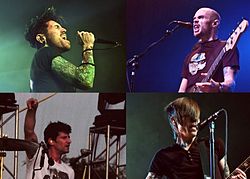
AFI (A Fire Inside)[a] is an American rock band from Ukiah, California, formed in 1991. Since 1998, it consists of lead vocalist Davey Havok, drummer and backing vocalist Adam Carson, bassist, backing vocalist and keyboardist Hunter Burgan, and guitarist, backing vocalist and keyboardist Jade Puget.[5] Havok and Carson are the sole remaining original members. Originally a hardcore punk band, they have since delved into many genres, starting with horror punk and following through post-hardcore and emo into alternative rock and gothic rock.
Key Information


AFI has released twelve studio albums, ten EPs, one live album and one DVD. The band first reached substantial commercial success with their fifth album, The Art of Drowning (2000), which peaked at number 174 on the Billboard 200.[6] They then broke into the mainstream with their sixth, Sing the Sorrow (2003), which peaked at number five on the Billboard 200 and remained on the chart for 51 weeks.[6] The album was supported by popular singles "Girl's Not Grey" and "Silver and Cold", both of which peaked at number seven on America's Hot Modern Rock Tracks chart in 2003. "The Leaving Song Pt. II" was also released as a single, reaching number 16 on the chart. Sing the Sorrow was certified Platinum by the RIAA in 2006[7] and is AFI's best-selling release, having sold over 1.26 million copies as of September 2009[update].[8]
AFI's seventh album, Decemberunderground (2006), debuted at number one on the Billboard 200[6][9] and featured the hit single "Miss Murder", which topped the Hot Modern Rock Tracks chart, reached number 24 on the Billboard Hot 100[b] and appeared in the video game Guitar Hero III: Legends of Rock. The album was certified Platinum by the RIAA in 2013.[10] Their next three albums, Crash Love (2009), Burials (2013) and AFI (2017), were also successful, peaking at increasing positions on the Billboard 200.[c] An EP, The Missing Man, followed in December 2018.[11] The band released their eleventh album, Bodies, on June 11, 2021. Their twelfth, Silver Bleeds the Black Sun..., was released on October 3, 2025.
History
[edit]Early years (1991–1994)
[edit]While still in high school in Ukiah, California, lead vocalist Davey Havok formed a band called AFI in November 1991 with Mark Stopholese and Vic Chalker.[12] At the time, the band did not know how to play any instruments. Stopholese suggested that his friend, drummer Adam Carson, join the band.[13] Stopholese learned guitar and Chalker learned bass, but Chalker was soon replaced by Geoff Kresge. By the end of October 1992, the band had played their first three shows, generally as an opener for a few other punk bands, including Influence 13, which featured future AFI guitarist Jade Puget and frequent collaborator Nick 13.[14] AFI recorded their first EP, Dork (1993), with the now defunct band Loose Change, which also featured Puget.
The band briefly broke up in 1993, when the members left Ukiah to attend different colleges. They decided to commit to AFI full-time after an extremely positive experience and enthusiastic crowd response at a reunion show they played at The Phoenix Theater over Christmas break.[15][16]
AFI relocated to Berkeley, California and lived in a squat that was a decommissioned fraternity house.[17] Between 1993 and 1995, the band independently released vinyl EPs such as Behind the Times, Eddie Picnic's All Wet and Fly in the Ointment, as well as the compilation EPs This Is Berkeley, Not West Bay, AFI/Heckle, and Bombing the Bay (with Swingin' Utters).
First three albums (1995–1998)
[edit]
AFI's first full-length album, Answer That and Stay Fashionable was released July 4, 1995, on Wingnut Records. It was co-produced by Doug Sangalang and Rancid's Tim Armstrong and Brett Reed. The album featured fast and upbeat hardcore songs, with humorous lyrical themes, which are vocalized in songs such as "Nyquil", "Cereal Wars", and "I Wanna Get a Mohawk (But Mom Won't Let Me Get One)".[18] Around this time, they coined the term 'East Bay hardcore' to describe their genre.[19]
AFI signed on to Nitro Records, a record label started by The Offspring's Dexter Holland and Greg K.[20] AFI would remain with the label until the release of the 336 EP (2002). In 1996, they released their second album, Very Proud of Ya. Two songs from their previous album, "Yurf Rendenmein" and "Two of A Kind", were re-recorded for this album. After several tours in support of the album, Kresge decided to leave the group. His spot was filled by current AFI bassist Hunter Burgan for the remaining album tour dates.
Burgan went on to help AFI record Shut Your Mouth and Open Your Eyes (1997) and was invited to become their full-time bassist.[21][d] Jade Puget, a former member of Influence 13 and Havok's close friend, also provided background vocals on the album, making it the first to feature the band's four current members. It is also the first album to be copyrighted to the band's official moniker, A Fire Inside.[a] Subsequently, A Fire Inside EP (1998) was released, straying into some death rock territory and featuring a cover of the Cure and of the Misfits. It was Stopholese's last outing with the band.[22]
Darker sound and wider reach (1999–2001)
[edit]
Puget became the band's lead guitarist for its next album, Black Sails in the Sunset (1999).[23][22] The release maintains a punk rock[24] or hardcore sound, exploring bleak themes with traces of Romanticism.[e] In 2003, The New York Times reflected on it as showcasing Havok's "develop[ment] into a singer and songwriter of substance".[25] The influence of gothic rock is also apparent and Dexter Holland provides backing vocals on two tracks.
The All Hallow's E.P. (1999) explored the horror punk genre with autumnal themes, including a cover of the Misfits song "Halloween". The song "The Boy Who Destroyed the World" was featured in the video game Tony Hawk's Pro Skater 3,[26] and the single "Totalimmortal" was later covered by The Offspring.[27]
On September 19, 2000, AFI released The Art of Drowning, which debuted on the Billboard Charts at number 174, and peaked at number 9 on the Heatseekers chart.[28] It continued to touch base with the horror punk genre, but expanded into styles that were a departure from previous works.[29] The album featured slower, more melodic songs that were more reminiscent of alternative rock, such as "Ever and a Day" and "6 to 8". Hardcore influences were present, more overtly on some tracks. The album sold over 100,000 copies.[30] "The Days of the Phoenix" was released as a single and video and had some moderate mainstream success, garnering the band more TV and radio airplay. The song reached the UK Singles Chart with its titular EP in 2001, peaking at number 152.[31] The success of The Art of Drowning helped to encourage the band to pursue higher mainstream notoriety.
Mainstream labels and popularity (2002–2007)
[edit]
In 2002, AFI left Nitro Records. DreamWorks Records artists and repertoire executive Luke Wood signed them to the label following intense interest.[32][better source needed] Their first album for the label, Sing the Sorrow, was released in 2003. The album opened in Billboard's top ten and scored enthusiastic lead reviews in major music magazines.[33] The songs "Girl's Not Grey", "The Leaving Song Pt. II", and "Silver and Cold" had some Billboard chart success and exposed the band to even larger audiences. They were nominated in the 2003 MTV Video Music Awards for the MTV2 award category for the "Girl's Not Grey" video, which came to be their first VMA.
In June 2006, AFI's seventh studio album, Decemberunderground, was released on Interscope Records. The album's first single, "Miss Murder", reached No. 1 on the Billboard Modern Rock Charts.[34] The release reflects the continually changing and growing fan base of the band, and the album debuted as No. 1 on the Billboard charts.[35] The album has been certified Gold by the RIAA for sales of over 500,000 copies of the album.[36] The album's second single, "Love Like Winter", was successful on MTV's Total Request Live and was retired after 40 days on the countdown.
On December 12, 2006, AFI released their first DVD, I Heard a Voice – Live from Long Beach Arena, featuring a live performance shot in Long Beach, California. The performance was later released on December 13, 2007, as a live album, and charted at number 133 on the Billboard 200, and number 16 on the Hard Rock Albums chart.[37] The album was well-received, with punknews.org giving it a four-star rating and commenting that when hearing or seeing the performance "you begin to realize AFI are truly a great live band," and that at some points "Pantera would say turn the noise down."[38]

On July 7, 2007, AFI performed on the American leg of Live Earth. They performed "The Missing Frame", "Love Like Winter", "Miss Murder", and a cover of David Bowie's "Ziggy Stardust".
Crash Love, Burials and The Blood Album (2008–2017)
[edit]In July 2009, Havok announced that after two years of writing and recording, a new album titled Crash Love would be released on September 29, 2009.[39] It was recorded with producer David Bottrill (who was later dismissed in favor of Joe McGrath and Jacknife Lee).[40][41] The first single from the album, "Medicate", was released on August 25, 2009, and reached number 7 on the Billboard Alternative Songs Chart. Another single, "Beautiful Thieves", followed later in the year. Havok called Crash Love "the album by which we'll be remembered".[42] It was the band's first release to make a significantly smaller impact than their previous effort,[43] but peaked at number 12 on the Billboard 200.[6]

From April to June 2013, several teaser videos were released on AFI's website.[44] The band was announced to play Riot Fest 2013, as well as being signed to Republic Records.[45] A single titled "I Hope You Suffer" was released on July 23,[46] and the title of the album, Burials, was announced.[47] Another single, "17 Crimes", was released on August 6.[48] The third single from the album, titled "The Conductor", was released on September 9. The album was released on October 22, produced by Gil Norton. It peaked at number 9 on the Billboard 200.[6]
In a June 2016 interview with Aggressive Tendencies, Puget confirmed that AFI had begun working on new material for their tenth studio album.[49] On October 27, the band released two new songs via Spotify, "Snow Cats" and "White Offerings".
The band's tenth album, AFI (also known as The Blood Album), was released on January 20, 2017. Puget served as the main producer. The album peaked at number 5 on the Billboard 200.[6] Other singles were released, including "Aurelia" and "Hidden Knives".
The Missing Man, Bodies and Silver Bleeds the Black Sun... (2018–present)
[edit]On October 26, 2018, the band surprise-released a new single called "Get Dark" on Spotify and iTunes. This was followed by The Missing Man EP on December 7, featuring five new songs.[11]
On March 25, 2020, AFI was announced as a headliner for the Two Thousand Trees Festival on July 10 of the same year. Puget was interviewed by Kerrang! to promote the festival appearance and said that "hopefully at least a couple of songs" from the band's eleventh album would be released by then.[50] On April 27, 2020, Puget said that the album was finished, but that its release date was being pushed back as a result of the COVID-19 pandemic.[51] The next day, it was announced that the Two Thousand Trees Festival was being pushed back to 2021, also due to the pandemic.[52]
On January 15, 2021, the band released the tracks "Twisted Tongues" and "Escape from Los Angeles".[53] On February 25, it was revealed that the album would be called Bodies, and be released on June 11. Along with the announcement, the band revealed two new songs as another joint single, "Looking Tragic / Begging for Trouble".[54] On April 9, "Dulceria / Far Too Near" were released,[55] followed by "Tied to a Tree" on May 25.[56]
On March 11, 2023, AFI played Sing the Sorrow in full for the first and last time at the Kia Forum on the album's 20th anniversary, supported by Jawbreaker, Chelsea Wolfe and Choir Boy.[57] Following a tour supporting Green Day in March 2025, the band announced their twelfth studio album Silver Bleeds the Black Sun..., which was released in October 2025 via Run for Cover Records – marking their first release with the label.[58]
Musical style
[edit]AFI's music has been classified under many genres of music, including punk rock,[59][60][61][62][63] hardcore punk,[59][25][60][64] emo,[65][66][67][68] gothic rock,[69][60][61][70] horror punk,[71][72][73] post-hardcore,[74][75] skate punk,[76] alternative rock,[77][78] screamo,[79] garage punk,[69] and pop-punk.[80]
AFI's sound has constantly changed.[81] AFI originally were a hardcore punk band.[82][83] AFI's first three albums, Answer That and Stay Fashionable (1995),[84] Very Proud of Ya (1996),[82] and Shut Your Mouth and Open Your Eyes (1997),[85] all have been described as hardcore punk. AFI's fourth album Black Sails in the Sunset and the band's fifth album The Art of Drowning both have been described as horror punk.[81] AFI's 2003 album Sing the Sorrow is considered post-hardcore[86] and emo.[87][86] Decemberunderground, which features elements of music genres like electronic, new wave, industrial, punk rock, hardcore punk, and synthpop,[88][89][90] is considered alternative rock,[91] post-hardcore[81] and emo.[92] AFI's 2009 album Crash Love is considered alternative rock[73] and pop rock.[81] AFI's 2013 album Burials is considered alternative rock[93] and gothic rock.[81] AFI's 2017 self-titled album, also referred to as The Blood Album, has been described as new wave, post-punk and gothic rock.[94][95] In 2021 AFI released their 11th album Bodies, which has been described as continuing their gothic rock sound and taking a greater influence from new wave.[96][97]
Louder wrote, "Long before My Chemical Romance topped the charts with the anthemic ‘'Welcome to the Black Parade'’, California's AFI were already injecting their brand of punk with gothic imagery and a sense of theatricality. By the time Gerard Way’s band arrived, AFI had already built a devoted fan base incorporating punks, hardcore fans, goths, metallers and every other type of musical pariah imaginable. They were a band that couldn't help but stand out everywhere they went."[59] AllMusic described AFI as "Northern California hardcore punk revivalists" whose style "evolved to include alternative rock, post-punk, emo, and new wave flair".[60] The Chicago Tribune said that the band "morphed from a conventional garage-punk band into a gothic-rock arena act."[69] Loudwire said that the band "developed from more of a SoCal punk style into a somewhat gothic post-hardcore band".[98] The Encyclopedia of Popular Music said that "Although often described as a cross between goth rock and hardcore punk, by the time of their commercial breakthrough in 2003, [AFI] started out as a straight ahead skate/punk band."[99] PopMatters wrote, "To call California-based hardcore/screamo quartet A.F.I. a band without a flag in the current modern rock landscape is not an unfair assessment of their situation."[100] Rolling Stone categorized the band as pop-punk.[101] AFI has often been labeled as "gothic punk" due to the band's appearance, but AFI band members never considered the label accurate. Jade Puget has said, "Goth-punk isn't a style of music, it doesn't even exist."[102]
Puget, who has produced much of the band's music, stated in 2021:
Anyone who knows our catalog knows that no two records really sit together. Some sit a little closer, maybe. We do certain things, just by virtue of who we are, that are consistent, but those things come about organically. Every time we do something, I have to judge it on its own merits. Some fans are going to judge a new album, or a new song, based on what's come before. But as artists, we can't do that, because it would only hinder our creativity.[53]
Influences
[edit]AFI have drawn inspiration from a diverse range of artists. "We have many, many influences that span the musical spectrum", Havok told the Boston Globe. "Each of us grew up on everything from punk to hardcore to dark '80s UK stuff like the Cure, Bauhaus, Joy Division, and [the] Sisters of Mercy. And there were rock bands like Guns N' Roses and Metallica and industrial bands like Skinny Puppy, Ministry, Front 242 and Alien Sex Fiend. And we all love the Smiths."[103] Other groups that have inspired AFI include Echo & the Bunnymen (particularly Heaven Up Here), Malcolm McLaren (particularly Swamp Thing), Red Lorry Yellow Lorry, John McLear Kim, the Creatures,[104] Bad Religion,[105] the Teen Idles, Dag Nasty, Government Issue, Negative Approach, Earth Crisis, Snapcase, Refused, Sick of it All, the Cro-Mags, Minor Threat, Black Flag, the Misfits, the Germs, and State of Alert.[106][107] AFI have also been influenced by electronic band OMD, whom Havok said "have and will continue to musically and emotionally inspire" him.[108][109]
Legacy
[edit]According to the Sydney Morning Herald, AFI have been "hailed as being responsible for bringing back the big '80s rock chorus."[110] The band has received much praise in particular from Alternative Press, which has supported the group since the mid-1990s. The publication rated the band's major-label debut, Sing the Sorrow, as the most anticipated album of 2003, and noted that it "blew the doors off goth-punk as we knew it".[111] AFI has also been granted responsibility for paving the way for the rise of the visual element of rock bands in the 2000s; in a December 2006 article, Revolver wrote that "AFI have increased the importance of a band's visual identity and the flair for the theatrical," adding that "when a group like Panic! at the Disco borrows imagery from a movie such as Moulin Rouge!, you have to consider the precedent AFI set when they borrowed cues from Tim Burton's The Nightmare Before Christmas."[112] Shoutmouth.com placed AFI at number 22 on its list of the 25 most influential punk bands, noting that the band "have evolved with each album, showing that a punk band can not only change, but stay true to their sound at the same time. AFI have been on a constant rise through their career, and as such, eeked [sic] out the honors".[113] After Sing the Sorrow's release, Yorkshire Evening Post described Havok's voice as one of those "you'll love or hate, but one thing can't be denied, this guy has range beyond belief".[114] Recognized by his trademark flair and vocal style, Havok has been recognized as "a bona fide rock god" by Alternative Press.[111]
In 2003, The Pitch described the band's fan club as a "particularly excitable bunch", adding that "there's also the type of sentiments that put the cult back into cult success, such as links to something called 'the Church of Havok'."[33]
Band members
[edit]|
Current
|
Former
|
Timeline

Discography
[edit]- Studio albums
- Answer That and Stay Fashionable (1995)
- Very Proud of Ya (1996)
- Shut Your Mouth and Open Your Eyes (1997)
- Black Sails in the Sunset (1999)
- The Art of Drowning (2000)
- Sing the Sorrow (2003)
- Decemberunderground (2006)
- Crash Love (2009)
- Burials (2013)
- AFI (2017)
- Bodies (2021)
- Silver Bleeds the Black Sun... (2025)
References
[edit]Footnotes
- ^ a b c "A Fire Inside" is first attested on the 1997 album Shut Your Mouth and Open Your Eyes.[1] Previously, monikers such as "Abuncha Fuckin' Idiots" and "Anthems for Insubordinates" were used,[2][3] with "Asking for It" being listed for fan mail.[1][4]
- ^ Another single, "Love Like Winter", reached number four on the Modern Rock Tracks chart.
- ^ Crash Love peaked at number twelve, Burials at number nine, and AFI at number five.[6]
- ^ Snapcase member Frank Vicario had been asked to join the band on bass, and was even featured in a photo shoot, but Burgan's performance on the album convinced the rest of the band that he should join permanently.[21]
- ^ A poem by Charles Baudelaire is whispered on the hidden track, "Midnight Sun".
Citations
- ^ a b Shut Your Mouth and Open Your Eyes liner notes.
- ^ Orion, Damon (January 27, 2010). "Very Proud of Ya". Good Times Santa Cruz. Retrieved April 13, 2021.
- ^ Dedman, Remfry (January 20, 2017). "AFI Interview with Davey Havok and Hunter Burgan: 'We felt the symbolism of blood tied in perfectly with the record'". The Independent. Archived from the original on November 12, 2020. Retrieved April 11, 2021.
- ^ Very Proud of Ya liner notes.
- ^ Ambrose, Anthony. "AFI / Gallows @ Sayreville 10/10 @ NYC 10/1". Intunewmusiconline.com. Archived from the original on July 31, 2012. Retrieved October 14, 2009.
- ^ a b c d e f g "AFI Chart History (Billboard 200)". Billboard. Retrieved April 14, 2018.
- ^ "Gold & Platinum – RIAA". RIAA. Retrieved June 10, 2016.
- ^ Mikael Wood ( September 14, 2009). AFI Revs Up The Rock On 'Crash Course'. Billboard.
- ^ "AFI Burns Brightly With No. 1 Debut". Billboard. Retrieved June 10, 2016.
- ^ "Gold & Platinum – RIAA". RIAA. Retrieved June 10, 2016.
- ^ a b "AFI secretly dropped a new song overnight called 'Get Dark' from a forthcoming EP called The Missing Man". Wall of Sound. October 26, 2018. Retrieved October 26, 2018.
- ^ "AFINewsHQ Exclusive Interview with AFI's Original Bassist". Archived from the original on March 7, 2014. Retrieved June 25, 2024.
- ^ An Extended Interview With AFI's Davey Havok. Rolling Stone. Austin Scaggs. Jun 01, 2006
- ^ "AFI: Adam's Playlist". Instagram. November 4, 2021. Archived from the original on December 26, 2021. Retrieved November 18, 2021.
- ^ "AFI interview (1999)". YouTube. Archived from the original on April 4, 2007. Retrieved July 4, 2011.
- ^ "THE TRAP SET". Thetrapset.net. Retrieved June 14, 2021.
- ^ Pettigrew, Jason (October 25, 2019). "AFI revisit 'All Hallows' EP as picture disc is reissued in time for Halloween". Altpress.com. Retrieved June 14, 2021.
- ^ "AFI – Answer That And Stay Fashionable (album review)". Sputnikmusic. January 14, 2005. Retrieved July 4, 2011.
- ^ Andrew Miller (November 23, 2000). "Asking For It Archived 2014-03-07 at the Wayback Machine". The Pitch.
- ^ "AFI: Davey Havok & Mark Stopholese WHAT'S THE STORY? Interview March 19, 1997 San Francisco, CA, USA". www.youtube.com. April 7, 2022. Retrieved June 25, 2024.
- ^ a b "Backspin: AFI on 'Shut Your Mouth and Open Your Eyes'". Yahoo!. February 17, 2017. Archived from the original on November 13, 2021. Retrieved December 18, 2020 – via YouTube.
- ^ a b "AFI's (guitarist) Jade Puget". Archived from the original on May 7, 2002. Retrieved July 8, 2024.
- ^ "AFI | Official site". Afireinside.net. Archived from the original on September 27, 2011. Retrieved October 9, 2011.
- ^ Strauss, Neil. AFI: Decemberunderground : Album Reviews. Rolling Stone. Jun 6, 2006
- ^ a b Strauss, Neil. "For a Hardcore Bunch, a Breakout". The New York Times. March 16, 2003.
- ^ "Tony Hawk's Pro Skater 3 – Credits". Allgame.com. Archived from the original on November 15, 2014. Retrieved June 14, 2021.
- ^ "Offspring * Total Immortal Lyrics, from Me Myself & Irene". Archived from the original on September 28, 2008. Retrieved October 12, 2018.
- ^ "Billboard.com – Artist Chart History – AFI". Billboard. Archived from the original on March 10, 2007. Retrieved August 17, 2006.
- ^ "AFI – The Art of Drowning (album review)". Sputnikmusic. August 2, 2006. Retrieved July 4, 2011.
- ^ "AFI – Sing The Sorrow". Punknews.org. March 14, 2003. Retrieved July 4, 2011.
- ^ "The Art of Drowning Video". Ovguide.com. Archived from the original on November 19, 2011. Retrieved July 4, 2011.
- ^ "Interview with Luke Wood". HitQuarters. March 4, 2002. Retrieved October 5, 2011.
- ^ a b Michael Tedder (June 19, 2003). "Inside Out Archived 2013-11-03 at the Wayback Machine". The Pitch.
- ^ "Billboard.com – Artist Chart History – AFI". Billboard. Archived from the original on March 10, 2007. Retrieved August 22, 2006.
- ^ "AFI burns brightly with No. 1 debut". Billboard. June 14, 2006. Archived from the original on July 11, 2006. Retrieved July 8, 2006.
- ^ "RIAA Certifications for Decemberuderground". Recording Industry Association of America. Archived from the original on September 24, 2015. Retrieved October 8, 2007.
- ^ "Billboard Chart History". Billboard. Retrieved May 6, 2016.
- ^ "AFI – I Heard a Voice DVD". Punknews.org. March 23, 2007. Retrieved March 29, 2012.
- ^ "New AFI record due Sept 29th". Sputnikmusic. Retrieved July 8, 2009.
- ^ "Quick Hits: Sheryl Crow, My Chemical Romance, AFI". FMQB. Archived from the original on January 31, 2008. Retrieved January 30, 2008.
- ^ "News about the album! – The Complete AFI Series Message Board". Board.afispace.com. Archived from the original on July 7, 2011. Retrieved July 4, 2011.
- ^ "Biography". afireinside.net. AFI. Archived from the original on February 24, 2012. Retrieved September 30, 2009.
- ^ "Backspin: AFI on 'Crash Love'". Yahoo!. February 17, 2017. Archived from the original on November 13, 2021. Retrieved December 18, 2020 – via YouTube.
- ^ Whitt, Cassie (April 17, 2013). "AFI launch cryptic video on website". Alternative Press. Retrieved April 18, 2013.
- ^ "AFI sign to Republic Records; plan fall 2013 album release – News – Alternative Press". Altpress.com. June 27, 2013. Archived from the original on June 3, 2016. Retrieved May 6, 2016.
- ^ "'I Hope You Suffer' Now Available On iTunes". AFI News Headquarters. Archived from the original on December 15, 2013. Retrieved December 21, 2014.
- ^ "AFI's Davey Havok Talks Maximalist New Album". Rolling Stone. Retrieved December 21, 2014.
- ^ "Amazon.com: 17 Crimes: AFI: MP3 Downloads". amazon.com.
- ^ Ralph, Caitlyn (July 1, 2016). "AFI confirm new album is coming". Alternative Press. Retrieved July 3, 2016.
- ^ "'It's an eclectic record – a little bit left of center.' – Jade on New Album". afireinside.net. March 28, 2020. Retrieved April 2, 2020.
- ^ Video on YouTube
- ^ "2000 Trees Festival postponed until 2021". afireinside.net. April 28, 2020. Retrieved April 28, 2020.
- ^ a b Johnson, Laura (January 15, 2021). "AFI Unveil Two New Tracks Twisted Tongues And Escape From Los Angeles". Stereoboard. Retrieved January 15, 2021.
- ^ Lewry, Fraser (February 26, 2021). "AFI detail upcoming album Bodies, launch two new songs". loudersound. Retrieved February 26, 2021.
- ^ Richards, Will (April 10, 2021). "AFI share two new songs, including one co-written by Billy Corgan". NME. Retrieved April 11, 2021.
- ^ Carter, Emily (May 25, 2021). "AFI show their evolution on striking new single, Tied To A Tree". Kerrang!. Retrieved May 27, 2021.
- ^ "AFI roars through 20th anniversary 'Sing the Sorrow' show at Kia Forum". Daily Breeze. March 12, 2023. Retrieved January 10, 2024.
- ^ "Silver Bleeds the Black Sun..." Bandcamp. Retrieved August 5, 2025.
- ^ a b c Barnard, Laurent (September 10, 2015). "This Is Hardcore: AFI – The Art Of Drowning". LouderSound. Retrieved July 3, 2022.
- ^ a b c d Steve Huey. "AFI – Biography – AllMusic". AllMusic. Retrieved December 21, 2014.
- ^ a b Hlavaty, Craig (November 23, 2009). "Aftermath: AFI, Looking Slightly Dated but Still Bringing the Goth-Rock at Verizon". Houston Press.
- ^ "AFI sign to Republic Records". Archived from the original on March 20, 2014. Retrieved December 21, 2014.
- ^ "TV Notes: 'Gilmore Girls' creator bids farewell with season finale". Pittsburgh Post-Gazette. Retrieved December 21, 2014.
- ^ Saard. "AFI UK Tour Dates & Ticket Details Announced". Stereoboard.com. Retrieved December 21, 2014.
- ^ "A.F.I.". Cincinnati Magazine: 232. October 2009. ISSN 0746-8210.
- ^ "VANS WARPED TOUR". SPIN. 22 (7): 97. July 2006. ISSN 0886-3032.
- ^ Bruce Britt (October 15, 2006). "AFI". Bmi.com.
- ^ Parker, Nick (July 19, 2006). "AFI Brings Emo Punk to Salt Lake City". The Globe. Salt Lake Community College. Archived from the original on April 27, 2009.
- ^ a b c Greg Kot (June 18, 2006). "AFI's vampire fetish makes it hard to take band seriously". Chicago Tribune.
- ^ Gentile, John (October 15, 2013). "AFI Confront Their Chaos in 'No Resurrection' – Song Premiere". Rolling Stone.
- ^ Aberback, Brian (October 21, 2015). "Horror punk pioneers the Misfits to perform at Starland Ballroom". NorthJersey.com.
The Misfits' influence spreads far and wide, from latter-day horror-punk bands like AFI, the Alkaline Trio and Japan's Balzac to heavy metal icons Metallica.
- ^ Clement, Kaitlyn (October 29, 2013). "AFI New Album 'Burials' Released". B-sides.tv. Archived from the original on July 2, 2017. Retrieved November 25, 2015.
- ^ a b Andrews, Jonathan. "Album: AFI – Crash Love". Dead Press!. Archived from the original on April 13, 2018. Retrieved April 12, 2018.
- ^ "AFI Coming Out With New Album In September 2013". CBS. April 17, 2013. Retrieved July 6, 2013.[permanent dead link]
- ^ "No. 23: AFI, 'Girl's Not Grey' – Top 21st Century Hard Rock Songs". Loudwire. June 28, 2012. Retrieved December 21, 2014.
- ^ Colin Larkin (May 27, 2011). The Encyclopedia of Popular Music. Omnibus Press.
Although often described as a cross between goth rock and hardcore punk, by the time of their commercial breakthrough in 2003, the Ukiah, California, USA-based quartet AFI (an acronym for A Fire Inside) started out as a straight ahead skate/ punk band.
- ^ "Live Review: AFI [Rock City, Nottingham] April 5, 2010". April 6, 2010. Retrieved December 21, 2014.
- ^ "Events". seattlepi.com. Archived from the original on October 22, 2014. Retrieved December 21, 2014.
- ^ Stephen Haag (April 17, 2003). "A.F.I.: Sing the Sorrow". PopMatters.
- ^ Gentile, John (October 22, 2013). "Q&A: AFI's Davey Havok on His Emotions and Hair Disasters". Rolling Stone.
- ^ a b c d e Yancey, Bryne (October 22, 2013). "AFI – Burials". Punknews.org. Retrieved April 12, 2018.
- ^ a b Moran, Chris (October 22, 2001). "AFI – Very Proud of Ya". Punknews.org. Retrieved April 12, 2018.
- ^ Landau, Ericka K. (November 17, 2009). "Q&A with Davey Havok from AFI, Playing Revolution Wednesday". Miami New Times. Retrieved April 12, 2018.
- ^ Heller, Jason (June 22, 2010). "AFI Answer That And Stay Fashionable". Alternative Press. Retrieved April 13, 2018.
- ^ Gross, Joe (April 2003). "Nü Day Rising". Spin. Vol. 19, no. 4. p. 102. ISSN 0886-3032.
- ^ a b Gilbert, Matthew (February 10, 2017). "'The Blood Album' by AFI, a cross-section of 25 years making music". The Daily Campus. Retrieved April 12, 2018.[permanent dead link]
- ^ Kappes, John (May 23, 2004). "Emo bands drawing young audience". The Spokesman-Review. Retrieved April 12, 2018.
- ^ Thompson, Ed (June 5, 2006). "AFI – Decemberunderground". IGN. Archived from the original on February 25, 2012. Retrieved July 19, 2017.
- ^ Apar, Corey. "Decemberunderground – AFI". AllMusic. Retrieved April 12, 2018.
- ^ "AFI: Decemberunderground". NME. May 26, 2006. Retrieved April 12, 2018.
- ^ McFarland, Kevin (April 15, 2014). "With Decemberunderground, AFI rode tacit approval all the way to the top". The A.V. Club. Retrieved April 12, 2018.
- ^ Jones, Jamie (September 18, 2015). "Can You Name The Classic Emo Album By The Cover Art?". BuzzFeed. Retrieved April 12, 2018.
- ^ Powell, Mike (October 22, 2013). "AFI: Burials". Rolling Stone. Retrieved April 12, 2018.
- ^ Hall, Carley (January 12, 2017). "AFI – AFI (The Blood Album)". The Music. Retrieved April 13, 2018.
- ^ Yeung, Neil Z. "AFI (The Blood Album) – AFI". AllMusic. Retrieved April 12, 2018.
- ^ "AFI's 'Bodies' Is Mostly Lifeless | Exclaim!". AFI's 'Bodies' Is Mostly Lifeless | Exclaim!. Retrieved July 8, 2024.
- ^ "Album review: AFI – Bodies". Kerrang!. June 11, 2021. Retrieved July 8, 2024.
- ^ "No. 23: AFI, 'Girl's Not Grey' – Top 21st Century Hard Rock Songs". Loudwire. June 28, 2012. Retrieved December 21, 2014.
- ^ Colin Larkin (May 27, 2011). The Encyclopedia of Popular Music. Omnibus Press.
Although often described as a cross between goth rock and hardcore punk, by the time of their commercial breakthrough in 2003, the Ukiah, California, USA-based quartet AFI (an acronym for A Fire Inside) started out as a straight ahead skate/ punk band.
- ^ Stephen Haag (April 17, 2003). "A.F.I.: Sing the Sorrow". PopMatters.
- ^ Gentile, John (October 22, 2013). "Q&A: AFI's Davey Havok on His Emotions and Hair Disasters". Rolling Stone.
- ^ Alex Burrows. Rolling Stone, March 2003
- ^ "A.F.I.'s Long Answered Influences". Rockdirt.com. July 23, 2003. Archived from the original on January 13, 2016. Retrieved December 17, 2024.
- ^ Zanes, Anna. "AFI's new album Silver Bleeds the Black Sun… explores life in a dystopian world". Alternative Press. Event occurs at 9m. Retrieved September 11, 2025.
To be clear, the first conversation in the meeting were Porngraphy, Heaven Up Here, Swamp Thing, I think Red Lorry was addressed, yes John McLear Kim, yes Creatures... as we began it almost immediately turned to something more tense, something slightly more aggressive. .
- ^ Davey Havok (September 18, 2025). Davey Havok Part 1: 1991 - 2003 (A HardLore Special). Knotfest. Event occurs at 1h10m. Retrieved September 19, 2025.
Bad Religion... That's another band that we probably could have pulled out [to cover on the self-titled EP or during early sets]... We listened to How Can Hell Be Any Worse over and over again, what a fucking record and then of course Suffer had just come out not long before we formed
- ^ Childers, Chad (November 21, 2014). "XTRMST's Davey Havok Talks Straight Edge Inspiration, Future Plans + More". Loudwire. Retrieved December 8, 2024.
- ^ "Believe it or not: a punk band from California". The Gateway. September 24, 1998. p. 16. Retrieved April 21, 2023.
- ^ Rosen, Steven (September 28, 2009). "AFI: 'We Wanted to Do Rock but Keep It Interesting'". Ultimate Guitar. Retrieved March 6, 2021.
- ^ Houghton, Richard (2019). OMD: Pretending to See the Future (expanded paperback ed.). This Day in Music Books. p. 455. ISBN 978-1-9161156-2-0.
- ^ "Wreaking Havok". Smh.com.au. August 8, 2003. Retrieved May 6, 2016.
- ^ a b "Alternative Press | Features | The List on AP: 9 classic albums Jerry Finn left his mark with". Altpress.com. October 20, 2008. Retrieved March 29, 2012.
- ^ Revolver Magazine (December 2006). Davey Havok has Agreed to Receive the Drag Queen (December 2006 ed.). p. 69. Archived from the original on July 12, 2012.
- ^ "The 25 Most Influential Punk Bands | News @". Ultimate-guitar.com. July 31, 2007. Retrieved March 29, 2012.
- ^ Jim Seton (March 15, 2003). "Full speed ahead". Yorkshire Evening Post.
Further reading
[edit]- AFI by Andi Coulter. J-Card Press. IBSN 979-8-9891947-4-2
External links
[edit]

- Official website
- AFI discography at Discogs

| International | |
|---|---|
| National | |
| Artists | |
AFI (band)
View on GrokipediaHistory
Formation and early years (1991–1998)
AFI was formed in 1991 in Ukiah, California, by high school students Davey Havok (bass and vocals) and Adam Carson (drums). The duo recruited guitarist Mark Stopholese and bassist Vic Chalker to complete the initial lineup. Havok later focused solely on vocals following subsequent member changes.[4] Original bassist Vic Chalker left in 1992 and was replaced by Geoff Kresge, who contributed to early releases until 1997, when Hunter Burgan took over permanently. This lineup churn reflects the DIY ethos but led to the stable configuration by 1998. The group drew heavily from the DIY punk influences of the Northern California scene, including bands like the Germs and Angry Samoans, which shaped their initial sound and ethos of self-reliance.[5] In 1993, at the age of 15, Hunter Burgan joined AFI as bassist, solidifying the early lineup alongside Carson, Stopholese, and Havok.[6] That same year, the band self-released their debut demo, Behind the Times, on Key Lime Pie Records, capturing their raw, energetic punk style through tracks recorded on a limited budget.[7] This release helped establish their presence in the local underground circuit, where they began playing frequent shows at small venues and house parties. AFI's first full-length album, Answer That and Stay Fashionable, arrived in 1995 via the independent Wingnut Records, showcasing their youthful, fast-paced hardcore punk roots with themes of rebellion and personal frustration.[8] The band supported the record with extensive West Coast tours, often sharing bills with other regional punk acts and relying on zines for promotion to cultivate a dedicated grassroots following.[9] By 1996, AFI signed with Nitro Records and released their second album, Very Proud of Ya, which refined their sound while introducing more aggressive hardcore elements and lyrics addressing social issues and personal introspection.[10] The following year, Shut Your Mouth and Open Your Eyes further emphasized this evolution, incorporating political commentary on topics like animal rights and societal conformity amid intensified touring that strengthened their reputation in the punk community.[11] Throughout these formative years, the lineup maintained stability after 1993, enabling consistent output and a growing network of fans across small clubs and DIY spaces.[12]Artistic evolution and breakthrough (1999–2003)
During this period, AFI transitioned from their hardcore punk roots to a darker, more atmospheric sound incorporating gothic and horror punk elements, marking a significant artistic maturation. The band's fourth studio album, Black Sails in the Sunset, released on May 18, 1999, through Nitro Records, featured Jade Puget as the permanent guitarist and introduced themes of mortality and the supernatural, blending punk energy with eerie, horror-inspired lyrics and melodies. After the release of the *A Fire Inside* EP in 1998, original guitarist Mark Stopholese departed the band. Jade Puget joined as guitarist and contributed to Black Sails in the Sunset (1999), solidifying the current lineup configuration.[13][14][15][16] Later that year, AFI issued the All Hallow's E.P. on October 5, 1999, also via Nitro Records, which further explored Halloween-themed motifs and prefigured the band's deepening fascination with death and the occult through tracks like "Halloween" and "The Boy Who Destroyed the World." This EP served as a bridge to their fifth album, The Art of Drowning, released on September 19, 2000, on Nitro Records, where existential dread and themes of loss permeated songs such as "The Days of the Phoenix" and "Ever and a Day," the latter becoming a key single that showcased their evolving melodic post-hardcore style. The album debuted at No. 174 on the Billboard 200 and reached No. 9 on the Heatseekers chart, signaling initial national traction.[17][18][19][20] In 2001, AFI signed with DreamWorks Records, paving the way for broader exposure. Their major-label debut, Sing the Sorrow, produced by Butch Vig and Jerry Finn and released on March 11, 2003, amplified these gothic influences with orchestral elements and introspective lyrics, yielding hits like "Girl's Not Grey" and "Silver and Cold." The album's artwork, featuring illustrations of animals and surreal imagery, drew from 19th-century literary aesthetics, evoking themes of sorrow and transformation reminiscent of Romantic-era works. It debuted at No. 8 on the Billboard 200, selling nearly 100,000 copies in its first week, and later earned the band's first RIAA Platinum certification in 2006.[21][22][23] Key events underscored this breakthrough, including major tours such as the 2001 Vans Warped Tour alongside acts like Alkaline Trio, which expanded their live audience, and increased visibility through MTV, where the "Girl's Not Grey" video won Best New Artist in a Video at the 2003 MTV Video Music Awards. These developments cultivated a growing fanbase, positioning AFI for mainstream success.[24][23]Commercial success and mainstream era (2004–2007)
Following the success of their previous album, AFI released Decemberunderground on June 6, 2006, through Interscope Records. The album debuted at number one on the Billboard 200 chart, selling 182,000 copies in its first week, marking the band's first chart-topping release.[25] It was certified gold by the RIAA on August 30, 2006, and later achieved platinum status in 2013, indicating sales exceeding one million units in the United States.[26] The album's lead single, "Miss Murder," released on April 3, 2006, peaked at number one on the Billboard Alternative Songs chart (formerly Modern Rock Tracks) and reached number 24 on the Hot 100. It earned a nomination for Best Direction in a Video at the 2006 MTV Video Music Awards.[27] The follow-up single, "Love Like Winter," also received significant radio play and contributed to the album's mainstream appeal. AFI promoted Decemberunderground through high-profile media, including a performance of "Miss Murder" at the 2006 MTV Movie Awards.[28] AFI's touring schedule intensified, with the band joining select dates on the 2006 Vans Warped Tour as a main act alongside groups like NOFX and Against Me!.[29] They also co-headlined arena shows, such as the 91X Nightmare Before Xmas concert on December 10, 2006, at San Diego Sports Arena with My Chemical Romance and Taking Back Sunday.[30] International expansion included a performance at Japan's Summer Sonic Festival on August 12, 2006, and subsequent European dates in early 2007.[31] The era saw growth in AFI's fanbase, bolstered by the official fan club, The Despair Faction, established in 2002 but surging in membership during this period through online forums and exclusive content.[32] In 2006, the band released a Japan-exclusive edition of Decemberunderground with bonus tracks, further engaging global audiences. By 2007, reports of band exhaustion surfaced amid relentless touring, leading to brief downtime before their next project.Post-peak experimentation (2008–2017)
Following the commercial momentum of their mainstream era, AFI ventured into new sonic territory with their eighth studio album, Crash Love, released on September 29, 2009, via DGC/Interscope Records. Produced by Joe McGrath and Jacknife Lee, the record emphasized a more straightforward alternative rock approach, dialing back the synth-heavy production of prior works in favor of arena-ready guitars and melodic hooks, while retaining subtle electronic flourishes and art-rock experimentation. The album debuted at No. 12 on the Billboard 200, selling 52,000 copies in its first week, and featured singles "Medicate," which peaked at No. 21 on the Alternative Airplay chart, and "Beautiful Thieves."[33][34] In the years after Crash Love, AFI parted ways with Interscope and signed with Republic Records in June 2013, signaling a fresh start amid creative reinvention. Their ninth album, Burials, arrived on October 22, 2013, produced by Gil Norton at EastWest Studios in Los Angeles, and embraced a darker, more atmospheric sound with prominent synth layers, gothic undertones, and brooding intensity that contrasted the brighter tones of their previous release. The artwork, featuring stark black-and-white imagery, was directed by the band in collaboration with Morning Breath Inc. Burials debuted at No. 9 on the Billboard 200, with 26,000 first-week sales, and the band supported it with a fall North American headlining tour alongside acts like Glassjaw on select dates. Singles included "17 Crimes" and "I Hope You Suffer," the latter addressing themes of emotional turmoil.[35][36][37] AFI continued their exploratory phase with their self-titled tenth studio album, commonly known as The Blood Album, released on January 20, 2017, through Republic Records. Produced primarily by guitarist Jade Puget with co-production from Matt Hyde, the record marked a partial return to the band's hardcore punk roots, blending aggressive riffs and faster tempos with post-punk edges and politically charged lyrics inspired by contemporary social issues, as articulated by vocalist Davey Havok. It debuted at No. 5 on the Billboard 200, moving 29,000 units in its opening week, and included singles "Get Hurt" and "Aurelia," the latter evoking ethereal introspection amid the album's raw energy.[38][39][40] Throughout this period, AFI marked milestones like their 20th anniversary as a band in 2011 with special performances drawing from their early catalog during various U.S. tours, while Havok integrated his long-standing vegan advocacy into promotional events and merchandise tie-ins to promote animal rights. The band also temporarily paused their electronic side project Blaqk Audio—whose 2012 album Bright Black Heaven preceded Burials—to prioritize AFI's output, resuming with Materia in 2016 after The Blood Album's completion. These years highlighted AFI's willingness to evolve beyond mainstream expectations, balancing commercial releases with artistic risks.[41]Contemporary phase (2018–present)
In 2018, AFI released the five-track EP The Missing Man on December 7 through Rise Records, marking a return to shorter-form releases with experimental and thrash-punk elements, including the opener "Trash Bat."[42][43] The EP was produced and mixed by guitarist Jade Puget and showcased the band's willingness to explore bold sonic directions beyond their traditional structures.[44] The band's touring plans were significantly disrupted by the COVID-19 pandemic in 2020, leading to cancellations and delays in live performances. This impacted the rollout of their next full-length album, Bodies, which was ultimately released on June 11, 2021, and described as a synth-punk effort drawing on post-punk and electronic influences.[45] The album featured singles like "Twisted Tongues," released in January 2021, and peaked at No. 36 on the US Independent Albums (Billboard) chart and No. 33 on the Top Album Sales chart. To mark their 30th anniversary since formation in 1991, AFI incorporated celebratory elements into the Bodies era, including themed merchandise and fan-focused promotions. In 2025, AFI issued their twelfth studio album, Silver Bleeds the Black Sun..., on October 3 via Run For Cover Records, leaning into post-punk and gothic textures across ten tracks.[46][47] The lead single, "Behind the Clock," arrived on August 5 with an accompanying video, followed by "Holy Visions" in September.[48][49] Vocalist Davey Havok described the record as his personal favorite in the band's discography, praising its immersive mood and production by Puget.[48] The album debuted at No. 110 on the Billboard 200 (as of the week ending October 18, 2025). AFI announced a 24-date North American headline tour in June 2025, supported by TR/ST, running from late September through December and marking their first major U.S. run since 2021.[50] Earlier that year, the band played headlining shows in Australia in March, their first standalone performances there in eight years.[51] Under stable stewardship at Run For Cover Records, AFI has maintained active fan engagement through social media updates on releases and tour announcements. The band continues to publicly endorse veganism and animal rights causes, aligning with long-standing personal commitments from members like Havok.Artistry
Musical style and genre shifts
AFI's musical style originated in the raw, aggressive vein of hardcore punk during the 1990s, characterized by fast tempos typically ranging from 140 to 180 beats per minute, blistering guitar riffs, and Davey Havok's intense, shouted vocals that conveyed urgency and rebellion.[52] Early releases emphasized short, explosive tracks with minimal production, drawing from the skate punk and powerviolence scenes of Northern California, where the band's high-energy performances and DIY ethos defined their sound.[53] This foundation showcased a relentless pace and unpolished edge, as heard in albums like Answer That and Stay Fashionable (1995) and Very Proud of Ya (1996), which prioritized speed and visceral impact over melody.[2] By their fourth album, Black Sails in the Sunset (1999), AFI began incorporating horror punk and gothic elements, blending the ferocity of hardcore with atmospheric keyboards, brooding melodies, and horror-themed aesthetics that evoked a darker, more theatrical tone. Critics classified it as melodic hardcore with horror punk influences, marking a shift toward post-hardcore experimentation while retaining punk's raw energy.[54] This evolution introduced slower builds and eerie synth layers, expanding the band's palette beyond pure aggression. The 2003 breakthrough Sing the Sorrow, produced by Butch Vig and Jerry Finn, further refined this into post-hardcore and alternative rock, featuring polished mixes, soaring melodic choruses, and subtle synth integrations that balanced Havok's screams with accessible hooks. AllMusic described it as a pivotal alternative/indie rock record with punk revival elements, highlighting its "gothic tendencies wrapped in aggressive hardcore."[55] Similarly, Decemberunderground (2006) amplified these traits, leaning into emo and goth rock with layered production and anthemic structures, as noted by critics for its "ever-evolving goth-punk" sound.[56] In the late 2000s and 2010s, AFI pursued more experimental directions, incorporating electronic textures and ambient production on Crash Love (2009), which critics viewed as a straight alternative rock pivot with genre-mixing flair.[57] Burials (2013) deepened this with industrial and electronic influences alongside goth rock, creating a diverse sonic landscape that blended pop accessibility with darker undertones.[58] The self-titled The Blood Album (2017) signaled a partial return to hardcore roots, reviving faster tempos and punk aggression within a pop/rock framework, earning praise for recapturing the band's early intensity.[59] Most recently, Silver Bleeds the Black Sun... (2025) embraces post-punk revival, featuring angular guitar lines, heavy reverb, and a cohesive gothic rock atmosphere that AllMusic and Louder hailed as the band's most confident evolution yet, channeling late-1970s death rock influences.[60][61] Throughout these shifts, AFI's production hallmarks—such as Vig's clean, dynamic mixes in the mid-2000s—have underscored their adaptability, allowing conceptual depth without abandoning punk's core drive.[62]Influences and lyrical themes
AFI's musical influences draw heavily from the punk and hardcore scenes of their formative years in Northern California, where the band absorbed the raw energy and social commentary of acts like Minor Threat, shaping their aggressive early sound and DIY ethos.[63] Local hardcore bands such as Blatz and Crimpshrine also left a mark, particularly on bassist Hunter Burgan's rhythmic style, emphasizing gritty, unrefined punk rhythms that echoed through AFI's initial recordings.[64] The Misfits' horror-punk aesthetics profoundly impacted their early work, infusing it with macabre imagery and theatrical elements that AFI later expanded into their signature dark romanticism.[65] As AFI evolved, broader post-punk and goth inspirations emerged, with frontman Davey Havok citing Bauhaus and The Cure as pivotal for their brooding atmospheres and emotional depth, influencing the band's shift toward synth integration and gothic visuals after 2003.[66] Bands like Joy Division and New Order contributed to this transition, inspiring the incorporation of atmospheric electronics and introspective tones in albums like Sing the Sorrow.[67] Literary sources, including 19th-century poet Edgar Allan Poe, informed Havok's poetic lyricism and album artwork, evident in the eerie, narrative-driven motifs of decay and the supernatural across their discography.[68] Thematic parallels to Oscar Wilde's The Picture of Dorian Gray appear in The Art of Drowning, where explorations of eternal beauty amid moral corruption mirror the novel's duality of appearance and reality. Lyrically, AFI's themes have progressed from the social critiques of their 1990s output, as in "Shut Your Mouth," which rails against conformity and silence in the face of injustice, to the romantic horror of the 2000s exemplified by "Miss Murder," blending love with fatal obsession.[69] The 2010s saw a turn toward abstract philosophy in tracks like those on Get Hurt, grappling with existential dread and human frailty through metaphors of pain and redemption.[62] Recent works, such as the album Bodies, incorporate environmentalism and vegan advocacy—reflecting Havok's straight-edge vegan lifestyle—with motifs of bodily autonomy and ecological urgency.[63] The 2025 album Silver Bleeds the Black Sun... continues these motifs with apocalyptic imagery and existential questioning in a godless dystopia, reflecting ongoing concerns with redemption and human frailty.[70] Recurring motifs of duality, contrasting light and dark, love and pain, underscore this evolution, creating a cohesive thread of emotional intensity throughout their catalog.[71]Members and associates
Current Members
Davey Havok (born David Paden Marchand on November 20, 1975, in Rochester, New York) serves as the lead vocalist of AFI since the band's formation in 1991. He adopted the stage name Davey Havok early in his career and has been vegan for over two decades, actively promoting animal rights through endorsements and public statements. Havok also has a background in acting, with roles in independent films such as The Dead & the Rotting (2002).[72][73][74] Adam Carson (born February 5, 1975) is the founding drummer and provides backing vocals, having been with AFI continuously since 1991. He contributes to the band's recording process with his technical expertise in drum engineering and tone production.[75][76] Hunter Burgan (born May 14, 1976, in Long Beach, California) joined AFI as bassist in 1997 and occasionally plays keyboards; he entered the music scene at a young age, having been involved in punk bands during his teens. Burgan has maintained a vegan lifestyle alongside his bandmates and pursues additional artistic endeavors including painting and writing.[77][78] Jade Puget (born November 28, 1973, in Santa Rosa, California) has been the guitarist, keyboardist, and primary songwriter since joining in 1998, also taking on production roles for AFI's albums. He co-founded the electronic duo Blaqk Audio with Havok in 2007, releasing multiple albums under the project. Puget favors Gibson Les Paul guitars for their simplicity and tone, often using Studio models in live and studio settings.[77][79][80]Former Members
Mark Stopholese was the founding guitarist from 1991 to 1998, contributing to AFI's early hardcore punk recordings. After departing, he largely stepped away from the public music scene, with no major documented projects or releases following his time in the band.[77][81] Early members included bassist Vic Chalker, who played from 1991 to 1992 during the band's initial formation in Ukiah, California. He was replaced by Geoff Kresge, who handled bass and backing vocals from 1992 to 1997 before Burgan's arrival. In 2017, AFI publicly disputed with Kresge over his sale of reissues of early recordings without sharing proceeds with former members.[77][81]Timeline of lineup changes
AFI's lineup has evolved through several key transitions since its inception, initially featuring frequent changes among supporting members before achieving long-term stability. These shifts corresponded with the band's relocation from Ukiah to the East Bay punk scene and their gradual incorporation of post-punk and gothic elements.[21] The following table outlines the major lineup changes chronologically:| Year | Change | Role and Details |
|---|---|---|
| 1991 | Formation | Drummer Adam Carson and guitarist Mark Stopholese founded the band in Ukiah, California, with vocalist Davey Havok joining shortly after; bassist Vic Chalker completed the initial lineup.[82] |
| 1993 | Bassist departure and replacement | Chalker exited the band; Geoff Kresge joined on bass, contributing to early recordings like the Behind the Times demo and Dork EP.[83] |
| 1997 | Bassist departure and replacement | Kresge left following the Shut Your Mouth and Open Your Eyes album; Hunter Burgan was added on bass, marking his debut on that record and providing continuity through subsequent releases.[84] |
| 1998 | Guitarist departure and replacement | Mark Stopholese departed the band after the *A Fire Inside* EP; Jade Puget joined as guitarist and keyboardist, replacing Stopholese and expanding the band's sonic palette with additional instrumentation during the Black Sails in the Sunset sessions.[85] |
Associated acts and side projects
Blaqk Audio is an electronic music duo formed by AFI vocalist Davey Havok and guitarist Jade Puget, serving as their primary side project since 2006.[87] The project emerged from their shared interest in synth-pop and electronic production, distinct from AFI's rock-oriented sound, and secured a deal with Interscope Records in 2007.[88] Their debut album, CexCells, was released on August 14, 2007, debuting at No. 18 on the Billboard 200 with 29,000 copies sold in its first week.[89] Subsequent releases include Bright Black Heaven (2012), Material (2016, Cleopatra Records), Only Things We Love (2019, Kobalt Records), Beneath the Black Palms (2020, Cleopatra Records), and Trop d'amour (2022).[90] Blaqk Audio has toured extensively, including North American dates in 2007 supporting CexCells, a 2016 run with Night Riots, a 2019 spring tour promoting Only Things We Love, and shows in 2022, without conflicting with AFI's schedule.[91][92][93] The duo's electronic experiments with Blaqk Audio influenced AFI's incorporation of synth elements on their 2009 album Crash Love.[94] AFI bassist Hunter Burgan has pursued several external endeavors, including the punk band The Frisk, which he co-formed with vocalist Jesse Luscious of Blatz in the early 2000s and practiced alongside influential Bay Area acts like Neurosis.[64] Burgan also contributed bass to Matt Skiba and the Sekrets' album Kuts in 2015.[95] Drummer Adam Carson provided drumming for the psychobilly band Tiger Army, filling in on their self-titled debut album (1999, Rise Records) and the Early Years EP, both featuring early contributions from AFI's Davey Havok on backing vocals.[96] He reunited with Tiger Army for a one-off performance at their Octoberflame event on October 26, 2008, playing a set of early material.[97] Havok has made recurring guest appearances providing backing vocals on Tiger Army recordings, including tracks from their self-titled debut, Tiger Army II: Power of Moonlite (2000), and Music from Regions Beyond (2007), fostering a long-standing collaboration between the bands.[98][99]Reception and legacy
Critical reception
AFI's early albums garnered underground acclaim within punk and hardcore circles for their raw energy and intense delivery. For instance, Shut Your Mouth and Open Your Eyes (1997) received an 8/10 from Punknews.org, which praised its dark, morbid imagery and fusion of melodic elements with screamed vocals, marking a bridge between the band's skate-punk roots and emerging goth influences.[100] However, these releases often faced mixed reactions for their inaccessibility to broader audiences, with critics noting the abrasive production and niche appeal limited their reach beyond dedicated scenes.[101] The band's breakthrough with Sing the Sorrow (2003) elevated their critical standing, earning a Metascore of 81/100 on Metacritic based on 11 reviews, with Alternative Press awarding a perfect 100/100 for its soaring melodies and hit-single potential.[102] This shift toward more polished, melodic post-hardcore was lauded for maturing AFI's sound, though it drew some purist backlash for softening their edges. Decemberunderground (2006) followed with a Metascore of 72/100, including a 3/5 from Rolling Stone, which critiqued the album's overly epic production and suggested "something isn't right" in the band's increasingly mainstream direction, often labeled a "pop-punk sellout" by skeptics.[103][104] The lead single "Miss Murder" won Best Rock Video at the 2006 MTV Video Music Awards, highlighting AFI's growing commercial viability.[105] Later works showed continued evolution, with Burials (2013) scoring 74/100 on Metacritic and praise from Kerrang! (80/100) for its pervasive darkness and atmospheric depth, while Alternative Press gave it 4/5 stars for widescreen production.[106] Bodies (2021) received a more mixed 67/100, with Kerrang! assigning 6/10 and noting the band's admirable experimentation but occasional straying from core strengths, though its themes resonated amid the pandemic.[107] The 2025 release Silver Bleeds the Black Sun... marked a return to form, earning 79/100 on Metacritic and acclaim as a "culmination" of AFI's goth-punk maturity.[108] Overall, AFI's Metacritic averages hover around 70/100 across their catalog, with user scores often higher (e.g., 8.9/10 for Sing the Sorrow), reflecting divides between critics wary of mainstream phases and fans embracing the evolution; retrospective coverage, such as the 20th anniversary of Sing the Sorrow in 2023, hailed it as a generation-defining pivot from hardcore to gothic rock stardom.[109][110]Cultural impact and accolades
AFI has been recognized as a pivotal force in the revival of horror punk during the late 1990s and early 2000s, blending punk's raw energy with gothic and horror-themed aesthetics that influenced subsequent generations of alternative rock acts.[32] Their evolution from hardcore roots to more accessible emo and post-hardcore sounds helped shape the broader scene, with elements of their dramatic lyricism and theatrical presentation echoed in bands navigating similar genre boundaries.[111] Central to AFI's cultural footprint is the Despair Faction, their official fan club established in 2002, which fostered a dedicated online community through message boards and exclusive content, predating widespread social media engagement in music fandoms.[32] This tight-knit group, often described as a "cult-like" network, has sustained the band's connection with fans for over two decades, enabling direct interaction and building a sense of belonging amid the emo explosion.[112] The band's songs have permeated popular media, notably with "Miss Murder" featured as downloadable content in the Rock Band video game series, exposing their music to gamers and broadening their reach beyond traditional rock audiences.[113] AFI's advocacy for veganism, led by frontman Davey Havok, included high-profile PETA campaigns in the 2000s and 2010s, such as anti-leather ads and public testimonials promoting animal rights, aligning the band with ethical causes in punk and alternative circles.[114] Havok's open exploration of gender expression and style has contributed to greater LGBTQ+ visibility in rock, inspiring fans within queer communities through the band's inclusive aesthetic and themes of identity.[115] In terms of formal accolades, AFI won the MTV Video Music Award for Best Rock Video in 2006 for the "Miss Murder" clip, marking a peak in their mainstream breakthrough.[105] The track also topped the Billboard Alternative Songs chart for five weeks, underscoring their commercial peak in alternative radio.[116] Their influence is documented in emo oral histories, including a 2017 Vice feature on the Despair Faction's role in fan culture during the genre's rise.[32] The band's 20th anniversary performance of Sing the Sorrow at the Kia Forum in 2023 sold out rapidly, highlighting enduring demand for their catalog amid anniversary celebrations.[117] In 2025, anticipation surrounded their twelfth album, Silver Bleeds the Black Sun…, with festival appearances at events like Four Chord Music Festival and Corona Capital generating buzz for their post-punk evolution.[118] Despite lacking major Grammy-level honors, AFI maintains a cult status in punk and emo spheres, valued for their consistent innovation and loyal following over three decades.[62]Discography
Studio albums
AFI has released twelve studio albums since their formation in 1991, with total sales exceeding 4 million copies worldwide. The band's early releases were issued on independent labels and focused on punk and hardcore styles, while later albums achieved mainstream success on major labels, peaking in the top five of the Billboard 200. Notable gaps between albums include the longest stretch of four years from 2017 to 2021. Key producers have included Tim Armstrong for the debut, Butch Vig for Sing the Sorrow, and Jade Puget for several later efforts.| Album | Release Date | Label | Peak Chart Position | Certification | Key Singles | Producer(s) |
|---|---|---|---|---|---|---|
| Answer That and Stay Fashionable | January 3, 1995 | Wingnut Records | — (indie charts) | — | "Understand" | Tim Armstrong, AFI |
| Very Proud of Ya | October 22, 1996 | Nitro Records | — | — | "My Wandering Heart" | AFI |
| Shut Your Mouth and Open Your Eyes | October 7, 1997 | Nitro Records | — | — | "A Single Second" | AFI |
| Black Sails in the Sunset | July 27, 1999 | Nitro Records | No. 178 Heatseekers | — | "The Despair Factor" | AFI, Geoff Sanoff |
| The Art of Drowning | September 19, 2000 | Nitro Records | No. 174 Billboard 200 | — | "The Lost Souls" | AFI, Louie Teran |
| Sing the Sorrow | March 11, 2003 | DreamWorks Records | No. 5 Billboard 200 | Platinum (RIAA) | "Girl's Not Grey," "The Leaving Song Pt. II," "Silver and Cold" | Butch Vig, Rob Cavallo |
| Decemberunderground | June 6, 2006 | Interscope Records | No. 1 Billboard 200 | Platinum (RIAA) | "Miss Murder," "Love Like Winter" | Gil Norton |
| Crash Love | September 29, 2009 | DGC Records | No. 11 Billboard 200 | — | "Medicate," "Beautiful Thieves" | Joe McGrath, Jackknife Lee |
| Burials | October 22, 2013 | Republic Records | No. 17 Billboard 200 | — | "I Hope You Suffer" | Gil Norton |
| AFI (The Blood Album) | January 20, 2017 | Concord Records | No. 13 Billboard 200 | — | "Get Hurt" | Jade Puget |
| Bodies | June 11, 2021 | Rise Records | — (did not chart on Billboard 200) | — | "Dulcería," "Twisted Tongues" | Jade Puget |
| Silver Bleeds the Black Sun... | October 3, 2025 | Run For Cover Records | No. 110 Billboard 200 | — | "Behind the Clock," "Holy Visions" | Jade Puget |
Extended plays and compilations
AFI's extended plays represent key milestones in the band's evolution from hardcore punk roots to more polished alternative rock sounds, often serving as bridges between full-length albums or showcases for new material. The band's initial EPs, released independently in the early 1990s, captured their raw, aggressive style influenced by skate punk and horror punk, with limited pressings distributed at shows. These releases laid the foundation for AFI's DIY ethos before signing with Nitro Records, which facilitated wider distribution for subsequent EPs. Later EPs experimented with melodic elements and thematic depth, reflecting lineup changes and growing commercial ambitions. The debut EP, Behind the Times, arrived on June 11, 1993, via Key Lime Pie Records, featuring four tracks of fast-paced hardcore with satirical lyrics targeting suburban conformity. Recorded with original bassist Geoff Kresge, it included songs like "Who Said You Could Touch Me?" that later appeared on the band's first album.[124] Followed by the live Eddie Picnic's All Wet in 1994, also on Key Lime Pie, this EP documented a reunion show at Petaluma's Phoenix Theater on December 29, 1993, blending covers and originals in a chaotic, energetic set emphasizing the band's live intensity. Tracks such as "Ny-Quil" highlighted early influences from bands like Misfits and Minor Threat.[125] Flying in the Ointment, released March 31, 1995, on Wedge Records, marked a slight refinement in production while retaining hardcore ferocity, with three originals and a cover of "Open Your Eyes" by Sweet Nothing. Songs like "Theory of Revolution" explored anti-authoritarian themes, some re-recorded for the 1996 album Very Proud of Ya.[126] Transitioning to a more established label, the A Fire Inside EP emerged on September 29, 1998, through Adeline Records, showcasing the band's moniker in full and featuring four tracks of melodic hardcore, including "3 1/2," which signaled a shift toward post-hardcore dynamics.[127] This was the last recording with drummer Adam Carson temporarily replaced, though he returned soon after.[128] Under Nitro Records, All Hallow's EP dropped on October 5, 1999, tying into Halloween themes with gothic punk tracks like "Fall Children" and "Totalimmortal," produced by the band alongside Chuck Johnson.[129] Its atmospheric sound bridged the punk of Black Sails in the Sunset and the emo-infused The Art of Drowning. Limited to 3,000 copies initially, it gained cult status for its horror-inspired aesthetic.[130] The Days of the Phoenix EP, limited to 500 copies and released April 30, 2001, on Nitro, previewed the album of the same name with two tracks from The Art of Drowning plus the exclusive "A Winter's Tale," emphasizing soaring melodies and Davey Havok's emotive vocals.[131] In recent years, AFI returned to the EP format with The Missing Man on December 7, 2018, via Rise Records, a five-track release blending post-punk and alternative rock. Featuring the single "Get Dark," it addressed themes of loss and urgency, produced by Jade Puget, and served as a thematic prelude to the 2021 album Bodies.[132] Pressed in limited vinyl variants, it underscored the band's enduring experimentation amid lineup stability with Havok, Jade Puget, Hunter Burgan, and Adam Carson.[133]| Extended Play | Release Date | Label | Key Tracks/Notes |
|---|---|---|---|
| Behind the Times | June 11, 1993 | Key Lime Pie Records | Debut EP; hardcore satire; 4 tracks.[124] |
| Eddie Picnic's All Wet | 1994 | Key Lime Pie Records | Live reunion set; covers included; 5 tracks.[125] |
| Fly in the Ointment | March 31, 1995 | Wedge Records | Production upgrade; Sweet Nothing cover; 4 tracks.[126] |
| A Fire Inside | September 29, 1998 | Adeline Records | Melodic shift; last with temp drummer; 4 tracks.[128] |
| All Hallow's | October 5, 1999 | Nitro Records | Gothic punk; Halloween theme; 4 tracks.[129] |
| The Days of the Phoenix | April 30, 2001 | Nitro Records | Album preview; limited to 500; 3 tracks.[131] |
| The Missing Man | December 7, 2018 | Rise Records | Post-punk; Jade Puget production; 5 tracks.[132] |