



Community hub
Recent from talks
Contribute something
Nothing was collected or created yet.
Additive white Gaussian noise
View on Wikipedia | This article relies largely or entirely on a single source. (February 2020) |
Additive white Gaussian noise (AWGN) is a basic noise model used in information theory to mimic the effect of many random processes that occur in nature. The modifiers denote specific characteristics:
- Additive because it is added to any noise that might be intrinsic to the information system.
- White refers to the idea that it has uniform power spectral density across the frequency band for the information system. It is an analogy to the color white which may be realized by uniform emissions at all frequencies in the visible spectrum.
- Gaussian because it has a normal distribution in the time domain with an average time domain value of zero (Gaussian process).
Wideband noise comes from many natural noise sources, such as the thermal vibrations of atoms in conductors (referred to as thermal noise or Johnson–Nyquist noise), shot noise, black-body radiation from the earth and other warm objects, and from celestial sources such as the Sun. The central limit theorem of probability theory indicates that the summation of many random processes will tend to have distribution called Gaussian or Normal.
AWGN is often used as a channel model in which the only impairment to communication is a linear addition of wideband or white noise with a constant spectral density (expressed as watts per hertz of bandwidth) and a Gaussian distribution of amplitude. The model does not account for fading, frequency selectivity, interference, nonlinearity or dispersion. However, it produces simple and tractable mathematical models which are useful for gaining insight into the underlying behavior of a system before these other phenomena are considered.
The AWGN channel is a good model for many satellite and deep space communication links. It is not a good model for most terrestrial links because of multipath, terrain blocking, interference, etc. However, for terrestrial path modeling, AWGN is commonly used to simulate background noise of the channel under study, in addition to multipath, terrain blocking, interference, ground clutter and self interference that modern radio systems encounter in terrestrial operation.
Channel capacity
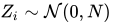
[edit]The AWGN channel is represented by a series of outputs at discrete-time event index . is the sum of the input and noise, , where is independent and identically distributed and drawn from a zero-mean normal distribution with variance (the noise). The are further assumed to not be correlated with the .



The capacity of the channel is infinite unless the noise is nonzero, and the are sufficiently constrained. The most common constraint on the input is the so-called "power" constraint, requiring that for a codeword transmitted through the channel, we have:

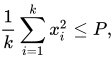
where represents the maximum channel power. Therefore, the channel capacity for the power-constrained channel is given by:[clarification needed]


where is the distribution of . Expand , writing it in terms of the differential entropy:


![{\displaystyle {\begin{aligned}&I(X;Y)=h(Y)-h(Y\mid X)\\[5pt]={}&h(Y)-h(X+Z\mid X)\\[5pt]={}&h(Y)-h(Z\mid X)\end{aligned}}\,\!}](https://wikimedia.org/api/rest_v1/media/math/render/svg/48065da1f590b68c2a3a7ab7dc62faf7c7d8bdd6)
But and are independent, therefore:


Evaluating the differential entropy of a Gaussian gives:
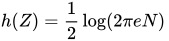
Because and are independent and their sum gives :


From this bound, we infer from a property of the differential entropy that

Therefore, the channel capacity is given by the highest achievable bound on the mutual information:

Where is maximized when:
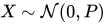
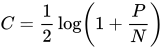
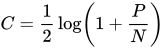
Thus the channel capacity for the AWGN channel is given by:

Channel capacity and sphere packing
[edit]Suppose that we are sending messages through the channel with index ranging from to , the number of distinct possible messages. If we encode the messages to bits, then we define the rate as:


A rate is said to be achievable if there is a sequence of codes so that the maximum probability of error tends to zero as approaches infinity. The capacity is the highest achievable rate.
Consider a codeword of length sent through the AWGN channel with noise level . When received, the codeword vector variance is now , and its mean is the codeword sent. The vector is very likely to be contained in a sphere of radius around the codeword sent. If we decode by mapping every message received onto the codeword at the center of this sphere, then an error occurs only when the received vector is outside of this sphere, which is very unlikely.

Each codeword vector has an associated sphere of received codeword vectors which are decoded to it and each such sphere must map uniquely onto a codeword. Because these spheres therefore must not intersect, we are faced with the problem of sphere packing. How many distinct codewords can we pack into our -bit codeword vector? The received vectors have a maximum energy of and therefore must occupy a sphere of radius . Each codeword sphere has radius . The volume of an n-dimensional sphere is directly proportional to , so the maximum number of uniquely decodeable spheres that can be packed into our sphere with transmission power P is:


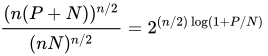
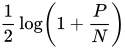
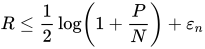
By this argument, the rate R can be no more than .
Achievability
[edit]In this section, we show achievability of the upper bound on the rate from the last section.
A codebook, known to both encoder and decoder, is generated by selecting codewords of length n, i.i.d. Gaussian with variance and mean zero. For large n, the empirical variance of the codebook will be very close to the variance of its distribution, thereby avoiding violation of the power constraint probabilistically.

Received messages are decoded to a message in the codebook which is uniquely jointly typical. If there is no such message or if the power constraint is violated, a decoding error is declared.
Let denote the codeword for message , while is, as before the received vector. Define the following three events:


- Event :the power of the received message is larger than .
- Event : the transmitted and received codewords are not jointly typical.
- Event : is in , the typical set where , which is to say that the incorrect codeword is jointly typical with the received vector.


An error therefore occurs if , or any of the occur. By the law of large numbers, goes to zero as n approaches infinity, and by the joint Asymptotic Equipartition Property the same applies to . Therefore, for a sufficiently large , both and are each less than . Since and are independent for , we have that and are also independent. Therefore, by the joint AEP, . This allows us to calculate , the probability of error as follows:




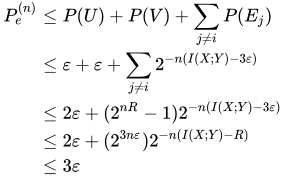
Therefore, as n approaches infinity, goes to zero and . Therefore, there is a code of rate R arbitrarily close to the capacity derived earlier.

Coding theorem converse
[edit]Here we show that rates above the capacity are not achievable.
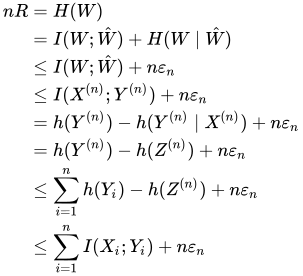
Suppose that the power constraint is satisfied for a codebook, and further suppose that the messages follow a uniform distribution. Let be the input messages and the output messages. Thus the information flows as:



Making use of Fano's inequality gives:
where as



Let be the encoded message of codeword index i. Then:
Let be the average power of the codeword of index i:

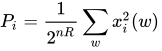
where the sum is over all input messages . and are independent, thus the expectation of the power of is, for noise level :


And, if is normally distributed, we have that

Therefore,
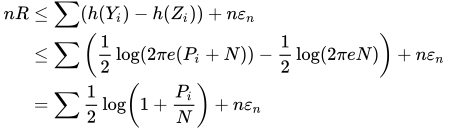
We may apply Jensen's equality to , a concave (downward) function of x, to get:


Because each codeword individually satisfies the power constraint, the average also satisfies the power constraint. Therefore,

which we may apply to simplify the inequality above and get:

Therefore, it must be that . Therefore, R must be less than a value arbitrarily close to the capacity derived earlier, as .
Effects in time domain
[edit]
In serial data communications, the AWGN mathematical model is used to model the timing error caused by random jitter (RJ).
The graph to the right shows an example of timing errors associated with AWGN. The variable Δt represents the uncertainty in the zero crossing. As the amplitude of the AWGN is increased, the signal-to-noise ratio decreases. This results in increased uncertainty Δt.[1]
When affected by AWGN, the average number of either positive-going or negative-going zero crossings per second at the output of a narrow bandpass filter when the input is a sine wave is
![{\displaystyle {\begin{aligned}&{\frac {\text{positive zero crossings}}{\text{second}}}={\frac {\text{negative zero crossings}}{\text{second}}}\\[8pt]={}&f_{0}{\sqrt {\frac {{\text{SNR}}+1+{\frac {B^{2}}{12f_{0}^{2}}}}{{\text{SNR}}+1}}},\end{aligned}}}](https://wikimedia.org/api/rest_v1/media/math/render/svg/abb3b89cd4e90b5bd3951b14cc24fe5607364855)
where
- ƒ0 = the center frequency of the filter,
- B = the filter bandwidth,
- SNR = the signal-to-noise power ratio in linear terms.
Effects in phasor domain
[edit]
In modern communication systems, bandlimited AWGN cannot be ignored. When modeling bandlimited AWGN in the phasor domain, statistical analysis reveals that the amplitudes of the real and imaginary contributions are independent variables which follow the Gaussian distribution model. When combined, the resultant phasor's magnitude is a Rayleigh-distributed random variable, while the phase is uniformly distributed from 0 to 2π.
The graph to the right shows an example of how bandlimited AWGN can affect a coherent carrier signal. The instantaneous response of the noise vector cannot be precisely predicted, however, its time-averaged response can be statistically predicted. As shown in the graph, we confidently predict that the noise phasor will reside about 38% of the time inside the 1σ circle, about 86% of the time inside the 2σ circle, and about 98% of the time inside the 3σ circle.[1]
See also
[edit]References
[edit]Additive white Gaussian noise
View on GrokipediaFundamentals
Definition and Characteristics
Additive white Gaussian noise (AWGN) is a canonical noise model employed in information theory and electrical engineering to represent the random disturbances that degrade signal transmission in communication systems. It combines three essential properties: additivity, whiteness, and Gaussian distribution, making it a versatile approximation for various physical noise sources. This model assumes the noise is superimposed on the signal without altering its form, possesses uniform power across frequencies, and exhibits a bell-shaped probability distribution typical of many natural random processes.[2] The additive nature of AWGN signifies that the noise is linearly added to the transmitted signal, resulting in a received signal that is the direct sum of the original signal and the noise component, with the noise being statistically independent of the signal itself. This independence ensures that the noise does not depend on the signal's content or amplitude, allowing for simplified analysis in system design. In practical terms, this models scenarios where external or internal disturbances overlay the desired information without multiplicative effects.[2] Whiteness describes the noise's power spectral density as constant over all frequencies of interest, implying equal energy contribution from each frequency band and uncorrelated samples in discrete-time representations. The Gaussian aspect means the noise values follow a normal probability distribution with zero mean, reflecting the cumulative effect of numerous independent microscopic fluctuations as per the central limit theorem. Additionally, AWGN is a stationary process, where its mean, variance, and correlation structure remain invariant over time, facilitating consistent statistical treatment.[2] AWGN originates as an idealized representation of thermal noise in electronic circuits, particularly the Johnson-Nyquist noise arising from the random thermal agitation of charge carriers in conductors at equilibrium temperature. First observed experimentally and theoretically derived in the late 1920s, this noise provides a foundational physical basis for the AWGN model, enabling its widespread use to approximate real-world impairments like those in amplifiers and transmission lines.[8][9]Historical Development
The foundations of additive white Gaussian noise (AWGN) were laid in the late 1920s through experimental and theoretical work on thermal noise in electrical conductors. In 1928, John B. Johnson published experimental findings demonstrating that thermal noise arises from the random agitation of electrons in resistors, with a power spectral density proportional to temperature and resistance. That same year, Harry Nyquist provided a rigorous theoretical derivation, confirming the noise's white spectrum and Gaussian distribution—stemming from the statistical superposition of numerous independent charge carrier motions via the central limit theorem. This Johnson-Nyquist theorem established thermal noise as inherently additive, Gaussian, and spectrally flat, providing the physical basis for AWGN models in subsequent signal processing. The integration of AWGN into information theory occurred in 1948 with Claude Shannon's foundational paper, "A Mathematical Theory of Communication," which formalized noisy channels using AWGN to quantify reliable data transmission limits.[10] Shannon's noisy channel coding theorem specifically targeted the AWGN channel, proving that arbitrarily low error rates are achievable at rates below the channel capacity, fundamentally shaping modern communications.[10] Post-World War II, the AWGN model saw rapid adoption in the 1950s for radar and telephony systems, where it served as a standard benchmark for noise impairment analysis and system design amid growing electronic warfare and long-distance voice transmission needs.[11] By the 1960s, coding theory advanced under this framework, with Peter Elias and Amiel Feinstein extending Shannon's ideas to practical error-correcting codes; their 1955 and 1954 works, respectively, derived bounds on error probabilities for discrete noisy channels, enabling codes that approach theoretical limits.[10] As of November 2025, AWGN remains central to digital communications standards like 5G New Radio (NR) and Wi-Fi (IEEE 802.11), where it underpins link-level simulations and performance evaluations in 3GPP specifications.[12] However, emerging technologies such as quantum communications are driving extensions to non-Gaussian noise models to account for photon loss, decoherence, and non-classical effects beyond traditional thermal assumptions.Statistical and Spectral Properties
Gaussian Distribution Aspects
The Gaussian component of additive white Gaussian noise (AWGN) is characterized by its probability density function (PDF), which for a single noise sample follows a normal distribution . The PDF is given by where the mean is zero, reflecting the absence of any directional bias in the noise, and the variance quantifies the noise's spread or intensity. This zero-mean property ensures that the noise does not systematically alter the signal's average value when added.[3][2] For a sequence of multiple independent noise samples, such as , the joint distribution is a multivariate Gaussian with a diagonal covariance matrix , where is the identity matrix. This structure arises because the samples are independent and identically distributed (i.i.d.), implying zero covariance between distinct samples and identical marginal distributions for each. The zero off-diagonal elements in the covariance matrix highlight the lack of correlation, simplifying statistical modeling in systems with discrete-time noise processes.[2] The Gaussian nature of real-world noise, such as thermal or Johnson noise in electronic systems, is justified by the central limit theorem (CLT), which states that the sum of many independent random variables, each with finite variance, converges to a Gaussian distribution regardless of their individual distributions. In physical systems, noise often results from the superposition of numerous microscopic fluctuations, like electron movements, leading to this approximation even when individual components are non-Gaussian.[13][14] The Gaussian distribution facilitates key implications for signal processing and analysis. The zero-mean property of the noise ensures that it does not introduce a bias in the mean of the received signal; that is, the expected value of y equals the expected value of x, assuming independence. Linear operations on Gaussian noise remain Gaussian, enabling tractable analysis; for instance, the matched filter achieves optimal detection performance in the presence of Gaussian noise by maximizing the signal-to-noise ratio at the filter output. The noise power is defined as the expected value , which directly relates to the signal-to-noise ratio (SNR) as , where is the signal power, providing a fundamental metric for system performance evaluation.[15][16]Whiteness and Power Spectral Density
The "whiteness" in additive white Gaussian noise (AWGN) refers to the property that the noise exhibits equal power across all frequencies, resulting in a flat power spectral density (PSD) that is idealized as extending over infinite bandwidth; in practical systems, this approximation holds only within the bandwidth of interest, as true infinite bandwidth would imply infinite total power.[17] The PSD of AWGN is constant for all frequencies , denoted as the two-sided PSD or the one-sided PSD , where represents the noise power per unit bandwidth in hertz.[5] This flat spectrum distinguishes white noise from colored noise, which has frequency-dependent power distribution. The autocorrelation function of AWGN, obtained as the inverse Fourier transform of its PSD, is , where is the Dirac delta function; this indicates that the noise samples are uncorrelated (delta-correlated) for any non-zero time lag .[18] In real communication systems, the white noise approximation is valid over the signal's bandwidth , where the total noise power within that band is for the one-sided PSD (or equivalently, integrating the two-sided PSD over ).[5] For thermal noise, which models AWGN in many physical channels, the one-sided noise PSD is given by , where J/K is Boltzmann's constant and is the absolute temperature in kelvin.Mathematical Formulation
Time-Domain Representation
In the time domain, additive white Gaussian noise (AWGN) is modeled as the direct superposition of a deterministic signal onto a stochastic noise process. For continuous-time systems, the received signal is expressed as , where is the transmitted signal and is the noise component.[5] The noise is characterized as a wide-sense stationary (WSS) Gaussian random process with zero mean, , and an autocorrelation function , where is the Dirac delta function and represents the two-sided power spectral density of the noise.[19] This delta-correlated property implies that noise samples at distinct times are uncorrelated, modeling the "whiteness" in the time domain.[5] In discrete-time representations, which arise in sampled or digital systems, the model simplifies to , where denotes the sample index. Here, the noise samples are independent and identically distributed (i.i.d.) as Gaussian random variables, , with zero mean and variance .[5] This i.i.d. assumption stems from the sampling of the continuous-time process under the Nyquist criterion, ensuring that the discrete noise maintains the uncorrelated nature of the original AWGN.[5] From a stochastic differential equation perspective, pure white noise is idealized and not a proper stochastic process; it can be formally viewed as the derivative of a Wiener (Brownian motion) process, , where is a standard Wiener process with and variance .[19] In practice, however, the AWGN model simplifies to direct addition without solving such equations, as the idealized delta autocorrelation suffices for most communication analyses. Approximations like the Ornstein-Uhlenbeck process, driven by white noise via and taking the limit , yield the white noise behavior but are typically not required in standard formulations.[20] The variance in the discrete model is often normalized to to ensure equivalence with the continuous-time case, particularly for bandlimited channels where the noise power within the bandwidth matches .[5] This normalization facilitates consistent signal-to-noise ratio (SNR) definitions across domains, with SNR given by , where is the signal power.[5] For simulation purposes, discrete-time AWGN is generated by drawing i.i.d. samples from a Gaussian distribution using pseudo-random number generators, such as the Box-Muller transform or built-in functions like MATLAB'srandn, scaled to the desired variance .[21] This approach allows efficient numerical evaluation of communication systems under AWGN conditions.[22]