
Recent from talks
Aetosauria
Knowledge base stats:
Talk channels stats:
Members stats:
Aetosauria
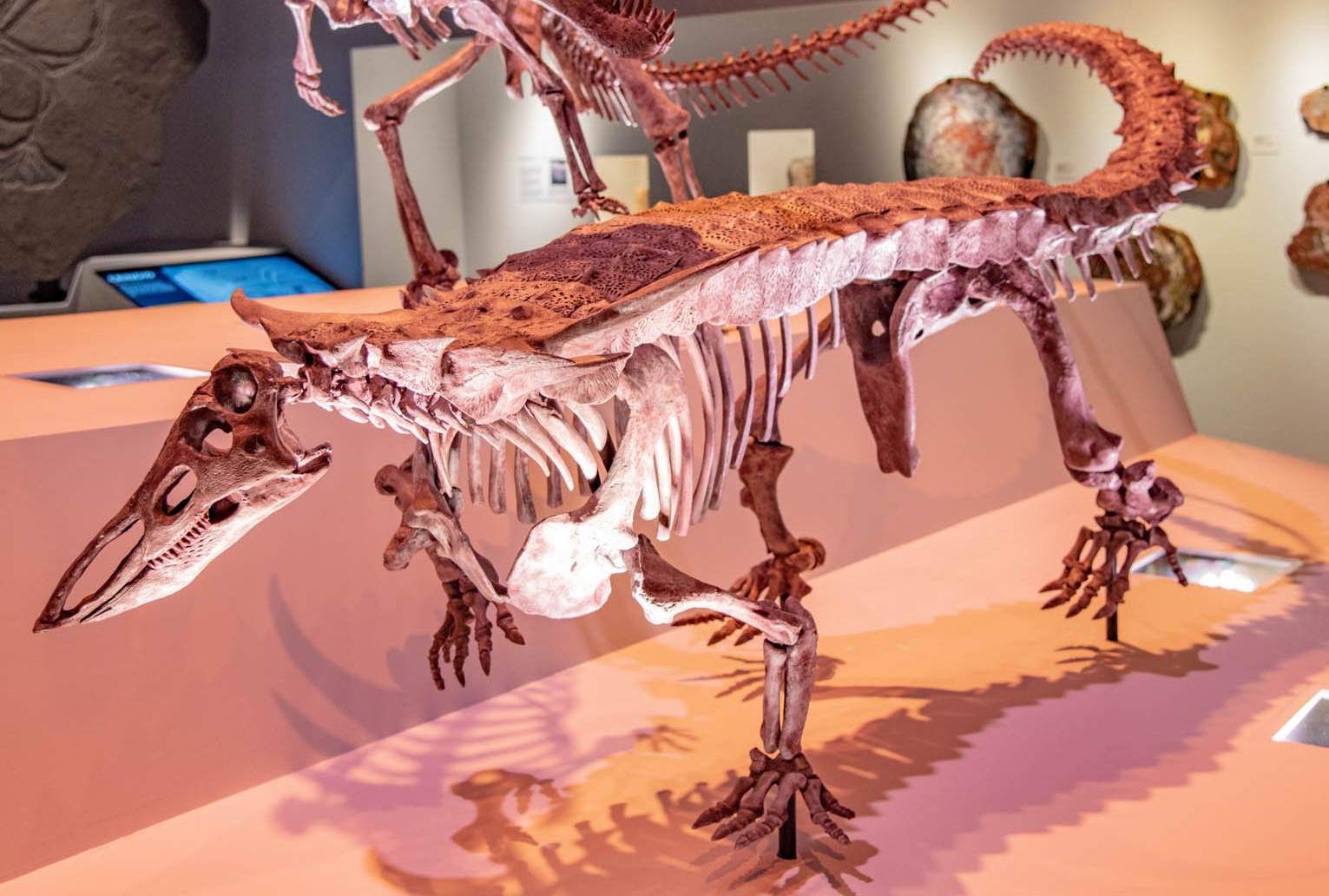
Aetosaurs (/eɪˌɛtoʊˈsɔːr/) are heavily armored reptiles belonging to the extinct order Aetosauria (/eɪˌɛtoʊˈsɔːriə/; from Greek, ἀετός (aetos, "eagle") and σαυρος (sauros, "lizard")). They were medium- to large-sized omnivorous or herbivorous pseudosuchians, part of the branch of archosaurs more closely related to crocodilians than to birds and non-avian dinosaurs. All known aetosaurs are restricted to the Late Triassic, and in some strata from this time they are among the most abundant fossil vertebrates. They have small heads, upturned snouts, erect limbs, and a body ornamented with four rows of plate-like osteoderms (bony scutes). Aetosaur fossil remains are known from Europe, North and South America, parts of Africa, and India. Since their armoured plates are often preserved and are abundant in certain localities, aetosaurs serve as important Late Triassic tetrapod index fossils. Many aetosaurs had wide geographic ranges, but their stratigraphic ranges were relatively short. Therefore, the presence of particular aetosaurs can accurately date a site in which they are found.
Nearly all aetosaurs (except for the genus Aetosauroides) belong to the family Stagonolepididae. Over 20 genera of aetosaurs have been described, and recently there has been controversy regarding the description of some of these genera. Two distinct subdivisions of aetosaurs are currently recognized, Desmatosuchia and Aetosaurinae, based primarily on broad differences in skull morphology. Osteoderms structure is generally one of the most useful traits for inferring aetosaur relations more precisely. Among other archosaurs, aetosaurs are most closely related to Revueltosaurus, a small reptile originally known from teeth mistakenly referred to herbivorous dinosaurs.
Aetosaur remains were first discovered in the early 19th century, although the first remains that were described were mistaken for fish scales. Aetosaurs were later recognized as crocodile relatives, at which point they were interpreted as semiaquatic scavengers closely related to phytosaurs. Subsequent work has established that aetosaurs were entirely terrestrial animals, and were likely herbivorous to some extent. Some forms have characteristics that may have been adaptations to digging for food. Supposed nesting structures have also been referred to aetosaurs, but this connection is considered ambiguous.
The skull of aetosaurs is relatively small compared to the body, and is quite distinctive in shape. Teeth are absent from both the front of the premaxilla (the bone forming the tip of the snout) and the front of the dentary (the toothed bone of the lower jaw). The teeth which are present are usually small and bulbous, ranging from basic conical forms to leaf-like shapes with large serrations. These are probably indicative of an omnivorous or herbivorous diet, and similar adaptations are seen in other archosaurs with less reliance on meat in their diet. A few aetosaurs have teeth with a ziphodont shape, meaning that the teeth are recurved, serrated, and flattened from the side. This shape, which is predominant in Aetosauroides and a small specimen tentatively referred to Coahomasuchus, is typical of carnivorous archosaurs.
In some aetosaurs (particular members of the group Desmatosuchia), the tip of the snout is expanded sideways into a flattened 'shovel' shape, akin to the snout of a pig. The external nares (nostril holes) are elongated, much larger than the antorbital fenestrae (a hole on the side of the skull). Many aetosaurs have a small knob on the premaxilla which projects into the nares from below. In all aetosaurs except Aetosauroides, the rear edge of the naris receives a contribution from the concave front edge of the maxilla bone. At the rear upper part of the skull, a hole known as the supratemporal fenestra is positioned and exposed on the side, unlike most other archosaurs where it is mostly visible when viewing the skull from above. The braincase is fairly standard by pseudosuchian standards, though the opening for the abducens nerve passes through the parabasisphenoid bone (at the lower front part of the braincase), rather than the prootic bone (at the upper front part). This trait is otherwise only seen in Revueltosaurus and crocodylomorphs among archosaurs. The mandible (lower jaw) is described as 'slipper'-shaped in many aetosaurs. This is due to a combination of features: the front of the dentary strongly tapers to a point, while the underside of the dentary sometimes flexes into a 'chin' (downwards projection) which may expose the splenial bone as well. The jaw joint is set at a low position, and the articular (the bone of the lower jaw which connects to the cranium) often has a tall projection right behind the jaw joint.
In most respects apart from their skull and armor, the skeletal anatomy of aetosaurs was fairly standard among other large Triassic pseudosuchians. The hindlimbs developed a "pillar-erect" limb posture similar to that seen in "rauisuchians", a related grade of carnivorous Triassic pseudosuchians ancestral to crocodylomorphs. A pillar-erect limb posture is one where the femur articulates vertically with the acetabulum of the hip, which is angled downward, so that the leg is positioned beneath the body and acts as a weight-bearing pillar. Nevertheless, there was likely significant variation in the hip structure of aetosaurs, and the forelimbs may have had a semi-sprawling 'hybrid' stance. While the hindlimb posture is similar to rauisuchians, other traits are more plesiomorphic (typical to ancestral pseudosuchians), such as the stout pelvis and broad, five-toed feet. The forelimbs were smaller than the hind limbs, and the radius in particular was much shorter than the humerus. Nevertheless, their low and heavy body shape requires that all aetosaurs were quadrupeds. They had multiple adaptations to strengthen the body in response to their heavy armor: the iliofibularis muscle attached to a lower position on the fibula, the fourth trochanter of the femur was enlarged, the transverse processes (rib attachments) developed into long massive pedestals, and the largest species even acquired hyposphene-hypantrum reinforcements between their vertebrae.
Although aetosaurs were generally wide-bodied reptiles, there is some variation in the degree of this trend. The typothoracines, exemplified by Typothorax and Paratypothorax, had a very broad, disc-shaped carapace, edged by small spines or keels and transitioning to a narrow tail. The largest species of typothoracines may have been around 3 meters (9.8 feet) in length and 110 kg (243 lbs) in weight. The desmatosuchines (Desmatosuchinae sensu stricto), such as Desmatosuchus and Longosuchus, had moderately narrower bodies and no belly armor. However, they also acquired spinier back armor, especially in the cervical (neck) region. Desmatosuchus was likely one of the largest known aetosaurs, at 4–6 m (13–20 ft) in length and 280 kg (620 lb) in weight. Aetosaurs which do not fit into these two categories, such as Stagonolepis and Neoaetosauroides, generally had narrow forms, slender limbs, and a restriction in the carapace above the hip. This body type is plesiomorphic (ancestral) to the other two shapes, with some narrow-bodied aetosaurs more closely related to typothoracines and others closer to desmatosuchines. Some plesiomorphic genera, like the widespread Norian genus Aetosaurus and the Carnian Coahomasuchus, tended to be small, about a metre (3.2 ft) in length. Others were larger, such as the basal-most aetosaur Aetosauroides and the early desmatosuchine Calyptosuchus.
Aetosaurs were very heavily armored, with rows of large, interlocking bony plates, known as osteoderms, protecting the back, sides, belly, and tail. These osteoderms generally have a quadrangular (four-sided) shape, and were most certainly used as a defense against predators. Most osteoderms are heavily pitted on their upper surfaces and smooth on their undersides. They have a heterogenous internal structure: the inner portion of each osteoderm is made of cancellous or spongy bone (also called diploë) and their outer portions are made up of compact bone. In life, these plates were probably covered in a keratinous (horn) covering, like modern crocodilian scutes, which are another example of pseudosuchian osteoderms. Osteoderms are useful in diagnosing aetosaur taxa, and aetosaur species can often be identified from individual scutes based on their shape, structure, or ornamentation pattern.
Hub AI
Aetosauria AI simulator
(@Aetosauria_simulator)
Aetosauria
Aetosaurs (/eɪˌɛtoʊˈsɔːr/) are heavily armored reptiles belonging to the extinct order Aetosauria (/eɪˌɛtoʊˈsɔːriə/; from Greek, ἀετός (aetos, "eagle") and σαυρος (sauros, "lizard")). They were medium- to large-sized omnivorous or herbivorous pseudosuchians, part of the branch of archosaurs more closely related to crocodilians than to birds and non-avian dinosaurs. All known aetosaurs are restricted to the Late Triassic, and in some strata from this time they are among the most abundant fossil vertebrates. They have small heads, upturned snouts, erect limbs, and a body ornamented with four rows of plate-like osteoderms (bony scutes). Aetosaur fossil remains are known from Europe, North and South America, parts of Africa, and India. Since their armoured plates are often preserved and are abundant in certain localities, aetosaurs serve as important Late Triassic tetrapod index fossils. Many aetosaurs had wide geographic ranges, but their stratigraphic ranges were relatively short. Therefore, the presence of particular aetosaurs can accurately date a site in which they are found.
Nearly all aetosaurs (except for the genus Aetosauroides) belong to the family Stagonolepididae. Over 20 genera of aetosaurs have been described, and recently there has been controversy regarding the description of some of these genera. Two distinct subdivisions of aetosaurs are currently recognized, Desmatosuchia and Aetosaurinae, based primarily on broad differences in skull morphology. Osteoderms structure is generally one of the most useful traits for inferring aetosaur relations more precisely. Among other archosaurs, aetosaurs are most closely related to Revueltosaurus, a small reptile originally known from teeth mistakenly referred to herbivorous dinosaurs.
Aetosaur remains were first discovered in the early 19th century, although the first remains that were described were mistaken for fish scales. Aetosaurs were later recognized as crocodile relatives, at which point they were interpreted as semiaquatic scavengers closely related to phytosaurs. Subsequent work has established that aetosaurs were entirely terrestrial animals, and were likely herbivorous to some extent. Some forms have characteristics that may have been adaptations to digging for food. Supposed nesting structures have also been referred to aetosaurs, but this connection is considered ambiguous.
The skull of aetosaurs is relatively small compared to the body, and is quite distinctive in shape. Teeth are absent from both the front of the premaxilla (the bone forming the tip of the snout) and the front of the dentary (the toothed bone of the lower jaw). The teeth which are present are usually small and bulbous, ranging from basic conical forms to leaf-like shapes with large serrations. These are probably indicative of an omnivorous or herbivorous diet, and similar adaptations are seen in other archosaurs with less reliance on meat in their diet. A few aetosaurs have teeth with a ziphodont shape, meaning that the teeth are recurved, serrated, and flattened from the side. This shape, which is predominant in Aetosauroides and a small specimen tentatively referred to Coahomasuchus, is typical of carnivorous archosaurs.
In some aetosaurs (particular members of the group Desmatosuchia), the tip of the snout is expanded sideways into a flattened 'shovel' shape, akin to the snout of a pig. The external nares (nostril holes) are elongated, much larger than the antorbital fenestrae (a hole on the side of the skull). Many aetosaurs have a small knob on the premaxilla which projects into the nares from below. In all aetosaurs except Aetosauroides, the rear edge of the naris receives a contribution from the concave front edge of the maxilla bone. At the rear upper part of the skull, a hole known as the supratemporal fenestra is positioned and exposed on the side, unlike most other archosaurs where it is mostly visible when viewing the skull from above. The braincase is fairly standard by pseudosuchian standards, though the opening for the abducens nerve passes through the parabasisphenoid bone (at the lower front part of the braincase), rather than the prootic bone (at the upper front part). This trait is otherwise only seen in Revueltosaurus and crocodylomorphs among archosaurs. The mandible (lower jaw) is described as 'slipper'-shaped in many aetosaurs. This is due to a combination of features: the front of the dentary strongly tapers to a point, while the underside of the dentary sometimes flexes into a 'chin' (downwards projection) which may expose the splenial bone as well. The jaw joint is set at a low position, and the articular (the bone of the lower jaw which connects to the cranium) often has a tall projection right behind the jaw joint.
In most respects apart from their skull and armor, the skeletal anatomy of aetosaurs was fairly standard among other large Triassic pseudosuchians. The hindlimbs developed a "pillar-erect" limb posture similar to that seen in "rauisuchians", a related grade of carnivorous Triassic pseudosuchians ancestral to crocodylomorphs. A pillar-erect limb posture is one where the femur articulates vertically with the acetabulum of the hip, which is angled downward, so that the leg is positioned beneath the body and acts as a weight-bearing pillar. Nevertheless, there was likely significant variation in the hip structure of aetosaurs, and the forelimbs may have had a semi-sprawling 'hybrid' stance. While the hindlimb posture is similar to rauisuchians, other traits are more plesiomorphic (typical to ancestral pseudosuchians), such as the stout pelvis and broad, five-toed feet. The forelimbs were smaller than the hind limbs, and the radius in particular was much shorter than the humerus. Nevertheless, their low and heavy body shape requires that all aetosaurs were quadrupeds. They had multiple adaptations to strengthen the body in response to their heavy armor: the iliofibularis muscle attached to a lower position on the fibula, the fourth trochanter of the femur was enlarged, the transverse processes (rib attachments) developed into long massive pedestals, and the largest species even acquired hyposphene-hypantrum reinforcements between their vertebrae.
Although aetosaurs were generally wide-bodied reptiles, there is some variation in the degree of this trend. The typothoracines, exemplified by Typothorax and Paratypothorax, had a very broad, disc-shaped carapace, edged by small spines or keels and transitioning to a narrow tail. The largest species of typothoracines may have been around 3 meters (9.8 feet) in length and 110 kg (243 lbs) in weight. The desmatosuchines (Desmatosuchinae sensu stricto), such as Desmatosuchus and Longosuchus, had moderately narrower bodies and no belly armor. However, they also acquired spinier back armor, especially in the cervical (neck) region. Desmatosuchus was likely one of the largest known aetosaurs, at 4–6 m (13–20 ft) in length and 280 kg (620 lb) in weight. Aetosaurs which do not fit into these two categories, such as Stagonolepis and Neoaetosauroides, generally had narrow forms, slender limbs, and a restriction in the carapace above the hip. This body type is plesiomorphic (ancestral) to the other two shapes, with some narrow-bodied aetosaurs more closely related to typothoracines and others closer to desmatosuchines. Some plesiomorphic genera, like the widespread Norian genus Aetosaurus and the Carnian Coahomasuchus, tended to be small, about a metre (3.2 ft) in length. Others were larger, such as the basal-most aetosaur Aetosauroides and the early desmatosuchine Calyptosuchus.
Aetosaurs were very heavily armored, with rows of large, interlocking bony plates, known as osteoderms, protecting the back, sides, belly, and tail. These osteoderms generally have a quadrangular (four-sided) shape, and were most certainly used as a defense against predators. Most osteoderms are heavily pitted on their upper surfaces and smooth on their undersides. They have a heterogenous internal structure: the inner portion of each osteoderm is made of cancellous or spongy bone (also called diploë) and their outer portions are made up of compact bone. In life, these plates were probably covered in a keratinous (horn) covering, like modern crocodilian scutes, which are another example of pseudosuchian osteoderms. Osteoderms are useful in diagnosing aetosaur taxa, and aetosaur species can often be identified from individual scutes based on their shape, structure, or ornamentation pattern.
Recent media