Hubbry Logo
Al-Samoud 2Al-Samoud 2Main
Open search
Al-Samoud 2
Community hub
Al-Samoud 2
logo
8 pages, 0 posts
0 subscribers
Be the first to start a discussion here.
Al-Samoud 2
Al-Samoud 2
from Wikipedia

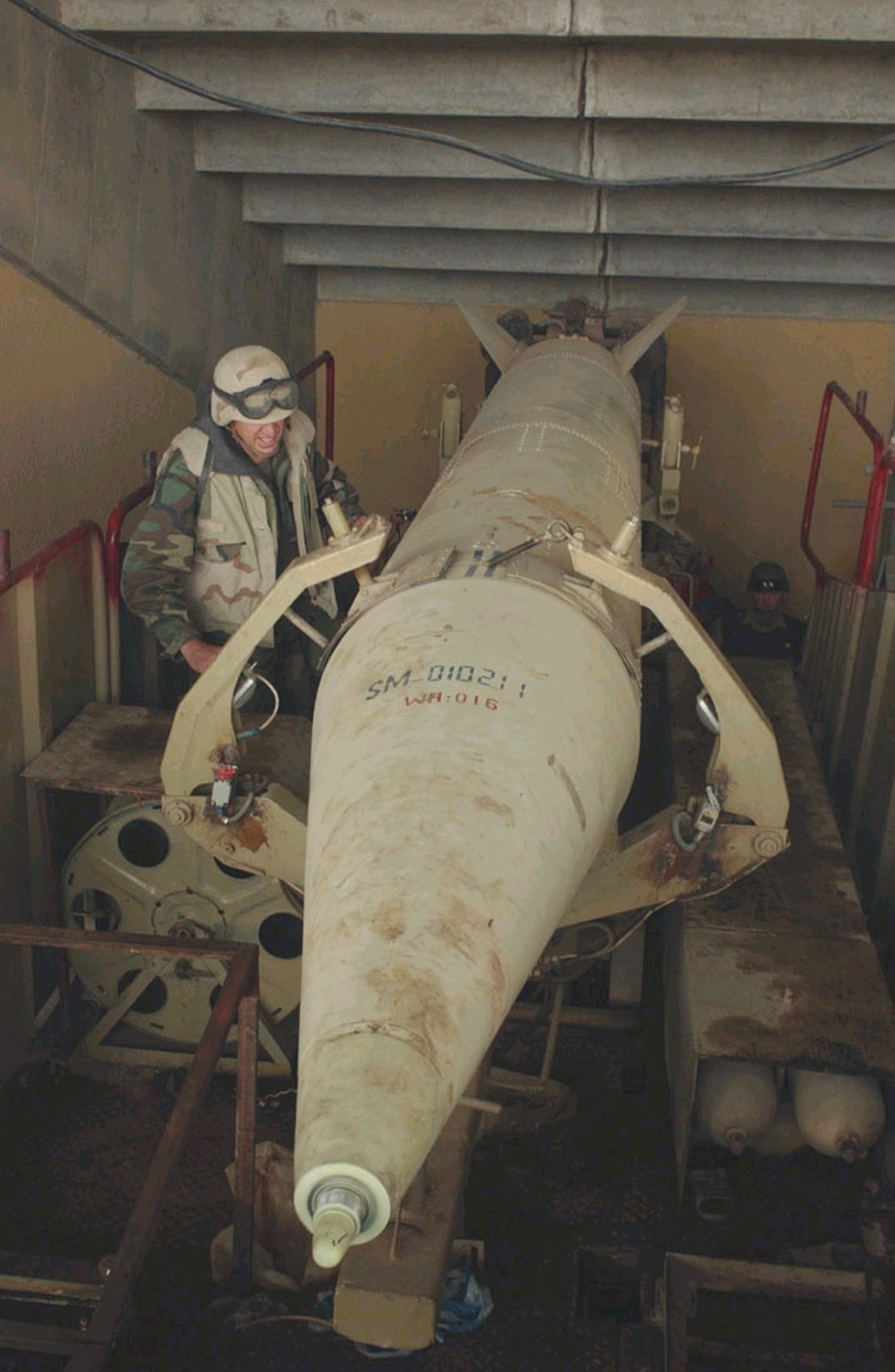
Al-Samoud (الصمود, alternately Al-Samed, which means steadfastness in Arabic)[2] was a liquid-propellant rocket tactical ballistic missile developed by Iraq in the years between the Gulf War and the 2003 Invasion of Iraq. The Iraqi army also developed a solid-fuel rocket version known as Ababil-100.

Key Information

Development

[edit]

The missile was essentially a scaled-down Scud,[citation needed] though parts were mostly derived from the Soviet S-75 Dvina surface-to-air missile. The first test-firing was carried out as early as 1997[2] and was supervised by UNSCOM.[3] The production started in 2001, and the goal was the assembly of ten missiles each month. The Al Samoud 2 was not fully operational by 2003, but some of them had been already delivered to the Iraqi army.[citation needed]

Engine

[edit]

The rocket engine evolved from the S-75 Dvina design and the thrust vector controls from the Scud. The system also included an Iraqi-designed mobile launcher similar to the Al-Nida, built for the missile Al Hussein,[4] produced by the Iraqi company Al-Fida.[5]

Payload

[edit]

The missile carried a 280 kilogram warhead that was half high explosives and half protective steel shell. The explosive charge weighed 140 kg, made of a mixture of 84 kg of RDX=60%, 42 kg of TNT= 30% and 14 kg of aluminium= 10%, the latter used as an energetic blast enhancer. The payload was also designed to upload different types of bomblets.[citation needed]

Guidance

[edit]

The guidance package was assembled by cannibalizing gyroscopes from the Chinese Silkworm cruise missile.[citation needed] A source is cited as claiming that there were inertial and even GPS guidance systems illegally imported from Belarus, but these allegations have not been confirmed.[citation needed]

Banned by the UN

[edit]
A test-launch of an Al Samoud, circa 1997

On February 13, 2003, a UN panel reported that Iraq's Al-Samoud 2 missiles, disclosed by Iraq to weapons inspectors in December, have a range of 180 km, in breach of UNSCR 1441. The limit allowed by the UN is 150 km.[citation needed]

Iraq agreed to destroy the Al-Samoud 2 long range missiles, and by mid-March 2003, a number had been destroyed. Although UNMOVIC ordered to stop its production, Iraq assembled some 20 missiles during the early months of 2003.[citation needed]

American forces found a cache of 12 Al Samoud missiles south of Baiji on July 21, 2003.[citation needed]

Operational history (March–April 2003)

[edit]
Aftermath of the Iraqi missile attack on 7 April

A number of Al-Samoud 2 missiles were fired at Kuwait during the 2003 conflict.[6] One of them, aimed at the Coalition Headquarters at Camp Doha, was successfully intercepted by a Patriot missile on March 27. Some debris hit buildings inside the US base.[7] The other missiles were also shot down or landed harmlessly in the desert.

A similar development, the Al-Fahd or Ababil-100, a solid propellant version of the Al-Samoud, was also used by the Iraqi army during the invasion. The Headquarters of the 2nd Brigade, US 3rd Infantry Division, were struck south of Baghdad by a missile of this kind on April 7. Three soldiers and two foreign reporters were killed in the blast.[8][9][10][11][12]

See also

[edit]

References

[edit]
[edit]
Revisions and contributorsEdit on WikipediaRead on Wikipedia
from Grokipedia
The Al-Samoud 2 was a single-stage, liquid-fueled developed by in the late 1990s as part of its post-Gulf War missile program, utilizing inertial guidance and road-mobile launchers for tactical deployment. It featured a of approximately 280-300 kilograms, with dimensions of roughly 7.5 meters in length and 0.76 meters in diameter, propelled by a combination of and . Drawing partial design elements from Soviet-era SA-2 surface-to-air missiles and Scud variants, the Al-Samoud 2 underwent initial flight tests starting in , achieving operational capability around despite ongoing restrictions. Iraqi declarations initially claimed compliance with the 150-kilometer range limit set by UN Security Council Resolution 687, but independent assessments and test data revealed capabilities exceeding 180 kilometers, rendering the system prohibited. In response to UNMOVIC inspections resumed in late 2002, Iraq disclosed details of the program, leading to an order for the destruction of all Al-Samoud 2 missiles, warheads, engines, and related infrastructure in February 2003; under supervised dismantlement, 34 missiles, two combat warheads, five engines, and one launcher were destroyed before the 2003 halted further verification. This episode underscored Iraq's persistent non-compliance with disarmament mandates, as evidenced by empirical flight test results and expert technical evaluations.

Background and Development

Post-Gulf War Constraints on Iraqi Programs

Following the 1991 , United Nations Security Council Resolution 687, adopted on 3 April 1991, established comprehensive constraints on Iraq's weapons of mass destruction (WMD) and programs as a prerequisite for the . The resolution mandated that declare, destroy, remove, or render harmless all biological and chemical weapons, nuclear capabilities, and with a range greater than 150 kilometers, including related major facilities and support infrastructure, all under international verification. It also linked the lifting of to 's full compliance, thereby restricting financial and material resources available for prohibited activities. To enforce these obligations, Resolution 687 created the (UNSCOM), empowered to conduct inspections, oversee destruction, and implement an ongoing monitoring regime to prevent reconstitution of banned capabilities. UNSCOM's missile-related efforts focused on Iraq's Scud-derived systems, such as the Al-Hussein variant, which had been used extensively during the ; the commission verified and supervised the destruction of 48 such missiles, 6 mobile launchers, 28 operational fixed launch pads (plus 32 under construction), and 30 chemical warheads. Overall, UNSCOM accounted for 817 of the 819 Soviet-supplied Scud missiles Iraq had imported, while confirming unilateral destruction of 83 additional Scud-type missiles and 9 launchers. Iraq's initial declaration under the resolution, submitted on 18 1991, listed only 53 Al-Hussein and Scud-type missiles, but subsequent revelations indicated underreporting of indigenous production, estimated at around 80 missiles. Compliance was hampered by systematic Iraqi obstruction, including concealment of components, removal of materials prior to inspections, false accounting of unilateral destructions (such as claims of destroying 100 Al-Hussein missiles without evidence), and denial of access to facilities, including presidential sites in 1997. These actions led to repeated Security Council condemnations of Iraq's material breaches and extended the sanctions regime. Under Resolution 715, adopted on 11 October 1991, UNSCOM extended its mandate to long-term monitoring of dual-use sites and imports to block resumption of programs exceeding the 150-kilometer threshold, including prohibitions on engines and airframes with diameters over 600 millimeters that could enable longer-range designs. Despite destroying much of the overt , the regime's limitations—exacerbated by Iraq's evasion tactics—allowed potential for clandestine efforts, as inspectors were ultimately withdrawn in December 1998 amid escalating non-cooperation. The (IAEA) complemented UNSCOM on nuclear- overlaps, but missile constraints remained primarily under UNSCOM until its successor, UNMOVIC, in 2002.

Initiation and Timeline of the Al-Samoud 2 Project

The Al-Samoud 2 project emerged from Iraq's broader liquid-propellant development efforts initiated in , which aimed to produce short-range ballistic s compliant with UN restrictions of 150 km range. These efforts built on the earlier Al-Samoud variant, whose flight tests began in 1997 and continued through 1998 under UNSCOM monitoring. By 2000, Iraq redirected ongoing work into the specifically designated Al-Samoud 2 program, a successor system utilizing a modified Soviet SA-2 air defense airframe for enhanced performance. Development accelerated in 2001, with the first of the Al-Samoud 2 conducted in 2001, validating initial design parameters. Production ramped up immediately thereafter in September 2001, targeting an output of 10 missiles per month to support operational deployment. The system reached the Iraqi Army by December 2001 following successful 2001 flight tests, marking the transition from prototyping to fielding. Iraq formally disclosed the program's status in its December 7, , declaration to UNMOVIC, including production details and test data. Subsequent flight tests in confirmed capabilities exceeding UN limits, with ranges up to km recorded for the Al-Samoud 2. UNMOVIC inspections from late verified the program's advanced stage, prompting orders to halt testing in February 2003 and initiate destruction in March 2003.

Technical Design and Capabilities

Propulsion System

The Al-Samoud 2 was powered by a single-stage engine adapted from the Soviet S-75 (SA-2 Guideline) surface-to-air missile's propulsion system. Iraqi engineers incorporated this engine, originally the Isayev 3D67 or similar variant producing approximately 20-25 kN of thrust, into a airframe drawing on Scud-derived structural elements for improved stability and range potential. The design emphasized storable hypergolic propellants to enable rapid fueling and launch preparation, typically using (RFNA) or an inhibited variant as the oxidizer and a kerosene-UDMH () or triethylamine-kerosene mixture as the fuel. This propulsion configuration allowed for a burn time of around 60-70 seconds, contributing to the missile's reported payload-range trade-offs, though inefficiencies such as thrust vector control via jet vanes reduced overall by up to 5% compared to optimized designs. conducted multiple static tests in the late 1990s and early to refine performance, focusing on increasing loading to extend range beyond UN-permitted limits, as evidenced by flight tests beginning in that demonstrated enhanced thrust-to-weight ratios. The system's reliance on imported or reverse-engineered components from the SA-2 limited scalability, with no evidence of clustered engines or upgrades beyond basic modifications for ballistic control.

Warhead and Payload Options

The Al-Samoud 2 featured a unitary high- with a total mass of 280 kilograms, comprising a 140-kilogram charge and an equal-weight metal fragmentation . The fill consisted of a mixture of 60% (84 kilograms), 30% TNT (42 kilograms), and 10% wax (14 kilograms), designed for enhanced blast and fragmentation effects. This configuration, which represented the actual deployed despite an initial design agreement with UN inspectors for 300 kilograms, was produced domestically by Iraqi facilities. Payload variations influenced the missile's range, with lighter configurations achieving up to 193 kilometers and heavier ones limited to 162 kilometers, reflecting trade-offs in mass for operational flexibility. Assessments of Iraqi capabilities indicated potential adaptations for chemical , such as a 200-kilogram bulk chemical fill intended to disperse agents for area denial and casualty generation upon impact. Cluster munitions were also evaluated as an option, incorporating approximately 30 submunitions each weighing 5 kilograms for sub-area targeting. Iraq produced 112 such warheads indigenously, alongside compatible fuzing systems, with UNMOVIC overseeing the destruction of many prior to the 2003 invasion. No evidence confirms deployment of non-conventional payloads, though the warhead's design accommodated liquid or agent-filled variants without structural modifications.

Guidance and Control Mechanisms

The Al-Samoud 2 missile utilized an for , incorporating gyroscopes, accelerometers, and associated software to determine trajectory corrections during flight. This system was derived from adapted components, including SA-2 elements and inertial measurement units, which provided attitude and velocity data to maintain the missile's programmed path. Hardware for the guidance package was obtained through indigenous development and procurement, with some gyroscopes reportedly cannibalized from Chinese anti-ship missiles to enable assembly. Control mechanisms relied on via four jet vanes in the engine exhaust, which received signals from the to adjust the missile's pitch, yaw, and roll. These vanes, similar in design to those used in Scud variants, allowed for aerodynamic stability and coarse trajectory adjustments primarily during the boost phase, though the system's overall accuracy remained limited by the rudimentary inertial platform, achieving estimates of several kilometers at maximum range. No evidence indicates integration of or advanced sensors like GPS, consistent with the program's constraints under sanctions and its focus on short-range ballistic applications. UNMOVIC inspections in early 2003 confirmed that the Al-Samoud 2 was the only variant in the family fitted with a complete guidance and control suite at the time, highlighting Iraq's prioritization of this missile for operational readiness despite ongoing verification scrutiny. Post-invasion analyses by the further detailed how these mechanisms enabled rapid deployment but underscored inherent limitations in precision due to component quality and testing constraints.

Performance Metrics: Range, Accuracy, and Limitations

The Al-Samoud 2 was officially declared by Iraqi authorities to achieve a maximum range of 149 kilometers when carrying a 300 kg , positioned as compliant with the ' 150 km limit under Resolution 687. In practice, UNMOVIC's review of Iraqi data—encompassing 23 tests conducted between 1997 and 2002—demonstrated that the exceeded 150 km in 13 instances, with the longest recorded flight reaching 183 km under full propellant loading. Early tests from January to April 1993 intentionally used partially filled tanks to restrict range below 150 km, while later configurations with indigenous lower-capacity tanks were planned but not fully implemented to enforce self-imposed limits. Independent engineering simulations and static/dynamic tests corroborated that the design inherently permitted ranges beyond 150 km without modifications, particularly for lighter variants with reduced payloads, rendering it proscribed under UN oversight. The , drawing from post-invasion interrogations and technical evaluations, affirmed that international experts had concluded the system's range capabilities "well beyond" the UN threshold, with potential for extension to 200 km or more via minor adjustments like fin modifications or fuel optimization. Accuracy metrics for the Al-Samoud 2, including (CEP), are not quantified in UNMOVIC assessments or declassified test records, though the missile incorporated basic inertial guidance systems adapted from Soviet SA-2 components. This setup, lacking advanced terminal homing, aligned with the imprecise targeting typical of short-range liquid-fueled ballistic missiles reliant on pre-programmed trajectories. Key limitations stemmed from its liquid-propellant propulsion using (UDMH) and nitrogen tetroxide, necessitating fueling shortly before launch, which extended preparation times to 30-60 minutes and heightened susceptibility to preemptive strikes. Production constraints arose from dependence on imported engines—380 declared by —and reverse-engineered elements, with roughly half of structural rings machined domestically during the 1998-2002 inspection hiatus, complicating verifiable scalability. Range variability with fuel loads exposed design flaws, as full tanks predictably violated limits, while partial filling reduced effectiveness and payload capacity. Overall, these factors curtailed operational reliability and strategic flexibility compared to solid-fuel alternatives.

International Restrictions and Inspections

UN Security Council Resolution 687 Framework

687, adopted unanimously on April 3, 1991, established the foundational ceasefire terms following the 1991 , mandating 's comprehensive disarmament of weapons of mass destruction (WMD) and associated delivery systems. In its Section C, the resolution explicitly required to destroy, remove, or render harmless, under international supervision, all ballistic missiles with a range greater than 150 kilometers, along with their major components, repair and production facilities, and related research, development, and support infrastructure. This 150-kilometer threshold was derived from pre-war assessments of 's capabilities, aiming to neutralize threats to neighboring states while permitting limited short-range defensive systems. The resolution obligated Iraq to submit a full declaration of its missile assets, including quantities, locations, and technical specifications, within 15 days of adoption, followed by on-site inspections to verify compliance. It created the United Nations Special Commission (UNSCOM) to oversee the destruction process and implement a long-term monitoring regime, including no-notice inspections of declared and suspected sites, with authority to demand access and seize prohibited items. UNSCOM's mandate extended to chemical, biological, and nuclear programs but placed particular emphasis on missiles due to Iraq's demonstrated use of extended-range Scuds during the conflict, which had targeted Israel and Saudi Arabia. Subsequent resolutions, such as 715 (1991), reinforced 687 by instituting an ongoing export/import monitoring mechanism to prevent from reconstituting prohibited capabilities, including dual-use items for propulsion and guidance. Violations of the range limit were treated as material breaches, potentially justifying enforcement actions, though implementation faced challenges from Iraqi obstruction, as documented in UNSCOM reports. The framework prioritized verifiable destruction over mere declarations, requiring photographic, video, and technical documentation of eliminations, with bearing the costs. By 1994, UNSCOM had supervised the destruction of over 40 fixed Scud launchers and hundreds of s exceeding the limit, but unresolved discrepancies in 's disclosures persisted.

UNMOVIC Findings on Al-Samoud 2 (2002–2003)

UNMOVIC commenced inspections in on November 27, 2002, under the authority of UN Security Council Resolution 1441, focusing on the Al-Samoud 2 missile program declared by Iraq as compliant with the 150 km range limit established by Resolution 687 (1991). Iraqi disclosures included data for the liquid-fueled Al-Samoud 2, which UNMOVIC technical teams analyzed alongside design specifications and production records. Initial assessments revealed discrepancies, as multiple tests conducted between 2001 and 2002 demonstrated ranges exceeding the permitted threshold, with one recorded flight reaching 183 km. In a January 27, 2003, briefing to the Security Council, UNMOVIC Executive Chairman reported that the Al-Samoud 2, along with the solid-propellant Al-Fatah, constituted cases of proscribed systems due to their tested ranges surpassing 150 km, prompting a directive to to halt further flight tests. Subsequent expert panel evaluations in February 2003, incorporating aerodynamic modeling and Iraqi-supplied data, confirmed that all variants of the Al-Samoud 2 exceeded the limit even under conservative assumptions, rendering the entire program subject to destruction irrespective of Iraqi claims that operational ranges would remain compliant when fully loaded. UNMOVIC formally notified of this determination on February 21, 2003, classifying the missile as prohibited. UNMOVIC inspection teams proceeded to tag approximately 74 Al-Samoud 2 missiles, along with engines, warheads, and , at sites including Taji, while directing the destruction of related items such as 380 SA-2 engines used in the program. Iraq initiated supervised destruction on March 1, 2003, at the Taji facility, with UNMOVIC overseeing the process; by March 17, 2003, 72 missiles had been demolished, including associated warheads and components, though the of interrupted completion of remaining items. These findings underscored ongoing substantive non-cooperation in missile , as Iraq provided access but withheld proactive evidence to resolve range ambiguities.

Iraqi Compliance Actions: Missile Destruction Process

In February 2003, following UNMOVIC's assessment that Al-Samoud 2 missiles violated UN Security Council Resolution 687's 150 km range limit, chief inspector directed to destroy all such missiles, associated warheads, propulsion components including approximately 380 illegally imported engines, and related production equipment under UN supervision, with the process to commence no later than March 1. agreed to this directive, declaring intent to dismantle up to 120 missiles originally inventoried, though prior declarations in June 2002 had listed 76 units, some expended in testing. Destruction operations began on March 1, 2003, at the Al Taji military complex north of , where UNMOVIC teams oversaw Iraqi personnel mechanically dismantling missiles via bulldozers that crushed airframes, warheads, and structural components to render them inoperable. This method ensured verifiable irretrievability without chemical or explosive means, allowing inspectors to document serial numbers, inspect internals prior to crushing, and confirm compliance through photographic and video records. Additional sites, including production facilities, were used for destroying ancillary items such as control software, fueling equipment, and empty warheads. Progress accelerated in early March, with 10 missiles destroyed over the March 1-2 weekend, followed by six more on March 3 alongside two empty warheads, and further batches including six missiles and 11 warheads by March 9. By March 7, 34 missiles (including four training variants), two combat warheads, one launcher, and five engines had been eliminated; this tally reached 65 missiles by March 14 and 72 by March 17, alongside the disablement of three launchers and sundry parts. The effort halted with the US-led coalition invasion on March 20, leaving incomplete destruction of the full declared inventory and prompting UNMOVIC to note Iraq's partial but supervised compliance as a step toward verification.

Operational Deployment

Pre-Invasion Preparations and Stockpiling

In late 2001, following a series of flight tests that year, initiated deployment of Al-Samoud 2 missiles to Iraqi Army units, marking the system's transition from development to operational preparation. U.S. intelligence assessments from the period indicated that was actively deploying the missiles, which were assessed as capable of exceeding the UN-mandated 150 km range limit, positioning them for potential short-range ballistic strikes in a defensive posture. By December 7, 2002, declared to UNMOVIC the production of 76 Al-Samoud 2 missiles, alongside stockpiles of supporting components including 118 engines, 64 warheads, 52 single-point liquid propellant tanks, and related infrastructure elements such as and test stands. These declarations reflected ongoing efforts to build operational inventories, with production facilities at sites like the Al Mamoun complex supporting assembly and integration activities. Intelligence reporting noted that conducted static tests of SA-2-derived sustainers to Al-Samoud readiness, aiming to enhance reliability for wartime deployment. As tensions escalated in early 2003, continued limited assembly despite UNMOVIC's assessment confirming the missile's range exceeded proscribed limits and orders to halt production and testing. This persistence suggested preparations for rapid operationalization, with stockpiles maintained at military sites for integration into army missile brigades. Pre-invasion destruction under UN supervision—beginning March 2, 2003, and encompassing 34 missiles, 4 training missiles, 2 warheads, 1 launcher, and 5 engines by mid-March—revealed the scale of accumulated hardware, though reserved some for potential retention amid invasion threats. Such stockpiling aligned with Iraqi defensive planning, focusing on mobile launch capabilities to counter anticipated coalition advances.

Combat Use During the 2003 Iraq War

During the initial phase of the 2003 Iraq War, Iraqi forces launched several Al-Samoud missiles toward , where coalition troops were positioned. On March 20, 2003, the first day of major combat operations, Iraq fired ballistic missiles at Kuwaiti targets, which U.S. officials identified as Al-Samoud 2 or variants thereof, contrasting with Kuwaiti reports labeling them as Scuds. These launches occurred amid air raid sirens in and were part of Iraq's early retaliatory efforts against the invading coalition. U.S. Patriot systems intercepted multiple incoming Al-Samoud threats, preventing significant damage or casualties. For instance, on March 20, three Patriot missiles were fired to down one Al-Samoud 2, which analysis later confirmed lacked chemical warheads. In another incident, revealed post-war, an Al-Samoud launched from north of targeted , the coalition headquarters in ; a U.S. Patriot battery fired two interceptors, with one successfully destroying the mid-flight. Overall, Patriot systems engaged and neutralized several short-range Iraqi ballistic missiles, including Al-Samoud variants, during the war's opening days, with at least nine tactical ballistic missiles destroyed across types. Coalition air forces responded aggressively to these launches by targeting Al-Samoud systems. U.S. A-10 destroyed an Iraqi site shortly after an Al-Samoud or similar Ababil-100 launch, demonstrating rapid hunt-and-strike capabilities. Navy F/A-18 jets struck multiple Al-Samoud launchers near Kuwaiti borders. These actions limited the missile's operational impact, as Iraq's inventory had been partially reduced pre-invasion under UN supervision, with remaining units proving inaccurate and vulnerable to suppression. No verified hits on populated or military targets from Al-Samoud firings were reported, underscoring the system's limited effectiveness against defended positions.

Controversies and Strategic Debates

Range Capability Disputes and Technical Analyses

UNMOVIC's technical evaluation of the missile, based on Iraqi-provided flight test data from 2001–2002, determined that the system exceeded the 150 km range limit stipulated by UN Security Council Resolution 687. Analysis of eight Iraqi-conducted tests revealed maximum ranges of up to 183 km, with theoretical modeling indicating potential operational ranges of 162–193 km depending on payload configuration—the lighter variant achieving approximately 193 km and the heavier one around 162 km. Iraqi officials maintained that the missile's design intentionally capped its range at 150 km through parameters such as propellant loading and nozzle geometry, dismissing exceeding test results as anomalies attributable to errors or non-standard conditions like excessive . However, UNMOVIC experts, employing aerodynamic simulations and assessments, countered that the missile's liquid-fueled engine—derived from modifications to Soviet-era SA-2 components—enabled consistent over-range performance in deployed configurations, irrespective of Iraqi-imposed software or hardware restrictions. This conclusion was briefed to the UN Security Council on February 14, 2003, by , who noted the system's prima facie proscription. Independent analyses corroborated UNMOVIC's findings, with U.S. intelligence assessments in August 2002 confirming two Al-Samoud flights surpassing 150 km based on , while evaluations highlighted the missile's scalability for chemical or conventional warheads, potentially extending effective reach against regional targets. 's resistance to immediate destruction—initially proposing modifications rather than dismantlement—intensified the dispute, as UNMOVIC deemed such alterations unreliable for enforcing compliance given the system's inherent capabilities. By March 2003, under UN supervision, commenced destroying 34 Al-Samoud 2 missiles, engines, and launchers, though debates persisted over whether pre-inspection production and testing reflected deliberate circumvention of sanctions-era constraints.

Iraqi Perspectives on Defensive Necessity

Iraqi military and regime officials described the Al-Samoud 2 as a tactical critical for supporting ground forces and bolstering national defense against potential border incursions and regional adversaries. In February 2003, amid UNMOVIC inspections, a factory director protested the tagging of Al-Samoud 2 missiles for destruction, declaring them "key to defense" due to their role in providing mobile amid Iraq's constrained conventional capabilities under sanctions. This perspective positioned the system as a necessary evolution from older Soviet-era designs, adapted for rapid deployment in defensive scenarios such as repelling invasions or suppressing enemy advances along frontiers with or . Saddam Hussein personally defended the program's legitimacy, insisting in a February 25, 2003, interview that the missiles did not violate UN Security Council Resolution 687's 150 km range limit and were configured for battlefield use only, rejecting demands for their dismantlement as an infringement on Iraq's sovereign right to minimal defensive armaments. Iraqi authorities provided technical data to UN inspectors claiming the missile's range remained under 150 km when equipped with standard warheads, arguing that empty-fuel tests artificially inflated distances and that the system was indispensable for compensating for artillery shortages inflicted by post-1991 disarmament and import restrictions. The broader Iraqi rationale emphasized vulnerability to encirclement by hostile neighbors, with the Al-Samoud 2 viewed as a deterrent against Iranian forces—still antagonistic after the 1980–1988 war—or Shia insurgencies in southern marshlands, where short-range precision strikes could neutralize threats without escalating to prohibited longer-range systems. Despite eventual compliance with partial destruction in March 2003 under threat of invasion, regime statements underscored the missile's irreplaceability for tactical depth in a sanctions-weakened , framing UN restrictions as punitive rather than balanced for regional security.

Critiques of UN Oversight and Resolution Enforcement

Critics of the ' oversight under Security Council Resolution 687, which prohibited from possessing ballistic missiles with ranges exceeding 150 kilometers, have pointed to systemic weaknesses in regimes and mechanisms that permitted the development and partial retention of Al-Samoud 2 missiles. The expulsion of UN Special Commission (UNSCOM) inspectors in December 1998 created a four-year gap in comprehensive monitoring, during which accelerated missile programs, including Al-Samoud variants designed to skirt range limits through modifications like extended fuel tanks and lighter payloads. This lapse, attributed to 's non-cooperation and the UN Security Council's reluctance to impose coercive measures amid veto threats from permanent members and , allowed of violations—such as flight tests reaching 170 kilometers—to accumulate undetected until UN Monitoring, Verification and Inspection Commission (UNMOVIC) resumed operations in November 2002. UNMOVIC's February 2003 expert panel analysis confirmed Al-Samoud 2's inherent capability to exceed 150 kilometers, prompting a Security Council demand for destruction of all such missiles, engines, and launchers. initiated supervised destruction of approximately 72 missiles and related components between and 20, 2003, but halted amid escalating pre-invasion tensions, leaving up to 36 missiles unaccounted for according to inventories. Detractors, including U.S. and officials, argued this partial compliance exemplified the UN's enforcement failures, as resolutions lacked automatic penalties for incomplete disclosures or verified breaches, relying instead on diplomatic pressure that exploited through obfuscation and incomplete declarations—such as underreporting engine imports and production scales. The Duelfer Report, compiling findings, substantiated that Iraqi engineers intentionally designed Al-Samoud 2 for range extension, with authorizing covert workarounds during inspection periods, underscoring how voluntary cooperation models failed against determined regime deception. Broader structural critiques highlight the UN framework's causal inefficacy: Resolution 687's ceasefire obligations were repeatedly breached—Iraq conducted over 600 prohibited missile tests post-1991—yet the Security Council issued condemnations without unified military enforcement, as seen in the 1997 "material breach" declaration over document concealment that yielded no decisive action. Post-invasion assessments revealed looted Al-Samoud components from monitored sites, suggesting oversight gaps persisted even during active UNMOVIC presence, exacerbated by intelligence silos and political divisions that prioritized consensus over rigorous verification. These lapses, per analyses from security think tanks, eroded deterrence, enabling to retain missile expertise and infrastructure for potential post-sanctions expansion, as evidenced by parallel Al-Fath development efforts. While UNMOVIC documented tangible disarmament steps, such as the supervised crushing of 47 Al-Samoud engines, critics contend the regime's overall non-compliance—rooted in undeclared dual-use procurements—demonstrated the limits of technocratic inspections absent robust coercive backing, a view reinforced by 's historical pattern of hiding proscribed assets until confronted by force.

Legacy and Assessments

Technological Achievements Amid Sanctions

Despite imposed following the 1991 , reconstituted and advanced its infrastructure, enabling the development of the Al-Samoud 2 liquid-propellant short-range missile by the early 2000s. The program leveraged reverse-engineering of legacy Soviet-era technologies, including adaptation of SA-2/ surface-to-air missile engines—300 of which were illicitly imported between 1996 and 2002 despite UN prohibitions. These engines, originally designed for anti-aircraft roles, were integrated into a drawing from Scud-derived designs, allowing for a capacity increase through an expanded 760 mm diameter body, which exceeded UN design limits intended to cap capabilities. Flight testing commenced in 2001, with Iraq conducting at least 40 launches by February 2003, during which the missile demonstrated structural integrity and propulsion performance permitting ranges beyond the 150 km UN restriction in 13 instances, as per Iraqi records analyzed by inspectors. This testing regime, conducted at sites like Al-Rafah, validated incremental design modifications, including improved guidance and stabilization systems derived from domestic production and smuggled components. By late 2002, Iraq had manufactured approximately 76 Al-Samoud 2 missiles, along with 118 warheads and associated launchers, reflecting scaled-up production at facilities such as the Al-Rashid complex, which had been partially rebuilt post-UNSCOM inspections. These efforts highlighted Iraq's circumvention strategies, including dual-use imports masked as civilian components and reliance on clandestine procurement networks, which sustained testing and airframe fabrication amid export controls. UNMOVIC assessments confirmed the program's technical maturation, noting enhancements in liquid-fuel handling and oxidizer systems that improved reliability over predecessor designs like the Ababil-100. However, the achievements were constrained by sanctions-induced material shortages, resulting in inconsistent and dependence on refurbished or foreign-sourced subsystems rather than fully indigenous innovation.

Influence on Post-2003 Analyses of Iraqi Arsenal

The Al-Samoud 2 missile program's covert development and deployment significantly shaped post-2003 evaluations of Iraq's overall arsenal, particularly in assessments by the (ISG). The Duelfer Report, released in September 2004, documented that Iraq initiated the liquid-propellant Al-Samoud II program in 2001 and had supplied prototypes to the military by 2002, confirming pre-war intelligence on prohibited activities despite the absence of operational weapons of mass destruction (WMD) stockpiles. This finding underscored Saddam Hussein's regime's systematic circumvention of UN Security Council Resolution 687's 150 km range limit, with engineering designs inherently capable of exceeding it, as evidenced by 13 flight tests surpassing the threshold prior to UNMOVIC's intervention. Analysts interpreted these violations as indicative of latent intent to reconstitute offensive capabilities, including potential WMD delivery systems, once sanctions eased, thereby validating partial aspects of U.S. and allied intelligence on Iraq's dual-use . Post-invasion discoveries at facilities like the Al-Samoud Factory near Abu Ghurayb revealed ongoing production of components, including engines and airframes, which influenced reassessments of Iraq's compliance posture. The ISG noted foreign assistance, such as Russian technicians reviewing designs, highlighting gaps in pre-2003 monitoring that allowed proliferation risks to persist. evaluations echoed this, citing the program's deployment alongside the solid-propellant as evidence of substantive but incomplete efforts, with Iraq destroying only about 70 missiles under UN supervision before the March 2003 invasion. These revelations prompted critiques of UN oversight mechanisms, arguing that partial compliance masked broader arsenal ambitions, and informed later reviews, such as the 2005 Commission on the Intelligence Capabilities, which affirmed accurate judgments on Al-Samoud variants' range potential despite overestimations in other areas. In strategic debates, the Al-Samoud case contributed to a nuanced view of Iraq's arsenal as dormant rather than defunct, countering narratives of wholesale fabrication. Reports from think tanks like CSIS emphasized that confirmed violations in short-range systems bolstered arguments for , as they demonstrated ongoing threats to regional stability independent of active WMDs. This perspective influenced policy analyses, revealing systemic challenges in verifying hidden programs under sanctions, and reinforced emphasis on delivery systems in future non-proliferation frameworks.

References

Add your contribution
Related Hubs
User Avatar
No comments yet.