Hubbry Logo
search
logo
1807355

Al Fateh Grand Mosque

logo
Community Hub0 Subscribers
Read side by side
from Wikipedia

The Al-Fateh Mosque, also known as the Al-Fateh Islamic Center and as the Al Fateh Grand Mosque, (Arabic: مسجد الفاتح, romanizedMasjid al-Fatih) is a large mosque, located in Manama, Bahrain. Encompassing 6,500 square metres (70,000 sq ft), with the capacity to accommodate over 7,000 worshippers at a time, it was one of the largest mosques in the world.[2] The mosque was built by the late Sheikh Isa Bin Salman Al Khalifa in 1987 and was named in honour of Ahmed Al Fateh. In 2006, Al-Fateh became the site of the National Library of Bahrain.

Key Information

Overview

[edit]

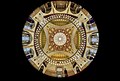
The mosque was the largest place of worship in Bahrain. It is located next to the Al Fateh Highway in Juffair, which is a suburban neighborhood of Manama. The huge 54-tonne (60-short-ton) dome, built on top of the Al-Fateh Mosque, was constructed entirely of fibreglass and was the world's largest fiberglass dome. The flooring is Italian marble and the chandelier was from Austria. The doors were made of teak from India.[3] There is Kufic calligraphy throughout the mosque.

Library

[edit]

The library of Ahmed Al-Fateh Islamic Center has approximately 7,000 books, some as old as 100 years or more. These include copies of the books of the teachings of Muhammad or what is referred to as the books of Hadith, the Global Arabic Encyclopedia, the Encyclopedia of Islamic Jurisprudence, Al-Azhar journals which have been printed more than a hundred years ago, as well as numerous periodicals and magazines.[4]

Tourism

[edit]

Besides being a place of worship, the mosque is one of the premier tourist attractions in Bahrain. It is open from 9am to 4pm and tours are conducted in a variety of languages including English, French, Filipino, Russian and many other languages, special arrangements are encouraged for smooth sailing. The mosque is open to visitors and tourists on all days except Fridays.

[edit]

See also

[edit]

References

[edit]
[edit]
Revisions and contributorsEdit on WikipediaRead on Wikipedia
from Grokipedia
The Al-Fateh Grand Mosque, located in the Juffair district of Manama, Bahrain, is the country's largest place of worship and one of the largest mosques in the world, spanning 6,500 square meters and accommodating up to 7,000 worshippers.[1] Constructed between 1984 and 1988 under the patronage of the late Amir Sheikh Isa bin Salman Al Khalifa, it serves as a central component of an Islamic educational complex that includes a Qur'anic studies department, a library, and a school for Quran memorization.[2][1] The mosque is named in honor of Ahmed Al-Fateh (Shaikh Ahmed bin Muhammad bin Khalifa), the 18th-century conqueror and founder of modern Bahrain from the ruling Al Khalifa family.[1][3] Renowned for its architectural splendor, the mosque features the world's largest fiberglass dome, intricate walls adorned with Kufic calligraphy quoting verses from the Quran, elegant crystal chandeliers, and teakwood doors handcrafted in India.[1][4] The design blends traditional Islamic motifs with modern engineering, including four minarets and separate prayer halls for men and women, creating a serene space that highlights Bahrain's commitment to Islamic heritage and education.[1] As a key cultural landmark, it attracts thousands of visitors annually, offering guided tours in multiple languages to promote interfaith understanding and showcase Islamic art and history; it remains open daily except Fridays and public holidays, when it is reserved for Muslim worshippers.[5][1] The mosque's establishment symbolizes Bahrain's royal legacy and its role as a hub for religious tolerance in the Gulf region.[1]

History

Construction and Completion

The construction of the Al Fateh Grand Mosque was initiated in 1984 as a national project under the patronage of Sheikh Isa bin Salman Al Khalifa, the Amir of Bahrain (r. 1961–1999).[4] Funded entirely by the State of Bahrain, the project utilized modern engineering techniques to erect the structure on a 6,500 square meter site in Juffair, Manama, transforming reclaimed land into a major religious landmark.[6][7] Key materials included Italian marble for the floors and walls, Indian teak for the doors, and a pioneering fiberglass composition for the central dome, which weighs 60 tons and spans 25 meters in diameter, enabling its expansive scale without traditional heavy reinforcements.[4][7] The mosque was completed and officially inaugurated in 1988 by Sheikh Isa bin Salman Al Khalifa, with an initial capacity to accommodate over 7,000 worshippers in its prayer halls.[4]

Naming and Dedication

The Al Fateh Grand Mosque is named after Sheikh Ahmed ibn Muhammad ibn Khalifa, commonly known as Ahmed Al Fateh, the 18th-century founder of the Al Khalifa dynasty and the modern state of Bahrain.[3] In 1783, Ahmed Al Fateh led the conquest of Bahrain, defeating the Persian governor Nasr Al Madhkur and establishing Al Khalifa rule over the archipelago, which marked the beginning of a new era for the region.[3] This historical achievement earned him the title "Al Fateh" (the Conqueror), and the mosque's naming honors his legacy as the progenitor of Bahrain's ruling family.[3] The mosque's dedication serves as a tribute to Bahrain's ruling Al Khalifa family and its enduring Islamic heritage, reflecting the dynasty's foundational role in the nation's history.[8] It was inaugurated in 1988 by Sheikh Isa bin Salman Al Khalifa, the then-Amir of Bahrain, who commissioned its construction four years earlier as part of an Islamic cultural center.[2] Official inauguration ceremonies were held in 1988.[9]

Architecture

Design Influences

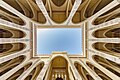
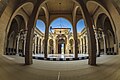
The design of the Al Fateh Grand Mosque incorporates traditional Islamic architectural elements rooted in the Abbasid era, including features such as the mihrab, minbar, minaret, sahn, and dome, which emphasize ordered repetition and rhythmic patterns typical of Islamic aesthetics.[10] These historical motifs are seamlessly integrated with contemporary materials and techniques, such as modern structural supports, to create a harmonious synthesis that reflects Bahrain's position as a cultural crossroads between ancient heritage and modern innovation.[10][11] Kufic calligraphy, originating from 7th-century Iraq during the early Islamic period, adorns the mosque's interiors, drawing on Mesopotamian influences to evoke spiritual depth without figurative representation, in line with longstanding Islamic artistic principles.[10] This stylistic choice underscores the mosque's commitment to aniconism while employing fractal-like geometric patterns for visual rhythm and symbolic infinity.[10] Central to the design is the strategic use of natural light and open spaces to cultivate a serene spiritual environment; the expansive sahn courtyard facilitates airflow and illumination, complemented by large windows that diffuse daylight throughout the prayer areas, enhancing the sense of tranquility and connection to the divine.[10]

Structural Elements

The Al Fateh Grand Mosque showcases remarkable engineering in its roof structure, featuring 82 domes of varying sizes that contribute to the building's expansive coverage and aesthetic harmony, with the central dome serving as the focal point. The massive central dome is constructed from fiberglass, weighing approximately 60 tons and spanning a diameter of 25 meters, engineered as one of the world's largest such structures to allow natural light and ventilation while minimizing weight on the foundations.[12][13][10] At the corners of the mosque stand two minarets, each reaching about 70 meters in height, designed to symbolize stability and provide elevated platforms for the call to prayer, integrating traditional Islamic symbolism with modern construction techniques to withstand Bahrain's coastal conditions.[10][14] The interior structural elements emphasize durability and beauty, with intricate Italian marble flooring laid across the vast prayer halls to create a seamless, reflective surface that enhances the sense of openness. Walls are adorned with elaborate Kufic calligraphy inscribed with Quranic verses, crafted to integrate seamlessly with the architecture without compromising structural integrity.[15][10] Illumination is achieved through a grand central chandelier of Austrian origin, suspended beneath the main dome and equipped with hundreds of lamps, representing an engineering feat in load distribution to support its substantial weight amid the dome's lightweight design.[14][16]

Facilities

Prayer Halls and Capacity

The prayer halls of the Al Fateh Grand Mosque are central to its function as a place of worship, featuring a spacious main hall primarily for men and a separate section for women, along with provisions for overflow in outdoor areas. The mosque features separate prayer halls for men on the ground floor and women on the mezzanine level, with an overall capacity of 7,000 worshippers.[17] These spaces are designed for daily prayers and larger Friday congregations, with the layout ensuring efficient movement and segregation in line with Islamic traditions. Key elements within the prayer halls include an intricately detailed mihrab on the qibla wall, indicating the direction of Mecca, and a simple yet elegant minbar from which the imam delivers sermons. Ablution facilities are integrated into the courtyard areas, providing dedicated spaces for ritual washing accessible to both men and women. The design emphasizes practicality for local use, with separate entrances and pathways leading to the halls.[17] To support comfort during gatherings, the mosque incorporates optimal acoustics for clear sound distribution throughout the halls and natural ventilation systems that promote airflow without mechanical reliance. These features, including courtyard designs and strategic openings, help maintain a serene environment even when filled to capacity. The overall site spans 6,500 square meters, allowing for additional outdoor prayer spaces during major events.[18][17]

Library and Educational Resources

The Ahmed Al-Fateh Islamic Center, which encompasses the Al Fateh Grand Mosque, includes an Islamic library housing approximately 7,000 books focused on Islamic studies, history, jurisprudence, and Arabic literature, with some volumes over 100 years old.[19][20] The library forms part of the center's educational infrastructure, established alongside the mosque's opening in 1988 to support scholarly research and community learning.[2] Complementing the Islamic library, the site has hosted the National Library of Bahrain since 2006, expanding access to broader cultural and historical collections for visitors and researchers.[21][13] The center's Quran Department, founded in 1988, serves as the primary hub for educational programs, offering classes in Arabic language for non-Arabs, as well as tajweed (proper Qur'anic recitation) and Qur'anic sciences for both Arabs and non-Arabs through theoretical and practical sessions.[22] It develops specialized curricula for recitation and memorization, conducts grading exams for affiliated centers, and organizes workshops and training courses for Qur'an teachers, imams, and muazzins to enhance teaching standards.[22] These initiatives promote ongoing religious education and skill-building within the community. The mosque facilitates lectures, Quran memorization classes, and interfaith dialogues, often integrated into guided tours that educate non-Muslims about Islamic practices and architecture.[2] Digital resources include an online platform providing access to the Holy Quran in multiple languages, supporting remote learning and recitation.[23] Preservation efforts focus on maintaining rare manuscripts and historical texts within the library collections to safeguard Bahrain's Islamic heritage.[20]

Significance

Religious and Cultural Role

The Al Fateh Grand Mosque serves as Bahrain's largest mosque, acting as the principal place of worship and a focal point for the country's Muslim community. As the largest mosque in the nation, it accommodates up to 7,000 worshippers for daily and Friday congregational prayers, reinforcing its central role in communal religious observance.[2] It hosts major Islamic holidays, including Eid al-Fitr and Eid al-Adha prayers, drawing large gatherings to celebrate these pivotal events in the Islamic calendar. The mosque's prominence extends to national religious functions, where members of the royal family participate in Friday prayers, highlighting its significance in Bahrain's spiritual and governmental traditions.[24] Integrated within the Ahmed Al Fateh Islamic Centre, the mosque promotes Islamic education through its Qur'anic studies department and library, which serve as resources for learning and knowledge dissemination. These facilities support initiatives aimed at youth and women, encouraging religious studies and community involvement to foster deeper understanding of Islamic principles. The centre's openness to visitors of all faiths further underscores its commitment to tolerance and interfaith dialogue in Bahrain's diverse society.[25][6] Named after Sheikh Ahmed al-Fateh, the Sunni conqueror who established the Al Khalifa dynasty in 1783, the mosque embodies the Sunni heritage of the ruling Al Khalifa family amid the Gulf region's religious diversity. This dedication honors the family's historical legacy since the conquest in 1783.[3]

Modern Events and Recognition

The mosque's iconic dome, constructed entirely of fiberglass and weighing over 60 tonnes, has been widely recognized as the largest of its kind in the world since its completion in the late 1980s.[8] This architectural feat, spanning a diameter of 25 meters, underscores the mosque's global acclaim for innovative engineering in Islamic design.[13] In recent years, the mosque has seen significant growth in tourism, welcoming a record 78,325 visitors in 2024, reflecting its increasing prominence as a cultural landmark.[26] To promote sustainability, a major green initiative in early 2025 involved the planting of 200 acacia trees across the grounds, in collaboration with the National Initiative for Agricultural Development and local nurseries, aligning with Bahrain's national afforestation goals to enhance environmental balance and visitor experience.[27]

Visiting

Tourism Overview

The Al-Fateh Grand Mosque serves as a prominent tourist attraction in Bahrain, drawing visitors eager to explore its blend of Islamic heritage and architectural grandeur. In 2024, the mosque welcomed a record 78,325 visitors from around the world, reflecting its growing appeal as a cultural landmark.[28] Open daily from 9 a.m. to 4 p.m. except on Fridays and public holidays, access is restricted during prayer times to respect worship activities.[5] Free guided tours, conducted by professional guides in multiple languages, provide in-depth insights into Islamic history, art, and culture, making the site accessible to diverse audiences.[18] Key highlights for tourists include the interior of the world's largest fiberglass dome, intricate exhibits of Arabic Kufic calligraphy adorning the walls, and expansive courtyards ideal for photography, offering serene spaces to appreciate the mosque's design.[18] These elements, combined with educational displays on Islamic teachings, foster cross-cultural understanding and enrich visitor experiences.[29] The mosque significantly bolsters Manama's tourism economy by attracting international sightseers and complementing nearby landmarks such as the Bab Al Bahrain souk, creating integrated itineraries that enhance the city's appeal as a Gulf heritage destination.[30]

Access and Guidelines

The Al Fateh Grand Mosque is located in the Juffair district of Manama, Bahrain, along Al Fateh Highway, making it readily accessible by car, taxi, or public transportation from central Manama or Bahrain International Airport, approximately 10-15 minutes away by road.[31][32] Free onsite parking is available for visitors, though spaces may fill quickly during peak times such as Fridays or holidays.[33][34] The mosque is wheelchair-accessible, with ramps and facilities to accommodate visitors with mobility needs.[35] Visiting hours are from 9:00 a.m. to 4:00 p.m. daily, excluding Fridays and public holidays, when the mosque is primarily reserved for worship.[5] All non-worshippers must join guided tours provided by the mosque's staff, and advance notification is required for groups larger than 15 or for non-English speakers to arrange appropriate guides.[5] Tours are not conducted during prayer times (typically five times daily, including noon on Fridays); visitors may wait in the reception area during these periods.[5] A strict dress code enforces modesty to respect the site's religious significance: men must wear long pants and shirts covering the shoulders, while women are required to don an abayah (full-length cloak) and headscarf, both provided free at reception if needed.[5] Shorts, mini-skirts, sleeveless tops, or any revealing attire are prohibited for all visitors.[5] Inside, photography is allowed in most areas but not of individuals praying or in ways that disrupt sanctity; loud conversations, eating, or disruptive behavior are forbidden to maintain a serene environment.[5]

References

User Avatar
No comments yet.