Hubbry Logo
KhatibKhatibMain
Open search
Khatib
Community hub
Khatib
logo
8 pages, 0 posts
0 subscribers
Be the first to start a discussion here.
Khatib
Khatib
from Wikipedia
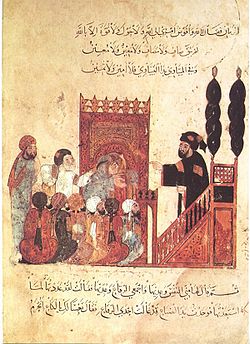
Abbasid Qadi delivers Khutbah in Mosque on the Minbar. (Khutbah is delivered by Qadis and Imams)

In Islam, a khatib or khateeb (Arabic: خطيب khaṭīb) is a person who delivers the sermon (khuṭbah) (literally "narration"), during the Friday prayer and Eid prayers.[1]

The khateeb is usually the prayer leader (imam), but the two roles can be played by different people. The khatib should be knowledgeable of how to lead the prayer and be competent in delivering the speech (khutba) however there are no requirements of eligibility to become a khatib beyond being an Adult Muslim. Some Muslims believe the khatib has to be male but women do lead Friday prayers in number of places.

Women may be khateebahs. Edina Leković gave the inaugural khutba at the Women's Mosque in California, United States, in 2015.[2][3]

See also

[edit]

References

[edit]
Revisions and contributorsEdit on WikipediaRead on Wikipedia
from Grokipedia
A khatib (Arabic: خَطِيب, khaṭīb, meaning "orator" or "preacher") is the designated speaker in who delivers the , a formal integral to congregational prayers such as the (ṣalāt al-jumuʿah) and the two . The khutbah typically includes praise of God, blessings upon the Prophet , recitation of Quranic verses, and exhortations on ethical, legal, or communal matters grounded in Islamic sources, serving both ritual and instructional purposes. While any knowledgeable Muslim may qualify, the role is conventionally fulfilled by males versed in , jurisprudence (), and , often overlapping with that of an . The title, derived from the Arabic root kh-ṭ-b connoting public address, also functions as a among , reflecting ancestral association with preaching or scribal duties.

Definition and Etymology

Linguistic Origins

The term khatib (خَطِيب) derives from , specifically as the active (fāʿil form) of the khaṭaba (خَطَبَ), which belongs to the triconsonantal kh-ṭ-b (خ-ط-ب). This root fundamentally connotes formal address, speech-making, or oration, often in a public or rhetorical context, as evidenced in classical lexicons where it encompasses delivering exhortations or discourses. Semantically, the root kh-ṭ-b extends beyond mere preaching to include proposing (khuṭbah as an oration) and general in communication, with khaṭīb thus denoting one who performs such acts—whether as a public speaker, suitor, or sermonizer. In pre-Islamic and early Islamic usage, this yielded applications for skilled orators, later specializing in religious contexts like the khuṭbah (). The term's entry into European languages occurred around the 1620s via influences, retaining its core meaning of "preacher." No direct Semitic cognates beyond are prominently attested in surviving sources, underscoring its rootedness in the language's rhetorical traditions.

Primary Meaning in Arabic

In Arabic, khatib (خَطِيب, khaṭīb) denotes an orator or public speaker, derived from the triliteral khāʾ-ṭāʾ-bāʾ (خ-ط-ب), which fundamentally relates to the act of addressing an audience formally or delivering a speech. The verb form khaṭaba (خَطَبَ) specifically means "to preach," "to orate," or "to speak eloquently in public," emphasizing rhetorical delivery often in communal or ceremonial contexts. As the active (ism fāʿil), khaṭīb thus carries the primary connotation of one who performs this act, i.e., a or eloquent speaker, without inherent religious restriction in classical usage, though it later became associated with Islamic sermonic roles. Classical Arabic lexicographers, such as those referenced in medieval dictionaries like Lisān al-ʿArab, define khaṭīb as a skilled in public address, capable of swaying listeners through structured , reflecting the term's emphasis on verbal prowess and audience engagement over mere conversation. This linguistic core prioritizes the skill of khuṭbah (خُطْبَة), a formal oration, distinguishing it from everyday speech (kalām). In pre-Islamic and early , the root appears in contexts of tribal leaders or poets delivering exhortations, underscoring its original secular applicability before Islamic codification. The term's evolution highlights Arabic's morphological system, where participles like khaṭīb encapsulate habitual action, making it a descriptor of professional speakers in assemblies or councils.

Role in Islamic Practice

The Khutbah Sermon

The khutbah, delivered by the khatib, constitutes the sermonic address preceding the congregational prayer (Jumu'ah) and , serving as a for the prayer's validity across major Islamic jurisprudential schools. It functions to remind the congregation of divine obligations, invoking praise for (hamd), blessings upon the (salawat), Quranic recitation, and exhortations to ethical conduct, thereby integrating worship with communal instruction. Jurists stipulate that the khutbah must occur after the zuhr prayer time commences and in the presence of the congregation, ensuring its public and timely nature. Structurally, the khutbah comprises two distinct parts separated by a brief sitting interval, during which the khatib pauses silently while the audience remains seated. The first part typically opens with the ("Allahu Akbar"), followed by , , a Quranic verse or , and moral or legal admonition; the second mirrors this but is often shorter, concluding with collective supplications for the Muslim community and rulers. Delivery occurs standing on the (pulpit), facing the qiblah, in to fulfill its liturgical role as an act of worship akin to , though translations may follow in multilingual settings for comprehension without affecting validity. The khatib must speak audibly, without notes in traditional practice, to maintain focus on remembrance over scripted oration. Content emphasizes core Islamic tenets, drawing from and to address , , and contemporary relevance without deviating into unsubstantiated opinion. Mandatory elements include explicit and , as omission invalidates the per consensus; optional inclusions encompass historical narratives or rulings, but brevity aligns with prophetic precedent, where sermons lasted approximately five to ten minutes. In Eid contexts, the follows the rather than preceding it, yet retains identical structural and substantive demands. This format, rooted in the Prophet Muhammad's practice—such as his addresses during migrations and the on 9 DH 10 (March 632 CE)—prioritizes spiritual efficacy over elaboration, fostering congregational unity through shared ritual.

Context in Friday and Eid Prayers

In the context of congregational prayer (salat al-jumu'ah), the khatib delivers the immediately preceding the prayer, rendering it an essential pillar for the prayer's validity according to the consensus of Sunni jurists. The comprises two distinct sermons separated by a short sitting period, during which the khatib stands on the , commences with praise of (), invokes blessings upon the Prophet Muhammad, recites Quranic verses, and offers admonition on , , and current affairs relevant to the community. Delivery occurs after the sun passes its , aligning with the prayer's prescribed time, and the khatib often serves as the leading the subsequent two rak'ahs of prayer, though the roles may be distinct. For and prayers, the khatib's follows the special congregational salat, which consists of two rak'ahs with additional takbirs, differing from the jumu'ah sequence where the precedes the prayer. This post-prayer is sunnah mu'akkadah (emphasized recommendation) rather than obligatory for validity, allowing attendees to depart after salat without listening, though it typically mirrors the jumu'ah structure in praising and exhorting the congregation. Thematic emphasis varies: for marking Ramadan's end, it often addresses distribution to ensure the needy partake in festivities; for commemorating Ibrahim's sacrifice, it focuses on themes of submission and (udhiyah). When Eid coincides with , juristic opinions differ—some Hanbali scholars permit substituting jumu'ah with Eid attendance for certain groups, but the khatib at the main upholds jumu'ah obligations.

Qualifications and Duties

Religious and Scholarly Requirements

A khatib must possess sound Islamic ('aqeedah) and religious knowledge to deliver the effectively, ensuring exhortations align with and rather than personal opinion. Scholarly competence includes familiarity with core texts for reminding congregants of Allah's obligations, such as , prayer, and moral conduct, without necessitating advanced but requiring avoidance of unsourced or innovative interpretations. Jurists across madhhabs emphasize that the khatib's delivery should foster (God-consciousness) through precise, evidence-based counsel, as superficial or erroneous sermons undermine the prayer's validity in intent if not form. Piety and moral integrity form core religious prerequisites, with the khatib expected to embody to credibly urge others toward obedience; major sinners or those lacking are deemed unsuitable by consensus, as their influence could mislead. While no explicit scriptural quota exists for memorized or , practical scholarly depth—such as understanding usul al- for deriving rulings—is vital for addressing contemporary issues without (innovation). In texts, the khatib's role demands loyalty to revealed sources over rhetoric alone, privileging depth in mastery to sustain communal faith. Contemporary applications often favor trained scholars from recognized institutions, though historical practice allowed qualified laypersons in necessity; however, unqualified delivery risks diluting doctrinal purity, as noted in fatwas urging verification of the preacher's . This underscores causal links between the khatib's preparation and the sermon's impact on adherence, with empirical observance in mosques prioritizing vetted individuals to counter .

Practical Responsibilities and Attributes

The khatib's primary practical responsibility is to deliver the in a structured format during Friday congregational prayers, consisting of two sermons separated by a brief sitting period to allow reflection. The first typically begins with praise of (), salutations upon the Prophet Muhammad (), and recitation of a Quranic verse, followed by exhortations on , moral duties, and community issues; it concludes with a (). After sitting silently for a short duration, the second mirrors this structure but often emphasizes practical guidance and ends with a final prayer for the Muslim . This format ensures the fulfills its role as a reminder of religious obligations while maintaining congregational focus, as the audience must listen attentively without interruption. In preparation, the khatib selects topics grounded in and , addressing timeless principles alongside contemporary challenges such as ethical conduct in daily life or social crises, to provide actionable spiritual and moral direction. Delivery occurs from the (pulpit) while standing, in a state of ritual purity (), with clear, audible speech to reach the assembly; the khatib may minimally but avoids excessive movement to preserve reverence. Post-khutbah, the khatib often leads the subsequent two-rak'ah , though this can be delegated to another qualified , underscoring the khutbah's precedence for validity. Brevity is emphasized, aligning with prophetic guidance to shorten sermons while extending , preventing listener fatigue and enhancing impact. Key attributes include oratorical eloquence for engaging diverse audiences, composure under public scrutiny, and adaptability to convey rulings or ethical advice logically and sequentially without digression. The khatib must exhibit and moral uprightness as a living example, fostering unity and ethical upbringing through relatable, evidence-based rather than unsubstantiated . In institutional settings, such as state-appointed roles, the khatib navigates delivering normative Islamic content amid potential external influences, prioritizing textual fidelity over politicized interpretations.

Historical Development

Origins in Early Islam

The khutbah, delivered by the khatib, originated as a public address by Prophet Muhammad to instruct and exhort the early Muslim community, particularly following the to in 622 CE. Upon arrival, the Prophet established the Friday congregational prayer (Jumu'ah), incorporating the khutbah as its essential component, with the first such sermon occurring among the Banu Salama ibn 'Awf tribe en route to or in early Medina. This practice drew from pre-Islamic Arab traditions of tribal spokesmen (khaṭībs) issuing pronouncements, but Muhammad imbued it with religious purpose, using it to convey Qur'anic guidance, legal rulings, and moral directives during communal assemblies. Throughout his prophethood until his death in 632 CE, personally served as the khatib, delivering khutbahs that addressed immediate community needs, such as unity between the and Ansar, or responses to events like battles. Authentic narrations record specific khutbahs, including one in emphasizing praise for , seeking His aid, and guidance in faith. These sermons were oral, standing on the (a simple ) or elevated ground, without written scripts, and typically bilingual in with interpretation for non-Arab converts when needed, though primarily in as the language of . The khutbah's structure—two parts separated by sitting, beginning with (praise) for and on the Prophet—emerged from this prophetic model, fulfilling the Qur'anic command for Jumu'ah assembly in al-Jumu'ah (62:9). Following Muhammad's death, the caliphs (632–661 CE) continued delivering s themselves, integrating the role into leadership duties. al-Siddiq, upon election as the first caliph in 632 CE at the Saqifah of Banu Sa'ida, immediately gave a affirming his authority and calling for obedience, setting a precedent for s to include political allegiance (). ibn al-Khattab and subsequent caliphs similarly used s for governance announcements, such as fiscal policies or military mobilizations, while maintaining the religious core. This era marked the khatib's function as synonymous with the caliph or appointed deputy in major mosques, without a specialized clerical title detached from rulership, emphasizing the khutbah's dual spiritual and communal authority in nascent Islamic polity.

Evolution During Caliphates and Medieval Periods

During the (661–750 CE), the khatib's role emphasized political legitimacy, with caliphs or appointed governors typically delivering the from the while seated, a practice symbolizing judicial and royal authority inherited from early Islamic leaders like and . (r. 661–680 CE) introduced ceremonial enhancements, including the —a screened for the preacher's protection and distinction—transforming the into a dynastic that affirmed through explicit mention of the ruler's name, thereby integrating religious observance with state across the expanding empire. The Abbasid Revolution of 750 CE marked a shift, as the new caliphs leveraged the to consolidate power by mandating invocations of their authority in mosques, evolving the khatib from a primarily ruling figure to a formalized, government-appointed position often held by qualified scholars or officials amid Baghdad's bureaucratic growth. This institutionalization reflected the Abbasids' (750–1258 CE) blend of prophetic symbolism with administrative control, delegating delivery to professional khatibs who balanced doctrinal content with political endorsements, while the caliphs increasingly withdrew from direct participation to focus on governance and intellectual patronage. In the post-Abbasid medieval era (roughly 900–1500 CE), encompassing dynasties like the Fatimids, Seljuks, and Ayyubids, the khatib's duties expanded under the influence of formalized systems, requiring deeper scholarly credentials in , , and to navigate sectarian tensions and deliver sermons aligning with ruling ideologies. Appointments remained state-controlled, serving as instruments for doctrinal enforcement—such as promoting Sunni under Seljuk viziers—yet khatibs gained in interpretive oratory, fostering a of persuasive preaching that incorporated legal and moral exhortation, though vulnerable to ruler interference in politically charged contexts. ![Abbasid Qadi from Maqamat al-Hariri][float-right]

Changes in the Modern Era

In the 20th and 21st centuries, the role of the khatib has increasingly come under state oversight in many Muslim-majority countries, with governments appointing preachers and scripting or approving khutbah content to align with national policies and curb perceived extremism. In Egypt, for instance, the Ministry of Religious Endowments began mandating weekly sermon themes in 2014, requiring imams to adhere strictly to provided texts distributed via official channels, a measure justified by authorities as preventing inflammatory rhetoric but criticized for prioritizing political conformity over independent religious discourse. Similar regulations emerged in Pakistan in 2017, where provincial governments planned to enforce pre-approved topics for Friday sermons to counter radical influences, while in Malaysia, khutbahs have served as vehicles for Islamization policies since the 1980s, reinforcing state-sanctioned Sunni orthodoxy. This centralization reflects a shift from community-selected khatibs to bureaucratized roles, often diminishing local autonomy in favor of unified messaging that may incorporate contemporary political or social agendas. Linguistic practices have also evolved to address audience comprehension in diverse settings, with khutbahs increasingly delivered in local languages rather than exclusively , particularly in non-Arab Muslim societies and communities. Traditional rulings emphasized for its ritual sanctity, but modern fatwas, such as those permitting non- delivery when the congregation predominantly lacks proficiency, have gained traction since the mid-20th century to enhance the sermon's instructional impact. Scholars like Muhammad Taqi Usmani have argued that using vernacular languages allows khatibs to convey practical guidance on current issues, a evident in places like , where post-1920s secular reforms mandated Turkish for public religious addresses, and Western mosques offering English or other translations. This change prioritizes accessibility over linguistic uniformity, though debates persist among traditionalists who view as indispensable for validity. Technological advancements have further transformed khutbah dissemination, enabling live broadcasts, online streaming, and subtitling to reach global audiences beyond physical mosques. During the starting in 2020, virtual Friday sermons proliferated via platforms like , allowing remote participation while raising questions about fulfilling congregational obligations through media. Examples include the ' 2023 initiative to air sermons with English subtitles for broader accessibility. In select communities, such as Balingka in , , longstanding local customs have permitted women to serve as khatibs for for over a century, challenging orthodox gender norms and highlighting regional variations amid broader modern pushes for inclusive religious leadership. These developments underscore the khatib's adaptation to , media, and societal shifts, though they often provoke contention over preserving scriptural fidelity versus engaging contemporary realities.

Variations and Debates

Sectarian Differences

In Twelver Shia , the Friday khutbah is not considered obligatory during the of the twelfth , rendering the congregational Friday itself recommended () rather than required, though it is still performed in many Shia communities as a precautionary or encouraged act. This contrasts with the four major Sunni schools of (Hanafi, Maliki, Shafi'i, and Hanbali), where the khutbah is an essential prerequisite for the validity of the obligatory Friday (salat ) for adult male Muslims who meet conditions like proximity to a and absence of valid excuses such as travel or illness. Content-wise, Sunni khutbahs adhere to a standardized structure derived from prophetic practice, beginning with praise of (hamd), salutations upon the , recitation of Quranic verses, admonition on moral and social issues, and supplications for the Muslim , often concluding with mention of contemporary Muslim rulers or general unity without doctrinal emphasis on specific lineages beyond the . In contrast, Shia khutbahs incorporate distinctive elements rooted in Imami theology, such as extended (blessings) upon the , his daughter , and the —particularly emphasizing ibn Abi Talib as the rightful successor—and invocations for the hastening of the twelfth Imam's appearance, alongside tabarra (disavowal of those perceived as enemies of the , such as historical figures like or Umayyad caliphs in some traditions). These inclusions reflect Shia's prioritization of the as a divinely appointed institution, differing from Sunni focus on elective or scholarly consensus (ijma'). Historically, the has served as a political instrument of legitimacy, with Sunnis under recognized caliphs or sultans required to invoke the ruler's name explicitly to affirm allegiance, a practice formalized since the Umayyad era to consolidate authority. Shia communities, viewing temporal rulers outside the Imami line as illegitimate during , traditionally omit such mentions or substitute references to the absent , leading to instances of when Shia khatibs refused to name Sunni caliphs, as occurred under Abbasid rule. In modern Shia-majority contexts like , khutbahs may reference the Supreme Leader as wali al-faqih (guardian jurist) in alignment with velayat-e faqih doctrine, though this represents a post-revolutionary rather than classical Shia consensus. Qualifications for the khatib also diverge: Sunni fiqh demands piety, knowledge of Islamic sciences, and public speaking ability, with preference for appointment by local authorities or mosque committees, but no strict sectarian exclusivity beyond adherence to Sunni orthodoxy. Shia requirements emphasize adherence to Ja'fari jurisprudence, often mandating the khatib be a mujtahid (qualified jurist) capable of independent reasoning (ijtihad) to ensure doctrinal purity, reflecting greater caution against dilution of Imami principles. Both sects prohibit women from delivering the khutbah in mixed congregations, citing prophetic precedents, though isolated contemporary Shia fatwas in Western contexts have permitted female-led sermons in gender-segregated settings without altering core validity. These differences underscore broader theological divides over authority and succession, with empirical observations from mixed regions like Iraq or Lebanon showing khutbahs as flashpoints for sectarian tension when content veers into polemics.

Contemporary Controversies

In several Muslim-majority countries, governments have imposed regulations on khatibs' sermons to counter perceived extremism and political agitation. In Egypt, following the 2013 rise of President Abdel Fattah el-Sisi, the Ministry of Religious Endowments mandated uniform Friday khutbah texts distributed to over 100,000 mosques, aiming to eliminate inflammatory rhetoric and promote state-aligned moderation; this policy sparked backlash from clerics and citizens who argued it undermined religious autonomy and the khutbah's traditional role as independent counsel. Similarly, in Bangladesh, after the 2016 Dhaka cafe attack that killed 29 people including 20 hostages, the government required imams to submit khutbah drafts for approval and banned topics inciting sectarianism or extremism, with penalties including mosque closures for non-compliance. Jordan adopted a system in 2016 sending pre-approved sermon texts via SMS to khatibs, ostensibly to standardize anti-extremist messaging, though critics contended it diminished the sermon's persuasive power against radicalism by enforcing uniformity over contextual adaptation. These measures reflect a broader trend where states, citing national security, co-opt khatibs as vectors for official narratives, often prioritizing regime stability over doctrinal independence, as evidenced in Morocco's 2023 enforcement of a guide mandating khatibs to avoid divisive content and align with monarchy-approved themes. Debates persist over women serving as khatibs, particularly in leading mixed-gender or women-only congregations for . In some Indonesian communities, such as Balingka in , women have historically acted as khatibs for over a century, rooted in local customs permitting female-led rituals; however, recent shifts toward conservatism have prompted transitions to male leadership, reflecting tensions between indigenous practices and orthodox interpretations emphasizing male precedence in . In Western contexts, proponents argue for women's eligibility based on scholarly opinions allowing females to lead women-only prayers, citing early Islamic sources, yet opponents invoke traditions restricting women from the to preserve congregational hierarchy and avoid fitna (social discord). These discussions intensified post-2000s with initiatives like female-led prayers in the U.S., which garnered support from reformist scholars but condemnation from traditionalists as (innovation), highlighting fractures between egalitarian impulses and classical rulings. Contentious khutbah themes also fuel disputes, including the balance between political commentary and spiritual focus. In , state oversight since the 1980s has oriented sermons toward government-favored topics like national unity, sidelining critiques of policy or calls for ummah-wide solidarity, which some khatibs view as diluting the Prophet Muhammad's precedent of addressing governance and injustice from the . Controversies arise over ideological sermons, such as those invoking the , with detractors labeling them divisive amid secular-nationalist frameworks, while advocates insist khutbahs must engage contemporary crises like economic disparity or foreign interventions to fulfill their advisory function. choices exacerbate divides, as insistence on recitation clashes with demands for delivery to ensure comprehension in diverse, modern audiences, per fatwas permitting mixed usage yet resisted by purists prioritizing ritual purity. Such frictions underscore causal pressures from and state , compelling khatibs to navigate authenticity against accessibility without verifiable erosion of core doctrinal tenets.

References

Add your contribution
Related Hubs
User Avatar
No comments yet.