Hubbry Logo
Amaranth (dye)Amaranth (dye)Main
Open search
Amaranth (dye)
Community hub
Amaranth (dye)
logo
8 pages, 0 posts
0 subscribers
Be the first to start a discussion here.
Amaranth (dye)
Amaranth (dye)
from Wikipedia
Amaranth
Names
IUPAC name
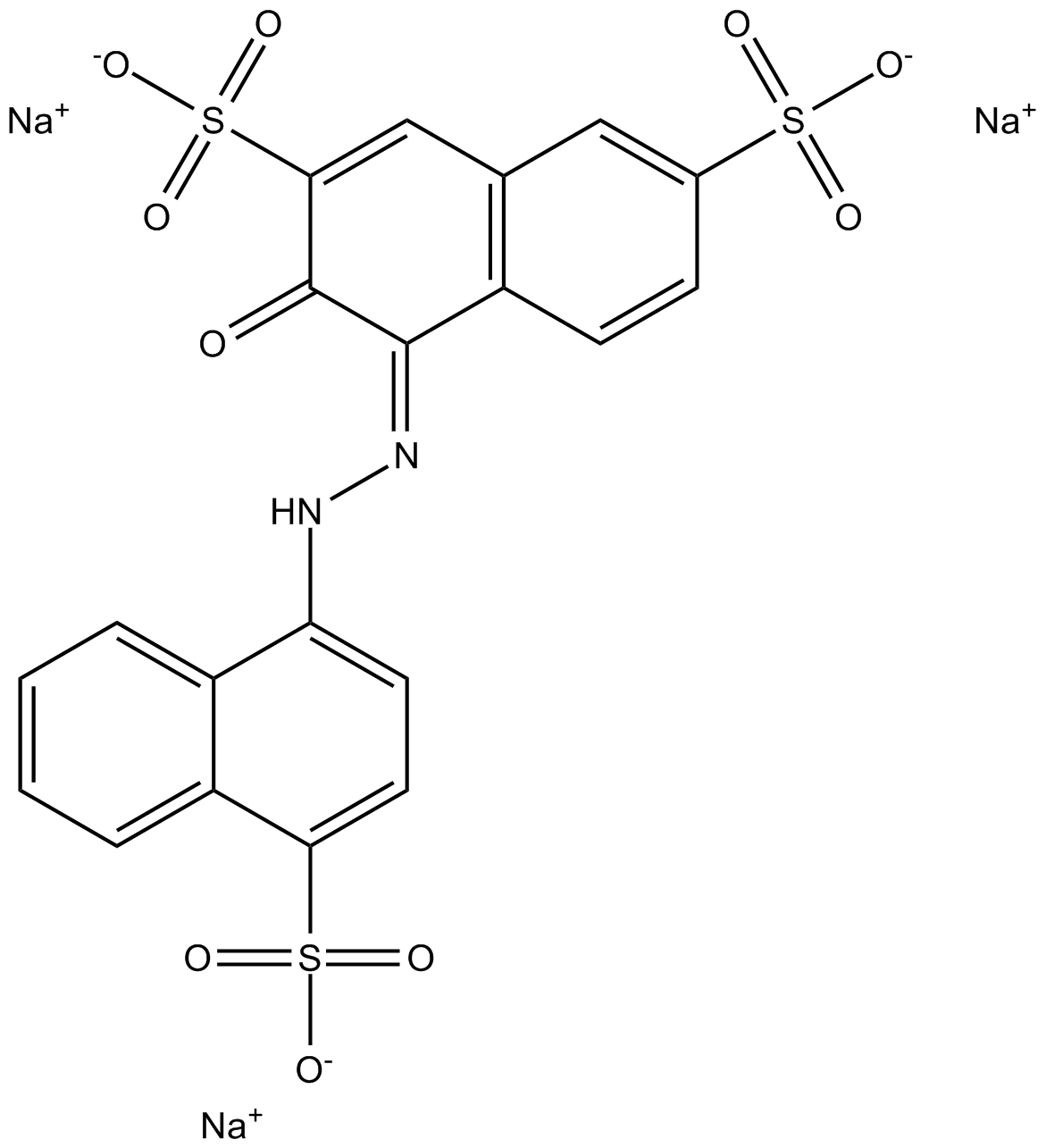
Trisodium (4E)-3-oxo-4-[(4-sulfonate-1-naphthyl)hydrazono]naphthalene-2,7-disulfonate
Other names
  • FD&C Red No. 2
  • E123
  • C.I. Food Red 9
  • Acid Red 27
  • Azorubin S
  • C.I. 16185
Identifiers
3D model (JSmol)
ChEBI
ChEMBL
ChemSpider
ECHA InfoCard 100.011.839 Edit this at Wikidata
EC Number
  • 213-022-2
E number E123 (colours)
KEGG
UNII
  • InChI=1S/C20H14N2O10S3.3Na/c23-20-18(35(30,31)32)10-11-9-12(33(24,25)26)5-6-13(11)19(20)22-21-16-7-8-17(34(27,28)29)15-4-2-1-3-14(15)16;;;/h1-10,23H,(H,24,25,26)(H,27,28,29)(H,30,31,32);;;/q;3*+1/p-3 checkY
    Key: WLDHEUZGFKACJH-UHFFFAOYSA-K checkY
  • InChI=1/C20H14N2O10S3.3Na/c23-20-18(35(30,31)32)10-11-9-12(33(24,25)26)5-6-13(11)19(20)22-21-16-7-8-17(34(27,28)29)15-4-2-1-3-14(15)16;;;/h1-10,23H,(H,24,25,26)(H,27,28,29)(H,30,31,32);;;/q;3*+1/p-3
    Key: WLDHEUZGFKACJH-DFZHHIFOAW
  • [Na+].[Na+].[Na+].[O-]S(=O)(=O)c4ccc(N=Nc1c2ccc(cc2cc(c1O)S([O-])(=O)=O)S([O-])(=O)=O)c3ccccc34
Properties
C20H11N2Na3O10S3
Molar mass 604.47305
Appearance Dark red solid
Melting point 120 °C (248 °F; 393 K) (decomposes)
Hazards
GHS labelling:
GHS07: Exclamation mark
Warning
H315, H319, H335
P261, P264, P271, P280, P302+P352, P304+P340, P305+P351+P338, P312, P321, P332+P313, P337+P313, P362, P403+P233, P405, P501
Except where otherwise noted, data are given for materials in their standard state (at 25 °C [77 °F], 100 kPa).
checkY verify (what is checkY☒N ?)

Amaranth, FD&C Red No. 2, E123, C.I. Food Red 9, Acid Red 27, Azorubin S, or C.I. 16185 is a modified red azo dye used as a food dye and to color cosmetics. The name was taken from amaranth grain, a plant distinguished by its red color and edible protein-rich seeds.

Amaranth is an anionic dye. It can be applied to natural and synthetic fibers, leather, paper, and phenol-formaldehyde resins. As a food additive it has E number E123. Amaranth usually comes as a trisodium salt. It has the appearance of reddish-brown, dark red to purple water-soluble powder that decomposes at 120 °C without melting. Its water solution has an absorption maximum of about 520 nm. Like all azo dyes, Amaranth was, during the middle of the 20th century, made from coal tar; modern synthetics are more likely to be made from petroleum byproducts.[1][2]

Since 1976, amaranth dye has been banned in the United States by the Food and Drug Administration (FDA)[3] as a suspected carcinogen.[4][5] Its use is still legal in some countries, notably in the United Kingdom where it is most commonly used to give glacé cherries their distinctive color.

History and health effects

[edit]

After an incident in the 1950s involving Orange 1[6][7] in Clover brand "Spooky Lozenges" and other orange and red candies manufactured at that time, the FDA retested food colors. Later, in 1960, the FDA was given jurisdiction over color additives, limiting the amounts that could be added to foods and requiring producers of food color to ensure the safety and proper labeling of colors. Permission to use food additives was given on a provisional basis, which could be withdrawn should safety issues arise.[7] The FDA gave "generally recognized as safe" (GRAS) provisional status to substances already in use, and extended Red No. 2's provisional status 14 times.

In 1971, a Soviet study linked the dye to cancer.[8][7] By 1976, over 1,000,000 pounds (450,000 kg) of the dye worth $5 million was used as a colorant in $10 billion worth of foods, drugs and cosmetics.[9] Consumer activists in the United States, perturbed by what they perceived as collusion between the FDA and food conglomerates,[10] put pressure on the FDA to ban it.[9] FDA Commissioner Alexander M. Schmidt defended the agency's stance, as he had earlier defended the FDA against collusion accusations in his 1975 book, stating that the FDA found "no evidence of a public health hazard".[9] However, testing by the FDA found a statistically significant increase in the incidence of malignant tumors in female rats given a high dosage of the dye,[7] as well as an increase in cholecystitis, and concluded that since there could also no longer be a presumption of safety, that use of the dye should be discontinued.[7] The FDA banned FD&C Red No. 2 in 1976.[9][11] FD&C Red No. 40 (Allura Red AC) replaced the banned Red No. 2, as its toxicity was determined to be significantly lower due to the removal of one sodium sulfonate functional group, among other molecular adjustments to furthermore reduce the immediate toxicity of the specific azo dye upon consumption.

See also

[edit]

References

[edit]
Revisions and contributorsEdit on WikipediaRead on Wikipedia
from Grokipedia

Amaranth, also designated as FD&C Red No. 2 or E123, is a synthetic red azo dye with the molecular formula C₂₀H₁₁N₂Na₃O₁₀S₃, employed historically as a colorant in foods, drugs, and cosmetics.
Developed in 1878, it provided a stable reddish hue derived from coal tar, supplanting earlier natural pigments in industrial applications.
Its certification by the U.S. Food and Drug Administration persisted until 1976, when delisting occurred following animal studies demonstrating tumor formation in female rats at high doses, prompting a precautionary ban on its use in ingested products despite debates over relevance to human exposure levels.
Although prohibited in the United States for safety reasons, amaranth retains limited authorization in regions like the European Union for specific non-solid food categories, underscoring persistent regulatory divergences on synthetic dye tolerability.
The episode exemplifies broader scrutiny of azo compounds' metabolic breakdown products, which can yield aromatic amines potentially linked to genotoxicity, fueling ongoing research into additive risks versus benefits in consumer goods.

Chemical Characteristics

Molecular Structure and Synthesis

Amaranth dye, chemically known as trisodium 3-hydroxy-4-[(4-sulfonatonaphthalen-1-yl)diazenyl]naphthalene-2,7-disulfonate, has the molecular formula C20_{20}H11_{11}N2_{2}Na3_{3}O10_{10}S3_{3}. This compound belongs to the class of azo dyes, characterized by the presence of the azo functional group (-N=N-) linking two naphthalene rings, which forms the core of its chromophoric system. The molecular structure features a diazenyl bridge connecting a 4-sulfonatonaphthalen-1-yl moiety to the 4-position of a 3-hydroxynaphthalene-2,7-disulfonate unit, with sodium counterions associated with the three sulfonic acid groups. This arrangement creates an extended conjugated π-electron system spanning the aromatic rings and the azo linkage, responsible for the dye's absorption in the visible spectrum and its characteristic reddish hue. Industrial synthesis of amaranth proceeds via the classic azo coupling reaction, involving diazotization of 1-aminonaphthalene-4-sulfonic acid to form the corresponding diazonium salt, followed by coupling with 1-naphthol-3,6-disulfonic acid under alkaline conditions to yield the trisodium salt after neutralization and salting out. The diazotization step typically employs sodium nitrite in acidic medium, such as hydrochloric acid at low temperature (0-5°C), to generate the electrophilic diazonium ion, which then electrophilically attacks the activated ortho position to the hydroxy group in the naphthol derivative. This method ensures high yield and purity suitable for commercial production, with the sulfonate groups enhancing water solubility.

Physical and Chemical Properties

Amaranth dye appears as a dark red to dark with almost no and a salty . It exhibits high in , approximately 70 g/L at 25°C, but is only slightly soluble in (up to 4 g/L) and insoluble in most organic solvents and oils. The dye demonstrates stability in neutral to mildly acidic conditions, particularly within 5-7, and resists up to 100°C, making it suitable for processed applications without significant color loss under standard conditions. However, it degrades under prolonged exposure to light via photochemical processes and in strong acids or bases, potentially cleaving the azo bond to release aromatic amines. Spectroscopically, amaranth shows a maximum absorption around 521 nm in , corresponding to its reddish hue in the . A 1% has a of approximately 10.8, and the compound remains stable under normal temperatures and pressures but decomposes above 120°C without melting.

Historical Development

Early Discovery and Commercialization

Amaranth, a trisulfonated , was first synthesized in 1886 by German Oswald Knecht through diazotization and coupling reactions involving naphthylamine derivatives derived from . This preparation occurred during the explosive growth of the synthetic industry in , spurred by earlier breakthroughs like Peter Griess's discovery of diazonium salts in 1858 and the commercialization of aniline-based colors, which shifted production from natural extracts to scalable using coal-tar byproducts. German firms dominated this era, patenting hundreds of by the 1880s, with emerging as a water-soluble variant amid over 400 new colorants developed between 1856 and 1900. Initial commercialization focused on textile dyeing, where Amaranth's stability in acidic baths and affinity for protein fibers like made it suitable for industrial-scale application by the late . Companies such as and Hoechst, leveraging Germany's near-monopoly on dye production (accounting for over 90% of global output by 1913), marketed it as a cost-effective alternative to expensive natural reds like from insects, reducing pigment costs by factors of 10 or more while providing consistent, vibrant shades resistant to fading. Its groups enhanced solubility and fixation, appealing to manufacturers amid the textile boom driven by mechanized spinning and . Transition to food uses began in the early 1900s following U.S. regulatory scrutiny under the 1906 , which initiated of coal-tar colors deemed harmless by chemists like Harvey Wiley. Amaranth received provisional approval as FD&C Red No. 2 around 1907–1910, enabling its addition to candies, beverages, and baked goods for visual enhancement, with annual U.S. production reaching thousands of pounds by the due to its heat stability and low production cost of approximately $0.50 per pound. This reflected empirical purity tests rather than long-term data, prioritizing economic viability over natural alternatives amid growing processed demand.

Mid-20th Century Adoption and Initial Regulations

Amaranth dye, designated as FD&C Red No. 2 , experienced widespread adoption in applications during the and , prior to formal certification requirements, appearing in products such as desserts, soft drinks, and baked goods to impart a vibrant hue. The Color Additive Amendments of 1960, enacted via 86-618, mandated FDA listing and batch certification for color additives, prompting the agency's provisional approval of for , , and cosmetic uses on October 12, 1960, which sustained its commercial viability amid ongoing safety evaluations. By the mid-1960s, amaranth's usage peaked in the U.S., with over 1,000,000 pounds certified annually by 1976—equivalent to a $5 million —coloring an estimated $10 billion in consumer goods, reflecting its staple role in enhancing visual appeal for mass-produced items like cereals and candies. Early regulatory oversight emphasized purity standards through mandatory batch , where each lot underwent chemical analysis to verify compliance with FDA specifications for and other contaminants, though voluntary industry guidelines predated this to address adulteration concerns. Consumer advocacy groups intensified scrutiny from the late 1960s, petitioning the FDA over potential impurities and long-term safety, which amplified calls for rigorous purity testing and contributed to provisional status extensions amid debates under the 1958 framework. Internationally, amaranth spread via approvals in the during the 1950s under the and Drugs Act, enabling its certification for like glacé cherries, and influenced precursor standards in emerging European frameworks, with global production cresting before 1976 amid efforts.

Applications

Food and Beverage Uses

(), a synthetic , serves primarily as a colorant in permitted food and beverage applications within jurisdictions such as the , where it provides stable crimson shades resistant to fading. It is commonly employed in acidic beverages, including soft drinks, aperitifs, and certain spirituous drinks like bitter sodas and Americano, as well as in items such as candies, jams, jellies, and . In baked goods and cake mixes, it contributes uniform coloration that withstands processing conditions. Usage levels are regulated to maximum permitted concentrations, typically up to 30 mg/kg in foodstuffs like fish roe substitutes and caviar analogs, while certain alcoholic beverages allow up to 100 mg/L in aperitif wines and similar products to achieve desired intensity without exceeding safety thresholds. These dosages ensure effective tinting at low concentrations, leveraging the dye's high tinctorial strength for economical application in volume-produced items. Compared to natural red pigments, amaranth offers enhanced stability across a broad pH range, particularly in acidic media prevalent in sodas and fruit-based drinks, preventing color shifts or degradation during storage. Its low tendency to bleed or migrate in formulations aids in maintaining product integrity in multi-component goods like layered candies and baked fillings, thereby supporting extended shelf-life and consistent consumer appeal.

Non-Food Applications

, a water-soluble , has been employed in industries for and to achieve a bright bluish-red hue via acid baths, as well as for coloring and synthetic fibers and . Its application extends to and phenol-formaldehyde resins, where it provides vibrant pigmentation suitable for non-ingestible materials. In cosmetics, amaranth has been utilized for imparting red tones to products such as lipsticks and other formulations, leveraging its anionic properties for stable coloration in water-based systems. However, its persistence in this sector is curtailed in regulated markets like the , where FD&C Red No. 2 was delisted for cosmetics following safety reviews initiated in the . Use continues in regions without equivalent prohibitions, though alternatives are increasingly favored due to ongoing toxicological scrutiny. Laboratory applications include its role as a , exhibiting color changes in acidic to alkaline conditions, and as a biological or in analytical procedures such as . It has also been incorporated in processes for sensitizing materials. These uses exploit its sharp color transitions and solubility, though substitution with safer dyes has reduced reliance in contemporary settings.

Regulatory Framework

United States Regulations

Amaranth, designated as FD&C Red No. 2, was provisionally listed and certified for use in foods, drugs, and in the until its delisting by the (FDA) on January 21, 1976. The FDA terminated certification following animal studies in the early 1970s that indicated tumor formation in rats, triggering application of the Delaney Clause in the Federal Food, Drug, and Cosmetic Act, which mandates prohibition of any color additive demonstrated to induce cancer in animals irrespective of dose levels or human extrapolations. This zero-tolerance provision, enacted via the 1960 Color Additive Amendments, precluded further approval despite debates over the studies' applicability to human risk, as the clause admits no threshold for carcinogenicity in test species. The 1976 ban was formalized through Federal Register notices, immediately halting domestic manufacture, sale, and use while allowing provisional tolerances for existing stocks until February 1977. No subsequent petitions or data have led to reinstatement, maintaining its status as permanently delisted with no permissible uses in any FDA-regulated products. The prohibition encompasses ingested drugs and external , reflecting the additive's prior certification across these categories, and extends to enforcement against adulterated imports containing the dye. FDA compliance is upheld through routine monitoring, warning letters, and import alerts targeting violative color additives, such as Import Alert 45-02, which detains shipments of foods, drugs, or adulterated by unapproved or delisted colors like . Products found non-compliant face detention without physical examination, , or injunctions, ensuring the ban's ongoing efficacy without exceptions for trace residues or alternative formulations. This framework prioritizes statutory absolutism over risk assessments favoring low-dose safety, as affirmed in FDA's historical application of the Delaney Clause to synthetic dyes.

European Union and International Standards

In the , amaranth (E 123) has been authorized as a since the establishment of harmonized legislation in the 1970s, with its use regulated under Annex II of Regulation (EC) No 1333/2008 on food additives. It is permitted in specific food categories at maximum levels of 30 mg/kg or , including roe (except sturgeon ), traditional French and German aperitif wines, and certain alcoholic beverages, but excluded from foods for infants and young children under 36 months unless explicitly authorized. The (EFSA) re-evaluated amaranth in 2010, establishing an (ADI) of 0–0.15 mg/kg body weight per day based on a (NOAEL) of 15 mg/kg bw/day from a 2-year study, applying an uncertainty factor of 100, and incorporating recent toxicokinetic and data showing no adverse effects at relevant exposure levels. The Joint FAO/WHO Expert Committee on Food Additives (JECFA) has evaluated multiple times, including in 1978 and 1984, allocating a temporary ADI and later affirming an ADI of 0–0.5 mg/kg bw/day while concluding no evidence of at doses up to 500 mg/kg bw/day, supported by negative results in bacterial assays, mammalian cell tests, and assays when accounting for metabolic reduction of the azo bond. Subsequent JECFA reviews aligned with findings of inadequate evidence for carcinogenicity in s or experimental animals, emphasizing that any potential effects occur only at doses far exceeding exposure estimates of less than 0.1 mg/kg bw/day for high consumers. Internationally, the Commission incorporates JECFA evaluations, listing (INS 123) with purity specifications including minimum content of 85% (as trisodium salt), limits on subsidiary dyes (≤0.5%), and heavy metal contaminants (e.g., lead ≤2 mg/kg), applicable to permitted uses in beverages and at levels up to 200 mg/kg in select categories. These standards ensure compliance with good manufacturing practices, contrasting with more restrictive national implementations by prioritizing data-driven risk assessments over precautionary exclusions.

Variations in Other Jurisdictions

In , Amaranth (E123) is approved as a food colouring agent at levels up to 300 p.p.m. in various products, with amending the List of Permitted Colouring Agents in November 2023 to expand its use in categories such as gelatins, puddings, and certain baked goods while maintaining limits elsewhere. In and , Food Standards Australia New Zealand authorizes Amaranth for application in , non-alcoholic beverages, and preserved fruits, without mandatory warning labels specific to this dye, though general advisories on synthetic colours exist in some states for child hyperactivity concerns. In , the additive is permitted for food use under national regulations, aligning with approvals in several South American markets that accommodate azo dyes more broadly than in restrictive jurisdictions. Some countries, including and , maintain prohibitions on Amaranth in food products, citing precautionary risk assessments despite its in harmonized frameworks like the EEA. These regulatory disparities generate trade frictions, particularly for exports from Amaranth-permitting regions to ban-imposing markets; manufacturers often must operate parallel production lines or reformulate recipes to exclude the , elevating costs and complicating supply chains for multinational companies targeting diverse destinations.

Toxicology and Safety Assessments

Animal and In Vitro Studies

In long-term feeding studies conducted in the 1970s, such as those involving CD rats administered amaranth (FD&C Red No. 2) at dietary concentrations exceeding 1%, researchers observed equivocal increases in testicular cell tumors in males, though these findings lacked a clear dose-response relationship and were not consistently replicated across studies. Subsequent comprehensive reviews, including multi-year dietary exposures up to 1250 mg/kg body weight daily in groups of 54 rats per sex, reported no significant elevation in tumor incidence attributable to the dye. In vitro genotoxicity assessments of amaranth have yielded mixed results, with the Ames Salmonella mutagenicity test consistently negative for inducing point mutations or frameshift mutations across tester strains. However, some assays in mammalian cell lines detected chromosomal aberrations, including gaps, breaks, and rearrangements, particularly at higher concentrations, indicating potential clastogenic activity without direct mutagenicity. More recent subchronic exposure studies in mice, such as a 2024 investigation into Swiss albino models treated with amaranth via oral routes, have indicated alterations in hematological parameters suggestive of anemia-like effects, including reduced counts and levels, alongside mild liver enzyme elevations at exaggerated doses equivalent to 500-1000 mg/kg body weight. These outcomes were observed under controlled conditions simulating high environmental or dietary overload but diminished at lower, physiologically relevant exposures.

Human Exposure and Epidemiological Data

Human exposure to (E123), a permitted in regions such as the , occurs predominantly via dietary sources including non-alcoholic beverages, , and certain preserved meats, with maximum permitted levels ranging from 50 to 300 mg/kg depending on the food category. Refined exposure assessments using consumption databases indicate mean dietary intakes below 0.1 mg/kg body weight per day across population groups in permitting countries, including children and high consumers, remaining substantially under the (ADI) of 0-0.15 mg/kg bw established by the (EFSA) following its 2010 re-evaluation. These levels reflect restricted usage and monitoring, contrasting with higher theoretical maximum intakes in unrefined models that overestimate actual consumption. No large-scale epidemiological studies have identified a causal link between amaranth intake and elevated risks of cancer, allergies, or hyperactivity in populations. Population-level surveillance in the , including post-market monitoring of food additives, has not detected spikes in tumor incidence or adverse allergic outcomes attributable to amaranth exposure. Rare case reports describe reactions, such as urticaria or exacerbation in aspirin-intolerant individuals, but these are not corroborated by cohort or case-control studies showing population-wide effects. In , amaranth is primarily metabolized via bacterial azoreductase activity in the gut , cleaving the azo bond to produce aromatic amines including 1-naphthylamine and derivatives, which are subsequently absorbed, conjugated, and excreted in urine. At typical exposure doses below the ADI, metabolite concentrations do not accumulate systemically, with rapid clearance preventing chronic buildup or sustained toxicological impact. This microbial-dependent pathway varies by individual gut flora but yields non-cumulative amine levels deemed insignificant for based on pharmacokinetic data.

Expert Panel Evaluations

In 2010, the (EFSA) Panel on Additives and Nutrient Sources added to Food re-evaluated (E 123), concluding that it presents no concern and lacks evidence of carcinogenicity across available studies, while establishing an (ADI) of 0-0.15 mg/kg body weight based on a (NOAEL) of 15 mg/kg bw/day from developmental toxicity studies in rats, adjusted by an uncertainty factor of 100 to account for inter- and intra-species variability. The panel's procedural approach emphasized comprehensive review of historical data, including long-term rodent studies showing non-carcinogenic outcomes, and prioritized conservative margins for non-genotoxic effects like renal changes observed at higher doses. The Joint FAO/WHO Expert Committee on Food Additives (JECFA) maintained its classification of as non-carcinogenic following evaluations in 1978 and 1984, allocating an ADI of 0-0.5 mg/kg bw in the latter year derived from a long-term rat carcinogenicity study with no neoplastic effects at doses up to 500 mg/kg bw/day, incorporating species-specific metabolic pathways that reduce relevance of certain animal findings to humans. This assessment procedure focused on human-relevant toxicology endpoints, rejecting precautionary restrictions absent clear mechanistic links to adverse outcomes. The International Agency for Research on Cancer (IARC) classified as Group 3—not classifiable as to its carcinogenicity to humans—in its 1975 monograph (reaffirmed in subsequent reviews), citing inadequate evidence from limited long-term and absence of human data, which underscored procedural gaps in exposure duration and endpoint specificity rather than affirmative safety or risk. This outcome reflected IARC's evidentiary threshold requiring consistent, mechanistically supported positives for higher classifications, without establishing quantitative safety margins.

Controversies and Debates

Evidence for Carcinogenicity Claims

Claims of amaranth's carcinogenicity primarily stem from rodent studies conducted in the 1960s and 1970s, which reported increased incidences of sarcomas and other tumors. Russian investigations, including a 1970 report, classified chemically pure amaranth as a carcinogen of medium strength based on tumor observations in rats. Similarly, U.S. Food and Drug Administration (FDA) evaluations in 1976 identified a statistically significant elevation in malignant tumors among female rats administered high oral doses, contributing to the dye's eventual ban in the United States. These findings often involved dosing regimens—such as gavage administration at levels equivalent to thousands of times typical human exposure—that have been critiqued for potentially inducing non-physiological effects or species-specific metabolic activations in rodents, though direct artifactuality remains debated. As an , amaranth undergoes bacterial reduction in the gut, potentially yielding metabolites such as naphthylamine derivatives, which have demonstrated carcinogenicity in historical studies of unsulfonated analogs. However, amaranth's trisulfonated structure imparts high water solubility, promoting rapid urinary excretion and diminishing the and systemic absorption of these reduction products compared to less polar azo compounds. Sulfonation is posited to hinder the metabolic activation of amines into genotoxic forms, thereby attenuating carcinogenic risk in mammalian models. Countervailing evidence includes long-term dietary studies in rats, encompassing multi-generation and in utero exposures, which reported no tumorigenic effects at doses up to 1,250 mg/kg body weight per day. The Joint FAO/WHO Expert Committee on Food Additives (JECFA) and the European Food Safety Authority (EFSA) have evaluated these data, concluding amaranth lacks carcinogenicity in rats under prolonged administration. Genotoxicity assessments, such as comet assays and micronucleus tests, frequently show no DNA damage or adduct formation in relevant tissues following oral exposure, supporting the absence of direct mutagenic mechanisms.

Precautionary Principle vs. Risk-Benefit Analysis

The ' 1976 ban on (FD&C Red No. 2), invoked under the Delaney Clause of the Federal Food, Drug, and Cosmetic Act, embodies a demanding zero tolerance for any shown to cause cancer in , regardless of dose extrapolation to humans or actual exposure levels in typical consumption scenarios. This framework effectively treats uncertain animal data as presumptive evidence of human risk, bypassing probabilistic assessments of low-dose irrelevance or metabolic differences between species, thereby prioritizing the elimination of even hypothetical hazards over practical utility. Conversely, the (EFSA) and Joint FAO/WHO Expert Committee on Food Additives (JECFA) adopt a risk-benefit analysis, deriving an (ADI) for (E 123) of 0.15 mg/kg body weight and 0-0.5 mg/kg body weight, respectively, based on no-observed-adverse-effect levels from toxicological studies adjusted by safety factors, while confirming its non-genotoxic and non-carcinogenic profile in updated evaluations. This approach incorporates estimated human exposures—typically far below ADI thresholds in permitted foods—and balances negligible risks against tangible benefits, such as the dye's stability in processed goods where natural colorants often underperform in vibrancy or shelf life, thereby sustaining economic viability for manufacturers and consumer preferences for appealing visuals. The divergence underscores trade-offs: precautionary bans like the U.S. model avert unproven threats but discarding additives with demonstrated safety margins, as no epidemiological studies link to human cancer rates despite decades of use in and elsewhere, suggesting decisions driven by rodent-specific findings rather than cross-species causal validation. -benefit paradigms, by contrast, demand empirical thresholds for action, potentially underestimating rare events but aligning regulations with observable absence of harm in exposed populations and avoiding disproportionate restrictions on innovation.

Comparisons with Permitted Azo Dyes

Amaranth exhibits a chemical profile akin to Allura Red (FD&C Red No. 40, E129), both being sulfonated monoazo dyes with comparable water solubility, light stability, and potential for intestinal reduction to aromatic amines via azoreductase enzymes. However, while Allura Red received FDA certification in 1971 following chronic toxicity studies in rats and dogs that demonstrated no carcinogenicity at doses up to 2% of diet, Amaranth (FD&C Red No. 2) was provisionally listed until its delisting in 1976 based on equivocal rat tumor data at exaggerated doses exceeding 100 times human exposure levels. This divergence persists despite genotoxicity assays, such as those using Saccharomyces cerevisiae, showing no mutagenic effects for either dye under similar conditions. Such regulatory asymmetry raises questions about the uniformity of risk thresholds for structurally analogous azo compounds, particularly as Allura Red remains authorized globally with an EU ADI of 7 mg/kg body weight. Tartrazine (E102, FD&C Yellow No. 5), another permitted , faces scrutiny for potential exacerbation of hyperactivity in sensitive children, with challenge studies reporting behavioral changes at single doses of 50 mg alongside other dyes like sunset yellow or . Yet, EFSA's 2009 re-evaluation upheld its safety with an ADI of 7.5 mg/kg body weight, citing insufficient evidence of or carcinogenicity , mirroring findings for in mouse micronucleus assays at doses up to 2000 mg/kg. Tartrazine's continued authorization, often with precautionary labeling in the but without bans, contrasts with amaranth's outright prohibition in the United States, suggesting historical precedents and jurisdictional variances influence outcomes more than divergent toxicological endpoints for these . Permitted synthetic azo dyes like Allura Red and provide superior stability (effective across 3–8 range) and thermal resistance compared to natural red alternatives such as beet-derived , which degrades rapidly above 5 or under heat processing. Production costs for natural pigments are typically 10-fold higher due to extraction inefficiencies and lower yields from botanical sources, rendering synthetics more viable for large-scale applications despite equivalent or lesser empirical risks in long-term rodent bioassays. This efficiency gap highlights how regulatory selectivity toward certain azo dyes may overlook practical trade-offs in stability and economics when weighed against data showing no clear superiority in safety margins.

References

Add your contribution
Related Hubs
User Avatar
No comments yet.