


Community hub
Recent from talks
Contribute something
Nothing was collected or created yet.
Amazon Fire
View on Wikipedia
 Logo used since 2024 | |
 Kindle Fire (7", 1st gen, 2011) showing Wikimedia main page | |
| Developer | Amazon Inc. |
|---|---|
| Manufacturer | Quanta Computer[1] |
| Type | Tablet computer Smart speaker (by turning on show mode) |
| Release date | November 15, 2011 (US) September 6, 2012 (Europe) December 18, 2012 (Japan) |
| Units sold | 7 million (as of October 2012[update])[2] |
| Operating system | Fire OS |
| System on a chip | TI OMAP 4 (1st and 2nd gen) MediaTek MT81xx (5th gen and newer) |
| CPU | Dual and Quad core (ARM) |
| Memory | 512 MB RAM (1st gen) 1 GB RAM (2nd gen)[3] 2 GB RAM (12th gen) |
| Storage | 8 GB,[4] 16 GB, or 32 GB |
| Display | 7 inch, 1024×600 resolution, capacitive multi-touch display[4] |
| Graphics | PowerVR and Mali |
| Sound | 3.5 mm stereo audio jack Top-mounted stereo speakers (1st and 2nd gen) Bottom-mounted mono speaker (5th gen and newer) |
| Camera | Front and Rear facing cameras |
| Connectivity | Micro-USB 2.0 (type B),[5] USB-C 2.0 (12th gen) 3.5 mm stereo socket[5] Wi-Fi Bluetooth (5th gen and newer) |
| Online services | Amazon Prime, Amazon Cloud Storage, Amazon Music, Amazon Prime Video, Amazon Silk, Amazon Appstore, Amazon Alexa, Amazon Kindle Store |
| Dimensions | 190 mm (7.5 in) H 120 mm (4.7 in) W 11.4 mm (0.45 in) D[6] |
| Weight | 413 g (14.6 oz)[7] |
| Successor | Fire HD |
| Website | Amazon Fire |
| Amazon Kindle Fire tablet models |
|---|
 |
| Android LCD devices |
|
| All later Fire OS LCD devices do not use Kindle in their branding. |

The Amazon Fire, formerly called the Kindle Fire, is a line of tablet computers developed by Amazon. Built with Quanta Computer, the Kindle Fire was first released in November 2011, featuring a color 7-inch multi-touch display with IPS technology and running on Fire OS, an Android-based operating system. The Kindle Fire HD followed in September 2012, and the Kindle Fire HDX in September 2013. In September 2014, when the fourth generation was introduced, the name "Kindle" was dropped. In later generations, the Fire tablet is also able to convert into a Smart speaker turning on the "Show Mode" options, which the primary interaction will be by voice command through Alexa.
History
[edit]
The Kindle Fire—which includes access to the Amazon Appstore, streaming movies and TV shows, and the Kindle Store for e-books—was released to consumers in the United States on November 14, 2011, after being announced on September 28.[8]
The original Kindle Fire retailed for US$199 in 2011.[9] Estimates of the device's initial bill of materials cost ranged from $150 to $202.[10][11] Amazon's business strategy was stated in 2011 as making money through sales of digital content on the Fire, rather than through sales of the device itself.[12][13][14]
On September 6, 2012, the Kindle Fire was upgraded to the second generation, and its price was reduced to US$159, RAM upgraded to 1 GB and processor clock speed upgraded to 1.2 GHz. On September 7, 2012, upgrades to the device were announced with consumer availability to those European countries with a localised version of Amazon's website (United Kingdom,[15] France, Germany, Italy and Spain).[16]
As of October 2012[update], the Kindle Fire was the second best selling tablet after Apple's iPad, with about 7 million units sold according to estimates by Forrester Research[2] and as of 2013[update] Amazon's tablets were the fourth best selling.[17]
The Fire tablet line was not updated until 2015; Amazon only released Fire HD and Fire HDX tablets during that time. In 2015, Amazon made a full refresh of their tablet family where they brought the range down market as a series of budget focused devices, returning to the lower-spec Fire line and cancelling the HDX line.
In September 2015, Amazon announced the release of the Fire 7, priced at US$49.99 for the 8GB version that displays advertisements on the lock screen. As of March 2016[update] it was the lowest-priced Amazon tablet.[18] In June 2016, its price was dropped briefly to US$39.99.[19] This fifth generation tablet introduced a micro SD card slot for extra storage.[20]
A slightly improved Fire 7 was released in June 2017, keeping the US$49.99 price point.[21]
An upgraded model of Fire 7 was announced in May 2019, with a scheduled release in June 2019 and keeping the US$49.99 price point.[22]
In 2022, Amazon released a significantly updated model of the Fire 7. New features to the basic Fire line are USB-C, Fire OS 8, a 2 MP front camera, a larger 10-hour life capable battery, and a significantly faster SoC with twice the RAM and storage of the previous generation. Though the tablet still features budget hardware, Amazon increased the base price to $59.99.[23]
Design
[edit]Hardware
[edit]The Kindle Fire hardware is manufactured by Quanta Computer (an Original Design Manufacturer), which also originally helped design the BlackBerry PlayBook, using it as a hardware template for the Kindle Fire.[24] First-generation Kindle Fire devices employed a 1-GHz Texas Instruments OMAP 4430 dual-core processor. The device has a 2-point multi-touch colour LCD screen with a diagonal length of 7 inches (180 mm) and a 600×1024-pixel resolution (160 dpi density). Connectivity is through 802.11n Wi-Fi and USB 2.0 (Micro-B connector). The device includes 8 GB of internal storage—said to be enough for 80 applications, plus either 10 movies or 800 songs or 6,000 books.[25][26] According to Amazon, the first-generation Kindle Fire's 4400 mAh battery sustains up to 8 hours of consecutive reading and up to 7.5 hours of video playback with wireless off;[27] later generations all offered around 7–8 hours[28]
Of the 8 GB internal storage available in the first-generation Kindle Fire, approximately 6.5 GB was available for content.[29][needs update]
The first-generation Kindle Fire has a sensor on the upper left-hand corner of the screen. This was widely considered to be an ambient-light sensor, disabled since an early software upgrade.[30]
Colour display technologies consume much more power than monochrome electronic paper (E-ink) types; Fire offer a typical battery life of 8 hours of mixed usage, while monochrome Kindles offer 15 to 30 hours' use without WiFi—"battery lasts weeks on a single charge"—with a much lower-capacity battery.[31]
Software
[edit]The first generation of Kindle Fire devices run a customised Android 2.3.3 Gingerbread OS.[32] The second-generation Kindle Fire HD runs a customised Android 4.0.3 Ice Cream Sandwich OS.[33] Along with access to Amazon Appstore,[5][34] the Fire includes a cloud-accelerated "split browser", Amazon Silk, using Amazon EC2 for off-device cloud computation; including webpage layout and rendering, and Google's SPDY protocol for faster webpage content transmission.[35][36][37] The user's Amazon digital content is given free storage in Amazon Cloud's web-storage platform,[5] 5 GB music storage in Amazon Cloud Drive, and a built-in email application allows webmail (Gmail, Yahoo!, Hotmail, AOL Mail, etc.) to be merged into one inbox.[5] The subscription-based Amazon Prime, which includes unlimited streaming of movies and TV shows, is available with a free 30-day trial period.[5]
Content formats supported by the first-generation Kindle Fire were Kindle Format 8 (KF8), Kindle Mobi (.azw), TXT, PDF, unrestricted MOBI, PRC natively, Audible (Audible Enhanced (AA, AAX)), DOC, DOCX, JPEG, GIF, PNG, BMP, PSD, EPUB non-DRM AAC, MP3, MIDI, OGG, WAV, MP4, VP8.[5][needs update][38]
Because of Amazon's USB driver implementation, the first-generation Kindle Fire suffered from slow USB transfer speeds. For example, transferring an 800MB video file may have taken more than three minutes in 2011.[39][needs update]
It is possible to convert a Kindle Fire to a tablet running standard Android, with some loss of Amazon-related functionality, and lacking features such as Bluetooth, microphone, camera, and memory expansion.[40]
In May 2022, Amazon announced the company were updating the foundation of the Fire Operating System. Amazon's next Fire 7 Tablet will come with the company's Fire OS called Fire OS 8, while Fire OS 7 has run on Android 9 since 2018, Fire OS 8 will be based on Android 11, described in the press as "a pretty significant upgrade to the foundational software currently powering Amazon tablets." With this development the company aims to introduce new user features such as a system-wide dark mode.[41]
Reception
[edit]Analysts had projected the device to be a strong competitor to Apple's iPad,[9][42] and that other Android device makers would suffer lost sales.[43][44]
In a 2012 review published by Project Gutenberg, the Kindle Fire was called a "huge step back in freedom from the Kindle 3"; the reviewer noted that Amazon introduced a "deliberate limitation" into the Fire that did not exist in the previous version: it is no longer possible to download free e-books from websites such as Project Gutenberg, Internet Archive, and Google Books and have them stored permanently in the same places where books from Amazon are kept.[45][needs update]
Sales
[edit]Customers began receiving Kindle Fires on November 15, 2011; in December 2012, customers had purchased over a million Kindle devices per week.[46] International Data Corporation (IDC) estimated that the Kindle Fire sold about 4.7 million units during the fourth quarter of 2011.[47]
The Amazon Kindle Fire helped the company beat their 2012 first quarter estimates and boosted the company's stock in extended trading.[48] As of May 2013, about 7 million units had been sold according to estimates.[2] Statistics for FY2014 or Q1&2 2015 are not yet available.[needs update]
Family
[edit]There have been many generations of Fire tablets spread across three different feature design lines: Fire, Fire HD, and Fire HDX.[49]
Beyond the tablet devices, Fire is also used for a range of media devices and for one generation of smart phone.
Models
[edit]Overview on generations and models for all Fire (including Fire HD) tablet devices:[49]
Display Size (Diag.) Generation (Year)
|
6 in | 7 in | 8 in | 8.9 in | 10.1 in | 11 in |
|---|---|---|---|---|---|---|
| 1st (2011) | Kindle Fire | |||||
| 2nd (2012) | Kindle Fire Kindle Fire HD |
|||||
| 2.5th (2012) | Kindle Fire HD WiFi Kindle Fire HD WAN |
|||||
| 3rd (2013) | Kindle Fire Kindle Fire HD WiFi Kindle Fire HD WAN |
Kindle Fire HD WiFi Kindle Fire HD WAN |
||||
| 4th (2014) | Fire HD | Fire HD | Fire HDX WiFi Fire HDX WAN |
|||
| 5th (2015) | Fire 7 | Fire HD 8 | Fire HD 10 | |||
| 6th (2016) | Fire HD 8 | |||||
| 7th (2017) | Fire 7 | Fire HD 8 | Fire HD 10 | |||
| 8th (2018) | Fire HD 8 | |||||
| 9th (2019) | Fire 7 | Fire HD 10 | ||||
| 10th (2020) | Fire HD 8 Fire HD 8+ |
|||||
| 11th (2021) | Fire HD 10 Fire HD 10+ |
|||||
| 12th (2022) | Fire 7 | Fire HD 8 Fire HD 8+ |
||||
| 13th (2023) | Fire HD 10 | Fire Max 11 | ||||
| 12th (2024) | Fire HD 8 |
Note: Items in bold are currently available.
Detailed specifications for Fire tablets:
Kindle Fire models (2011 - 2013)
| Generation (within Amazon Fire tablets) |
1st (2011) |
2nd (2012) | |
|---|---|---|---|
| Model | Kindle Fire | ||
| Code name | Otter/Blaze | Otter2 | |
| Model Number | D01400[50] | KFOT | |
| Release date | November 15, 2011 | September 14, 2012 | |
| Status | Discontinued | Discontinued | |
| OS | Fire OS 1 based on Android 2.3.3[51] |
Fire OS 2.4(?) based on Android 4.0.3[52] | |
| System Version | 6.3.4[53] | 10.5.1[53] | |
| Fire OS (latest) | 2.4 | 3.1 | |
| Screen | Size (diagonal) | 7" | |
| Resolution | 1024 × 600 | ||
| Density | 169 ppi | ||
| CPU | Maker | Texas Instruments | |
| Kind | Dual-core OMAP4 | ||
| Model | 4430 HS | ||
| Cores | 2× ARM Cortex-A9 @ 1.0 GHz |
2× ARM Cortex-A9 @ 1.2 GHz | |
| Width | 32-bit | ||
| GPU | Designer | Imagination Technologies | |
| Kind | PowerVR | ||
| Model | SGX540 | ||
| Clock | 304 MHz[54] | 384 MHz[55] | |
| Storage | RAM | 512 MiB | 1 GiB |
| Internal | 8 GB | ||
| Camera | — | ||
| Microphone | — | ||
| Bluetooth | — | ||
| Wireless | Wi-Fi | 802.11 b/g/n | |
| Location | — | Wi-Fi based | |
| Accelerometer | Yes | ||
| Weight | 413 g (14.6 oz) | 400 g (14 oz) | |
| Dimensions | 190 × 120 × 11.4 mm (7.48 × 4.72 × 0.45 in) |
189 × 120 × 11.5 mm (7.44 × 4.72 × 0.45 in) | |
| Battery | Capacity | 4400 mA⋅h | |
| Life (up to) | ? | ||
Legend: Unsupported Supported Latest version | |||
Amazon Fire models (2014 and newer)
| Generation (within Amazon Fire tablets) |
5th (2015) |
7th (2017) |
9th (2019) |
12th (2022) | |
|---|---|---|---|---|---|
| Model | Fire | Fire 7 | |||
| Code name | Ford | Austin | Mustang | Quartz | |
| Model Number | KFFOWI | KFAUWI | KFMUWI | KFQUWI | |
| Release date | September 30, 2015 | June 7, 2017 | June 6, 2019 | June 29, 2022 | |
| Status | Discontinued | Discontinued | Supported | Current | |
| OS | Fire OS 5.0.1 based on Android 5.1.1 |
Fire OS 5.3.6 based on Android 5.1.1 |
Fire OS 6.3.0 based on Android 7.1 |
Fire OS 8 based on Android 11 | |
| Fire OS (latest) | 5.7.1.0[53] | 7.3.2.9[53] | 8.3.3.3[53] | ||
| Screen | Size (diagonal) | 7" | |||
| Resolution | 1024 × 600 | ||||
| Density | 171 ppi | ||||
| CPU | Maker | MediaTek | |||
| Kind | Quad-core | ||||
| Model | MT8127B[55] | MT8163V/B (in 32-bit mode)[56] |
MT8168V/B | ||
| Cores | 4× ARM Cortex-A7 @ 1.3 GHz |
4× ARM Cortex-A53 @ 1.3 GHz |
4× ARM Cortex-A53 @ 2.0 GHz | ||
| Width | 32-bit | 64-bit & 32-bit[57] | |||
| GPU | Designer | ARM Holdings | |||
| Kind | Mali | ||||
| Model | 450 | 450 MP4 | T720 MP2 | G52 3EE MC1 | |
| Clock | 600 MHz | 600 MHz[58] | 520 MHz[59] | 800 MHz[60] | |
| Storage | RAM | 1 GiB | 2 GiB | ||
| Internal | 8 GB or 16 GB | 16 GB or 32 GB | |||
| External | At least up to 128 GB microSDXC |
At least up to 256 GB microSDXC |
At least up to 512 GB microSDXC |
At least up to 1 TB microSDXC | |
| Camera | Back | 2 MP | |||
| Front | 0.3 MP VGA | 2 MP | |||
| Microphone | Yes | ||||
| Bluetooth | Bluetooth 4.0 LE | Bluetooth 4.1 LE | Bluetooth 5.0 LE | ||
| Wireless | Wi-Fi | 802.11 b/g/n | 802.11 a/b/g/n (dual band) | 802.11 a/b/g/n/ac (dual band) | |
| Location | Wi-Fi based | ||||
| Accelerometer | Yes | ||||
| Weight | 313 g (11.0 oz) | 295 g (10.4 oz) | 286 g (10.1 oz) | 282 g (9.9 oz) | |
| Dimensions | 191 × 115 × 10.6 mm (7.52 × 4.53 × 0.42 in) |
192 × 115 × 9.6 mm (7.56 × 4.53 × 0.38 in) |
192 × 115 × 9.6 mm (7.56 × 4.53 × 0.38 in) |
180.7 × 117.6 × 9.7 mm (7.11 × 4.63 × 0.38 in) | |
| Battery | Capacity | 2980 mA⋅h[61] | 2980 mA⋅h | 3200 mA⋅h | 3750 mA⋅h |
| Life (up to) | 7 hours | 8 hours | 7 hours | 10 hours | |
Legend: Unsupported Supported Latest version | |||||
Gallery
[edit]-
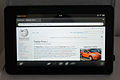 The Kindle Fire in horizontal position displaying web page
 -
 The iPad (left) compared with the Kindle Fire (right)
 -
 The Kindle Fire (left) compared with the iPod Touch (right)
 -
 The Kindle Fire (left) compared with the iPad Mini (center) and the Nexus 7 (2012 version) (right)


Timeline
[edit]| Timeline of Amazon Fire tablet models |
|---|
 Disclaimer: The discontinuation dates may not be precise. |
See also
[edit]References
[edit]- ^ Lai, Marcus (September 27, 2011). "Amazon to burn new tablet this week, says report". Punch Jump LL C. Archived from the original on April 3, 2012. Retrieved September 29, 2011.
- ^ a b c Brian X. Chen (October 19, 2012). "How Are 7-Inch Tablets Doing?". The New York Times. Retrieved October 20, 2012.
- ^ "Kindle Fire Device and Feature Specifications". Amazon Mobile app distribution. Amazon. Archived from the original on January 15, 2013. Retrieved February 16, 2013.
- ^ a b Lee, Tyler (September 28, 2011). "Amazon Kindle Fire unveiled". Ubergizmo. Blogzilla LLC.
- ^ a b c d e f g "Kindle Fire - the Amazon Tablet with Full Color 7" Multi-Touch Display, Wi-Fi". Amazon.com. Retrieved October 2, 2011.
- ^ "Kindle Fire Amazon description". Amazon. Accessed: November 23, 2011
- ^ Grabham, Dan (October 31, 2011). "Amazon Kindle Fire: what you need to know Updated: Kindle tablet release date, specs, features and more". TechRadar UK. Future Publishing Ltd.
- ^ "Kindle Fire | Amazon - The Verge". The Verge. Archived from the original on November 13, 2022. Retrieved August 10, 2022.
- ^ a b "Amazon's Kindle Fire to sell at $199, challenging iPad". Chicago Tribune. September 28, 2011. Archived from the original on October 26, 2011.
- ^ Merritt, Rick (September 28, 2011). "Kindle Fire profitable at estimated $150 BoM". eetimes.
- ^ Olivarez-Giles, Nathan (November 18, 2011). "Amazons 199 Kindle Fire costs 201.70 to build, report says". Los Angeles Times.
- ^ Myslewski, Rik (September 30, 2011). "Amazon's Kindle Fire is sold at a loss". theregister.co.uk. The Register.
- ^ Whitney, Lance (September 29, 2011). "Amazon to lose $50 on each Kindle Fire, says analyst". CNET. Retrieved June 26, 2020.
- ^ Naughton, John (October 2, 2011). "Kindle Fire: the tablet that knows your next move". The Guardian / The Observer.
- ^ "Kindle Fire Comes to the UK—Introducing the All-New Kindle Fire HD and Kindle Fire". Amazon.co.uk. September 6, 2012. Retrieved September 10, 2012.
- ^ "Amazon's Kindle Fire to go on sale in Europe (AFP)". Phys.org. September 6, 2012. Retrieved September 14, 2012.
- ^ "Newsroom, Announcements and Media Contacts | Gartner". Archived from the original on March 3, 2014.
- ^ "Amazon Fire tablets". Amazon. Retrieved March 4, 2016. List of current Fire tablets on Amazon, sorted by price.
- ^ "You can actually get a brand new Amazon Fire tablet right now for $40". bgr.com. June 13, 2016. Retrieved September 26, 2016.
- ^ "Fire Tablets MicroSD Card How To Guide – Everything You Need to Know". ebook reader. October 5, 2015. Retrieved September 26, 2016.
- ^ "Amazon Fire 7 (2017)". PCMag UK. July 5, 2017. Retrieved September 12, 2017.
- ^ Haselton, Todd (May 16, 2019). "Amazon just announced a new version of its $50 tablet". CNBC. Retrieved October 21, 2021.
- ^ "Amazon Fire 7 Tablet (2022 Release) Review".
- ^ "The Amazon tablet will look like a PlayBook - because it basically is". Engadget. Archived from the original on March 14, 2017. Retrieved June 19, 2014.
- ^ Murph, Darren (September 28, 2011). "Amazon Kindle Fire tablet unveiled: Android-based, 7-inch display, $199 price tag". Engadget. AOL Inc.
- ^ Ziegler, Chris (September 28, 2011). "Amazon Kindle Fire vs. iPad 2 vs. Nook Color: by the numbers". This Is My Next. Archived from the original on September 30, 2011.
- ^ "Kindle Fire - Full Color 7" Multi-Touch Display with Wi-Fi". Amazon. Retrieved March 18, 2013.
- ^ "Fire HD 6 - Amazon site". Amazon.com. Retrieved March 7, 2016. See "Compare Fire Tablets" section: New HD6, HD8, and HD10 all claim "Up to 8 hours of reading, surfing the web, watching video, and listening to music"; 7" Fire claims 7 hours.
- ^ Dawson, Christopher (November 17, 2011). "Kindle Fire: Edu holy grail or one more DRM-ridden toy?". ZDNet. Archived from the original on November 18, 2011. Retrieved March 18, 2013.
- ^ "Eric Bergman-Terrell's Blog". Ericbt.com. Retrieved March 18, 2013.
- ^ "Kindle e-reader – Amazon's Official Site – Learn More". Amazon.com. Retrieved March 7, 2016.
- ^ Hollister, Sean (September 28, 2011). "Amazon's Kindle Fire UI: it's Android, but not quite". This Is My Next. Archived from the original on October 31, 2011.
- ^ "Getting Started with Kindle Fire". Archived from the original on October 7, 2012. Retrieved September 27, 2012.
- ^ Tung, Liam (September 20, 2011). "Amazon opens global Appstore by stealth". Itnews.com.au. Retrieved March 18, 2013.
- ^ Boulton, Clint (September 29, 2011). "Amazon EC2 Underlies Kindle Tablet 'Silk' Browser". eweekeurope.co.uk. Archived from the original on October 5, 2011.
- ^ "Introducing Amazon Silk". amazon.com. Retrieved October 2, 2011.
- ^ Amazon Silk team (September 28, 2011). "Introducing Amazon Silk". amazonsilk.wordpress.com. Archived from the original on July 5, 2012.
- ^ "Fire Tablet Specifications: Fire Models | Fire Tablets". developer.amazon.com. Retrieved January 16, 2023.
- ^ Ku, Andrew (November 24, 2011). "Storage Performance: Slightly Faster Than USB 1.0?! : The Amazon Kindle Fire: Benchmarked, Tested, And Reviewed". Tom's Hardware: Hardware News, Tests and Reviews. Retrieved December 4, 2011.
- ^ Rick Broida (June 21, 2013). "Turn your Kindle Fire into an Android 4.2 tablet". Cnet.com. Retrieved March 7, 2016.
- ^ "Amazon's updating the foundation of Fire OS to something a bit more modern". The Verge. May 20, 2022. Retrieved May 25, 2022.
- ^ Letzing, John (September 28, 2011). "Amazon to Challenge iPad". The Wall Street Journal. Retrieved October 1, 2011.
- ^ "Amazon's Kindle Fire Will 'Vaporize' Android But Leave Apple Unscathed". The Wrap. December 6, 2011. Archived from the original on March 13, 2013. Retrieved March 18, 2013.
- ^ Lee Brodie, ed. (September 28, 2011). Gene Munster: Samsung, Others Should Worry about Kindle Fire. CNBC. Archived from the original on October 27, 2014. Retrieved September 9, 2017.
- ^ "Kindle Fire Review". Project Gutenberg. December 21, 2012. Archived from the original on January 12, 2013. Retrieved March 17, 2013.
You can get free ebooks to the Fire too, but the process is so cumbersome that it isn't worth the trouble given the alternative of buying a Nexus 7, which handles free ebooks with ease. To be specific, there is no way to download free books from the web and have the Kindle Fire store them permanently or in the same places where your books from Amazon are kept. This was easy with the Kindle 3. No more.
- ^ "Amazon Appstore Presentation at CES". Amazon Appstore Developer Blog. January 6, 2012. Archived from the original on January 19, 2012. Retrieved January 7, 2012.
- ^ Thomas Claburn (April 7, 2012). "iPad Mini: 6 Reasons Apple Must Do It". InformationWeek. Archived from the original on April 9, 2012. Retrieved April 13, 2012.
- ^ Nakashima, Ryan (April 26, 2012). "Kindle Fire helps Amazon beat 1Q estimates". Yahoo News -Tech. Retrieved April 28, 2012.
- ^ a b "Fire Tablet Device Specifications: Overview". developer.amazon.com. Retrieved May 31, 2021.
- ^ "Amazon Kindle Fire D01400 Tablet Teardown | Electronics360". electronics360.globalspec.com. Retrieved November 20, 2021.
- ^ "Fire Tablet Specifications: Fire Models".
- ^ "Fire Tablet Specifications: Fire Models".
- ^ a b c d e "Fire Tablet Software Updates". Amazon.
- ^ "Amazon's Kindle Fire HD: Better; Can It Compete With The Nexus 7?". October 25, 2012.
- ^ a b "Tablet Device Specifications Fire Tablets". developer.amazon.com. Retrieved October 29, 2018.
- ^ "Tablet Device Specifications Fire Tablets". developer.amazon.dom. Retrieved May 21, 2019.
- ^ "Fire Tablet Specifications: Fire Models | Fire Tablets". developer.amazon.com. Retrieved July 1, 2022.
- ^ "MediaTek MT8127 review and specs (Size, cores, gpu Gflops, GHZ, nm)".
- ^ "MediaTek MT8163 review and specs (Nm, gpu Gflops, size, cores, GHZ)".
- ^ "MediaTek MT8168 review and specs (Gpu Gflops, size, cores, nm, GHZ)".
- ^ "Macro photo of the Amazon Fire 2015 motherboard". forum.xda-developers.com. October 18, 2015. Retrieved December 23, 2015.
External links
[edit]
- Fire Tablets – home page on Amazon site
- Amazon Fire - Device and Feature Specifications
- Kindle Fire Review at The Wall Street Journal

| National | |
|---|---|
| Other | |


