



Community hub
Recent from talks
Knowledge base stats:
Talk channels stats:
Members stats:
American crow
The American crow (Corvus brachyrhynchos) is a large passerine bird species of the family Corvidae. They are a common bird found throughout much of North America, only absent from the tundra biome. American crows are the New World counterpart to the carrion crow and the hooded crow of Eurasia; all occupying the similar ecological niches.
American crows have all black plumage, with iridescent feathers. It looks much like other all-black corvids. They are highly intelligent, similar to other Corvidae, and are adaptable to human environments. The most common call of an American crow is the CaaW!-CaaW!-CaaW! They can be distinguished from the common raven by their smaller size and a slightly less pronounced beak; from the carrion crow by their size, as the carrion crow is larger and of a stockier build. American crows can be difficult to distinguish from the fish crow, however fish crows tend to fluff their throat feathers when calling. They are omnivores, feeding on insects, seeds, nuts, and preying on small animals. They also rarely feed on carrion, leading to associations with death, thieves, and bad luck in some cultures, however, in Native American culture, along with some Gaelic cultures, crows are considered good luck, due to their intelligence.
American crows are common, widespread, and susceptible to the West Nile virus, making them a useful bioindicator for tracking the virus's spread. Direct transmission of the virus from crows to humans is impossible. According to BirdLife International, there are 31 million crows as of 2012.
The American crow was described by German ornithologist Christian Ludwig Brehm in 1822. Its scientific name means literally 'short-billed crow', from Ancient Greek βραχυ- brachy- ('short-') and ρυνχος rhynchos ('billed').
A 2012 genetic analysis of the genus Corvus calculated that the American crow diverged from a lineage that gave rise to the collared, carrion and hooded crows around 5 million years ago.
"American crow" has been designated the official name by the International Ornithologists' Union (IOU).
The number of subspecies varies by authority, ranging between three and five. The unclear taxonomy of the northwestern crow, previously its own species, has complicated subspecies determinations. Subspecies differ in bill proportion and form a rough NE–SW clinal in size across North America. Birds are smallest in the far west and on the southern coast.
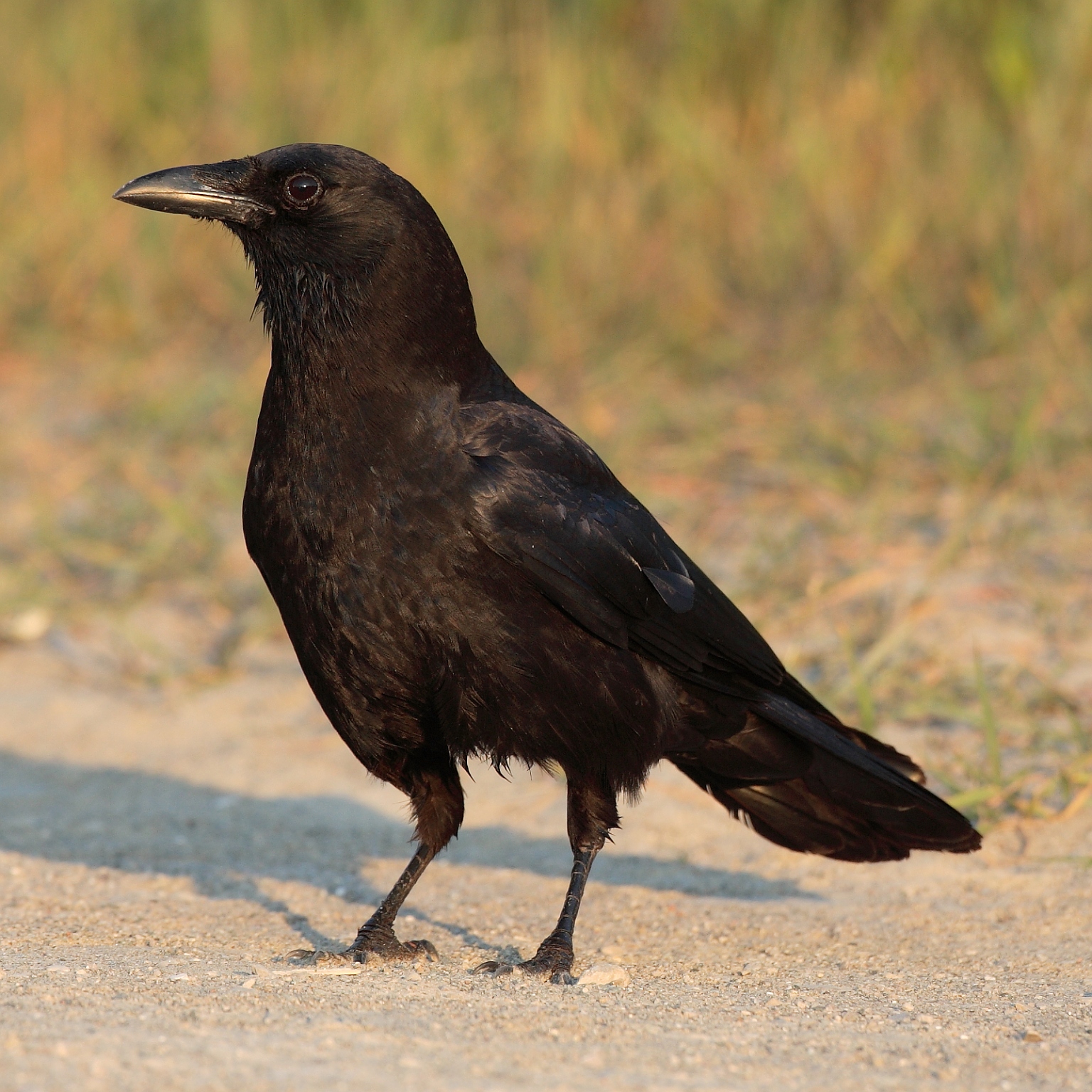
The American crow is a large, distinctive bird with iridescent black feathers all over. Its legs, feet and bill are also black. They measure 40–53 cm (16–21 in) in length, of which the tail makes up about 40%. The wing chord is 24.5 to 33 cm (9.6 to 13.0 in), with the wingspan ranging from 85 to 100 cm (33 to 39 in). The bill length can be from 3 to 5.5 cm (1.2 to 2.2 in), varying strongly according to location. The tarsus is 5.5 to 6.5 cm (2.2 to 2.6 in) and the tail is 13.5 to 19 cm (5.3 to 7.5 in). The body mass can vary from 316 to 620 g (11.1 to 21.9 oz). Males tend to be larger than females. The most usual call is a loud, short, and rapid caaw-caaw-caaw. Usually the birds thrust their heads up and down as they utter this call. American crows can also produce a wide variety of sounds and sometimes mimic noises made by other animals, including other birds, such as barred owls.
Hub AI
American crow AI simulator
(@American crow_simulator)
American crow
The American crow (Corvus brachyrhynchos) is a large passerine bird species of the family Corvidae. They are a common bird found throughout much of North America, only absent from the tundra biome. American crows are the New World counterpart to the carrion crow and the hooded crow of Eurasia; all occupying the similar ecological niches.
American crows have all black plumage, with iridescent feathers. It looks much like other all-black corvids. They are highly intelligent, similar to other Corvidae, and are adaptable to human environments. The most common call of an American crow is the CaaW!-CaaW!-CaaW! They can be distinguished from the common raven by their smaller size and a slightly less pronounced beak; from the carrion crow by their size, as the carrion crow is larger and of a stockier build. American crows can be difficult to distinguish from the fish crow, however fish crows tend to fluff their throat feathers when calling. They are omnivores, feeding on insects, seeds, nuts, and preying on small animals. They also rarely feed on carrion, leading to associations with death, thieves, and bad luck in some cultures, however, in Native American culture, along with some Gaelic cultures, crows are considered good luck, due to their intelligence.
American crows are common, widespread, and susceptible to the West Nile virus, making them a useful bioindicator for tracking the virus's spread. Direct transmission of the virus from crows to humans is impossible. According to BirdLife International, there are 31 million crows as of 2012.
The American crow was described by German ornithologist Christian Ludwig Brehm in 1822. Its scientific name means literally 'short-billed crow', from Ancient Greek βραχυ- brachy- ('short-') and ρυνχος rhynchos ('billed').
A 2012 genetic analysis of the genus Corvus calculated that the American crow diverged from a lineage that gave rise to the collared, carrion and hooded crows around 5 million years ago.
"American crow" has been designated the official name by the International Ornithologists' Union (IOU).
The number of subspecies varies by authority, ranging between three and five. The unclear taxonomy of the northwestern crow, previously its own species, has complicated subspecies determinations. Subspecies differ in bill proportion and form a rough NE–SW clinal in size across North America. Birds are smallest in the far west and on the southern coast.
The American crow is a large, distinctive bird with iridescent black feathers all over. Its legs, feet and bill are also black. They measure 40–53 cm (16–21 in) in length, of which the tail makes up about 40%. The wing chord is 24.5 to 33 cm (9.6 to 13.0 in), with the wingspan ranging from 85 to 100 cm (33 to 39 in). The bill length can be from 3 to 5.5 cm (1.2 to 2.2 in), varying strongly according to location. The tarsus is 5.5 to 6.5 cm (2.2 to 2.6 in) and the tail is 13.5 to 19 cm (5.3 to 7.5 in). The body mass can vary from 316 to 620 g (11.1 to 21.9 oz). Males tend to be larger than females. The most usual call is a loud, short, and rapid caaw-caaw-caaw. Usually the birds thrust their heads up and down as they utter this call. American crows can also produce a wide variety of sounds and sometimes mimic noises made by other animals, including other birds, such as barred owls.