Hubbry Logo
Siberia (continent)Siberia (continent)Main
Open search
Siberia (continent)
Community hub
Siberia (continent)
logo
8 pages, 0 posts
0 subscribers
Be the first to start a discussion here.
Siberia (continent)
Siberia (continent)
from Wikipedia
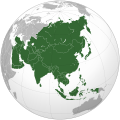
Current location of the remains of the ancient landmass of Siberia in north Asia

Siberia, also known as Siberian Craton, Angaraland (or simply Angara) and Angarida,[1] is an ancient craton in the heart of Siberia. Today forming the Central Siberian Plateau, it formed an independent landmass prior to its fusion into Pangaea during the late Carboniferous-Permian. The Verkhoyansk Sea, a passive continental margin, was fringing the Siberian Craton to the east in what is now the East Siberian Lowland.[2]

Angaraland was named in the 1880s by Austrian geologist Eduard Suess who erroneously believed that in the Paleozoic Era there were two large continents in the Northern Hemisphere: "Atlantis", which was North America connected to Europe via a peninsula (Greenland and Iceland), and "Angara-land", which would have been eastern Asia, named after the Angara River in Siberia.[3]

Tectonics

[edit]

About 2.5 billion years ago (in the Siderian Period), Siberia was part of a continent called Arctica, along with the Canadian Shield. Around 1.1 billion years ago (in the Stenian Period), Siberia became part of the supercontinent of Rodinia, which lasted until the Tonian about 750 million years ago when it broke up, and Siberia became part of the landmass of Protolaurasia. During the Ediacaran Period around 600 million years ago, Protolaurasia became part of the southern supercontinent of Pannotia. Around 550 million years ago, both Pannotia and Protolaurasia split up to become the continents of Laurentia, Baltica and Siberia.[citation needed]

Map of Earth's continents and oceans in the middle of the Ordovician Period, about 470 million years ago (SI=Siberia, LA=Laurentia, BA=Baltica)

Siberia was an independent continent through the early Paleozoic until, during the Carboniferous Period, it collided with the minor continent of Kazakhstania. A subsequent collision with Euramerica/Laurussia during the Late Carboniferous-Permian formed Pangaea.[4]

Pangaea split up during the Jurassic though Siberia stayed with Laurasia. Laurasia gradually split up during the Cretaceous with Siberia remaining part of present-day northeastern Eurasia. Today, Siberia forms part of the landmass of Afro-Eurasia. To the east it is joined to the North American plate at the Chersky Range. In around 250 million years from now Siberia may be in the subtropical region and part of the new supercontinent of Pangaea Proxima.[citation needed]

Features

[edit]

See also

[edit]

References

[edit]
[edit]
Revisions and contributorsEdit on WikipediaRead on Wikipedia
from Grokipedia
Siberia, also known as the , , or , is an ancient craton located in the central and northern part of Siberia, , forming the core of the Asian portion of the Eurasian tectonic plate. It encompasses an area of approximately 2.5–3 million square kilometers, consisting of and crystalline basement rocks overlain by and sedimentary platforms. Geologically, Siberia originated through the assembly of microcontinents and s during the , stabilizing as a by the late . It remained an independent continent throughout much of the era, positioned in various paleogeographic configurations relative to other landmasses, until the Carboniferous period when it collided with the , initiating its integration into the larger Eurasian continent during the and . This tectonic evolution is marked by surrounding fold belts, such as the Altay-Sayan and , and marginal basins that record episodes of rifting, , and accretion. The craton's stability has preserved extensive records of Earth's geological history, including evidence of supercontinent cycles like and Pangea, while its mineral resources, including diamonds, , and hydrocarbons, underscore its economic significance in modern geological studies.

Geological Formation

Precambrian Assembly

The Siberian craton, the core of the ancient continent of , underwent initial assembly during the Paleoproterozoic era, primarily between 2.1 and 1.8 billion years ago, through the collision and welding of multiple and early Paleoproterozoic crustal blocks. This process involved the accretion of microcontinents such as the Anabar, Aldan, and Olenek superterranes, which were sutured together by extensive orogenic belts, including the Akitkan and belts in southern Siberia. These events marked a transition from fragmented terranes to a more cohesive cratonic structure, with high-grade metamorphic complexes and granitic intrusions playing key roles in stabilizing the amalgamated blocks. Major orogenic activity in southern Siberia during this interval, coinciding with global tectonic episodes, included subduction-related magmatism from 2.15 to 2.04 billion years ago and collisional events between 2.00 and 1.87 billion years ago, culminating in post-collisional granitoid emplacement around 1.88 to 1.84 billion years ago. Geochronological evidence from U-Pb dating of in these southern Siberian granitoids and volcanic rocks confirms the timeline, revealing a South Siberian postcollisional magmatic belt that delineates suture zones between the accreted terranes. This assembly formed stable cratonic blocks resistant to subsequent deformation, setting the foundation for later stabilization processes.

Cratonic Stabilization

Following the initial assembly of the Siberian craton in the , stabilization processes during the and eras solidified its structural integrity, enabling the accumulation of extensive, largely undeformed sedimentary sequences. In the (approximately 1.6 to 1.0 Ga), the craton experienced tectonic quiescence that facilitated the deposition of Riphean sediments in intracratonic basins, reaching thicknesses of 1–4 km in central areas and up to 10–14 km along margins such as the Uchur-Maya region. These sediments, primarily carbonates and clastics, overlie the cratonic with minimal tectonic disturbance, reflecting a transition to and platform conditions. By the , Vendian sediments (630–542 Ma) were deposited conformably or with minor unconformities atop the Riphean layers, further attesting to the craton's enhanced rigidity and resistance to deformation. This period of stabilization culminated in the development of a stable platform characterized by flat-lying, undeformed strata that form the foundational core of the . Post-1.8 Ga, the platform underwent minimal orogenic activity, allowing for the preservation of these sedimentary covers without significant folding or , which distinguishes it from more dynamic continental margins. The resulting architecture provided a robust, low-relief expanse that has endured subsequent geological epochs with little alteration, underscoring the craton's long-term tectonic passivity. Central to this stability were Archean nuclei exposed in key geological provinces, notably the Aldan Shield in the southeast and the Anabar Shield in the north, which acted as anchoring blocks for the craton's framework. These shields, comprising ancient dating back to 3.0–2.5 Ga, resisted subsequent tectonic forces and influenced the distribution of overlying sediments, with Riphean and Vendian layers thinning toward these exposed cores. The extent and preservation of individual sedimentary layers across the platform directly correlate with the prolonged tectonic quiescence initiated around 1.8 Ga, during which extensional rifting created basins without major disruptive events.

Tectonic Evolution

Paleozoic Independence and Collisions

During the early Era, from the through the periods, the Siberian existed as an independent continent, separated from other major landmasses by expansive oceanic basins. This isolation stemmed from of the in the late , allowing Siberia to drift northward as a coherent block with its stable core providing structural integrity. Paleomagnetic reconstructions indicate that Siberia occupied high northern latitudes, potentially north of , with minimal tectonic interference until the late . Early tectonic interactions along Siberia's margins are evidenced by subduction-related eclogite-facies in the latest to Early (approximately 500–470 Ma), recorded in rocks of the and peri-Siberian terranes. This high-pressure , reaching conditions of 15–20 kbar and 500–600°C, suggests of in a transition zone between and , hinting at initial convergence before full isolation ended. Such events involved the consumption of intervening ocean floor, marking the onset of peripheral orogenic activity without disrupting the craton's core. Siberia's independence concluded with a series of collisions in the late , first with the minor continent of during the Period. This event, dated to the –Bashkirian stages (325–315 Ma), involved the closure of the Irtysh-Zaisan Ocean through southward , culminating in along the Irtysh-Zaisan suture zone. The impact is documented by a shift from marine to terrestrial sedimentation, post-collisional magmatism, and deformation in the Altai region, effectively welding to Siberia's southern margin. Following this amalgamation, the enlarged Siberia-Kazakhstania block collided with Euramerica (Laurussia) in the Late Carboniferous to Permian (approximately 320–250 Ma), contributing to the assembly of the supercontinent. This convergence closed the Uralian Ocean and generated the through oblique continent-continent collision, with peak deformation in the Early Permian involving thrust faulting, folding, and magmatism along the eastern margin of . The produced a fold-and-thrust belt over 2,000 km long, with metamorphic grades reaching facies in some zones, marking Siberia's integration into the northern flank of .

Mesozoic and Cenozoic Integration

During the period, the supercontinent underwent breakup, with Siberia, as part of the northern landmass, integrating into alongside and . This fragmentation initiated around 200 million years ago, driven by rifting that separated from , allowing Siberia to maintain its position within the northern supercontinent throughout the era. In contrast to the intense Precambrian and deformations that shaped the , and rocks exhibit gentle, localized deformation, characterized by mild folding and faulting in sedimentary covers. This subdued tectonic activity reflects the craton's stabilization within , with post-rift subsidence dominating over major orogenic events, as evidenced by the preservation of Upper and lower Tertiary strata in relatively undeformed states. Today, Siberia's eastern margin links to the North American Plate across the Chersky Range, a seismically active boundary zone marking the transition between the Eurasian and North American plates, while the craton as a whole forms an integral part of Afro-Eurasia. GPS measurements confirm that the region east of the Chersky Range moves with the North American Plate, highlighting ongoing subtle interactions at this plate boundary. The West Siberian Basin exemplifies this integration through its sequential tectonic stages from the Late Carboniferous to : an initial orogenic phase involving Permian collisions that formed foldbelts in the basement, followed by rifting that deposited volcanic and clastic sequences, and culminating in a to platform stage marked by stable subsidence and deposition of the thick Formation. These stages transitioned from a collisional margin to a passive intracratonic basin, facilitating extensive with minimal disruption.

Paleogeographic Positions

In Supercontinents

Siberia's cratonic core played a pivotal role in the assembly and disassembly of ancient supercontinents, beginning with its integration into Rodinia during the Stenian period around 1.1 billion years ago. As a stable continental fragment, Siberia occupied a position along the northern margin of Laurentia within this Neoproterozoic supercontinent, contributing to Rodinia's cohesive structure through Grenvillian-age orogenic events that welded it to surrounding cratons. This stability enabled Siberia's enduring participation in supercontinent cycles, despite subsequent rifting, though exact positions remain subject to ongoing paleomagnetic debates. Rodinia's breakup commenced around 750 million years ago in the Tonian period, fragmenting the supercontinent through widespread extension and initiating the dispersal of its components, including Siberia. Following Rodinia's fragmentation, , along with and , has been hypothesized to form part of an intermediate landmass (sometimes termed Protolaurasia) that briefly assembled into the debated short-lived supercontinent around 600 million years ago during the period, though its existence as a coherent entity remains controversial based on geochronological evidence. In proposed reconstructions, formed part of a northern assembly alongside these cratons, positioned equatorially and influencing early paleogeography before the supercontinent's instability led to rifting. By approximately 550 million years ago, the configuration split, separating from and and granting it tectonic independence as a discrete continental block drifting through the early oceans. Siberia assumed a position on the northern margin of during the Late Carboniferous to Permian periods, approximately 320 to 250 million years ago, through collisions with (part of Laurussia) and other peri-Gondwanan terranes that integrated it into the 's northern framework via the Uralian orogeny. This convergence closed intervening ocean basins and stabilized Siberia within 's structure, where it influenced global climate and biogeographic patterns. Models project Siberia's involvement, as part of , in a future such as (or Ultima), potentially forming around 250 million years from now via the closure of the Atlantic and collision of with the Americas.

Through Geological Eras

During the latest to Early , the occupied a northern position relative to the craton, situated at low to mid-latitudes in the , as indicated by paleomagnetic data and faunal correlations. This configuration placed proximal to but distinct from , with the two cratons separated by a narrow seaway that facilitated limited biotic exchange. Throughout much of the , following its early independence, maintained an isolated paleogeographic position as a discrete continental block, drifting northward from southerly latitudes with its eastern margin characterized as a passive fringed by the Verkhoyansk Sea. The Verkhoyansk Sea represented a broad, subsiding basin that accumulated thick sedimentary sequences along 's eastern flank, reflecting tectonic stability and minimal influence during this era. By the late , had accreted with adjacent terranes to form the core of Angaraland, integrating into the northern margins of the . In the , particularly post-Jurassic, Siberia formed an integral part of following the initial breakup of Pangea, undergoing gradual southward migration as the assembly shifted toward tropical latitudes. This drift, evident from apparent polar wander paths, positioned Siberia in increasingly subtropical realms during the , influencing marine and terrestrial depositional environments across its margins. By the Cenozoic, had attained its modern paleogeographic configuration within northern , locked into the stable Eurasian plate following the closure of marginal basins and collisional events. This northern position, spanning high latitudes from approximately 50°N to 75°N, profoundly shapes regional climate patterns through its role as a continental and barrier to oceanic moisture transport, while also dictating biota distribution by confining boreal forests and ecosystems to distinct latitudinal bands.

Physical and Geological Features

Cratonic Core

The cratonic core of Siberia is embodied in the Siberian Craton, a vast, stable block of that underlies much of modern Siberia within the Russian Federation, spanning over 2,500 kilometers from in the south to the in the north and from the Yenisey River in the west to the Sea of in the east. This craton represents one of the principal stable portions of the Earth's , characterized by its resistance to significant tectonic disruption since its assembly. At the heart of this core lies the , an elevated region dominated by ancient and basement rocks that form the foundational framework of the . These basement rocks include assemblages dating back to approximately 3.5–2.5 Ga, comprising granulite-gneiss terranes, granite-greenstone belts, and intrusions of anorthosites and ultramafic rocks, overlain or intruded by formations from around 2.1–1.8 Ga such as meta-gabbro-diorites and granitoids. The plateau's topography reflects this ancient, rigid substrate, with exposures revealing the craton's deep-seated stability achieved through amalgamation of microcontinents. Prominent among the exposed elements of this core are the Aldan and Anabar shields, which serve as key cratonic nuclei preserving the oldest crustal records. The Anabar Shield, located in the northern part of the plateau and geographically aligning with the Anabar Plateau, consists primarily of granulitic complexes (around 2.7 Ga) covering about 80% of its area, with overprints including the 1.96 Ga Lamuyka Complex and shear zones like the Kotuikan-Monkholin, where migmatite- formations indicate collisional assembly. Similarly, the Aldan Shield in the southeast exposes granite-greenstone and high-grade terrains from 3.35 Ga in its western blocks, reworked by mid- metamorphism and migmatization between 1.96–1.87 Ga under to conditions. These shields highlight the craton's mosaic of terranes sutured during the late . While the craton's interior remains largely undeformed, its core margins exhibit intensive deformation of pre-Cambrian and rocks, manifested in fault zones, flexural warps, and retrogressive such as eclogite-to-amphibolite facies transitions under pressures of 5.5–15 kbar and temperatures of 650–700°C. These marginal alterations, including downfaulting of the by 2–3 km along edges, delineate the boundaries where the stable core transitions to surrounding mobile belts.

Marginal Sedimentary Basins

The marginal sedimentary basins of encircle the stable cratonic core, which provided a reliable for accumulation and tectonic deformation during events. These basins developed primarily along the western and eastern peripheries through rifting, passive margin , and subsequent compressional , hosting thick sequences of clastic, , and coal-bearing deposits that record interactions with adjacent basins. The East Siberian Lowland exemplifies a sedimentary feature originating from the Paleozoic Verkhoyansk Sea, a marine embayment that fringed the northeastern Siberian from the Late through the . This lowland preserves up to 10-12 km of unmetamorphosed sediments, including to carbonates and terrigenous clastics deposited in a subsiding shelf environment, with detrital zircons indicating from eroding fold belts like the Taimyr and Central Asian orogens. The 's evolution involved initial rifting in the , followed by thermal subsidence that allowed deep marine incursions, culminating in inversion as the margin collided with terranes to the east. In contrast, the West Siberian Basin on the western margin underwent a distinct triphasic evolution from the Late Carboniferous to Middle Jurassic, transitioning from orogenic uplift to rifting and platformal stability. During the orogenic stage (Late Carboniferous to Early Triassic), domal highs emerged from the cratonization of the Ural-Mongolian belt, shedding coarse clastics into adjacent depressions. This was succeeded by rift-stage extension in the Early Triassic, part of a global Pangean breakup event, which created north-south grabens exceeding 7 km in depth and facilitated marine transgression from the north. By the early platform stage (Early to Middle Jurassic), widespread subsidence led to cyclical marine and continental deposits, including thick sandstones and shales that form major hydrocarbon reservoirs, such as the Talinskoye field with channel sands over 200 km long. Along the eastern margins, prominent fold-and-thrust belts like the Verkhoyansk and Yana-Kolyma systems record the compressional deformation of these passive margin sediments during Mesozoic collisions. The Verkhoyansk fold-and-thrust belt, spanning over 2,000 km from the Arctic to the Sea of Okhotsk, features an outer zone of imbricate thrusts involving Mesoproterozoic to Mesozoic strata deformed in the Cretaceous, with basement depths reaching 18 km and structural styles akin to Atlantic-type margins. Its inner zone exhibits open folds in Permian and younger rocks atop shallower basement (8-10 km), lubricated by Devonian evaporites, marking the transition to continental crust with rift basins. The adjacent Yana-Kolyma system, part of the broader orogenic belt, incorporates accreted terranes and thrust sheets that inverted the Verkhoyansk margin, forming a collage of fold zones with gold mineralization linked to Early Cretaceous tectonics. Underlying much of the Siberian Traps flood volcanics, the coal-bearing Tungusskaya Series represents a key Permian sedimentary unit in the Tunguska Basin, intruded by voluminous sills during the End-Permian crisis. This series consists of fluvial sandstones, siltstones, and seams up to several meters thick, deposited in a continental setting prior to Traps emplacement around 252 Ma. Sills, some exceeding m thick, permeated the series, causing and gas release (e.g., CO₂ and CH₄) that contributed to environmental perturbations, with the volcaniclastics overlying these intruded strata forming part of the massive pile.

Economic and Scientific Importance

Mineral Resources

Siberia's and marginal basins host some of the world's most significant mineral deposits, driven by the region's ancient geological stability that preserved traps for valuable ores and hydrocarbons. The 's shields, particularly in the northeast, contain rich concentrations of , , , and platinum-group elements (PGEs), formed through and magmatic processes. For instance, the Yakutian diamond fields in the northeastern feature multiple pipes, such as those in the Mirny and Udachnaya districts, which have yielded over 99% of Russia's production since the , with primary deposits linked to Middle kimberlites emplaced into stable cratonic . occurs in both placer and deposits across the craton's margins, with major hardrock sources in eastern Siberia contributing substantially to Russia's output through epithermal and orogenic systems. Similarly, the Norilsk-Talnakh district on the northwestern craton edge hosts the world's largest Ni-Cu-PGE sulfide deposits, emplaced within Permian-Triassic intrusions, accounting for a dominant share of global and resources. The West Siberian Basin, a platformal depression along the craton's western margin, holds vast and reserves, formed during Jurassic-Cretaceous subsidence over a rift system. The basin's primary source rock, the organic-rich Bazhenov Formation (Upper Jurassic), has generated over 80% of the discovered oil, with reservoirs in Neocomian clastics and gas in sands; total discovered resources exceed 144 billion barrels of oil and 1,300 cubic feet of gas, making it the largest basin globally. Proterozoic sediments in the craton's southern shields underpin resources, such as those in the Angara-Ilimsk district, where metasedimentary sequences host magnetite-rich deposits formed during 1.8-1.6 Ga rifting and . resources are prominent in the Tungusskaya Series, a Permian terrigenous sequence within the Tunguska Basin, comprising up to 100 meters of cumulative coal seams that represent one of the largest coal basins, with reserves exceeding billions of tons influenced by intrusions. Historical extraction, beginning with Soviet-era development in the mid-20th century, has altered Siberia's through and subsurface operations, creating large-scale landforms like the 525-meter-deep pit in Yakutia and inducing thaw that destabilizes cratonic sediments. Current operations, including hydraulic fracturing in the West Siberian Basin and sulfide mining at , contribute to geological hazards such as , fracturing of strata, and that weathers exposed iron and coal-bearing formations, exacerbating in the basin margins. The craton's inherent stability has helped maintain these traps over billions of years, but extraction now poses risks to this preservation.

Role in Supercontinent Studies

Siberia's cratonic rocks provide crucial evidence for reconstructing ancient , particularly through paleomagnetic and sedimentary records that illuminate assembly and dispersal phases. In the context of , formed around 1.1 billion years ago, paleomagnetic poles from Siberian formations such as the Moyero River sediments (approximately 490 Ma, though indicative of older remanence) and Turukhansk sediments (987 Ma) align with Laurentia's apparent path, suggesting Siberia occupied a promontory-like position on the supercontinent's periphery, possibly adjacent to eastern or separated by a of fragments. Sedimentary successions along Siberia's Meso- to passive margins, including thick miogeoclinal deposits up to 1,600 m thick, further support this configuration, indicating long-lived continental edges without Grenville-age orogenic imprints (1,200–1,000 Ma) typical of Rodinia's core. For , a transitional supercontinent around 600–540 Ma, Siberian rock records show limited direct integration, but magmatic arcs (900–720 Ma) and ophiolites along its southern and western margins imply early rifting influences that contributed to post-Rodinia dispersal. By the assembly of , paleomagnetic data from Siberian platform sequences place the craton at northern latitudes, converging with by 250 Ma to form the supercontinent's northern sector, evidenced by Uralian orogenic belts sealing prior ocean basins. Paleomagnetic studies of undeformed sediments in offer key insights into breakup and reassembly dynamics. Formations like the Karagas Group (850–720 Ma) and Oselok Group (Vendian, <650 Ma) in the Pre-Sayan region preserve primary remanence, documenting Siberia's during Rodinia's west-to-east breakup (800–550 Ma), with its southern margin facing northern before drifting independently. These data reveal an anticlockwise rotation of northern Siberia relative to its southern part in the mid-Paleozoic (~20°), facilitating convergence with adjacent blocks during Pangaea's formation around 300 Ma, where Siberia's inverted orientation (750 Ma) shifted from mid-northerly to equatorial latitudes before northward drift. Such records from stable, undeformed layers enable precise tracking of latitudinal motions over 800 million years, highlighting Siberia's role in testing models of cycles, including similarities in drift patterns with and . U-Pb from accessory minerals in these sediments has aided in dating these events, providing chronological anchors for global reconstructions. Siberia's paleomagnetic and tectonic data contribute to predictive models of future supercontinents, such as , by informing long-term plate motions and introversion processes. Ongoing reconstructions using Siberian apparent polar wander paths project its northward trajectory, positioning it in subtropical latitudes within a closing Atlantic framework by approximately 250 million years from now, consistent with introversion models where remnant ocean basins like the Pacific persist. This integration draws on Siberia's historical isolation and mergers to refine simulations of assembly via subduction-driven closure. In plate reconstruction theories, Siberia's integration with adjacent continents like underscores its pivotal role in tectonics leading to . From the Late (360–310 Ma), oblique collisions and strike-slip motions along the East Uralian zone consolidated Siberia with , sealing the Chara suture by Late Carboniferous-Permian granitoids (~307 Ma) and forming part of the Uralian that docked both against . Paleomagnetic constraints place in mid-low latitudes proximal to southwest Siberia during the Early-Middle , with oroclinal bending (380–310 Ma) and south-dipping driving their merger, ultimately incorporating these blocks into 's northern assembly by the Early Permian. This synthesis, supported by global models spanning 410–250 Ma, highlights Siberia- interactions as a template for understanding multi-plate convergence in formation.

References

Add your contribution
Related Hubs
User Avatar
No comments yet.