



Community hub
Recent from talks
Contribute something
Nothing was collected or created yet.
Antiunitary operator
View on WikipediaIn mathematics, an antiunitary transformation is a bijective antilinear map

between two complex Hilbert spaces such that
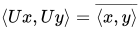
for all and in , where the horizontal bar represents the complex conjugate. If additionally one has then is called an antiunitary operator.


Antiunitary operators are important in quantum mechanics because they are used to represent certain symmetries, such as time reversal.[1] Their fundamental importance in quantum physics is further demonstrated by Wigner's theorem.
Invariance transformations
[edit]In quantum mechanics, the invariance transformations of complex Hilbert space leave the absolute value of scalar product invariant:


for all and in .
Due to Wigner's theorem these transformations can either be unitary or antiunitary.
Geometric Interpretation
[edit]Congruences of the plane form two distinct classes. The first conserves the orientation and is generated by translations and rotations. The second does not conserve the orientation and is obtained from the first class by applying a reflection. On the complex plane these two classes correspond (up to translation) to unitaries and antiunitaries, respectively.
Properties
[edit]- holds for all elements of the Hilbert space and an antiunitary .
- When is antiunitary then is unitary. This follows from
- For unitary operator the operator , where is complex conjugation (with respect to some orthogonal basis), is antiunitary. The reverse is also true, for antiunitary the operator is unitary.
- For antiunitary the definition of the adjoint operator is changed to compensate the complex conjugation, becoming
- The adjoint of an antiunitary is also antiunitary and (This is not to be confused with the definition of unitary operators, as the antiunitary operator is not complex linear.)








Examples
[edit]- The complex conjugation operator is an antiunitary operator on the complex plane.
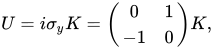
- The operator where is the second Pauli matrix and is the complex conjugation operator, is antiunitary. It satisfies .




Decomposition of an antiunitary operator into a direct sum of elementary Wigner antiunitaries
[edit]An antiunitary operator on a finite-dimensional space may be decomposed as a direct sum of elementary Wigner antiunitaries , . The operator is just simple complex conjugation on


For , the operator acts on two-dimensional complex Hilbert space. It is defined by


Note that for

so such may not be further decomposed into 's, which square to the identity map.

Note that the above decomposition of antiunitary operators contrasts with the spectral decomposition of unitary operators. In particular, a unitary operator on a complex Hilbert space may be decomposed into a direct sum of unitaries acting on 1-dimensional complex spaces (eigenspaces), but an antiunitary operator may only be decomposed into a direct sum of elementary operators on 1- and 2-dimensional complex spaces.
References
[edit]- ^ Peskin, Michael Edward (2019). An introduction to quantum field theory. Daniel V. Schroeder. Boca Raton. ISBN 978-0-201-50397-5. OCLC 1101381398.
{{cite book}}: CS1 maint: location missing publisher (link)
- Wigner, E. "Normal Form of Antiunitary Operators", Journal of Mathematical Physics Vol 1, no 5, 1960, pp. 409–412
- Wigner, E. "Phenomenological Distinction between Unitary and Antiunitary Symmetry Operators", Journal of Mathematical Physics Vol 1, no 5, 1960, pp.414–416
See also
[edit]Antiunitary operator
View on GrokipediaDefinition and Mathematical Foundations
Formal Definition
An antiunitary operator on a complex Hilbert space is a bijective antilinear map that preserves the inner product up to complex conjugation, satisfying for all , where denotes complex conjugation.[5] This condition ensures that antiunitary operators maintain the geometric structure of the space, including the norm, since .[5] Antilinearity distinguishes these operators from linear ones: for scalars , Unlike linearity, which applies scalars directly without conjugation, antilinearity conjugates the coefficients, reflecting the involvement of complex conjugation in the inner product preservation.[6][5] General antilinear operators, by contrast, do not necessarily satisfy the inner product condition and thus fail to preserve norms or the sesquilinear form up to conjugation.[6] Antiunitary operators exist and can be constructed as the composition of a unitary operator and a complex conjugation operator , where is defined with respect to an orthonormal basis and extended antilinearly.[7][5]Relation to Unitary Operators
Antiunitary operators bear a close structural relationship to unitary operators, differing primarily in their linearity properties. Every antiunitary operator on a complex Hilbert space can be decomposed as , where is a unitary operator satisfying and thus preserving the inner product , while denotes the complex conjugation operator with respect to a fixed orthonormal basis , defined by .[8] This is antilinear, satisfies , and in the position representation acts as .[8] The decomposition highlights that antiunitaries extend unitaries by incorporating an antilinear conjugation element, enabling the representation of symmetries like time reversal that involve complex conjugation.[7] To verify that satisfies the antiunitary condition, note first that is antilinear as the composition of the linear and antilinear : for scalars , .[8] For the inner product preservation, antiunitaries satisfy . Substituting the decomposition yields since is unitary. Now, , confirming the condition.[8] This relation underscores the conjugate-preserving nature of antiunitaries compared to the direct preservation by unitaries. The proof of the decomposition's existence proceeds by fixing an orthonormal basis and defining as above, then setting (noting ). Linearity of follows from the antilinearity of both and , yielding a linear operator. Unitarity is established via , as derived earlier.[8] Alternatively, a polar decomposition for antilinear operators , where is conjugation and linear, can be applied; for antiunitary , is unitary, yielding the form directly.[8] The decomposition is unique up to phase factors: if , then and for some real , though the latter adjustment preserves the conjugation property only in adapted bases.[8] The operator is not unique across all bases but is fixed once a standard orthonormal basis is chosen, ensuring the representation is well-defined in that frame.[8] This basis dependence reflects the interplay between the complex structure of the Hilbert space and the choice of representation for conjugation.Core Properties
Algebraic Properties
Antiunitary operators on a complex Hilbert space satisfy the isometry condition and , where the adjoint is defined such that for all .[9] This condition ensures that antiunitary operators preserve the norm of vectors, i.e., for all , and more generally, they preserve inner products up to complex conjugation: .[10] As a consequence, the inverse of an antiunitary operator coincides with its adjoint, .[9] The defining feature of an antiunitary operator is its antilinearity: for scalars and vectors , where denotes complex conjugation.[10] This antilinearity has direct implications for compositions. The composition of two antiunitary operators and is a unitary operator, as the antilinear maps compose to yield a linear map that preserves inner products without conjugation: .[9] Conversely, the composition of an antiunitary operator with a unitary operator remains antiunitary.[11] A fundamental identity arising from antilinearity is that the square of an antiunitary operator is unitary.[9] In specific representations, such as the time-reversal operator for systems with angular momentum, , where is the total angular momentum quantum number; this yields for integer spin and for half-integer spin.[10] The collection of all unitary and antiunitary operators on forms a group under composition, known as the unitary-antiunitary group , with the unitary operators comprising the connected component containing the identity.[11] Within this group, the antiunitary operators form a coset of the unitary subgroup, reflecting their role in extending linear symmetries to include conjugation-like operations. Due to antilinearity, the set of antiunitary operators does not form a vector space over , as scalar multiplication would violate the preservation of inner products up to conjugation.[9] All antiunitary operators on a Hilbert space are bounded linear (or antilinear) operators with operator norm , following directly from the isometry condition and the completeness of .[9]Spectral Properties
Antiunitary operators, due to their antilinear nature, do not possess eigenvalues in the conventional linear sense, as the set of solutions to the eigenvector equation does not form a vector subspace closed under complex scalar multiplication.[7] Applying to both sides of the equation yields , implying if , which is typical for many symmetry representations; more generally, is unitary, constraining the possible further.[12] For real eigenvalues, only are possible, corresponding to eigenspaces where (fixed points) or (anti-fixed points). These real eigenvalues arise in one-dimensional invariant subspaces under Wigner's normal form, where the operator leaves basis vectors invariant up to a phase that can be chosen to yield .[13] If , as in time-reversal for half-integer spin systems, no such real eigenvalues exist, leading to at least twofold degeneracy without eigenvectors.[12] For non-real with , eigenvectors occur in conjugate pairs: if , then there exists such that , typically with related to via the action of (e.g., ) and satisfying orthogonality . These pairs span two-dimensional invariant subspaces in Wigner's decomposition, where the antiunitary acts by swapping basis vectors with phase factors , ensuring the spectrum lies on the unit circle with conjugation symmetry.[13] Unlike unitary operators, antiunitary operators lack a full spectral theorem providing a diagonalization over the entire Hilbert space, as antilinearity prevents a complete set of orthogonal eigenvectors. Instead, the space decomposes into orthogonal direct sums of one- and two-dimensional invariant subspaces, restricting spectral analysis to these finite-dimensional blocks.[13] This norm-preserving property for all confirms the spectrum's location on the unit circle, with the pairing mechanism enforcing conjugate symmetry even in the absence of traditional eigenvalues.[7]Physical Interpretations and Applications
Time-Reversal Invariance
In quantum mechanics, time-reversal invariance is implemented by an antiunitary operator , which ensures that the laws of physics remain unchanged under the reversal of time. For a time-independent Hamiltonian , the condition for time-reversal invariance is , meaning the operator conjugates the Hamiltonian to itself while preserving the dynamics in the reversed time direction.[15] This antiunitarity arises because time reversal must reverse the direction of time derivatives in the Schrödinger equation, leading to the property , where is the imaginary unit; this follows directly from the antilinear nature of , as for complex , and thus conjugates scalars like to . The action of on quantum states in the Schrödinger picture maps a state evolving forward in time to its time-reversed counterpart, typically expressed as , where the asterisk denotes complex conjugation in a basis where acts as conjugation. This transformation preserves transition probabilities, , but conjugates the phases of the states, reflecting the antiunitary structure that inverts the sign of phase angles under time reversal. According to an extension of Wigner's theorem, symmetries of the projective Hilbert space (ray space) that preserve inner product magnitudes can be represented by either unitary or antiunitary operators on the full Hilbert space; time reversal falls into the antiunitary category because a unitary operator would fail to reverse momenta and phases appropriately.[16][15] The consequences for observables depend on their time parity: time-even operators, such as position , satisfy and thus commute with , while time-odd operators, such as momentum and angular momentum , satisfy and anticommute with . This distinction ensures that velocities and rotations reverse under time reversal, consistent with classical intuitions extended to quantum systems. Eugene Wigner introduced the antiunitary time-reversal operator in 1931, particularly in the context of spin-1/2 systems, where he demonstrated its necessity for maintaining symmetry in atomic spectra. A key property is that , where is the spin quantum number; this yields for integer spin (bosons) and for half-integer spin (fermions), leading to Kramers' degeneracy in the latter case under time-reversal invariance.[17]Geometric and Symmetry Interpretations
Antiunitary operators possess a profound geometric interpretation in the context of Hilbert spaces, where they act as anti-isometries that reverse the orientation of the projective Hilbert space while preserving the metric structure up to complex conjugation. Unlike unitary operators, which induce orientation-preserving transformations akin to rotations, antiunitaries implement orientation-reversing isometries, such as reflections, in the geometry of the state space. This reflective property stems from their anti-linear nature, which effectively conjugates the complex phases, mirroring the action of complex conjugation in the complex plane that flips the imaginary axis across the real line.[18][19] In the framework of symmetry groups acting on quantum systems, antiunitary elements correspond to orientation-reversing transformations in the projective Hilbert space, extending the unitary representations to include improper isometries that are crucial for capturing full symmetry structures, such as those involving spatial reflections or inversions. These operators ensure invariance of physical observables under such transformations by mapping states in a way that conjugates inner products, thereby maintaining the probabilistic interpretation while inverting the geometric orientation. For instance, in systems with discrete symmetries, antiunitaries facilitate the implementation of group elements that would otherwise be inaccessible through unitary means alone.[20] Charge conjugation, which interchanges particles and antiparticles, is formulated as an antiunitary operator in certain quantum mechanical contexts, particularly in embedding approaches or when considering the interplay with other discrete symmetries. This antiunitary character arises because charge conjugation involves complex conjugation of field operators, leading to anti-linear effects on the Hilbert space states. In the context of the TCP theorem, the combined charge conjugation (C), parity (P), and time reversal (T) transformation is antiunitary overall, since C and P are unitary while T is antiunitary, guaranteeing the invariance of relativistic quantum field theories under this full symmetry operation.[21][22] Antiunitary operators also play a role in extending unitary groups, such as , to broader structures that incorporate conjugation-like operations, often referred to as pseudo-unitary extensions in the presence of indefinite metrics or symmetry enlargements. These extensions generate groups that include both orientation-preserving and reversing elements, allowing for a complete description of symmetry operations that mix unitary and antiunitary actions. In finite-dimensional cases, such as qubit systems, the action of antiunitaries on the Bloch sphere manifests as reflections through the real axis, effectively flipping the sphere's orientation and providing a visualizable geometric counterpart to the abstract Hilbert space transformations; similar reflections occur in the phase space of coherent states, underscoring the pervasive reflective geometry.[23][18]Examples and Constructions
Basic Examples
One of the simplest examples of an antiunitary operator is the complex conjugation operator acting on the Hilbert space , defined by for a function . This operator is antilinear, as for complex , and it preserves the inner product up to conjugation: , confirming its antiunitarity. Moreover, , the identity operator. In the context of time-reversal symmetry for a spinless particle, the time-reversal operator in the position basis simplifies to complex conjugation, so .[3] More generally, in the momentum basis, , where is the momentum reversal operator (implemented via the Fourier transform), but the position representation reduces to alone since wave functions can be chosen real for spinless systems.[3] This operator satisfies and reverses velocities while preserving positions.[3] For a spin-1/2 particle, the time-reversal operator incorporates the spin degree of freedom and is given by , where is the Pauli y-matrix and denotes componentwise complex conjugation in the spinor basis.[24] Acting on a spinor , this yields , which flips the spin direction while complex conjugating the components.[25] It satisfies , reflecting the fermionic nature of spin-1/2 systems, and is antiunitary as it preserves the spinor inner product up to conjugation.[25] A finite-dimensional example occurs in , where the operator provides an antiunitary map, with and the conjugation. This illustrates how antiunitaries in low dimensions can mimic reflections while involving conjugation, and . In quantum electrodynamics (QED), the charge conjugation operator for Dirac fields acts on a spinor as , or equivalently in the single-particle description, where is a Dirac matrix and denotes complex conjugation. This operator is antiunitary due to the conjugation, interchanging particle and antiparticle states while preserving the Dirac equation's form, and satisfies in the standard representation.[26]Decomposition into Elementary Antiunitaries
In quantum mechanics, an elementary antiunitary operator, often referred to as a Wigner antiunitary, acts on an irreducible representation space and takes the form , where is a unitary operator, denotes complex conjugation with respect to a chosen orthonormal basis, and is a real phase factor. This normal form arises from the ability to select a basis in which the antiunitary operator simplifies to a phase times a unitary followed by conjugation, capturing the essential structure without loss of generality. A fundamental result in the theory is the decomposition theorem for antiunitary operators on a separable Hilbert space : any such operator can be expressed as a direct sum , where each is an elementary Wigner antiunitary acting on a minimal -invariant subspace . These minimal subspaces are the building blocks, analogous to irreducible subspaces in unitary representation theory, and the full space decomposes orthogonally as . The theorem extends to normal antilinear operators more broadly, partitioning into Hermitian-diagonalizable parts (with eigenvectors) and even-dimensional parts lacking real eigenvectors but paired via the operator. The proof sketch leverages an extension of Schur's lemma to the enlarged algebra generated by both unitary and antiunitary actions. Specifically, for an irreducible corepresentation under this joint action, any intertwining antiunitary operator must be scalar (up to unitary equivalence) or zero, ensuring the minimality and irreducibility of the . This irreducibility criterion prevents further nontrivial invariant subspaces, mirroring the unitary case but accounting for the antilinearity through basis-dependent conjugation. The minimal subspaces are classified up to equivalence by their dimension and the signature of . When , the representation is of conjugation type, allowing real eigenvalues; in contrast, implies skew-conjugation type, requiring even dimensionality and leading to Kramers degeneracy, where states cannot be nondegenerate due to pairing under the antiunitary. Multiplicities arise from repeated equivalent blocks in the direct sum, determined by the overall dimension of . This decomposition framework underpins symmetry classifications in physical systems, particularly for crystal space groups and molecular symmetries incorporating time-reversal, where antiunitaries combine with spatial operations to form magnetic or gray groups. The irreducible types dictate degeneracy patterns and topological invariants in such contexts.Advanced Extensions
Representations in Hilbert Spaces
In a Hilbert space equipped with an orthonormal basis , an antiunitary operator acts on a vector by first complex-conjugating the coefficients and then applying a unitary transformation represented by the matrix elements , yielding . This representation highlights the antilinear nature of , as the conjugation step distinguishes it from unitary operators, which act linearly on the coefficients without conjugation. The matrix itself satisfies unitarity conditions adjusted for the conjugation, ensuring for all .[8] In the position basis on , antiunitary operators typically combine complex conjugation , defined by , with a unitary operator. For the time-reversal operator acting on a spinless particle, the explicit form is , so ; this preserves the position but reverses momentum via , as the conjugation flips the sign of the imaginary unit in the momentum operator. Unitarity is verified by and the inner product relation . In the momentum basis, the action becomes , incorporating a phase factor from the Fourier transform that reflects the momentum reversal.[3] For infinite-dimensional Hilbert spaces like , explicit constructions of antiunitaries often factor as , where is unitary and is complex conjugation in the position basis. The time-reversal example satisfies antiunitarity: for complex , and with the adjoint defined via the conjugated inner product. Such operators preserve the Hilbert space norm and orthogonality up to conjugation, enabling their role in symmetry transformations without altering the space's structure.[3] In the Bargmann representation, where states of the harmonic oscillator are holomorphic functions on with the measure , antiunitary operators act as antilinear combinations of differential operators followed by complex conjugation, mapping holomorphic functions to antiholomorphic ones while preserving the inner product up to conjugation. Two antiunitary operators and on a Hilbert space are equivalent if there exists a unitary operator such that , intertwining their actions and preserving the antiunitary structure through the linearity of . This unitary equivalence classifies representations up to basis changes, ensuring that spectral or transformation properties remain invariant.[27]Antiunitary Groups and Algebras
Antiunitary groups arise in quantum mechanics as extensions of unitary symmetry groups to include orientation-reversing transformations, forming closed subgroups under operator composition where the product of two antiunitary operators is unitary. For a Lie group with a normal subgroup of index 2 (often the identity component), an antiunitary representation maps elements of to antiunitary operators on a Hilbert space while preserving the group structure, thus combining unitary and antiunitary operators into a cohesive representation of the full group.[20] Such groups capture full symmetry operations, including those like improper rotations, which reverse orientation and require antiunitarity to preserve probabilities in quantum systems.[28] Incorporating antiunitary operators into Lie algebras presents challenges due to their antilinearity, which disrupts standard linear exponentiation; generators may include anti-Hermitian components, but the algebra structure relies on modular operators like the modular conjugation and Hamiltonian , where one-parameter subgroups generated by antiunitaries relate to boosts or dilations in groups like the affine group .[20] For instance, in representations of the Lorentz group, antiunitary extensions yield Lie algebra elements tied to time-reversal symmetries, complicating the infinitesimal structure but enabling descriptions of modular theory in von Neumann algebras.[20] Examples of antiunitary groups include the orthogonal group , which, in the complexification of real representations, decomposes into unitary proper rotations (determinant +1) and antiunitary improper transformations (determinant -1), preserving the real structure while accounting for conjugation.[29] More generally, Pin groups in Clifford algebras provide concrete realizations: the Pin groups are double covers of the orthogonal group , generated by unit vectors in the Clifford algebra with norm , where elements act as unitary or antiunitary transformations on spinor spaces, particularly incorporating antiunitarity for time reversal via co-representations like .[30] In physics, and distinguish fermion behaviors under charge conjugation , parity , and time reversal , with antiunitary ensuring for spin-1/2 particles.[30] Irreducible representations of antiunitary groups are classified using corepresentations, where the Frobenius-Schur indicator (over the Haar measure) determines the type: for real representations (extendable unitarily with ), for quaternionic (requiring antiunitary with , as in fermionic time reversal), and for complex (non-extendable). This indicator, extended to corepresentations, identifies whether an irreducible unitary representation of the unitary subgroup extends irreducibly to the full antiunitary group, crucial for symmetry types in quantum systems.[20] In topological contexts, antiunitary groups connect to K-theory through extensions classifying symmetry-protected phases, such as in topological insulators where time-reversal symmetry (antiunitary with ) leads to invariants via quaternionic K-theory (KQ-theory) or real K-theory (KR-theory).[31] The bulk-boundary correspondence maps bulk KQ-classes over momentum space to boundary KO-invariants at time-reversal fixed points, with the index given by the mod 2 parity of Majorana zero modes, distinguishing trivial from nontrivial insulators in class AII.[31][32]References
- https://arxiv.org/pdf/quant-ph/0209054.pdf