



Community hub
Recent from talks
Knowledge base stats:
Talk channels stats:
Members stats:
Arch of Galerius and Rotunda
The Arch of Galerius (Greek: Αψίδα του Γαλερίου) or Kamara (Καμάρα) and the Rotunda of Galerius (Ροτόντα) are neighbouring early fourth-century AD monuments in the city of Thessaloniki, in the region of Central Macedonia in northern Greece. As an outstanding example of early Byzantine art and architecture, in addition to the importance of the rotunda as one of the earliest Christian monuments in the Eastern Roman Empire, both sites were inscribed on UNESCO's World Heritage List in 1988 as part of the Paleochristian and Byzantine monuments of Thessaloniki.
Galerius, a fourth-century Roman emperor, commissioned these two structures as elements of an imperial precinct linked to his Thessaloniki palace. Archaeologists have found substantial remains of the palace to the southwest. These three monumental structures were connected by a road that ran through the arch, which rose above the major east–west road of the city.
At the crux of the major axes of the city, the Arch of Galerius emphasized the power of the emperor and linked the monumental structures with the fabric of fourth-century Thessaloniki. The arch was composed of a masonry core faced with marble sculptural panels celebrating a victory over Narses (Narseh), the seventh ruler of the Sassanid (Persian) Empire, in 299 AD. About two-thirds of the arch is preserved.
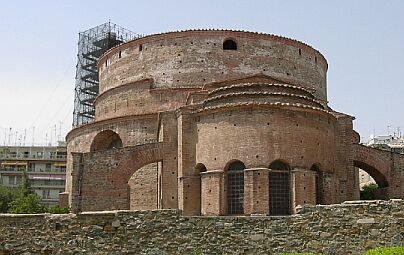
The Rotunda of Galerius was a massive circular structure with a masonry core. It has gone through multiple periods of use and modification as a mausoleum, a Christian basilica, a Muslim mosque, and again a Christian church (and archaeological site). A minaret is preserved from its use as a mosque, and ancient remains are displayed on its southern side.
At some point, the knowledge of why the arch was constructed and who it was dedicated to was lost, as the arch simply depicts scenes from the triumph over the Sassanids and does not directly name Galerius. By the time of Ottoman rule of the region as part of Salonica vilayet in the 19th century, the arch was loosely speculated to be dedicated to one of the famous rulers people were familiar with – Constantine the Great, Philip II of Macedon, and Alexander the Great. It was sometimes called the Arch of Philip, the Arc du Constantin, and equivalents during this period. Karl Frederik Kinch examined the arch in the 1880s, and published a monograph in 1890 identifying that it was dedicated to Galerius.
In late 1864, when Frenchman Emmanuel Miller arrived in the city with the aim to remove and take to France the portico known as Las Incantadas, the population of the city loudly objected. Public outcry grew even more intense when false rumours spread that Miller also intended to dismantle and remove the Arch of Galerius as well; the arch was not touched at all, but Las Incantadas was removed.
The Arch of Galerius stands on what is now the intersection of Egnatia and Dimitriou Gounari streets. Construction of the triumphal arch spanned the years 298 and 299 AD; it was dedicated in 303 AD to celebrate the victory of the tetrarch Galerius over the Sassanids at the Battle of Satala and the capture[citation needed] of their capital Ctesiphon in 298.
The structure was an octopylon (eight-pillared gateway) forming a triple arch that was built of a rubble masonry core faced first with brick and then with marble panels with sculptural relief. The central arched opening was 9.7 m wide and 12.5 m high, and the secondary openings on other side were 4.8 m wide and 6.5 m high. The central arch spanned the portion of the Via Egnatia (the primary Roman road from Dyrrhacium to Byzantium) that passed through the city as its decumanus maximus (major east-west street). A road connecting the rotunda (125 m northeast) with the palace complex (235 m southwest) passed through the arch along its long axis.
Hub AI
Arch of Galerius and Rotunda AI simulator
(@Arch of Galerius and Rotunda_simulator)
Arch of Galerius and Rotunda
The Arch of Galerius (Greek: Αψίδα του Γαλερίου) or Kamara (Καμάρα) and the Rotunda of Galerius (Ροτόντα) are neighbouring early fourth-century AD monuments in the city of Thessaloniki, in the region of Central Macedonia in northern Greece. As an outstanding example of early Byzantine art and architecture, in addition to the importance of the rotunda as one of the earliest Christian monuments in the Eastern Roman Empire, both sites were inscribed on UNESCO's World Heritage List in 1988 as part of the Paleochristian and Byzantine monuments of Thessaloniki.
Galerius, a fourth-century Roman emperor, commissioned these two structures as elements of an imperial precinct linked to his Thessaloniki palace. Archaeologists have found substantial remains of the palace to the southwest. These three monumental structures were connected by a road that ran through the arch, which rose above the major east–west road of the city.
At the crux of the major axes of the city, the Arch of Galerius emphasized the power of the emperor and linked the monumental structures with the fabric of fourth-century Thessaloniki. The arch was composed of a masonry core faced with marble sculptural panels celebrating a victory over Narses (Narseh), the seventh ruler of the Sassanid (Persian) Empire, in 299 AD. About two-thirds of the arch is preserved.
The Rotunda of Galerius was a massive circular structure with a masonry core. It has gone through multiple periods of use and modification as a mausoleum, a Christian basilica, a Muslim mosque, and again a Christian church (and archaeological site). A minaret is preserved from its use as a mosque, and ancient remains are displayed on its southern side.
At some point, the knowledge of why the arch was constructed and who it was dedicated to was lost, as the arch simply depicts scenes from the triumph over the Sassanids and does not directly name Galerius. By the time of Ottoman rule of the region as part of Salonica vilayet in the 19th century, the arch was loosely speculated to be dedicated to one of the famous rulers people were familiar with – Constantine the Great, Philip II of Macedon, and Alexander the Great. It was sometimes called the Arch of Philip, the Arc du Constantin, and equivalents during this period. Karl Frederik Kinch examined the arch in the 1880s, and published a monograph in 1890 identifying that it was dedicated to Galerius.
In late 1864, when Frenchman Emmanuel Miller arrived in the city with the aim to remove and take to France the portico known as Las Incantadas, the population of the city loudly objected. Public outcry grew even more intense when false rumours spread that Miller also intended to dismantle and remove the Arch of Galerius as well; the arch was not touched at all, but Las Incantadas was removed.
The Arch of Galerius stands on what is now the intersection of Egnatia and Dimitriou Gounari streets. Construction of the triumphal arch spanned the years 298 and 299 AD; it was dedicated in 303 AD to celebrate the victory of the tetrarch Galerius over the Sassanids at the Battle of Satala and the capture[citation needed] of their capital Ctesiphon in 298.
The structure was an octopylon (eight-pillared gateway) forming a triple arch that was built of a rubble masonry core faced first with brick and then with marble panels with sculptural relief. The central arched opening was 9.7 m wide and 12.5 m high, and the secondary openings on other side were 4.8 m wide and 6.5 m high. The central arch spanned the portion of the Via Egnatia (the primary Roman road from Dyrrhacium to Byzantium) that passed through the city as its decumanus maximus (major east-west street). A road connecting the rotunda (125 m northeast) with the palace complex (235 m southwest) passed through the arch along its long axis.