Hubbry Logo
ArnsideArnsideMain
Open search
Arnside
Community hub
Arnside
logo
8 pages, 0 posts
0 subscribers
Be the first to start a discussion here.
Arnside
Arnside
from Wikipedia

Arnside is a village and civil parish in Westmorland and Furness, Cumbria, England. It is historically part of Westmorland, near the border with Lancashire, England. The Lake District National Park is located a few miles north. Travelling by road, Arnside is 10 miles (16 km) to the south of Kendal, 25.3 miles (40.7 km) to the east of Ulverston, 35.2 miles (56.6 km) to the east of Barrow-in-Furness, 13 miles (21 km) to the north of Lancaster and 14.3 miles (23.0 km) to the east of Grange-over-Sands. In the 2001 census the parish had a population of 2,301,[2] increasing at the 2011 census to 2,334 but falling to 2,233 in the 2021 census.[1]

Key Information

It faces the estuary of the River Kent on the north-eastern corner of Morecambe Bay, within the Arnside and Silverdale Area of Outstanding Natural Beauty and is overlooked by Arnside Knott, a hill that rises out of the estuary. A detailed account of the wildlife of the Arnside and Silverdale AONB is provided by John Wilson and Peter Lennon.[3] Mammals include red squirrel and otter, breeding birds at the time of publication included the bittern which is still found in the area.

Formerly a small fishing village and port trading with Liverpool and Ireland the village has been attractive to visitors since the 19th century but never developed as a traditional seaside resort. Writing in The Local Historian, Caunce describes it as "an unwitting pioneer of eco-tourism", with visitors attracted by the scenery and in particular Arnside Knott.[4]

Buildings

[edit]
View of the Kent Estuary from Arnside Knott

The oldest building in the parish is Arnside Tower, a Peel tower built in the 14th/15th century as a refuge against raids from Scots and the Border Reivers.

The now defunct Arnside Golf Club was founded in 1906 and closed during the World War II.[5]

The former customs house from the port of Arnside is now occupied by the Sailing Club, and many of the buildings on the promenade were built as accommodation for visitors.[4]

Arnside viaduct

[edit]

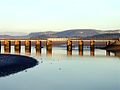
The railway line is carried over the River Kent on a viaduct 552 yards (505 m) long, it was built in 1857 and rebuilt in 1915.[6]

Governance

[edit]

Arnside is part of the Morecambe and Lunesdale parliamentary constituency, for which Lizzi Collinge has been the MP since 2024, representing the Labour Party.[7][8]

For local government purposes, it is administered as part of the Westmorland and Furness unitary authority.

The civil parish of Arnside includes the hamlet of Far Arnside as well as the village of Arnside. The parish is bordered by the Kent estuary to the north, Morecambe Bay to the west, Silverdale to the south (along the historic Westmorland / Lancashire county boundary), and Beetham to the east ( the eastern boundary following the railway at its north and south, and extending a little further east).[1] The parish has its own parish council, Arnside Parish Council.[9]

Transport

[edit]

Arnside has its own railway station, Arnside railway station, which lies on the Furness line giving connections to Lancaster, Barrow-in-Furness, Ulverston, Grange-over-Sands, Carnforth and Carlisle. The Furness Line passes over the River Kent via the Arnside Viaduct.

Tides

[edit]
This video size: 360x240 500 kbit/s
Alternative size: 720x480 2000 kbit/s

With each high tide, the coast of Arnside is subjected to a very fast rising tide. Because of the potential danger warning notices are posted at the pier, and an audible warning is sounded before every high tide (in daylight). The sequence of warnings is:-

  1. Eight sounds on the siren - around 2.25 h before high tide
  2. Eight sounds on the siren - around 1.75 h before high tide
  3. Twelve sounds on the siren - around 1.25 h before high tide, when the incoming tide is just visible from the Coastguard station (location of the siren 54°11′56″N 2°50′28″W / 54.199°N 2.841°W / 54.199; -2.841 )

The cause of this fast tide is a combination of the large area of Morecambe Bay, which narrows rapidly at Arnside, plus the second highest tidal range (at Barrow-in-Furness), which can be as much as 32 feet (9.8 m) on a spring tide nearest the spring and autumn equinox: these typically give rise to a tidal bore, which may be as high as 12 inches (30 cm), and is often used by canoeists.[10]

Notable people

[edit]

See also

[edit]
[edit]

References

[edit]
[edit]
Revisions and contributorsEdit on WikipediaRead on Wikipedia
from Grokipedia
Arnside is a coastal village and in the of , (since 2023), located on the of the River Kent at the northern tip of . With a of 2,233 as recorded in the 2021 census, it serves as a modest and gateway to the Lake District , celebrated for its unspoiled natural beauty and historic landmarks such as the 19th-century Arnside Viaduct and the medieval Arnside Tower. Historically, Arnside developed as a small and trading in a rural dominated by farming, salt-making, and later quarrying, but its growth accelerated in the mid-19th century with the arrival of the and Lancaster Railway in 1857, which included the construction of the iconic across the estuary. The village's , originally built in 1860 to accommodate pleasure boats after the viaduct obstructed , further boosted its role as a destination for visitors from nearby industrial cities like and . By the early , Arnside had become a popular spot for seaside s, hosting a children's camp from 1905 until 2000, and its population expanded from a mere handful before 1857 to 844 by 1911 and 2,301 by 2001. Geographically, Arnside occupies 7.3 km² (1,804 acres) within the Arnside and Silverdale , a protected landscape spanning southern and northern , characterized by hills, woodlands, and coastal marshes that support diverse , , and birdlife. The prominent Arnside Knott, rising to 159 meters (522 feet), offers panoramic views across to the Lakeland fells and , while the village's Victorian-era St James' Church, built in 1864–1866, and the ruined 15th-century pele tower—once a defensive structure split by a in 1884—add to its . Today, Arnside remains a hub for walkers, enthusiasts, and rail travelers along the Furness line, blending quiet residential charm with accessible outdoor pursuits.

Geography and Location

Position and Boundaries

Arnside is a village and situated at coordinates 54°11′56″N 2°50′28″W in the district of , . This positioning places it at the mouth of the River Kent estuary, where the river flows into , marking a transitional zone between coastal and inland landscapes. The encompasses 1,055 hectares (approximately 4 square miles) of varied terrain, including shoreline and low hills, and serves as a key entry point to the broader region's natural attractions. Administratively, Arnside formed part of the district until local government reorganization in 2023, which abolished the former district councils and created the unitary authority covering southern . This change integrated Arnside into a larger administrative area that includes former , Eden, and districts, facilitating unified planning and services across the region. The parish maintains its own local governance through the Arnside Parish Council, which addresses community-specific matters within these boundaries. Arnside lies within the Arnside and Silverdale National Landscape (formerly known as the ), designated in 1972 and covering 75 square kilometers across and , emphasizing conservation of its limestone landscapes and coastal habitats. To the north, the parish borders the National Park, providing a seamless connection to one of England's most iconic protected areas and enhancing its appeal as a gateway destination. Approximately 10 miles south of and 13 miles north of Lancaster, Arnside's strategic location supports easy access via the A6 road and rail links, positioning it 12 miles from the junction.

Physical Features

Arnside is situated on a low-lying coastal plain at the edge of , where the terrain gently rises inland to form the prominent hill of Arnside Knott, reaching a summit elevation of 159 metres above . This topography creates a distinctive transition from flat estuarine margins to steeper wooded slopes, with Arnside Knott providing panoramic vistas across the expansive bay and distant fells of the . The hill's southern face features stratified screes developed from periglacial processes, contributing to its rugged profile. The underlying geology of Arnside consists predominantly of early limestones, deposited around 340 million years ago in shallow tropical seas during the Dinantian stage. These include the Dalton Limestone, a dark grey formation with bituminous characteristics and fossil content visible in coastal exposures like Blackstone Point, and the overlying Park Limestone, a paler, erosion-prone unit that forms much of Arnside Knott's structure and associated screes. The soluble nature of this has led to landscape features in the vicinity, such as limestone pavements characterised by clints and grikes, though these are more pronounced on adjacent hills like Middlebarrow rather than directly on Arnside Knott itself. Tectonic folding and glacial influences have further shaped the area's bedrock, with erratics from older rocks scattered across the surface. Hydrologically, the area is defined by the estuary of the River Kent, which enters at Arnside after a 32-kilometre course from the fells, creating a dynamic interface of freshwater outflow and tidal incursion. The supports extensive intertidal mudflats and that shift with tidal currents, alongside fringing salt marshes that accrete sediment vertically in response to sea-level changes. These features form part of the broader system, where ebb-dominant flows transport material northward, maintaining a macro-tidal regime with spring ranges up to 8.4 metres. Arnside experiences a temperate maritime climate typical of northwest , moderated by the , resulting in mild winters with average January temperatures around 4–6°C and cool summers peaking at 15–17°C in July. is relatively even throughout the year, influenced by westerly airflows, with an annual average of approximately 1,000 mm, though higher totals occur during stormy periods. This climatic pattern supports lush vegetation on the soils while contributing to the estuary's sediment dynamics.

History

Early Settlement and Medieval Period

Archaeological evidence indicates early human presence in the Arnside area during the period, with significant finds from Kents Bank Cave, located approximately 5 km south along the Kent Estuary. of human remains from the cave places activity around 9,100 ± 35 BP, suggesting use of the coastal landscape for shelter and resource exploitation. Possible Roman activity in the vicinity is linked to nearby military installations, such as the fort at Over Burrow (Brough), about 6 miles east, which served as a defensive outpost along routes connecting the Eden Valley to the coast during the AD. While no direct Roman structures have been identified in Arnside itself, the estuary's strategic position likely facilitated and movement supporting these garrisons. By the 11th century, Arnside formed part of the larger manor of Beetham, recorded in the of 1086 as a berewick—a estate—within the hundred of Amounderness in (now ). The entry for Beetham notes approximately 6 carucates of taxable land, with resources including meadows, for 20 pigs, and a , reflecting an agrarian under the lordship of Roger of Poitou following the . Arnside, as a coastal berewick, contributed to this manorial structure through its estuarine holdings. Medieval development centered on defense and local industries, with Arnside Tower constructed in the late as a peel tower to protect against Scottish border raids during periods of instability. Built on lands of the Beetham manor, the tower served as a fortified residence, later damaged by fire in 1602 but emblematic of the era's need for strongholds. Primary activities included fishing in the Kent Estuary and salt-making at sites like Salt Cote, supporting the manor's feudal economy. Ownership passed from the Beetham family (via the Middletons) to the Stanley earls of after the Battle of Bosworth in 1485, and was sold to the Wilson family in 1815.

Industrial and Victorian Era

During the mid-19th century, Arnside's economy transitioned from rural pursuits like farming, fishing, and salt-making to industrial activities centered on limestone quarrying and lime-burning, which became prominent as demand for lime in agriculture and construction grew. Local limestone deposits were extracted and processed in kilns to produce quicklime, supporting regional building and soil improvement efforts. Concurrently, Arnside served as a modest port facilitating trade with Liverpool and Ireland, where exports of Kendal woollen goods and gunpowder were exchanged for imports such as coal from the Cumberland and Wigan coalfields, with waterfront warehouses handling the commerce for merchant families like the Greenwoods and Bushes. However, by the 1870s, progressive silting of the Kent Estuary channels, exacerbated by shifting sands and tidal dynamics, restricted steamer access and rendered the port increasingly unviable, leading to its decline in favor of more accessible harbors like Glasson Dock. The arrival of the railway marked a pivotal shift, with the construction of the Arnside Viaduct in 1857 by the Ulverston and Lancaster Railway (later integrated into the network) spanning the Kent Estuary to connect Arnside to the broader Lancaster and Carlisle line. This 552-yard structure with 50 piers enabled the Furness Line's completion, dramatically improving connectivity to industrial centers like and facilitating the transport of goods and passengers, which supplanted much of the estuary's shipping trade. The viaduct's fixed spans also contributed to the port's silting by altering tidal flows, further diminishing maritime viability. From the onward, Arnside gained a reputation as an idyllic seaside retreat, drawing an influx of wealthy Victorian visitors seeking the health benefits of and leisurely promenade walks along the shores, even before the railway's full impact. The burgeoning spurred the development of hotels, villas, and houses, such as the conversion of former inns like Ashmeadow and Beachwood into accommodations, with the expanding from around 140 in to 600 by 1891. Infrastructure enhancements followed, including a stone pier in 1865 for docking pleasure boats from and , and an extended promenade between 1897 and 1904 that solidified its resort character, though bathing machines saw limited use due to the tidal nature of the bay. Key events included the viaduct's substantial rebuilding and strengthening in 1915 to support wartime munitions transport to Barrow, and the founding of the Arnside Golf Club in 1906 on Arnside Knott, which operated until its closure during for military purposes.

Economy and Society

Historical Economy

During the medieval period, Arnside's economy was predominantly rural, centered on , , and small-scale salt production along the Kent Estuary. Farming involved mixed arable and pastoral activities typical of the region, with local households cultivating crops and raising on the fertile coastal lands. and cockling supplemented incomes, utilizing the estuary's resources, while salt-making—evidenced by place-names like Salt Cote and recorded salt pans—was conducted through coastal methods, though on a modest scale compared to larger Solway operations. By the 18th and 19th centuries, economic activities diversified with the expansion of quarrying, particularly at sites like Sandside Quarry near Arnside, where stone was extracted for building and agricultural lime. This material was processed in numerous lime kilns dating from the late 18th to mid-19th century and exported via the local port, supporting regional trade networks. Small-scale emerged around 1838, led by figures like Francis Crossfield, producing vessels for local use and contributing to the transport of goods such as corn from nearby mills and imported timber essential for and repair. Arnside's facilitated these exchanges, including trade with for woollen and other commodities, bolstered by a customs house established in the 1700s to collect duties on incoming and outgoing cargoes. However, by the late , the declined due to silting in the , which hindered and shifted to deeper harbors like Lancaster. Labor patterns reflected these industries, with residents employed in quarrying, lime burning, and fisheries, sustaining a population of approximately 668 in 1801 within the Beetham area encompassing Arnside.

Modern Economy and Tourism

Following the decline of traditional industries such as quarrying after , Arnside's economy transitioned toward tourism and service-based activities, leveraging its scenic location within the Arnside and Silverdale . Quarrying operations, exemplified by nearby Sandside Quarry which had been active since 1901 producing for and lime, faced reduced demand due to the rise of and joined larger aggregates firms like Tarmac by 1962, leading to a broader contraction in extractive sectors across the region. This shift positioned tourism as the primary economic driver, with visitors drawn to the area's natural beauty, including walking trails on Arnside Knott—a 159-meter hill offering panoramic views of —and the seaside promenade developed between 1897 and 1904 for leisurely strolls and bay observation. Key attractions further bolster this sector, including the Arnside Sailing Club, established in and housed in the historic Old Customs House on the promenade, which provides , , and opportunities while hosting social events that attract year-round. Annual events such as the Arnside Vintage Carnival on the promenade celebrate local heritage with parades and activities, enhancing visitor appeal alongside and eco-focused pursuits in the bay's intertidal zones. In the broader district encompassing Arnside, employment reflects this orientation, with approximately 29% of resident workers in distribution, hotels, and restaurants—a category heavily influenced by —based on 2021 data, alongside 18% in wholesale and retail and 26% in public administration, education, and health services. Small businesses, including cafes, bed-and-breakfasts, and independent shops, dominate the local economy, with limited manufacturing presence. Economic challenges persist due to tourism's , with visitor numbers peaking in summer but dropping during wet winters, impacting income stability for service providers. Efforts to promote eco-tourism address this, including the 2023 Eco Escapes initiative in collaboration with the Arnside and Silverdale National Landscape Partnership, which won a Green Business Award for sustainable practices like low-impact trails and education to extend the tourism season and reduce environmental strain. The area's redesignation from AONB to National Landscape in November 2023 further supports these initiatives by emphasizing conservation and resilient visitor experiences.

Governance and Demographics

Local Administration

Arnside falls within the Morecambe and Lunesdale parliamentary constituency, represented in the by Lizzi Collinge of the Labour Party, who was elected in the 2024 general election. At the regional level, Arnside is administered by the , which was established on 1 April 2023 and covers the former districts of , , and Eden. Prior to this, the area was part of District Council. This 2023 reorganization of in merged the previous six district councils and the into two new unitary authorities— and —to create a single tier of aimed at streamlining services such as , , and community support. Locally, Arnside is served by the Arnside Parish Council, the lowest tier of government, which addresses issues including applications, maintenance of community facilities, and organization of local events. The council, consisting of elected members, holds meetings on the second Monday of each month at the Cemetery Chapel on Silverdale Road.

Population and Community

According to the 2001 , Arnside had a population of 2,301 residents. This figure rose modestly to 2,334 by the 2011 , reflecting a 1.4% increase over the decade. However, the 2021 recorded a slight decline to 2,231 residents, indicating a 4.4% decrease from 2011 and an overall trend of stabilization with minor contraction. Demographically, Arnside remains predominantly White British, with 96.7% of residents identifying as such in the 2011 Census; this proportion saw the village as 99.3% White (2,216 individuals) by 2021. The community skews older, with a median age of around 60 in 2011 and a high concentration of seniors persisting into 2021, where 37% of residents (818 individuals) were aged 70 or over. Home ownership is notably high, with 82.9% of households owning their properties outright or with a mortgage in 2011, underscoring a stable, property-focused residential base. Key community facilities support daily life and social engagement, including Arnside CofE Primary School for local education, Arnside Library for public resources, and the Arnside WI and Village Hall for events and gatherings. Active groups enhance cohesion, such as the Arnside (WI) for social activities and sports clubs like the Arnside Cricket Club, Football Club, and Tennis Club, which promote recreation and community involvement. Social trends highlight an influx of retirees, contributing to the elevated proportion of aged 65 and over (40.8% in ). This demographic shift has spurred community initiatives for , notably through the Plan (2003–2008) and its 2008 review, which addressed environmental preservation, local services, and long-term planning in response to .

Buildings and Landmarks

Arnside Viaduct

The Arnside Viaduct, also known as the Kent Viaduct, was constructed between 1856 and 1857 to carry the Ulverston and Lancaster Railway across the estuary of the River Kent near Arnside, . The structure was designed by civil engineer James Brunlees as an iron trestle viaduct with cast-iron piers, measuring approximately 505 meters (552 yards) in length and comprising 51 spans, with the track set at a height of about 26 feet (7.9 meters) above the water level at high tide. Initially accommodating a single track, the viaduct was widened in 1863 to support double tracks, enhancing capacity for growing rail traffic. The original design featured slender cast-iron columns sunk into the estuary bed using innovative water-jet piling techniques for the footings, reflecting mid-19th-century advancements in bridge engineering over challenging tidal terrains. Over time, the structure underwent significant modifications: in 1885–1887, the decking and girders were replaced with riveted plate girders, and in 1915, the piers were encased in walls filled with to reinforce against scour from the fast-flowing tidal currents and to bear heavier wartime munitions trains from , averting potential failure without a recorded partial collapse. The most recent major maintenance occurred during a reconstruction project by , which replaced the entire 51-span superstructure with prefabricated welded steel deck units weighing up to 24 tonnes each, refurbished the abutments, and installed continuous welded rails, ensuring the viaduct's ongoing operational integrity at a cost of £11 million. As a prominent example of Victorian , the exemplifies the era's ambitious projects that connected remote coastal areas to industrial centers, symbolizing technological and the expansion of Britain's rail network. It has served as a visual in regional and media, including depictions in local historical accounts and films highlighting Cumbria's industrial heritage, while its scenic position over the estuary contributes to Arnside's appeal as a tourist destination. access across the has been prohibited since the early for safety reasons, with fines up to £1,000 imposed on trespassers to prevent risks from passing trains and structural vulnerabilities. As of November 2025, this prohibition remains in place, though feasibility studies funded in are exploring a proposed cantilevered bridge as part of the Arnside to Grange Trail project, with no construction completed to date.

Arnside Tower and Other Structures

Arnside Tower, a fortified pele tower to the , stands as one of the oldest structures in the , constructed from massive rubble walls with roughly dressed stone details. Originally comprising five storeys, the L-shaped tower features a rectangular staircase turret, a projecting , and internal divisions including a cross-wall separating areas possibly used as a , hall, and , evidenced by a niche that may have served as a . It was likely built for defensive purposes amid regional border conflicts, though the exact builders remain uncertain, with early traditions attributing it to the de Betham family or associates like the Middletons and Stanleys, who owned it for centuries thereafter. The tower suffered significant damage from a in 1602 and partial collapse during an 1884 , leaving it in a ruinous state without roof or floors, and it was abandoned as a residence in the early . Designated as a Grade II* listed building since , it is protected under the Planning (Listed Buildings and Conservation Areas) Act 1990, with noting its unique freestanding design among regional tower houses. As of 2023, assessed its condition as "very bad," indicating high risk and the need for urgent stabilization works. Along the promenade, 19th-century terraced buildings emerged to accommodate growing numbers of visitors drawn to Arnside as a seaside settlement, featuring sinuous rows of stone-fronted properties that reflect the area's rapid development in the mid-to-late . Among these is the former customs house, constructed in the late 1700s as a with offices above to oversee trade on the Kent Estuary, now repurposed as the clubhouse for Arnside Sailing Club. Other notable structures include St James' Church, an Anglican parish church built between 1864 and 1866 by architect of to serve the expanding community, later enlarged in 1884, 1905, and 1914, with its windows and east window from 1880 adding to its architectural interest. Victorian villas, characterized by their elegant stone facades and gabled roofs, dot the landscape near the promenade, exemplifying the resort's appeal to affluent tourists during the railway era. Preservation efforts for these buildings are guided by the Arnside and Silverdale (AONB) designation since 1972, which encompasses 115 listed buildings and emphasizes maintaining historic character through design guidelines and heritage records. Recent initiatives include the 2006 "Three Towers" conservation report recommending stabilization for Arnside Tower amid ongoing deterioration, alongside broader AONB volunteer programs supporting repairs to walls and structures in the 2000s and 2010s.

Transport

Rail Connections

Arnside railway station, located on the Furness Line, first opened in 1857 as part of the Ulverston and Lancaster Railway, which connected the region to broader networks and was later absorbed by the Furness Railway in 1862. The station serves local and regional travel, with Northern Trains operating hourly services in both directions; journeys to Lancaster, approximately 12 miles southeast, typically take 15 minutes, while those to Barrow-in-Furness, about 28 kilometers northwest, last around 45 minutes. The Furness Line, on which Arnside station lies, expanded significantly following the completion of the Arnside Viaduct in 1857, enabling reliable cross-estuary connectivity and doubling to two tracks by 1863 to accommodate growing freight and passenger traffic from industrial areas in . Electrification proposals for the line have been discussed in regional strategies since the early , with calls for upgrades to improve efficiency, but as of 2025, no implementation has occurred, leaving the route diesel-operated. Annual passenger usage at Arnside station has hovered around 100,000 entries and exits in recent years, with estimates recording 101,480 for 2023-2024, reflecting a recovery from lows but below pre- levels of 96,348 in 2019-2020. The station offers basic facilities, including passenger shelters on both platforms, a park with level access to one platform, ticket machines, and storage, though it lacks a staffed ticket office or . Future developments for the Furness Line, including Arnside station, are outlined in 2020s regional transport strategies by Transport for the North, which propose journey time reductions, capacity enhancements, and frequency improvements to better integrate with northern rail networks, amid debates over alignments with scaled-back HS2 extensions and initiatives.

Road and Footpaths

Arnside's primary road connection is the A590 trunk road, which runs through the village and links it northeast to and southwest towards the at Junction 36, approximately 5 miles away. The B5282 secondary road provides access northwest to Silverdale, facilitating local travel within the Arnside and Silverdale Area of Outstanding Natural Beauty. Public bus services in Arnside are operated mainly by , with the 555 route offering regular connections to Lancaster and , running multiple times daily. Additionally, the 552 service links Arnside to , Silverdale, and . A minibus scheme, including services like the Storth Community Transport, provides affordable transport for local residents to medical appointments and nearby towns such as , operated by volunteers at a cost of 45p per mile. For non-motorized travel, Route 6 passes through Arnside, connecting Lancaster to via shared paths and quiet roads suitable for cyclists of varying abilities. The coastal path along forms part of the England Coast Path, offering scenic walking routes from Arnside towards Grange-over-Sands. In the vicinity, Arnside Knott features well-maintained trails, including a popular 5-mile circular route that ascends to viewpoints over the estuary and Kent Estuary. Accessibility for visitors is supported by free parking along the promenade, providing convenient access to the village center and waterfront, though spaces can fill quickly during peak times. charging points have been installed in the at locations such as the pub on the promenade, promoting sustainable eco-tourism in the area.

Natural Environment

Tides and Estuary Dynamics

The tides in , which borders Arnside, exhibit one of the largest tidal ranges in the , reaching up to 10 meters (approximately 32 feet) during spring tides. This extreme variation is amplified by the bay's funnel-like shape, where the wide entrance narrows dramatically toward the estuaries, funneling water into a rapid influx that covers vast intertidal sands twice daily. The incoming flood advances quickly across the shallow bay, often at speeds exceeding 5 and up to 8 in channels near Arnside, posing significant risks to those on the sands. A notable feature of these dynamics is the Arnside bore, a tidal wave formed as the incoming meets resistance in the narrowing River Kent and surges upstream as a visible . Typically occurring 1.5 to 2 hours before high water on larger , the bore can reach heights of up to 1 (3 feet), though it varies with tidal strength and is best observed from the Arnside promenade during periods. Traveling at speeds of up to 9 knots (about 10 ), it provides a dramatic display but underscores the estuary's hazardous currents, where the water level can rise abruptly behind the wave. To mitigate dangers, Arnside employs a warning siren system, a repurposed World War II air raid siren sounded twice during daylight hours in the tourist season, approximately 15 to 20 minutes before the bore's arrival and again shortly before it reaches the promenade. Additional safety is provided by guided crossing services led by the Queen's Guide to the Sands (now King's Guide), an official role dating back centuries, who escorts groups across the bay from Arnside to points like Grange-over-Sands, navigating shifting channels and tides for charity events. Historical records document numerous strandings and drownings in the 19th and 20th centuries, with at least 35 fatalities among travelers overtaken by tides or quicksands in the 1800s alone, and over a dozen more in the mid-20th century from recreational activities. Modern prevention includes the nearby RNLI lifeboat station, operational since 1966, which conducts frequent rescues in the bay and promotes water safety education through local fundraising branches like Arnside's.

Wildlife and Conservation Areas

Arnside's natural environment, part of the Arnside and Silverdale Area of Outstanding Natural Beauty (AONB), encompasses diverse habitats including salt marshes, coastal dunes, and ancient woodlands that support a rich array of biodiversity. The salt marshes and intertidal mudflats of Morecambe Bay, adjacent to Arnside, provide essential feeding grounds for migratory waders such as oystercatchers (Haematopus ostralegus) and red knots (Calidris canutus), with the bay hosting internationally significant populations of these species during winter months. Woodlands and limestone pavements within the AONB further contribute to habitat variety, sheltering mammals like European otters (Lutra lutra) along the estuary and grey seals (Halichoerus grypus) occasionally observed in Arnside Bay. These ecosystems are influenced by the dynamic tidal regime of Morecambe Bay, which shapes the availability of foraging areas for estuarine species. Conservation efforts in the region are robust, with significant portions designated as Sites of Special Scientific Interest (SSSIs) and integrated into the Morecambe Bay Limestones Special Area of Conservation (SAC). Approximately 54% of the AONB is covered by SSSI designations, protecting key habitats from development pressures, while the broader area is managed by to maintain its ecological integrity. Bird populations, including waders in the estuary, have been documented since 1978 through surveys detailed in early reports, providing baseline data for ongoing monitoring. Community involvement has strengthened since the 1990s, with local groups such as the Arnside and District Society and AONB volunteer programs conducting regular surveys and assessments to track species trends. Key threats to Arnside's wildlife include coastal erosion driven by tidal forces and storm events, which degrade salt marsh and dune habitats essential for breeding and foraging. To counter these, initiatives in the 2020s have focused on habitat restoration and species reintroduction, such as the release of hazel dormice (Muscardinus avellanarius) into ancient woodlands in 2022 to bolster biodiversity. The AONB's Nature Recovery Plan outlines rewilding strategies to enhance connectivity between habitats, while projects like Our Future Coast employ nature-based solutions, such as sediment-trapping weaves, to mitigate erosion and support estuarine ecosystems. These efforts aim to build resilience against environmental pressures while preserving the area's ecological value.

Culture and Notable Figures

Community Life and Events

Arnside's community life revolves around a variety of organizations that foster social connections among residents. The Arnside & District Probus Club, established for retired and semi-retired professionals, holds monthly meetings featuring lunches and guest speakers to promote fellowship and learning. Historically, the Arnside Players dramatic society contributed to local culture by staging and producing plays from 1949 to 1956, reflecting the village's early post-war enthusiasm for amateur theater. Complementing these, the Arnside Choral Society performs a range of choral works, including oratorios, with at least two concerts annually, often around , emphasizing community participation in music. The village newsletter plays a central role in disseminating information, with the monthly Arnside Broadsheet distributed to all households and available online, highlighting upcoming activities, events, and local news to keep residents informed and connected. Arnside Parish Council also issues seasonal newsletters, such as the Autumn 2025 edition, which detail community updates and encourage involvement in village matters. Annual events strengthen communal bonds and attract visitors, infusing Arnside with vibrant traditions. The Arnside Carnival, held each summer, features a colorful through the village streets, accompanied by live , food stalls, and funfair rides, celebrating local spirit and family fun. Nearby in Silverdale, the annual Country Show Day provides additional regional engagement with stalls, entertainment, and family-oriented activities that draw Arnside residents. During the festive season, events include the Arnside RNLI Charity & Fair, offering crafts, refreshments, and community gatherings, while illuminations and a traditional village enhance the holiday atmosphere along the promenade. Arnside's cultural heritage is shaped by its location in , where the local dialect bears influences from the broader Cumbrian tongue, incorporating northern English elements like distinctive vowel shifts and vocabulary rooted in and Scots heritage. The Silverdale and Arnside , held annually over a weekend in late June, showcases over 70 local artists across 15 venues, featuring ceramics, paintings, textiles, and jewelry; its emphasis on home-based studios ties into the creative legacy of the nearby , promoting artistic expression within the natural landscape. In modern times, Arnside exhibits high levels of community engagement, bolstered by digital tools following the . The official village website serves as a hub for event listings, newsletters, and notices, facilitating coordination and participation in local activities since 2020. council communications, including digital newsletters and event postings, have further enhanced , enabling residents to stay involved through virtual updates and hybrid gatherings.

Notable Residents

Margaret Constance Helen Blackler (1902–1981), born in Arnside, was a prominent British phycologist known for her research on marine algae, including studies of growth and reproduction phases in species. She served as a lecturer at the ' Gatty Marine Laboratory from 1947 until her retirement in 1967, where she contributed to the institution's algal programs and co-authored Fauna and Flora of St Andrews Bay in 1974. Blackler also curated significant seaweed collections, including those of Victorian phycologist Margaret Gatty, which are housed at the St Andrews Botanic Garden. Robert Greenwood Wilson (1922–1980), born in Arnside and raised in the local area, was an English first-class cricketer who played six matches between 1946 and 1948, including for Oxford University and in county fixtures. A right-handed batsman and right-arm fast-medium bowler, he featured in games against notable opponents like the touring side. During , Wilson served as a in the Royal Air Force Volunteer Reserve, rising to and receiving the Distinguished Flying Cross in 1945 and the Air Force Cross in 1957 for his service. While Arnside has produced no major celebrities, contemporary artists, such as Gerry Hickson based in Arnside, have drawn inspiration from Morecambe Bay's landscapes, exhibiting paintings that capture the estuary's tides and vistas in local galleries. These figures reflect Arnside's subtle ties to broader Cumbrian cultural traditions, including and artistic depictions of the periphery.

References

Add your contribution
Related Hubs
User Avatar
No comments yet.