Hubbry Logo
search
logo

Asian option

logo
Community Hub0 Subscribers
Read side by side
from Wikipedia

An Asian option (or average value option) is a special type of option contract. For Asian options, the payoff is determined by the average underlying price over some pre-set period of time. This is different from the case of the usual European option and American option, where the payoff of the option contract depends on the price of the underlying instrument at exercise; Asian options are thus one of the basic forms of exotic options.

There are two types of Asian options: Average Price Option (fixed strike), where the strike price is predetermined and the averaging price of the underlying asset is used for payoff calculation; and Average Strike Option (floating strike), where the averaging price of the underlying asset over the duration becomes the strike price.

One advantage of Asian options is that these reduce the risk of market manipulation of the underlying instrument at maturity.[1] Another advantage of Asian options involves the relative cost of Asian options compared to European or American options. Because of the averaging feature, Asian options reduce the volatility inherent in the option; therefore, Asian options are typically cheaper than European or American options. This can be an advantage for corporations that are subject to the Financial Accounting Standards Board revised Statement No. 123, which required that corporations expense employee stock options.[2]

Etymology

[edit]

In the 1980s Mark Standish was with the London-based Bankers Trust working on fixed income derivatives and proprietary arbitrage trading. David Spaughton worked as a systems analyst in the financial markets with Bankers Trust since 1984 when the Bank of England first gave licences for banks to do foreign exchange options in the London market. In 1987 Standish and Spaughton were in Tokyo on business when "they developed the first commercially used pricing formula for options linked to the average price of crude oil." They called this exotic option the Asian option because they were in Asia.[3][4][5][6]

Permutations of Asian option

[edit]

There are numerous permutations of Asian option; the most basic are listed below:

where A denotes the average price for the period [0, T], and K is the strike price.
The equivalent put option is given by

  • Floating strike (or floating rate) Asian call option payout
where S(T) is the price at maturity and k is a weighting, usually 1 so often omitted from descriptions.
The equivalent put option payoff is given by


Types of averaging

[edit]

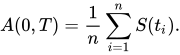
The Average may be obtained in many ways. Conventionally, this means an arithmetic average. In the continuous case, this is obtained by

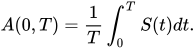
For the case of discrete monitoring (with monitoring at the times and ) we have the average given by

There also exist Asian options with geometric average; in the continuous case, this is given by

Pricing of Asian options

[edit]

A discussion of the problem of pricing Asian options with Monte Carlo methods is given in a paper by Kemna and Vorst.[7]

In the path integral approach to option pricing,[8] the problem for geometric average can be solved via the Effective Classical potential [9] of Feynman and Kleinert.[10]

Rogers and Shi solve the pricing problem with a PDE approach.[11]

A Variance Gamma model can be efficiently implemented when pricing Asian-style options. Then, using the Bondesson series representation to generate the variance gamma process can increase the computational performance of the Asian option pricer.[12]

Within jump diffusions and stochastic volatility models, the pricing problem for geometric Asian options can still be solved.[13] For the arithmetic Asian option in Lévy models, one can rely on numerical methods[13] or on analytic bounds.[14]

European Asian call and put options with geometric averaging

[edit]

We are able to derive a closed-form solution for the geometric Asian option; when used in conjunction with control variates in Monte Carlo simulations, the formula is useful for deriving fair values for the arithmetic Asian option.

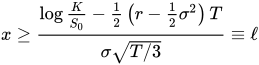
Define the continuous-time geometric mean as:where the underlying follows a standard geometric Brownian motion. It is straightforward from here to calculate that:To derive the stochastic integral, which was originally , note that:This may be confirmed by Itô's lemma. Integrating this expression and using the fact that , we find that the integrals are equivalent - this will be useful later on in the derivation. Using martingale pricing, the value of the European Asian call with geometric averaging is given by:In order to find , we must find such that:After some algebra, we find that:At this point the stochastic integral is the sticking point for finding a solution to this problem. However, it is easy to verify with Itô isometry that the integral is normally distributed as:This is equivalent to saying that with . Therefore, we have that:Now it is possible the calculate the value of the European Asian call with geometric averaging! At this point, it is useful to define:Going through the same process as is done with the Black-Scholes model, we are able to find that:In fact, going through the same arguments for the European Asian put with geometric averaging , we find that:This implies that there exists a version of put-call parity for European Asian options with geometric averaging:

Variations of Asian option

[edit]

There are some variations that are sold in the over-the-counter market. For example, BNP Paribas introduced a variation, termed conditional Asian option, where the average underlying price is based on observations of prices over a pre-specified threshold. A conditional Asian put option has the payoff
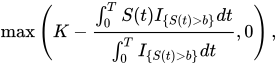
where is the threshold and is an indicator function which equals if is true and equals zero otherwise. Such an option offers a cheaper alternative than the classic Asian put option, as the limitation on the range of observations reduces the volatility of average price. It is typically sold at the money and last for up to five years. The pricing of conditional Asian option is discussed by Feng and Volkmer.[15]

References

[edit]
Revisions and contributorsEdit on WikipediaRead on Wikipedia
from Grokipedia
An Asian option, also known as an average option, is an exotic derivative contract in finance whose payoff depends on the average price of the underlying asset—such as a stock, commodity, or currency—over a predetermined period, rather than the asset's spot price at expiration.[1][2] This averaging mechanism, which can be arithmetic or geometric and sampled discretely or continuously, distinguishes Asian options from vanilla European or American options, which rely solely on the terminal value.[1][3] Originating in the financial markets of Tokyo in 1987, Asian options were developed by bankers at Bankers Trust to address volatility in crude oil pricing and foreign exchange, building on earlier theoretical work from the late 1970s.[2][3] They gained popularity in commodities trading due to their ability to smooth out short-term price fluctuations, making them particularly useful for importers, exporters, and producers hedging long-term exposures.[1][3] Key variants include fixed-strike options, where the strike price is predetermined, and floating-strike options, where the strike is based on an initial average or spot price; additionally, they can be forward-starting, beginning the averaging period after initiation.[2] Pricing Asian options presents challenges because arithmetic averages do not follow a lognormal distribution, precluding closed-form solutions like the Black-Scholes model for most cases.[3] Geometric Asian options, however, allow analytical pricing via modified Black-Scholes formulas assuming lognormal paths, while arithmetic versions typically require numerical methods such as Monte Carlo simulations, finite difference solutions to partial differential equations, or moment-matching approximations.[2][3] Compared to standard options, Asian options exhibit lower premiums owing to reduced volatility from averaging, offering cost-effective hedging but with the trade-off of potentially capping extreme payoffs.[1] They also mitigate risks of market manipulation in illiquid assets and are commonly traded over-the-counter in markets like energy and FX.[1]

Definition and Fundamentals

Core Concept and Payoff Structure

An Asian option is an exotic derivative financial instrument whose payoff depends on the average price of the underlying asset over a specified period, rather than solely on the spot price at maturity. This structure distinguishes it from standard European or American options, which rely on the asset's value at expiration. The payoff mechanics of Asian options vary based on whether the average replaces the strike price or the underlying price in the standard option formula. For an average price call option, the payoff at maturity is given by
max(AK,0), \max(A - K, 0),
where AA is the average price of the underlying asset over the averaging period and KK is the fixed strike price. Similarly, for an average price put option, the payoff is max(KA,0)\max(K - A, 0). In contrast, for an average strike call option, the payoff is
max(STA,0), \max(S_T - A, 0),
where STS_T is the spot price of the underlying asset at maturity TT. The corresponding average strike put option payoff is max(AST,0)\max(A - S_T, 0). These formulations allow the option to hedge against average performance rather than point-in-time fluctuations. The averaging period is a specified interval over which the asset prices are sampled, often at discrete points such as daily or monthly closes, and may span from the option's initiation to maturity or a subset thereof. This averaging process inherently reduces the volatility of the payoff relative to vanilla options, as it smooths out short-term price spikes and emphasizes the underlying asset's overall trend. For example, consider a hypothetical three-month average price call option on a stock with a strike price of $100. If the daily closing prices average $105 over the period, the payoff would be $5 per share at maturity, regardless of the final spot price.

Distinction from Standard Options

Asian options differ fundamentally from standard vanilla European and American options in their payoff structure and risk characteristics. Vanilla European options base their payoff solely on the underlying asset's spot price at expiration, resulting in high gamma and volatility exposure, as the value can swing dramatically with large price movements near maturity. In contrast, Asian options incorporate an average of the asset price over a specified period, which smooths the payoff and diminishes the impact of extreme price fluctuations, leading to lower overall volatility and reduced sensitivity to short-term market noise. This averaging effect also lowers model risk, as the dependence on a path of prices rather than a single point makes the option less vulnerable to inaccuracies in modeling instantaneous volatility or jumps. The pricing implications of these distinctions are significant. Due to the volatility-dampening effect of averaging, Asian options are typically less expensive than their vanilla counterparts, as the probability of extreme payoffs is reduced, effectively lowering the option's premium. For instance, while a vanilla European call option's payoff is max(STK,0)\max(S_T - K, 0), where STS_T is the spot price at expiration and KK is the strike, an Asian average price call uses max(AK,0)\max(A - K, 0), with AA representing the average price over the averaging period; this substitution illustrates the reduced vega (sensitivity to volatility) and gamma (sensitivity to price changes) in Asian options compared to vanillas. Behaviorally, Asian options exhibit traits that enhance their suitability for certain hedging scenarios. Their lower sensitivity to short-term fluctuations makes them particularly advantageous in thinly traded markets, where vanilla options might be susceptible to manipulation near expiration. By spreading the payoff determination across multiple price observations, Asian options mitigate the risk of artificial price spikes or dips influencing the outcome, providing a more stable risk profile for long-term exposure management.

Historical Development

Origins and Etymology

The term "Asian option" was coined in 1987 by Mark Standish and David Spaughton, employees at Bankers Trust's Tokyo office, where the instrument was initially developed and offered to clients for hedging purposes.[4] This naming derives from its development in Tokyo, an Asian financial hub, distinguishing it from existing "European" and "American" option conventions, rather than any geographical limitation on its use. The first practical implementation of Asian options traces to 1987, when Bankers Trust's Tokyo branch introduced them as a tool for pricing average-strike options on crude oil contracts, addressing the need to mitigate manipulation risks in volatile petroleum markets.[5] This marked their emergence in commodity trading, particularly for oil companies seeking stable pricing mechanisms amid fluctuating spot rates in Asian exchanges.[6] Asian options gained formal academic recognition in 1990 through the seminal work of Kemna and Vorst, who provided a pricing framework for geometric average variants and highlighted their utility for averaging over time to hedge against price volatility in commodities.[7] Initially motivated by the challenges of erratic crude oil prices in Asian trading centers like Tokyo during the 1980s, these options predated their broader adoption in equity and currency markets.

Evolution in Financial Markets

The adoption of Asian options expanded significantly in the 1990s, integrating into equity and foreign exchange (FX) markets as advancements in option pricing models, building on the foundational Black-Scholes framework, enabled the valuation of path-dependent exotics like averages.[8] Initially prominent in commodity trading in Asia, these instruments transitioned from niche OTC contracts to broader use in hedging currency fluctuations and equity volatility, with early applications in FX reflecting the need for averaging to mitigate spot price risks.[9] Key academic milestones in the 1990s advanced their theoretical and practical refinement, including Levy's 1992 paper, which introduced a binomial tree approach for pricing European average rate currency options, providing an efficient numerical method adaptable to discrete monitoring.[9] This work, alongside contributions like Kemna and Vorst's geometric approximation, facilitated wider market acceptance by addressing the computational challenges of arithmetic averages.[8] Post-2000, regulatory frameworks enhanced their legitimacy in OTC markets; the Dodd-Frank Act of 2010 in the U.S. and equivalent measures globally mandated clearing and reporting for standardized OTC derivatives, including Asian-style contracts, promoting transparency and reducing systemic risks. In the aftermath of the 2008 financial crisis, the structured products industry incorporating Asian options experienced stagnation in some Asian markets, such as Hong Kong.[10] As of November 2025, applications of Asian options continue to extend to cryptocurrency derivatives amid rising institutional adoption in Asia. In October 2025, DBS and Goldman Sachs completed the first interbank over-the-counter cryptocurrency options trade, involving cash-settled Bitcoin and Ether options.[11] Overall cryptocurrency derivatives trading volumes averaged approximately $24.6 billion daily in 2025.[12]

Classification of Asian Options

Averaging Techniques

Asian options employ various averaging techniques to determine the reference value in their payoff structure, primarily arithmetic and geometric methods, which can be computed either discretely or continuously. Arithmetic averaging calculates the average price of the underlying asset as the simple mean of observed values, providing a straightforward measure that aligns with common financial practices but lacks closed-form pricing solutions in most models.[13] For discrete arithmetic averaging, the average $ A $ is given by
A=1ni=1nSti, A = \frac{1}{n} \sum_{i=1}^n S_{t_i},
where $ S_{t_i} $ represents the asset price at the $ i $-th sampling time $ t_i $ over $ n $ points, often using closing prices to reflect market conventions.[14] In the continuous case, it becomes an integral form:
A=1T0TStdt, A = \frac{1}{T} \int_0^T S_t \, dt,
where $ T $ is the averaging period, theoretically capturing the full path of the asset price under stochastic processes like geometric Brownian motion.[13] Geometric averaging, in contrast, uses the exponential of the average logarithm, which facilitates analytical tractability in Black-Scholes frameworks due to the log-normal distribution of asset prices. The discrete geometric average is
A=(i=1nSti)1/n, A = \left( \prod_{i=1}^n S_{t_i} \right)^{1/n},
equivalent to $ \exp\left( \frac{1}{n} \sum_{i=1}^n \ln S_{t_i} \right) $, allowing exact pricing formulas for geometric Asian options. For continuous geometric averaging, it takes the form
A=exp(1T0TlnStdt), A = \exp\left( \frac{1}{T} \int_0^T \ln S_t \, dt \right),
which serves as a benchmark for approximations in arithmetic cases since the two converge under log-normal assumptions. Discrete averaging relies on sampled prices at fixed intervals, such as daily closing values, making it practical for exchange-traded options where continuous monitoring is infeasible.[14] Continuous averaging, however, approximates the integral via simulated paths in models like Brownian motion, offering a theoretical ideal but requiring numerical methods for implementation. Discrete methods serve as approximations to the continuous case, with the error diminishing as the number of sampling points increases, though they introduce minor biases in volatility exposure compared to full path integration. Sampling frequencies for discrete averages typically include daily, weekly, or monthly intervals, selected based on the underlying asset's liquidity and the option's maturity to balance computational cost and precision. Daily sampling, using end-of-day prices, is most common for equities and currencies to minimize manipulation risks, while weekly or monthly frequencies suffice for less volatile commodities and yield coarser but still accurate approximations to continuous averages. Higher frequencies reduce the discrepancy between discrete and continuous results, improving accuracy by capturing more path variability, particularly in high-volatility environments.[15] These techniques apply to both fixed-strike and floating-strike Asian options, where the average replaces the terminal price or strike in the payoff.[13]

Price vs. Strike Permutations

Asian options are classified based on whether the averaging mechanism is applied to the underlying asset's price or to the strike price, leading to distinct payoff structures and risk profiles. In average price Asian options, the strike price KK is fixed and predetermined, while the payoff depends on the average price AA of the underlying asset over a specified period. For an average price call option, the payoff is max(AK,0)\max(A - K, 0), and for a put, it is max(KA,0)\max(K - A, 0). This structure reduces the volatility of the payoff compared to standard options, as the averaging smooths out short-term price fluctuations, making these options particularly suitable for hedging against average exposure in volatile markets.[1] In contrast, average strike Asian options use the average price AA as a dynamic strike, with the payoff based on the terminal asset price STS_T. The payoff for an average strike call is max(STA,0)\max(S_T - A, 0), and for a put, max(AST,0)\max(A - S_T, 0). This design allows option buyers to participate in the underlying asset's price movements relative to its historical average, offering potential benefits in trending markets where STS_T may significantly exceed or fall below AA, while still benefiting from the lower premium costs associated with averaging.[1] These classifications combine with averaging techniques to form four permutations: arithmetic average price, geometric average price, arithmetic average strike, and geometric average strike options. Average strike variants are less common in practice due to their increased pricing complexity and path-dependent nature.[16] The choice between average price and average strike depends on the user's objectives; average price options are typically selected for hedging average asset exposures, such as in commodity or currency contracts, to mitigate volatility risks effectively. Average strike options, meanwhile, appeal to those seeking cost-efficient ways to capture upside potential in directional markets without a fixed strike commitment.[1]

Pricing Methodologies

Analytical Solutions for Geometric Averages

The geometric average of asset prices under the Black-Scholes model follows a log-normal distribution, which enables a closed-form analytical solution for pricing geometrically averaged Asian options by modifying the parameters of the standard Black-Scholes formula.[17] This tractability arises because the logarithm of the geometric average is normally distributed, allowing the option price to be expressed using the cumulative normal distribution function in a manner analogous to vanilla European options.[17] For a European geometric average price call option with fixed strike under continuous averaging from initiation, the price under the Black-Scholes assumptions of constant risk-free rate $ r $, constant volatility $ \sigma $, and no dividends is given by
C=erT[SeaTN(d1)KN(d2)], C = e^{-r T} \left[ S e^{a T} N(d_1) - K N(d_2) \right],
where $ a = \frac{1}{2} \left( r - \frac{\sigma^2}{6} \right) $,
d1=ln(S/K)+(a+σ26)TσT/3,d2=d1σT/3, d_1 = \frac{\ln(S / K) + \left( a + \frac{\sigma^2}{6} \right) T}{\sigma \sqrt{T / 3}}, \quad d_2 = d_1 - \sigma \sqrt{T / 3},
$ S $ is the current asset price, $ K $ is the strike price, $ T $ is the time to maturity, and $ N(\cdot) $ is the cumulative distribution function of the standard normal distribution.[17] The adjustment to the volatility term reflects the reduced variance of the geometric average, specifically $ \sigma' = \sigma / \sqrt{3} $, while the drift adjustment incorporates the effective dynamics of the averaged process.[17] This formula extends to cases with a continuous dividend yield $ q $ by adjusting $ a = \frac{1}{2} \left( r - q - \frac{\sigma^2}{6} \right) $, yielding
C=erT[SeqT+aTN(d1)KN(d2)], C = e^{-r T} \left[ S e^{-q T + a T} N(d_1) - K N(d_2) \right],
with
d1=ln(S/K)+(a+σ26)TσT/3,d2=d1σT/3.[](http://homepage.ntu.edu.tw/ jryanwang/courses/Financial d_1 = \frac{\ln(S / K) + \left( a + \frac{\sigma^2}{6} \right) T}{\sigma \sqrt{T / 3}}, \quad d_2 = d_1 - \sigma \sqrt{T / 3}.[](http://homepage.ntu.edu.tw/~jryanwang/courses/Financial%20Computation%20or%20Financial%20Engineering%20%28graduate%20level%29/FE_Ch10%20Asian%20Option.pdf)
For the corresponding put option, a similar closed-form expression applies via put-call parity adapted for Asian options: $ C - P = e^{-r T} (F - K) $, where $ F $ is the forward price of the geometric average, which is analytically computable as $ F = S e^{ \left( (r - q)/2 - \sigma^2 / 12 \right) T } $.[17] These solutions assume a geometric Brownian motion for the underlying asset, constant parameters, and continuous averaging over the option's life, all within the Black-Scholes framework (Kemna and Vorst, 1990).[17] However, closed-form solutions are available only for geometric averages; arithmetic averages lack this tractability due to the non-lognormal distribution of the average and require numerical methods such as Monte Carlo simulation or PDE solvers.[17]

Numerical Approaches for Arithmetic Averages

Since no closed-form solutions exist for arithmetically averaged Asian options under standard models like Black-Scholes, numerical methods are essential for pricing them by approximating the distribution of the arithmetic average.[18] These approaches handle the path-dependent nature of the payoff, which depends on the integral or discrete sum of the underlying asset price StS_t over time, by simulating or discretizing the stochastic process.[19] Monte Carlo simulation is a widely used method for pricing arithmetic Asian options, involving the generation of multiple random paths for the underlying asset price StS_t under the risk-neutral measure, computation of the arithmetic average A=1T0TStdtA = \frac{1}{T} \int_0^T S_t \, dt (or its discrete counterpart) for each path, and then discounting the average payoff across paths to obtain the option price.[20] To improve efficiency and reduce variance, techniques such as control variates are applied, where the geometrically averaged Asian option—whose price has a closed-form solution—serves as a proxy to correlate with the arithmetic payoff, achieving variance reductions of up to 90% in typical implementations.[20] This method is particularly effective for high-dimensional or complex path dependencies, though it requires a large number of simulations (often 10,000 or more) for convergence.[20] Lattice methods, including binomial and trinomial trees, discretize the continuous-time Black-Scholes dynamics into a recombining tree of asset prices at discrete time steps, allowing the arithmetic average to be tracked by averaging node prices along paths from the root to terminal nodes. In the binomial tree approach developed by Hull and White (1993), the tree is constructed with up/down moves calibrated to match the log-normal volatility, and the option value is computed backward from maturity, incorporating the running average at each node to handle the path dependence. Trinomial trees extend this by adding a middle branch for finer granularity, improving convergence to the continuous averaging limit as the number of steps increases, with error rates typically decreasing as O(1/N)O(1/N) where NN is the number of time steps.[21] These lattice methods are computationally intensive for fine discretizations due to the exponential growth in nodes but offer interpretability and ease of extension to American-style exercise. Moment-matching approximations provide a faster alternative by estimating the first two moments (mean and variance) of the arithmetic average distribution and fitting it to a log-normal distribution for closed-form Black-Scholes-like pricing.[18] The seminal Levy approximation (1992) achieves this by matching the moments of the sum of log-normal variables approximating the integral, yielding errors typically below 1% for at-the-money options with maturities up to two years under constant volatility. This method is computationally efficient, requiring only moment calculations, and serves as a benchmark for validating more complex numerical schemes, though it assumes log-normality which may underperform in high-volatility regimes.[22] Partial differential equation (PDE) methods solve the Black-Scholes PDE modified to include the averaging integral, transforming the problem into a two-dimensional PDE in variables representing the current asset price and the running average.[19] Finite difference schemes, such as Crank-Nicolson implicit methods, discretize this PDE on a grid and solve backward in time, providing stable and second-order accurate solutions with grid sizes of 100x100 often sufficient for precision within 0.1%.[23] These approaches handle continuous averaging directly and converge to the true value as the grid refines, but they demand careful boundary condition handling to avoid oscillations near the average boundaries.[19] Computational considerations for these methods emphasize efficiency in path generation and error quantification; for instance, Monte Carlo simulations typically report 95% confidence intervals with half-widths of 0.5-2% of the option price after 50,000 paths, while lattice and PDE methods achieve similar accuracy with O(N2)O(N^2) operations where N200N \approx 200 steps.[20] Geometric closed-form solutions are often used briefly as validation benchmarks to ensure numerical prices align within 0.1-0.5% for low-volatility cases.[20] Overall, the choice depends on dimensionality and required precision, with hybrid approaches combining approximations and simulations for production use.[18]

Practical Applications

Usage in Commodity and Currency Markets

Asian options are particularly valuable in commodity markets for hedging against price volatility, where producers and consumers face exposure to fluctuating spot prices over extended periods. Oil producers, for instance, utilize Asian options to lock in revenues based on the average price of Brent crude oil, mitigating the impact of seasonal demand swings and supply disruptions. This averaging mechanism allows firms to hedge annual or monthly exposures more cost-effectively than vanilla options, as the payoff depends on the arithmetic or geometric average of oil prices rather than a single settlement point. In practice, airlines and energy companies have incorporated monthly Asian options on crude oil into their portfolios to stabilize fuel costs, replacing portions of standard contracts with annual averaging structures for better alignment with operational cash flows.[24][25] Asian options are predominantly traded over-the-counter (OTC) to customize averaging periods for participants hedging oil supplies. These instruments help address volatility patterns in oil markets, where geopolitical factors and regional demand influence pricing. For example, Mexican state-owned oil company Pemex has employed Asian options to hedge its export revenues throughout the year, ensuring protection against intra-year price drops without the need for multiple vanilla contracts.[26] In currency markets, Asian options serve as effective tools for exporters managing foreign exchange (FX) risk, particularly in pairs like USD/JPY, where averaging the exchange rate over a contract period reduces the influence of short-term spot volatility. This approach is especially relevant in export-driven economies, where the averaged rate provides a smoother hedge compared to point-in-time settlements, lowering premiums and enhancing predictability for cash flow planning.[27] Asian options are frequently embedded in structured products tailored for retail investors in emerging Asian markets, such as equity-linked notes or autocallables that incorporate averaging features to offer downside protection and yield enhancement. These products appeal to investors in markets like China and India, where demand for customized risk management combines with limited access to plain vanilla derivatives. By integrating Asian option payoffs, issuers create instruments that cap exposure to single-day market moves, making them suitable for conservative retail portfolios seeking principal protection amid volatile local currencies and commodities.[28][29]

Risk Management Benefits

Asian options offer several advantages in risk management, primarily due to their averaging mechanism, which smooths out price fluctuations over time. One key benefit is the lower premium costs compared to vanilla options, as the averaging reduces the effective volatility of the underlying asset, making these instruments more affordable for hedging strategies. This cost efficiency allows market participants to allocate capital more effectively while maintaining protection against adverse price movements. Additionally, by focusing on an average price rather than a single spot price, Asian options mitigate exposure to short-term volatility spikes, providing a more stable hedge for long-term positions in volatile assets. The averaging feature also serves as an anti-manipulation tool, particularly in illiquid markets where single-day price manipulations can distort outcomes. By diluting the impact of isolated price spikes through the average, Asian options reduce the risk of artificial distortions, enhancing the reliability of risk mitigation for assets like certain commodities. In terms of risk sensitivities, known as the Greeks, Asian options generally exhibit lower delta and vega compared to vanilla options, reflecting their reduced sensitivity to spot price changes and volatility shifts, respectively. However, they display higher rho sensitivity, making them more responsive to interest rate variations, which can be advantageous in environments with changing monetary policies but requires careful monitoring in hedging portfolios. Despite these benefits, Asian options have limitations in risk management stemming from their path-dependent nature. For American-style Asian options, the path dependency complicates early exercise decisions, as optimal exercise boundaries must account for the entire price history, increasing computational and strategic complexity. In non-trending or range-bound markets, the averaging mechanism may lead to under-hedging, where the option fails to fully capture directional risks, potentially leaving positions exposed to prolonged sideways movements. These attributes make Asian options particularly useful in commodity and foreign exchange applications for balanced risk control.

Extensions and Variations

Hybrid and Path-Dependent Features

Hybrid Asian options integrate the averaging mechanism of standard Asian options with barrier features, where the payoff is contingent on whether the average price or the underlying asset price breaches a predefined barrier level during the option's life. In Asian-barrier options, the barrier condition can apply to either the underlying asset price or directly to the running average, resulting in knock-out variants that become worthless if the monitored value hits the barrier. For instance, a down-and-out Asian call option activates only if the average price remains above a lower barrier throughout discrete monitoring dates, combining path dependency from both averaging and barrier monitoring to reduce premium costs while offering protection against extreme price movements. This structure is particularly useful in volatile markets to hedge against sustained declines without full exposure to spot price risks.[30] Another prominent hybrid is the Asian-lookback option, which links the payoff to the relationship between the average price over the averaging period and the minimum or maximum price attained by the underlying asset during that path. Fixed-strike Asian-lookback calls, for example, pay the maximum of the difference between the average and a strike or between the maximum path value and the strike, effectively capturing both temporal averaging and extremal path information to enhance upside potential. Floating-strike versions compare the average to the terminal asset price or adjust the strike based on path minima/maxima, providing symmetry in valuation under Lévy processes that equates certain Asian-lookback payoffs to standard lookback options via numéraire changes. These hybrids amplify path dependency by incorporating extremal values alongside averages, making them suitable for strategies seeking to optimize entry or exit points based on historical price ranges.[31] Path-dependent enhancements in Asian options often include chooser features, allowing the holder to decide at maturity whether the option settles as a call or put based on the realized average price relative to the strike. An Asian chooser option thus embeds the averaging payoff within a flexible call/put election, where the choice maximizes value by selecting the more favorable structure given the path-dependent average— for example, opting for a call if the average exceeds the strike or a put otherwise. This combination increases the option's adaptability to uncertain market paths, as the averaging smooths volatility while the chooser element permits post-path adjustment, though it introduces additional complexity in determining the optimal decision boundary. Pricing such options typically relies on binomial tree models that propagate the averaging state and choice probabilities forward, validated against Monte Carlo simulations for accuracy.[32] Valuing these hybrid and path-dependent Asian options presents significant challenges due to the heightened dimensionality from multiple path-dependent variables, such as running averages, barrier crossings, and extremal trackers, which preclude closed-form solutions for arithmetic averaging cases. Advanced numerical methods are essential: Monte Carlo simulations must incorporate variance reduction techniques to handle the correlated paths efficiently, while partial differential equation (PDE) solvers require auxiliary variables to track the average or barrier state, managing jump conditions at discrete observation points for convergence. For American-style hybrids, early exercise adds further layers, necessitating robust interpolation schemes like upstream biased quadratic methods to resolve discontinuities. These approaches, while computationally intensive, enable precise pricing under Black-Scholes assumptions, with PDE methods often preferred for their ability to incorporate American features and discrete monitoring.[30][33] A notable example of path-dependent enhancement is the Asian-cliquet option, employed in equity-linked notes to provide periodic averaging resets that lock in gains over sequential intervals. In this structure, the payoff sums capped returns based on the average performance in each reset period, such as quarterly averages of an equity index, allowing investors to capture local upside while mitigating overall market downturns through averaging. Commonly issued by insurance firms for guaranteed products, Asian-cliquets exhibit strong path dependency from the chained averaging periods, requiring semi-closed-form expressions via Fourier analysis or PDEs for hedging and pricing under stochastic volatility. This design suits long-term notes by balancing accumulation of positive averages with reset mechanisms that prevent carryover losses.[34]

Recent Adaptations in Derivatives

In recent years, Asian options have seen adaptations in cryptocurrency markets, particularly for hedging volatility in decentralized finance (DeFi) protocols. Platforms like Deribit, a leading cryptocurrency derivatives exchange, have incorporated Asian-style options to average Bitcoin and Ethereum prices over specified periods, enabling traders to mitigate extreme price swings without the settlement risks of spot trading. This approach gained traction post-2020 amid the surge in crypto derivatives volume, with perpetual swaps on exchanges such as Binance integrating average-price mechanisms to facilitate continuous hedging strategies in volatile environments.[35][36] ESG-linked Asian options have emerged as tools for pricing sustainability performance in green finance instruments. In sustainability-linked bonds (SLBs), the coupon adjustments often depend on the average achievement of environmental, social, and governance (ESG) targets over time, analogous to an Asian option where the payoff reflects the arithmetic mean of metrics like carbon emission reductions or sustainable commodity yields. For instance, issuers use this averaging to link bond yields to the trajectory of carbon credit prices or renewable energy outputs, promoting transparency in green bonds issued in Asia-Pacific markets. This structure incentivizes long-term sustainability goals, with empirical models showing reduced spreads for bonds meeting averaged ESG thresholds.[37] Machine learning integrations have enhanced the handling of discrete averages in Asian options, particularly for high-frequency trading applications. Deep neural networks have been applied to approximate arithmetic Asian option prices under stochastic volatility, achieving computational speeds that support real-time pricing—computing thousands of scenarios in seconds compared to traditional Monte Carlo methods. These AI-optimized models improve sampling efficiency for discrete monitoring dates, reducing approximation errors in high-volatility assets and enabling faster execution in algorithmic trading environments. Seminal work demonstrates that such techniques outperform classical methods in accuracy and speed, facilitating broader adoption in dynamic markets.[38][39] Regulatory updates under MiFID II have influenced over-the-counter (OTC) Asian options in Europe by mandating enhanced transparency since 2018. The directive requires post-trade reporting of OTC derivatives, including exotics like Asian options, to public tape systems, covering price, volume, and time details to improve market oversight and reduce opacity in bilateral trades. This has led to adaptations in reporting protocols for Asian options traded off-exchange, with exemptions calibrated for illiquid instruments but overall increasing disclosure for European counterparties. Compliance has streamlined OTC workflows while fostering cross-border alignment in derivatives markets.[40][41]

References

User Avatar
No comments yet.