Hubbry Logo
search
logo

Astronomical nutation

logo
Community Hub0 Subscribers
Read side by side
from Wikipedia

Astronomical nutation is a phenomenon which causes the orientation of the axis of rotation of a spinning astronomical object to vary over time. It is caused by the gravitational forces of other nearby bodies acting upon the spinning object. Although they are caused by the same effect operating over different timescales, astronomers usually make a distinction between precession, which is a steady long-term change in the axis of rotation, and nutation, which is the combined effect of similar shorter-term variations.[1]

An example of precession and nutation is the variation over time of the orientation of the axis of rotation of the Earth. This is important because the most commonly used frame of reference for measurement of the positions of astronomical objects is the Earth's equator — the so-called equatorial coordinate system. The effect of precession and nutation causes this frame of reference itself to change over time, relative to an arbitrary fixed frame.

Nutation is one of the corrections which must be applied to obtain the apparent place of an astronomical object. When calculating the position of an object, it is initially expressed relative to the mean equinox and equator — defined by the orientation of the Earth's axis at a specified date, taking into account the long-term effect of precession, but not the shorter-term effects of nutation. It is then necessary to apply a further correction to take into account the effect of nutation, after which the position relative to the true equinox and equator is obtained.

Because the dynamic motions of the planets are so well known, their nutations can be calculated to within arcseconds over periods of many decades. There is another disturbance of the Earth's rotation called polar motion that can be estimated for only a few months into the future because it is influenced by rapidly and unpredictably varying things such as ocean currents, wind systems, and hypothesised motions in the liquid nickel-iron outer core of the Earth.

Earth's nutation

[edit]
Nutation (N) of the Earth produces a slight axial wobble over the course of the 26,000 year precessional cycle (P).

Precession and nutation are caused principally by the gravitational forces of the Moon and Sun acting upon the non-spherical figure of the Earth. Precession is the effect of these forces averaged over a very long period of time, and a time-varying moment of inertia (If an object is asymmetric about its principal axis of rotation, the moment of inertia with respect to each coordinate direction will change with time, while preserving angular momentum), and has a timescale of about 26,000 years. Nutation occurs because the forces are not constant, and vary as the Earth revolves around the Sun, and the Moon revolves around the Earth. Basically, there are also torques from other planets that cause planetary precession which contributes to about 2% of the total precession. Because periodic variations in the torques from the sun and the moon, the wobbling (nutation) comes into place. You can think of precession as the average and nutation as the instantaneous.

The largest contributor to nutation is the inclination of the orbit of the Moon around the Earth, at slightly over 5° to the plane of the ecliptic. The orientation of this orbital plane varies over a period of about 18.6 years (this period is referred to as the saros). Because the Earth's equator is itself inclined at an angle of about 23.4° to the ecliptic (the obliquity of the ecliptic, ), these effects combine to vary the inclination of the Moon's orbit to the equator by between 18.4° and 28.6° over the 18.6 year period. This causes the orientation of the Earth's axis to vary over the same period, with the true position of the celestial poles describing a small ellipse around their mean position. The maximum radius of this ellipse is the constant of nutation, approximately 9.2 arcseconds.

Smaller effects also contribute to nutation. These are caused by the monthly motion of the Moon around the Earth and its orbital eccentricity, and similar terms caused by the annual motion of the Earth around the Sun.

Effect on position of astronomical objects

[edit]

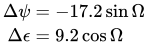
Because nutation causes a change to the frame of reference, rather than a change in position of an observed object itself, it applies equally to all objects. Its magnitude at any point in time is usually expressed in terms of ecliptic coordinates, as nutation in longitude () in seconds of arc and nutation in obliquity () in seconds of arc. The largest term in nutation is expressed numerically (in arcseconds) as follows:

where is the ecliptic longitude of the ascending node of the Moon's orbit. By way of reference, the sum of the absolute value of all the remaining terms is 1.4 arcseconds for longitude and 0.9 arcseconds for obliquity.[2]

Spherical trigonometry can then be used on any given object to convert these quantities into an adjustment in the object's right ascension () and declination () For objects that are not close to a celestial pole, nutation in right ascension () and declination () can be calculated approximately as follows:[3]

Free nutation

[edit]

Earth also has an additional 0.10 to 0.15 seconds of arc nutations with a period 6 and half years called Chandler wobble and its due to free nutation caused by irregular distribution of mass around Earth axis.[4]

History

[edit]

Nutation was discovered by James Bradley from a series of observations of stars conducted between 1727 and 1747. These observations were originally intended to demonstrate conclusively the existence of the annual aberration of light, a phenomenon that Bradley had unexpectedly discovered in 1725–6. However, there were some residual discrepancies in the stars' positions that were not explained by aberration, and Bradley suspected that they were caused by nutation taking place over the 18.6 year period of the revolution of the nodes of the Moon's orbit. This was confirmed by his 20-year series of observations, in which he discovered that the celestial pole moved in a slightly flattened ellipse of 18 by 16 arcseconds about its mean position.[5]

Although Bradley's observations proved the existence of nutation and he intuitively understood that it was caused by the action of the Moon on the rotating Earth, it was left to later mathematicians, Jean le Rond d'Alembert and Leonhard Euler, to develop a more detailed theoretical explanation of the phenomenon.[6]

See also

[edit]

References

[edit]
Revisions and contributorsEdit on WikipediaRead on Wikipedia
from Grokipedia
Astronomical nutation is a subtle, periodic oscillation in the orientation of Earth's rotational axis, superimposed on the much slower precession of the equinoxes, resulting from gravitational torques exerted by the Moon and Sun on Earth's oblate figure.[1] This motion causes small variations in the tilt (obliquity) and longitude of the axis, with the principal component arising from the 5-degree inclination between the Moon's orbital plane and the ecliptic, leading to a dominant 18.6-year period and an amplitude of about 9.2 arcseconds.[2] Additional smaller nutations occur on timescales from days to decades due to the elliptical orbits of Earth and the Moon, as well as planetary influences, contributing to a complex "wobble" in the celestial pole's position.[3] The phenomenon was first discovered by English astronomer James Bradley between 1728 and 1748 through meticulous observations of stellar positions using a zenith sector telescope, initially mistaken as part of stellar aberration but later identified as an Earth-based effect.[4] Bradley's work quantified the nutation in obliquity and longitude, establishing it as a key component of Earth's rotational dynamics alongside precession, which has a 26,000-year cycle driven by the same gravitational forces.[5] Modern models, such as those from the International Astronomical Union, incorporate over 100 nutation terms to achieve sub-milliarcsecond precision for applications in astrometry and space navigation.[6] In practical terms, astronomical nutation shifts the apparent positions of celestial objects by up to several arcseconds, necessitating corrections in telescope pointing, satellite orbits, and global positioning systems to maintain accuracy.[7] While imperceptible without instruments, these motions highlight the dynamic interplay between Earth's rotation and solar system gravitational fields, underscoring the need for ongoing geophysical monitoring.[8]

Definition and Fundamentals

Overview of Nutation

Astronomical nutation refers to the small, periodic oscillations superimposed on the precession of Earth's rotational axis, causing slight variations in the orientation of the axis relative to the fixed stars. These oscillations have maximum amplitudes of approximately 17 arcseconds in longitude and 9 arcseconds in obliquity./06%3A_The_Celestial_Sphere/6.08%3A_Nutation) Nutation manifests as a subtle wobble in the position of the celestial pole, introducing irregularity into what would otherwise be a smoother precessional path.[2] The periods of nutation vary widely, ranging from a few days to several years, with the dominant principal component having an 18.6-year period corresponding to the regression of the Moon's orbital nodes. This motion arises from external gravitational perturbations acting on Earth's non-spherical mass distribution, positioning nutation as a second-order effect in the dynamics of Earth's rotation, subordinate to the primary precessional trend.[9][10] Visually, nutation can be likened to the nodding wobble of a spinning top under applied torque, where the axis traces a slightly elliptical or irregular path rather than a perfect circle./06%3A_The_Celestial_Sphere/6.08%3A_Nutation) Superimposed on the longer-term, roughly circular precession cycle of about 26,000 years, nutation modulates the overall motion of Earth's axis in space.[2]

Relation to Precession

Axial precession is the gradual, westward drift of Earth's rotational axis around the ecliptic pole, completing one full cycle in approximately 26,000 years due to the differential gravitational torques from the Sun and Moon acting on Earth's equatorial bulge.[11] This torque arises because the Earth's rotation causes a centrifugal bulge at the equator, which is not aligned with the gravitational pull from the Sun and Moon, leading to a steady torque that shifts the axis in a circular path with a radius equal to the obliquity of the ecliptic, about 23.4 degrees.[2] Nutation manifests as small, oscillatory deviations superimposed on this precessional motion, akin to a nodding perturbation that causes the true celestial pole to wobble around the mean pole defined by precession alone.[12] As a result, the path of the ecliptic pole becomes a slightly irregular, wavy circle rather than a smooth one, with the nutational effects modulating the position of the axis over shorter timescales.[2] The dominant component of this oscillation has an 18.6-year period and an amplitude of roughly 9.2 arcseconds.[2] In contrast to precession, which represents a secular and monotonic long-term shift without reversal, nutation is inherently periodic and reversible, producing temporary excursions that average out over time.[13] Furthermore, the scale of nutation is vastly smaller, confined to arcseconds, whereas precession involves angular displacements on the order of degrees across its cycle.[2]

Causes and Mechanisms

Gravitational Influences

The gravitational influence of the Moon dominates the induction of astronomical nutation on Earth, primarily owing to its close proximity and the approximately 5° inclination of its orbital plane relative to the ecliptic. This tilt causes periodic variations in the gravitational torque exerted on Earth's equatorial bulge as the Moon's nodes regress around the ecliptic with a period of 18.6 years, establishing the principal component of nutation.[2][14] The Sun exerts a secondary gravitational effect on nutation, with contributions approximately one-third the amplitude of the lunar terms, arising from the eccentricity of Earth's orbit and the resulting annual variations in solar position relative to the equatorial plane. Unlike the Moon, the Sun's influence lacks a direct orbital inclination but still perturbs Earth's rotation through these orbital dynamics.[15] Planetary bodies such as Jupiter and Venus produce minor gravitational perturbations on nutation, with individual and collective effects limited to less than 0.1 arcseconds in amplitude due to their greater distances and smaller masses compared to the Moon and Sun. Non-gravitational influences, like atmospheric loading from pressure variations, contribute negligibly to classical nutation, typically at the microarcsecond level or below.[16][17]

Torque on Earth's Bulge

Earth's rotation imparts a centrifugal force that causes the planet to assume an oblate spheroidal shape, characterized by an equatorial bulge where the equatorial radius exceeds the polar radius by approximately 21 km, corresponding to a flattening ratio of about 1/298. This oblateness results in a non-uniform mass distribution, with the equatorial region possessing a greater moment of inertia compared to the polar regions, quantified by the dynamical ellipticity (C - A)/C ≈ 0.0032738, where C and A are the principal moments of inertia along the polar and equatorial axes, respectively. The equatorial bulge interacts with the gravitational fields of the Moon and Sun, producing a torque when the Earth's rotational axis is misaligned with respect to these fields' symmetry planes. Specifically, the misalignment of the bulge with the gravitational gradient—arising from the differential pull across the Earth's figure—generates a restoring torque that tends to realign the equator with the perturbing body's orbital plane.[18] This torque manifests as an oscillatory component superimposed on the secular precession, constituting the nutation. In vector terms, the torque acts perpendicular to both the Earth's angular momentum vector and the plane containing the rotational axis and the perturbing body's position, inducing a "nodding" motion of the rotational axis in response to variations in the declination of the Moon and Sun. The magnitude and direction of this torque depend on the orientation of the equatorial bulge relative to the external gravitational potential, leading to periodic reorientations of the Earth's figure axis.

Earth's Nutation

Principal Components

The principal component of astronomical nutation on Earth arises from the gravitational torque exerted by the Moon due to the precession of its orbital nodes, resulting in a periodic oscillation with an 18.6-year period. This term dominates the nutation series and manifests as variations in the orientation of Earth's rotation axis relative to the ecliptic, with an amplitude of approximately 17.2 arcseconds in nutation longitude (Δψ) and 9.2 arcseconds in nutation obliquity (Δε).[19] These amplitudes reflect the maximum displacements in the position of the celestial pole and the tilt of the equator, respectively, and are derived from high-precision models incorporating rigid and non-rigid Earth effects.[20] Secondary nutation terms arise from additional gravitational perturbations, primarily from the Sun and Moon, accounting for orbital eccentricities, inclinations, and planetary influences. Notable among these are the 9.2-year term, representing half the lunar nodal cycle with amplitudes on the order of several arcseconds; the annual term, driven by the Earth's orbit around the Sun with periods near 365 days and amplitudes around 0.4 arcseconds; and the semi-annual term near 182 days, also solar-dominated but with slightly smaller effects. Classical nutation models, such as those developed in the mid-20th century and refined for IAU adoption, incorporate approximately 20 significant terms exceeding a threshold of about 0.001 arcseconds, capturing the bulk of the observed variations beyond the principal component.[21] Nutation components are further distinguished by their spherical harmonic degrees: zonal terms (m=0) correspond to long-period variations like the principal 18.6-year and secondary 9.2-year effects, which primarily drive the overall wobble of the rotation axis; in contrast, tesseral terms (m≠0) involve shorter diurnal and semi-diurnal periods, influencing higher-frequency excitations but contributing less to the dominant axial motion. Zonal nutations thus account for the majority of the observable changes in Earth's figure axis orientation.[20]

Effects on Celestial Positions

Nutation alters the orientation of Earth's rotational axis relative to the ecliptic, resulting in periodic shifts of the equinoxes that change the reference points for equatorial coordinates. These shifts necessitate corrections to the right ascension (Δα) and declination (Δδ) of celestial objects in star catalogs to obtain their mean positions free from nutational effects. The corrections are derived from the nutation parameters, primarily the nutation in longitude (Δψ) and in obliquity (Δε), ensuring accurate transformation between the true and mean equatorial systems. The principal 18.6-year nutation component dominates these effects, producing shifts of up to 17 arcseconds in polar positions. Such displacements impact precise astrometry by introducing systematic errors if uncorrected, limiting the resolution of star position measurements to sub-arcsecond levels essential for modern surveys. Telescope pointing for observations, including those in optical and radio astronomy, requires these corrections to align instruments accurately with target objects, avoiding offsets that could degrade data quality. In timekeeping, nutation contributes to the equation of the equinoxes, which differentiates apparent sidereal time from mean sidereal time and thus relates Universal Time UT1 (tied to Earth's rotation) to Coordinated Universal Time UTC.[22] To reduce raw observations to the International Celestial Reference System (ICRS), a barycentric, quasi-inertial frame defined at epoch J2000.0, nutation corrections are applied as part of the full Earth orientation transformation. This process involves removing the effects of nutation, precession, and other rotations to align observed positions with the ICRS, enabling consistent comparisons across epochs and instruments. The IAU 2000A nutation model, adopted in the IERS Conventions, provides the series expansions for these corrections, achieving accuracies better than 1 milliarcsecond for most applications.

Free Nutation

Free nutation, also known as the Chandler wobble, refers to the free Eulerian nutation of Earth's rotation axis, resulting from the planet's elastic response to rotational dynamics and coupling between the core and mantle.[23] This internal oscillation manifests as a prograde motion of the rotation pole relative to the Earth's crust, with a period of approximately 430 days.[2] The lengthening of this period from Euler's rigid-body prediction of 305 days arises primarily from the elastic deformation of the mantle and the presence of the fluid outer core, which modifies the effective moments of inertia.[23] The Chandler wobble exhibits a typical amplitude of about 0.7 arcseconds in polar motion, though this varies over time due to excitation and damping mechanisms. However, observations indicate that the amplitude has greatly diminished since 2015, nearly vanishing as of the 2020s, linked to large-scale mass anomalies from a massive La Niña event.[24] It is primarily excited by stochastic internal mass redistributions, such as seasonal changes in atmospheric pressure, ocean currents, and hydrological loading, which apply torques to the solid Earth.[25] Core-mantle interactions further influence the mode's stability and damping, with the wobble's quality factor indicating low dissipation primarily in the mantle.[20] Unlike forced nutations driven by predictable external gravitational torques, free nutation persists as a damped, nearly circular oscillation maintained by these irregular internal forcings.[2] Observational evidence for free nutation emerged from analyses of astronomical latitude variations, first systematically detected by Seth Carlo Chandler in 1892 using data from multiple observatories including Berlin, Prague, and Pulkova.[23] Chandler identified a 14-month (427-day) periodicity in these variations, initially unexplained but later recognized as the manifestation of polar motion associated with the free nutation of the rotation axis.[23] Modern observations from space geodesy, such as VLBI and SLR, confirm the wobble's prograde circular path and link it directly to excitations from Earth's fluid layers.[20]

Mathematical Description

Nutation Equations

The mathematical description of astronomical nutation begins with Euler's equations for the rotation of a rigid body, which provide the foundational framework for both torque-free and forced motions relevant to Earth's axial wobble. In the torque-free case, where no external torques act on the body, Euler's equations in the principal axis frame are given by
I1ω˙1+(I3I2)ω2ω3=0, I_1 \dot{\omega}_1 + (I_3 - I_2) \omega_2 \omega_3 = 0,
I2ω˙2+(I1I3)ω3ω1=0, I_2 \dot{\omega}_2 + (I_1 - I_3) \omega_3 \omega_1 = 0,
I3ω˙3+(I2I1)ω1ω2=0, I_3 \dot{\omega}_3 + (I_2 - I_1) \omega_1 \omega_2 = 0,
where I1,I2,I3I_1, I_2, I_3 are the principal moments of inertia and ω1,ω2,ω3\omega_1, \omega_2, \omega_3 are the components of the angular velocity vector.[26] For Earth, approximated as an oblate spheroid with I1=I2=AI_1 = I_2 = A (equatorial moments) and I3=CI_3 = C (polar moment, C>AC > A), these simplify to describe the free nutation, or polhode motion, where the angular velocity vector traces a closed path on the body's surface relative to the angular momentum vector, leading to small oscillations in the orientation of the rotation axis. In the forced case, external gravitational torques from the Moon and Sun are included on the right-hand sides as τ1,τ2,τ3\tau_1, \tau_2, \tau_3, yielding
Aω˙1+(CA)ω2ω3=τ1, A \dot{\omega}_1 + (C - A) \omega_2 \omega_3 = \tau_1,
Aω˙2(CA)ω1ω3=τ2, A \dot{\omega}_2 - (C - A) \omega_1 \omega_3 = \tau_2,
Cω˙3=τ3. C \dot{\omega}_3 = \tau_3.
These torques perturb the motion, causing the observed astronomical nutation superimposed on precession.[26] The nutation angle θ\theta, representing the tilt of the rotation axis relative to the angular momentum vector, evolves under torque according to the approximate relation dθ/dtτ/Ld\theta/dt \approx \tau / L, where τ\tau is the magnitude of the perturbing torque and LL is the magnitude of the angular momentum; this follows from L˙=τ\dot{\mathbf{L}} = \boldsymbol{\tau}, with the perpendicular component of torque causing the tip of L\mathbf{L} to sweep a small circle, altering θ\theta at a rate inversely proportional to LL.[5] The overall transformation accounting for both precession and nutation is encapsulated in the precession-nutation matrix, which combines small rotations corresponding to the nutation in longitude Δψ\Delta\psi and the nutation in obliquity Δϵ\Delta\epsilon. This matrix is constructed as the product of three elementary rotation matrices in the standard Euler angle convention: a rotation about the ecliptic x-axis by ϵA-\epsilon_A (mean obliquity), followed by a rotation about the line of nodes by Δψ\Delta\psi, and then a rotation about the ecliptic x-axis by ϵA+Δϵ\epsilon_A + \Delta\epsilon, yielding
N=R1(ϵA)R3(Δψ)R1(ϵA+Δϵ), \mathbf{N} = \mathbf{R}_1(-\epsilon_A) \mathbf{R}_3(\Delta\psi) \mathbf{R}_1(\epsilon_A + \Delta\epsilon),
where R1(α)\mathbf{R}_1(\alpha) and R3(α)\mathbf{R}_3(\alpha) are the standard rotation matrices about the x- and z-axes, respectively. For small nutations, this approximates to
N(1ΔψcosϵAΔϵsinϵA+ΔψsinϵA01Δϵ001), \mathbf{N} \approx \begin{pmatrix} 1 & -\Delta\psi \cos \epsilon_A & \Delta\epsilon \sin \epsilon_A + \Delta\psi \sin \epsilon_A \\ 0 & 1 & -\Delta\epsilon \\ 0 & 0 & 1 \end{pmatrix},
transforming coordinates from the mean ecliptic frame to the true equatorial frame and capturing the oscillatory shifts in celestial positions. This matrix combines with the precession matrix to form the full bias-precession-nutation transformation.[27] The classical expression for the nutation in longitude Δψ\Delta\psi arises from balancing the gravitational torque exerted by the Moon on Earth's equatorial bulge against the rotational dynamics. The torque τ\boldsymbol{\tau} due to the Moon's gravitational field on the oblate Earth (with dynamical ellipticity H=(CA)/CH = (C - A)/C) has a component varying with the lunar ascending node longitude Ω\Omega. The principal lunar term, obtained by averaging the torque over the lunar orbit near the 18.6-year nodal period, is approximately Δψ17.2sinΩ\Delta\psi \approx -17.2'' \sin \Omega (in arcseconds).[5] Modern IAU nutation models extend these basic equations with higher-order series for precision applications.

IAU Nutation Models

The IAU 2000A nutation model, adopted by the International Astronomical Union in 2000, provides a high-precision standard for computing the nutation components in longitude (Δψ) and obliquity (Δε). This model employs a Fourier series expansion comprising 1365 terms derived from a theoretical treatment of the non-rigid Earth, incorporating effects from the deformation due to tidal forces and the planet's figure. It is based on the lunar theory of Simon et al. (1994) for the fundamental arguments and planetary ephemerides such as JPL DE405 for additional perturbations. The model's accuracy reaches approximately 10 microarcseconds when compared to very long baseline interferometry (VLBI) observations over extended periods, making it suitable for precise astronomical and geodetic applications.[20][28] Subsequent refinements led to the IAU 2006 precession-nutation model, which pairs the IAU 2000A nutation series with an updated precession framework to enhance dynamical consistency. Adopted via IAU Resolutions in 2006 and further specified in 2009/2010 through IERS Conventions, this model integrates relativistic corrections from general theory, adjustments for the Earth's non-rigidity (including core-mantle interactions), and minor periodic terms to mitigate biases in the original series. The updated structure retains the core nutation series of 1365 terms but includes adjustments for improved alignment with the International Celestial Reference Frame (ICRF), achieving residual errors on the order of a few microarcseconds in post-fit analyses against modern observations. These enhancements address discrepancies in low-frequency terms and ensure compatibility with the IAU 2006 primary equatorial system based on the Celestial Intermediate Origin. As of 2025, the IAU 2000A/2006 model remains the adopted standard, with ongoing IAU and IAG collaborations developing a new consistent precession-nutation model.[29][30] Computation of nutation in the IAU models relies on fundamental arguments derived from mean orbital elements of the Moon, Sun, and planets, evaluated at the desired epoch using time-dependent expressions. The key arguments include the mean longitude of the Moon (l), mean anomaly of the Moon (F), mean longitude of the Sun (l'), elongation of the Moon from the Sun (D), longitude of the Moon's ascending node (Ω), and mean longitudes of planets (p_i). Each term in the series is of the form Δψ = ∑ (A_{jk} sin φ_{jk} + B_{jk} cos φ_{jk}), where φ_{jk} is a linear combination of the arguments with integer coefficients j_k, and A_{jk}, B_{jk} are tabulated amplitudes in microarcseconds. For example, the principal lunisolar term for the 18.6-year nodal precession is approximated by Δψ ≈ -17.20 sin Ω (in arcseconds, scaled appropriately), with phase adjustments for obliquity. Similar series apply to Δε, with coefficients ensuring the transformation between celestial and terrestrial frames. These series are implemented in standard libraries like the IERS Conventions software for efficient evaluation.[20][31]

Historical Development

Early Discovery

In 1728–1729, while conducting observations to confirm the aberration of light he had recently discovered, English astronomer James Bradley noticed small, periodic displacements in the positions of certain stars that exceeded what aberration and the known precession of the equinoxes could account for. These residuals, initially puzzling, suggested an additional motion in Earth's axis with an amplitude of approximately 9 arcseconds and a period matching the 18.6-year precession cycle of the Moon's orbital nodes.[32][33] Bradley pursued systematic stellar observations over the following two decades using a zenith sector at his observatory in Wanstead, amassing data on numerous stars to isolate and quantify the effect. By 1747, his extensive records demonstrated that the motion was oscillatory rather than a simple progression, with variations in right ascension and declination correlating to the changing orientation of the Moon's orbit relative to Earth's equator.[32][33] In a letter read to the Royal Society and published in 1748 in Philosophical Transactions, Bradley formally announced the discovery, naming it "nutation" and attributing it to the gravitational torque exerted by the Moon (and to a lesser extent the Sun) on Earth's equatorial bulge, causing a small "nodding" of the rotational axis. This work extended Isaac Newton's earlier explanation of precession in Philosophia Naturalis Principia Mathematica (1687), where he described the steady westward drift of the equinoxes due to similar lunisolar forces, but Bradley's findings revealed the superimposed short-term wobble arising from the Moon's inclined and precessing orbit.[33][32] Bradley's nutation measurements were corroborated by his own long-term dataset, which covered a full nodal cycle, and later validated through independent star catalogs compiled by astronomers at the Royal Observatory, Greenwich, in the mid-18th century.[32]

Theoretical Formulations

Leonhard Euler provided the first analytical solution for astronomical nutation in his 1749 paper, modeling the Earth as a rigid rotating spheroid subject to gravitational torques from the Moon and Sun. Using principles of rigid body dynamics, Euler derived the differential equations governing the motion of the Earth's rotational axis, expressing the torque as a function of the planet's oblateness and the positions of the perturbing bodies. This approach predicted the principal nutation term arising primarily from the lunar torque, with an amplitude of approximately 9.2 arcseconds in latitude, superimposed on the longer-period precession.[34] In the mid-18th century, Jean le Rond d'Alembert and Joseph-Louis Lagrange refined these torque calculations by more precisely incorporating the Earth's non-spherical figure as an oblate spheroid, which amplifies the differential gravitational pull on the equatorial bulge. D'Alembert's 1749 work applied Newtonian mechanics to derive a differential equation for the combined precession and nutation, representing the nutation path as an ellipse rather than a circle and estimating the semi-major axis at about 9 arcseconds based on the luni-solar forces.[35] Lagrange extended this in 1788 by formulating the problem analytically without geometric constructions, using variational principles to compute the perturbations on the rotational axis due to the varying orientations of the Moon and Sun relative to the ecliptic.[35] Pierre-Simon Laplace advanced the theory at the turn of the 19th century through detailed analyses of luni-solar perturbations, integrating them into a comprehensive framework for Earth's rotation in his Mécanique Céleste. Laplace employed Euler's equations to express nutation as a harmonic series modulated by the moments of inertia, quantifying the effects of the Sun and Moon's declinations on the axial tilt with periods tied to the lunar nodes and apsides. His calculations refined the principal nutation amplitude to 9.21 arcseconds, attributing smaller terms to planetary influences while emphasizing the dominant role of the Moon's orbit.[35] In the 1860s, Charles-Eugène Delaunay developed a high-precision lunar theory that enabled systematic series expansions for nutation terms, treating the Moon's orbit as a perturbed ellipse and deriving Fourier-like decompositions of the gravitational potential. This work, spanning multiple volumes from 1860 to 1867, provided the foundational arguments (such as mean anomaly, argument of latitude, and node longitude) for expanding nutation into over 100 periodic components, with amplitudes ranging from arcseconds to milliarcseconds, far surpassing earlier approximations.[35] Simon Newcomb's 1898 tables marked a significant 20th-century advance by compiling comprehensive numerical values for nutation in longitude and obliquity based on Delaunay's expansions and updated planetary ephemerides, serving as a practical precursor to modern IAU standards. These tables, computed to 0.001 arcsecond accuracy over centuries, integrated luni-solar and planetary effects into readily applicable forms for astronomical almanacs, influencing subsequent models until the IAU's adoption of refined series in 1980.[36]

References

User Avatar
No comments yet.