Hubbry Logo
search
logo
2112858

Atlantic Time Zone

logo
Community Hub0 Subscribers
Read side by side
from Wikipedia

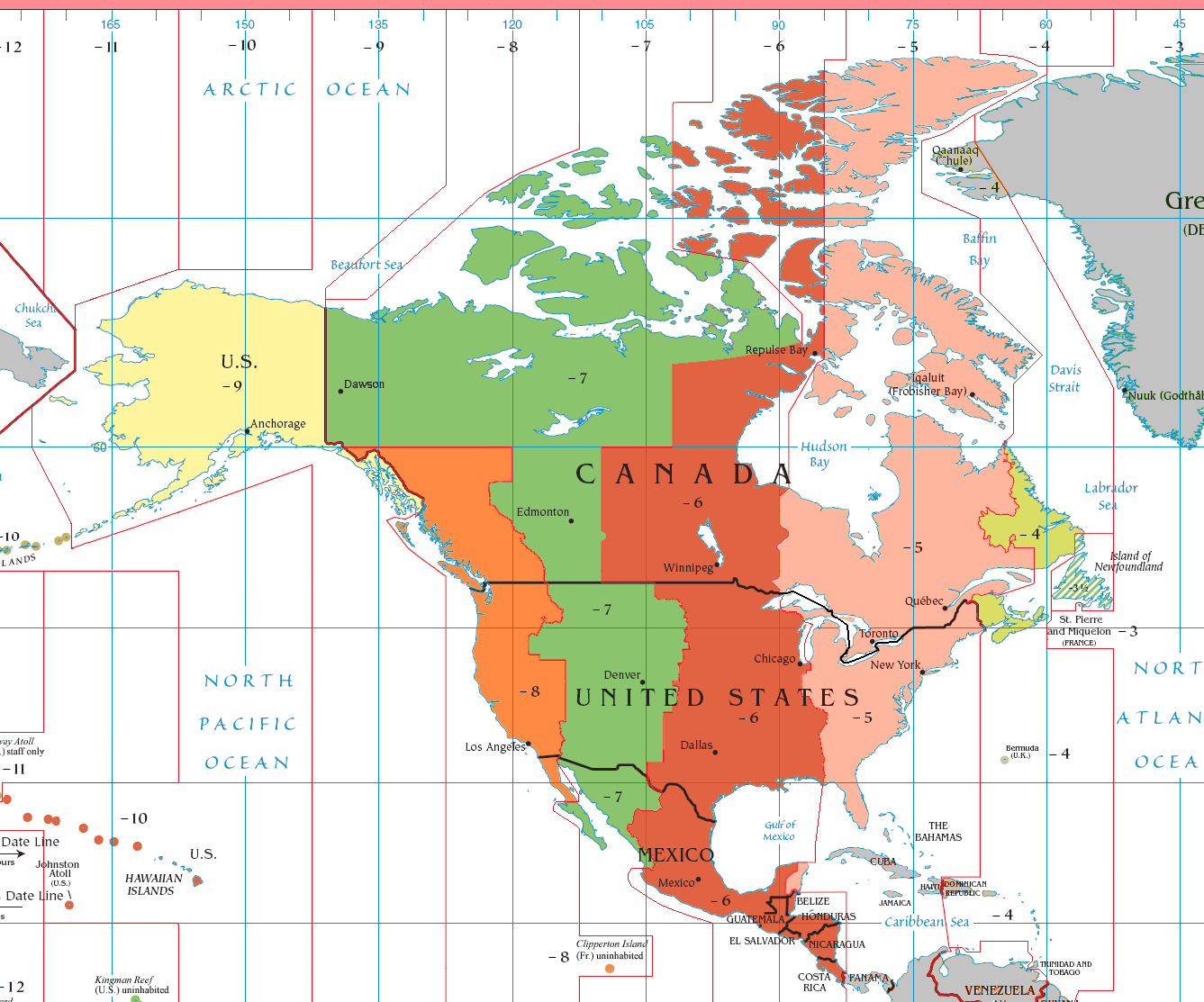
The Atlantic Time Zone is a geographical region that keeps standard time—called Atlantic Standard Time (AST)—by subtracting four hours from Coordinated Universal Time (UTC), resulting in UTC−04:00. AST is observed in parts of North America including several Caribbean islands. During part of the year, some portions of the zone observe daylight saving time, referred to as Atlantic Daylight Time (ADT), by moving their clocks forward one hour to UTC−03:00. The clock time in this zone is based on the mean solar time of the 60th meridian west of the Greenwich Observatory.

Key Information

In Canada, the provinces of New Brunswick,[1] Nova Scotia,[2] and Prince Edward Island are in this zone, though legally they calculate time specifically as an offset of four hours from Greenwich Mean Time (GMT–4) rather than from UTC. Small portions of Quebec (eastern Côte-Nord and the Magdalen Islands) also observe Atlantic Time. Officially, the entirety of Newfoundland and Labrador observes Newfoundland Standard Time,[3] but in practice Atlantic Time is used in most of Labrador.

No part of the continental United States uses Atlantic Time, although it is used by the territories of Puerto Rico and the U.S. Virgin Islands. In the 2010s, several U.S. states considered legislation to move from the Eastern Time Zone to Atlantic Standard Time. Any changes must be approved by the United States Department of Transportation and the United States Congress before taking effect.

The United States National Hurricane Center's official advisories typically report AST and UTC when tracking storms in the Caribbean that threaten the U.S., which may confuse the mainland public not familiar with the time zone designation (although AST is equivalent to Eastern Daylight Time (EDT) for most of the Atlantic hurricane season).[4]

Areas covered

[edit]

Caribbean

[edit]

North America

[edit]

Additional local areas

[edit]

U.S. states considering a change to Atlantic Standard Time

[edit]

All six of the New England states in the northeastern U.S., currently in the Eastern Time Zone (with daylight saving time), have considered legislation to shift to UTC−04:00, equivalent to Atlantic Standard Time (with no observance of daylight saving time) or Eastern Daylight Time. Virtually all of this region is west of the theoretical western border of the zone at 67.5°W; only a small part of Maine lies east of that meridian. A Massachusetts commission concluded in 2017 that the benefits of changing to Atlantic Standard Time year-round would outweigh the disadvantages, provided that a majority of northeastern states make the same change.[5] In May 2017, the Maine Senate approved a change to AST, on the condition that there would be a referendum, and that Massachusetts and New Hampshire decided to make the same switch.[6] Also in 2017, the New Hampshire House of Representatives approved a bill in favor of a regional change, but this was voted down by the state's Senate.[7] Similar bills have been put forward in Connecticut, Rhode Island, and Vermont.[6][8]

In 2018, Florida enacted into law the "Sunshine Protection Act", under which the state would observe daylight saving time year-round. Most of the state would permanently keep Eastern Daylight Time, which is equivalent to Atlantic Standard Time; the state's panhandle region would move to year-round Central Daylight Time.[9][10] However, the change cannot take effect until it is passed into federal law by the United States Congress.[10]

On March 15, 2022, the United States Senate voted unanimously to advance a federal version of the "Sunshine Protection" legislation from Florida, also called the "Sunshine Protection Act", to the United States House of Representatives;[11] the bill was not brought to a vote in the House.[12] A similar bill was introduced in the Senate in 2023.[13]

See also

[edit]

References

[edit]
[edit]
Revisions and contributorsEdit on WikipediaRead on Wikipedia
from Grokipedia
The Atlantic Time Zone is a geographical region in North America that maintains Atlantic Standard Time (AST) at four hours behind Coordinated Universal Time (UTC−4).[1][2] In areas observing daylight saving time, it advances to Atlantic Daylight Time (ADT) at UTC−3 from mid-March to early November.[3] The zone is based on the mean solar time of the 60th meridian west longitude.[4] It encompasses the Canadian Maritime provinces of New Brunswick, Nova Scotia, and Prince Edward Island in full, along with eastern Quebec, most of Labrador, and smaller Atlantic islands under Canadian jurisdiction.[4] In the United States, the zone applies to the territories of Puerto Rico and the US Virgin Islands, where AST is observed year-round without daylight saving time transitions.[1] This makes it the easternmost standard time zone in the contiguous North American landmass for DST-observing regions, facilitating synchronization for shipping, aviation, and cross-border commerce in the northwest Atlantic.[5] Standardized time zones, including the Atlantic designation, emerged from railroad conventions in 1883 to replace disparate local solar times, with formal adoption across the US and Canada on November 18 of that year.[2] Unlike broader continental zones, the Atlantic Time Zone reflects the longitudinal span of Canada's Atlantic seaboard and Caribbean outliers, without the political subdivisions or exemption debates seen in mainland US zones.[1]

Definition and Technical Specifications

UTC Offset and Designations

The Atlantic Time Zone maintains a standard offset of four hours behind Coordinated Universal Time (UTC−04:00), officially designated as Atlantic Standard Time (AST).[4] This offset applies during the non-daylight saving period, aligning the zone with the mean solar time centered on the 60° W meridian, which spans regions approximately 52.5° W to 67.5° W longitude.[6][7] When daylight saving time (DST) is observed, clocks advance by one hour to UTC−03:00, designated as Atlantic Daylight Time (ADT).[5] This adjustment facilitates extended evening daylight in applicable jurisdictions, with the UTC−03:00 offset serving as the effective standard during those months.[8] The zone differs from the neighboring Newfoundland Time Zone, which employs a half-hour offset of UTC−03:30 for standard time (advancing to UTC−02:30 during DST observance), thereby preserving distinct temporal boundaries despite geographical proximity.[9]

Relation to Adjacent Time Zones

The Atlantic Time Zone, with a standard offset of UTC−4, borders the Eastern Time Zone (UTC−5 standard) to its west, establishing a one-hour time lag for the latter relative to the former during periods when both maintain their standard offsets.[4][2] Where daylight saving time is observed in the Atlantic Time Zone, advancing to UTC−3, the one-hour difference persists year-round against the Eastern Time Zone's UTC−4 daylight offset.[10][11] In portions of the Atlantic Time Zone that forgo daylight saving time, the UTC−4 offset remains constant, causing those areas to synchronize temporally with the Eastern Time Zone's daylight period (also UTC−4) and thus experience no practical time difference during summer months, while reverting to a one-hour lead in winter.[4] This dynamic introduces variability in cross-border coordination, as non-observing Atlantic regions align seasonally with Eastern daylight but diverge otherwise.[12] Such offsets influence practical interactions, including commerce between eastern Canadian regions in the Atlantic Time Zone and U.S. Northeastern markets in the Eastern Time Zone, where the standard one-hour disparity necessitates adjustments in trading hours, supply chain logistics, and financial transactions to mitigate scheduling discrepancies.[13] In Caribbean contexts, the Atlantic Time Zone's UTC−4 standard overlaps without offset against the year-round Eastern Caribbean Time (also UTC−4), facilitating seamless temporal alignment in those adjacent equatorial bands.[4]

Historical Development

Pre-Standardization Era and Early Adoption

Prior to the adoption of standardized time zones, timekeeping across North America, including areas in the Maritime provinces that later aligned with the Atlantic Time Zone, depended on local solar time, where clocks were set so that noon corresponded to the sun's highest point overhead. This practice led to significant variations, with more than 144 distinct local times in use continent-wide, as each community or railroad station adjusted independently based on its longitude, resulting in time differences of about one minute per 18 kilometers of east-west separation.[14][15] In regions around the future Atlantic meridian (approximately 60° W longitude), such as Halifax, Nova Scotia (at about 63.6° W), local mean time approximated a four-hour offset from Greenwich, but practical discrepancies arose from imprecise observations and the needs of local commerce and navigation.[16] The push for unification accelerated with railroad expansion, as inconsistent times complicated train scheduling and increased accident risks. On November 18, 1883, U.S. and Canadian railroads implemented a coordinated system of five standard time zones at noon local time, replacing chaotic local variations with meridians spaced 15° apart. For the Maritime provinces, this included the Intercolonial Time Zone, centered on the 60° W meridian and named after the dominant Intercolonial Railway, serving as the precursor to the modern Atlantic Standard Time and enabling synchronized operations in Nova Scotia, New Brunswick, and Prince Edward Island.[17][18][16] Canadian engineer Sir Sandford Fleming, frustrated by scheduling errors during transcontinental rail projects, had advocated for such zonal divisions since the 1870s, influencing the railroad convention's decision.[16] Initial implementation encountered resistance in some communities, where residents and businesses clung to local mean time for its perceived alignment with daily solar rhythms and traditional practices, viewing the new system as an imposition by distant railroads. In the Maritimes, while railroads adopted Intercolonial Time, some locales initially favored the adjacent Eastern Time (75° W) for trade continuity with central Canada and the U.S. Northeast. This reluctance was gradually overcome through practical necessities of rail-dependent commerce and provincial endorsements, with broader legal mandates emerging in Canada by the early 1900s to enforce uniformity ahead of federal oversight.[18][16]

Standardization and Post-1918 Adjustments

The Standard Time Act of March 19, 1918, enacted by the U.S. Congress, formalized standard time zones across the nation, defining the Atlantic Time Zone as UTC−4 based on the 60th meridian west, primarily for coordination with eastern maritime and territorial regions.[19][2] This legislation, motivated by World War I transportation needs, mandated uniform observance within zones to enhance efficiency in rail and communication systems.[14] In Canada, lacking a parallel federal act, the Maritime provinces of Nova Scotia, New Brunswick, and Prince Edward Island aligned with these standards by adopting Atlantic Standard Time (AST) through provincial measures in the ensuing years, synchronizing with U.S. rail practices established since 1883.[20] The 1918 Act also temporarily introduced daylight saving time (DST) nationwide from the last Sunday in March to the last Sunday in October, observed in 1918 and 1919, to conserve energy during World War I; this provided early data on time offset impacts in Atlantic-aligned areas, though it faced opposition and was repealed in 1919.[21] During World War II, Congress imposed year-round "war time"—an advance equivalent to DST—from February 9, 1942, to September 30, 1945, testing prolonged offsets across zones, including territories; post-war, this contributed to the permanent designation of AST without DST in U.S. possessions like Puerto Rico (acquired 1898) and the U.S. Virgin Islands (acquired 1917), formalizing their inclusion in the Atlantic Zone under federal oversight.[22][23] The Uniform Time Act of 1966 further refined observance by standardizing DST dates (last Sunday in April to last Sunday in October) as optional for states and territories, promoting uniformity while allowing exemptions; Atlantic U.S. territories opted out entirely, retaining year-round AST due to equatorial proximity minimizing seasonal light variation, whereas Canadian Atlantic provinces implemented DST variably before aligning more consistently by the early 1970s in coordination with U.S. practices.[14][23] These adjustments addressed inconsistencies from wartime experiments, ensuring stable offsets for economic and logistical purposes.[19]

Geographical Coverage

Canadian Provinces and Territories

The Atlantic Time Zone covers the entire provinces of New Brunswick, Nova Scotia, and Prince Edward Island, which collectively form the core of its usage in Canada.[24] These Maritime provinces adopted standardized time zones following the 1918 implementation of nationwide regulations, aligning their clocks with UTC-4 for Atlantic Standard Time to reflect their eastern geographical position relative to the rest of the continent.[24] In Newfoundland and Labrador, the zone applies to most of the Labrador region, excluding a small southeastern portion around Black Tickle that follows Newfoundland Time (UTC-3:30).[25] This division stems from historical and practical considerations, with Labrador's larger land area and population centers oriented toward Atlantic Time for coordination with neighboring provinces and the northeastern United States.[25] Portions of Quebec east of 63° W longitude, including the Magdalen Islands and the Lower North Shore (from Kegaska to Blanc-Sablon), also observe Atlantic Time.[24] In these remote areas, Atlantic Standard Time is maintained year-round without transitions to daylight saving time, prioritizing consistency for isolated communities over seasonal adjustments.[26] This adherence supports economic activities such as fishing and shipping, synchronizing operations with Atlantic seaboard partners despite the province's predominant use of Eastern Time.[26] The zone's implementation in these regions, serving roughly 2 million residents across the Maritimes and adjacent areas, enables efficient alignment with U.S. East Coast markets for trade in fisheries, energy exports, and tourism.[4]

United States Territories and Possessions

Puerto Rico and the United States Virgin Islands, the principal U.S. territories in the Atlantic Time Zone, observe Atlantic Standard Time (AST, UTC−4) year-round without daylight saving time adjustments.[27][28] This fixed observance has been in place since September 30, 1945, for both territories, following earlier experimental DST periods during and immediately after World War II.[29] Together, these areas encompass approximately 3.3 million residents as of 2024, with Puerto Rico accounting for about 3.24 million and the U.S. Virgin Islands around 85,000.[30][31] The adoption of AST in these territories traces to U.S. acquisition following the Spanish-American War, when Puerto Rico was ceded by Spain in 1898, and later the U.S. Virgin Islands were purchased from Denmark in 1917; time zone alignment with Atlantic standards supported administrative and economic integration under U.S. oversight.[32] Minimal alterations have occurred since, even amid sporadic legislative discussions on reinstating DST, due to the equatorial proximity minimizing seasonal light variations and local preferences for time stability.[27] The consistent AST offset enhances operational efficiency in tourism, a key economic driver attracting millions of visitors annually, and maritime shipping, by aligning schedules with neighboring Caribbean entities that similarly forgo DST shifts.[33] This uniformity reduces logistical disruptions in inter-island travel, port operations, and supply chains reliant on predictable timing.[33]

Caribbean and South American Regions

Several independent Caribbean nations, including Antigua and Barbuda, Barbados, Dominica, Grenada, Saint Kitts and Nevis, Saint Lucia, and Saint Vincent and the Grenadines, observe Atlantic Standard Time (AST, UTC−4) year-round without implementing daylight saving time.[4] These islands, located along the eastern edge of the Caribbean Sea, adopted AST primarily to align with their approximate solar longitude, which falls between the Eastern and Atlantic time meridians, facilitating coordination in aviation, maritime shipping, and telecommunications established under international standards post-World War II.[34] Colonial histories under British, Dutch, and French administrations also influenced this choice, as former possessions harmonized times with metropolitan or regional precedents to support trade routes across the Atlantic.[35] The combined population of these AST-observing independent Caribbean nations approximates 900,000 residents as of recent estimates, serving small, tourism- and service-oriented economies reliant on consistent scheduling with North American and European partners.[36] Most forgo DST due to minimal seasonal daylight variation near the equator—averaging 12 hours daily year-round—and to prevent temporal misalignment with non-observing trade counterparts, preserving stable business hours for sectors like cruise shipping and air travel.[4] For instance, Barbados formalized AST in the mid-20th century without DST shifts, prioritizing reliability over marginal energy savings debated in temperate zones.[37] In South America, formal adoption of the Atlantic Time Zone remains absent, though Guyana maintains a fixed UTC−4 offset year-round under its national Guyana Time designation, reflecting geographical positioning east of the 60° W meridian.[38] This offset, implemented consistently since independence in 1966, supports alignment with Caribbean neighbors for regional commerce but lacks the DST component typical of North American Atlantic regions. Occasional discussions in Caribbean AST nations, such as proposals in Antigua and Barbuda during the 2010s, have explored shifting westward to Eastern Time for enhanced synchronization with major U.S. markets, though none have materialized due to logistical disruptions in local solar alignment and existing aviation protocols.[35]

Implementation Details

Daylight Saving Time Observance

In regions of the Atlantic Time Zone that observe daylight saving time (DST), clocks are advanced one hour forward from Atlantic Standard Time (AST, UTC-4) to Atlantic Daylight Time (ADT, UTC-3) at 2:00 a.m. on the second Sunday in March.[4] Clocks revert one hour backward to AST at 2:00 a.m. on the first Sunday in November.[4] These transition dates have been standardized across observing areas in Canada and the United States since 2007, following the U.S. Energy Policy Act of 2005, which extended the DST period by approximately one month at each end to better align with seasonal activity patterns.[39] Canadian provinces in the zone, such as Nova Scotia and New Brunswick, adopted the same schedule to maintain cross-border consistency.[40] The primary rationale for DST observance in the Atlantic Time Zone mirrors broader North American policy: to shift one hour of morning daylight to the evening, thereby extending periods of natural light during peak commercial and recreational hours after standard workdays.[21] This adjustment aims to reduce reliance on artificial lighting and promote outdoor economic activity, a practice rooted in early 20th-century efforts to conserve energy during wartime but retained for productivity alignment.[14] However, empirical assessments of energy savings have yielded mixed results; the U.S. Department of Transportation's 1975 study on extended DST found only modest net benefits after factoring in increased heating costs in spring and air conditioning in extended evenings.[41] Subsequent analyses, including natural experiments in Indiana, indicate that DST may even increase overall residential electricity demand by 1% or more, as evening usage patterns offset morning savings, particularly in warmer climates where cooling dominates.[42] These findings underscore that while DST facilitates temporal synchronization with human routines, its causal impact on energy consumption is minimal and context-dependent, with no consistent evidence of substantial reductions zone-wide.[43]

Exceptions and Non-Observing Areas

Puerto Rico observes Atlantic Standard Time (AST, UTC-4) year-round without transitioning to daylight saving time, a practice established after discontinuing DST following its last observance in 1945, driven by legislative preferences for stable scheduling amid the island's equatorial proximity reducing seasonal light variation benefits.[44][23] Similarly, the U.S. Virgin Islands adhere to permanent AST, exempt from federal DST mandates under U.S. territorial law, prioritizing avoidance of biannual clock adjustments that could disrupt local commerce and daily routines.[23][45] Several independent Eastern Caribbean nations and territories, including Aruba, the British Virgin Islands, and others aligned with AST such as parts of the Leeward Islands, forgo DST entirely, maintaining UTC-4 consistently to align with U.S. Eastern Daylight Time during summer months and sidestep administrative burdens of time shifts in tropical climates where daylight duration varies minimally.[46][47] This uniformity stems from local enactments post-colonial standardization, reflecting practical needs over energy-saving rationales historically tied to temperate-zone agriculture and wartime policies. Rare federal overrides have tested these exceptions; under the 1973 Emergency Daylight Saving Time Energy Conservation Act, which enforced year-round DST nationwide from January 6, 1974, to April 27, 1975, to curb oil consumption amid the Arab embargo, Puerto Rico and the Virgin Islands secured exemptions, preserving AST to mitigate public opposition to darker winter mornings in low-latitude settings.[48][49] Non-observance creates seasonal interoperability challenges within the broader Atlantic framework: during DST periods (typically March to November), these areas lag one hour behind observing regions like Canada's Maritime provinces on Atlantic Daylight Time (ADT, UTC-3), complicating aviation timetables, teleconferencing, and supply chain logistics across the zone, as evidenced by required manual offsets in flight planning between San Juan and Halifax.[4][45]

Proposals and Potential Expansions

U.S. States Considering Adoption

In Maine, legislative efforts to adopt the Atlantic Time Zone have centered on bills conditioning the shift on neighboring states' actions to ensure regional coordination. In 2017, the Maine House approved a measure to transition to Atlantic Standard Time (AST) year-round, eliminating daylight saving time (DST), but only if Massachusetts and New Hampshire enacted similar changes; the Senate later endorsed a version requiring voter approval via referendum under those conditions.[50][51] These proposals aimed to provide more evening sunlight in winter by effectively advancing clocks permanently by one hour relative to Eastern Standard Time, while aligning with Canadian Maritime provinces for trade and tourism benefits. No implementation has occurred, as contingent states did not follow through. Massachusetts established a special commission in 2017 to evaluate time zone options, which recommended shifting to the Atlantic Time Zone with year-round observance equivalent to permanent DST, contingent on a majority of northeastern states (including Connecticut, Maine, New Hampshire, Rhode Island, and Vermont) adopting compatible measures to avoid economic disruptions from mismatched hours.[52] The commission cited potential competitiveness gains from extended evening light for commerce and recreation, but emphasized federal approval and interstate agreement as prerequisites. Subsequent follow-up studies, such as in 2023, reiterated these findings without advancing legislation.[53] New Hampshire has pursued multiple bills for AST adoption, often linked to permanent standard time to prioritize winter evening visibility over morning light. House Bill 85 (2021) passed the House to implement AST year-round upon federal approval but was defeated in the Senate by a 22-1 vote, reflecting concerns over misalignment with major economic partners like Boston.[54] In 2024, a new bill proposed the switch contingent on Maine, Vermont, and Rhode Island joining, underscoring recurring emphasis on regional synchronization.[55] Similar regional initiatives have emerged in Connecticut, Rhode Island, and Vermont, typically as conditional proposals to join AST for year-round use, driven by desires for more afternoon daylight and cross-border harmony with Atlantic-observing areas. Connecticut lawmakers introduced bills in 2019 and 2021 seeking federal permission for the shift, framing it as part of a northeastern bloc to counter Eastern Time's perceived mismatch with local solar positioning.[56] Rhode Island's 2016 and 2017 measures tied adoption to Massachusetts' actions, while Vermont has been referenced in contingent bills from adjacent states without standalone legislation advancing.[57][45] As of October 2025, no U.S. state has successfully adopted AST, primarily due to the U.S. Department of Transportation's veto authority under the Uniform Time Act of 1966, which requires federal review of boundary changes to prevent commerce disruptions and ensure geographical and economic rationale.[58] Proposals frequently highlight alignment with Canada's Atlantic regions for supply chain efficiency, yet face hurdles from interstate dependencies and DOT scrutiny of impacts on national uniformity.[59]

Regional and International Coordination Efforts

In the 2010s, several New England states explored proposals to shift from Eastern Time to Atlantic Standard Time year-round, aiming to harmonize with the Maritime provinces of Canada, which observe Atlantic Time.[59] This alignment was intended to facilitate cross-border trade, tourism, and energy grid synchronization by eliminating the one-hour offset during standard time periods and avoiding daylight saving transitions.[60] Maine lawmakers advanced bills in 2017 and 2019 to adopt Atlantic Time, contingent on reciprocal action by Massachusetts and New Hampshire, citing improved evening daylight for economic activities tied to Canadian partners like Nova Scotia and New Brunswick.[61] Similar initiatives emerged in Massachusetts, where a 2017 state commission recommended the switch after analyzing competitiveness benefits from closer temporal alignment with Atlantic Canada, though it noted potential disruptions in national media and transportation scheduling.[53] New Hampshire considered legislation in 2017 and 2021 to join, emphasizing regional coordination to prevent isolated state changes that could complicate interstate commerce.[54] These efforts stalled primarily due to U.S. Department of Transportation requirements for contiguous state consensus and federal approval, alongside disagreements among states on implementation timelines and voter preferences for maintaining Eastern Time ties to major U.S. markets.[62] Connecticut's 2019 proposal for Atlantic Time similarly required gubernatorial application to federal authorities and highlighted coordination challenges with broadcasters and neighboring states.[63] Proponents argued that unified observance could reduce scheduling errors in binational supply chains, but no multi-state compact materialized, leaving the offset intact.[45] Internationally, broader efforts for Atlantic Time harmony remain limited, with no formalized agreements beyond ad hoc bilateral discussions on DST alignment between Canada and U.S. territories like Puerto Rico.[14]

Controversies and Empirical Impacts

Economic and Productivity Effects

The Atlantic Time Zone's UTC-4 offset positions regions like Canada's Maritime provinces for partial workday overlap with European markets, facilitating transatlantic commerce and exports; for example, Nova Scotia's location enables four hours of business-hour alignment with London, supporting sectors reliant on UK and EU trade.[64] This alignment aids efficiency in time-sensitive operations, such as fisheries and energy exports, where Atlantic Canada's marine sectors contribute significantly to GDP through international shipments.[65] Daylight saving time observance in Atlantic Canada, synchronized with much of North America, yields mixed economic outcomes based on broader empirical analyses. The 2008 U.S. extension of DST, which aligned with Canadian practices, correlated with modest retail sales increases in outdoor recreation sectors but elevated overall energy consumption by approximately 0.03% nationally, per Department of Energy modeling, with no net energy savings.[66] Localized studies indicate potential productivity drags, such as amplified stock market return dips on Mondays following spring transitions, magnifying losses by 200-500% due to sleep disruption effects on traders.[67] These patterns suggest similar frictions for Atlantic financial and commerce activities, though direct provincial data remains sparse. Cross-time-zone disparities introduce trade inefficiencies within Canada and with the U.S. Eastern Time Zone, creating a persistent one-hour gap outside DST periods that complicates scheduling for interprovincial supply chains and border commerce; for instance, Quebec's eastern areas occasionally align with Atlantic Time, but standard differences hinder seamless coordination in manufacturing and logistics.[68] In non-DST Caribbean territories like Puerto Rico (year-round AST), misalignment with U.S. mainland DST observance exacerbates tourism coordination challenges, as visitors from Eastern states face varying offsets, potentially contributing to localized revenue variability amid broader regional economic pressures.[24] Agricultural productivity in Maritime Canada shows limited direct disruption from DST shifts or zonal offsets, with modern mechanized farming mitigating historical concerns over milking or harvest timing; empirical reviews confirm negligible crop yield impacts, as operations adapt via artificial lighting and flexible labor.[69] Overall, while alignment perks support export-oriented growth, empirical evidence points to modest net productivity effects rather than transformative GDP shifts, with frictions more pronounced in seasonal trade than in baseline zonal structure.

Health and Circadian Rhythm Concerns

The biannual clock transitions of Daylight Saving Time (DST) induce acute circadian misalignment by shifting social time relative to solar cues, elevating risks of cardiovascular events and accidents. A 2019 meta-analysis of twelve studies documented a modest but significant increase in acute myocardial infarction following spring DST onset, attributing this to sleep deprivation and disrupted autonomic function, with no comparable rise after the fall transition. Finnish research similarly identified an 8% uptick in ischemic strokes within the first two days post-spring change, linking it to physiological stress from lost sleep. Road safety data reveal a 6% surge in fatal traffic accidents in the week after spring DST, correlated with fatigue and impaired vigilance.[70][71][72] Within the Atlantic Time Zone, western margins such as Labrador exhibit amplified misalignment, where longitudinal span causes clock time to precede local solar noon, yielding winter sunrises delayed beyond 8:00 AM AST and curtailing morning photic input critical for suppressing melatonin and advancing circadian phase. This fosters chronic sleep debt, particularly in northern latitudes with abbreviated daylight, heightening vulnerability to mood disorders and metabolic disruptions via weakened entrainment. Biological imperatives favor solar-aligned standard time to prioritize dawn exposure, which robustly resets internal clocks, over strategies emphasizing extended evenings that defer this signal.[73][74] The American Academy of Sleep Medicine endorses permanent standard time over DST observance or year-round advanced time, positing it as optimally synced with circadian physiology to avert recurrent disruptions and yield net health gains including reduced chronic disease incidence. Longitudinal evidence underscores that such misalignments compound risks for hypertension, diabetes, and immune dysregulation, with scant data indicating DST's societal yields—such as purported energy conservation—justify the biological toll.[75][76][77]

References

User Avatar
No comments yet.