


Community hub
Recent from talks
Contribute something
Nothing was collected or created yet.
Audi Q2
View on Wikipedia
| Audi Q2 | |
|---|---|
 | |
| Overview | |
| Manufacturer | Audi AG |
| Production | 2016–present |
| Model years | 2017–present |
| Assembly | |
| Designer | Matthias Fink[3] and Dre Ahn under Marc Lichte |
| Body and chassis | |
| Class | Subcompact luxury crossover SUV |
| Body style | 5-door SUV |
| Layout |
|
| Platform | Volkswagen Group MQB A1 |
| Related | Volkswagen Golf Mk7 Volkswagen T-Roc Volkswagen Taos/Tharu SEAT Ateca SEAT León Mk3 Cupra Formentor Jetta VS5 Škoda Karoq Škoda Octavia Mk3 Audi A3 Mk3 |
| Powertrain | |
| Engine | |
| Electric motor | 100 kW (140 PS; 130 hp) AC asynchronous motor (Q2L e-Tron) |
| Transmission |
|
| Battery | 38 kWh Li-ion (Q2L e-Tron) |
| Dimensions | |
| Wheelbase | 2,601 mm (102.4 in) 2,628 mm (103.5 in) (Q2L) |
| Length | 4,191 mm (165.0 in) 4,229 mm (166.5 in) (Q2L) |
| Width | 1,794 mm (70.6 in) |
| Height | 1,508 mm (59.4 in) |
| Curb weight | 1,205 kg (2,657 lb) |
| Chronology | |
| Successor | Audi A3 allstreet |
The Audi Q2 is a subcompact luxury crossover SUV developed and manufactured by the German car manufacturer Audi, a subsidiary of the Volkswagen Group. It was first unveiled to the public on 1 March 2016 at the 2016 Geneva Motor Show and built on the Volkswagen Group MQB A1 platform as the Mk7 series Volkswagen Golf. The car is manufactured at the headquarters of Audi in Ingolstadt, Germany; by FAW-Volkswagen in Foshan, China; and in Relizane, Algeria by SOVAC-Volkswagen.
It has been sold since November 2016 in markets in Europe. Unlike Audi's other crossovers, the Q2 is not sold in the United States or Canada. A long-wheelbase version called the Q2L is sold in China.
The Q2L e-tron is an all-electric version that has been built and sold in China since November 2019. Powered by a 38 kWh lithium-ion battery of Chinese supplier Contemporary Amperex Technology, the Q2L e-tron has a range of 265 kilometres (165 miles) on one charge and a top speed of 150 km/h (93 mph). Its electric motor delivers the maximum power of 100 kW (134 hp) and maximum torque of 290 N⋅m (214 lbf⋅ft).[4]
In February 2022, Volkswagen AG confirmed that the Audi Q2 will not see a second generation and will instead be discontinued without a direct successor planned after the model completes its life cycle, due to poor sales and plans to shift Audi into selling larger premium crossovers and SUVs.[5]
Design
[edit]The Q2's front face is formed flat and in an upwards slant, like the other models of Audi's Q Series. The interior incorporates a 5.8 inch Audi MMI display and a 12.3 inch virtual cockpit display.
The car also employs an LED ambient lighting system, which projects differently coloured light into the car, depending on the time of day.[6]
-
 Q2 (Pre-facelift)
 -
 Q2 (Pre-facelift)
 -
 35TFSI Auto
 -
 Interior
 -
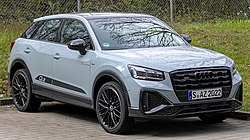 Q2 (Facelift)
 -
 Q2 (Facelift)
 -
 SQ2
SQ2 -
 SQ2
SQ2 -
 SQ2 (Facelift)
 -
 Q2L e-tron (China)
 -
 Q2L (China)
 -
 Q2L (China)

.jpg)


.jpg)
.jpg)

Pricing
[edit]The Q2 subcompact SUV has multiple trim levels: [7]
- SE, Sport
- S line
- Technik
- Edition #1
- Black edition
SQ2 (2019)
[edit]| Audi SQ2 | |
|---|---|
 2019 Audi SQ2 | |
| Overview | |
| Production | 2019-present |
| Powertrain | |
| Power output | 2.0 TFSI |
The SQ2 was previewed in 2018 at the Paris Motor Show.[8]
Powertrain
[edit]The 2.0 TFSI 4-cylinder makes 295 hp (220 kW; 299 PS) at 5200 rpm. The top speed is electronically limited to 250 km/h (155 mph).
Safety
[edit]| Test | Points | % |
|---|---|---|
| Overall: | 
| |
| Adult occupant: | 35.5 | 93% |
| Child occupant: | 42.2 | 86% |
| Pedestrian: | 29.5 | 70% |
| Safety assist: | 7.3 | 60% |
Sales
[edit]Technical data
[edit]| Model | Years | Engine | Power | Torque | Drivetrain | Transmission | Curb wt. | Top speed | 0–100 km/h (0–62 mph) |
Fuel cons. | CO2 emission {g/km) |
Emission std. |
|---|---|---|---|---|---|---|---|---|---|---|---|---|
| 1.0 TFSI | 2017–present | 999 cc I3 turbo | 85 kW (114 hp; 116 PS) @ 5500 rpm | 200 N⋅m (148 lbf⋅ft) @ 2000–3500 rpm | FWD |
|
1,205 kg (2,657 lb) |
190 km/h (118 mph) |
10.5-10.7 s | Unknown | Unknown | Euro 6 |
| 1.4 TFSI COD / 35 TFSI | 1395 cc I4 turbo | 110 kW (148 hp; 150 PS) @ 5000–6000 rpm | 250 N⋅m (184 lbf⋅ft) @ 1500–3500 rpm |
|
Unknown | 205–208 km/h (127–129 mph) |
8.5-9.0 s | 52.3 mpg‑imp (5.40 L/100 km) |
124 | |||
| 2.0 TFSI | 1984 cc I4 turbo | 140 kW (188 hp; 190 PS) @ 4200–6000 rpm | 320 N⋅m (236 lbf⋅ft) @ 1450–4150 rpm | AWD (quattro) | 7-spd. S tronic DSG | Unknown | 219 km/h (136 mph) |
6.8 s | Unknown | Unknown |
| Model | Years | Engine | Power | Torque | Drivetrain | Transmission | Curb wt. | Top speed | 0–100 km/h (0–62 mph) |
Fuel cons. | CO2 emission {g/km) |
Emission std. |
|---|---|---|---|---|---|---|---|---|---|---|---|---|
| 1.6 TDI | 2017–present | 1598 cc I4 turbo | 85 kW (114 hp; 116 PS) @ 3250–4000 rpm | 250 N⋅m (184 lbf⋅ft) @ 1500–3200 rpm | FWD |
|
Unknown | 190 km/h (118 mph) |
10.7 s | Unknown | Unknown | Euro 6 |
| 2.0 TDI | 1968 cc I4 turbo | 110 kW (148 hp; 150 PS) @ 3500–4000 rpm | 340 N⋅m (251 lbf⋅ft) @ 1750–3000 rpm |
|
Unknown | 202–208 km/h (126–129 mph) |
8.5–8.7 s | 64.2 mpg‑imp (4.40 L/100 km) |
114 | |||
| 140 kW (188 hp; 190 PS) @ 3500–4000 rpm | 400 N⋅m (295 lbf⋅ft) @ 1900–3300 rpm | AWD (quattro) | 7-spd. S tronic DSG | Unknown | 218 km/h (135 mph) |
7.0 s | Unknown | Unknown |
| Model | Years | Engine | Power | Torque | Drivetrain | Transmission | Curb wt. | Top speed | 0–100 km/h (0–62 mph) |
Fuel cons. | CO2 emission {g/km) |
Emission std. |
|---|---|---|---|---|---|---|---|---|---|---|---|---|
| L 30 e-tron | 2019–present | Permanent Magnet electric motor | 100 kW (134 hp; 136 PS) | 290 N⋅m (214 lbf⋅ft) | FWD | Single-speed Fixed gear | Unknown | 150 km/h (93 mph) |
? s | Unknown | Unknown |
References
[edit]- ^ "SOVAC Algérie : Top départ des Audi Q2 et A3 assemblés à Relizane". Auto News Algerie. 8 December 2018.
- ^ Pankow, Gabriel (6 December 2018). "Audi startet Produktion in Algerien" [Audi starts production in Algeria]. produktion.de (in German). Retrieved 22 February 2026.
- ^ Nicolic, Trent (3 March 2016). "Audi Q2 designer had the young, fashionable and sporty in mind". drive.com.au. Retrieved 9 May 2023.
- ^ "Audi launches first locally built EV". Automotive News. 25 November 2019. Retrieved 14 December 2019.
- ^ "Audi Q2 Will be Discontinued After Only One Generation: Official".
- ^ Paclibar, Jenah (5 March 2016). "Audi Q2 2016 News: Vehicle Features Vibrant, Youthful Look for Younger Consumers". Vine Report. Archived from the original on 12 March 2016. Retrieved 11 March 2016.
- ^ "How Many Left?". www.howmanyleft.co.uk. Retrieved 8 November 2023.
- ^ "Audi SQ2 lands in Paris with 296 horsepower, hot-hatch looks".
- ^ "ANCAP results for Audi Q2 all variants excluding SQ2". ancap.com.au. 2017.
- ^ a b "【易车销量榜】全国2023年奥迪终端量销量榜-易车榜-易车". car.yiche.com. Retrieved 12 February 2026.
- ^ a b "【易车销量榜】全国2024年奥迪终端量销量榜-易车榜-易车". car.yiche.com. Retrieved 12 February 2026.
- ^ a b "【易车销量榜】全国2025年奥迪终端量销量榜-易车榜-易车". car.yiche.com. Retrieved 12 February 2026.
External links
[edit]
- Official website (German)


Audi Q2
View on GrokipediaIntroduction
Background and development
The Audi Q2 originated as part of Audi's strategy to expand its SUV lineup into the compact segment, aiming to capture younger urban drivers seeking a premium crossover with agile handling and versatile functionality. Development began in the early 2010s, with the model previewed through the Crosslane Coupé concept unveiled at the 2012 Paris Motor Show, which drew stylistic influences from the 2010 quattro concept car's bold, angular design and emphasis on all-wheel-drive performance.[10][11] The production Q2 was formally unveiled on March 1, 2016, at the Geneva International Motor Show, marking Audi's entry into the subcompact luxury SUV market below the Q3. It was engineered on the Volkswagen Group's Modular Transverse Toolkit (MQB) platform, the same architecture underpinning models like the Volkswagen Golf and Audi A3, enabling efficient shared components while allowing for Audi-specific premium tuning. Key engineering objectives included maintaining a compact footprint under 4.2 meters in length—specifically 4,191 mm—to suit city driving, while incorporating optional quattro all-wheel drive for enhanced traction and a sporty character.[1][12] Production commenced in July 2016 at Audi's primary facility in Ingolstadt, Germany, where the model was assembled to meet high standards of build quality and integration of advanced features. From inception, the Q2 emphasized early adoption of Audi's virtual cockpit, a 12.3-inch digital instrument cluster providing customizable displays for navigation, media, and driver aids, setting it apart as a tech-forward entry-level offering in Audi's portfolio. This focus on innovative ergonomics and premium connectivity aligned with the vehicle's positioning as an accessible yet sophisticated urban SUV.[13][14]Launch and positioning
The Audi Q2 was unveiled at the 2016 Geneva Motor Show and went on sale in Europe during the summer of that year, with deliveries beginning in most markets by September. In the United Kingdom, sales commenced in late 2016, following the model's European debut. The vehicle was primarily targeted at European and Asian markets, along with select regions such as Australia and South Africa, but was not offered in North America. This strategic rollout positioned the Q2 as Audi's smallest and most affordable crossover SUV, aiming to capture the growing demand for compact premium vehicles in urban environments. Priced from approximately €22,000 in its base configuration upon launch, the Q2 was marketed as an entry-level option within Audi's lineup, appealing to first-time premium buyers and younger demographics. It competed directly with rivals such as the BMW X1, Mercedes-Benz GLA, and later the Volvo XC40, emphasizing its role in the subcompact luxury SUV segment. Audi's marketing campaigns highlighted the Q2's youthful and dynamic styling, targeting young professionals and urban families seeking a blend of practicality, technology, and sporty aesthetics without the higher costs of larger models. Initial sales performance was strong, with the model surpassing 100,000 units sold globally within its first two years on the market, reflecting positive reception to its positioning as an accessible yet premium urban crossover. Front-wheel drive was standard across all variants, while the optional quattro all-wheel-drive system was available on higher trims to enhance traction and appeal in varied driving conditions. This drivetrain flexibility underscored Audi's intent to balance affordability with performance-oriented options in the entry-level segment.Design and styling
Exterior features
The Audi Q2 is distinguished by its signature single-frame grille, a trapezoidal design element that anchors the front fascia and conveys the brand's premium identity. Flanking this are sharp LED headlights with integrated daytime running lights, creating an angular and dynamic expression that emphasizes the vehicle's forward-leaning stance. Bold, muscular wheel arches further accentuate the Q2's sporty, coupe-like SUV profile, blending compact dimensions with an athletic silhouette that highlights its urban versatility.[15] At its 2016 launch, the Q2 measured 4.19 meters in length, 1.79 meters in width, and 1.51 meters in height, positioning it as Audi's entry-level crossover with agile proportions.[15] The body structure employs high-strength steel in 22% of its components, including the A- and B-pillars, roof, and floor areas, which contributes to enhanced chassis rigidity and overall safety without compromising lightweight construction.[16] Wheel options start at 16 inches for base models, scaling up to 18 inches as standard on higher trims, while S line variants offer 19-inch alloys for a more assertive presence.[17] A range of exterior colors, including metallic finishes like Mythos Black and Tango Red, allows for personalization, complemented by trim-specific features such as optional anodized roof rails that add functional utility to the design.[2] The Q2's styling incorporates trapezoidal exhaust tailpipes on select powertrains, enhancing the rear's visual balance, along with dynamic turn signals in the LED taillights that provide sequential illumination for improved visibility. Aerodynamically, the model achieves a drag coefficient of 0.31 Cd, optimized through features like underbody panels and roof spoiler integration to balance form and efficiency.[18]Interior and ergonomics
The Audi Q2 features a standard five-seat configuration, providing comfortable accommodation for passengers in its compact cabin. The rear seats incorporate a 60/40 split-folding mechanism, allowing flexible cargo expansion while maintaining seating versatility for smaller groups. With all seats in place, the luggage compartment offers 405 liters of capacity according to the VDA measurement standard, which increases to 1,050 liters when the rear seats are folded flat, creating a nearly level load floor suitable for larger items.[2][19][20] Interior materials emphasize premium quality and durability, with standard options including cloth or leatherette upholstery, while higher trims and packages introduce fine Nappa leather upholstery. Ergonomic front seats come with height adjustment as standard for the driver and optionally for the front passenger, featuring pronounced side bolsters in sport variants to support dynamic driving. Ambient lighting, available as an option, illuminates the cabin with customizable LED accents, contributing to a refined atmosphere. The dashboard adopts a horizontal layout with clean lines that visually widen the space, fostering a sense of openness despite the Q2's compact dimensions.[21][22][23] The steering wheel is a multifunction design with ergonomic grips and integrated controls, positioned in a driver-centric layout that prioritizes accessibility to essential functions without diverting attention from the road. Accessibility is further enhanced by a low loading sill height of approximately 75 cm from the ground to the boot floor, facilitating easy loading of heavy or bulky items. An optional panoramic sunroof adds to the airy feel of the interior by flooding the cabin with natural light.[7][24][25]Technology and equipment
Infotainment systems
The Audi Q2 features Audi's Modular Infotainment Toolkit (MMI) system as standard, which at launch in 2016 included a 7-inch touchscreen display for controlling navigation, media, and vehicle settings.[26] This setup supported smartphone integration with Apple CarPlay and Android Auto from the model's introduction, allowing users to mirror compatible apps via a wired USB connection.[27] An optional upgrade to an 8.3-inch screen was available, enhancing visibility and responsiveness for infotainment functions. The Audi Virtual Cockpit, a 12.3-inch digital instrument cluster standard since the 2024 update, integrates seamlessly with the MMI system to display navigation maps, media information, and trip data in high resolution behind the steering wheel.[28][9] For audio, the base configuration includes a 6-speaker system providing clear sound reproduction throughout the cabin.[29] Higher trims offer the premium Bang & Olufsen sound system, featuring 14 speakers—including a center speaker and subwoofer—powered by a 705-watt amplifier for immersive surround sound.[30] Connectivity options emphasize seamless device integration, with standard Bluetooth for hands-free calling and audio streaming, alongside USB ports in the center console for charging and media playback.[31] Optional wireless charging via a Qi-compatible phone holder is available, enabling cable-free device powering in the storage compartment.[32] Voice control is supported through the MMI system and Audi connect services, allowing natural language commands for navigation, calls, and media adjustments via the "Hey Audi" activation or steering wheel button.[33] In the 2024 mid-cycle update, the Q2 adopted the third-generation MMI (MIB3) platform with an enlarged 8.8-inch touchscreen (1,270 x 720 pixel resolution) as standard, replacing the rotary dial with touch and gesture controls for more intuitive operation.[9] This system enables over-the-air (OTA) software updates to deliver new features and improvements without dealership visits, alongside enhanced Audi connect integration for real-time traffic and online POI searches.[34] Optional navigation packages include high-resolution maps projected on the Virtual Cockpit for guidance.[28]Safety and driver assistance
The Audi Q2 is equipped with a comprehensive suite of standard passive safety features, including front airbags for the driver and passenger, side airbags integrated into the front seats, and head-level curtain airbags that provide protection for both front and rear occupants.[29] Rear side airbags are available as an optional upgrade in select packages, enhancing lateral impact protection for backseat passengers.[25] Additionally, the vehicle incorporates anti-lock braking system (ABS), electronic stability control (ESC) with traction control, and seatbelt reminders for all seating positions as standard equipment.[29] In crash testing conducted by Euro NCAP in 2016, the Audi Q2 earned a five-star overall safety rating, reflecting strong performance across key categories.[35] It achieved 93% for adult occupant protection, demonstrating effective restraint systems and structural integrity in frontal and side impacts, and 86% for child occupant protection, supported by ISOFIX anchors and compatibility with child seats.[35] The model's vulnerable road user score was 70%, aided by its autonomous emergency braking system's pedestrian detection capabilities, while safety assist features scored 60%.[35] Active safety is bolstered by Audi's pre-sense technologies as standard. The pre-sense city system includes autonomous emergency braking (AEB) with detection for pedestrians and cyclists at urban speeds, helping to mitigate or avoid low-speed collisions.[29] Complementing this, the multi-collision brake assist activates after an initial impact to apply brakes and stabilize the vehicle, reducing the risk of secondary accidents.[36] Pre-sense basic further prepares for potential crashes by tensioning front seatbelts, closing windows, and activating hazard lights during detected unstable situations.[29] The 2024 mid-cycle update enhanced the standard driver assistance suite, adding traffic sign recognition, lane departure warning, and rear park assist to all models.[9][37] Adaptive cruise control with Stop & Go functionality, which maintains set speeds and distances in traffic and integrates with the infotainment for alerts, remains optional.[29] Lane-keeping assist, known as Audi active lane assist, provides gentle steering corrections to prevent unintentional lane departures and is now complemented by the standard lane departure warning.[25] Traffic sign recognition uses a forward-facing camera to identify and display speed limits and other signs on the instrument cluster.[9] For parking, rear park assist with ultrasonic sensors and visual guidance for parallel and perpendicular maneuvers is standard since 2024, while advanced park assist remains optional.[29][37]Powertrain options
Standard engines and efficiency
The Audi Q2 features a selection of efficient petrol and diesel engines designed for balanced performance and low running costs in a compact SUV format. Petrol powertrains include the entry-level 1.0 TFSI three-cylinder turbocharged unit, which produces 85 kW (116 PS) and 200 Nm of torque.[5] A more potent option is the 1.5 TFSI four-cylinder engine, delivering 110 kW (150 PS) and 250 Nm, equipped with cylinder on demand (COD) technology that deactivates two cylinders during low-load conditions to optimize fuel use.[5][38] The range also includes a 2.0 TFSI four-cylinder engine producing 140 kW (190 PS) and 320 Nm of torque, typically available with quattro all-wheel drive.[5] Diesel engines emphasize torque for effortless driving, with the base 2.0 TDI four-cylinder turbo offering 85 kW (116 PS) and 300 Nm.[5] The higher-output 2.0 TDI variant provides 110 kW (150 PS) and 360 Nm, suitable for those prioritizing refinement and pulling power.[5] Efficiency across the lineup is strong under WLTP testing, with petrol models achieving combined fuel consumption of 5.7–7.6 L/100 km and CO₂ emissions of 130–174 g/km, while diesels range from 4.8–6.3 L/100 km and 125–164 g/km.[5] The 1.5 TFSI incorporates a 12 V mild-hybrid electric vehicle (MHEV) system introduced in the 2020 refresh, which uses a belt-driven starter-generator to recover energy during braking and support the engine, reducing consumption by up to 0.3 L/100 km in real-world conditions.[20] These engines pair with either a six-speed manual or seven-speed S tronic dual-clutch transmission for seamless power delivery.[5]Transmissions and drivetrains
The Audi Q2 is available with a choice of transmissions tailored to its engine options, including a 6-speed manual gearbox standard on the base 30 TFSI model for direct and engaging driving dynamics. Higher-output variants, such as the 35 TFSI and 40 TFSI, pair with a 7-speed S tronic dual-clutch automatic transmission, which delivers rapid shifts and seamless power delivery through its wet-clutch design.[8][39] Front-wheel drive is standard on all Q2 models, providing efficient everyday performance, while select higher-trim variants offer the optional quattro all-wheel drive system. The quattro ultra technology in these models features a multi-plate clutch that can decouple the rear axle during low-demand conditions, such as steady cruising, to minimize drivetrain losses and enhance fuel economy before reactivating for improved traction on slippery surfaces. This variable torque distribution between axles—typically 40:60 front-to-rear under normal conditions—contributes to stable handling without constant engagement.[40][41] The Q2's chassis utilizes a MacPherson strut front suspension with coil springs and an anti-roll bar, complemented by a four-link rear suspension for composed ride quality and precise steering response. An optional sport suspension, available on S line and higher trims, lowers the ride height by 20 mm for reduced body roll and sharper cornering, while maintaining comfort through adaptive damping in select configurations. The quattro system's integration with electronic stability control enables torque vectoring in higher trims by selectively braking the inner rear wheel to direct power outward, aiding agility without mechanical differentials. The all-wheel drive option typically increases fuel consumption by around 0.5 L/100 km compared to front-wheel drive equivalents, depending on driving conditions and engine pairing.[42][2][25]Performance variants
SQ2 model
The Audi SQ2 was introduced in September 2018 at the Paris Motor Show as the high-performance variant of the Q2 compact SUV, entering the market for the 2019 model year. It features a turbocharged 2.0-liter TFSI inline-four engine producing 221 kW (300 PS) and 400 Nm of torque, paired exclusively with a seven-speed S tronic dual-clutch transmission and quattro all-wheel drive. This powertrain enables acceleration from 0 to 100 km/h in 4.9 seconds, with an electronically limited top speed of 250 km/h.[43] Distinguishing the SQ2 from the standard Q2, its exterior incorporates S-specific styling elements, including aggressive front and rear bumpers with larger air intakes, quad exhaust tailpipes, and 19-inch alloy wheels as standard. Inside, the cabin emphasizes sportiness with bolstered S sport seats upholstered in leather or Alcantara, a flat-bottom multifunction steering wheel, and red-stitched accents throughout. The suspension is lowered by 20 mm compared to the base model for enhanced handling, complemented by standard adaptive dampers.[44] In November 2020, Audi unveiled a facelifted SQ2 for the 2021 model year, featuring an updated Singleframe grille with a more pronounced honeycomb pattern and redesigned LED headlights—standard—as well as optional Matrix LED units with dynamic indicators. The powertrain remained unchanged in output, but refinements to the engine tuning and chassis calibration improved responsiveness and reduced noise levels. This update also brought minor interior enhancements, such as expanded virtual cockpit options, while maintaining the core performance focus.[45][46] In mid-2024, the SQ2 received a further update aligning with the Q2 lineup, introducing a standard 12.3-inch Audi virtual cockpit digital instrument cluster and a larger 10.1-inch MMI touchscreen infotainment system, along with enhanced Audi connect services. The powertrain and performance specifications remained unchanged.[9]Special editions
The Audi Q2 has been offered in several special editions and region-specific variants that emphasize unique styling, equipment, or market adaptations without altering core performance characteristics. These models cater to buyers seeking distinctive aesthetics or localized features, building on standard trims like Sport or Technik. The Edition #1, introduced as a launch edition in 2016, featured an exclusive Quantum Gray paint finish with Manhattan Gray and black exterior accents, including contrast bumpers and C-pillar blades bearing the Audi rings logo. It included 19-inch five-arm rotor alloy wheels in gloss anthracite with diamond-cut finish, a black styling package, and premium interior elements such as front sport seats in Granite Gray Fine Nappa leather with Amaretto brown contrast stitching, illuminated door sill trims, and the Virtual Cockpit digital instrument cluster as standard. Additional equipment comprised the MMI Navigation system with SD card, Audi Connect infotainment services, LED headlights with dynamic indicators, and an advanced LED interior lighting pack. Available for a limited time starting in September 2016, the Edition #1 was priced from approximately £31,170 in the UK and represented a sportier take on the base model for early adopters. The edition one special model for the 2020 facelift, available from launch, was offered in exclusive colors such as apple green or arrow gray, with unique 19-inch wheels, extended S line exterior package, and interior upgrades including fine Nappa leather seats and advanced LED lighting. It included the MMI navigation plus with MMI touch response and the Audi virtual cockpit as standard.[21] In the UK market, the Black Edition trim, introduced in 2019, provides a darker, more aggressive appearance with gloss black exterior elements, including 19-inch alloy wheels in a diamond-cut finish, black roof rails, and shadowed LED headlights. It builds on the S line package with additions like a powered tailgate, advanced key with hands-free trunk release, and enhanced interior options such as extended leather upholstery and stainless steel pedals. This edition is available across various engine options, such as the 1.5 TFSI, and emphasizes premium connectivity features like Apple CarPlay and Android Auto as standard. The S line trim, offered globally since the Q2's debut, delivers sportier aesthetics without performance enhancements, including unique front and rear bumpers, S line badges, 18- or 19-inch alloy wheels, lowered suspension, and interior upgrades like sport seats with S-embossed headrests, a flat-bottom multifunction steering wheel, and illuminated door sills. It serves as a mid-to-high specification level, adding value through cosmetic and comfort-focused elements available on models like the 30 TFSI or 35 TFSI. For the Chinese market, the Q2L variant, launched in 2018, features a stretched wheelbase of 2,680 mm—50 mm longer than the standard Q2—to accommodate rear passenger legroom preferences in that region. Produced by FAW-Volkswagen, it retains similar powertrains but includes localized adjustments like adjusted suspension for urban driving and exclusive trim options; an all-electric Q2L e-tron sub-variant with a 38 kWh battery was introduced in 2019, offering up to 100 kW power and a range of 265 km (NEDC). An updated version in 2022 featured a 44.1 kWh battery with a range of 325 km (CLTC).[47]Updates and facelifts
2020 refresh
The Audi Q2 received its first significant update in September 2020, with sales commencing in October of that year, aiming to refine its compact SUV design while enhancing digital connectivity and efficiency. This mid-cycle refresh introduced subtle yet distinctive exterior modifications to maintain the model's angular, youthful aesthetic, building on the original 2016 launch's bold styling. Presales began in select markets like Germany from approximately €25,000, with a special "edition one" launch model available.[21][48] Exterior revisions focused on sharper detailing, including a deeper, lower, and wider octagonal Singleframe grille with quattro-inspired slits for a more aggressive front fascia, alongside redesigned front and rear bumpers featuring angular air intakes on S line trims and a polygon-motif rear diffuser insert for improved visual flow. Standard full-LED headlights became mandatory across all variants, offering enhanced illumination and efficiency over previous halogen options, while higher trims gained the option for advanced matrix LED units with dynamic turn signals and adaptive high-beam assist. Five new paint colors were added to the palette, such as vibrant Apple Green, Manhattan Gray, and Turbo Blue, alongside updated wheel designs up to 18 inches. These changes contributed to a slightly refined aerodynamic profile, achieving a drag coefficient of 0.31 when equipped with the sport suspension.[21][48] Interior enhancements emphasized premium materials and usability, with redesigned air vent surrounds, a new gear selector for both manual and automatic variants, and updated door panel fabrics including optional Dinamica microfiber upholstery made from recycled polyester. The infotainment suite saw meaningful upgrades, including an optional 8.3-inch MMI navigation plus display operated via rotary pushbutton and the 12.3-inch Audi virtual cockpit digital instrument cluster on Sport, S line, and Black Edition trims, supporting Apple CarPlay, Android Auto, and DAB radio. New Audi connect services integrated emergency call functionality, online traffic updates, and remote vehicle control through the myAudi smartphone app, while standard active safety features like autonomous emergency braking and optional blind-spot monitoring were bolstered. Wireless Qi-compatible phone charging remained an optional feature via the center console phone box on select configurations.[21][48] Powertrain options launched with the 1.5 TFSI petrol engine (110 kW/150 PS, 250 Nm), incorporating Audi's cylinder-on-demand system for seamless efficiency during light loads, paired with a six-speed manual or optional seven-speed S tronic dual-clutch transmission and front-wheel drive. Fuel economy for this unit improved to 5.1–5.4 L/100 km (NEDC cycle) and CO2 emissions of 116–124 g/km, aided by the aero tweaks and lightweight quattro all-wheel-drive option using a multi-plate clutch. Additional engines, including two TFSI petrols and two TDI diesels—all Euro 6d-compliant—followed by year-end, with the 2.0-liter 35 TDI diesel introducing a 48-volt mild-hybrid system for further coasting recovery and start-stop refinement.[21][49]2024 mid-cycle update
In mid-2024, Audi introduced a significant technology-focused refresh to the Q2 lineup, including the SQ2 variant, emphasizing enhanced digital interfaces and connectivity without altering the vehicle's exterior dimensions or powertrain offerings.[9] The update standardizes the Audi virtual cockpit across all models, featuring a 12.3-inch TFT display with 1,920 × 720 pixel resolution and customizable layouts for navigation, media, and vehicle data.[28] The central infotainment system adopts the third-generation Modular Infotainment Toolkit (MIB3), centered on an 8.8-inch touchscreen (1,270 × 720 pixels) that replaces the prior rotary dial, enabling touch and natural voice controls for functions like climate adjustment and media playback.[28] This setup integrates an LTE module for wireless connectivity, a Wi-Fi hotspot, and the Audi smartphone interface supporting wireless Apple CarPlay and Android Auto via two USB-C ports.[28] Audi connect services enhance usability with online navigation, high-resolution maps updated monthly for three years at no extra cost, and emergency call functionality.[28] Optional features include a phone box for inductive charging and amplified signal via 5G/LTE antennas, as well as a 705-watt Sonos sound system with 14 speakers.[28] Safety improvements incorporate camera-based traffic sign recognition to display speed limits and no-entry zones on the virtual cockpit.[28] Powertrain configurations remain consistent with pre-update models, maintaining the existing petrol, diesel, and mild-hybrid options for efficiency and performance, while the SQ2 benefits from the same digital upgrades starting at €50,500 in Germany.[9] The refreshed Q2 entered the European market in the second quarter of 2024, with entry-level pricing from €28,600.[28]Technical specifications
Dimensions and capacities
The Audi Q2, introduced in 2016, measures 4,191 mm in length, 1,794 mm in width (excluding mirrors), 1,508 mm in height, and has a wheelbase of 2,601 mm. The 2020 facelift increased length to 4,208 mm while retaining width at 1,794 mm and height at 1,508 mm. No dimension changes occurred in the 2024 update. Curb weight varies by powertrain and drivetrain, ranging from 1,380 kg for base front-wheel-drive models to 1,610 kg for SQ2 all-wheel-drive variants (as of 2025).[29] Key capacities include a 50-liter fuel tank and cargo space of 405 liters with rear seats upright, expanding to 1,050 liters when folded (for base models); quattro variants offer 355 liters expanding to 1,000 liters.[6] Ground clearance stands at 150 mm in standard configuration, increasing to 170 mm with the optional off-road package that raises the ride height.[50] The all-wheel-drive quattro models support a maximum braked towing capacity of 1,500 kg.[51] Most models feature mild-hybrid (MHEV) systems for improved efficiency since the 2020 facelift.Performance data
The Audi Q2 demonstrates competent performance across its engine lineup, with acceleration and top speeds varying by powertrain (as of 2025 MY). The 35 TFSI petrol engine, producing 150 PS, achieves 0-100 km/h in 8.6 seconds and a top speed of 218 km/h.[6] The more potent 40 TFSI quattro variant, outputting 190 PS, sprints to 100 km/h in 6.9 seconds while reaching a maximum of 231 km/h. Diesel options are limited in availability. Performance variants elevate the Q2's dynamics further. The SQ2, equipped with a 300 PS 2.0 TFSI engine and quattro drivetrain, accelerates from 0 to 100 km/h in 4.9 seconds and is electronically limited to 250 km/h.[6] Its braking performance is notable, stopping from 100 km/h in 34 meters.[52] Handling characteristics contribute to the Q2's agile feel in its class. The quattro system aids stability during dynamic maneuvers.| Engine Variant | 0-100 km/h (s) | Top Speed (km/h) |
|---|---|---|
| 35 TFSI (150 PS) | 8.6 | 218 |
| 40 TFSI (190 PS quattro) | 6.9 | 231 |
| SQ2 (300 PS quattro) | 4.9 | 250 |