Hubbry Logo
BMW TurboBMW TurboMain
Open search
BMW Turbo
Community hub
BMW Turbo
logo
8 pages, 0 posts
0 subscribers
Be the first to start a discussion here.
BMW Turbo
BMW Turbo
from Wikipedia
BMW E25 Turbo
Overview
ManufacturerBMW
Production1972
2 produced
DesignerPaul Bracq
Body and chassis
ClassConcept car
Body style2-door coupé
LayoutRear mid-engine, rear-wheel-drive
Powertrain
Engine2.0 L turbocharged I4
Transmission4-speed manual
Dimensions
Wheelbase2,400 mm (94.5 in)
Length4,155 mm (163.6 in)
Width1,880 mm (74.0 in)
Height1,100 mm (43.3 in)
Curb weight1,272 kg (2,804.3 lb)
Chronology
SuccessorBMW M1

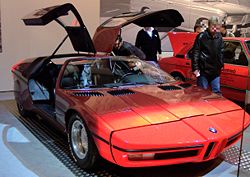
The BMW E25 Turbo concept sports car was built by BMW as a celebration for the 1972 Summer Olympics in Munich.[1][2] It was designed by Paul Bracq, with gullwing doors and was based on a modified 2002 chassis with a mid-mounted engine.[2] The Turbo featured a 276-hp turbocharged version of the engine from the BMW 2002, foam-filled front and rear sections to absorb impact, side impact beams, a braking distance monitor utilizing radar,[3] and a futuristic cockpit. The car developed 206 kW (280 PS; 276 hp) at 7100 rpm[citation needed] and could reach 100 km/h (62 mph) from a standstill in 6.6 seconds. The top speed was limited to 250 km/h (155 mph).[4]

Only two were ever built.[5] BMW later used the Turbo's design themes on the M1, the 8 Series, the Z1 and the 2008 M1 Homage Concept.[citation needed] The BMW E-25 is however most similar to the BMW M1.

Rear 3/4 view of the Turbo
Interior

References

[edit]
Revisions and contributorsEdit on WikipediaRead on Wikipedia
from Grokipedia
The Turbo is a mid-engine developed by in 1972 as an experimental showcase of advanced , safety features, and turbocharged performance, with only two prototypes ever built. Designed by Paul Bracq, the Turbo featured a sleek, low-slung body with gull-wing doors, pop-up headlights, and the brand's emerging "shark nose" front end, characterized by a slanted angular nose and compact kidney grille, which became influential in BMW's future styling. Its transverse-mounted 1,990 cc (2.0 L) four-cylinder engine, turbocharged to produce 280 horsepower, enabled acceleration from 0 to 100 km/h (62 mph) in 6.6 seconds and a top speed of 250 km/h (155 mph), making it a performance benchmark for its era. The car's mid-engine, rear-wheel-drive layout weighed just 1,272 kg (2,805 lb), emphasizing lightweight construction and agile handling. Developed around the time of the 1972 Munich Olympics and unveiled at the Paris Autosalon later that year, the BMW Turbo served as a "mobile laboratory" for innovative technologies, including the first BMW with an (ABS), radar-based distance alert, a collapsible safety , hydraulic shock absorbers, and a safety belt interlock required to start the engine—features that were visionary at the time. A second prototype, with minor modifications, appeared at the 1973 IAA motor show. Although never intended for production, the concept directly inspired the supercar launched in 1978, sharing aerodynamic and engineering principles that defined BMW's high-performance lineage. The Turbo's legacy endures as a icon, earning the top prize at the 1992 Concours d'Élégance de Bagatelle, reappearing at the 2024 Pebble Beach Concours d'Elegance, and remaining on display at the in and the BMW Zentrum in , underscoring its role in pioneering turbo technology and safety advancements for road cars. It predated the production 2002 Turbo of 1973, Europe's first series-produced turbocharged car, but stood apart as a pure experimental vision rather than a consumer model.

Overview

Introduction

The BMW Turbo, unveiled in to coincide with the Summer Olympics in , represented BMW's forward-looking vision for the sports car of the future. Commissioned as a showcase of innovative engineering and design, it highlighted the company's ambitions in performance and technology during a pivotal era for automotive advancement. Featuring a mid-engine, rear-wheel-drive configuration, the concept boasted gullwing doors and a sleek, futuristic exterior that emphasized aerodynamic efficiency. At its core was a turbocharged 2.0-liter inline-four delivering 280 horsepower, marking one of BMW's earliest forays into forced-induction for high-performance . The Turbo prioritized advanced safety elements, including foam-filled bumpers, a collapsible , and early , while its low-slung profile optimized for superior handling. This experimental project, with only two prototypes constructed—one for static exhibition and another as a functional test —laid foundational groundwork for later icons like the M1.

Production and Prototypes

The Turbo project resulted in the construction of only two hand-built prototypes in 1972. These units were assembled using a modified chassis, shortened to accommodate the mid-engine layout and featuring custom bodywork with distinctive gullwing doors. The body panels were subcontracted to the Italian coachbuilder Michelotti in for fabrication, while the core mechanical components originated from 's engineering in . The first functioned primarily as a static show car, employed for public unveilings and promotional displays, including its debut at the 1972 . In contrast, the second was fully drivable and utilized for internal testing purposes, encompassing track evaluations to assess the integration of its turbocharged 2.0-liter inline-four and . The second , featuring minor modifications, was displayed at the 1973 IAA motor show. After their active use in 1972, the prototypes' fates diverged initially but ultimately led to preservation within BMW's collections. The drivable second unit continued in development and testing roles before being stored; today, one prototype is on display at the in , while the other is at the BMW Performance Center in , both safeguarded as key artifacts of automotive history.

Development

Historical Context

In the wake of West Germany's —the of the 1950s and 1960s that fueled rapid industrialization, rising consumer incomes, and automotive sector expansion—BMW transitioned from post-war survival strategies to a focus on performance and innovation by the late 1960s. The launch of the Neue Klasse sedans in 1962 exemplified this shift, introducing compact, sporty vehicles with advanced engineering that prioritized handling, safety, and aesthetic appeal, helping BMW triple its car sales over the decade and solidifying its identity as a premium performance brand. The in , hosted in 's hometown, served as a national stage to highlight 's post-war resurgence through technological showcase, with the event symbolizing rebuilt infrastructure and industrial confidence after decades of recovery. leveraged this occasion by developing the Turbo concept car, designed by Paul Bracq, which was unveiled shortly thereafter at the Autosalon and represented the pinnacle of forward-thinking German amid the country's and global reintegration. Early turbocharging advancements in racing, notably Porsche's introduction of the 917/10 for the 1972 Can-Am series, which demonstrated turbo technology's potential for high power and efficiency in demanding conditions, directly inspired 's application of similar principles to road cars. Concurrently, aimed to exemplify and in response to impending international regulations, such as the U.S. Federal Standard 215 requiring 5 mph impact-resistant bumpers effective from , by integrating deformable energy-absorbing structures into the Turbo's design. This concept aligned with the parallel development of the 2002 Turbo production model, introduced in 1973 as 's inaugural turbocharged series car and a practical extension of the prototype's innovations.

Design and Engineering Team

The BMW Turbo concept, also known as the E25, was primarily led in design by Paul Bracq, who served as BMW's head of design from 1970 to 1974. Bracq, drawing from his experience at Mercedes-Benz and Peugeot, headed a small style center team of about a dozen members tasked with creating BMW's first concept car to showcase futuristic aesthetics. This collaborative effort emphasized a human-centric approach, with Bracq articulating the philosophy that vehicles should function as an "intimate cell" fitting like a "second skin" to prioritize occupant comfort and integration. The design philosophy blended aerodynamic efficiency—evident in the low-slung wedge shape and "shark front" kidney grille—with safety innovations and high-performance previewing supercar capabilities, all unveiled at the 1972 Paris Autosalon. Engineering contributions came from BMW's internal development teams, integrating turbocharged technology derived from the M10 inline-four engine family into a transverse mid-engine layout. This setup, producing up to 280 horsepower, addressed key challenges in packaging for a compact sports car, achieving a low center of gravity and near-ideal 50:50 weight distribution at just 1,272 kg curb weight. The mid-engine configuration presented hurdles in component integration and space optimization, requiring innovative solutions to balance the turbo system with drivetrain elements while maintaining overall compactness. Further collaboration involved suppliers for , notably incorporating foam-filled hydraulic shock absorbers into the crash structure to enhance impact —a feature later adopted in series production models. This partnership underscored the project's focus on merging engineering rigor with forward-thinking , setting a precedent for BMW's future mid-engine designs like the M1.

Technical Specifications

Engine and Drivetrain

The BMW Turbo was powered by a 2.0 L (1,990 cc) derived from the M10 block used in production models like the series, with a of 6.8:1. This engine incorporated a to boost performance, marking an early application of in BMW's lineup. The system was adapted from the Bosch mechanical setup in the standard models, ensuring reliable delivery under boosted conditions. The engine delivered 276 hp (206 kW) at 7,100 rpm and 238 Nm of , providing a high-revving character suitable for the concept's ambitions. Mounted transversely in a mid-engine configuration behind the passenger compartment, it contributed to balanced handling by achieving a near-even front-to-rear . This layout optimized traction and stability without the need for advanced electronic aids, relying instead on mechanical precision. Power was transmitted through a 4-speed manual gearbox paired with , emphasizing the prototype's focus on driver engagement. The drivetrain's simplicity allowed for direct power delivery to the rear wheels, with the mid-engine placement minimizing front-end lift during acceleration and enhancing the car's agile response. This setup foreshadowed BMW's later mid-engine explorations, such as in the M1.

Dimensions and

The BMW Turbo was engineered with compact dimensions to enhance aerodynamic efficiency and handling dynamics, featuring a of 2,400 mm, an overall length of 4,155 mm, a width of 1,880 mm, and a height of 1,100 mm. These proportions contributed to its low-slung profile, which helped minimize drag while accommodating the mid-engine configuration. The curb weight was 1,272 kg, reflecting a balance between structural integrity and performance-oriented lightness. The chassis formed the foundation of the BMW Turbo's innovative layout, derived from a modified 2002 (E10) platform with a reinforced subframe specifically adapted to house the mid-mounted . This adaptation shortened the by approximately 100 mm compared to the donor model and repositioned components to centralize mass distribution for improved balance. The was mounted transversely behind the cabin, integrated directly into the reinforced structure without extensive additional framing. Suspension duties were handled by an independent setup, utilizing MacPherson struts at the front for precise steering response and semi-trailing arms at the rear to manage the rear-wheel-drive dynamics effectively. This configuration, carried over and refined from the 2002 series, provided compliant ride characteristics while supporting the car's sporty aspirations. Anti-roll bars were incorporated at both ends to reduce body roll during cornering. The body's lightweight construction featured panels over a modified unibody , which allowed for reduced mass without compromising rigidity or safety features like integrated . This hybrid approach facilitated the gullwing doors and expansive glass areas, emphasizing the concept's futuristic aesthetic and engineering experimentation. The tire setup consisted of 205/70 VR13 fronts and 225/50 VR15 rears fitted to custom wheels, optimizing grip for the era's high-performance standards.

Design and Features

Exterior Styling

The exterior styling of the 1972 BMW Turbo concept car, penned by design director Paul Bracq, presented a bold, low-slung wedge-shaped profile that captured a futuristic vision of automotive form. This coupe-like silhouette featured sharp, rising lines from a sloped nose to a tapered tail, incorporating the iconic kidney grille in a compact, integrated form to maintain brand identity while embracing modern aesthetics. The design prioritized a sleek, minimalist appearance with clean contours and partially covered rear wheels, evoking the era's fascination with high-speed efficiency and drawing inspiration from Italian supercar proportions. A hallmark of the Turbo's exterior was its gullwing doors, which hinged upward from the roofline to facilitate easy entry and exit, enhancing both practicality and visual drama. Complementing this were retractable pop-up headlights that preserved the smooth frontal when retracted, minimizing protrusions for a streamlined look. The bodywork included integrated aerodynamic elements such as the wedge profile and subtle spoilers, refined through testing across 17 variants to achieve a low . These features underscored the car's emphasis on management without compromising its aggressive, forward-thrusting stance. The Turbo's construction utilized a chassis with advanced safety-oriented body elements, including foam-filled bumpers and , finished in a striking two-tone scheme—typically orange fading to red—for a dynamic, effect that amplified its sense of motion. Black accents outlined key contours, such as the wheel arches and door edges, contributing to a high-contrast, high-tech appearance. Overall, the minimalist lines and proportional balance highlighted themes of speed and structural integrity, positioning the Turbo as BMW's pioneering statement on safety-integrated .

Interior and Safety Innovations

The BMW Turbo's interior was designed as a compact two-seat , emphasizing driver-centric and lightweight construction to enhance performance and safety. Featuring supportive seats upholstered in durable materials, the cabin minimized weight while providing secure lateral support during high-speed maneuvers. The adopted a minimalist layout, with essential controls clustered within easy reach to reduce driver distraction and promote focus on the road ahead. Instrumentation in the cockpit centered on analog gauges angled toward the driver, allowing visibility without releasing the , a forward-thinking measure. Prominent among these was a dedicated turbo boost meter, which provided real-time feedback on engine performance, alongside , , and fuel gauges arranged in a semi-circular cluster for optimal . This jet-like arrangement of dials reflected the era's aviation-inspired trends while prioritizing intuitive operation in a high-performance environment. Safety innovations in the BMW Turbo extended to both passive and active systems, setting it apart as a pioneer in automotive protection. The front and rear bumpers incorporated foam-filled structures capable of absorbing impacts up to 8 km/h, enabling minor collision recovery without permanent deformation and complying with emerging federal standards. Doors featured integrated side-impact beams to mitigate intrusion during lateral crashes, enhancing occupant protection. Additionally, an early radar-based distance warning system used sensors to monitor the gap to the preceding vehicle, alerting the driver via a gauge to potential braking needs—a precursor to modern advanced driver assistance systems (ADAS). For rollover scenarios, the gullwing door mechanism included an integrated roll bar formed by the door posts extending into the roof structure, providing robust overhead protection without compromising the car's sleek profile.

Performance and Testing

Acceleration and Top Speed

The BMW Turbo concept, tested in the early , achieved 0-100 km/h (0-62 mph) acceleration in approximately 6.6 seconds, a remarkable figure for a turbocharged of its era powered by a mid-mounted 2.0-liter four-cylinder producing up to 280 hp. This stemmed from the 's high-revving nature, with peak output delivered at 7,100 rpm, highlighting the turbocharger's role in providing a sudden surge once boost built. The vehicle's top speed reached 250 km/h (155 mph), limited to balance the prototype's aerodynamic design and power delivery during and track evaluations. Early evaluations also noted characteristic turbo lag in the , where initial response was subdued until exhaust gases spooled the turbo at higher RPMs, leading to abrupt peak power delivery that demanded precise driver input. Due to the experimental nature of the two prototypes, with very limited mileage accumulated, performance figures derive from controlled tests rather than extensive real-world use.

Handling Characteristics

The BMW Turbo prototype's mid-engine layout, with the turbocharged 2.0-liter four-cylinder engine mounted transversely behind the passenger compartment, delivered a balanced setup that promoted neutral handling with minimal understeer during dynamic driving. This configuration contributed to a low center of gravity and well-balanced axle load distribution, optimizing predictable road behavior despite the vehicle's short wheelbase of 2,400 mm. The suspension was engineered for high-speed stability, featuring a McPherson rear axle with trailing and transverse links, along with a double wishbone arrangement that allowed the wheels to move parallel to the car's centerline, effectively suppressing self-steering effects and enhancing control on demanding roads. In-depth handling tests at BMW's Aschheim proving grounds confirmed the system's effectiveness, with improvements in straight-line stability achieved through tire optimizations, though the overall design prioritized agility and maneuverability over low-speed responsiveness. Braking performance relied on ventilated disc brakes at all four wheels, integrated with BMW's first application of an (ABS) and a pioneering radar-based brake distance warning system that provided early alerts for modulated stops, improving in emergency situations. Test feedback praised the responsive from the collapsible safety column with three universal joints, but the turbo engine's inherent lag was observed to limit low-speed agility, a common trait in early turbocharged designs of the era. The weight distribution supported the prototype's composed and predictable dynamics.

Legacy and Influence

Impact on BMW Models

The BMW Turbo concept car, unveiled in 1972, served as a direct precursor to the 1978 supercar, introducing a mid-engine layout that positioned the driver optimally for performance and handling, a configuration retained in the M1's production design. This layout, combined with the Turbo's demonstration of turbocharging's potential through its 2.0-liter four-cylinder engine producing 280 horsepower, informed the M1's engineering, where a similar mid-engine setup enabled high-revving performance, and later racing variants like the M1 Procar explored turbo applications for enhanced power output. The Turbo's innovative turbo technology thus laid groundwork for in BMW's high-performance lineage, emphasizing compact engines with substantial boost for superior acceleration without excessive displacement. The aerodynamic testing methods developed for the BMW Turbo, involving wind tunnel evaluations to achieve a low through its wedge profile and underbody panels, were adopted in the creation of the 2008 M1 Hommage Concept, which paid homage to the original by refining airflow management around the mid-engine layout for optimal and stability. This continuity in aero refinement ensured the Hommage's surfaces minimized , echoing the Turbo's pioneering approach to integrating form and function for high-speed efficiency. Advancements in turbocharging from the BMW Turbo were directly implemented in the 1973 BMW 2002 Turbo production model, which adapted the concept's boosted 2.0-liter —detuned to 170 horsepower for reliability—marking BMW's first series-production turbocharged and proving the technology's viability for everyday performance vehicles. This foundation extended to later engines, where turbo systems evolved from the Turbo's principles of efficient power delivery, influencing models like the E36 M3's inline-six with and subsequent V8s in the M5 and M6, enabling compact, high-output units that balanced drivability with potency.

Cultural and Modern Recognition

The BMW Turbo made its public debut at the , where it captivated audiences with its futuristic gullwing doors and aerodynamic wedge shape, symbolizing BMW's forward-thinking vision for . Following its initial reveal, the prototype has been preserved and showcased in prominent exhibitions, including permanent display at the in as a highlight of the brand's heritage, and more recently at the in as part of rotating collections focused on innovative designs, including a 2025 "Wedge cars" exhibit. In , the BMW Turbo has appeared in automotive documentaries and films that evoke the era's sense of technological optimism and futurism, such as the 1983 British television series History of the Motor Car, where it represented pioneering engineering, and the 2007 German drama Das wilde Leben, underscoring its iconic status in media portrayals of automotive innovation. These appearances highlight the car's role as a of an age when bold concepts like mid-engine layouts and turbocharging promised a new frontier in performance vehicles. As an indirect tribute to the Turbo's pioneering innovations in turbo technology and mid-engine packaging, BMW unveiled the 2002 Hommage concept in 2016, drawing stylistic cues from the 1970s era while honoring the lineage of turbocharged performance that the original Turbo helped inspire. Preservation efforts by BMW Classic have ensured the prototype's longevity, with the division maintaining the surviving example and featuring it in events like the 2022 , where it was publicly driven for the first time in decades to mark the car's 50th anniversary, emphasizing its enduring influence on BMW's design philosophy. Among enthusiast communities, the Turbo continues to inspire custom builds and scale models that replicate its distinctive silhouette and gullwing features, with high-fidelity diecast replicas produced by manufacturers like Schuco in 1:18 and 1:43 scales, allowing collectors to engage with its retro-futuristic aesthetic. These tributes extend to hobbyist modifications on later BMW chassis, where builders incorporate Turbo-inspired elements such as aerodynamic wedges and turbo setups to evoke the concept's experimental spirit. The car's design DNA also subtly informed the , bridging its conceptual boldness to production reality.

References

Add your contribution
Related Hubs
User Avatar
No comments yet.