Hubbry Logo
Straight-four engineStraight-four engineMain
Open search
Straight-four engine
Community hub
Straight-four engine
logo
8 pages, 0 posts
0 subscribers
Be the first to start a discussion here.
Straight-four engine
from Wikipedia
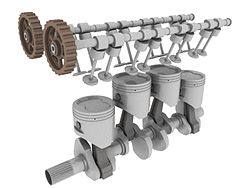
Diagram of a DOHC straight-four engine
1989-2006 Ford I4 DOHC engine with the cylinder head removed
2006-2009 Nissan M9R diesel engine

A straight-four engine (also referred to as an inline-four engine) is a four-cylinder piston engine where cylinders are arranged in a line along a common crankshaft.

The majority of automotive four-cylinder engines use a straight-four layout[1]: pp. 13–16  (with the exceptions of the flat-four engines produced by Subaru and Porsche)[2] and the layout is also very common in motorcycles and other machinery. Therefore the term "four-cylinder engine" is usually synonymous with straight-four engines. When a straight-four engine is installed at an inclined angle (instead of with the cylinders oriented vertically), it is sometimes called a slant-four.

Between 2005 and 2008, the proportion of new vehicles sold in the United States with four-cylinder engines rose from 30% to 47%.[3][4] By the 2020 model year, the share for light-duty vehicles had risen to 59%.[5]

Design

[edit]

A four-stroke straight-four engine always has a cylinder on its power stroke, unlike engines with fewer cylinders where there is no power stroke occurring at certain times. Compared with a V4 engine or a flat-four engine, a straight-four engine only has one cylinder head, which reduces complexity and production cost.

Displacement

[edit]

Petrol straight-four engines used in modern production cars typically have a displacement of 1.3–2.5 L (79–153 cu in), but larger engines have been used in the past, for example the 1927–1931 Bentley 4½ Litre.

Diesel engines have been produced in larger displacements, such as a 3.2 L turbocharged Mitsubishi engine (used the Pajero/Shogun/Montero SUV) and a 3.0 L Toyota engine. European and Asian trucks with a gross vehicle weight rating between 7.5 and 18 tonnes commonly use inline four-cylinder diesel engines with displacements around 5 litres.[6][7][8][9][10][11][12] Larger displacements are found in locomotive, marine and stationary engines.

Displacement can also be very small, as found in kei cars sold in Japan. Several of these engines had four cylinders at a time when regulations dictated a maximum displacement of 550 cc; the maximum size is currently at 660 cc.

Primary and secondary balance

[edit]

Straight-four engines with the preferred crankshaft configuration have perfect primary balance.[1]: p. 12  This is because the pistons are moving in pairs, and one pair of pistons is always moving up at the same time as the other pair is moving down.

However, straight-four engines have a secondary imbalance. This is caused by the acceleration/deceleration of the pistons during the top half of the crankshaft rotation being greater than that of the pistons in the bottom half of the crankshaft rotation (because the connecting rods are not infinitely long). As a result, two pistons are always accelerating faster in one direction, while the other two are accelerating more slowly in the other direction, which leads to a secondary dynamic imbalance that causes an up-and-down vibration at twice crankshaft speed. This imbalance is common among all piston engines, but the effect is particularly strong on four-stroke inline-four because of the two pistons always moving together.

The strength of this imbalance is determined by the reciprocating mass, the ratio of connecting rod length to stroke, and the peak piston velocity. Therefore, small displacement engines with light pistons show little effect, and racing engines use long connecting rods. However, the effect grows quadratically with engine speed (rpm).

Pulsations in power delivery

[edit]
Animation of an Inline-four engine

Four-stroke engines with five or more cylinders are able to have at least one cylinder performing its power stroke at any given point in time. However, four-cylinder engines have gaps in the power delivery, since each cylinder completes its power stroke before the next piston starts a new power stroke. This pulsating delivery of power results in more vibrations than engines with more than four cylinders.

Usage of balance shafts

[edit]
Mitsubishi Silent Shaft display

A balance shaft system is sometimes used to reduce the vibrations created by a straight-four engine, most often in engines with larger displacements. The balance shaft system was invented in 1911 and consists of two shafts carrying identical eccentric weights that rotate in opposite directions at twice the crankshaft's speed.[1]: pp. 42–44  This system was patented by Mitsubishi Motors in the 1970s, introduced in the Mitsubishi Astron engine with the "Silent Shaft" name, and has since been used under licence by several other companies.[13][14]

Not all large displacement straight-four engines have used balance shafts, however. Examples of relatively large engines without balance shafts include the 2.4 litre Citroën DS engine, the 2.6 litre Austin-Healey 100 engine, the 3.3 L Ford Model A (1927) engine and the 2.5 L GM Iron Duke engine. Soviet/Russian GAZ Volga and UAZ engines with displacements of up to 2.9 litres were produced without balance shafts from the 1950s to the 1990s, however these were relatively low-revving engines which reduces the need for a balance shaft system.[1]: pp. 40–44 

Usage in production cars

[edit]
1908–1941 Ford Model T engine
1970 Alfa Romeo Twin Cam engine

Most modern straight-four engines used in cars have a displacement of 1.5–2.5 L (92–153 cu in). The smallest automotive straight-four engine was used in the 1963–1967 Honda T360 kei truck and has a displacement of 356 cc (21.7 cu in), while the largest mass-produced straight-four car engine is the 1999–2019 Mitsubishi 4M41 diesel engine which was used in the Mitsubishi Pajero and has a displacement of 3.2 L (195 cu in).[15][16]

Significant straight-four car engines include:

Usage in racing cars

[edit]
1980s BMW M12/13 Formula One engine

Many early racing cars used straight-four engines, however the Peugeot engine which won the 1913 Indianapolis 500 was a highly influential engine. Designed by Ernest Henry, this engine had double overhead camshafts (DOHC) with four valves per cylinder, a layout that would become the standard until today for racing inline-four engines.[19]: pp. 14–17 

Amongst the engines inspired by the Peugeot design was the Miller engine, which was a successful racing engine through the 1920s and early 1930s. The Miller engine evolved into the Offenhauser engine which had a highly successful spanning from 1933 until 1981, including five straight victories at the Indianapolis 500 from 1971 to 1976.[19]: pp. 182–185 

Many cars produced for the pre-WWII voiturette Grand Prix motor racing category used inline-four engine designs. 1.5 L supercharged engines found their way into cars such as the Maserati 4CL and various English Racing Automobiles (ERA) models. These were resurrected after the war, and formed the foundation of what was later to become Formula One, although the straight-eight supercharged Alfettas would dominate the early years of F1.

Another engine that played an important role in racing history is the straight-four Ferrari engine designed by Aurelio Lampredi. This engine was originally designed as a 2 L Formula 2 engine for the Ferrari 500, but evolved to 2.5 L to compete in Formula One in the Ferrari 625.[19]: pp. 78–81, 86–89  For sports car racing, capacity was increased up to 3.4 L for the Ferrari 860 Monza.

The Coventry Climax straight-four engine was also a very successful racing engine, which began life as a 1.5 litre Formula 2 engine. Enlarged to 2.0 litres for Formula One in 1958, it evolved into the large 2,495 cc FPF that won the Formula One championship in Cooper's chassis in 1959 and 1960.[19]: pp. 130–133 

In Formula One, the 1980s were dominated by the 1,500 cc turbocharged cars. The BMW M12/13 engine was notable for the era for its high boost pressures and performance. The cast iron block was based on a standard road car block and powered the F1 cars of Brabham, Arrows and Benetton and won the world championship in 1983. The 1986 version of the engine was said to produce about 1,300 hp (950 kW) in qualifying trim, at 5.5 bar of turbo boost.[20]

Usage in motorcycles

[edit]
1970 Honda CB750 engine

Belgian arms manufacturer FN Herstal, which had been making motorcycles since 1901, began producing the first motorcycles with inline-fours in 1905.[21] The FN Four had its engine mounted upright with the crankshaft longitudinal. Other manufacturers that used this layout included Pierce, Henderson, Ace, Cleveland, and Indian in the United States, Nimbus in Denmark, Windhoff in Germany, and Wilkinson in the United Kingdom.[22]

The first across-the-frame 4-cylinder motorcycle was the 1939 racer Gilera 500 Rondine, it also had double-over-head camshafts, forced-inducting supercharger and was liquid-cooled.[23] Modern inline-four motorcycle engines first became popular with Honda's SOHC CB750 introduced in 1969, and others followed in the 1970s. Since then, the inline-four has become one of the most common engine configurations in street bikes. Outside of the cruiser category, the inline-four is the most common configuration because of its relatively high performance-to-cost ratio.[citation needed] All major Japanese motorcycle manufacturers offer motorcycles with inline-four engines, as do MV Agusta and BMW. BMW's earlier inline-four motorcycles were mounted horizontally along the frame, but all current four-cylinder BMW motorcycles have transverse engines. The modern Triumph company has offered inline-four-powered motorcycles, though they were discontinued in favour of triples.

The 2009 Yamaha R1 has an inline-four engine that does not fire at even intervals of 180°. Instead, it uses a crossplane crankshaft that prevents the pistons from simultaneously reaching top dead centre. This results in better secondary balance, which is particularly beneficial in the higher rpm range, and "big-bang firing order" theory says the irregular delivery of torque to the rear tire makes sliding in the corners at racing speeds easier to control.

Inline-four engines are also used in MotoGP by the Suzuki (since 2015) and Yamaha (since 2002) teams. In 2010, when the four-stroke Moto2 class was introduced, the engines for the class were a 600 cc (36.6 cu in) inline-four engine made by Honda based on the CBR600RR with a maximum power output of 110 kW (150 hp). Starting in 2019, the engines were replaced by a Triumph 765 cc (46.7 cu in) triple engine.

Usage in light and medium duty commercial vehicles

[edit]

Inline-four engines are also used in light duty commercial vehicles such as Karsan Jest and Mercedes-Benz Sprinter.

See also

[edit]

References

[edit]
[edit]
Revisions and contributorsEdit on WikipediaRead on Wikipedia
from Grokipedia
A straight-four engine, also known as an inline-four engine, is an consisting of four cylinders arranged in a single straight line parallel to the , sharing one and . This configuration delivers balanced primary forces through opposing movements, making it a compact, lightweight, and cost-effective power source widely used in passenger cars, light trucks, motorcycles, and small . The development of the straight-four engine parallels the evolution of the automobile in the late 19th century, building on Nikolaus Otto's patent for the four-stroke cycle, with early four-cylinder implementations appearing in experimental engines by the 1880s. produced one of the first practical four-cylinder engines in 1890 for his motorized carriage, marking a shift toward multi-cylinder designs for smoother operation and greater power. By 1908, Henry Ford's Model T popularized the inline-four in mass-produced vehicles, with its 177-cubic-inch engine producing 22 horsepower on various fuels and enabling affordable mobility for millions. Over the 20th century, advancements like overhead valves, turbocharging, and balance shafts—first conceptualized by Frederick Lanchester in 1911—refined the design for better efficiency and reduced vibrations, solidifying its dominance in everyday transportation. Key advantages of the straight-four include its simplicity, with fewer parts than V or boxer configurations, leading to lower production costs, easier maintenance, and improved fuel economy through reduced energy losses. It also offers inherent primary balance, low emissions compliant with modern standards, and versatility across and diesel variants, powering vehicles from compact sedans to high-performance sports cars. However, disadvantages arise from secondary imbalances causing vibrations, particularly in larger displacements over 2.5 liters, often necessitating balance shafts that add complexity and cost. Additionally, it may lack the low-end of six- or eight-cylinder engines for heavy loads and can experience power drop-off at high RPMs without advanced tuning. Despite competition from and downsized turbocharged alternatives, the straight-four remains a cornerstone of due to its optimal balance of performance, economy, and reliability, with ongoing innovations focusing on hybridization and emissions reduction. Notable examples include BMW's long-running inline-four lineage since the and Honda's transverse-mounted versions in motorcycles from the 1969 CB750 onward.

Configuration and Basics

Definition and Layout

The straight-four engine, also known as an inline-four engine, is an configuration featuring four s arranged in a single straight line parallel to the axis, typically operating on a four-stroke cycle where , compression, power, and exhaust phases occur sequentially in each . This inline arrangement contrasts with alternative four-cylinder layouts such as the V4, which positions cylinders in two banks forming a V shape, or the flat-four (boxer), where cylinders are horizontally opposed on opposite sides of the ; the straight-four's linear design allows for a single covering all four cylinders, simplifying manufacturing, reducing part count, and lowering costs compared to multi-bank configurations that require separate heads. Structurally, the straight-four employs a with four crank throws typically spaced at 180-degree intervals, enabling even firing intervals where one ignites every 180 degrees of crankshaft rotation for smooth power delivery in four-stroke operation. These engines are commonly mounted in either longitudinal orientation, aligning the parallel to the vehicle's direction of travel for rear-wheel-drive applications, or transverse orientation, positioning it to the travel direction to optimize front-wheel-drive packaging and space efficiency in compact vehicles. The straight-four remains the most prevalent engine type in modern passenger vehicles due to its balance of performance, efficiency, and manufacturability, with U.S. for four-cylinder engines rising from approximately 30% in 2005 to 45% by model year 2020 and around 57% as of 2023.

Firing Order and Operation

The straight-four engine, also known as an inline-four, typically employs a firing order of 1-3-4-2, where the cylinders are numbered sequentially from the front to the rear of the . This sequence ensures that the power strokes occur at evenly spaced 180-degree intervals over the degrees of crankshaft rotation required for a complete four-stroke cycle, resulting in consistent power pulses that minimize torsional vibrations and reduce stress on the . The arrangement avoids adjacent cylinder firings, which could otherwise cause uneven delivery and increased mechanical strain. In operation, the straight-four follows the standard four-stroke cycle, with variations depending on whether it is a spark-ignition (, typically ) or compression-ignition (, typically diesel) engine. Each undergoes , compression, power, and exhaust phases. During the stroke, the descends with the open, drawing in air (and a pre-mixed air- mixture for spark-ignition engines) or air only (for compression-ignition engines); the compression stroke follows as the ascends with both valves closed, compressing the intake charge (with injected during this stroke for compression-ignition engines); the power stroke occurs as the compressed charge is ignited—by spark for spark-ignition or by compression heat for compression-ignition—driving the downward to produce at or near top dead center; and the exhaust stroke expels burned gases as the rises with the exhaust open. Across the four s, this results in one power stroke per every two crankshaft revolutions, or equivalently, a firing event every 180 degrees of rotation, providing continuous power output without idle periods between s. The in a straight-four engine features four throws positioned at 180-degree intervals to align with this , pairing the pistons such that cylinders 1 and 4 (along with 2 and 3) move in unison while the pairs oppose each other. This flat-plane configuration contributes to smoother delivery by distributing the power impulses evenly, though it can introduce secondary vibrations that are often mitigated elsewhere in the design. Valve and camshaft configurations in straight-four engines leverage the linear cylinder layout for efficient operation, commonly using overhead valve (OHV), single overhead camshaft (SOHC), or double overhead camshaft (DOHC) systems. In OHV setups, the resides in the block and actuates valves via pushrods and rocker arms, offering compact design suitable for cost-sensitive applications but limited to two valves per . SOHC places a single in the head to directly or indirectly operate up to four valves per via rocker arms, balancing simplicity with improved breathing in the inline arrangement. DOHC employs two s—one for and one for exhaust—enabling precise control of four valves per for enhanced airflow and efficiency, a configuration particularly effective in the straight-four's elongated head space.

History

Early Development

The development of the straight-four engine, also known as the inline-four, emerged in the late as engineers sought to improve upon the limitations of single-cylinder, twin, and triple-cylinder configurations in early automobiles. Pre-1900 experiments focused on inline multi-cylinder layouts to deliver more consistent power delivery and reduce vibration compared to earlier vee or opposed designs. A pivotal precursor was the work of et Levassor in , who introduced four-cylinder engines in racing prototypes as early as 1896 for events like the Paris-Marseilles-Paris race, where the design doubled the displacement of their twin-cylinder models to achieve higher speeds and reliability on demanding roads. These efforts influenced the transition toward inline fours by demonstrating smoother operation through evenly spaced firing intervals, addressing the uneven power pulses of twins and the complexity of triples in emerging motorized vehicles. The first production straight-four engines appeared in the early 1900s, marking a shift toward practical automotive and motorcycle applications. In the United States, the H.H. Franklin Manufacturing Company produced the first four-cylinder production automobile in 1902, featuring a transverse-mounted, vertical inline-four air-cooled engine of 1.9 liters displacing about 10 horsepower, which powered lightweight runabouts and set a precedent for American engineering innovation in multi-cylinder designs. Concurrently, in Europe, the Belgian firm Fabrique Nationale d'Herstal (FN Herstal) introduced the world's first production inline-four motorcycle in 1905 with the FN Four, a 362 cc side-valve engine producing around 3 horsepower and notable for its shaft drive and low vibration, which facilitated smoother high-speed travel compared to contemporary single- or twin-cylinder bikes. Key milestones in the early 1910s highlighted the straight-four's potential in competition and aviation, driven by the need for balanced power in high-performance settings. In 1913, a L76 racer with a 7.6-liter inline-four DOHC engine, designed by Ernest Henry and producing 155 horsepower, secured victory at the , driven by Jules Goux, who completed the 500 miles without relief—demonstrating the configuration's endurance and influencing subsequent racing designs. During , straight-four engines found adoption in aircraft for their compact inline layout and reliable output; for instance, the American Liberty L-4, a 102-horsepower water-cooled inline-four developed in 1917, powered training and observation planes, underscoring the shift from rotary and multi-bank engines to inline fours for better cooling and weight distribution in . This evolution reflected broader technological drivers, as the straight-four's even provided inherently smoother operation than twins or triples, enabling higher speeds and greater usability in the burgeoning automobile era without the need for complex balancing mechanisms.

20th Century Evolution

The straight-four engine saw significant maturation during the and era, transitioning from niche applications to both racing dominance and . In racing, the (Offy) engine, evolved from Harry Miller's designs acquired by Fred Offenhauser in 1934 following Miller's bankruptcy, became a cornerstone of American open-wheel competition. The Offenhauser four-cylinder variant, introduced in and rooted in earlier innovations, powered entries through the 1960s and beyond, contributing to 27 total victories in the from 1935 to 1976, including every race from 1947 to 1964 due to its reliability, high-revving capability up to 8,000 rpm, and output exceeding 400 horsepower in supercharged form. In parallel, advanced with the Ford Model A of 1928, featuring a 3.3-liter L-head straight-four producing 40 horsepower at 2,200 rpm, which equipped over 4.8 million vehicles by 1931 and exemplified efficient, affordable inline-four design for everyday use. Post-World War II innovations focused on improving efficiency and performance amid recovering economies and rising automotive demand. The British Motor Corporation's A-Series engine, launched in 1951 for the , introduced overhead valves (OHV) in a compact 0.8-liter straight-four configuration, delivering 27 horsepower and enabling the revolutionary Mini's transverse layout in 1959, which prioritized space efficiency over raw power. Fuel injection emerged as a performance enhancer in the 1950s, though initially more common in V8s like Chevrolet's 1957 system; for straight-fours, mechanical injection appeared in European models such as the 1954 Mercedes-Benz 190 SL's 1.9-liter unit, boosting throttle response and economy in small-displacement applications. By the , stringent emissions regulations under the U.S. Clean Air Act of 1970 and (CAFE) standards from 1975 compelled manufacturers to downsize engines, favoring straight-fours under 2.0 liters—such as the 1.6-liter versions in many compacts—to meet hydrocarbon and limits while improving to 20-25 , a shift that reduced average displacement from 4.0 liters in 1970 to about 3.0 liters by 1980. Diesel straight-four engines also evolved significantly in the 20th century, with early examples like the OM 636 (introduced 1938) providing reliable power for commercial vehicles and influencing post-war designs. Volkswagen's 1.5-liter and 1.6-liter air-cooled diesels in the 1970s and models emphasized efficiency, achieving up to 50 mpg and paving the way for modern common-rail systems. Key engine families exemplified the straight-four's refinement in the late 20th century. Honda's D-Series, debuting in 1984 but building on 1960s precedents like the 1.3-liter SOHC unit in the 1968 sedan (producing 80 horsepower), became a hallmark of reliability and tunability, powering and Integras with displacements from 1.5 to 1.8 liters and outputs up to 130 horsepower by the 1990s through SOHC and variants. Similarly, Mitsubishi's 4G-Series, introduced in 1978, incorporated twin balance shafts starting in 1987 in models like the turbocharged 4G63, reducing second-order vibrations by up to 90% and enabling smooth high-output performance exceeding 200 horsepower in rally applications. Globally, straight-fours dominated Japanese automotive production, reflecting a focus on compact, efficient designs for export markets. Toyota developed over a dozen inline-four families in the , including the K-Series (1950s-1980s) and later MZ-Series, powering models like the Corolla and achieving widespread adoption through precise engineering and low NVH. Nissan followed suit with the A-Series and later GA-Series straight-fours, emphasizing durability in vehicles like the Sunny, contributing to Japan's rise as the world's top auto exporter by the 1980s. In contrast, the U.S. favored V8s for their in larger sedans and trucks throughout the 1970s and 1980s—despite emissions-driven detuning that dropped outputs from 300+ to under 200 horsepower—leading to a relative decline in straight-four usage in mainstream passenger cars until mandates in the 2000s revived them in economy segments.

Design Features

Balance and Vibration

The straight-four engine achieves perfect primary balance through its symmetric piston configuration. The two outer pistons rise and fall simultaneously, while the two inner pistons move 180 degrees out of phase, ensuring that the primary inertial forces—arising from the first-order sinusoidal acceleration of the pistons at crankshaft speed—cancel out completely. This results in no net primary force or primary rocking couple, providing inherent smoothness in primary vibrations compared to unbalanced configurations like single-cylinder engines. Secondary imbalance, however, remains a characteristic issue in straight-four engines, stemming from the second-order components of acceleration due to the connecting rod's angularity. These forces occur at twice crankshaft speed and do not cancel, instead summing across all four cylinders to produce a net vertical shaking force. The secondary force for a single is given by Fsecondary=mrω2cos2θn,F_\text{secondary} = \frac{m r \omega^2 \cos 2\theta}{n}, where mm is the reciprocating (primarily the ), rr is the crank radius, ω\omega is the , θ\theta is the crank , and n=l/rn = l/r is the connecting rod length-to-crank radius ratio (approximately 4 in common automotive designs). In the inline layout, the symmetric arrangement eliminates any secondary rocking couple, but the additive vertical forces create noticeable high-frequency vibrations, particularly at higher engine speeds where the force scales with ω2\omega^2. Beyond inertial imbalances, straight-four engines exhibit pulsations in power delivery due to their four-stroke cycle, generating only two power strokes per revolution and resulting in uneven exhaust and pulses every 180 degrees. This produces with peaks up to 300% above the mean and valleys dipping 200% below, creating a characteristic "sawtooth" with significant second-order torsional excitation. In contrast, a six-cylinder inline engine fires every 120 degrees, delivering six more evenly spaced pulses per revolution for smoother output and reduced ripple . These combined inertial and torsional vibrations in straight-four engines impose practical limits on maximum RPM without countermeasures, as the shaking forces can exceed 1,000 pounds at 5,000 RPM in typical 2-liter designs, risking component and reducing refinement. The inline layout exacerbates secondary vibrations compared to opposed-piston configurations like the boxer-four, where horizontally opposed cylinders cancel both primary and secondary forces through symmetric opposition, achieving near-perfect inherent balance. Such imbalances are often addressed with balance shafts rotating at twice speed.

Displacement and Sizing

Straight-four engines in passenger cars typically feature displacements ranging from 1.0 to 2.5 liters, balancing , , and performance for everyday use. For diesel variants in trucks and commercial vehicles, displacements can extend up to 5.0 liters to deliver higher for heavy-duty tasks, as exemplified by the DD5 engine, which offers a 5.0-liter capacity optimized for medium-duty applications. The smallest production straight-four ever built was the 356 cc unit in the 1963 , a water-cooled inline-four derived from Honda's technology that produced modest power for light utility work. Engine sizing in straight-four designs is heavily influenced by bore-to-stroke ratios, which determine trade-offs between low-end and high-revving capability. Undersquare configurations (stroke longer than bore) favor production at lower RPMs by allowing longer travel for greater leverage on the , but they increase piston speeds and exacerbate secondary imbalances inherent to the inline-four layout. Conversely, oversquare setups (bore larger than stroke) enable higher RPM limits for peak power, as shorter strokes reduce reciprocating mass stresses, though this can compromise low-speed without . Since the 2000s, a prominent evolution in straight-four sizing has been the downsizing trend, driven by stricter emissions regulations and fuel efficiency demands, where turbocharged smaller-displacement engines replace larger naturally aspirated ones to maintain or exceed output while reducing consumption. For instance, a 1.5-liter turbocharged straight-four can deliver performance comparable to a previous 2.5-liter naturally aspirated version, achieving up to 20-30% better fuel economy through boosted power density and optimized combustion. Among the largest mass-produced examples, the Mitsubishi 4M41 diesel straight-four, with its 3.2-liter displacement, powered vehicles like the Pajero from 1999 to 2019, emphasizing durability and torque for off-road and SUV applications.

Balance Shafts and Mitigation

Balance shafts consist of paired counter-rotating shafts fitted with eccentric weights that generate forces to counteract the secondary imbalances inherent in straight-four engines. The underlying principle was patented by British engineer Frederick W. Lanchester in 1907. Mitsubishi pioneered their practical modern implementation through the 1975 Silent Shaft system, the first production use of twin balance shafts in a four-cylinder engine, which dramatically reduced vibrations in the Astron series. In typical configurations, the two balance shafts are mounted parallel to the within the or oil pan and driven by gears or chains at twice the speed to align with the frequency of secondary forces. The counteracting produced by the eccentric weights on each shaft follows the equation: Fcounter=msrs(2ω)2sin(2θ)F_{\text{counter}} = m_s r_s (2\omega)^2 \sin(2\theta) where msm_s is the eccentric , rsr_s is the throw radius, ω\omega is the , and θ\theta is the crank ; this precisely opposes the secondary imbalance in both magnitude and phase. Alternative vibration mitigation techniques include tuned mass dampers, which attach to the to absorb torsional oscillations in four-cylinder setups; flexible elastomeric mounts that isolate engine vibrations from the ; and crankshafts, which offset crank pins at 90 degrees to improve primary balance, though they remain uncommon in straight-fours due to higher costs and uneven firing orders. Balance shafts saw widespread adoption starting in the 1980s by manufacturers like and , becoming a standard feature in contemporary straight-four designs for enhanced refinement. These systems effectively diminish secondary vibrations by 80–90%, yielding smoother operation and lower (NVH) levels. However, they increase mechanical complexity, add 5–8 kg of weight per engine, and incur parasitic losses of 5–10% through friction and drive mechanisms, equivalent to about 1.6 kW at high speeds in tested conversions.

Advantages and Disadvantages

Key Benefits

The straight-four engine offers notable simplicity in its design compared to V6 or V8 configurations, featuring a single , simpler and exhaust manifolds, and fewer overall components, which streamlines and reduces production costs. This configuration typically results in lower expenses than more complex V-type engines, making it a cost-effective choice for mass-produced vehicles. For instance, relative to a V4, the straight-four avoids the need for dual banks, further minimizing material and assembly requirements. In terms of efficiency, the straight-four's compact footprint and lighter weight—due to its linear arrangement—facilitate easier vehicle packaging and contribute to improved fuel economy, particularly in small- to medium-displacement applications ranging from 1.5 to 2.5 liters. These engines often achieve better mileage than larger V configurations by operating with fewer cylinders and reduced frictional losses, aligning well with demands for economical daily transportation. Performance-wise, straight-four engines deliver adequate , especially when turbocharged, enabling outputs exceeding 200 horsepower from a 2.0-liter displacement, as seen in engines like the General Motors LTG series. They also provide smoother operation than inline-three-cylinder engines or twin-cylinder setups, benefiting from inherent primary balance, with secondary vibrations typically less perceptible than in fewer-cylinder designs though often requiring balance shafts for further mitigation. Regarding versatility, the adapts readily to front-wheel-drive or all-wheel-drive layouts through transverse or longitudinal mounting, and its modular architecture supports emissions compliance by integrating modern technologies like direct injection with minimal redesign.

Principal Limitations

One of the primary limitations of straight-four engines is their inherent characteristics, stemming from secondary imbalances caused by the reciprocating masses of the pistons. These imbalances become particularly pronounced at higher RPMs, limiting the engine's refinement and contributing to elevated (NVH) levels compared to inherently smoother configurations like the inline-six or flat-four engines. Balance shafts are often required to mitigate these effects, but they add complexity and do not fully eliminate the issue in demanding applications. Straight-four engines also face a practical power ceiling, with scaling beyond approximately 3.0 L of displacement exacerbating vibration problems and making high-output designs more challenging to balance effectively. In comparisons of similar displacements, straight-fours typically produce less low-end than V6 engines due to fewer cylinders and the resulting uneven power delivery, which can affect drivability in performance-oriented vehicles. Packaging constraints further limit the straight-four's versatility, as its relatively long inline configuration suits longitudinal rear-wheel-drive layouts but poses challenges in transverse front-wheel-drive (FWD) setups common in compact passenger cars. The extended length can complicate integration with the transmission and driveline components, potentially increasing overall width or requiring compromises in engine design. Additional challenges include higher mean piston speeds in short-stroke straight-four designs, which enable elevated RPMs for power but accelerate wear on components like piston rings, cylinder walls, and connecting rods due to increased side-loading and friction. In hybrid applications, the engine's integration with electric systems introduces transition issues, such as frequent start-stop cycles that strain lubrication and lead to uneven thermal management, making straight-fours less modular and adaptable than pure electric powertrains.

Applications

Passenger Cars

Straight-four engines have long dominated the powertrain landscape for economy-oriented passenger cars, particularly in the compact and subcompact segments, where their compact size, cost-effectiveness, and make them ideal for mass-market vehicles. Typically displacing between 1.5 and 2.5 liters in both petrol and diesel variants, these engines power a wide array of popular models designed for everyday commuting and family use. The , introduced in 1966, exemplifies this enduring reliance on straight-four engines, starting with the 1.1-liter K-series inline-four and evolving through various displacements up to the modern 2.0-liter Dynamic Force series, maintaining its status as one of the world's best-selling vehicles with over 50 million units produced. Similarly, the , launched in 1998, has consistently featured inline-four engines such as the 2.0-liter Duratec, delivering balanced performance and economy in a front-wheel-drive compact platform. These engines enable lightweight construction and transverse mounting, optimizing space in front-wheel-drive architectures common to economy cars. In the 2000s, modern trends toward turbo downsizing further entrenched straight-fours in passenger cars, allowing smaller displacements to match or exceed the power of larger naturally aspirated units while improving efficiency. Volkswagen's 1.4-liter TSI, introduced in 2006 as part of the EA111 family with twincharging ( and ), debuted in models like the and , producing up to 180 horsepower and enabling compliance with stricter emissions regulations without sacrificing drivability. This approach spread across the industry, with straight-four turbo engines becoming standard in compact cars to balance performance and fuel consumption. Hybrid integrations have also leveraged straight-four architectures for enhanced efficiency, particularly through Atkinson-cycle variants that prioritize thermal efficiency over power density. The Toyota Prius, since its second generation in 2003 and refined in the third generation from 2009, employs a 1.8-liter Atkinson-cycle inline-four engine paired with electric motors, achieving up to 50 mpg combined and setting benchmarks for hybrid passenger vehicles. This configuration uses valve timing to extend the expansion stroke, boosting fuel economy in stop-start urban driving typical of passenger car use. Straight-fours hold a predominant market position in compact passenger cars, powering over 57 percent of new vehicles in the U.S. market as of 2023, with even higher adoption in the compact segment where alternatives like three- or six-cylinders are less common due to packaging and cost constraints. Among larger examples, the 2.5-liter inline-four engines, such as Ford's Duratec HE used in models like the Fusion through the , represent the upper end of typical displacements for passenger cars, offering around 175 horsepower while maintaining reasonable efficiency. Following the 1970s oil crises, straight-four engines played a pivotal role in U.S. automakers' compliance with (CAFE) standards, enacted in 1975 to double fleet from 13.5 to 27.5 by 1985. By shifting from larger V8s to smaller inline-fours in economy models, manufacturers like Ford and GM reduced average consumption and avoided penalties, with straight-fours' inherent aiding the industry's adaptation to shortages and rising prices. This transition solidified their dominance in passenger cars, influencing global trends toward downsized, efficient powertrains.

Racing

Straight-four engines have played a prominent role in motorsports since the early 20th century, beginning with the L76's victory at the 1913 500. This 7.6 L inline-four, featuring double overhead camshafts and four valves per cylinder, was driven by Goux to win the race at an average speed of 75.59 mph, marking the first foreign victory at the event and showcasing the engine's advanced design for the era. The Offenhauser inline-four further exemplified straight-four dominance in American open-wheel racing, powering winners at the from 1934 through 1965, securing 21 victories during that span alone. Evolving from Harry Miller's designs, these engines typically displaced between 2.8 L and 4.2 L, with double overhead cams and high compression ratios enabling outputs exceeding 400 hp in supercharged variants, while maintaining reliability over 500-mile races. Their success stemmed from lightweight construction and efficient power delivery, making them the standard for until the mid-1960s. In Formula 1 during the 1980s turbo era, the M12/13 straight-four became legendary for its extreme performance, derived from the production M10 block but turbocharged to produce approximately 1,300 hp in qualifying trim from its 1.5 L displacement. Used by teams like and Williams, it contributed to Nelson Piquet's drivers' championship and multiple constructors' titles, with boost pressures reaching 5.5 bar enabling such outputs despite the engine's short lifespan of often just one race. Contemporary entry-level single-seater categories continue to rely on straight-four powerplants, such as the FIA Formula 4 series, where 2.0 L naturally aspirated inline-fours—often based on the Ford EcoBoost or K20—deliver around 160 hp while adhering to cost-controlled specifications. These engines emphasize driver development over raw power, with rev limits typically around 8,000 rpm, providing a balanced platform for aspiring racers transitioning to higher formulas. Racing straight-fours incorporate specialized adaptations to maximize performance, including high-revving capability up to 12,000 rpm in turbocharged applications like the M12/13, which allowed for rapid acceleration despite turbo lag. Dry-sump lubrication systems are standard to prevent oil starvation under high lateral g-forces, scavenging oil from the to an external reservoir for consistent pressure and reduced windage losses. Individual throttle bodies, one per cylinder, enhance throttle response and high-rpm by minimizing restrictions and equalizing air distribution, often boosting power by 10-15% in naturally aspirated setups. In rally applications during the 1990s and 2000s, straight-four engines powered competitive cars, exemplified by the WRC's 2.0 L turbocharged inline-four producing about 300 hp. This setup, with all-wheel drive, helped secure multiple victories and contributed to Toyota's return to the series, highlighting the engine's delivery and durability on varied surfaces. Similar configurations in cars like the WRC underscored the straight-four's versatility in turbocharged, high-boost rally environments.

Motorcycles

The straight-four engine made its debut in motorcycles with the FN Four, produced by Belgian manufacturer starting in 1905, marking the world's first production inline-four motorcycle with a 362 cc displacement. This early design featured a sidevalve configuration and shaft drive, prioritizing smoothness over the single- and twin-cylinder engines common at the time, though production continued only until due to limited market adoption. The configuration gained widespread popularity in the late through Honda's CB750, introduced in 1969, which popularized inline-four engines in the 400–1,000 cc range for street and sport use with its 736 cc overhead-cam unit delivering reliable performance and setting the template for modern superbikes. In motorcycle applications, straight-four engines are typically mounted transversely across the frame to optimize balance and integration, with the oriented perpendicular to the direction of travel for compact packaging and reduced unsprung weight. Most contemporary designs employ double overhead (DOHC) valvetrains to enable high-revving operation, often exceeding 14,000 rpm, which supports peak power outputs in sport-oriented models while maintaining valvetrain stability at elevated speeds. Modern straight-four engines dominate high-performance motorcycles, particularly in sportbikes like the , which uses a 998 cc DOHC inline-four producing around 200 horsepower for agile track and road performance. In , they power prototypes such as Suzuki's GSX-RR, a 1,000 cc inline-four MotoGP bike deployed from the mid-2010s until Suzuki's withdrawal in 2022, emphasizing lightweight construction and rapid acceleration. Compared to V4 alternatives, inline-fours offer a shorter overall engine length in transverse setups, allowing for more compact designs that enhance handling and in tight racing lines. They also provide superior smoothness over parallel-twin engines, with evenly spaced firing intervals minimizing vibrations for refined high-speed cruising and reduced rider fatigue.

Commercial Vehicles

Straight-four engines are widely used in light- and medium-duty commercial vehicles, particularly diesel variants with displacements ranging from 2.0 to 4.5 liters, due to their balance of power, efficiency, and compact design suitable for vans and small trucks. In the , the OM651 is a 2.1-liter inline-four turbocharged that powers various and passenger configurations, offering up to 161 horsepower and emphasizing fuel economy for urban delivery fleets. Similarly, the Ford Transit employs the 2.0-liter EcoBlue inline-four , which delivers 130 to 170 horsepower depending on the variant, with features like variable-geometry turbocharging for improved in load-hauling scenarios. These engines prioritize low-end for capacities up to 2,500 kilograms in medium-duty applications. Durability is a key attribute in commercial straight-four designs, enabling high-mileage operation in demanding environments like fleet trucking and pickups. The 4BT, a 3.9-liter inline-four diesel introduced in 1983, exemplifies this robustness, routinely achieving over 500,000 miles with minimal overhauls in applications such as Dodge Ram pickups and industrial chassis cabs, thanks to its cast-iron block and mechanical system. Its compact size and output of up to 265 pound-feet make it ideal for retrofits in older commercial vehicles requiring reliable under heavy loads. In industrial and marine sectors, straight-four engines power generators and auxiliary systems, valued for their steady output and ease of . Volvo Penta's D4 series, a 3.7-liter inline-four diesel, serves as a variable-speed genset for marine vessels and stationary power units, producing up to 180 horsepower with direct injection for efficient operation in harsh saltwater or off-grid environments. For aviation applications, the , a 1.3-liter inline-four certified by the FAA in 1994, represents a rare certified use in light commercial and ultralights, delivering 80 to 100 horsepower for short-haul and training flights. Recent trends in commercial vehicles integrate straight-four engines into hybrid systems to extend range and reduce emissions in delivery operations. The 2023 Ford Transit Custom , for instance, pairs a 2.5-liter Duratec inline-four with an and 11.8 kWh battery, achieving up to 56 kilometers of electric-only range while the four-cylinder provides supplemental power for longer routes in urban fleets. This configuration supports goals by maintaining the familiarity of internal while cutting fuel use by up to 50 percent in mixed driving.

References

Add your contribution
Related Hubs
User Avatar
No comments yet.