


Community hub
Recent from talks
Contribute something
Nothing was collected or created yet.
BMW X4
View on Wikipedia
| BMW X4 | |
|---|---|
 BMW X4 (G02) | |
| Overview | |
| Manufacturer | BMW |
| Production | 2010–2025 |
| Model years | 2010–2025 |
| Body and chassis | |
| Class | Compact luxury crossover SUV |
| Body style | 5-door coupé SUV |
| Layout | Front-engine, all-wheel-drive (xDrive) |
| Related | BMW X3 |
| Chronology | |
| Successor | BMW iX4 |
The BMW X4 is a compact luxury crossover SUV manufactured by BMW since 2010. It is marketed as a sports activity coupé (SAC),[1] the second model from BMW marketed as such after the X6, and features styling elements and the roofline of a traditional two-door coupé.[2] The X4 is widely considered as a "coupé" version of the X3, trading its practicality with a sloping rear roof which offers a sportier styling.[3][4] BMW has indicated 2025 will be the X4's final model year.[5]
First generation (F26; 2014)
[edit]| First generation | |
|---|---|
_%E2%80%93_Frontansicht,_11._April_2015,_D%C3%BCsseldorf.jpg) 2015 BMW X4 xDrive35d M Sport Package | |
| Overview | |
| Model code | F26 |
| Production | July 2014 – March 2018 |
| Assembly |
|
| Designer | Christoph Nordmann[9] |
| Body and chassis | |
| Platform | BMW L7[10] |
| Related | |
| Powertrain | |
| Engine | |
| Transmission | |
| Dimensions | |
| Wheelbase | 2,810 mm (110.6 in) |
| Length | 4,671 mm (183.9 in) |
| Width | 1,881 mm (74.1 in) |
| Height | 1,624 mm (63.9 in) |
| Kerb weight | 1,735–1,860 kg (3,825–4,101 lb) |
The first-generation X4 was unveiled at the 2014 New York International Auto Show,[11][12] followed by the 13th Beijing International Automotive Exhibition 2014,[13] and at the 22nd Auto Mobil International Leipzig 2014.[14] Early models included xDrive20i, xDrive28i, xDrive35i, xDrive20d, xDrive30d, and xDrive35d.[15][16]
The M Performance M40i model was announced in 2015.[17] It was officially revealed at the 2016 Detroit Auto Show,[18] and produces 265 kW (355 hp) and 465 N⋅m (343 lb⋅ft) from its turbocharged 6-cylinder engine. It has a 0–100 km/h (62 mph) time of 4.7 seconds. It went on sale from February 2016.[19][20]
Development and launch
[edit]The F26 X4 is previewed by the BMW Concept X4 that was unveiled at Auto Shanghai 2013.[21] The production model was later unveiled in 2014 at the New York International Auto Show.[22] The X4 shares its powertrains with the X3, including a variety of four and six-cylinder petrol and diesel engines.[23] The X4 is slotted above the X3 but below the X5 in the model range,[24] and is 23 mm (1 in) longer and 37 mm (1 in) taller than the F25 X3 it is based on.[25]
A total of $900 million was invested in the BMW Spartanburg plant in preparation for the production of X models, including the F26 X4.[26]
Equipment
[edit]Models are offered in a standard, xLine, or M Sport trim.[27] All feature BMW EfficientDynamics program that includes an engine start stop system and brake energy regeneration.[28] Available equipment includes 40:20:40 split folding rear seats, iDrive, a head-up display, and real-time traffic information.[29] M40i models feature 19-inch alloy wheels, a sports exhaust system, a stiffer suspension setup, and M Sport styling.[30]
All models are only available with all-wheel drive (xDrive), and meet Euro 6 emission regulations.[31]
M Performance Parts were released in the facelift and can be installed to all models. These include carbon fibre mirrors, a sport steering wheel, M rims, black kidney grilles, a carbon fibre spoiler and Aluminium pedals. 30d models also get a power boost kit making 27hp more (286hp) and 20d models can be fitted with a dual exhaust.
-
 2015 BMW X4 xDrive28i
 -
 2015 BMW X4 xDrive28i
 -
 2015 BMW X4 xDrive35d M Sport Package
 -
 2015 BMW X4 xDrive35d M Sport Package
 -
 Interior


,_rear_(cropped).jpg)
,_front_(cropped).jpg)

Models
[edit]Petrol engines
[edit]| Model | Years | Engine | Power | Torque | 0–100 km/h (0–62 mph) |
|---|---|---|---|---|---|
| xDrive20i | 2014–2018 | N20B20 2.0 L I4 turbo | 135 kW (181 hp) at 5,000–6,250 rpm | 270 N⋅m (199 lb⋅ft) at 1,250–4,500 rpm | 8.1 s |
| xDrive28i | 180 kW (241 hp) at 5,000–6,500 rpm | 350 N⋅m (258 lb⋅ft) at 1,250–4,800 rpm | 6.2 s | ||
| xDrive35i | N55B30M0 3.0 L I6 turbo | 225 kW (302 hp) at 5,800–6,400 rpm | 400 N⋅m (295 lb⋅ft) at 1,200–5,000 rpm | 5.1 s | |
| M40i | 2015–2018 | N55B30T0 3.0 L I6 turbo | 265 kW (355 hp) at 5,800–6,000 rpm | 465 N⋅m (343 lb⋅ft) at 1,350–5,250 rpm | 4.9 s |
Diesel engines
[edit]| Model | Years | Engine | Power | Torque | 0–100 km/h (0–62 mph) |
|---|---|---|---|---|---|
| xDrive20d | 2014–2018 | B47D20 2.0 L I4 turbo | 140 kW (188 hp) at 4,000 rpm | 400 N⋅m (295 lb⋅ft) at 1,750–2,250 rpm | 8.0 s |
| xDrive30d | N57D30 3.0 L I6 turbo | 190 kW (255 hp) at 4,000 rpm | 560 N⋅m (413 lb⋅ft) at 1,500–3,000 rpm | 5.8 s | |
| xDrive35d | N57D30TOP 3.0 L I6 twin turbo | 230 kW (308 hp) at 4,400 rpm | 630 N⋅m (465 lb⋅ft) at 1,500–2,500 rpm | 5.2 s |
Second generation (G02; 2018)
[edit]| Second generation | |
|---|---|
 2018 BMW X4 xDrive20d M Sport | |
| Overview | |
| Model code | G02 F98 (X4 M) |
| Production | March 2018 – 2025 |
| Assembly |
|
| Designer | Alexander Schneider[34] |
| Body and chassis | |
| Platform | BMW CLAR platform |
| Related | |
| Powertrain | |
| Engine | |
| Transmission | 8-speed ZF 8HP automatic |
| Hybrid drivetrain | Mild hybrid |
| Dimensions | |
| Wheelbase | 2,864 mm (112.8 in) |
| Length | 4,752 mm (187.1 in) |
| Width | 1,918–1,938 mm (75.5–76.3 in) |
| Height | 1,621 mm (63.8 in) |
| Kerb weight | 1,715–1,895 kg (3,781–4,178 lb) |
The second-generation was revealed online in February 2018 as the successor to the F26 X4, with sales commenced in July 2018.[35] It shares its platform and basic styling elements with the third-generation BMW X3. Available variants include xDrive30i, xDrive20d, xDrive30d, xDriveM40i, and xDriveM40d.
In North America, the 2019 BMW X4 went on sale in the second quarter of 2018 as an early 2019 model year vehicle. It is available in either xDrive30i or M40i variants.[36]
Development and launch
[edit]The G02 X4 was developed alongside the G01 X3, on which it is based on.[37] The X4 features dual ball joint front axle and five-link rear axle suspension, and uses BMW's Cluster Architecture (CLAR) platform that incorporates aluminium and high strength steel.[38] Compared to its predecessor, the X4 is 50 kg (110 lb) lighter and is 52 mm (2.0 in) taller, 81 mm (3.2 in) longer, and 37 mm (1.5 in) wider.[39]
Equipment
[edit]Standard equipment consists of bi-LED headlights, an automatic tailgate, 40:20:40 split folding rear seats, and iDrive 6.0.[40] Models are offered in xLine, M Sport, and M Sport X trim.[41] xLine trim models feature underbody protection, 19-inch alloy wheels and sports seats, while M Sport models include M Sport styling, and M Sport suspension and brakes.[42] M Sport X models include the same features, as well as anthracite headliner and Frozen Grey exterior trim elements.[43] The M40i and M40d also gain a rear M Sport Differential—a single-clutch electromechanical rear differential which emulates the behavior of a conventional LSD.[44] Optional ConnectedDrive features also enable Apple CarPlay and Amazon Alexa or Google Assistant integration.[45]
All 20-40 models can be fitted with M Performance Parts. These include carbon fiber mirrors.
In the spring of 2020, the X4 xDrive20d was given a mild hybrid 48 volt system.[46]
-
 2018 BMW X4 xDrive20d M Sport
 -
 BMW X4 (facelift)
 -
 BMW X4 (facelift)


X4 M
[edit]In 2019, BMW introduced the X4 M and X4 M Competition (F98), being the first time an X4 had a M version. The X4 M is fitted with a 3.0 L S58 straight-six that produced 473 horsepower with the Competition models producing 503 horsepower.[47][48]
Full M models can be fitted with full M specific M Performance Parts. These include a splitter, spoiler, sport steering wheel, carbon fibre vents and kidney grilles.
-
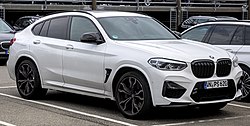 BMW X4 M Competition
 -
 BMW X4 M Competition
 -
 BMW X4 M Competition (facelift)
 -
 BMW X4 M Competition (facelift)
_IMG_4971.jpg)
_IMG_5333.jpg)
_FL_1X7A0310.jpg)
_FL_IMG_6824.jpg)
Models
[edit]Petrol engines
[edit]| Model | Years | Engine | Power | Torque | 0–100 km/h (0–62 mph) |
|---|---|---|---|---|---|
| xDrive20i | 2018– | B48B20 2.0 L I4 turbo | 135 kW (181 hp) at 5,000-6,500 rpm | 270 N⋅m (199 lb⋅ft) at 1,350-4,600 rpm | 8.3 s |
| xDrive30i | 185 kW (248 hp) at 5,200–6,500 rpm | 350 N⋅m (258 lb⋅ft) at 1,450–4,800 rpm | 6.3 s | ||
| M40i | 2018–
2019 |
B58B30M0 3.0 L I6 turbo | 265 kW (355 hp) at 5,500-6,500 rpm | 500 N⋅m (369 lb⋅ft) at 1,520–4,800 rpm | 4.8 s |
| 2020– | B58B30O1 3.0 L I6 turbo | 285 kW (382 hp) at 5,800-6,500 rpm[49] | 500 N⋅m (369 lb⋅ft) at 1,800-5,000 rpm[49] | 4.4 s[49] | |
| M | 2019– | S58 3.0 L I6 twin-turbo | 353 kW (473 hp) at 6,250 rpm | 600 N⋅m (443 lb⋅ft) at 2,600–5,200 rpm | 4.2 s |
| M Competition | 375 kW (503 hp) at 6,250 rpm | 4.0 s |
Diesel engines
[edit]| Model | Years | Engine | Power | Torque | 0–100 km/h (0–62 mph) |
|---|---|---|---|---|---|
| xDrive20d | 2018– | B47D20 2.0 L I4 turbo | 140 kW (188 hp) at 4,000 rpm | 400 N⋅m (295 lb⋅ft) at 1,750–2,500 rpm | 8.0 s |
| xDrive25d | B47D20 2.0 L I4 twin turbo | 170 kW (228 hp) at 4,400 rpm | 500 N⋅m (369 lb⋅ft) at 2,000 rpm | 6.8 s | |
| xDrive30d | B57D30 3.0 L I6 turbo | 195 kW (261 hp) at 4,000 rpm | 620 N⋅m (457 lb⋅ft) at 2,000–2,500 rpm | 5.8 s | |
| M40d | 240 kW (322 hp) at 4,400 rpm | 680 N⋅m (502 lb⋅ft) at 1,750–2,750 rpm | 4.9 s |
Alpina XD4
[edit]
The Alpina XD4 debuted at the 2018 Geneva Motor Show.[50] It is fitted with a modified version of the B57 diesel engine with four turbochargers,[51] and outputs 285 kW (382 hp) and 770 N⋅m (570 lb⋅ft).[52][53] The XD4 is the fastest accelerating diesel-powered production SUV, and can accelerate from 0–100 km/h (62 mph) in 4.6 s and has a top speed of 268 km/h (167 mph).[54] It is available in left-hand drive markets only.[55]
Safety
[edit]
Production and sales
[edit]| Year | Production | Sales | |
|---|---|---|---|
| Europe[57] | U.S.[58] | ||
| 2014 | 21,688[59] | 10,845 | 2,653 |
| 2015 | 55,050[60] | 23,380 | 6,429 |
| 2016 | 58,055[61] | 24,840 | 4,989 |
| 2017 | 52,167[6] | 21,881 | 5,198 |
| 2018 | 66,792[62] | 17,943 | 4,323 |
| 2019 | 61,569[63] | 26,434 | 8,758 |
| 2020 | 55,237[64] | 16,981 | 7,677 |
See also
[edit]References
[edit]- ^ Wilson, Kevin A. (29 May 2019). "The 2019 BMW X4 Proves That No Niche Is Too Small". Car and Driver. Retrieved 19 March 2021.
- ^ "BMW's 2015 X4 crossover is an SAV that thinks it's a coupe". Digital Trends. 16 April 2014. Retrieved 29 June 2018.
- ^ "BMW X4 review". Auto Express. Retrieved 19 March 2021.
- ^ "BMW X4 Review 2021". carwow.co.uk. Retrieved 19 March 2021.
- ^ "BMW Is Killing the X4". Motor1.com. Retrieved 31 January 2025.
- ^ a b c d "BMW Group Annual Report 2017" (PDF). BMW Group (Report). Archived (PDF) from the original on 17 May 2021. Retrieved 24 March 2021.
- ^ "BMW X4". Wroom.ru. Retrieved 24 July 2018.
- ^ ""BMW" تبدأ تجميع السيارة "318i" محلياً بالسوق المصري - جريدة البورصة". جريدة البورصة (in Arabic). 20 July 2016. Retrieved 16 May 2018.
- ^ "Patent Images". United States Patent and Trademark Office. Archived from the original on 2 September 2022. Retrieved 2 September 2022.
- ^ Buckley, Julian. "Supplying the BMW Group" (PDF). IHS Automotive. Retrieved 18 March 2025.
- ^ "BMW at the 114th New York International Auto Show 2014". www.press.bmwgroup.com.
- ^ "2015 BMW X4 is a budget X6". Autoblog. 16 April 2014.
- ^ "BMW at the 13th Beijing International Automotive Exhibition 2014". www.press.bmwgroup.com.
- ^ "BMW at the 22nd Auto Mobil International Leipzig 2014". www.press.bmwgroup.com.
- ^ "The new BMW X4". www.press.bmwgroup.com.
- ^ "Specifications of the new BMW X4, valid from July 2014". www.press.bmwgroup.com.
- ^ "The new BMW X4 M40i". www.press.bmwgroup.com.
- ^ "BMW unveils M2 and X4 M40i at Detroit auto show". Detroit Free Press. Retrieved 11 January 2016.
- ^ "Detroit Auto Show: BMW M2 and X4 M40i". NY Daily News. Retrieved 11 January 2016.
- ^ "2016 Detroit Auto Show: BMW X4 M40i". BMW BLOG. 11 January 2016. Retrieved 11 January 2016.
- ^ "Autotrader - page unavailable". www.autotrader.com. Archived from the original on 29 June 2018. Retrieved 29 June 2018.
- ^ "2018 BMW X4 Review @ Top Speed". Top Speed. Retrieved 29 June 2018.
- ^ "Used 2016 BMW X4 xDrive35i for Sale on Edmunds.com". Edmunds. Retrieved 29 June 2018.
- ^ "10 Things You Need To Know About The 2015 BMW X4". Retrieved 29 June 2018.
- ^ Knapman, Chris (9 December 2015). "BMW X4 review: the SUV that thinks it's a coupe". The Telegraph. ISSN 0307-1235. Retrieved 29 June 2018.
- ^ "Announcement: BMW X4 and new $900 Million investment at Spartanburg Plant". BMW BLOG. 12 January 2012. Retrieved 29 June 2018.
- ^ "BMW X4 officially unveiled at New York Motor Show". Auto Express. Retrieved 29 June 2018.
- ^ "BMW X4 xDrive20d review | Car review | RAC Drive". www.rac.co.uk. Retrieved 29 June 2018.
- ^ "BMW X4 Estate (2014– ) Features, Equipment and Accessories | Parkers". www.parkers.co.uk. Retrieved 29 June 2018.
- ^ "2017 BMW X4 M40i". Car and Driver. Retrieved 29 June 2018.
- ^ "BMW X4 Estate (2014– ) Running Costs | Parkers". www.parkers.co.uk. Retrieved 29 June 2018.
- ^ "Bangkok Post".
- ^ "Новую модель BMW начали выпускать на калининградском "Автоторе"". Wroom.ru. 7 November 2018. Retrieved 7 November 2018.
- ^ "Patent Images". United States Patent and Trademark Office. Archived from the original on 2 September 2022. Retrieved 2 September 2022.
- ^ "2018 BMW X4 price, specs and release date". Archived from the original on 29 June 2018. Retrieved 29 June 2018.
- ^ "BMW X4 Sports Activity Coupe ® - Model Overview - BMW USA". Archived from the original on 19 June 2019.
- ^ "2019 BMW X4 crossover's longer wheelbase offers more comfort". Automotive News. Retrieved 29 June 2018.
- ^ "2018 BMW X4: new swept-back SUV sets sights on Evoque | Autocar". www.autocar.co.uk. Retrieved 29 June 2018.
- ^ "What do you think of the way the new BMW X4 looks?". Top Gear. 14 February 2018. Retrieved 29 June 2018.
- ^ "New 2018 BMW X4: German coupe-SUV revealed with sleek looks". Auto Express. Retrieved 29 June 2018.
- ^ "Video: BMW X4 Generations Compared Side to Side". BMW BLOG. 16 March 2018. Retrieved 29 June 2018.
- ^ "2018 BMW X4 – price, specs and release date". What Car?. Archived from the original on 29 June 2018. Retrieved 29 June 2018.
- ^ "2019 BMW X4 Drops By Geneva With Two M Performance Variants, Diesel And Petrol | Carscoops". Carscoops. 6 March 2018. Retrieved 29 June 2018.
- ^ "BMW X4 M40d Review 2018: Glamour and grunt". CarBuyer. Retrieved 27 July 2018.
- ^ "The updated 2019 BMW X4 SUV still doesn't make a lot of sense". Digital Trends. 14 February 2018. Retrieved 29 June 2018.
- ^ Staff (17 January 2020). "The First BMW Mild Hybrids This Spring". BimmerFile. Retrieved 17 September 2024.
- ^ Perkins, Chris (12 February 2019). "The 2020 BMW X3 and X4 M are 503-HP Family Haulers". Road & Track. Retrieved 1 May 2023.
- ^ "2020 BMW X3 M, X4 M SUVs revealed with 473 bhp". Motor1.com. Retrieved 1 May 2023.
- ^ a b c "X4 M40i Sports Activity Coupe". www.bmwusa.com. Retrieved 22 December 2022.
- ^ Panait, Mircea (9 March 2018). "Alpina Brings XD3 And XD4 In Geneva, Both Are Quad-Turbocharged". autoevolution. Retrieved 15 July 2018.
- ^ "2018 Geneva: BMW ALPINA D5 S in Alpina Green looks stunning". BMW BLOG. 9 March 2018. Retrieved 15 July 2018.
- ^ "Technical Data: ALPINA Automobiles". www.alpina-automobiles.com. Retrieved 6 July 2019.
- ^ "Alpina revs up BMW SUVs with new XD3 and XD4". CAR Magazine. Retrieved 15 July 2018.
- ^ Rae, Alex (6 March 2018). "Alpina reveals world's fastest diesel SUV - The world's fastest diesel SUV". Drive. Archived from the original on 15 July 2018. Retrieved 15 July 2018.
- ^ "Alpina XD3 coming next year, XD4 not for Australia | CarAdvice". CarAdvice.com. Retrieved 15 July 2018.
- ^ "ANCAP results for BMW X4 all variants". ancap.com.au. 2018.
- ^ Demandt, Bart (3 August 2014). "BMW X4 European sales figures". carsalesbase.com. Archived from the original on 16 May 2020. Retrieved 24 March 2021.
- ^ Demandt, Bart (30 October 2015). "BMW X4 US car sales figures". carsalesbase.com. Archived from the original on 19 September 2020. Retrieved 24 March 2021.
- ^ "BMW Group Annual Report 2014" (PDF). BMW Group (Report). Archived (PDF) from the original on 12 October 2019. Retrieved 24 March 2021.
- ^ "BMW Group Annual Report 2015" (PDF). BMW Group (Report). Archived (PDF) from the original on 17 May 2021. Retrieved 24 March 2021.
- ^ "BMW Group Annual Report 2016" (PDF). BMW Group (Report). Archived (PDF) from the original on 17 May 2021. Retrieved 24 March 2021.
- ^ "BMW Group Annual Report 2018" (PDF). BMW Group (Report). Archived (PDF) from the original on 12 October 2019. Retrieved 24 March 2021.
- ^ BMW Group Annual Report 2019 (PDF) (Report). Retrieved 17 March 2021.
- ^ "BMW Group Report 2020" (PDF). BMW Group (Report). Archived (PDF) from the original on 19 March 2021. Retrieved 24 March 2021.
External links
[edit]
BMW X4
View on GrokipediaIntroduction
Concept and positioning
The BMW X4 is classified as a Sports Activity Coupe (SAC), a model type that merges the off-road capability and interior versatility of a traditional SUV with the sleek, aerodynamic profile of a coupe. This design philosophy allows the X4 to offer elevated seating, all-wheel drive, and cargo space akin to its SUV counterparts while prioritizing a sloping roofline for enhanced visual appeal and handling dynamics.[7][8] Positioned as a niche variant of the BMW X3, the X4 shares the same platform and mechanical underpinnings but trades some practicality—such as reduced rear headroom and cargo volume—for sportier aesthetics that appeal to buyers seeking a more dynamic appearance without fully sacrificing utility. It targets premium consumers who value style and agility in the compact luxury crossover market, distinguishing itself from boxier SUVs by emphasizing coupe-like proportions.[9][10] The X4 evolved from BMW's broader X-lineup strategy, which pioneered the SAC segment with the introduction of the larger X6 in 2008 to blend SUV functionality with coupe elegance. Launched in 2014, the X4 extended this concept to the compact class, filling a market gap for a smaller, more accessible version amid growing demand for stylish crossovers.[8][11] In the competitive landscape, the X4 contends primarily with the Mercedes-Benz GLC Coupe, Audi Q5 Sportback, and Porsche Macan, all of which offer similar blends of luxury, performance, and coupe-SUV styling in the mid-size segment. BMW applies its longstanding "Ultimate Driving Machine" ethos to the X4 by integrating responsive chassis tuning, precise steering, and powerful engine options into the crossover format, ensuring engaging on-road performance despite the vehicle's elevated ride height.[12][5]Production overview
The BMW X4 entered production with its first generation (F26) in March 2014 at BMW's Spartanburg plant in South Carolina, USA, and continued until March 2018. This initial run established the model as a compact sports activity coupe, sharing its underpinnings with the second-generation X3 (F25). The second generation (G02) followed seamlessly, with production starting in 2018 at the same facility, marking a key transition to an updated version of BMW's Cluster Architecture (CLAR) platform that improved rigidity, handling, and integration of advanced driver assistance systems. By the time of the G02's introduction, the F26 had built a foundation for the lineup's evolution toward more dynamic crossover designs.[13][14] In September 2024, BMW confirmed that 2025 would serve as the final model year for the internal combustion-engined X4, with production winding down by late 2025 to mid-2026 depending on market demand and variant. Gasoline-powered models ceased production by September 30, 2025, while remaining diesel options are set to end shortly thereafter. This phase-out aligns with BMW's electrification strategy, which prioritizes the Neue Klasse platform for future vehicles to achieve up to 50% electric sales globally by 2030 and reduce fleet emissions. The company plans no direct third-generation ICE successor, instead redirecting resources to battery-electric models amid regulatory pressures and shifting consumer preferences toward sustainable mobility.[4][15][16] As part of this transition, BMW is developing the all-electric iX4 (internal code NA7) as the X4's successor, built on the Neue Klasse architecture for enhanced efficiency and range. Prototypes of the iX4 were spotted in testing in November 2025, showcasing its sloped-roof coupe-SUV profile. Production is slated to begin in November 2026 at the new Debrecen plant in Hungary, with customer deliveries expected in early 2027; the model will feature a sloped-roof coupe-SUV profile to maintain the X4's sporty positioning while offering dual-motor all-wheel drive and up to 108 kWh battery options. By the 2021 facelift of the G02, the X4 had already achieved nearly 400,000 global sales since launch, underscoring its market impact before the model's conclusion.[17][18][19]First generation (F26; 2014–2018)
Development and launch
The BMW X4 (F26) was developed as a coupé-styled variant of the second-generation X3 (F25), sharing its platform and many components while introducing a sloped roofline to blend SUV utility with sports coupé aesthetics. The project built on the Sports Activity Coupé (SAC) concept pioneered by the X6, targeting a more compact premium segment. Engineering emphasized dynamic handling through xDrive all-wheel drive and tuned suspension, with prototypes tested for aerodynamics and performance to achieve a drag coefficient of 0.34. The F26 utilized BMW's EfficientDynamics technologies, including Auto Start-Stop and brake energy recuperation, to enhance fuel efficiency across its powertrains.[20] The production X4 was previewed by the BMW Concept X4, unveiled at the 2013 Shanghai Auto Show, and made its world debut at the 2014 New York International Auto Show. Production began in March 2014 at BMW's Spartanburg plant in South Carolina, USA, with initial sales starting in the US in June 2014 at a base price of $45,625 for the xDrive28i model. Availability expanded to Europe later in 2014, where diesel variants were offered. The model reached 200,000 units produced by January 2018, with production ending in March 2018 to make way for the second generation.[7][2]Design and features
The first-generation X4 (F26) measured 4,671 mm in length, 1,881 mm in width, and 1,624 mm in height, with a wheelbase of 2,810 mm—23 mm longer and 37 mm taller than the X3 while maintaining similar ground clearance of 204 mm. Its exterior featured a bold kidney grille, slim xenon or optional adaptive LED headlights, and L-shaped LED taillights, accented by character lines that emphasized its athletic stance. The sloping roofline reduced rear headroom compared to the X3 but contributed to a more dynamic profile, with 19-inch alloy wheels standard on higher trims. Aerodynamic elements included active air flaps and underbody panels, achieving a Cd of 0.34 for improved stability and efficiency.[21] The interior mirrored the X3's layout, seating five passengers with leather upholstery, a 40:20:40-split folding rear bench, and 450 liters of cargo space behind the seats—expanding to 1,350 liters when folded. Standard features included dual-zone automatic climate control, an 8.8-inch central display with iDrive infotainment (upgradable to navigation), Bluetooth connectivity, and a 12-speaker Harman Kardon audio system on premium models. M Sport packages added sport seats, a flat-bottom steering wheel, and adaptive suspension for enhanced handling. Safety equipment comprised front and side airbags, dynamic stability control, and optional rearview camera. The cabin offered ambient lighting and optional panoramic sunroof, prioritizing driver focus with a lower seating position 20 mm below the X3's.[20]Powertrains
The first-generation BMW X4 (F26) was equipped with BMW TwinPower Turbo engines paired with an eight-speed ZF automatic transmission and xDrive all-wheel drive as standard. In the US market, petrol options included the xDrive28i with a 2.0-liter turbocharged inline-four (N20) producing 240 horsepower and 260 lb-ft of torque, and the xDrive35i with a 3.0-liter turbocharged inline-six (N55) delivering 300 horsepower and 300 lb-ft. From 2016, the M40i variant featured an upgraded 3.0-liter inline-six with 355 horsepower and 365 lb-ft. Diesel engines, primarily for non-US markets, included the xDrive20d (2.0-liter B47, 190 hp, 295 lb-ft) and xDrive35d (3.0-liter N57 twin-turbo, 313 hp, 465 lb-ft). All met Euro 6 emissions standards, with fuel economy ranging from 23-30 mpg combined (US estimates for petrol models). Performance varied, with the xDrive35i achieving 0-60 mph in 5.2 seconds and a top speed of 155 mph (electronically limited).[20][22]| Model | Engine Type | Displacement | Power (hp) | Torque (lb-ft) | 0-60 mph (sec) | Top Speed (mph) | Fuel Economy (city/hwy mpg, US est.) |
|---|---|---|---|---|---|---|---|
| xDrive28i | 2.0L turbo I4 petrol | 2.0 L | 240 | 260 | 6.2 | 130 (limited) | 21/28 |
| xDrive35i | 3.0L turbo I6 petrol | 3.0 L | 300 | 300 | 5.2 | 155 | 17/24 |
| M40i (2016+) | 3.0L turbo I6 petrol | 3.0 L | 355 | 365 | 4.6 | 155 | 17/24 |
| xDrive28d (US limited) | 2.0L turbo I4 diesel | 2.0 L | 180 | 280 | 7.7 | 127 | 24/31 |
| xDrive20d (non-US) | 2.0L turbo I4 diesel | 2.0 L | 190 | 295 | 7.7 | 136 | N/A |
| xDrive35d (non-US) | 3.0L twin-turbo I6 diesel | 3.0 L | 313 | 465 | 5.2 | 152 | N/A |
Second generation (G02; 2018–2025)
Development and launch
The development of the second-generation BMW X4 (G02) began in the mid-2010s, building directly on the engineering advancements of the concurrent G01 X3 project. It adopted BMW's updated Cluster Architecture (CLAR) platform, a modular rear- and all-wheel-drive setup that enhanced structural integrity through optimized use of high-strength steel and aluminum components, resulting in improved rigidity over the first-generation F26's older architecture. This platform evolution allowed for a weight reduction of up to 50 kg via BMW's EfficientLightweight strategy, incorporating more aluminum in the chassis and body structure while maintaining balanced weight distribution for better handling. The design also continued the Sports Activity Coupe (SAC) concept introduced in the first generation, refining it for greater sportiness in a compact luxury crossover format.[25][26][27] Engineering efforts focused on elevating performance and efficiency, with prototypes undergoing rigorous testing from 2016 to 2017 to fine-tune coupe-specific aerodynamics, including active air flaps and optimized airflow management around the sloped roofline and rear spoiler. These tests emphasized drag reduction, achieving a segment-leading coefficient of 0.30 (Cd), which contributed to better fuel economy and stability at high speeds. The platform's adaptability also laid the groundwork for future integrations, such as mild-hybrid technology with a 48-volt system, which was incorporated later in the model cycle to boost efficiency without compromising the X4's dynamic character. Production of the G02 ended in 2025, with gasoline models discontinued earlier and diesel variants ceasing by late 2025; no direct combustion successor is planned.[28][25][29] The G02 X4 made its global reveal online in February 2018, followed by its world premiere at the Geneva International Motor Show in March 2018. Sales commenced in July 2018 across Europe and North America, with initial availability for the xDrive30i variant starting at $50,450 USD, positioning it as a premium alternative to the standard X3 in the midsize SUV segment. This accelerated timeline reflected BMW's strategy to refresh its lineup rapidly amid growing competition, particularly in key markets like China.[25][30][31]Design and features
The second-generation BMW X4 (G02) featured a more assertive exterior design characterized by a larger kidney grille that contributed to its bold front-end appearance, setting it apart from competitors in the compact luxury crossover segment. The vehicle's overall length measured 4,752 mm, providing a stretched silhouette that enhanced its coupe-like proportions, while the wheelbase of 2,864 mm supported improved stability and interior space.[6] Aerodynamic efficiency was a key focus, with an optimized body shape achieving a drag coefficient (Cd) of 0.30, the lowest in its class at launch, which helped reduce wind resistance and improve fuel efficiency without compromising the sporty stance.[32] Inside, the X4 offered a driver-centric cabin with a digital instrument cluster measuring 10.25 inches, delivering customizable displays for vehicle data and navigation cues as part of the optional Live Cockpit Professional system.[33] The central infotainment display, also 10.25 inches, ran BMW's iDrive 6.0 interface, providing intuitive control over multimedia and vehicle settings via a rotary controller. Ambient lighting with multiple color options created a premium atmosphere, while cargo capacity totaled 525 liters behind the rear seats, expanding to 1,430 liters with the 40/20/40-split folding seats lowered, accommodating everyday loads with practical versatility.[34] Standard equipment emphasized connectivity and comfort, including Apple CarPlay integration for seamless smartphone mirroring, wireless charging for compatible devices, and 19-inch alloy wheels that balanced style and ride quality.[35] An optional head-up display projected key information onto the windshield, aiding driver focus during spirited driving. Safety technologies were robust from the base model, with forward collision warning featuring automatic emergency braking and pedestrian detection as standard, alongside lane departure warning that alerted drivers to unintended drifts via vibration and visual cues. The suspension setup prioritized the X4's unique coupe-SUV balance, with M Sport tuning standard for sharper handling and reduced body roll. An optional Adaptive M suspension allowed electronic damping adjustments across Comfort, Sport, and Sport Plus modes, incorporating revised axle geometry to optimize weight distribution and enhance agility on winding roads.[36]2021 facelift
The 2021 facelift for the second-generation BMW X4 (G02) was revealed in June 2021, with its world premiere at the Chengdu Motor Show in late August 2021 and European debut at the IAA in Munich in September 2021; sales commenced in Europe during the summer of 2021 following production start in August at BMW's Spartanburg plant in the US.[9] This mid-cycle refresh built upon the 2018 base design by introducing subtle aesthetic enhancements and technological upgrades aimed at improving efficiency and connectivity for the 2022 model year.[37] Exterior revisions included slimmer adaptive LED headlights with standard Matrix high-beam function and optional BMW Laser Light technology extending visibility up to 650 meters, paired with a larger, more angular vertical kidney grille featuring an exclusive mesh design.[9][38] New front and rear bumpers adopted a sportier profile with redesigned lower aprons incorporating angular air vents and wider tailpipe trims, while updated flat LED taillights gained a 3D effect to accentuate the vehicle's width.[9][38] Inside, the cabin received a revised steering wheel with leather M Sport multi-function trim and an updated center console featuring new switchgear and vents inspired by the 4 Series.[38] The infotainment system was enhanced with BMW Operating System 7 on iDrive 7.0, including a standard 10.25-inch control display upgradeable to a 12.3-inch unit, combined with a 12.3-inch digital instrument cluster to form a seamless dual-screen setup.[9][37][39] Additional features emphasized connectivity and luxury, with standard wireless Android Auto integration for seamless smartphone mirroring of music, media, and messaging apps.[9] An optional Bowers & Wilkins Diamond Surround Sound system provided high-fidelity audio, while a digital rearview mirror became available to enhance visibility without obstructing passenger space.[37][40] Mechanically, all engines received a 48-volt mild-hybrid system with an integrated starter generator, delivering smoother engine starts, reduced emissions, and an efficiency boost of up to 11 horsepower during acceleration.[9][39]Powertrains
The second-generation BMW X4 (G02) offers a range of petrol and diesel powertrains, all paired exclusively with an eight-speed ZF automatic transmission and standard xDrive all-wheel drive. Petrol options include the xDrive30i with a 2.0-liter turbocharged inline-four engine producing 248 horsepower and 258 lb-ft of torque, with the 48-volt mild-hybrid system (post-2021 facelift) providing up to an additional 11 horsepower boost during acceleration. The M40i variant features a 3.0-liter turbocharged inline-six engine delivering 382 horsepower and 369 lb-ft, also enhanced by the mild-hybrid setup for improved efficiency and low-end torque. Higher-performance models include the X4 M with a twin-turbocharged 3.0-liter inline-six rated at 473 horsepower and 457 lb-ft, rising to 503 horsepower and 479 lb-ft in the Competition trim.[41][5] Diesel powertrains, available primarily in markets outside North America, consist of the xDrive20d with a 2.0-liter turbocharged inline-four generating 190 horsepower and 295 pound-feet of torque, and the xDrive30d with a 3.0-liter inline-six offering 286 horsepower and 479 pound-feet. Both diesel variants received the 48-volt mild-hybrid technology post-2021 facelift, providing an additional 11 horsepower during acceleration and enabling smoother engine stop-start functionality.[42][43][39][44]| Model | Engine Type | Displacement | Power (hp) | Torque (lb-ft) | 0-60 mph (sec) | Top Speed (mph) | Fuel Economy (city/hwy mpg, US est.) |
|---|---|---|---|---|---|---|---|
| xDrive30i | 2.0L turbo I4 petrol + mild-hybrid (post-2021) | 2.0 L | 248 (+11 boost) | 258 | 6.0 | 130 (US limited) | 23/28 |
| M40i | 3.0L turbo I6 petrol + mild-hybrid (post-2021) | 3.0 L | 382 (+11 boost) | 369 | 4.4 | 155 | 22/26 |
| X4 M | 3.0L twin-turbo I6 petrol | 3.0 L | 473 | 457 | 3.9 | 155 | 16/22 |
| X4 M Competition | 3.0L twin-turbo I6 petrol | 3.0 L | 503 | 479 | 3.7 | 177 (optional) | 16/22 |
| xDrive20d | 2.0L turbo I4 diesel + mild-hybrid (post-2021) | 2.0 L | 190 (+11 boost) | 295 | 7.7 | 136 | N/A (non-US) |
| xDrive30d | 3.0L turbo I6 diesel + mild-hybrid (post-2021) | 3.0 L | 286 (+11 boost) | 479 | 5.4 | 144 | N/A (non-US) |