Hubbry Logo
BMW GINABMW GINAMain
Open search
BMW GINA
Community hub
BMW GINA
logo
8 pages, 0 posts
0 subscribers
Be the first to start a discussion here.
BMW GINA
BMW GINA
from Wikipedia
BMW Gina
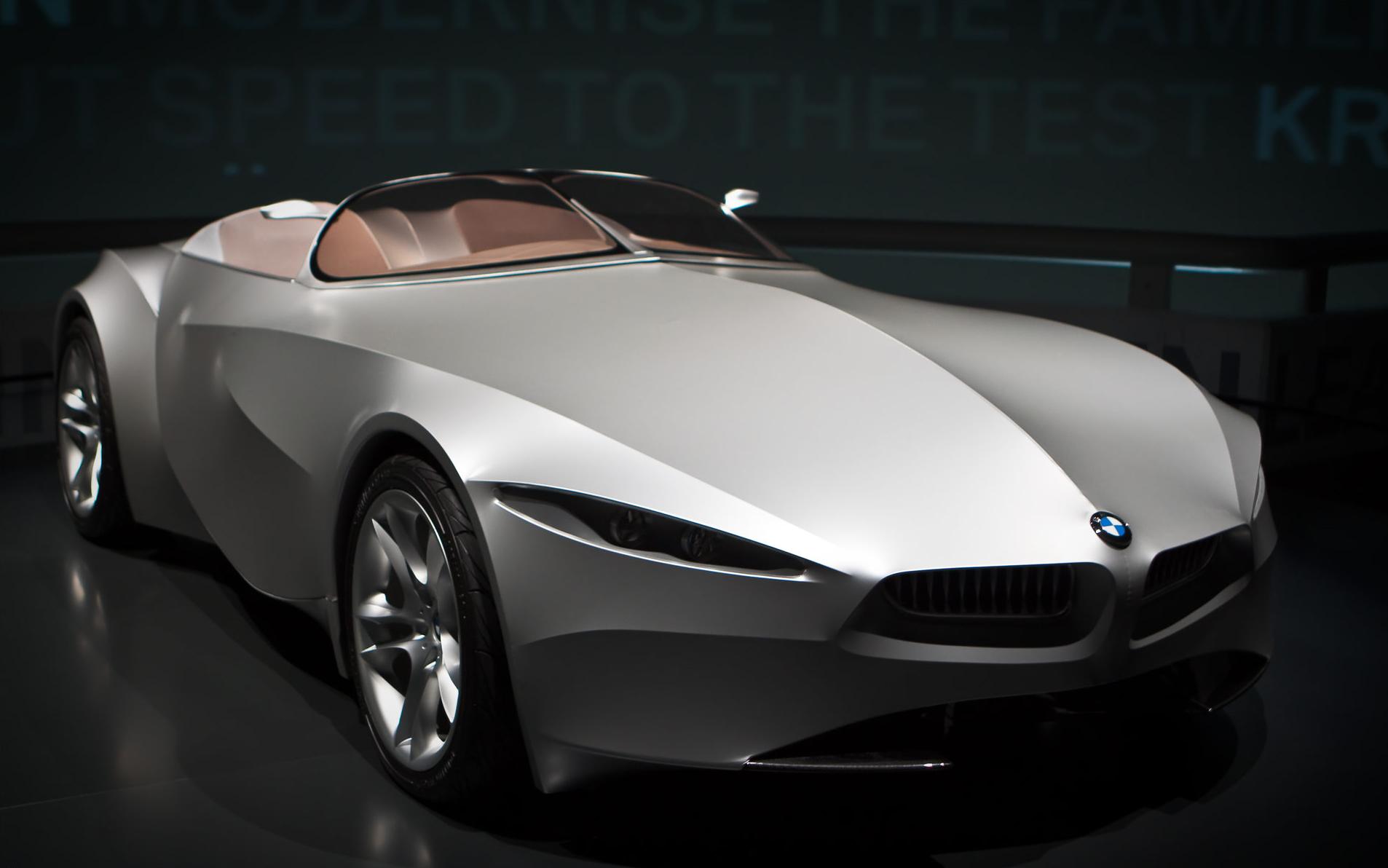
BMW Gina concept, BMW Museum, Munich, Germany
Overview
ManufacturerBMW
DesignerChris Bangle
Body and chassis
ClassConcept sports car
Rear view

The GINA Light Visionary Model is a fabric-skinned shape-shifting sports car concept built by BMW. GINA stands for "Geometry and functions In 'N' Adaptions".[1][2][3] It was designed by a team led by BMW's head of design, Chris Bangle, who says GINA allowed his team to "challenge existing principles and conventional processes."[1] Other designers include Anders Warming.[4]

Construction began in 2001, with the finished car being presented in 2008.[5]

Fabric body

[edit]

BMW claims the elastic, water resistant, translucent man-made fabric skin—polyurethane-coated Spandex—is resilient and durable. It resists high or low temperatures, does not swell or shrink, and the movement does not slacken or damage the fabric.[6] The body changes its shape according to exterior conditions and speeds, and it also allows the driver to change its shape at will. The fabric is stretched over a frame with moving parts;[1] shapes are formed beneath the skin by an aluminium wire structure, though at points where flexibility is needed (ducts, door openings, spoiler), flexible carbon struts are used.[1]

The shape of the frame is controlled by many electric and hydraulic actuators; for example, the headlights are revealed when small motors pull the fabric open from slits in an eyelid-like fashion, and access to the engine can be gained through a slit that opens down the middle of the bonnet.[1] As the fabric is translucent, the taillights simply shine through it.

GINA has just four "panels"—the bonnet, the two side panels and the trunk.[1] Its skin appears seamless, but it can "grow" out its rear spoiler for stability at high speed.[6] Its doors open in a butterfly style and are each covered by a fabric piece reaching all the way from the nose of the car to their trailing edge which, when closed, leaves a perfectly smooth surface.

Interior

[edit]

When the car is parked, the car's steering wheel and instruments sit in an "idle" position on the centre console to allow the driver easy entry.[6] The steering wheel and instruments assume their correct positions when the driver presses the start button and the headrest rises from the seat once the driver is seated, making it easier to get in and out of the car.

Jokes around the name

[edit]

The unusual name for the concept vehicle has amused some commentators. A few have compared the opening on the bonnet/hood to a vagina. Carscoops did so after receiving an image of the vehicle from Top Gear Magazine, commenting: "Mystery Solved: Why BMW Calls it 'Gina...".[7] Jalopnik also picked up on the name but refused to clarify, joking that they were a "family show".[8]

This along with the selection of a V8 engine has further motivated several YouTube commentators to suggest V8GINA as a custom license plate number for BMW Gina.

References

[edit]
[edit]
Revisions and contributorsEdit on WikipediaRead on Wikipedia
from Grokipedia
The GINA Light Visionary Model is a visionary concept car developed by , featuring a seamless, flexible outer skin made of durable stretched over a movable metal substructure, enabling adaptive shape-shifting for enhanced functionality and aesthetics. Unveiled on June 6, 2008, as a non-production research object, GINA—standing for Geometry and Functions In "N" Adaptations—challenges traditional by prioritizing creative freedom and future-oriented mobility solutions over conventional construction. Under the direction of BMW design chief , the GINA was built on the platform of the roadster, incorporating an aluminum , carbon-fiber struts, and a sourced from the E39 M5 for performance. Key innovative features include adaptive elements such as a rear spoiler that deploys for aerodynamic efficiency, movable headlights integrated into the iconic kidney grille, and translucent fabric sections that illuminate for rear lighting functions like brake lights and indicators. The exterior fabric, a water-repellent, expansion-resistant reinforced with a stabilizing , allows components like wheel arches and the bonnet to adjust dynamically via button controls, while the interior offers similar flexibility with adjustable headrests and seating. This two-seater roadster exemplifies BMW's exploration of lightweight, multifunctional materials and structures, influencing subsequent design philosophies by demonstrating how vehicles could evolve beyond rigid forms to integrate form and function more fluidly. As a symbol of selective, forward-thinking concepts, the GINA has been displayed in museums and galleries, underscoring its role in inspiring adaptive technologies for future automotive innovation.

Development and Background

Project Origins

The BMW GINA (Geometry and Functions In "N" Adaptations) project emerged as a key initiative within BMW Group Design's efforts to redefine future mobility concepts, emphasizing adaptability in vehicle design to meet evolving customer expectations for personalization and functionality. The acronym GINA encapsulates the philosophy of infinite geometric and functional adaptations, allowing designers to transcend conventional constraints and explore innovative forms that enhance both aesthetic appeal and practical utility. This approach was driven by a desire to address the growing demand for vehicles that offer emotional engagement and versatility, positioning BMW at the forefront of automotive innovation during the mid-2000s. Development of the GINA Light Visionary Model began in as part of BMW's broader research into flexible architectures, with the project evolving over the subsequent years to challenge the rigidity of traditional body panels. The primary motivation was to investigate how pliable materials could enable dynamic shape changes, improving through optimized airflow and delivering novel aesthetic expressions that adapt to user needs or environmental conditions. This exploration built on earlier BMW concepts, such as the X-Coupé, but focused specifically on fabric-based skins to create a more organic, responsive vehicle form. Conceptualization intensified around 2007, culminating in the prototype's completion by mid-2008, just prior to its public unveiling. The GINA initiative reflected 's strategic push to integrate and mechanisms, fostering a shift toward sustainable and customizable mobility solutions that prioritize driver interaction over static design. By embodying these principles, the project not only tested engineering boundaries but also influenced subsequent BMW production models in terms of form and adaptability. The prototype debuted on June 6, 2008, at BMW's Visionary Model exhibition in , , marking a pivotal moment in the company's design history. This event showcased the GINA as a two-seater roadster that exemplified the potential of shape-adaptive technologies, setting the stage for ongoing innovations in .

Design Team and Philosophy

The BMW GINA project was led by Christopher E. Bangle, who served as Director of BMW Group Design from 1992 to 2010 and championed innovative approaches to automotive aesthetics. Bangle publicly introduced the GINA philosophy in 2005, which culminated in the Light Visionary Model three years later. Bangle emphasized a reinterpretation of the "form follows function" principle, where adaptability enables dynamic forms that respond to user needs and environmental conditions, moving beyond static designs to create more intuitive vehicles. Under his leadership, the project embodied the GINA acronym—Geometry and Functions In "N" Adaptations—as a framework for exploring versatile, individualized mobility solutions. Central to the GINA was a deliberate break from traditional body construction, which Bangle and his team viewed as limiting creativity and functionality in modern vehicles. Instead, the concept pursued dynamic, organic shapes that evoked fluidity and movement, drawing inspiration from forms to achieve sculptural, convex-concave surfaces capable of seamless transitions. This approach aligned with broader biomimetic principles, where the vehicle's "skin" mimics the adaptability of living organisms that morph in response to their surroundings, fostering emotional connections between driver and machine. The development involved close collaboration across BMW's design, engineering, and material science teams, including contributions from Group DesignworksUSA to integrate advanced production techniques and novel materials. This interdisciplinary effort aimed to a "living" exterior that could evolve, challenging conventional while prioritizing malleable surfaces for enhanced safety through better energy absorption, reduced weight via fewer rigid components, and aesthetic fluidity that allows forms to adapt without compromising structural integrity. articulated this vision as an opportunity to "challenge existing principles and conventional processes," ultimately redefining the car body as a responsive, efficient entity.

Technical Innovations

Fabric Skin and Structure

The BMW GINA Light Visionary Model features an innovative exterior skin made from a polyurethane-coated fabric, which provides a flexible, seamless covering stretched taut over the underlying structure to achieve a smooth, wrinkle-free surface. This material, often referred to as Lycra in some descriptions, combines elasticity with durability, allowing it to conform to the car's contours while maintaining structural integrity under varying conditions. The fabric's hybrid construction includes a stabilizing netting for reinforcement and a water-repellent outer layer, ensuring it remains functional as a protective barrier. Key properties of the fabric include high resilience to temperature extremes, resistance to expansion and contraction, and maximum dimensional stability, which prevent sagging or distortion over time. It is also light-permeable yet non-transparent, enabling integrated lighting elements like turn signals and taillights to diffuse through the skin for a subtle glow effect. These attributes make the material suitable for automotive use, where it must withstand environmental stresses while supporting aesthetic fluidity. The fabric's water resistance further enhances its practicality, repelling moisture without compromising the seamless design. Beneath the skin lies a aluminum that serves as the primary structural backbone, providing essential rigidity and crash safety while accommodating the fabric's flexibility. This moveable substructure incorporates carbon fiber struts to enable precise shaping, particularly for curved elements with tight radii, without adding excessive weight. The frame's design allows the fabric to be tensioned evenly across its surface through strategically placed attachment points. The manufacturing process emphasizes precision craftsmanship, with the fabric panels cut to exact patterns by BMW's seat design specialists to ensure uniform tension and fit. Once prepared, the material is affixed directly to the frame at defined points, creating the characteristic taut appearance without reliance on traditional forming or . This approach not only facilitates the GINA's adaptive form but also allows for straightforward panel replacement, simplifying maintenance compared to conventional bodywork.

Shape-Adaptive Mechanisms

The shape-adaptive mechanisms of the concept car rely on a moveable metal substructure beneath the flexible , enabling the vehicle's exterior to morph in response to driving conditions or driver inputs. This substructure, composed of metal wires and carbon fiber struts, is actuated by electro-hydraulic and electric systems that precisely adjust tension and position, allowing the fabric to stretch, fold, or undulate without traditional hinges or panels. These mechanisms prioritize seamless integration, where shape changes enhance , functionality, and simultaneously. Headlight deployment exemplifies this adaptive engineering: the lights remain concealed under the taut fabric when not in use, but activation triggers the metal substructure to shift, stretching the skin open in an eyelid-like manner to reveal dual headlights positioned adjacent to the iconic kidney grille. This motion eliminates visible seams or pop-up housings, maintaining the car's fluid silhouette while ensuring illumination deploys efficiently. Similarly, air intake adaptation occurs at the front grille, where the substructure adjusts to open or constrict the fabric-covered apertures, optimizing for cooling based on demands or speed—such as widening for increased ventilation during high-performance driving. The uses electro-hydraulic actuators to enable real-time responsiveness, such as elevating the rear spoiler for at higher velocities or reshaping rocker panels to refine airflow. The fabric's inherent elasticity supports these deformations by returning to a stable form once actuators relax, underscoring the between passive material properties and active mechanical control.

Chassis and Powertrain

The chassis of the BMW GINA Light Visionary Model features a lightweight aluminum space frame reinforced with carbon fiber elements, forming a structural backbone that supports the vehicle's adaptive fabric exterior while ensuring torsional rigidity. This construction, derived from the BMW Z8 platform, contributes to a significantly lower weight than conventional roadsters of similar size due to the absence of traditional sheet metal panels. The space frame's design positions key components to achieve a low center of gravity, prioritizing agile handling and dynamic stability on the road. At the heart of the powertrain is the BMW S62 , a 4.9-liter naturally aspirated unit producing 394 horsepower at 6,600 rpm and 369 lb-ft of torque at 3,800 rpm. Mounted longitudinally behind the front axle, the engine drives the rear wheels via a rear-wheel-drive layout, enhancing for balanced . It is mated to a six-speed manual transmission, allowing precise control and engaging driver interaction typical of BMW's heritage. The powertrain and chassis suggest performance comparable to the donor Z8 roadster, with the low center of gravity and reduced mass enabling exceptional handling, responsive cornering, and minimal body roll, underscoring BMW's focus on driver-centric dynamics in the GINA concept.

Interior and User Experience

Cabin Layout

The BMW GINA features a two-seat roadster configuration with side-by-side seating for the driver and front passenger, designed as an open-top vehicle without a fixed roof to emphasize its lightweight and adaptive nature. The low-slung cockpit provides an intimate driving position, fostering a close connection between the occupants and the road, while the seamless integration of interior and exterior elements creates a fluid boundary that enhances the overall minimalist aesthetic. Interior materials prioritize a minimalist approach, utilizing the same flexible, polyurethane-coated spandex fabric as the exterior skin for the seats, door trim, and armrests, ensuring a consistent tactile and visual continuity. This translucent material allows for subtle illumination effects, matching the exterior's light-transmissive properties and contributing to the cabin's ethereal ambiance without the use of traditional rigid panels. The consists of a curved, fabric-covered panel that houses vertically arranged analog gauges on the center console, including the rev counter, , and , positioned for optimal driver visibility in the compact space. Access to the low-slung cabin is facilitated by fabric-covered that swing outwards and upwards in a butterfly-style motion, folding neatly to provide wide entry while maintaining the vehicle's smooth silhouette when closed.

Functional Adaptations

The functional adaptations in the GINA's interior emphasize dynamic responsiveness to enhance driver comfort, , and interaction, aligning with the vehicle's overall of form following function. The employs electric actuators to enable precise ergonomic customization, adjusting its position based on individual driver preferences stored in the vehicle's system. Upon 's approach, the wheel moves towards to ease entry, then returns to the optimal driving position, reducing physical strain during operation. Seat bolstering and support are achieved through integrated shape-adaptive mechanisms, where the automatically adjust to an optimized shape and position upon the driver sitting, with the headrest rising seamlessly from the backrest to ensure proper neck support and . This fabric, extending continuously from the exterior into the cabin, maintains the vehicle's unified aesthetic while allowing fluid reconfiguration without rigid panels. The engine is started via a start/stop button, and the shift lever protrudes from textile bellows on the center console for tactile feedback. The round instruments—including the rev counter, , and —reposition themselves toward the driver when activated, ensuring all elements adapt fluidly to user inputs without disrupting the minimalist .

Reception and Legacy

Public and Critical Response

The BMW GINA Light Visionary Model received widespread acclaim upon its unveiling in June 2008 in , where it was lauded for pioneering sustainable and lightweight design principles that challenged conventional automotive engineering. Critics and industry observers praised its use of a flexible fabric skin as a bold step toward adaptive, eco-friendly vehicles, emphasizing how the concept's minimalistic structure reduced material waste and enabled dynamic form changes for improved . Media outlets highlighted GINA's visionary potential, with Top Gear describing it as a "shape-shifting " that exemplified innovative applications in , influencing BMW's flame-surfaced aesthetic in production models. Similarly, coverage in Wired and positioned GINA as a forward-thinking prototype that foreshadowed advancements in efficiency through lightweight, adaptable materials. Despite the enthusiasm, the concept faced criticism regarding its real-world viability, particularly the fabric's durability against tearing, punctures from , and environmental wear, which raised doubts about long-term performance in everyday conditions. Experts also expressed concerns over practicality, including vulnerability to —such as key scratches—and insufficient for crash safety, as noted in analyses questioning the skin's ability to meet regulatory standards without extensive reinforcement. High production costs were another point of contention, with the complex adaptive mechanisms and specialized materials deemed prohibitively expensive for mass manufacturing, ultimately confining GINA to prototype status. GINA's legacy endures in BMW's subsequent concepts, inspiring flexible form explorations in the 2016 Vision Next 100, which echoed its shape-adaptive philosophy for autonomous and electric mobility.

Cultural References and Name Jokes

The BMW GINA concept has left a mark on through its appearances in and exhibitions, often highlighting its unconventional fabric skin and shape-shifting capabilities as symbols of futuristic . In 2023, automotive content creator Supercar Blondie produced a detailed walkaround video of the GINA, exploring its innovative structure and reigniting interest among enthusiasts for the 2008 prototype. This coverage contributed to the concept's visibility, with similar videos garnering significant online engagement and underscoring its role in discussions about adaptive vehicle aesthetics. The GINA also featured prominently in the 2014 "Dream Cars: Innovative Design, Visionary Ideas" exhibition at the in , where it was showcased alongside other visionary automobiles to illustrate breakthroughs in materials and form. Its inclusion emphasized the concept's cultural resonance as an emblem of experimental engineering, influencing broader conversations on how cars can evoke organic, living forms. The name GINA has inspired lighthearted jokes among commentators, often playfully linking the acronym to the car's fluid, organic design elements, such as the kidney grille or bonnet opening, which some have humorously compared to female anatomy. As a product of Chris Bangle's tenure as BMW design chief, the GINA embodies the era's provocative and divisive style, frequently referenced in automotive humor that critiques or celebrates the brand's departure from traditional norms. Articles on Bangle's influence, such as those poking fun at his emphasis on dramatic rear-end designs, position the GINA within this legacy of bold, meme-worthy innovations that challenged industry conventions.

References

Add your contribution
Related Hubs
User Avatar
No comments yet.