


Community hub
Recent from talks
Contribute something
Nothing was collected or created yet.
BYD Tang
View on Wikipedia
| BYD Tang | |
|---|---|
 BYD Tang DM-p | |
| Overview | |
| Manufacturer | BYD Auto |
| Production | 2015–present |
| Body and chassis | |
| Class | Mid-size crossover SUV (E-segment)[1] |
| Body style | 5-door SUV |
| Chronology | |
| Predecessor | BYD S6/S7 |
The BYD Tang (Chinese: 比亚迪唐) is a series of mid-size crossover SUV manufactured by BYD Auto, available as a battery electric, a plug-in hybrid or formerly a conventional ICE vehicle. The vehicle is the second model of BYD's "Dynasty" series passenger vehicles after the Qin, and gets its name from the Tang dynasty, the most prosperous of all the great Chinese dynasties.[2]
The first-generation BYD Tang was introduced at the 2014 Beijing Auto Show and was available as a plug-in hybrid only. Retail deliveries began in China in June 2015.[3]
The second-generation BYD Tang debuted at Auto China in April 2018.[4] The battery electric variant went on sale in Europe (in Norway) in 2021.[5][6][7]
First generation (2015)
[edit]| First generation | |
|---|---|
 | |
| Overview | |
| Production | 2015–2018 |
| Body and chassis | |
| Layout | Front-engine, front-wheel-drive |
| Related | BYD S6 |
| Powertrain | |
| Engine | 2.0 L BYD487ZQA I4 turbo petrol[2] |
| Electric motor | 2×110 kW[2] |
| Battery | 18.4 kWh LFP[2] |
| Electric range | 80 km (50 mi)[2] |
| Dimensions | |
| Wheelbase | 2,720 mm (107.1 in) |
| Length | 4,815 mm (189.6 in) |
| Width | 1,855 mm (73.0 in) |
| Height | 1,720 mm (67.7 in) |
The first-generation BYD Tang is a plug-in hybrid SUV based on the BYD S6. Its 18.4 kWh lithium iron phosphate battery pack delivers an all-electric range of 80 km (50 mi). The Tang was introduced at the 2014 Beijing Auto Show[2] and was produced to at least 2018.
The first-generation Tang was the top selling plug-in electric passenger car in China in 2016,[8] and the world's top selling plug-in hybrid in 2016. Also, the Tang ranked as the world's third best-selling plug-in car that year.[9]
Specifications
[edit]The Tang is powered by a 2.0-litre internal combustion engine which delivers 151 kW (202 hp) and 320 N⋅m (236 lbf⋅ft) of torque; and two electric motors, front and rear, each rated at 110 kW (148 hp) and 250 N⋅m (184 lbf⋅ft) in the entry-level Tang, and 300 N⋅m (221 lbf⋅ft) in the performance model. Total system output is 371 kW (498 hp) and 820 N⋅m (605 lbf⋅ft) for the entry-level model, and 411 kW (551 hp) and 870 N⋅m (642 lbf⋅ft) for the concept performance model. The latter accelerates from 0 to 100 km/h (62 mph) in 4.5 seconds and the entry level in 4.9 seconds. The Tang is fitted with BYD's second generation Dual Mode (DM) system which allows drivers to switch between all-electric mode (EV mode) and hybrid electric mode (HEV mode).[2] This vehicle is an electric version of the BYD S6.
-
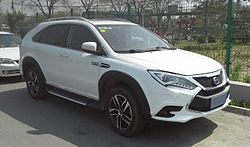 Front view
 -
 Rear view


Second generation (2018)
[edit]| Second generation | |
|---|---|
 2018 BYD Tang DM | |
| Overview | |
| Also called |
|
| Production | 2018–present |
| Designer | Under the lead of Wolfgang Egger |
| Body and chassis | |
| Body style | 5-door SUV |
| Layout |
|
| Platform | e-Platform 3.0 (Electric) |
| Related | |
| Powertrain | |
| Engine | |
| Electric motor | 110 kW front AC permanent magnet synchronous 180 kW AC permanent magnet synchronous |
| Transmission | 6-speed DCT E-CVT |
| Battery | |
| Electric range | |
| Dimensions | |
| Wheelbase | 2,820 mm (111.0 in) |
| Length | 4,870 mm (191.7 in) |
| Width | 1,950 mm (76.8 in) |
| Height | 1,725 mm (67.9 in) |
Featuring BYD's new family design language and previewed by the BYD Dynasty concept car in 2017, the second generation BYD Tang with completely redesigned exterior and interior debuted at Auto China in April 2018. The new model line will include purely gasoline powered versions and pure electric versions (Tang EV600 and EV600D) besides plug-in hybrid ones (DM),[16] with powertrains similar to the first generation.[4] The Tang is also BYD's first vehicle to be exported to Europe, starting with Norway in 2021.[6][17]
-
 Rear view
 -
 BYD Tang (ICE)
 -
 Rear view (ICE)
 -
 BYD Tang EV


2021 facelift and DM-i
[edit]The Tang DM received a facelift for the 2021 model year alongside the introduction of the DM-i hybrid powertrain. Both models both receive the updated front and rear bumper designs.
The BYD DM-i powertrain is constructed with a 1.5-litre turbocharged engine powered plug-in hybrid system. The Tang DM-i is available as two models with a pure electric range of 52 km (32 mi) and 112 km (70 mi) respectively, with a total combined cruising range of 1,050 km (652 mi), equipped with a lithium iron phosphate blade battery. The fuel consumption is 5.3 L/100 km (44 mpg‑US; 19 km/L) and 5.5 L/100 km (43 mpg‑US; 18 km/L) for the two trim models respectively, and its 0–100 km/h (62 mph) acceleration time is 8.5 seconds.[18] The 1.5-litre turbo engine is specifically built to accommodate the company's DM-i hybrid technology. In order to achieve high thermal efficiency, BYD designed the engine with compression ratio of 15.5, an increased bore to stroke ratio, Atkinson cycle for improved combustion efficiency, an exhaust gas recirculation (EGR) system, and a series of friction-reducing measures.[19]
-
 BYD Tang II DM-i
 -
 BYD Tang II DM-i rear
 -
 BYD Tang II DM-i (left) and DM (right)


_and_DM_(right)_20230628.jpg)
2022 facelift and DM-p
[edit]The second generation BYD Tang EV (the all-electric variant) received a facelift for the 2022 model year eliminating the grille, in line with the rest of the BYD Dynasty EV line-up. The battery capacity was increased to 108.8 kWh.[20]
Among the DM (plug-in hybrid) variants, The DM-p was also introduced as a more performance oriented DM variant featuring the 1.5-litre turbo engine hybrid system. The 0–100 km/h (62 mph) acceleration time for the DM-p variant is under 4.3 seconds while maintaining the 215 km (134 mi) pure electric range.[21]
The Tang DM-p received another update in 2023 featuring restyled tail lamps. The updated DM-p model debuted during the Chengdu Auto Show in August 2023.[22]
-
 BYD Tang EV (2022 facelift)
 -
 Rear view


-
 BYD Tang DM-p (2022 facelift)
 -
 Rear view


Markets
[edit]Philippines
[edit]The Tang DM-i was launched in the Philippines on 17 September 2025, as the first plug-in hybrid BYD model equipped with a turbocharged engine in the country. It is available in the sole variant powered by the 1.5-litre DM-i turbocharged petrol engine and front-wheel drive.[23]
Vietnam
[edit]The Tang L EV is marketed as the BYD Sealion 8 in Vietnam. It was launched on 18 April 2025 alongside the Sealion 6. It is available in the sole Performance variant using the 108.8 kWh Blade Battery pack.[24]
Tang L (2025)
[edit]| BYD Tang L | |
|---|---|
 | |
| Overview | |
| Also called |
|
| Production | 2025–present |
| Assembly | China: Shenzhen, Guangdong; Changzhou, Jiangsu[27] |
| Designer | Under the lead of Wolfgang Egger |
| Body and chassis | |
| Class | Mid-size crossover SUV (E-segment) |
| Layout | |
| Platform |
|
| Related | |
| Powertrain | |
| Engine |
|
| Electric motor | Permanent magnet synchronous |
| Transmission | E-CVT (DM-i/DM-p) |
| Hybrid drivetrain | Plug-in hybrid (DM-i/DM-p) |
| Battery | |
| Dimensions | |
| Wheelbase | 2,950 mm (116.1 in) |
| Length | 5,040 mm (198.4 in) |
| Width | 1,996 mm (78.6 in) |
| Height | 1,760 mm (69.3 in) |
| Curb weight | 2,240–2,967 kg (4,938–6,541 lb) |
The BYD Tang L was officially unveiled in China on 16 January 2025,[28] and was later launched on 9 April 2025.[29] It is positioned higher than the existing BYD Tang and as BYD's largest SUV. Previous Tang models continue to be offered at a lower price.
Design
[edit]The exterior of the Tang L adopts the series’ Loong Face (formerly Dragon Face) design language inspired by Chinese heritage. There are dragon whisker-like air intakes and split headlights that are connected to the chrome-plated trim on the front fascia, while the taillights on the rear fascia are inspired by traditional bamboo weaving techniques.[30][31]
The interior of the Tang L has a similar design to the Han L and has a dual-colour theme. There is a 15.6-inch rotatable touchscreen infotainment system, an augmented reality heads-up display, four-spoke flat-bottom design steering wheel, full digital driver's instrument panel, the shift-by-wire gear lever used for the automatic transmission mounted on the steering wheel column and the physical buttons retained in the armrest area. Other interior features are ambient lighting, bamboo wood accents, dual wireless charging pads, Dynaudio sound system, an integrated fragrance dispenser, an onboard refrigerator and a panoramic sunroof.[31][32][33]
The Tang L has a boot space of 675 L (23.8 cu ft) and expands to 1,960 L (69 cu ft) when the second and third row seats are folded down. The battery electric model also has a frunk storage area. The vehicle has a 2+3+2 seven-seat layout.[31][33]
-
 Rear view

Safety
[edit]The Tang L features God’s Eye C (DiPilot 300) intelligent driving assistance system incorporates the DiLink 150 intelligent cockpit system and a roof-mounted Lidar on higher trim levels.[29]
Powertrain
[edit]The Tang L offers two powertrain options shared with the Han L - battery electric and plug-in hybrid. Battery electric variants sit on BYD's super e platform - a 945 V architecture with redesigned blade batteries to allow faster ion transfer in the electrolyte and less resistance through the diaphragm, resulting in a theoretical maximum of 10C charging rate.
| Model | Battery | Power | Range | 0-100 km/h (0-62 mph) | ||||
|---|---|---|---|---|---|---|---|---|
| Type | Weight | Engine | Front | Rear | Total | |||
| EV RWD | 100.5 kWh [34]LFP | 640 kg (1,411 lb) | — | — | 500 kW (671 hp; 680 PS) | 670 km (420 mi)[35] | 6.9 s | |
| EV AWD | 230 kW (308 hp; 313 PS) | 580 kW (778 hp; 789 PS) | 810 kW (1,086 hp; 1,101 PS) | 600 km (370 mi) | 3.9 s | |||
| DM-i | 29.5 kWh LFP | 266 kg (586 lb) | 1.5 L turbo
115 kW (154 hp; 156 PS) |
— | 200 kW (268 hp; 272 PS) | 170 km (106 mi) | 7.9 s | |
| DM-p | 200 kW (268 hp; 272 PS) | 400 kW (536 hp; 544 PS) | 145 km (90 mi) | 4.3 s
(4.5 s*) | ||||
*DM-p models equipped with a drone module have a slightly slower acceleration time.
Safety
[edit]
Sales
[edit]| Year | China | |||
|---|---|---|---|---|
| Tang DM[38] | Tang EV[39] | Tang (ICE)[40] | Total | |
| 2015 | 18,375 | — | — | 18,375 |
| 2016 | 31,405 | 31,405 | ||
| 2017 | 14,547 | 14,547 | ||
| 2018 | 34,867 | 27,211 | 62,078 | |
| 2019 | 40,945 | 35,796 | 76,741 | |
| 2020 | 21,029 | 563 | 13,991 | 35,583 |
| 2021 | 48,152 | 5,062 | 990 | 54,204 |
| 2022 | 116,312 | 23,824 | 9,625 | 149,761 |
| 2023[41] | 128,812 | 12,049 | — | 140,861 |
See also
[edit]References
[edit]- ^ "BYD reveals 6 EVs at IAA 2023 | News". DriveElectric. 2023-09-06. Retrieved 2023-12-23.
- ^ a b c d e f g h Mike Millikin (2015-01-23). "BYD Tang SUV PHEV available for pre-orders starting at $48.3K before incentives; twice that for performance model". Green Car Congress. Retrieved 2015-01-31.
- ^ "Chinese EV Sales Ranking in the First Half of 2015". China Auto Web. 2015-07-17. Retrieved 2015-08-02.
- ^ a b "【图】2018北京车展:新唐DM补贴后预售25-30万_汽车之家" [[Photo] 2018 Beijing Auto Show: Xintang DM pre-sale price after subsidy is 250,000-300,000 yuan]. Autohome (in Chinese). 2018-04-25. Retrieved 2018-04-28.
- ^ "Denne mangler egentlig bare én ting: Et kjent navn" [This one is really only missing one thing: A familiar name.]. Motor.no (in Norwegian). 11 September 2021.
- ^ a b Kane, Mark (2021-03-01). "Blade Battery-Powered BYD Tang Finally Coming to Norway in Late Summer". InsideEVs.
- ^ Kane, Mark (2020-05-04). "BYD Enters European EV Car Market Starting with Tang SUV in Norway". InsideEVs.
- ^ Staff (2017-01-19). "Best-selling China-made EVs in 2016". China Auto Web. Retrieved 2017-01-25. Three BYD Auto models topped the Chinese ranking of best-selling new energy passenger cars in 2016. The BYD Tang SUV was the top selling plug-in electric car in China in 2016 with 31,405 units sold, followed by the BYD Qin with 21,868 units sold, and ranking third overall in 2016 was the BYD e6 with 20,605 units.
- ^ Cobb, Jeff (2017-01-31). "Tesla Model S Is World's Best-Selling Plug-in Car For Second Year In A Row". HybridCars.com. Retrieved 2017-01-31. See also detailed 2016 sales and cumulative global sales in the two graphs.
- ^ Balhessa, Mauro (2022-02-08). "BYD inicia as vendas do Tan EV, SUV elétrico de 7 lugares; confira o valor". Motor Show (in Brazilian Portuguese). Retrieved 2022-02-22.
- ^ "腾势N8、唐DM-p、护卫舰07相比,该怎么选?主要看钱包". db.m.auto.sohu.com. Retrieved 2023-12-20.
- ^ a b c "比亚迪e购商城".
- ^ a b c "比亚迪汽车官方网站 比亚迪汽车 ─ 新能源汽车世界冠军". mall.bydauto.com.cn.
- ^ a b "比亚迪汽车官方网站 比亚迪汽车 ─ 新能源汽车世界冠军". mall.bydauto.com.cn.
- ^ https://viewer.ipaper.io/rsa-no/byd/byd-tang-long-range-teknisk-info-og-utstyr/?page=4
- ^ Kane, Mark (2018-11-25). "BYD Introduces Tang EV600 With 82.8 kWh Battery". InsideEVs.
- ^ Page, Felix (2020-05-04). "BYD announces expansion into Europe". Autocar. Retrieved 2020-05-06.
- ^ "BYD TANG DM-i Is About to Launch with a ultra long range of 1050km". Chinapev. 2021-01-08. Retrieved 2020-06-05.
- ^ "byd-hits-efficiency-target-with-hybrid-specific-engin". 18 November 2020. Archived from the original on 2020-12-01.
- ^ https://www.electrive.com/2022/04/11/byd-tang-gets-a-significantly-larger-battery/
- ^ "售28.98万起 比亚迪唐DM-p正式上市" [BYD Tang DM-p officially launched with a starting price of RMB 289,800]. Autohome (in Chinese). 18 November 2020.
- ^ "2023成都车展探馆:比亚迪唐DM-p将预售" [2023 Chengdu Auto Show: BYD Tang DM-p will be pre-sold]. Autohome (in Chinese). 23 August 2023.
- ^ "BYD Cars PH Launches 7-Seater Tang DM-i For P 2.098M (w/ Specs)". CarGuide.PH | Philippine Car News, Car Reviews, Car Prices. 2025-09-17. Retrieved 2025-09-17.
- ^ "BYD Sealion 8 chính thức ra mắt với giá 1,569 tỷ" [BYD Sealion 8 officially launched at 1.569 billion]. xehay (in Vietnamese). 2025-04-18. Retrieved 2025-07-02.
- ^ "2025 BYD Sealion 8 will be Chinese brand's first seven-seat SUV in Australia". CarExpert. 2025-06-10. Retrieved 2025-06-11.
- ^ Bobylev, Denis (2025-10-16). "BYD Tang L with up to 1,086 hp to enter global markets under the Atto 8 name". CarNewsChina.
- ^ "All about BYD". MarkLines Automotive Industry Portal. Retrieved 2025-01-17.
- ^ Bobylev, Denis (2025-01-16). "BYD Han L & Tang L officially revealed in China as 1085-hp beasts". CarNewsChina. Retrieved 2025-05-01.
- ^ a b Miao, Liu (2025-04-10). "BYD Tang L EV and PHEV SUV launched starting at 31,700 USD". CarNewsChina. Retrieved 2025-05-01.
- ^ Leung, Adrian (2025-03-14). "BYD Tang L arrives at dealerships, a 7-seater packed with 1,086 hp". CarNewsChina. Retrieved 2025-05-01.
- ^ a b c Al-Mansouri, Yasir (2025-04-11). "BYD Tang L 1086 Horsepower at Your Command". Cartea. Retrieved 2025-05-01.
- ^ Chen, Dong Yi (2025-01-19). "BYD Tang L & Han L official interior images unveiled". CarNewsChina. Retrieved 2025-05-01.
- ^ a b "BYD's new 7-seater medium and large SUV - 2025 BYD Tang L unveiled! EV/DM dual power". gneenev. 2025-02-20. Retrieved 2025-05-01.
- ^ "参数对比". BYD (in Chinese (China)). Retrieved 2025-10-21.
- ^ "参数对比". BYD (in Chinese (China)). Retrieved 2025-10-21.
- ^ "C-NCAP官方网站|测评结果". www.c-ncap.org.cn. Retrieved 2025-04-02.
- ^ https://www.euroncap.com/en/results/byd/tang/50188
- ^ "BYD Tang PHEV - Sales in China". Chinamobil. Retrieved 2023-12-12.
- ^ "BYD Tang EV - Sales in China". Chinamobil. Retrieved 2023-12-12.
- ^ "BYD Tang - Sales in China". Chinamobil. Retrieved 2023-12-17.
- ^ "【易车销量榜】全国2023年比亚迪零售量销量榜-易车榜-易车" [[Yiche Sales Ranking] BYD Retail Sales Ranking in China in 2023 - Yiche Ranking - Yiche]. Yiche (in Chinese). Retrieved 2024-01-20.
External links
[edit]
- Official website Archived 2022-01-10 at the Wayback Machine (in Chinese)
A subsidiary of BYD Company | |||||||||||||||||
| Key people | |||||||||||||||||
| Marques | |||||||||||||||||
| Current models |
| ||||||||||||||||
| Discontinued models | |||||||||||||||||
| Related | |||||||||||||||||

BYD Tang
View on GrokipediaDevelopment and History
Origins and Initial Launch
In the early 2010s, BYD Auto intensified its focus on new energy vehicles (NEVs) amid China's growing emphasis on sustainable mobility, building on its earlier plug-in hybrid efforts like the 2008 F3DM and 2013 Qin to establish leadership in electrified powertrains.[5] The Tang emerged as BYD's flagship plug-in hybrid SUV, embodying the company's "542" technology strategy, which targets acceleration from 0-100 km/h in under 5 seconds, electric all-wheel drive, and fuel consumption below 2 L/100 km for high-performance hybrids.[6] This model represented a pivotal step in BYD's diversification into premium SUV segments, leveraging its battery expertise to challenge conventional fossil-fuel dominance.[7] The Tang was first unveiled as a concept at the 2014 Beijing Auto Show, showcasing its dual-mode plug-in hybrid system and aggressive styling derived from BYD's Dynasty series.[8] Development emphasized integration of a turbocharged gasoline engine with dual electric motors for all-wheel drive, positioning it as a mid-size crossover SUV on a platform evolved from the BYD S6 compact SUV.[8] Production commenced in January 2015 at BYD's primary manufacturing facility in Shenzhen, Guangdong Province, enabling rapid scaling for domestic demand.[9] Retail sales in China began in June 2015, with initial pricing around 300,000 yuan to target urban professionals seeking luxury-like performance in an electrified package.[10] The vehicle's potent output and efficiency quickly gained traction, leading to its recognition as the world's top-selling plug-in hybrid in 2016 with 31,405 units delivered, surpassing global competitors and solidifying BYD's NEV market position.[11]Technological Evolution
The BYD Tang's technological evolution began with the introduction of the Dual Mode (DM) hybrid system in its first generation, which integrated a 2.0-liter turbocharged gasoline engine producing 205 horsepower with electric motors delivering a combined output of 354 horsepower, enabling seamless switching between electric-only and hybrid modes for enhanced efficiency and performance.[8] This DM system marked BYD's early focus on plug-in hybrid technology, pairing the internal combustion engine with dual electric motors—one for the front axle and one for the rear—to achieve four-wheel drive capability while prioritizing low fuel consumption of approximately 2 liters per 100 kilometers.[8] Battery innovations have been central to the Tang's progression, with BYD employing lithium iron phosphate (LFP) chemistry from the outset for its inherent safety and longevity, starting with an 18.4 kWh pack in the first-generation DM variant that supported an all-electric range of about 80 kilometers. Over generations, this evolved dramatically in capacity and integration, reaching 108.8 kWh in the second-generation electric version, which utilizes the advanced Blade Battery design to boost energy density and thermal stability while maintaining LFP's advantages in cost and cycle life.[2] The Blade Battery's cell-to-pack architecture eliminates modules for better space utilization and passed extreme nail penetration tests, underscoring BYD's emphasis on safety without compromising range, now exceeding 730 kilometers under CLTC standards in EV models.[12] Platform developments transitioned from the first generation's S6-based architecture, a conventional body-on-frame setup derived from earlier BYD SUVs, to the more sophisticated e-Platform 3.0 in the second generation and subsequent models, which structurally integrates the Blade Battery into the chassis for doubled torsional rigidity and optimized weight distribution.[8][13] This EV-dedicated platform enhances overall efficiency above 89% through an 8-in-1 powertrain module and supports intelligent features like over-the-air updates, fundamentally enabling the Tang's shift toward advanced EV and PHEV capabilities.[12] Hybrid variants progressed with the second generation's adoption of DM-i for efficiency-oriented driving and DM-p for performance, both leveraging a 1.5-liter turbocharged Xiaoyun engine achieving up to 45.3% thermal efficiency when paired with electric motors in the DM-i configuration. The DM-i system prioritizes electric propulsion for extended pure-EV ranges up to 112 kilometers, while the DM-p variant amplifies output to over 600 horsepower through dual-motor setups, reflecting BYD's dual-track strategy for balancing economy and acceleration in the Tang lineup.[14]First Generation (2015–2018)
Design and Platform
The first-generation BYD Tang featured an exterior design characterized by an aggressive front fascia, including a prominent mesh grille and integrated headlights with daytime running lights (DRLs), which contributed to its bold SUV styling. The vehicle measured 4,815 mm in length with a 2,720 mm wheelbase, providing a spacious footprint for its mid-size classification, while its overall width and height of 1,855 mm and 1,720 mm respectively enhanced stability and presence on the road. Configured as a 5-seater SUV, the Tang's exterior emphasized aerodynamic lines and a robust profile suited for urban and highway driving.[15][16][17] Inside, the Tang offered a practical interior layout with leather-upholstered seats for front and rear occupants, prioritizing comfort in a straightforward cabin design. A central 12-inch touchscreen served as the hub for the basic infotainment system, handling audio, navigation, and vehicle controls without integration of advanced driver assistance systems (ADAS) like adaptive cruise control or lane-keeping assist. The dashboard and console incorporated simple analog-digital gauges alongside wood and leather accents, creating a premium yet functional environment focused on everyday usability.[18] The underlying platform of the first-generation Tang was based on the BYD S7, sharing architecture derived from the BYD S6 compact SUV, adapted to support a front-engine, front-wheel-drive layout as standard, with an all-wheel-drive option enabled through rear electric motors for enhanced traction. This structure facilitated the integration of the plug-in hybrid powertrain, allowing seamless switching between electric and gasoline modes without compromising the vehicle's core chassis dynamics. The body utilized a steel unibody construction for structural integrity.[8][19][20]Powertrain and Specifications
The first-generation BYD Tang utilized BYD's Dual Mode (DM) plug-in hybrid powertrain, integrating a 2.0-liter turbocharged inline-four gasoline engine with dual electric motors for all-wheel drive capability. The engine produced 151 kW (205 hp) and 320 Nm of torque, while each permanent magnet synchronous electric motor delivered 110 kW (150 hp) and 250 Nm, yielding a combined system output of 370 kW (505 hp) and 820 Nm of torque. This setup enabled responsive performance, with acceleration from 0 to 100 km/h in 4.9 seconds and a top speed of 180 km/h.[21][22] The hybrid system relied on an 18.4 kWh lithium iron phosphate (LFP) battery pack, which supported an electric-only range of 80 km under the NEDC cycle. In combined operation, the Tang achieved a fuel economy of 2.3 L/100 km, benefiting from the DM technology's ability to switch between electric, gasoline, and blended modes for optimized efficiency. The vehicle supported Level 2 AC charging at 7 kW, allowing for practical recharging times in home or public settings.[23][17][24] The first-generation Tang was offered exclusively as a DM plug-in hybrid variant, with no pure electric version available during its production run from 2015 to 2018. This powertrain configuration was built on BYD's proprietary DM platform, which facilitated the integrated layout of the engine, motors, and battery for enhanced vehicle dynamics.[18]Second Generation (2018–2025)
Initial Release and Features
The second-generation BYD Tang, a mid-size plug-in hybrid SUV, was unveiled at the 2018 Beijing Auto Show in April.[25] Sales commenced in China in June 2018, with entry-level pricing starting at ¥265,900.[26] The initial model employed BYD's DM dual-mode hybrid powertrain, combining a 2.0-liter turbocharged gasoline engine with dual electric motors for a total system output of 505 horsepower.[25] Externally, the Tang adopted BYD's Dragon Face 2.0 design language, characterized by a bold front grille, aerodynamic lines, and full LED headlamps and taillights.[25] It measured 4,870 mm in length, 1,950 mm in width, 1,725 mm in height, and featured a 2,820 mm wheelbase, providing a spacious footprint for family use.[25] The interior centered on a 12.8-inch rotating touchscreen that could switch between landscape and portrait orientations, powered by the DiLink infotainment system for connectivity and navigation.[25] Ambient lighting enhanced the cabin atmosphere, while the standard 7-seater layout offered comfortable seating with premium materials.[27] Standard equipment on the initial release included adaptive cruise control for semi-autonomous driving, a panoramic sunroof for an open-air feel, and 18-inch alloy wheels for balanced ride dynamics.[27] Additional safety and convenience features encompassed a 360-degree camera system, lane departure warning, and automatic emergency braking.[25]Facelifts and Variant Updates
The second-generation BYD Tang received its first major facelift in 2021, introducing an updated front fascia with sharper LED headlights and a more streamlined grille design to enhance aerodynamic efficiency and visual appeal. This refresh coincided with the debut of the DM-i plug-in hybrid powertrain, which pairs a 1.5-liter turbocharged gasoline engine rated at 102 kW with an electric motor or dual motors for a combined system output ranging from 145 kW to 220 kW depending on the variant. Battery options include capacities of 18.3 kWh and smaller packs using lithium iron phosphate chemistry, delivering pure electric ranges of 52 km to 112 km under NEDC testing conditions.[28][29] In 2022, the Tang underwent another facelift that expanded the lineup with the performance-oriented DM-p variant, featuring the same 1.5-liter turbo engine integrated with dual electric motors for a total system power of 452 kW and all-wheel drive capability. The DM-p employs a 45.8 kWh Blade Battery, providing a pure electric range of 215 km (NEDC) and accelerating from 0 to 100 km/h in 4.3 seconds. Additionally, the all-electric version was updated with an 108.8 kWh battery, achieving a range of 530 km (CLTC) and retaining strong performance metrics.[30][31] A further refresh debuted at the 2023 Chengdu Auto Show, featuring restyled tail lamps for improved aesthetics and functionality, with pre-sales starting for updated DM-i, DM-p, and EV variants.[32]Global Market Adaptations
The second-generation BYD Tang marked its entry into the European market with the launch of its battery electric variant in Norway in August 2021, serving as a pilot for BYD's passenger vehicle expansion in the region. This all-electric model complied with Euro 6 emissions standards through its zero-tailpipe emissions design, enabling regulatory approval across European countries. Subsequent introductions of plug-in hybrid variants utilizing DM-i technology expanded availability, offering a combined electric and gasoline powertrain to address diverse consumer preferences for range and refueling infrastructure.[33][2] In Asia, the Tang DM-i plug-in hybrid variant launched in the Philippines on September 17, 2025, priced at P2.098 million, positioning it as a premium seven-seater option for families seeking electrified performance. In Vietnam, the model debuted as the Sealion 8 battery electric SUV in April 2025 at 1.569 billion VND, adapting the second-generation platform for local demand with its spacious interior and advanced battery technology. These launches highlighted BYD's strategy to tailor hybrid and electric configurations to regional incentives for low-emission vehicles.[34][35][36] The Tang also saw initial market entries in Australia and other Southeast Asian countries, where right-hand drive conversions were implemented to meet local driving conventions and regulatory requirements. These adaptations facilitated smoother integration into right-hand traffic markets, with the DM-p performance hybrid variant serving as a basis for exports emphasizing enhanced acceleration and efficiency.[37] To suit international conditions, the Tang incorporates localized infotainment systems supporting multiple languages, including integration with regional voice assistants and navigation for markets like Europe and Asia. Suspension tuning has been adjusted for varying road surfaces, providing improved ride comfort and handling in regions with diverse infrastructure, such as pothole-prone Southeast Asian roads or smoother European highways.[38][39][40]Tang L (2025–present)
Design and Dimensions
The BYD Tang L debuted on January 17, 2025, as a flagship 7-seater SUV designed for larger families, featuring significantly increased dimensions compared to its predecessors. It measures 5,040 mm in length, 1,996 mm in width, and 1,760 mm in height, with a wheelbase of 2,950 mm—the longest in BYD's current lineup—providing ample interior space for three rows of seating.[41][42][43] It is set to be exported globally as the BYD Atto 8 starting in late 2025.[42] The exterior adopts BYD's updated Loong Face design language, characterized by a bold front fascia with split-type LED headlights, an integrated LED light bar serving as an illuminated grille element, and hidden door handles for a sleek profile. It rides on 21-inch alloy wheels shod with low-rolling-resistance tires, complemented by a panoramic glass roof that enhances the airy cabin feel. The aerodynamic design achieves a coefficient of drag of 0.26, contributing to improved efficiency through optimized airflow around the body's elongated form.[44][45][46][47] Structurally, the Tang L is built on BYD's Super e-Platform, incorporating cell-to-body (CTB) integration that fuses the blade battery pack directly into the chassis for superior torsional rigidity and lightweight construction. This evolutionary step from the second-generation Tang's design emphasizes enhanced structural integrity while maintaining a premium aesthetic. Positioned above the second-generation Tang in BYD's SUV hierarchy, the Tang L targets the family luxury segment with its spacious, upscale proportions.[48][49][50]Powertrain Options
The BYD Tang L offers a pure electric (EV) variant equipped with a 1000-volt architecture and dual electric motors delivering a combined output of up to 810 kW (1,086 hp). This configuration enables all-wheel drive and accelerates from 0 to 100 km/h in 3.9 seconds, while a battery pack exceeding 100 kWh—specifically 100.5 kWh using BYD's Blade Battery technology—provides up to 600 km of range under the CLTC standard for the performance-oriented model.[51] Lower-output single-motor rear-wheel-drive versions offer 500 kW and up to 670 km CLTC range with the same battery size.[51] For plug-in hybrid electric vehicle (PHEV) options, the Tang L includes the DM-i system, which pairs a 1.5-liter turbocharged engine with a single electric motor for front-wheel drive, with a combined range exceeding 1,000 km under CLTC conditions with a 35.62 kWh battery enabling 215 km of electric-only driving.[52] The performance-focused DM-p variant combines the same 1.5-liter engine (115 kW) with dual electric motors for all-wheel drive, producing around 400 kW total and offering 150 km of electric range with a 1,017 km combined range under WLTC. Charging capabilities emphasize rapid replenishment, with the EV model supporting up to 1,000 kW DC fast charging (10C rate), achieving 10-80% state of charge in about 5 minutes and adding roughly 400 km of range (CLTC) under optimal conditions.[53] The DM-i PHEV demonstrates efficiency of 4.4 L/100 km in hybrid mode with a depleted battery.[54] In China, the base PHEV model starts at approximately 229,800 CNY ($31,700 USD).[52] These powertrains are enabled by BYD's Super e-Platform, which integrates advanced battery and thermal management for enhanced performance and efficiency.[51]Interior and Technology Features
The BYD Tang L features a spacious seven-seat cabin designed for family comfort, with the second-row seats adopting a zero-gravity configuration that provides enhanced ergonomic support through 12-way electric adjustment, ventilation, heating, and massage functions.[45] Premium Nappa leather upholstery is available on higher trims, contributing to a luxurious interior finished with soft-touch materials, bamboo wood accents, and dual-tone crimson trim for a refined aesthetic.[45] The infotainment system centers around a 15.6-inch rotating touchscreen powered by the DiLink 5.0 platform, which integrates the Qualcomm Snapdragon 8295 chipset for smooth operation and supports advanced multimedia and navigation functions.[47] Complementing this is a 12.3-inch digital instrument cluster and an augmented reality head-up display (AR-HUD) that projects key driving information onto the windshield.[47] Audio enthusiasts benefit from a 12-speaker Dynaudio premium sound system, delivering high-fidelity playback throughout the cabin.[47] Comfort-oriented technologies include a built-in refrigerator in the center console for beverages and perishables, as well as multi-zone massage seats in the front and second rows to alleviate fatigue on long drives.[45] The vehicle is equipped with an advanced air purification system featuring a CN95-rated filter to maintain cabin air quality by capturing fine particles and allergens.[45] Connectivity is enhanced by integrated 5G network support, enabling faster data speeds for streaming and real-time services, alongside over-the-air (OTA) update capabilities for ongoing software improvements.[45] The Xuanji voice assistant facilitates hands-free control of navigation, climate, and entertainment through natural language processing across multiple zones.[45]Safety and Driver Assistance
Crash Test Ratings
The BYD Tang models have been evaluated in several independent crash test programs, highlighting their structural integrity and occupant protection capabilities across generations. The first-generation Tang earned a five-star overall rating in the 2016 C-NCAP tests, reflecting robust performance in frontal, side, and rear impact scenarios. The second-generation Tang achieved an overall score of 86.2% in the 2018 C-NCAP evaluation, with 88.13% for occupant protection, 67.43% for vulnerable road user protection, and 96.18% for safety assistance systems. In Europe, the second-generation Tang EV received a five-star rating from Euro NCAP in its 2023 assessment (conducted on the 2022 model year), with an 87% score for adult occupant protection, 87% for child occupant protection, 80% for vulnerable road users, and 73% for safety assist systems. The frontal offset deformable barrier test demonstrated good protection for all critical body regions of both the driver and passenger dummies, while the passenger compartment remained stable with minimal intrusion. Side barrier and pole tests also provided good protection to the head, neck, chest, and abdomen of occupants. Vulnerable road user protection included a 72% score for active systems like autonomous emergency braking detecting pedestrians and cyclists. No ratings have been issued by the Insurance Institute for Highway Safety (IIHS) for any Tang model to date. As of November 2025, the Tang L model has not yet received independent crash test ratings from major programs such as C-NCAP or Euro NCAP. Structurally, the Tang incorporates extensive high-strength steel in its body, with up to 77.4% usage in the second generation to enhance crash energy absorption and rigidity. These material choices help maintain vehicle integrity during impacts, reducing injury risk.[55]Advanced Safety Systems
The first-generation BYD Tang (2015–2018) incorporated basic active safety technologies, such as electronic stability control and parking sensors.[16] These features relied on simpler camera and sensor inputs, focusing on reactive interventions to enhance road safety without advanced autonomy. The second-generation Tang (2018–2025) elevated safety through advanced driver assistance features, including adaptive cruise control, forward collision warning, and blind-spot monitoring.[56] In the Tang L (2025–present), the God's Eye C system utilizes 29 sensors—including 13 cameras, five millimeter-wave radars, and 12 ultrasonic sensors—for comprehensive environmental perception, with some variants incorporating one LiDAR unit. This setup enables Highway NOA (navigate on autopilot), permitting hands-free highway driving with automatic lane changes and speed adjustments, complemented by 360-degree cameras for panoramic visibility and a full ADAS suite optimized for urban scenarios, including automatic emergency steering and traffic jam assist.[57][58] The system's reliability has been validated through over 1 million kilometers of cumulative testing across Han and Tang models in extreme conditions.[59]Production and Sales
Manufacturing Locations
The BYD Tang series is primarily produced at BYD's major facilities in China, including the plants in Xi'an, Shaanxi province, and Shenzhen, Guangdong province. The Xi'an plant, one of BYD's largest, achieved an annual production milestone of over one million new energy vehicles (NEVs) in 2024 and has a total capacity of 1.5 million units per year.[60] The Shenzhen headquarters complex encompasses extensive manufacturing capabilities, contributing to BYD's overall NEV output exceeding four million units annually across its Chinese sites.[61] The Tang L is produced at facilities in Shenzhen, Guangdong, and Changzhou, Jiangsu. BYD is expanding Tang production overseas to support regional markets. In Europe, a new passenger vehicle factory in Szeged, Hungary, is under construction and on track to begin vehicle manufacturing by the end of 2025, marking BYD's first major car production site on the continent.[62] In Southeast Asia, BYD's Rayong facility in Thailand, operational since July 2024, has an annual capacity of 150,000 vehicles and facilitates localized assembly for models such as the Dolphin, Atto 3, Seal, and Sealion 6 to meet regional demand.[63][64] BYD's supply chain for the Tang emphasizes vertical integration, with the company producing over 70% of vehicle components in-house to ensure quality and efficiency. This includes the proprietary Blade Battery, manufactured at dedicated facilities within BYD's ecosystem, such as those integrated into its Chinese plants, enabling seamless integration and cost control across the production process.[65][66]Annual Sales Data
The BYD Tang has demonstrated significant sales growth since its introduction in 2015, establishing itself as a key model in BYD's Dynasty series and a leader in the plug-in hybrid SUV category. Initial sales were modest but accelerated with the model's evolution, particularly following the introduction of the DM-i powertrain in 2021, which boosted efficiency and appeal in China's competitive new energy vehicle market. By 2022, the Tang reached its peak annual volume, driven by expanded production and consumer demand for affordable hybrid options. Sales remained strong in subsequent years, with 2024 sales totaling 151,000 units amid broader EV adoption.| Year | Global Sales (Units) |
|---|---|
| 2015 | 18,375 |
| 2016 | 31,405 |
| 2017 | 14,547 |
| 2018 | 62,078 |
| 2019 | 76,741 |
| 2020 | 36,753 |
| 2021 | 54,204 |
| 2022 | 149,761 |
| 2023 | 140,861 |
| 2024 | 151,000 |