Hubbry Logo
Bab edh-DhraBab edh-DhraMain
Open search
Bab edh-Dhra
Community hub
Bab edh-Dhra
logo
8 pages, 0 posts
0 subscribers
Be the first to start a discussion here.
Contribute something
Bab edh-Dhra
Bab edh-Dhra
from Wikipedia

Bab edh-Dhra (Levantine Arabic: باب الذراع, romanized: bāb əl-ḏrāʿ) is the site of an Early Bronze Age city located near the Dead Sea on the south bank of the wadi of al-Karak with dates in the EB IB, EB II, EB III, and EB IVA.[1] Bab edh-Dhra was discovered in 1924 on an expedition led by William F. Albright.[2]

Key Information

Causes of downfall; Sodom theory

[edit]

The ancient name of Bab-edh-Dhra still remains unidentified.[3] Some biblical scholars argue that this was the site of "Sodom".[4] Other archaeologists disagree.[5]

Unlike the neighboring ruins of Numeira, Bab edh-Dhra does not appear to have been destroyed by a significant fire.[6] Numeira and Bâb edh-Dhrâʿ were destroyed at different times, about 250 years apart. While the early conclusions of Rast and Schaub, that Bâb edh-Dhrâʿ and Numeira were both destroyed at approximately the same time (i.e., 2350–2067 BC), are often reported, it is now known that their individual destruction was separated by approximately two and a half centuries (250 years), with the destruction of Bâb edh-Dhrâʿ at c. 2350 BC[7][8][9] and Numeira at c. 2600 BC.[10][9] However, Kris J. Udd proposed that the date of destruction of Numeira and that of Bab edh-Dhra could be lowered to 2100-2050 BC and 2000-1950 BC respectively.[11]

Archaeological evidence suggests that the site was abandoned by its inhabitants, but also "suffered exposure to fire".[8][12]

Other possible reasons this site may not be the biblical Sodom are because the village was too small (10 acres), not in the designated geographical area (Genesis 13:10–12) and did not exist in the appropriate time period. Bab Edh-Dhraʿ was destroyed in 2350 BC (Early Bronze period), while most biblical scholars believe that the Biblical Patriarchs lived in the Middle Bronze period (2166–1550 BC).[13]

Supporters of the Southern Sodom theory have argued that, on closer examination to the biblical account, this does fit the geographical description of where Sodom would be located. They also argue that a set time frame for its destruction is not necessarily reliable.[14] Proponents of the Southern Sodom theory have put forward various hypotheses to explain the causes of its abandonment. Rast suggested an earthquake or an external attack.[6] Bitumen and petroleum deposits have been found in the area, which contain sulfur and natural gas (as such deposits normally do), and one theory suggests that a pocket of natural gas led to the incineration of the city. However, archaeologists who worked at the site found no evidence of a conflagration, or indeed, any sort of catastrophe to explain the sudden desertion of its inhabitants.

Cemetery

[edit]

Two large cemeteries known as Khirbet Qazone (or Qayzune) are located across the modern road (highway 50) from the occupational ruins of Bab edh-Dhra and date to the earliest part of the Early Bronze Age (EBA, ca. 3300–2000 BCE) until it was finally abandoned in 2350 BC. The dates in this section of the article are reported from research on the cemeteries, published by Chesson and Schaub in 2007.[15][16] Three phrases of use, with different styles of burial were used.

Shaft tombs

[edit]

In the Early Bronze IA (3500–3100 BCE) shaft tombs or ossuary style graves were used with an estimated 20,000 tombs[3] that archaeologists estimated to account for over half a million bodies.[17][18] The pits varied in size from 0.6–0.9 meters (2.0–3.0 ft) in diameter and about 9 feet (2.7 meters) deep.[3] These graves belong to the pre-urban period of the site and date to about 3150-3000 BC.

Charnel houses

[edit]
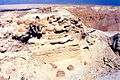
Early Bronze Age III charnel house, Bab edh-Dhra cemetery

In the Early Bronze II (3100–2650 BCE) and III period (2650–2350 BCE) the method used for burial was rectangular mudbrick buildings called charnel houses or "body libraries." All the human remains identified at Bâb edh-Dhrâʿ, have been confined to the cemetery (charnel house tombs) and are not found in the destruction layer of the city.[19]

Around 2900 BCE the residents of Bab edh-Dhra abandoned the subterranean shaft tombs for above-ground rectangular charnel houses in the cemetery.[20] The rectangular charnel houses resembled the residential houses of the cities but with steps inside that led down to a pebbled floor where among the deceased were placed personal items such as beads, textiles, pottery and other objects of stone and metal.[15] The destruction of the charnel houses occurred during the destruction of the city in 2350 BCE.[6] There were four houses excavated[21] and two others partially excavated with well dressed orthostats door posts, each over a meter in height, with a wooden door frame and inside the threshold the floor was packed with skulls and pottery. The buildings varied in size from 11.50 X 5.50 meters (37x18 ft) to 7 x 5 meters (23 x 16 ft).[22]

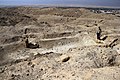
Bab edh-Dhra, Bronze Age burial ground in the plain (Cemetery C)

Tumulus tombs

[edit]

The cairn burial (or tumulus tomb), that dated to the Early Bronze Age III (2650-2300 BCE), was the latest burial form found at the site.[22] They were above-ground circular tombs made from mudbrick (circular charnel houses) in which were found evidence of various mortuary practices.[23][21][15] The tomb was a shallow pit where the body is laid with pottery and a dagger with a round heap of stones piled on top (thus called Tumulus). It was the tombs used by those who conquered the city and burned it.[3][21]

Museums

[edit]

Artifacts from Bab edh-Dhra are on display at Museum at the Lowest Place on Earth, Jordan; Karak Archaeological Museum in Jordan; the Kelso Bible Lands Museum housed at Pittsburgh Theological Seminary in Pittsburgh, United States; The Gustav Jeeninga Museum of Bible and Near Eastern Studies in Anderson, United States; and the British Museum in London, United Kingdom.

References

[edit]

Literature

[edit]
  • Chesson, Meredith S., and R. Thomas Schaub. "Death and Dying on the Dead Sea Plain: Fifa, Al- Khanazir and Bab Adh-Dhra` Cemeteries". In Crossing Jordan: North American Contributions to the Archaeology of Jordan, edited by Thomas Evan Levy, P. M. Michèle Daviau, Randall W. Younker, and May Shaer, 253–60. London: Equinox, 2007.
  • Chesson, Meredith S., and R. Thomas Schaub. "Life in the Earliest Walled Towns on the Dead Sea Plain: Numayra and Bab Edh-Dhraʿ". In Crossing Jordan: North American Contributions to the Archaeology of Jordan, edited by Thomas Evan Levy, P. M. Michèle Daviau, Randall W. Younker, and May Shaer, 245–52. London: Equinox, 2007.
  • Graves, David E. The Location of Sodom: Key Facts for Navigating the Maze of Arguments for the Location of the Cities of the Plain. Toronto: Electronic Christian Media, 2016. ISBN 978-1985830837
  • Rast, Walter E. "Patterns of Settlement at Bab Edh-Dhraʿ". In The Southeastern Dead Sea Plain Expedition: An Interim Report of the 1977 Season, edited by R. Thomas Schaub and Walter E. Rast, 7–34. AASOR 46. Boston, MA: American Schools of Oriental Research, 1979.
  • Rast, Walter E. and R. Thomas Schaub, eds. Bâb edh-Dhrâ'. Excavations at the Town Site (1975–1981). Reports of the Expedition to the Dead Sea Plain, Jordan 2. Winona Lake: Eisenbrauns, 2003. ISBN 978-1-57506-088-0
  • Rast, Walter E. and R. Thomas Schaub "Survey of the Southeastern Plain of the Dead Sea, 1973". Annual of the Department of Antiquities of Jordan 19 (1974): 5–53, 175–85.
  • Rast, Walter E., R. Thomas Schaub, David W. McCreery, Jack Donahue, and Mark A. McConaughy. "Preliminary Report of the 1979 Expedition to the Dead Sea Plain, Jordan". Bulletin of the American Schools of Oriental Research 240 (1980): 21–61.
  • Schaub, R. Thomas. "Bab Edh-Dhraʿ". In The New Encyclopedia of Archaeological Excavations in the Holy Land, edited by Ephraim Stern, Ayelet Levinson-Gilboa, and Joseph Aviram, 1:130–36. Jerusalem: The Israel Exploration Society, 1993.
  • Schaub, R. Thomas. "Bab Edh-Dhraʿ". In The Oxford Encyclopedia of Archaeology in the Near East, edited by Eric M. Meyers, 1:248–51. Oxford: Oxford University Press, 1997.
  • Schaub, R. Thomas. "Southeast Dead Sea Plain". In The Oxford Encyclopedia of Archaeology in the Near East, edited by Eric M. Meyers, 5:62–64. Oxford,: Oxford University Press, 1997.
  • Schaub, R. Thomas, and Walter E. Rast. "Preliminary Report of the 1981 Expedition to the Dead Sea Plain, Jordan". Bulletin of the American Schools of Oriental Research, no. 254 (1984): 35–60.
  • Schaub, R. Thomas, and Walter E. Rast, eds.: Bab edh-Dhra': Excavations in the Cemetery Directed by Paul W. Lapp (1965—1967), Reports of the Expedition to the Dead Sea Plain, Jordan 1. Winona Lake: Eisenbrauns 1989. ISBN 978-0-931464-51-5
[edit]
Revisions and contributorsEdit on WikipediaRead on Wikipedia
from Grokipedia

Bab edh-Dhra is a major Early situated on the southeastern shore of the in , featuring a fortified settlement and an extensive with over 20,000 burials spanning multiple phases of occupation. The site, located at approximately 240 meters below sea level on the south bank of the Wadi Kerak, includes a walled town of about 9 hectares enclosing structures that supported a population estimated at 600 to 1,000 during its peak in Early II-III.
Excavations initiated by Paul W. Lapp in 1965–1967 and continued by the Expedition to the Dead Sea Plain from 1975 to 1981 uncovered evidence of continuous habitation from the period through Early IV, with the settlement originating around 3300–3000 BC in Early I. The , positioned south of the wadi, features Early IA shaft tombs with primary burials and such as , transitioning to s for secondary ossilegium in Early III, reflecting evolving mortuary practices and . The town experienced destruction by fire toward the end of Early III, circa 2350 BC, after which the site saw squatter occupation in Early IV before abandonment. Notable artifacts include gold jewelry and imports indicating regional trade networks.

Location and Environmental Context

Geographical Position and Topography

Bab edh-Dhra is located in the Karak Governorate of , on the eastern side of the Dead Sea at approximately 31°15′ N and 35°32′ E . The site occupies a position on the southeastern shore of the Dead Sea, east of the Lisan Peninsula and Ghor el-Mazra'a, along the south bank of the Wadi Kerak. Situated about 240 meters below sea level, it lies within the arid of the Dead Sea plain. The topography consists of a low hill or plateau that rises above the surrounding flat, , providing an elevated settlement area bordered by the incised Kerak to the north. Steeper slopes descend westward toward the Dead Sea, while gentler terrain extends eastward into higher ground used for cemeteries. The landscape features typical characteristics, including channels, outcrops, and salt-encrusted flats, with minimal vegetation due to the hyper-arid climate. The site's hilltop location offered strategic oversight of the plain and access to resources, though and modern activity have altered some contours. Associated cemeteries, such as Cemetery A on nearby hills and Cemetery C in the plain, reflect adaptation to the varied micro-topography for practices.

Regional Significance in the Dead Sea Plain

Bab edh-Dhra's position on the Lisan Peninsula in 's southeastern Dead Sea Plain placed it within a semi-arid zone characterized by seasonal flooding and proximity to natural resources, enabling it to function as a focal point for Early (EB) settlement aggregation. Covering approximately 9-10 hectares during its EB II-III urban phase (ca. 3100-2350 BCE), the site featured massive fortifications and a dense layout, distinguishing it as one of the largest fortified centers in the southern Levant at the time. This development coincided with the emergence of nearby sites such as (ca. 4 km south), Feifa, and Safi, forming a regional network that evidenced coordinated in an environmentally marginal area reliant on alluvial , , and resource extraction. Shared assemblages and mortuary practices across these sites indicate socio-economic interconnections, with Bab edh-Dhra likely serving as a central node for intra-regional exchange and possibly longer-distance trade links to copper-rich Wadi Faynan (ca. 50 km east) and bitumen deposits. Excavations reveal evidence of craft production, including vessel imports suggesting northern Levantine contacts, and subsistence patterns combining cultivation in bottoms with , supporting an estimated population of 2,000-3,000 inhabitants during peak occupation. The site's extensive cemeteries—EB I shaft tombs in Cemetery A (over 500 documented) transitioning to EB III charnel houses—reflect evolving social organization and possibly regional catchment for burials, underscoring its demographic and ritual prominence. The synchronized abandonment or destruction of Bab edh-Dhra and associated plain settlements around 2350 BCE, marked by conflagration layers and structural collapses, signals a of this urban trajectory, attributable to factors like of fragile ecosystems or seismic events rather than isolated incidents. This event disrupted the Dead Sea Plain's EB urbanism, reverting the region to smaller-scale nomadism until later periods, and highlights the experimental nature of early in peripheral zones.

History of Excavations

Initial Surveys and Paul Lapp's Work (1960s)

In 1965, Paul W. Lapp, director of the American School of Oriental Research in , initiated surveys at Bab edh-Dhra, identifying extensive cemetery remains associated with Early activity. These preliminary investigations revealed surface scatters of pottery and disturbed tombs, prompting systematic excavations from 1965 to 1967 under ASOR sponsorship. Lapp's work targeted Cemetery A on the adjacent hill, uncovering over 400 shaft tombs dating primarily to Early IA (ca. 3500–3300 BCE), characterized by deep vertical shafts leading to multiple chamber burials. Lapp's excavations documented a range of practices, including simple shaft tombs with such as vessels, tools, and beads, indicating social differentiation through varying tomb sizes and offerings. He also explored charnel houses in B, structures used for secondary where bones were collected and stored, suggesting communal mortuary rituals. Preliminary analysis of ceramics linked the site to regional Early Bronze developments, with painted wares and ledge-handled jars pointing to connections with northern Jordanian and Palestinian sites. Lapp interpreted Bab edh-Dhra as a specialized center serving nearby settlements, potentially functioning as a cultic rather than a primary habitation site during certain phases. His findings highlighted the site's significance for understanding Early mortuary customs, though limited seasons and his untimely death in 1969 left much unpublished until later volumes. These efforts established Bab edh-Dhra as a key locus for investigating the transition from to urban Early Bronze societies in the Dead Sea region.

Expedition to the Dead Sea Plain (1977–1981)

The Expedition to the Dead Sea Plain, co-directed by Walter E. Rast of Illinois Benedictine College and R. Thomas Schaub of the University of Wisconsin-La Crosse, shifted focus from the cemetery to the town site at Bab edh-Dhra, conducting excavations across four seasons from 1975 to 1981, with fieldwork in 1977, 1979, and 1981 emphasizing stratigraphic recovery of settlement layers. These efforts built on Paul Lapp's prior surveys by employing systematic grid-based excavation in 13 designated fields, targeting mudbrick architecture, defensive structures, and occupational debris to reconstruct urbanism in the southeastern plain. During the 1977 season, teams exposed portions of an Early Bronze III stone wall and associated EB II public buildings, revealing multi-phase with of planned layout including broad room structures and courtyards, while recovering ceramics and faunal remains indicative of and agricultural subsistence. Excavations in A yielded animal bones in tomb contexts, suggesting ritual or secondary deposition practices, with analysis identifying caprine and bovine elements linked to EB phases. The 1979 and 1981 seasons extended these probes, uncovering signs of a violent termination in EB IB, including burned structures and abrupt abandonment layers, alongside a 1981 topographic survey of the cemetery using electronic instruments to 33 shaft tombs and four rectangular EB III funerary buildings containing primary flexed burials and like jewelry in Tomb A22. Overall, the EDSP's work documented a fortified settlement spanning EB IB to EB III, with walls up to 4 meters thick, gate complexes, and intra-mural reflecting social differentiation, though limited preservation in some areas; these findings, published in detailed reports, established Bab edh-Dhra as a key regional center with over 10 hectares of occupation. Bioarchaeological and analyses from these seasons indicated continuity with external links, evidenced by imported pottery forms, challenging prior views of isolated highland-lowland divides. The expedition's anthropological orientation prioritized contextual data over typology, yielding strata that confirmed EB IA shaft with disarticulated remains, totaling thousands of individuals across phases.

Chronological Framework

Early Bronze Age IB Phase (ca. 3300–3100 BCE)

The Early IB phase at Bab edh-Dhra marks the transition to permanent village settlement following the earlier EB IA period, with occupational layers identified in multiple excavation fields including II, IV, VIII, XI, XII, XIII, XIV, and F. These layers, situated above bed gravel and marl, contain evidence of stone and structures, such as walls and a cobbled in Field XII, alongside ash deposits indicating sustained habitation. This phase reflects an experimental yet enduring occupation, developing from precursors into a pattern of emerging villages across the region. Burial practices during EB IB continued shaft tomb traditions from EB IA but introduced innovations, including four excavated chambers with disarticulated remains, two surface burials, and two round funerary buildings measuring 3.50–3.70 meters in diameter. These funerary buildings featured articulated burials and group-line painted decorations on vessels, suggesting a shift toward primary interments associated with settled communities. One reused an EB IA chamber, indicating continuity in cemetery use at Cemetery A. Artifacts from EB IB contexts include such as juglets, stone maceheads, shell bracelets, and beads, reflecting local and possible exchange. Skeletal remains from the funerary buildings show evidence of burning and perimortem head wounds, potentially indicating interpersonal or practices at the phase's end. Bioarchaeological analysis of an EB IB reveals cremations possibly performed off-site before interment, with skeletal pathologies suggesting a population adapted to village life. Overall, the EB IB points to local development rather than external influences, laying foundations for later urban expansion.

Early Bronze Age II–III Phases (ca. 3100–2350 BCE)

The Early Bronze Age II phase (ca. 3100–2650 BCE) at Bab edh-Dhra represented a shift toward urban development, building on the preceding EB IB village settlement with the construction of enclosure walls and public buildings on elevated terrain. Excavations directed by Walter E. Rast and R. Thomas Schaub revealed structures such as a sanctuary in Field XII (measuring approximately 12 by 6 meters) and an administrative center in Field XI, alongside mudbrick walls like Wall B, which reached 2.5 meters in width. These features indicate emerging social organization and centralized activities, with pottery assemblages showing continuity from EB IB but increasing complexity in forms and production techniques. During the EB III phase (ca. 2650–2350 BCE), the site expanded into a fortified town encompassing about 9 acres, characterized by a massive up to 7 meters wide, constructed with stone foundations and superstructure. Settlement concentrated within the walled core, with extramural extensions to the east and west, including domestic and industrial zones marked by deep debris layers from sustained occupation. Public architecture, including a rebuilt , and industrial areas with evidence of underscore the peak of , while the EB II-III transition, calibrated between 2940 and 2820 BCE via , aligns with broader regional patterns of intensification. Burial practices evolved to include rectangular charnel houses in Cemetery A, ranging from 2.8 by 4.8 meters to 7.5 by 15 meters, used for secondary interment of disarticulated remains, contrasting with earlier shaft tombs. Key artifacts from EB III contexts, such as gold jewelry in Tomb A22, bronze tools, and impressions of cloth on , suggest participation in regional networks potentially linking to Syrian and Mesopotamian spheres. The phase concluded with violent destruction, evidenced by burnt layers in the town and charnel houses, dated around 2350 BCE.

Settlement Structure and Economy

Urban Layout, Fortifications, and Domestic Architecture

The town site of Bab edh-Dhra during the Early Bronze II-III phases featured a fortified settlement characterized by a multi-layered defense system. Excavations uncovered three lines of city walls enclosing the urban area, with a prominent gate providing access. The primary wall in the EB III period was constructed of mudbrick and measured 7-8 meters in width, indicating substantial defensive capabilities. These fortifications enclosed an area of approximately 9-10 acres, protecting the inhabitants and key structures within. Urban layout included organized spaces for habitation, , and possibly administrative functions, though detailed plans remain partially understood due to and limited exposure. The settlement was situated on a plateau overlooking the Dead Sea plain, optimizing natural defensibility. Inside the walls, areas designated for temples and domestic use were identified, suggesting a centralized community structure. Domestic architecture primarily consisted of rectangular buildings, often arranged in rows sharing common walls to maximize space efficiency. These structures featured broadroom plans typical of Early southern Levant sites, with walls incorporating in upper courses over stone foundations in some cases. Evidence from excavations points to simple, functional dwellings adapted to the local environment, with remnants of plaster and roof debris indicating multi-story potential in select buildings.

Evidence of Subsistence, Trade, and Craft Production

Archaeological evidence from Bab edh-Dhra indicates a mixed reliant on and during the Early . Faunal assemblages reveal a predominant focus on caprine herding, with sheep and goats comprising the majority of domestic animals; the goat-to-sheep ratio averaged 3:1 overall, reaching 3.23:1 in the EB III phase, suggesting specialized meat production and of herds suited to the semi-arid plain. Hunting contributed minimally, with wild species accounting for less than 2% of remains, underscoring the primacy of domesticated resources over . Agricultural practices, well-established by EB IA (ca. 3300 BCE), likely involved cultivation of cereals such as , alongside intensification of fruit trees and vines, facilitated by the site's location on alluvial plains amenable to dry farming or seasonal from systems. Storage jars, comprising 22% of ceramics in Stratum II, point to organized or reserves supporting year-round settlement rather than purely nomadic patterns. Trade networks positioned Bab edh-Dhra as a regional exchange hub in the southern Levant, linking marginal inland areas to coastal and highland zones. Artifacts such as marine shells in faunal contexts evidence connections to Mediterranean shores, while ceramic parallels with sites like , Arad, and Tel Yarmouth indicate pottery or resource circulation across and . Proximity to Faynan copper sources implies involvement in metal trade, with regional flows of ingots and tools extending to during EB II–III (ca. 3100–2350 BCE), though direct exports from the site remain unconfirmed. These exchanges likely involved surpluses, such as meat or hides, bartered for imported goods in a system blending local production with inter-site reciprocity. Craft production at the site centered on and groundstone tools, reflecting domestic and possibly specialized workshops integrated into urban life. Excavated assemblages include over 19,000 diagnostic sherds, featuring standardized forms like holemouth jars, kraters, lamps, and burnished storage vessels, consistent with local kiln-fired manufacture for and containment. Groundstone implements, including hammerstones, supported grinding of grains or ores, while early production from local materials hints at small-scale specialization, though evidence for is sparse compared to nearby Faynan sites. These activities underscore an economy scaling from household-level crafts to surplus-oriented output, enabling participation in broader Levantine networks without reliance on elite-controlled industries.

Religious and Social Practices

Temples and Ritual Installations

Excavations at Bab edh-Dhra revealed temples and ritual installations primarily associated with the Early III phase (ca. 2650–2350 BCE), concentrated in Field XII on the site's southwestern elevation. Sanctuary B, identified as an early temple complex, comprised two superimposed mud-brick structures erected directly atop the charred remains of Stratum IV destruction layers, suggesting ritual continuity following prior urban catastrophes. This broad-room , measuring approximately 10 by 6 meters, featured a rectangular plan with an entrance on the eastern side and internal divisions likely for cultic functions, including possible altars or offering benches akin to regional EB temple typology. Associated artifacts, such as ceramic vessels and faunal remains, indicate or sacrificial rites, though interpretive caution is warranted due to post-depositional disturbances. A western temple structure, also EB III in date, exhibited similar mud-brick construction and was marked by thick ash layers from a final , aligning with site-wide evidence of violent abandonment around 2350 BCE. Plans of these installations depict tripartite layouts with forecourt, main hall, and rear sanctuary, paralleled in contemporary sites like Khirbet al-Batrawy, implying standardized Levantine for communal or elite ceremonies. No earlier EB I–II temples were conclusively identified, though scattered altars and standing stones in domestic contexts hint at decentralized practices predating formalized sanctuaries. These features underscore Bab edh-Dhra's role as a regional cult center, with installations facilitating social cohesion amid urban expansion.

Insights from Bioarchaeology: Kinship, Status, and Violence

of skeletal remains from Bab edh-Dhra's cemeteries indicate that Early IA (EBIA) shaft likely housed kin groups, as evidenced by patterns in mortuary practices and dental morphology suggesting familial relatedness among interred individuals. The transition to communal charnel houses in Early IB (EBIB) reflects evolving definitions of group identity, potentially incorporating broader networks or social affiliations beyond immediate families, with remains showing commingled processing that prioritized collective commemoration over individual separation. Indicators of derived from osteological stress markers, such as linear (), cribra orbitalia, and porotic hyperostosis, reveal no significant differences in physiological stress frequencies across family-associated tombs, implying relatively egalitarian conditions with low levels of inequality among adults during EBIA. However, biogeochemical analyses of and oxygen isotopes in teeth suggest possible variations in mobility or resource access among subsets of the population, hinting at subtle status distinctions tied to placement or group affiliation in EBIB. Evidence of interpersonal violence is prominent in cranial trauma patterns, with a relatively high frequency of healed depressed fractures observed in both EBIA and EBIB assemblages compared to contemporaneous Levantine sites, indicating recurrent blunt force injuries likely from interpersonal conflict rather than accidental causes. These injuries, concentrated on the and affecting individuals across age and sex categories, underscore the pervasiveness of amid social intensification and urbanization at the site. Additional pathologies, including and potential tubercular lesions, further highlight a population exposed to trauma and , though direct causation remains tied to environmental and social stressors.

Cemetery Complex

Shaft Tombs and Early Burial Customs

The shaft tombs at Bab edh-Dhra, concentrated in Cemetery A on the hillslopes overlooking the settlement, characterize Early IA (EB IA) mortuary practices, dating approximately to 3600–3300 BCE. These structures feature vertical shafts sunk into the soft bedrock, typically 5–15 meters deep, with multiple side chambers branching off horizontally at the base. Chambers were generally circular or oval, averaging 1–2 meters in , and sealed post-interment with large stones or mudbricks; roofs were corbeled or flat. Excavations documented over 60 such tombs, many with 2–5 chambers each, indicating repeated use for kin-group burials spanning generations. Burials within these tombs consisted primarily of inhumations in flexed or extended positions, with skeletal remains showing minimal disturbance until later secondary manipulations in some cases. Grave goods included EB IA pottery vessels for offerings, copper tools, shell beads, and ground stone implements, deposited alongside the deceased to signify status or utility in the afterlife. Subadults predominated, comprising 27.4% infants and fetuses among analyzed remains, higher than in subsequent phases, suggesting preferential burial of vulnerable group members or higher infant mortality. No evidence exists for elaborate embalming; positioning implies simple wrapping or direct placement on chamber floors. Customs reflect egalitarian yet kin-oriented , with reuse promoting collective ancestral veneration over individual ostentation. Pathological analyses of skeletons reveal interpersonal and nutritional stress, but treatment showed no differentiation by sex or age beyond quantity. This primary inhumation focus contrasts with later EB phases' secondary processing in charnel houses, marking an toward communal defleshing rituals amid urban growth.

Charnel Houses and Communal Ossuaries

During the Early Bronze II–III phases (ca. 3100–2350 BCE), burial practices at Bab edh-Dhra shifted to the use of above-ground charnel houses in Cemetery B, marking a transition to secondary interment involving defleshing and bone collection. These structures, constructed from mudbrick with stone orthostats at the base, were typically rectangular, though some earlier examples exhibit curved walls suggesting circular forms, and measured roughly 4–6 meters in length. Excavators identified and investigated at least ten such charnel houses, including A8, A22, A41, A51, and A55, where bodies were initially placed for decomposition before skeletal elements were gathered into communal ossuaries or piled within the interior spaces. The communal ossuaries consisted of disarticulated and commingled bones from multiple individuals, often numbering in the hundreds per structure, reflecting group-oriented funerary rituals possibly tied to units or social identities. Bioarchaeological analysis of remains from these ossuaries, such as in Charnel House A22, reveals evidence of burning, with bones exhibiting color variations from black to white due to intense heat, consistent with roofs being set ablaze before structural collapse. Strontium, oxygen, and carbon isotope studies on dental enamel from charnel houses like A55 indicate that many interred individuals were nonlocal, likely originating from other Plain settlements lacking their own EB II–III cemeteries, suggesting Bab edh-Dhra served as a regional center. This practice underscores a causal link between urban development and formalized mortuary behaviors, where charnel houses facilitated repeated access for ritual manipulation of ancestors' remains, contrasting with earlier primary burials in Cemetery A. The concentration of nonlocal remains in ossuaries points to inter-community ties, though interpretations of status differentiation remain tentative without clear stratification, as and artifacts were minimal and primarily utilitarian. Destruction layers in multiple charnel houses, including fire-damaged interiors, align with the site's overall abandonment around 2350 BCE, preserving the ossuaries in collapsed states for modern recovery.

Tumulus Tombs and Later Developments

In the Early Bronze Age III phase (ca. 2650–2350 BCE), burial practices at Bab edh-Dhra shifted toward or tombs, consisting of stone piles constructed over pit graves or secondary interments, often sealing skeletal remains and . These structures, less elaborate than preceding shaft tombs or charnel houses, appear primarily in Cemetery A and reflect a possible return to more individualized or small-group inhumations amid urban expansion. Tomb A1 in Cemetery A exemplifies this form, featuring a overlay with preserved mat impressions on the burial floor and disarticulated bones including a human arm, accompanied by minimal . Such cairns, documented in Paul Lapp's 1965–1967 excavations, parallel regional EB III trends toward above-ground markers but remain outnumbered by earlier communal facilities, suggesting selective use for specific kin groups or status levels. Post-destruction of the settlement ca. 2350 BCE, cemetery use persisted sporadically into Early Bronze IV (ca. 2300–2000 BCE), with isolated tombs indicating intermittent pastoralist activity rather than organized urban burial. Tomb G7550B, an EB IV example, contained Tepe Gawra-style and other forms absent in prior phases, linking it to broader Levantine nomadic traditions and implying reuse of the site by mobile herders post-urban collapse. These later interments lacked tumulus elaboration, featuring simple pits or reused shafts with fewer artifacts, consistent with regional depopulation and shift to semi-nomadism after EB III catastrophes. By mid-EB IV, burials ceased entirely, with no evidence of or later systematic reuse, underscoring the site's abandonment as a following the failure of Dead Sea plain urbanism.

Destruction and Site Abandonment

Archaeological Evidence of Catastrophe

Excavations conducted by the Expedition to the Dead Sea Plain under Walter E. Rast and R. Thomas Schaub uncovered pervasive evidence of a violent destruction at Bab edh-Dhra during the final phase of Early Bronze Age III, dated approximately to 2350–2200 BCE. Throughout the settlement, layers of ash and charcoal up to one meter thick blanket collapsed mudbrick structures, indicating widespread conflagrations that reduced buildings to burned debris. In Field VI, Layer 5 specifically documents the fiery demise of the latest Early Bronze structures, with pottery and artifacts preserved in situ amid the collapse. The town gate, a key , was rebuilt atop a meter-thick of destruction , underscoring the scale of and the subsequent limited reoccupation before final abandonment. Structural failures, including tumbled walls and fallen roofs, suggest possible contributions from seismic activity exacerbating the fires, though the primary mechanism appears to be fueled by the site's organic materials and windswept location near the Dead Sea. No evidence of gradual decline precedes the catastrophe; rather, the abrupt halt in and absence of post-destruction layers point to a sudden, terminal event. Associated sites like exhibit parallel destruction horizons with ash deposits and unburned but collapsed architecture, reinforcing regional synchronicity around the EB III terminus. Bioarchaeological remains show no signs of mass casualties within the town, implying rapid evacuation or external agency, yet the uniform burning across domestic, industrial, and possibly areas indicates a comprehensive calamity affecting the entire urban complex.

Empirical Causes: Fire, Earthquake, and Human Factors

Excavations at Bab edh-Dhra uncovered thick layers of , charcoal, and burned s throughout the fortified town, signaling an intense conflagration at the end of Early Bronze III, dated circa 2350–2200 BCE, which precipitated site abandonment. At the northeast , accumulations of broken bricks mixed with indicate exposure, while western sectors revealed massive collapses from a burned . This burning extended to cemetery charnel houses, where charred wooden beams, deposits up to 30 cm thick, and inward roof collapses attest to flames originating atop structures before propagating downward, scattering contents. Wall falls oriented inward across multiple buildings suggest fire-induced weakening of mudbrick and timber supports, rather than external battering or gradual erosion. Post-fire erosion patterns and a shift from sedimentation to erosional regimes in adjacent wadis, as analyzed by geologist , imply tectonic uplift of approximately 28 meters following the event. The site's position along the eastern margin of the Dead Sea Transform Fault supports seismic involvement, with catastrophic structural collapses at Bab edh-Dhra and nearby consistent with shaking that could have ignited flammable roofing or exposed hearths. However, explicit indicators like foundation fractures or displaced fault scarps in architectural remains are not prominently documented in excavation reports. Absence of warfare indicators—such as sling stones, arrowheads , or skeletons with perimortem trauma—rules out human as the dominant factor. Excavators Rast and Schaub highlighted no parallels for deliberate human torching of charnel houses, rendering improbable without supporting artifacts like tools or access points. The uniform across town and extramural cemetery thus points to accidental or natural ignition, possibly seismic in origin, without evidence of intentional human intervention.

Controversies: Identification as Biblical Sodom

Arguments Supporting the Sodom Hypothesis

The identification of Bab edh-Dhra as the biblical Sodom originates with its excavators, Walter E. Rast and R. Thomas Schaub, who proposed the link during their 1970s expeditions, citing the site's position in the southeastern plain as aligning with Genesis 13:10–12's description of the "plain of the " (kikkar ha-Yarden), a fertile, well-watered region comparable to the . Rast and Schaub identified a cluster of Early settlements in the area—Bab edh-Dhra as Sodom, nearby (1.6 km southeast) as Gomorrah, and others like Safi (ancient Zoar, spared per Genesis 19:20–23)—matching the five "cities of the plain" in Genesis 14:2 and Deuteronomy 29:23. The site's elevation overlooking the corresponds to the gate where Lot meets the angels in Genesis 19:1, and the southern basin's abundant pits fit Genesis 14:10's "pits of " (bêrôṯ ha-kāmar), a resource scarce northward. Archaeological features bolster the case: Bab edh-Dhra was a fortified urban center spanning 9–10 acres (3.6–4 ha) with 7-meter-wide mudbrick walls, the largest in the region during Early Bronze III (ca. 2600–2350 BC), supporting its role as a prominent city like Sodom. Excavations revealed evidence of sudden catastrophe, including thick ash and charcoal layers from intense fires, collapsed buildings, and possible seismic disruption, consistent with Genesis 19:24's "fire and sulfur" (gāḡiṯ wāʾēš) raining from heaven. Numeira shows parallel destruction layers up to 0.4 m thick with human remains, suggesting contemporaneous regional devastation affecting multiple sites, as described for Sodom, Gomorrah, Admah, and Zeboiim. Agricultural remains indicate irrigation-supported crops like barley, wheat, and grapes, evoking the biblical portrayal of a lush plain overturned into desolation (Genesis 13:10; 19:25). Chronologically, the site's abandonment at the end of Early Bronze III, dated ca. 2350–2300 BC by Rast, aligns with adjusted biblical timelines placing Abraham's era around 2100–2000 BC, particularly under high chronologies for the Exodus (mid-15th century BC) that compress the intervening periods. Proponents like Bryant Wood argue the destruction's scale—fiery end following an earlier raid (Genesis 14)—fits patriarchal narratives without requiring northern alternatives lacking tar pits or southern plain geography. Biblical texts such as Ezekiel 16:46, placing Sodom "to the south" of Jerusalem, further favor the southern locale over northeastern proposals.

Chronological and Geographical Objections

The archaeological destruction layer at Bab edh-Dhra dates to the end of , with radiocarbon and pottery analyses placing it around 2350–2300 BCE, based on excavations revealing widespread burning and abandonment. This timing precedes the conventional biblical chronology for the patriarchal era, where Abraham's life is often dated to circa 2100–1900 BCE using genealogical data from Genesis and cross-references like Exodus 12:40 and Galatians 3:17, positioning Sodom's destruction shortly before Abraham's death around 2080 BCE. Critics maintaining a Middle Bronze Age setting for the patriarchs, aligned with broader Near Eastern historical correlations, argue this creates a mismatch of 200–300 years, rendering Bab edh-Dhra's identification implausible without revising established biblical timelines, which some view as to fit archaeological data. Geographically, Bab edh-Dhra lies southeast of the in a narrow, rugged section of the , approximately 20 kilometers from the southern shore, which does not align with Genesis 13:10–12's depiction of the "plain of the " (kikkar ha-Yarden) as a lush, well-watered expanse visible to Lot from the vicinity of Bethel and Ai, overlooking the northern basin. The southern sites, including Bab edh-Dhra and nearby , are obscured by the rugged terrain of the Lisan Peninsula and Moabite highlands, making direct visibility from Bethel—about 40 kilometers north—impossible without elevation or travel southward past , contrary to the narrative's implication of an immediate, eastward view toward a fertile plain likened to and Zoar. Proponents of northern alternatives, such as Tall el-Hammam, contend that the site's larger scale (over 30 hectares) and position in the broader circle better match the biblical emphasis on a prominent, irrigated lowland accessible from patriarchal routes, while dismissing southern locations as marginal and mismatched to the text's topographical cues.

Competing Sites and Alternative Interpretations

The primary competing site for biblical Sodom is Tall el-Hammam, a large Early settlement in the , approximately 13 kilometers northeast of the 's northern tip. Proponents, including Steven Collins, contend that its location better matches the Genesis 13 description of the "kikkar of the ," a fertile plain east of the , rather than the southeastern basin associated with Bab edh-Dhra. The site's 36-hectare fortified urban complex, with monumental architecture and evidence of sudden destruction circa 1650 BCE—including vitrified pottery, , and high-temperature melt residues—has been interpreted by some as consistent with the biblical account of fiery overthrow (Genesis 19:24). However, a peer-reviewed paper linking this destruction to a Tunguska-scale airburst was retracted in amid disputes over data interpretation and experimental validity, underscoring methodological challenges in such claims. Critics further note Tall el-Hammam's reoccupation in the Middle , conflicting with biblical references to perpetual desolation (e.g., Deuteronomy 29:23), and its distance from Zoar, the escape site in Genesis 19:22-23. Other proposed southern alternatives to Bab edh-Dhra include smaller sites like (often paired as Gomorrah) and Tell Feifa (possibly Zoar), excavated in the 1980s and showing Early Bronze III destruction layers around 2350 BCE with ash and collapsed mudbrick structures. These are argued to fit a cluster of five cities (Genesis 14:2) in the Ghor al-Mazra plain, but lack Tall el-Hammam's scale or northern geographical alignment, and their earlier chronology precedes the estimated patriarchal period by centuries under conventional dating. Beyond site-specific debates, alternative interpretations reject historical identification altogether, viewing the Sodom narrative as a cautionary etiology or folk memory of natural disasters rather than literal urban destruction. Scholars emphasizing textual criticism note the absence of Sodom in contemporary Near Eastern records or inscriptions, attributing the story's motifs—such as divine fire and inversion of hospitality—to broader Canaanite literary traditions, with no empirical link to any excavated ruin. This perspective prioritizes the narrative's theological function over archaeological correlation, cautioning against confirmation bias in equating destruction layers with biblical events absent corroborative evidence like toponyms or artifacts.

Artifacts, Preservation, and Modern Study

Major Artifact Categories and Their Significance

represents the predominant artifact category recovered from Bab edh-Dhra, comprising thousands of vessels including bowls, jars, juglets, and ledge-handled forms excavated from both settlement and contexts across Early Bronze phases. These ceramics, tempered with local sands and occasionally featuring red slips or incised bands, exhibit stylistic sequences—such as Fine Ware, Plain Ware, and Carinated Ware in EB I—that enable precise chronological phasing and reveal continuity in local production techniques. In shaft tombs of EB I (ca. 3500–3100 BCE), clusters in chambers alongside multiple skeletons, suggesting communal mortuary provisioning and emerging social differentiation through vessel quantity and form, indicative of pastoral-to-urban economic shifts. Metal artifacts, primarily copper-based pins, tools, and weapons, number at least a dozen analyzed specimens from town and excavations, with compositions including arsenical alloys pointing to early regional capabilities by EB III (ca. 2700–2350 BCE). These items, often corroded but revealing pin forms for fastening and rare blade weapons in deposits, signify technological innovation and possible elite status or defensive functions, as their scarcity contrasts with abundant and implies controlled access to ore sources like those in the Wadi Faynan area. Lithic tools, dominated by tabular flint scrapers from settlement layers, display microwear patterns consistent with animal butchery rather than hide scraping, underscoring a herding-based supplemented by limited . stone vessels, such as bowls found in EB I groups, complement ceramic forms and may derive from local or nearby quarries, their durability and placement near skeletal remains highlighting ritual preferences for enduring over perishable organics. Personal ornaments including beads and copper pins accompany burials in shaft tombs and charnel houses, with distributions varying by phase—more individualized in EB I chambers versus communal EB III ossuaries—evidencing evolving mortuary ideologies from kin-group affiliation to collective defleshing practices, while signaling , age, or status markers through material rarity. Collectively, these categories illuminate Bab edh-Dhra's pivotal role in southern Levantine urbanization, with artifact assemblages reflecting resource exploitation, craft specialization, and prior to the site's EB III abandonment around 2350 BCE.

Locations in Museums and Ongoing Analyses

Artifacts from Bab edh-Dhra excavations, primarily ceramics, stone tools, and burial goods from Early contexts, are preserved in several institutional collections. The in New York houses multiple ceramic vessels, including a bowl with punctate decoration and a plain bowl, both attributed to Early IA (ca. 3500–3300 BCE) from the site's region. Loyola Marymount University's maintains a collection of objects from shaft tomb 72 Northeast in A, dating to approximately 3300–3000 BCE, encompassing pottery and related recovered during joint expeditions. The University of Melbourne's Potter Museum of Art previously exhibited Early vessels from Paul Lapp's 1965–1967 cemetery excavations, highlighting mortuary ceramics from the site's charnel houses and tombs. Ongoing analyses focus on refining chronologies, material sourcing, and bioarchaeological data from the site's cemeteries. The Expedition to the Plain continues stratigraphic and artifactual study of Cemetery A and associated areas, with publication pending completion of related volumes on nearby ; this includes reassessment of shaft tombs and charnel houses for urban social organization insights. Recent research examines bowls from Cemetery A, investigating potential non-local sourcing absent regional quarries, led by Yorke Rowan and collaborators to trace Early exchange networks. A collaborative project on impacts in Jordan's southeast Plain cemeteries incorporates dental analysis of Bab edh-Dhra skeletal remains to evaluate population health, migration patterns, and post-excavation disturbance effects, addressing gaps in earlier bioarchaeological reporting. These efforts prioritize peer-reviewed integration of excavation archives with modern techniques like isotopic and use-wear studies to counter losses and enhance understandings of Early mortuary shifts from individual shaft burials to communal charnel practices.

References

Add your contribution
Related Hubs
Contribute something
User Avatar
No comments yet.