Hubbry Logo
AmpegAmpegMain
Open search
Ampeg
Community hub
Ampeg
logo
8 pages, 0 posts
0 subscribers
Be the first to start a discussion here.
Ampeg
Ampeg
from Wikipedia

Ampeg ("amplified peg") [1][2] is a manufacturer best known for its bass amplifiers.

Key Information

Originally established in 1946 in Linden, New Jersey by Everett Hull and Stanley Michaels as "Michael-Hull Electronic Labs," today Ampeg is part of the Yamaha Guitar Group. Although specializing in the production of bass amplifiers, Ampeg has previously manufactured guitar amplifiers and pickups and instruments including double basses, bass guitars, and electric guitars.[3]

History

[edit]

Early years (1946―1959)

[edit]

Everett Hull (born Charles Everitt Hull), a pianist and bassist from Wisconsin working with bandleader Lawrence Welk in Chicago, had invented a pickup for upright bass in an effort to amplify his instrument with more clarity. Hull's design placed a transducer atop the soundpost, a support peg inside the body of his instrument, inspiring his wife Gertrude to name the invention the "Ampeg," an abbreviated version of "amplified peg." On February 6, 1946, Hull filed a patent application for his "sound amplifying means for stringed musical instruments of the violin family," for which U.S. patent 2,430,717 was awarded the following year. The Hulls relocated to New Jersey, and Everett met electrical engineer and amp technician Stanley Michael, who was selling a bass amplifier of his own design, soon renamed the Michael-Hull Bassamp. In 1946, they established Michael-Hull Electronic Labs in Newark, New Jersey, to sell their two products. Michael left the company in 1948, leaving it to Hull, who relocated the company the following year to 42nd Street in Manhattan, above the New Amsterdam Theatre, renaming it "The Ampeg Bassamp Company."

Michael-Hull advertised in DownBeat magazine, listing bassists like Chubby Jackson and Johnny Frigo as endorsers. Additionally, Eddie Safranski signed on with Michael-Hull to promote Ampeg products, receiving a royalty payment for equipment sold by their influence. After Michael's departure, Hull continued to leverage connections with well-known musicians to increase awareness of his products within the New York jazz community; Ampeg's new location between Carnegie Hall, NBC Studios in 30 Rockefeller Plaza, and the Paramount Theatre helped establish relationships with bassists like Oscar Pettiford, Joe Comfort, Amos Milburn and Don Bagley.

In 1955, local musician and electrician Jess Oliver visited Ampeg's offices to purchase an amplified peg, and upon easily making the installation himself, Hull offered him a job. Oliver didn't join Ampeg on a full-time basis until 1956, the same year that Ampeg's name was simplified to "The Ampeg Company." In 1959, the company was incorporated as "The Ampeg Company, Inc.," with Everett Hull as President, Gertrude Hull as Secretary, and Jess Oliver as Vice President.[4]

Growing pains and a changing market (1960―1967)

[edit]

In 1960, Ampeg introduced the B-15, a bass combo amplifier with an innovative flip-top function, invented and patented by Oliver. The B-15 was the first in the company's Portaflex series, and after becoming the preferred studio amp of session musicians like James Jamerson and Chuck Rainey. The B-15 and its subsequent variants went on to become the most-recorded bass amplifier in history.[5][6] By 1963, the Portaflex series business had grown to 44% of Ampeg's amplifier sales. In 1962, Ampeg introduced the plastic-bodied Baby Bass, a compact upright electric bass created from the Zorko bass, whose design Ampeg had acquired from the Dopera brothers,[7] along with a unique Oliver-designed, Ampeg-patented pickup.

In 1962, Ampeg and its 40 employees moved to a new manufacturing facility in Linden, New Jersey. At 8,000 square feet, it was three times larger than their previous home. In June of the following year, after continued struggles to meet production demands and maintain cash flow, Ampeg announced an initial stock offering and became a publicly held company. By 1964, Ampeg had 100 employees and needed more space, relocating to a larger space one block away.

The combination of the rising popularity of rock and roll and the shift of bassists from upright bass to electric bass guitar during this time posed a challenge to Ampeg’s core business. The company's ads continued to feature prominent classical, jazz, and country artists, but with a notable absence of rock artists, and Hull strove to minimize rock musician visits to Ampeg's facilities. Hull's distaste for rock and roll music was further compounded by the success of Ampeg's chief competitor, Fender, as they continually bested Ampeg in overall sales.[3] Through the 1960s, Ampeg amplifiers were designed for "clean, undistorted sound", with Hull saying "we will never make anything for rock 'n' roll".[8]

The company continued to experience growing pains – by October 1966, with 200 employees and 40,000 square feet of space, Ampeg's production capacity had increased to $350,000 per month, yet had $3.5 million in unfulfilled backorders.[citation needed] Amidst company struggles related to growth and manufacturing, as well as disagreements with Hull, Oliver resigned from Ampeg. Hull began to seek potential buyers for the company.

Ampeg enters the rock market (1967―1970)

[edit]

In September 1967, Ampeg became a subsidiary of Unimusic Inc. when the newly formed investor group acquired a majority share of Ampeg stock. Unimusic consisted of investors interested in capitalizing on opportunities in the highly fragmented music equipment market of the time, not unlike CBS (which owned Fender and Rhodes), or later Norlin (which owned Gibson Guitars, Lowrey and Moog Music).[9] While Hull was retained as President of Ampeg, Unimusic had purchased the company with the intention of using as a starting point for change. After a year of conflict between Hull and Unimusic, Hull tendered his resignation on October 3, 1968.[4] Unimusic introduced a redesigned Ampeg logo and a new series of advertisements targeted at the rock market. In an effort to establish an Ampeg presence in key music markets, Ampeg opened regional offices: in Chicago; in Nashville near the Ryman Auditorium; and in the Hollywood Palladium in Hollywood.[citation needed]

Ampeg chief engineer Bill Hughes and Roger Cox, with input from Bob Rufkahr and Dan Armstrong (a New York session guitarist and guitar expert hired as a consultant), were developing what Cox envisioned as the “biggest, nastiest bass amplifier the world had ever seen.” The Rolling Stones anticipated using Hiwatt DR-103 amps, as during their 1969 Hyde Park gig, which they brought from England. Their road manager, Ian Stewart, contacted Rich Mandella at the Ampeg office in Hollywood, and Rich arranged for the band to use five prototype amplifier heads of this new high-output model. These employed a 14-tube design to generate 300 watts of power in an era when most tube amps generated less than 100. The Rolling Stones took these prototypes and Mandella on tour, playing all guitars and basses through them for the entire tour. After the tour, Ampeg put the design into production as the SVT, introducing it at the NAMM Show in 1969.[10][11][12][13][14][15]

After Armstrong and his amp tech Tom Duffy began modifying B-25 bass heads for rock guitar, the design team responsible for the SVT created the V series, introducing the V-3, V-2 and V-4 heads, VT-22 and VT-40 combos in 1970. The V-2, V-4 and V-22 were adopted by high-profile guitarists like Ron Wood and Keith Richards; both would use Ampeg SVT heads and cabs until 1981, when they replaced the SVTs with Mesa Boogie Mark I and Coliseum 300 amps.

Armstrong designed a transparent plastic guitar and bass for Ampeg. The guitar was used by Keith Richards with The Rolling Stones during the same 1969, 1970, and 1971 tours and some early shows of the 1972 tour, and the bass version by Bill Wyman on the 1972 tour and some of the 1973 Winter tour shows. In 1971, citing lack of compensation for his contributions to the V-series amplifiers, Armstrong left Ampeg, and refused to renew the agreement allowing manufacture his guitar and bass.[16]

Changes in ownership (1971―1985)

[edit]

In 1971, Ampeg was acquired by Magnavox,[17][18] which owned musical instrument manufacturer Selmer, but was better known for televisions, radios and hi-fi components. The following year, Magnavox dissolved Ampeg’s incorporation and moved Ampeg’s management to the Selmer-Magnavox offices in Elkhart, Indiana. In 1974, amidst economic struggles and production capacity surpluses, Magnavox closed Ampeg’s Linden plant, moving production to a portion of a Magnavox electronics factory there. In 1978, SVT designer Bill Hughes left the company.

In 1980, Ampeg was acquired by Music Technology, Inc. (MTI), a wholesaler specializing in amplifiers from Japan and keyboards from Italy looking to expand. Under MTI management, SVT and V series amps were prototyped for production in Japan (though V series were never produced). MTI also introduced five new solid-state amps and six new tube amps for Ampeg, and a series of effects pedals. But after production issues and substandard sales, MTI declared bankruptcy a few years later.[when?]

St. Louis Music and LOUD (1986―2018)

[edit]

In 1986, St. Louis Music (SLM) acquired the assets of Ampeg,[17] including the rights to the name and all remaining MTI inventory. SLM converted leftover V5 heads into SVT-100s and set out to re-create the SVT, setting aside a room at SLM Electronics for an intensive development project. Working from original SVT drawings and parts purchase orders from 1969, the team created a run of 500 amplifiers in 1987 dubbed the Limited Edition SVT-HD amps.[19] SLM then re-established Ampeg manufacturing in its Borman Avenue factory in St. Louis, introducing fourteen new Ampeg guitar and bass amps and the world’s largest bass amplifier at the 1987 summer NAMM Show.[citation needed]

In 2005, LOUD Technologies Inc. purchased St. Louis Music and its brands, including Ampeg[17] and Crate amplifiers, ending their production at the Yellville, Arkansas facility in March 2007, outsourcing amplifier manufacture to contract manufacturers in Asia.[18]

In May 2018, following the purchase of Loud Technologies Inc. by Transom, the Ampeg brand was acquired from the restructured LOUD Audio LLC by Yamaha Guitar Group, Inc.[20][21]

The current Ampeg company is mainly known in the field of bass amps.[22] They also have a line of guitar amplifiers and a remake of the Dan Armstrong guitar and bass.[23]

Ampeg holds six U.S. patents under the Ampeg brand name.[20]

Amplifiers

[edit]
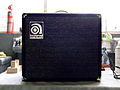
Ampeg Portaflex B-15N (early 1970s)

Ampeg Portaflex

[edit]

In the late-1950s Jess Oliver invented[3] a combo amplifier with a chassis that could be inverted and tucked inside the speaker enclosure to protect the vacuum tubes. This combo bass amp was introduced in 1960 as the Portaflex, and remained a popular choice through the 1960s.

Reverberocket

[edit]
Ampeg R-12-R Reverberocket

In 1961, Ampeg became the first company to incorporate reverberation (reverb) in an amplifier with its Reverberocket, which preceded Fender's Vibroverb amp by nearly two years.[25] Despite Hull's distaste for rock and roll and resistance to distortion, the Reverberocket employed 6V6 -type power tubes which sounded "Fendery" and did break up in a way that rock and roll players could use.[26]

Super Valve Technology

[edit]
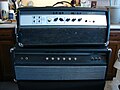
Ampeg SVT VR "Vintage Reissue"

During the 1960s Ampeg only produced fairly low wattage combo amplifiers. Rock concerts were becoming increasingly large affairs and bigger amplifiers were needed. In 1969, Ampeg's Chief Engineer Bill Hughes designed the Super Valve Technology circuitry for the amplifier of the same name. At 85 lb (39 kg), the Ampeg SVT provided 300 watts of RMS power, considerably more than most other bass amplifiers of the era. The high power rating made the SVT a candidate for use in larger venues. The SVT saw widespread use by rock acts in the 1970s and is still considered by many to be the world standard reference bass amp. The SVT-VR (Vintage Reissue) is almost identical in design and construction and the closest thing to any of the original SVT models produced by Ampeg.

Recent amplifiers (after 1990s)

[edit]

In the mid-1990s, SLM issued several guitar amplifiers under the Ampeg name. Some of these, the "Diamond Blue Series," used the names of vintage Ampeg models (such as Jet and Reverberocket) and featured the bluish-colored diamond-checkerboard covering associated with Ampeg amps of the 1960s. The circuit designs of these amplifiers, however, were new. The Portaflex bass amp was reissued, with updates intended to make it more appealing to modern bass players.

The Ampeg GVT series, introduced around 2010, is a series of tube amplifiers built in South Korea, employing the Baxandall tone circuit.[27][jargon]


Instruments and accessories

[edit]

Ampeg also manufactured (or had manufactured for them) lines of quirky but distinctive instruments to complement their amplifiers.

Zorko Bass
Ampeg Baby Bass

Baby Bass

[edit]

Baby Bass, introduced around 1962, was an electric upright bass with a full-size wooden neck and a cello-sized Uvex plastic body. The design was purchased from Zorko, re-engineered by Jess Oliver, and manufactured in a corner of Ampeg's Linden, New Jersey factory. It appeared in Ampeg's price list until about 1970, though popular only with bassists in Latin and salsa bands.[citation needed]

Guitars by Burns

[edit]

In the early 1960s, Ampeg-branded guitars and basses were produced by Burns of London. These instruments did not sell well because import costs made them too expensive compared to Fenders and Gibsons. Baldwin's purchase of Burns in 1965 ended the association with Ampeg.

Ampeg AEB-1 Horizontal Bass
Dan Armstrong see-through (1970)

Horizontal Bass and Devil Bass

[edit]
1966–1969, designed by Dennis Kager, etc.

In 1966, Ampeg introduced their home-built line of long-scale "Horizontal Basses" (aka "scroll" or "f-hole" basses), both fretted and fretless (reputed to be the first production fretless electric bass)[citation needed]. Some with different bodies were produced as the "Devil Bass" with distinctive horns, but the circuitry was identical. Originally using a transducer below the bridge, they were redesigned around 1968 to use a conventional magnetic pickup. At the same time, short-scale fretted and fretless basses, with magnetic pickups, were also produced.[28]

Dan Armstrong "see-through"

[edit]

In 1969, the Horizontal Basses were replaced by the Dan Armstrong-designed "see-through" guitars and basses, with bodies carved from colorless acrylic plastic.[29][30] The transparent bodies contributed to long sustain but were heavy. The guitars incorporated slide-in user-changeable pickups, and the short-scale basses used two stacked coils with a "pan" pot[jargon] for a wide range of tones. Production of the "see-through" instruments ended in 1971 when Armstrong left the company.

Stud series

[edit]
Big Stud electric bass (1973-1975)

In the mid-1970s, Ampeg had a line of Japanese-made guitars and basses under the "Stud" name. The guitars included the Stud, Heavy Stud, and Super Stud, and the basses included the Big Stud and Little Stud. The Studs were knock-offs of popular Fender and Gibson instruments (although the Fender copies sported rather incongruous 3/3 and 2/2 guitar and bass headstocks). Some of the Stud instruments were poorly built (e.g. the plywood bodies and necks on the Little Stud), while others had good-quality features (e.g., gold-plated hardware on the Super Stud).

Hagström distribution

[edit]
Swede Patch 2000 (1976-79)

In 1971, Ampeg was acquired by Magnavox, which led to a distributorship deal with the Swedish guitar company, Hagström. In 1975, Ampeg and Hagström collaborated to develop their first guitar/synthesizer hybrid using the contact of the strings on the frets as electric switches: In 1976 the Swede Patch 2000 was released, which required Ampeg Patch 2000 Pedals and an external synthesizer (Steiner-Parker Microcon was designed for it).[31]

Effects pedals & Accessories

[edit]

Ampeg also produced effects pedals, including stand-alone reverb units in the 60s, the Scrambler (distortion) from 1969 (a resurgence in interest resulted in an updated Scrambler being reissued in 2005 along with Sub-Blaster (octaver) that produced a note one octave down), the Phazzer (phaser) from the mid- to late-70s, and a line of nine stomp boxes produced in Japan in the mid-80s.

There were also Ampeg branded accessories that included covers, picks, strings, straps, polish, as well as two practice amps, the Sound Cube and the Buster (a Pignose clone). Currently, Ampeg mostly offers covers, some outerwear, and a few other accessories with their logo.

Recent instruments (after 1990s)

[edit]

In the mid- to late-1990s, Ampeg reissued the Baby Bass, the Horizontal Bass,[3] and the "See-Through" instruments, as well as wooden instruments based on the "See-Through" design.

References

[edit]

Bibliography

[edit]

Further reading

[edit]
[edit]
Revisions and contributorsEdit on WikipediaRead on Wikipedia
from Grokipedia
Ampeg is an American manufacturer of amplifiers, cabinets, and related musical equipment, specializing in high-powered, tone-defining products that have shaped modern bass amplification since its inception. Co-founded in 1946 by Everett Hull and Stanley as Michaels-Hull Electronic Labs, with Hull, an upright bass player, the company originated from Hull's invention of an electromagnetic pickup to amplify the upright bass, which his wife named "Ampeg" as a blend of "amp" and "peg." Renamed the Ampeg Bassamp Company in 1949 after Hull became sole proprietor, it quickly established itself as a leader in bass-specific gear, holding multiple U.S. patents for innovations in amplification technology. Key milestones include the 1960 introduction of the B-15 Portaflex, the first portable combo amplifier designed exclusively for , featuring a design and a tuned 15-inch speaker cabinet that delivered superior low-end response and portability. This was followed in 1969 by the groundbreaking SVT (Super ) series, a 300-watt all-tube head paired with an 8x10-inch cabinet, which provided unprecedented power for live performances and became synonymous with the thunderous bass tones of and arena music. Over the decades, Ampeg's products, such as the Reverbrocket and modern Heritage reissues, have been favored by influential bassists including of the sound and members of , cementing its cultural impact in , , and . The company underwent several ownership changes, including acquisition by in 1986, LOUD Technologies in 2005, and Yamaha Guitar Group, Inc. in 2018, under which it continues to produce classic and contemporary lines like the SVT Pro Series, Rocket Bass combos, and Venture Series, maintaining its reputation for robust, reliable amplification.

History

Founding and Early Innovations (1946–1959)

Ampeg originated in 1946 when Everett Hull, an accomplished pianist and upright bass player, partnered with Stanley Michaels to establish Michaels-Hull Electronic Labs in . The company's initial focus was on developing a novel magnetic pickup designed by Hull to electrically amplify upright basses, addressing the challenges of projecting low frequencies in live settings without mechanical modifications to the instrument. This pickup, fitted to the bass's endpin, was dubbed the "Ampeg" or "Amplified Peg," a name coined by Hull's wife to describe the innovation that transformed the acoustic instrument into an amplified one. In 1947, Hull secured U.S. No. 2,430,717 for the device, which utilized a microphone-like to capture string vibrations directly, marking it as the first commercially viable solution for upright bass amplification. The partnership introduced an accompanying tube-based amplifier, the Michael-Hull Bassamp—an 18-watt, 1x12-inch model—to power the pickup, enabling portable setups for and musicians transitioning toward more electric-oriented performances. By 1949, following Hull's buyout of , the company rebranded as the Ampeg Bassamp Company and relocated operations, fully shifting production toward integrated rather than just pickups. Early models like the Super 800, a 30-watt tube introduced that year, built on the Bassamp design with enhanced power and reliability for professional use, establishing Ampeg's emphasis on robust, low-end-focused . Hull's entrepreneurial vision drove these developments, pioneering the concept of dedicated bass preamplification and portable systems that preserved the upright bass's natural tone while adapting to emerging electric music demands. Over the decade, Ampeg secured additional patents related to audio transduction, solidifying its role as an innovator in bass technology before broader market expansions in the .

Expansion Amid Market Shifts (1960–1967)

In 1960, Ampeg introduced the Portaflex B-15, a groundbreaking bass combo amplifier designed by engineer Jess Oliver, featuring a flip-top chassis that allowed the amp head to nest inside the speaker cabinet for enhanced portability. This innovation addressed the needs of touring musicians during the burgeoning surf and early rock scenes, establishing the Portaflex as a staple for bassists seeking compact yet powerful setups. To support growing production demands, Ampeg relocated its manufacturing operations to a larger facility in , in 1962, expanding from a modest Queens-based operation to an 8,000-square-foot plant that enabled scaled-up output of amplifiers and accessories. The early 1960s marked significant market shifts for Ampeg, as the rising popularity of electric basses—exemplified by models like the —diminished demand for upright bass amplification systems, prompting the company to pivot toward versatile combo amplifiers tailored for full band applications. Building on its foundational work with magnetic pickups for upright basses in the 1940s, Ampeg adapted by emphasizing electric bass tone and portability, with the Portaflex series exemplifying this transition to meet the demands of combo-oriented genres like . Ampeg expanded into guitar amplification during this period, pioneering built-in reverb with the 1961 Reverberocket, the first production guitar amp to incorporate Accutronics spring reverb tanks for a lush, ambient effect that predated competitors' offerings. This model, available in configurations like the R-12-R, broadened Ampeg's appeal beyond bassists to guitarists seeking innovative tone-shaping tools, solidifying the company's reputation for engineering advancements amid the combo amp boom. To capture wider , Ampeg launched the B-18 Portaflex in 1963, a more powerful variant of the B-15 with an 18-inch speaker and 50 watts of output, designed for greater headroom and suitability across bass and guitar applications in live settings. However, rapid expansion brought financial challenges, including overextension from the new facility and intensified competition from Fender, which dominated overall sales in the amplifier market. These "" culminated in September 1967, when Unimusic Inc. acquired a majority stake in Ampeg, providing capital infusion but marking the end of founder Everett Hull's direct control.

Breakthrough in Rock Amplification (1968–1970)

In 1967, Ampeg was acquired by Unimusic Inc., a move that redirected the company's engineering efforts toward high-wattage amplifiers tailored for the intensifying volume demands of . Under this new ownership, Ampeg expanded operations and emphasized robust, stage-ready designs to compete in the evolving electric instrument market. The breakthrough arrived in 1969 with the introduction of the SVT (Super Vacuum Tube) 300-watt head, unveiled as prototypes at the in and designed by chief engineer Bill Hughes in collaboration with Roger Cox. This all-tube powerhouse, weighing 95 pounds and incorporating 14 tubes—including six massive 6146 power tubes—delivered unprecedented output when paired with an 8x10 speaker cabinet, enabling bassists to achieve extreme volume that could penetrate dense rock arrangements. The design prioritized raw power and tonal clarity, with a factory warning label cautioning users about potential hearing damage from its intensity. Celebrity endorsements accelerated the SVT's rise, particularly through its adoption by during their 1969 U.S. tour, where bassist relied on prototype units after the band's Fender amplifiers failed during rehearsals. Ampeg technician Rich Mandella supported the tour, and the SVTs powered performances captured in the documentary , including Wyman's driving bass lines alongside contributions from and on guitar. The SVT's launch catalyzed a profound market shift, transitioning bass amplification from the portable, reverb-focused combos suited to and upright bass toward high-output systems essential for electric bass in rock dominance. As the first 300-watt all-tube bass head, it redefined professional standards for live tone and reliability, influencing generations of musicians and solidifying Ampeg's role in arena-scale rock. This era marked Ampeg's creative zenith in rock-oriented innovation, with the SVT entering full production in amid surging demand, though the peak proved brief as corporate transitions loomed by 1971.

Ownership Transitions and Challenges (1971–1985)

In 1971, Ampeg was acquired by the Corporation, which integrated the company into its Selmer musical instruments division. This ownership change marked the beginning of a period of corporate restructuring, as sought to streamline operations amid growing competition in the musical instrument market. Shortly after the acquisition, Ampeg updated its flagship SVT series with the introduction of Blackline models, featuring cosmetic changes to the front panel and a switch to 6550 output tubes for improved reliability, though these were minor evolutions rather than groundbreaking innovations. By 1974, economic pressures and excess production capacity led Magnavox to close Ampeg's longstanding Linden, New Jersey facility and relocate manufacturing to Jefferson City, Tennessee. This move disrupted workflows and contributed to a perceived decline in build quality, as the company struggled to maintain its reputation for robust tube amplification during a market shift toward more affordable solid-state designs. Ampeg responded by expanding its solid-state lineup, including models like the V-6B bass head, which offered 240 watts of power with clean headroom but failed to capture the same enthusiasm as the classic tube amps amid the broader industry transition away from vacuum tubes. Overall, the era saw limited product development, with the V4B all-tube combo representing one of the few notable additions, emphasizing portability over power. In 1980, sold Ampeg to Music Technologies Inc. (MTI), a wholesaler focused on imported , which outsourced production to to cut costs. This transition exacerbated quality concerns, as MTI-era SVTs, while functionally similar, suffered from inconsistent components and cosmetic deviations that alienated longtime users. Financial difficulties mounted for MTI throughout the early 1980s, leading to production halts and an inability to innovate beyond minor SVT updates, resulting in overall brand stagnation during a time when competitors advanced digital and hybrid technologies. By 1985, MTI filed for bankruptcy, prompting the sale of Ampeg's assets, including inventory and trademarks, to St. Louis Music Inc. in 1986. Despite the turbulence of multiple ownership shifts and operational disruptions, Ampeg's core designs, particularly the SVT series originating from , endured as icons of bass amplification, preserving the company's legacy through reissues and collector interest even as the brand navigated near collapse.

Revival under St. Louis Music (1986–2017)

In 1986, Inc. acquired the assets of Ampeg from , providing the brand with stable ownership and enabling a return to U.S.-based operations. This acquisition marked the end of a turbulent period of multiple ownership changes and allowed Ampeg to focus on revitalizing its core product lines. Under , production emphasized high-quality tube amplifiers, re-establishing Ampeg's reputation for reliable bass amplification. During the , Ampeg reintroduced classic designs with modern enhancements for improved reliability and performance. The SVT Classic, launched in 1994, updated the iconic SVT series with a more robust and added features like a front-panel fuse, while retaining the original tube-driven tone. Portaflex reissues, such as the B-15N and B-15R models, were also brought back, incorporating upgraded components like improved speakers and wiring to address historical durability issues without altering the signature flip-top portability and warm overdriven sound. These efforts helped restore consumer confidence and positioned Ampeg as a premium choice for professional bassists. In 2005, LOUD Technologies acquired St. Louis Music, including Ampeg, continuing the brand's expansion while shifting some operations to its Woodinville, Washington headquarters. Under LOUD, Ampeg broadened its market reach by introducing the BA series of solid-state combo amplifiers in the early , targeting budget-conscious players with affordable, lightweight options that delivered accessible Ampeg tone through classic preamp circuits and 3-band EQ. Key innovations during this era included the development of Super Grit Technology (SGT) in the 2010s, an overdrive circuit designed to produce versatile grit and distortion tones inspired by vintage models, enhancing both amps and pedals. Ampeg also expanded into effects pedals, launching products like the SCR-DI preamp/DI in 2015 and the Classic Analog series in 2017, which offered portable emulations of SVT and Portaflex circuits for stage and studio use. This period solidified Ampeg's status as the industry standard for bass amplification, bolstered by high-profile endorsements from artists such as Metallica's , who relied on SVT stacks for their powerful, aggressive tone, and ' , whose use of Portaflex and SVT models became synonymous with dynamic rock bass sounds.

Yamaha Acquisition and Contemporary Developments (2018–present)

In May 2018, Yamaha Guitar Group (YGG), a subsidiary of , acquired the Ampeg brand from , LLC, integrating it into its portfolio alongside Line 6 and Yamaha guitar products. This move relocated Ampeg's headquarters to YGG's facilities in , facilitating a smooth transition while allowing LOUD to refocus on pro-audio brands like Mackie and EAW. The acquisition preserved Ampeg's legacy in bass amplification, with commitments to continue developing its amps, cabinets, and pedals under Yamaha's global infrastructure. Post-acquisition, Ampeg marked the 50th anniversary of its groundbreaking SVT amplifier—originally debuted in 1969—with the Heritage 50th Anniversary SVT head in 2019. This limited-edition model distilled the classic circuit into a 300-watt, stage-ready design using premium components like custom transformers and vintage-style tubes, honoring the amp's role in shaping rock and bass tones. In 2021, Ampeg refreshed its portable offerings with the Rocket Bass series of combo amplifiers, emphasizing lighter weights (under 40 pounds for most models) and the new Super Grit Technology (SGT) overdrive circuit for authentic Ampeg grit alongside 3-band EQ and switchable Ultra Hi/Lo extensions. That same year, Ampeg ventured into software with the SVT Suite plugin, emulating three iconic SVT heads—the Heritage 50th Anniversary SVT, Heritage SVT-CL, and SVT-4PRO—for digital audio workstations, capturing analog warmth through photorealistic interfaces and precise modeling. By 2023, Ampeg expanded its modern lineup with the Venture series, introducing solid-state heads like the 1200-watt V-12 and 700-watt V-7, both under 9 pounds and optimized for portability with Legacy preamps, sweepable mids, and footswitchable SGT overdrive. These amplifiers pair with lightweight cabinets like the VB-112 and VB-210, delivering high headroom for gigging bassists while maintaining Ampeg's signature tone. In 2024, Ampeg celebrated its 75th anniversary—marking the incorporation of the Ampeg Bassamp Company in 1949—with a special series of content honoring the brand's legacy and innovations. That June, the company debuted the Venture VB-88 bass speaker cabinet, a compact 8x8-inch enclosure weighing 67 pounds and rated at 800 watts RMS, designed as a portable modern counterpart to the classic SVT-810. As of November 2025, Ampeg remains under YGG ownership with no further changes, continuing to prioritize bass amplification innovations that blend heritage circuits with contemporary features like digital emulation and compact power. The Yamaha integration has bolstered Ampeg's R&D, enabling synergies in materials and technology that support evolving demands for reliable, versatile gear in live and studio settings.

Amplifiers

Portaflex and Combo Designs

The Ampeg Portaflex series, introduced in 1960 with the model B-15, marked a pivotal advancement in bass amplification by offering the first dedicated combo designed specifically for the electric . This 25-watt all-tube unit featured a single 15-inch Jensen P15N speaker housed in a portable cabinet with a innovative flip-top lid that allowed the amplifier head to nest inside for easy transport, addressing the growing need for upright bass players transitioning to electric instruments during the instrument's early adoption in and . The design, conceived by Ampeg's chief engineer Jess Oliver, incorporated a reflex baffle system that enhanced low-end projection while maintaining compactness, weighing approximately 58 pounds when fully assembled. Over the subsequent years, the Portaflex line evolved to meet the demands of professional musicians, with the B-15N variant emerging in 1961 to refine circuit stability and speaker options, often pairing the original Jensen with a CTS 15-inch driver by 1965 for improved durability and tonal consistency. In 1966, the B-15R model introduced integrated spring reverb, expanding its appeal for studio and stage use while retaining the core 30-watt output in later iterations, though the focus remained on tube-driven warmth rather than power escalation. By the , transitional models like the B-15S incorporated solid-state rectifiers for greater reliability, boosting output to 60 watts in some configurations while preserving the flip-top portability; these adaptations reflected Ampeg's response to the era's shift toward more robust, roadworthy gear without abandoning the series' vintage tube character. The tonal signature—characterized by a warm, punchy bass response derived from the flip-top baffle's acoustic tuning—became iconic, providing articulate low-end clarity that excelled in intimate settings and recordings. Renowned for its versatility, the Portaflex found favor among jazz pioneers, including bassist , who endorsed and utilized the B-15 in live performances during the 1960s, praising its ability to capture the nuanced dynamics of acoustic-to-electric bass translation. Production of the original tube models continued through the late , establishing the Portaflex as the benchmark for bass combos and influencing subsequent portable designs across the industry by prioritizing integrated transportability and focused bass reproduction over sheer volume. In the 1990s, under the revival, Ampeg launched the Heritage series reissues, faithfully recreating the B-15's vintage circuits with hand-wired construction and period-correct components like 6SL7 preamp tubes, limited to small runs that honored the original's legacy while incorporating modern safety features.

Reverberocket and Early Reverb Models

In , Ampeg introduced the Reverberocket, marking a pioneering advancement as the first production to feature built-in spring reverb, predating similar offerings from competitors like Fender by nearly two years. The initial model, designated the R-12R, delivered approximately 15 to 18 watts through a single 12-inch Jensen speaker, utilizing a tube-driven circuit with output tubes and preamp tubes for a clean, jazz-oriented tone that contrasted with the emerging rock styles. This reverb implementation relied on an Accutronics spring tank, a technology that became standard in the industry, providing a lush, watery effect controlled by a single knob that adjusted the mix of dry and wet signals in the circuit. The reverb circuit, developed under the direction of Ampeg founder Everett Hull, integrated seamlessly into the amplifier's preamp stage, where the input signal split to drive the spring tank via a 6U10 tube, with the recovered wet signal blended back into the dry path for adjustable depth without overwhelming the core tone. Hull, originally focused on bass amplification innovations, envisioned this feature as an enhancement for clean performance, though its harmonic richness lent itself to overdriven sounds when pushed. By 1962, variations emerged, including the higher-output Reverberocket II (GS-12R), which incorporated a solid-state for improved reliability while retaining the tube preamp and power section, signaling an early evolution toward hybrid designs in the late and into the . Ampeg extended the reverb technology to bass applications with the 1962 B-12X Portaflex variant, a 30-watt, 1x12-inch combo designed for portability and suited to upright bass amplification, building on the modular "" Portaflex chassis for easy transport while adding and reverb to enhance acoustic tones in ensemble settings. This model maintained the spring reverb's blend control, allowing bassists to add subtle ambiance without muddiness, and exemplified Ampeg's shift toward versatile, effects-equipped portables. The Reverberocket gained cultural prominence in the scene of the early , where its distinctive spring reverb captured the echoing, wave-like quality essential to the genre, as heard in instrumental tracks by artists like , whose high-speed picking and reverb-drenched tones helped define the style even if he primarily favored Fender stacks. Its entry into the guitar market broadened Ampeg's appeal beyond bassists, influencing garage and rock players seeking affordable, built-in effects amid the British Invasion's rise. Production of the original tube-based Reverberocket line continued through the but was discontinued as Ampeg prioritized higher-power models and solid-state innovations amid shifting market demands. The design's legacy endured, leading to faithful reissues in the late and , such as the R-12R and R-212R, which replicated the classic circuitry and became sought-after collector items for their vintage-inspired tone and in effects evolution.

SVT Series and Super Valve Technology

The Ampeg SVT series, short for Super Vacuum Tube, debuted in 1969 as a groundbreaking all-tube bass amplifier head designed to deliver unprecedented power for live performances in large venues. Developed by engineers Bill Hughes and Roger Cox at Ampeg, with contributions from Bob Rufkahr and , the original SVT head produced 300 watts of output, surpassing competitors like the 200-watt and enabling stadium-level volume when paired with the matching 8x10-inch speaker cabinet. This design built on the bass-focused innovations of earlier models like the Portaflex series, emphasizing portability and tone for electric bass guitars. At its core, the SVT employed Super Valve Technology, featuring a push-pull tube output stage with six 6550 power tubes for robust low-end response and an ultra-high gain preamp section to handle aggressive playing styles. The head weighed approximately 95 pounds and included options for 2, 4, and 8 loads, allowing flexible connectivity to cabinets like the 105-pound 8x10 enclosure with its array of 10-inch speakers. This configuration provided a tonal signature characterized by growling, articulate lows that cut through dense mixes, making it a staple for rock and beyond. The SVT series evolved through the decades while preserving its tube-driven heritage. In the 1980s, the SVT-CL emerged as a faithful reissue of the original design, maintaining the all-tube architecture for purists seeking vintage tone. The 1990s saw the introduction of the SVT-3 Pro, a solid-state model offering 450 watts in a more compact rackmount format, appealing to players needing reliability without the maintenance of tubes. By the 2000s, the Heritage series produced exact replicas of classic SVT components, such as the SVT-CL head, using premium matched tubes to replicate the 1969 circuit's dynamics and ensuring the line's enduring appeal. From its early adoption by during their 1969 world tour—where it powered Bill Wyman's bass on the live album Get Yer Ya-Ya's Out!—to its use in heavy genres, the SVT became synonymous with powerful bass amplification. Iconic players like of employed it for its aggressive, defining growl in metal contexts, while its versatility extended to fusion artists such as and , solidifying the series' influence across Motown-influenced R&B to .

Modern Amplifiers and Innovations (1990s–present)

In the , Ampeg expanded its lineup with the BA series of affordable solid-state combo amplifiers designed primarily for and rehearsal settings. These models, produced during the St. Louis Music era, emphasized reliability and portability for beginner and intermediate bassists, featuring legacy-inspired preamp circuits in a compact format. For instance, the BA-115 delivered 100 watts through a 1x15-inch speaker, providing versatile tone shaping with Ampeg's classic EQ stack suitable for home use or small gigs. Similarly, lower-powered options like the BA-108 offered 20 watts via an 1x8-inch speaker, prioritizing ease of use and durability for everyday without the complexity of tube designs. Building on the SVT legacy as a tonal foundation, Ampeg introduced Super Grit Technology (SGT) in the with the SVT-3PRO head, enabling switchable clean and overdrive modes for enhanced versatility in live and studio applications. Released around 2008, the SVT-3PRO provided 450 watts of hybrid tube/solid-state power, incorporating SGT as a footswitchable circuit that delivered gritty while preserving the amp's signature punch and clarity. This innovation allowed bassists to transition seamlessly between pristine tones and aggressive overdrive, influencing subsequent Ampeg designs by integrating modern switching capabilities into traditional SVT architecture. In 2021, Ampeg launched the Rocket Bass series of combo amplifiers, targeting gigging musicians with lightweight, high-performance options that incorporated SGT for dynamic tone control. The lineup included models such as the 100-watt RB-112 with a 1x12-inch speaker and the 200-watt RB-115 featuring a 1x15-inch configuration, both equipped with 3-band EQ, aux input, and footswitchable SGT overdrive to emulate classic Ampeg warmth in a portable package weighing under 30 pounds. These combos utilized custom Eminence speakers and efficient Class D power sections, making them ideal for practice, recording, and stage use while reducing overall setup weight compared to earlier tube-heavy models. The Venture series, introduced in 2023, further advanced Ampeg's focus on portability with Class D heads and lightweight cabinets tailored for modern touring bassists. Key models include the V3 at 300 watts, V7 at 700 watts, and V12 at 1200 watts, all featuring 3-band EQ, SGT overdrive, balanced XLR DI, effects loop, and headphone output in ultra-compact enclosures weighing as little as 8.8 pounds for the V12. Complementing these are neodymium-loaded cabinets like the VB-112 and VB-210, which prioritize reduced weight and high efficiency for easy transport without sacrificing projection. This series represents Ampeg's shift toward gig-ready, feature-rich amplification that supports contemporary workflows. Also in 2021, Ampeg released the SVT Suite plugin, a digital emulation of iconic SVT amp heads including the Heritage 50th Anniversary SVT, SVT-CL, and SVT-4PRO, designed for integration into workstations. The plugin offers photorealistic controls for precise tone recreation, including variable impedance loading and cabinet simulations, allowing producers and recording artists to capture authentic sounds virtually. It supports major formats like VST, , and AAX, emphasizing low-latency performance for real-time tracking. At the 2025 , Ampeg highlighted the SVT Time Live initiative, a livestream demo series on platforms like and , showcasing artist endorsements and gear demonstrations to engage the bass community. Hosted by Ampeg's brand manager, episodes featured roundups of new products and discussions on tonal applications, reinforcing the brand's ongoing commitment to education and innovation.

Instruments and Accessories

Early Bass Models and Pickups

Ampeg's entry into bass instrumentation began in 1946 with the development of a specialized pickup designed by Everett Hull, an accomplished and . This device, fitted to the endpin of an upright bass, captured acoustic vibrations and converted them into an electrical signal for amplification, addressing the challenges of projecting bass tones in larger ensembles. Dubbed the "Amplified Peg" or "Ampeg," it marked the company's origins in bass-focused innovation and was produced under the initial partnership of Michaels-Hull Electronic Labs. Building on this foundation, Ampeg expanded into full bass instruments during the with the introduction of the Baby Bass in 1962, a compact electric upright hybrid aimed at traveling musicians seeking portability without sacrificing playability. The model featured a full-sized neck for familiar upright , paired with a smaller cello-sized body constructed from Uvex plastic composite for lightweight durability and reduced transport issues. As a 4-string design with a 41.25-inch scale length, it included onboard volume and tone controls, along with a piezo-style bridge pickup that emphasized acoustic-like resonance and upright tonal emulation, including bow compatibility. This innovation represented Ampeg's first venture into amplified variants, prioritizing a warm, resonant sound that mimicked traditional upright basses while integrating seamlessly with the company's early amplifiers for enhanced output. Production continued through the , with a limited run making surviving examples rare collectibles today, valued for their unique blend of acoustic tradition and electric convenience.

Electric Guitars and Collaborations

In the early 1960s, Ampeg formed a partnership with British guitar maker Burns of London, enabling the distribution and co-branding of Burns-designed electric guitars in the United States under the "Ampeg by Burns of London" label. This collaboration introduced models such as the TR2, a semi-hollowbody electric guitar with a carved solid top and back, featuring a sunburst finish and Burns' innovative split-sound pickups that allowed for versatile tonal splitting between rhythm and lead voices. These guitars targeted emerging rock musicians seeking British-inspired designs with enhanced playability and unique switching options. Transitioning to in-house production in the 1970s, Ampeg launched the Stud series of solid-body electric guitars, manufactured in Japan by Matsumoku, to expand beyond their bass guitar roots. Key models included the Super Stud GE-500, an SG-style double-cutaway with two humbucking pickups, and the Stud Student, a more affordable entry-level variant aimed at aspiring players. Design elements emphasized rock-oriented features, such as dual-coil humbucker pickups derived from Ampeg's early bass pickup technology for robust output and reduced hum, along with Bigsby-style tremolo systems on select models like the GE-500 for expressive vibrato effects. The Stud series production was short-lived, spanning approximately 1973 to 1975 and affected by Ampeg's ownership transitions, including the shift to in 1971, resulting in limited overall output estimated at fewer than 5,000 units across models. This brief run contributed to the rarity of surviving examples today. Ampeg's foray into electric guitars via these collaborations and the Stud line bridged their expertise in bass amplification and pickups to six-string instruments, fostering hybrid tones that combined punchy low-end response with articulate highs, influencing subsequent rock guitar designs.

Specialty Instruments and Distribution

In the late , Ampeg introduced the Horizontal Bass series, innovative electric basses designed for enhanced through a flat-lying body orientation that allowed for more comfortable playing positions compared to traditional upright designs. Models such as the AEB-1 (fretted) and AUB-1 (fretless), produced from 1966 to 1969, featured a scroll-style , semi-solid construction, and an onboard "Mystery Pickup"—a vibration-sensitive system simulating upright bass tones—along with adjustable bridges and dual strap buttons for versatility. Priced at around $325, these instruments represented Ampeg's push toward experimental , though production was limited to approximately 1,200 units, reflecting their niche appeal among bassists seeking alternative play styles. Building on this experimental ethos, Ampeg collaborated with luthier Dan Armstrong in the early 1970s to develop the Devil Bass, an angular see-through electric bass crafted from plexiglass (polymethyl methacrylate) for a striking transparent body that emphasized visibility and modern aesthetics. Introduced around 1970 as part of the broader see-through series (1969–1971), the Devil Bass featured a bolt-on maple neck, a 34-inch scale, and an interchangeable pickup system with options for different tonal profiles, weighing about 10 pounds due to the solid acrylic construction. This model, along with expansions like additional Lucite guitar variants, highlighted Ampeg's boundary-pushing designs, but limited output—fewer than 3,000 units across the series—stemmed from high manufacturing costs and specialized market demand, rendering them commercially minor despite their cult following. During the and , Ampeg expanded its role beyond manufacturing by serving as the primary U.S. distributor for Swedish instrument maker , facilitating the importation and marketing of models like the Swede, Viking, and HIIN (rebranded as HG801 in the U.S.). This , formalized in and lasting through the decade, allowed Ampeg to offer Hagström's lutes, solid-body guitars, and basses—known for their fast necks and innovative features like the Patch 2000 integration—to American musicians, broadening Ampeg's portfolio while leveraging Hagström's European craftsmanship. The arrangement ended around 1979 amid industry shifts, but it underscored Ampeg's influence in cross-brand distribution during a pivotal era for electric instruments. These specialty efforts, from ergonomic basses to transparent innovations and strategic distribution, exemplified Ampeg's willingness to explore unconventional designs and alliances, though their limited commercial success highlighted the challenges of niche products in a market dominated by standard configurations.

Effects Pedals and Current Accessories

Ampeg's effects pedals trace their origins to the 1970s, when the company offered straightforward analog designs like the original fuzz/distortion unit, introduced in 1969 and continued into the decade, which provided raw overdrive with simple volume and fuzz controls for guitar and bass applications. Similarly, the Phazzer 8830 phase shifter from the 1970s delivered swirling modulation effects tailored for electric instruments, marking Ampeg's early foray into compact tone-shaping tools. By the 2010s, Ampeg revitalized this legacy with pedals blending vintage inspiration and modern reliability, exemplified by the Scrambler Bass Overdrive released in 2017, which captures the gritty, tube-like sag and of the iconic SVT amplifier series through adjustable drive, blend, treble, and volume knobs, enabling bassists to achieve everything from clean boosts to saturated tones while preserving low-end clarity. In , Ampeg expanded its pedal lineup with the Opto Comp Analog Optical , a studio-quality device optimized for bass sustain and dynamic control, utilizing an optical circuit for smooth, artifact-free compression alongside dedicated knobs for compression ratio, release time, and output level, complemented by true operation to maintain signal integrity when disengaged. Also in , the company introduced the Liquifier Analog Chorus pedal, featuring a dual chorus circuit design for rich, immersive tones, with controls for level, depth, speed, and mix, true switching, and bass-specific voicing to deliver classic modulation effects without low-end loss. Under Yamaha's since 2018, Ampeg's 2020s offerings have shifted toward hybrid analog-digital solutions for enhanced stage utility, including the SGT-DI preamp/DI box with its Super Grit Technology overdrive circuit—referencing the SVT series' warmth—and the SCR-DI, which integrates Scrambler overdrive with classic Ampeg EQ, Ultra-Hi/Ultra-Lo filters, and balanced XLR outputs for direct recording or integration, alongside essential accessories like instrument cables and power supplies. As of 2025, Ampeg's accessory focus supports amplifier and protection without introducing new instruments, featuring items such as padded Rocket Bass covers constructed from durable vinyl with rear storage pockets for cables and tools, as well as kits containing replacement footswitches, grilles, and power components to ensure longevity of classic and modern amps. This evolution underscores Ampeg's transition from rudimentary pedals to versatile, bass-centric hybrids that prioritize tonal authenticity and practical integration in contemporary setups.

References

Add your contribution
Related Hubs
User Avatar
No comments yet.