Hubbry Logo
Bad quartoBad quartoMain
Open search
Bad quarto
Community hub
Bad quarto
logo
8 pages, 0 posts
0 subscribers
Be the first to start a discussion here.
Bad quarto
Bad quarto
from Wikipedia
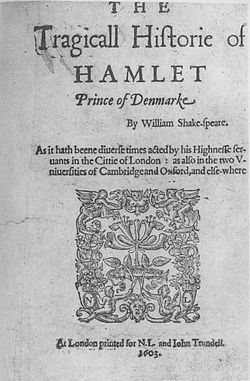
Hamlet Q1 (1603), the first published text of Hamlet, is often described as a "bad quarto".

A bad quarto, in Shakespearean scholarship, is a quarto-sized printed edition of one of Shakespeare's plays that is considered to be unauthorised, and is theorised to have been pirated from a theatrical performance without permission by someone in the audience writing it down as it was spoken or, alternatively, written down later from memory by an actor or group of actors in the cast – the latter process has been termed "memorial reconstruction". Since the quarto derives from a performance, hence lacks a direct link to the author's original manuscript, the text would be expected to be bad, i.e. to contain corruptions, abridgements and paraphrasings.[1][2]

In contrast, a good quarto is considered to be a text that is authorised and which may have been printed from the author's manuscript (or a working draft thereof, known as his foul papers), or from a scribal copy or prompt copy derived from the manuscript or foul papers.[3]

The concept of the bad quarto originates in 1909, attributed to A W Pollard and W W Greg. The theory defines as "bad quartos" the first quarto printings of Romeo and Juliet, Henry V, The Merry Wives of Windsor and Hamlet,[2] and seeks to explain why there are substantial textual differences between those quartos and the 1623 printing of the first folio edition of the plays.

The concept has expanded to include quartos of plays by other Elizabethan authors, including Peele's The Battle of Alcazar, Greene's Orlando Furioso, and the collaborative script, Sir Thomas More.[4][5]

The theory has been accepted, studied and expanded by many scholars; but some modern scholars are challenging it[6][7][8][9] and those, such as Eric Sams,[10] consider the entire theory to be without foundation. Jonathan Bate states that "late twentieth- and early twenty-first century scholars have begun to question the whole edifice".[11]

Origins of bad quarto theory

[edit]

The concept of the bad quarto as a category of text was created by bibliographer Alfred W. Pollard in his book Shakespeare Folios and Quartos (1909). The idea came to him in his reading of the address by the editors, John Heminges and Henry Condell, which appears at the beginning of Shakespeare's First Folio and is titled, "To the Great Variety of Readers". Heminges and Condell refer to "diuerse stolne, and surreptitious copies" of the plays. Up until 1909, it had been thought that the reference to stolen copies was a general reference to all quarto editions of the plays.

Pollard, however, claimed that Heminges and Condell meant to refer only to "bad" quartos (as defined by himself), and Pollard listed as bad the first quartos of Romeo and Juliet (1597), Henry V (1600), The Merry Wives of Windsor (1602), Hamlet (1603), and Pericles (1609). Pollard pointed out that not only do these five texts contain "badness" (namely significant textual errors and corruptions), but also that there is (legal) "badness" in those who pirated them.[12]

Scholar W. W. Greg worked closely with Pollard and published the bad quarto of The Merry Wives of Windsor,[13] which is a work that is significant in the history of the "bad quarto" theory. Greg described how the text may have been copied, and he identified the actor who played the role of "Host" as the culprit. Greg called the process that the actor may have used "memorial reconstruction", a phrase later used by other scholars[14][15] – meaning, literally, a reconstruction of it from memory.

Comparison of the "To be, or not to be" soliloquy in the first three editions of Hamlet

For Shakespeare, the First Folio of 1623 is the crucial document; of the 36 plays contained in that collection, 18 have no other source. The other 18 plays had been printed in quarto form at least once between 1594 and 1623, but since the prefatory matter in the First Folio itself warns against earlier texts, which are termed "stol'n and surreptitious copies, maimed and deformed by frauds and stealths of injurious impostors", 18th- and 19th-century editors of Shakespeare tended to ignore the quarto texts and preferred the Folio.

It was at first suspected that the bad quarto texts represented shorthand reporting, a practice mentioned by Thomas Heywood in the Prologue to his 1605 play If You Know Not Me, You Know Nobody; reporters would surreptitiously take down a play's text in shorthand during a performance and pirate a popular play for a competing interest. However, Greg and R.C.Rhodes argued instead for an alternative theory: since some of the minor speeches varied less (from the folio text) than those of major characters, their hypothesis was that the actors who played the minor roles had reconstructed the play texts from memory and thereby gave an accurate report of the parts that they themselves had memorized and played, but a less correct report of the other actors' parts.

The idea caught on among Shakespearean scholars. Peter Alexander added The First Part of the Contention Betwixt the Two Famous Houses of York and Lancaster (1594) and The True Tragedy of Richard Duke of York (1595) – the earliest versions of Henry VI, Part 2 and Henry VI, Part 3 – to the roster of bad quartos; both had been previously thought to be source plays for Shakespeare's later versions of the same histories. The concept of the bad quarto was then extended to play texts by authors other than Shakespeare, and by the second half of the 20th century the idea was being widely adopted.[16] However, by the end of the century dissenting views had been published, such as the work of Laurie Maguire, then at the University of Ottawa.

Criticism and alternative hypotheses

[edit]

Various problems exist with the bad quarto hypothesis, particularly concerning the notion of memorial reconstruction. Furthermore, the hypothesis makes no allowance for changes to occur in the text across the enormous period between 1594 and 1623 (almost thirty years), from revisions by the author, abridgements for special circumstances, or natural evolution resulting from improvements to the text made by the actors in performance.

For some plays, critics seem undecided even as to what amounts to a bad quarto. The first quarto of Richard III, for instance, is often now termed a bad quarto, "even though it is an unusually good bad quarto".[17] Alexander himself recognised that the idea of memorial reconstruction did not apply perfectly to the two plays he studied, which possessed problematical features that could not be explained, and in the end retreated to arguing, instead, that the quartos of the two early histories were "partial" memorial reconstructions.

Some critics, including Eric Sams and Hardin Craig, dispute the entire concept of memorial reconstruction by pointing out that, unlike shorthand reporting, no reliable historical evidence exists that actors reconstructed plays from memory. They believe that memorial reconstruction is a modern fiction.

Individual scholars have sometimes preferred alternative explanations for variant texts, such as revision or abridgement by the author. Steven Urkowitz argued the hypothesis that King Lear is a revised work, in Shakespeare's Revision of "King Lear". Some scholars have argued that the more challenging plays of the Shakespearean canon, such as All's Well That Ends Well and Troilus and Cressida, make sense as works that Shakespeare wrote in the earliest, rawest stage of his career and later revised with more sophisticated additions.

Steven Roy Miller considers a revision hypothesis, in preference to a bad-quarto hypothesis, for The Taming of a Shrew, the alternative version of Shakespeare's The Taming of the Shrew.[18]

Robert Burkhart's 1975 study Shakespeare's Bad Quartos: Deliberate Abridgements Designed for Performance by a Reduced Cast provides another alternative to the hypothesis of bad quartos as memorial reconstruction. Other studies have also questioned the "orthodox view" on bad quartos, as in David Farley-Hills's work on Romeo and Juliet.

Maguire study

[edit]

In 1996, Laurie Maguire of the Department of English at the University of Ottawa published a study[19] of the concept of memorial reconstruction, based on the analysis of errors made by actors taking part in the BBC TV Shakespeare series, broadcast in the late 1970s and early 1980s.

She found that actors typically add, drop or invert single words. But the larger-scale errors that would be expected if actors were attempting to piece together the plays some time after their performance failed to appear in all but a few of the bad quartos. The study uncovered only limited circumstantial evidence suggestive of possible memorial reconstruction, in the bad quartos of Hamlet, The Merry Wives of Windsor and Pericles.

In fact, according to Maguire, virtually all the so-called bad quartos appear to be accurate renditions of original texts, which "merit our attention as valid texts in their own right".[20] This challenges the entire concept of bad quartos as pirated editions, mired in textual corruption; and presents them, rather, as earlier versions of the plays printed in the 1623 folio.

Of other playwrights

[edit]

Though the bad quarto concept originated in reference to Shakespearean texts, scholars have also applied it to non-Shakespearean play texts of the English Renaissance era.

In 1938, Leo Kirschbaum published "A Census of Bad Quartos" and included 20 play texts.[21] Maguire's 1996 study examined 41 Shakespearean and non-Shakespearean editions that have been categorised as bad quartos, including the first editions of Arden of Feversham, The Merry Devil of Edmonton and Fair Em, plays of the Shakespeare Apocrypha; plus George Chapman's The Blind Beggar of Alexandria; Christopher Marlowe's Doctor Faustus and The Massacre at Paris; Part 1 of Heywood's If You Know Not Me, You Know Nobody; and Beaumont and Fletcher's The Maid's Tragedy.[22]

References

[edit]

Sources

[edit]
  • Alexander, Peter. Shakespeare's Henry VI and Richard III. Cambridge, Cambridge University Press, 1929.
  • Burkhart, Robert E. Shakespeare's Bad Quartos: Deliberate Abridgements Designed for Performance by a Reduced Cast. The Hague, Mouton, 1975.
  • Craig, Hardin. A New Look at Shakespeare's Quartos. Stanford, California, Stanford University Press, 1961.
  • Evans, G. Blakemore, textual editor. The Riverside Shakespeare. Boston, Houghton Mifflin, 1974.
  • Farley-Hills, David. "The 'Bad' Quarto of Romeo and Juliet," Shakespeare Survey 49 (1996), pp. 27–44.
  • Halliday, F. E. A Shakespeare Companion 1564–1964. Baltimore, Penguin, 1964.
  • Hart, Alfred, "Stolne and Surreptitious Copies: A Comparative Study of Shakespeare's Bad Quartos," Melbourne Univ. Press, 1942 (reprinted Folcroft Library Editions, 1970).
  • Kirschbaum, Leo. "A Census of Bad Quartos." Review of English Studies 14:53 (January 1938), pp. 20–43.
  • Maguire, Laurie E. Shakespearean Suspect Texts: The "Bad" Quartos and Their Contexts. Cambridge, Cambridge University Press, 1996.
  • Miller, Steven Roy, ed. The Taming of a Shrew: the 1594 Quarto. Cambridge, Cambridge University Press, 1998.
  • Pollard, Alfred W. Shakespeare Folios and Quartos. London, Methuen, 1909.
  • Rhodes, R. C. Shakespeare's First Folio. Oxford, Blackwell, 1923.
  • Urkowitz, Steven. Shakespeare's Revision of "King Lear." Princeton, N.J., Princeton University Press, 1980.
Revisions and contributorsEdit on WikipediaRead on Wikipedia
from Grokipedia
A bad quarto is a term in Shakespearean textual scholarship referring to certain early printed editions of William Shakespeare's plays, published in quarto format between the 1590s and 1610s, that are considered inferior or "corrupt" compared to later authoritative texts due to significant textual inaccuracies, abbreviations, omissions, and errors such as misplaced lines, metrical irregularities, and garbled passages. These editions are typically shorter than their "good" quarto counterparts, which are believed to derive from Shakespeare's working manuscripts or "foul papers," and they often exhibit inconsistencies in scene structure and dialogue that deviate from the plays' intended forms. Scholars identify around 20 to 41 such suspect quartos, depending on the criteria used, with publications spanning from 1594 to 1620, though only a subset—such as the 1603 , the 1594 The Taming of a Shrew, the 1602 , the 1597 , the 1600 Henry V, and the 1609 —are widely classified as definitively "bad" due to strong evidence of memorial reconstruction or other non-authorial processes. The origins of these texts remain debated, but leading theories posit they arose from piracy, including reconstructions from actors' memories of performances, shorthand notations taken during stage productions, or adaptations for provincial touring companies, rather than direct access to Shakespeare's manuscripts. These bad quartos played a pivotal role in the early transmission of Shakespeare's works, sometimes serving as the only surviving early versions of plays like before being superseded by more reliable editions in the 1623 , though their textual flaws have influenced modern editorial practices by necessitating careful collation with later sources to reconstruct the dramatist's original intentions. Despite their imperfections, they offer valuable insights into Elizabethan printing practices, performance histories, and the fluid nature of dramatic texts in the period, challenging assumptions about textual stability in Renaissance drama.

Definition and Characteristics

Definition

A bad quarto refers to an early, unauthorized quarto edition of a William Shakespeare's play that exhibits textual inferiority, brevity, and corruption relative to subsequent authoritative texts, such as those compiled in the of 1623. These editions typically deviate substantially from the dramatist's intended script, featuring inconsistencies, abbreviations, and alterations that undermine their reliability as sources for the plays' original forms. The term "bad quarto" was introduced by the bibliographer Alfred W. Pollard in his 1909 study Shakespeare Folios and Quartos, where he categorized certain quartos as "bad" to differentiate them from "good" quartos, which derive from more dependable manuscripts and preserve the plays with greater fidelity. Pollard's framework emphasized the piratical or reconstructive nature of these texts, often printed without permission from the play's owners, such as Shakespeare's acting company. Prominent examples of bad quartos include the first editions of (1597), Henry V (1600), (1602), and (1603), each of which is markedly shorter and more erratic than its Folio counterpart. Scholars classify a quarto as "bad" based on criteria such as textual instability—evident in erratic verse patterns and prose intrusions—substantial omissions of dialogue or scenes, and non-authorial origins, frequently attributed to memorial reconstruction by performers who recalled the play from memory rather than consulting an official script.

Key Features

Bad quartos are distinguished by their textual corruption, which manifests in garbled verse, substitutions of prose for original verse, rearrangements of scenes, and confusions among characters. For instance, in the First Quarto of Hamlet (1603), the famous soliloquy begins as "To be, or not to be, I, there's the point," with lines rearranged and verses fragmented, while prose often replaces the iambic pentameter found in later authoritative texts. Similarly, character names are conflated or altered, such as Polonius becoming Corambis and his son Reynaldo renamed Montano, alongside companions referred to as Gilderstone and Rossencraft instead of Rosencrantz and Guildenstern. These anomalies suggest reconstruction from memory rather than direct authorial manuscripts, leading to inconsistencies that disrupt dramatic coherence. A hallmark of bad quartos is their significantly shortened length, typically 30-50% shorter than corresponding folio or "good" quarto versions, achieved through omitted scenes, dialogues, or entire passages. The First Quarto of Henry V (1600), for example, spans about 1,717 lines—roughly half the 3,381 lines of the 1623 —excluding key elements like the choruses, the "Once more unto the breach" speech (3.1), and scenes of French preparations (4.2). This abbreviation likely reflects practical adaptations for performance or unauthorized reporting, prioritizing action over elaboration. Linguistic anomalies further mark these texts, including anachronistic phrasing, simplified tailored to , and stage directions oriented toward rather than literary detail. In bad quartos, verse is often irregularly lineated, with sections from folios rendered as verse, as seen in the First of Henry V where Williams's speech is versified. Such simplifications reduce complex to more straightforward expressions, potentially aiding or touring productions. Printing evidence in bad quartos reveals irregularities like inconsistent , compositor errors from hasty production, and frequent absence of authorial attribution, underscoring their unauthorized status. The First Quarto of , printed by Valentine Simmes for Nicholas Ling and John Trundell, lacks Shakespeare's name on the and shows deviations indicative of non-authoritative sources. Compositor mistakes, such as mislineation or erroneous speech prefixes, compound the textual instability, distinguishing these from meticulously prepared editions.

Historical Context and Examples

Publication History

In the Elizabethan and Jacobean periods, the printing and publication of dramatic works were regulated by the Stationers' Company, granted a in 1557 that established a monopoly over the English book trade. Members, known as stationers, secured exclusive rights to print specific titles by entering them into the Stationers' Register, a practice intended to curb unlicensed printing and facilitate . However, this system did not protect , leading to widespread where printers produced unauthorized editions to evade competition and maximize profits. Unauthorized printings often involved collaboration between printers and actors, who might sell or reconstruct play texts from memory to supply material for these illicit ventures. The publication of play quartos in single-sheet folded format proliferated during the 1590s, coinciding with frequent theater closures due to plague epidemics that disrupted performances and reduced companies' revenues. A notable surge occurred in 1594 following the 1592–1593 plague outbreak, which shuttered playhouses and prompted an unprecedented wave of eighteen play prints, many derived from professional troupes. Within this context, bad quartos—defective early editions marked by textual irregularities—emerged prominently between 1597 and 1603, exemplified by the first quarto of in 1597 and in 1603. Economic pressures drove the production of these bad quartos, as stationers sought to capitalize rapidly on the growing popularity of without securing authorization from play-owners like acting companies. Printers prioritized speed and low cost, using inexpensive paper and hasty typesetting to flood the market with affordable pamphlets priced at sixpence, often before a play's full run or official release. This opportunistic approach contrasted sharply with later efforts, such as the , compiled by Shakespeare's fellow actors John Heminges and using company-provided manuscripts to present 36 plays in a collected, authoritative edition that superseded the flawed quartos.

Specific Shakespeare's Quartos

The First Quarto of Henry V (Q1, 1600) is approximately half the length of the text, with significant omissions including the choruses and much of the comic material, resulting in shortened battle scenes that streamline the Agincourt campaign into a more concise, patriotic narrative emphasizing English heroism and unity. This version simplifies complex historical elements, such as the French perspective and internal conflicts, to heighten nationalistic fervor, potentially reflecting adaptations for touring performances. The First Quarto of (Q1, 1597) is nearly 800 lines shorter than the Second Quarto, featuring an abbreviated plot that condenses key events like the feud's origins and the lovers' meetings, while altering the ending with a more abrupt and confused death scene where Romeo's final lines are truncated and Juliet's occurs hastily without extended lamentation. Scholars attribute these changes to a possible memorial reconstruction derived from performance, as evidenced by garbled verse and substitutions in . The First Quarto of Hamlet (Q1, 1603) is radically condensed, roughly half the length of later versions, with fragmented scenes, nonsensical prose passages, and actor confusions where lines are reassigned or merged, such as Horatio delivering parts of Marcellus's dialogue. Notably, the "To be or not to be" soliloquy appears earlier, in Act 2 before the nunnery scene with Ophelia, and is rephrased with simplified language focusing on action over philosophical depth, altering its contemplative tone. Debated cases include the 1595 octavo of 3 Henry VI (printed as The True Tragedy of Richard Duke of York), which shares memorial reconstruction traits like inconsistent verse and omitted episodes with undisputed bad quartos, though some scholars question its due to potential early draft status. Similarly, the 1609 of Pericles is viewed as a partial bad quarto, with the first two acts showing heavy and reconstruction errors, while later acts appear more authoritative, possibly indicating collaborative reporting from performance. These texts align with the memorial reconstruction , where performers pieced together scripts from memory.

Development of the Theory

Pollard's Origins

In 1909, bibliographer Alfred W. Pollard introduced the distinction between "good" and "bad" quartos in his seminal work Shakespeare Folios and Quartos: A Study in the Bibliography of Shakespeare's Plays, 1594-1685, categorizing early printed editions of Shakespeare's plays based on their textual quality and reliability. Pollard identified 14 "good" quartos as authoritative texts derived from manuscripts close to Shakespeare's originals, while designating six others— including those of (1597), Henry V (1600), and (1603)—as "bad" due to their abbreviated, corrupted, and inconsistent nature. This classification stemmed from Pollard's analysis of the (1623), where editors Jaggard, Heminges, and Condell described certain quartos as "stol'n and surreptitious copies," which Pollard interpreted as referring specifically to these defective editions rather than all pre-Folio printings. At the core of Pollard's theory was the notion that bad quartos represented unauthorized, pirated publications, obtained and printed without access to authorial or theatrical manuscripts, leading to their inferior quality. He posited that these texts were likely reconstructed through non-authorial means, such as reports from performances or recollections by participants, resulting in omissions, alterations, and errors that deviated markedly from later authoritative versions. As evidence, Pollard highlighted textual inconsistencies, such as shortened scenes, garbled dialogue, and structural anomalies when compared to the Folio texts, alongside potential biases from actors or reporters who might prioritize memorable lines or stage cues over fidelity to the script. For instance, the bad quarto of Hamlet (Q1, 1603) exhibits significant divergences from the 1604-05 quarto, including compressed action and altered phrasing, underscoring the reconstructive process. Pollard's framework quickly gained traction in early 20th-century scholarship, laying the groundwork for the New Bibliography movement of the and 1930s, which emphasized rigorous textual analysis to establish authoritative editions of Shakespeare's works. Scholars like W.W. Greg and R.B. McKerrow built upon his ideas, adopting the bad quarto category to investigate practices and textual transmission, thereby influencing editorial practices that prioritized "good" texts for modern editions. This early acceptance solidified the theory's role in distinguishing from corrupt ones, shaping bibliographic studies for decades.

Early Theoretical Advances

Building upon Alfred W. Pollard's initial classification of certain Shakespearean quartos as unauthorized "bad" editions in 1909, early 20th-century scholars refined the theory through detailed textual analysis, emphasizing processes of unauthorized transmission rather than simple piracy. W. W. Greg, in his 1923 publication Two Elizabethan Stage Abridgements, advanced the concept of "memorial reconstruction," positing that these texts resulted from systematic efforts by actors to reconstruct plays from memory after performances, rather than direct copying from manuscripts. This hypothesis, first tentatively applied by Greg to The Merry Wives of Windsor in his 1910 edition, explained characteristic features like omissions, substitutions, and inconsistencies as artifacts of performative recall, particularly by participants in provincial tours or rival companies. Greg's framework gained traction in the 1920s as it integrated with emerging bibliographical methods, allowing scholars to distinguish bad quartos from authorial drafts through examination of printing irregularities, such as erratic lineation and compositor errors indicative of unstable copy. For instance, analytical bibliography revealed that texts like the 1603 Hamlet (Q1) lacked the foul papers' hallmarks—authorial revisions and cancellations—supporting non-authorial origins derived from oral or reconstructed sources. Peter Alexander, in his 1920s and 1930s studies, further elaborated this by identifying actor-specific errors, such as role confusions in Hamlet Q1 where characters like Corambis (Polonius) and Montano are conflated, suggesting the reconstructor was an actor familiar with multiple parts but prone to blending them under memory strain. By the 1930s, the theory expanded to incorporate potential influences from prompt copies, where actors might have drawn on abbreviated stage manuscripts to aid reconstruction, blending memorized with skeletal plot notes for brevity in touring versions. Additionally, hypotheses of reporting emerged as a complementary , with and others exploring whether Elizabethan stenographic techniques—capable of capturing live performances—could account for the abbreviated, error-prone nature of bad quartos like Henry V (Q1), though remained cautious about its prevalence. These advances solidified the bad quarto as a category of derivative texts, prioritizing performative and mnemonic processes over , and laid groundwork for later bibliographical scrutiny.

Criticisms and Alternatives

Challenges to Traditional Views

One of the primary challenges to the traditional memorial reconstruction for bad quartos arises from inconsistencies in the evidentiary patterns across these texts. While proponents like W.W. Greg argued that the variations stemmed from actors' faulty recollections, not all bad quartos display uniform indicators of actor-specific errors, such as conflated roles or omitted cues; instead, some exhibit patterns suggestive of authorial revisions or adaptations for different performance contexts. This variability undermines the assumption of a singular reconstructive process, as the errors do not consistently align with memory lapses from theatrical performance. Critics have also highlighted an overemphasis on the "badness" of these quartos, which often relies on subjective qualitative assessments biased by retrospective comparison to the more polished Folio texts. The label "bad" presupposes the Folio's superiority as a benchmark, yet this hierarchy ignores the possibility that quartos could represent legitimate early drafts or regional variants valued in their own right, rather than inherently inferior reconstructions. Such judgments, rooted in early 20th-century New Bibliography, have been faulted for , where textual discrepancies are deemed "bad" precisely because they deviate from later editions, without independent verification of their origins. Historical critiques further erode the by pointing to a profound lack of supporting methods like surreptitious or group recall. No contemporary records document or stenographers reconstructing full plays from for , and alternative printing sources—such as abbreviated prompt-books or authorized foul papers—offer plausible explanations for the texts' peculiarities without invoking illicit reconstruction. This evidentiary gap has led scholars to question the feasibility of the proposed mechanisms, emphasizing instead the commercial and theatrical norms of the era that favored legitimate dissemination. Key figures in these challenges include Alfred Hart, whose 1942 study rigorously questioned the practicality of as a piracy tool, demonstrating that Elizabethan stenographic systems lacked the speed and accuracy needed to transcribe complex dramatic dialogue verbatim. Building on such doubts, Hardin Craig in 1961 critiqued the broader reliance on memory accuracy, arguing that the inconsistencies in bad quartos better reflect authorial experimentation or compositional stages than flawed recollections by performers. These mid-20th-century interventions shifted focus toward more nuanced textual histories, highlighting the theory's speculative foundations.

Competing Hypotheses

One prominent alternative to the memorial reconstruction theory posits that some bad quartos represent earlier authorial drafts subsequently revised by Shakespeare himself. Lukas Erne argues that textual differences in quartos of Romeo and Juliet, Henry V, and Hamlet may stem from Shakespeare's intentional revisions, rather than corruption through memory, suggesting these shorter versions served as pre-performance scripts adapted for stage needs. Similarly, for Hamlet Q1, Leah S. Marcus proposes it as a provisional early version worthy of study as a standalone text, potentially reflecting Shakespeare's initial composition before later expansions, emphasizing its ties to oral and performative elements over derivative piracy. Another hypothesis attributes textual irregularities in bad quartos to compositor errors during , compounded by adaptations for commercial purposes such as length or market appeal. Compositors often misheard dictated text, selected incorrect type, or grappled with illegible , leading to substitutions like "sallied" for "" in Hamlet or "word" for "name" in , which could render a quarto "bad" without invoking actor memory. Booksellers or printers might further abridge or alter manuscripts to fit constraints or provincial performances, prioritizing brevity over fidelity. Theatrical reporting variants offer a nuanced explanation, suggesting bad quartos derive from a mix of foul papers (authorial drafts) and performance annotations in theatrical manuscripts, rather than solely from memorized reconstructions. Leo Kirschbaum's analysis indicates that pirates likely accessed such hybrid documents, incorporating stage directions and cues that blend original writing with practical notations, as seen in the detailed but erratic directions of Q1. This approach accounts for inconsistencies without assuming flawed human recall alone. Ur-text hypotheses propose that certain bad quartos, particularly *, may preserve elements closer to lost precursors or pre-Shakespearean sources like the hypothetical from the 1580s, possibly by . Terri Bourus examines how Q1's structure and content align more closely with references to an earlier Hamlet play (e.g., by Nashe in 1589), suggesting it captures a foundational version predating Shakespeare's fuller elaboration, rather than a degraded derivative.

Modern Scholarship

Maguire's Contributions

Laurie E. Maguire's 1996 monograph Shakespearean Suspect Texts: The "Bad" Quartos and Their Contexts fundamentally reevaluated the concept of "bad quartos" by employing empirical methods to assess the uniformity of textual errors across 41 suspect play texts from Shakespeare's era. Through a systematic statistical , Maguire examined 28 diagnostic features—such as repetition, transposition, and substitution—commonly attributed to memorial reconstruction, comparing their frequency in these texts to a large control corpus of non-suspect plays printed between 1585 and 1625. Her tabulated results demonstrated that these errors were not uniquely concentrated in the so-called bad quartos, thereby challenging the traditional categorization as a homogeneous group derived from actor-reported manuscripts. Building on earlier articles from the , such as her analyses of textual omissions, Maguire further compared patterns of "lost "—including abbreviated scenes and gaps—across multiple plays, revealing inconsistencies that deviated from expected memorial reconstruction models. For instance, omissions in texts like the first of Henry V (1600) exhibited patterns more akin to deliberate abridgment or compositional variants than faulty recollection, as evidenced by their alignment with non-memorial sources like commonplace books and folk traditions. These comparisons highlighted diverse error distributions that undermined the uniformity of the bad category, suggesting instead a of textual instabilities influenced by multiple factors beyond . Maguire's findings attributed many corruptions to printing house practices, including compositorial errors, unauthorized alterations during , and the reuse of damaged manuscripts, rather than actor reconstruction or reporting. She explicitly rejected the shorthand theory, originally proposed by early twentieth-century scholars like Alfred Pollard, by demonstrating through quantitative evidence that no single mechanism like stenography could account for the varied textual anomalies observed. This data-driven critique exposed the limitations of New Bibliographical assumptions, such as those advanced by W. W. Greg, which had prioritized memorial origins without sufficient empirical validation. Maguire's work profoundly shifted scholarly focus toward the diversity of textual transmission in early modern drama, emphasizing multifaceted provenances over monolithic explanations. Her methodologies influenced subsequent editorial practices, encouraging editors of modern editions—such as those in the series—to treat suspect texts with greater nuance, often retaining variants as potential authorial or performative insights rather than dismissing them as derivatives. This reevaluation has become a cornerstone of contemporary Shakespearean , promoting interdisciplinary approaches that integrate , statistics, and historical evidence.

Recent Reassessments

In the , scholars began reevaluating the label applied to early Shakespeare quartos, emphasizing their value as records of theatrical practice rather than mere corruptions. Emma , in her editorial contributions to The Cambridge Companion to Shakespeare's First Folio (2016), argued that these texts, often dismissed as "bad," function as performative documents capturing the dynamism of adaptations and contributions, challenging the notion of inherent inferiority by highlighting their role in the playhouse . This perspective aligns with broader critiques that reposition suspect quartos as legitimate variants reflecting performance choices over . Digital humanities tools have further illuminated the complexities of these texts through advanced collation and analysis. In a 2019 special issue of Critical Survey dedicated to the First Quarto of Hamlet, researchers employed digital collation software to compare variants across editions, revealing patterns of printing errors, compositorial interventions, and potential memorial elements without defaulting to the "bad quarto" framework; for instance, tools like Juxta and Collate identified substantive differences that suggest controlled abridgments for touring rather than wholesale reconstruction. These applications have enabled more nuanced understandings of textual transmission, underscoring how printing variants preserve traces of early modern theatrical adaptation. Debates over terminology have intensified in the mid-2010s, with scholars advocating for neutral descriptors to avoid bias against non-Folio texts. Studies from 2015 to 2019, building on Laurie E. Maguire's foundational work, proposed terms like "suspect quarto" or "variant quarto" to describe texts such as Q1 Hamlet (1603), critiquing "bad" as a value-laden term that privileges later editions; for example, Terri Bourus in Critical Survey (2019) reframed Q1 Hamlet as a "good enough quarto," emphasizing its coherence as a standalone performance script. This shift reflects a consensus that such labels better facilitate objective analysis of textual diversity. By 2025, major editorial projects have incorporated these reassessments, treating early quartos as authoritative witnesses in their own right. The Third Series, in editions like (2006, revised 2016), includes parallel texts of Q1 alongside Q2 and F, presenting them as viable performative versions without hierarchical judgment. Similarly, the New Oxford Shakespeare (2016–2017) volumes integrate variant quartos into multi-text apparatuses, such as for , validating Q1 (1597) as a potential early draft or , influencing ongoing scholarly and theatrical engagements with these materials.

Extensions to Other Playwrights

Non-Shakespearean Examples

While the concept of "bad quartos" originated with analyses of Shakespeare's texts, similar textual irregularities—such as apparent memorial reconstruction, unauthorized publication, and performance-related abbreviations—appear in quartos of plays by other early modern dramatists associated with the (later the King's Men). These instances suggest broader patterns of textual instability in the theater company's during the late Elizabethan and early Jacobean periods. Ben Jonson's Sejanus His Fall, published in in 1605, exemplifies such issues through its fragmented structure and omissions. In the "To the Readers," Jonson explains that the printed text represents the version performed by the King's Men, but with certain passages excised because they exceeded ' interpretive capacities or the play's allowable length, resulting in a corrupted or incomplete dramatic whole compared to his intended authorial . This self-documented highlights how performance constraints could lead to textual truncation akin to reconstruction errors in suspect editions. The 1599 of Jonson's differs from the revised version of 1616 in dialogue, attributions, and stage directions. These discrepancies arise from Jonson's own authorial revisions for the folio, including changes to setting and character names, rather than from theatrical sources. Other notable cases include the 1612 of John Webster's , the anonymous (1608), performed by the King's Men and falsely attributed to Shakespeare on its , demonstrates hallmarks of through its abbreviated length, garbled phrasing, and evident reconstruction from memory, as it condenses a real-life domestic into a terse dramatic form. Across these examples, common traits emerge: unauthorized or hastily printed editions derived from actors' recollections or partial scripts, often linked to the Chamberlain's/King's Men's efforts to control but ultimately failing to prevent textual dissemination outside official channels. These parallels underscore and reconstruction as systemic vulnerabilities in early modern play publication, extending beyond Shakespeare to his contemporaries.

Comparative Insights

Bad quartos, or suspect texts exhibiting significant textual irregularities, appear not only in Shakespeare's works but also in those of other Elizabethan and Jacobean playwrights, revealing shared patterns in the era's printing practices. For instance, the first quarto of Christopher Marlowe's Doctor Faustus (1604) displays mnemonic errors and omissions akin to those in Shakespeare's Hamlet Q1 (1603), suggesting actor involvement in reconstructing plays from memory for unauthorized publication. Similarly, Thomas Dekker and Thomas Middleton's The Fair Maid of Bristow (1605) and Robert Greene's Orlando Furioso (1594) exhibit garbled passages and structural inconsistencies attributable to piracy, mirroring the surreptitious printing seen in Shakespeare's suspect quartos like Henry V Q1 (1600). These parallels indicate that actors, seeking quick profit, often supplied printers with imperfect recollections of performed scripts across the dramatic repertoire. Despite these commonalities, differences emerge when comparing individual playwrights' circumstances. exercised unprecedented authorial control over his texts' dissemination, personally overseeing the printing of his 1616 folio collection Workes, which included revised versions of earlier plays and minimized opportunities for pirated editions. This vigilance resulted in fewer "bad" instances for Jonson compared to Shakespeare, whose company relied more on posthumous or collaborative oversight for quarto publications. In contrast, Thomas Heywood's prolific output, frequently collaborative with figures like Dekker and Webster, produced texts with pronounced variants due to multiple authorial inputs and iterative revisions; for example, the 1605 quarto of Heywood's If You Know Not Me, You Know Nobody was decried by the author himself as corrupted, likely through unauthorized reporting that amplified discrepancies inherent in joint composition. These cross-playwright comparisons bolster the view that bad quartos stem from systemic issues in the early modern printing trade—such as rampant and inconsistent textual transmission—rather than peculiarities unique to Shakespeare's memorial reconstruction theory. By demonstrating industry-wide vulnerabilities, non-Shakespearean cases underscore the limitations of Alfred W. Pollard's 1909 framework, which emphasized or memory lapses in Shakespeare-specific contexts. Scholars have extended Pollard's model through analysis of non-Shakespearean examples, testing its applicability and revealing subtler corruptions. Laurie Maguire's examination of 41 suspect texts, including non-Shakespearean ones like George Peele's The Battle of Alcazar (1594), finds fewer instances of uniform memorial errors than Pollard anticipated, pointing instead to diverse origins such as partial manuscripts or audience reporting. This broader scrutiny refines the theory, emphasizing contextual factors like company practices over playwright-specific traits, and highlights how fewer standardized corruptions in texts like Sir Thomas Wyatt (1602) challenge assumptions of consistent reconstruction methods.

References

Add your contribution
Related Hubs
User Avatar
No comments yet.