Hubbry Logo
BaghbanBaghbanMain
Open search
Baghban
Community hub
Baghban
logo
8 pages, 0 posts
0 subscribers
Be the first to start a discussion here.
Baghban
Baghban
from Wikipedia

The Baghban are a Muslim community, found in North India and in Pakistan. In the Deccan region they are known as Bagwan.[1][2]

Key Information

References

[edit]
Revisions and contributorsEdit on WikipediaRead on Wikipedia
from Grokipedia
The Baghban are a Muslim community found in and . The name "Baghban," derived from Persian meaning "gardener," reflects their traditional occupation as market gardeners, vegetable sellers, and horticulturists. In the Deccan region of , they are known as Bagwan. Most Baghban are and are considered a or branch of the Kunjra community in some traditions.

Etymology

Origin of the Name

The term "Baghban" derives from , where it literally means "" or "one who tends gardens," directly reflecting the community's longstanding involvement in . This underscores the occupational identity tied to the cultivation and of gardens, orchards, and plots, a role that shaped the group's social and economic position in . During the Mughal era, the term "Baghban" appeared in administrative and legal documents to refer to market gardeners and orchard keepers, particularly in regions around and the . For instance, records from the reign of (1628–1658) include references to individuals identified by the "tribe Baghban" in land tenancy and acquittance deeds, indicating their recognized status as a professional group managing agricultural lands for produce. Such usage highlights how the name encapsulated both the and emerging affiliations amid the empire's agrarian . While "Baghban" shares linguistic roots with the term "Mali," which denotes a similar occupation among Hindu castes, the term "Baghban" is specifically used to identify the Muslim community. This distinction reflects the Persian-influenced terminology prevalent in Muslim contexts, in contrast to the indigenous for Hindu groups. The Baghban community is known by the variant name "Bagwan" in the Deccan region, particularly in areas such as and , where regional phonetic shifts have led to this adaptation of the term for the same Muslim gardening group. This variation reflects local linguistic influences without altering the community's core occupational identity as and vegetable cultivators. The Baghban are considered a specialized of the broader Kunjra community, which traditionally engages in selling and trading; in contrast, the Baghban focus more narrowly on and cultivation rather than general market trading. In , for instance, the Baghban identify as an independent occupational subgroup within the Kunjra framework. In , there is notable overlap between the Baghban and the Maliar (or Malyar) communities, where the terms are sometimes used interchangeably to denote market gardeners, though they may represent slightly distinct subgroups based on local customs and practices. This synonymy extends to related terms like , highlighting the fluid occupational boundaries among gardening castes in the region.

History

Early Origins and Conversion

The Baghban community emerged as a distinct Muslim group through conversions from Hindu agricultural castes, particularly the (gardeners), Kachhi, and Murao, during the and early Mughal periods in . According to some traditions, the Baghban retain three endogamous sub-divisions—Kachhi, Murao (or Murdo), and Sani—mirroring these Hindu occupational groups associated with vegetable cultivation and market gardening in the . These origins tie the community to pre-Islamic agrarian societies of the region, where such castes formed the backbone of settled farming communities along the fertile alluvial soils of the and river systems. The religious transition was influenced by Sufi missionaries, whose teachings attracted lower-caste agriculturalists seeking and spiritual solace amid the political upheavals of Muslim rule. Sufi orders like the Chishti and Suhrawardi, active from the 13th century onward, played a role in integrating local customs with Islamic practices, facilitating gradual conversions in rural . The Persian term baghban, meaning "gardener" or "one who tends the garden," adopted as the community's name, underscores this era's cultural synthesis, as it replaced or paralleled Sanskrit-derived terms like while preserving occupational continuity. A notable phase of community formation occurred around the in , during the later Tughlaq and Lodi dynasties, when Sufi outreach in the and regions led to increased conversions among agrarian populations, solidifying the Baghban's Muslim identity distinct from their Hindu counterparts. These conversions were often communal, involving entire villages or kin groups drawn to Sufi pirs (saints) who emphasized equality and agrarian piety, thereby embedding the Baghban within the broader tapestry of Indo-Islamic society.

Migration and Settlement Patterns

During the 18th and 19th centuries, the Baghban community, traditionally engaged in and , undertook significant migrations from regions in , such as and Rampur, to and the Deccan, prompted by the political instability following the Mughal Empire's decline and the disruptions caused by famines and regional conflicts. These movements were influenced by British land reforms, including the Punjab Land Alienation Act of 1901, which listed Baghban among agricultural tribes eligible for land protections and allotments in canal colonies. In the colonial era, Baghban contributed to trade networks, with communities present in urban centers like in and in the Deccan to supply fresh to markets under British administration. Their skills in market allowed them to establish communities in these towns, contributing to local economies through the distribution of vegetables and flowers, often integrating with existing trade routes that connected northern to the south. The in 1947 affected Muslim communities like the Baghban in , where and border changes led to displacements, with many crossing into and resettling in and , while those in consolidated in eastern and . This shift disrupted traditional settlement patterns but reinforced community networks in the new nation-states, with Baghban adapting their agricultural practices to the altered landscapes.

Geographic Distribution

Presence in India

The Baghban community, traditionally associated with and , maintains significant concentrations in northern and , particularly in , where they are prominently settled in urban centers such as and . In , the community engages in vegetable cultivation and trade, often identifying as an independent occupational group linked to broader Muslim agricultural castes. Further south, notable presence exists in , especially around , where community organizations and events underscore their established networks. Karnataka also hosts a substantial Baghban population, recognized under state backward classes lists for their horticultural roles. Smaller pockets are found in and , where they maintain ties to similar agrarian pursuits and are associated with Muslim other backward classes. Within India, the Baghban exhibit a marked urban-rural divide, with a stronger urban footprint in Deccan cities of and , driven by opportunities in market gardening, wholesale fruit and vegetable trade, and street vending. This concentration in urban areas like Vijayapura in reflects adaptations to commercial hubs, where women from the community often participate as vendors. In contrast, rural settlements in tend to focus on traditional cultivation, though overall, the community's mobility has shifted more members toward urban economies over time. Regional variations include the adoption of the "Bagwan" identity in southern states like Karnataka and Maharashtra, a localized variant reflecting Deccan linguistic influences while preserving the core occupational heritage of gardening. This nomenclature appears in official recognitions and community welfare initiatives, highlighting adaptations among descendants of northern migrants.

Presence in Pakistan

The Baghban community in has historical roots in regions like the former (now ) and , with significant concentrations in , where they number approximately 185,000 and engage in gardening and agriculture. In , around 61,000 Baghban reside, particularly in rural areas focusing on orchard management and fruit cultivation in fertile belts such as those around . Their traditional skills in growing citrus and other crops support 's horticultural output, with many continuing as cultivators and traders. Following the in 1947, some Baghban from Indian regions, including limited numbers from and , contributed to communities in Pakistani , forming settlements in urban centers like . The locality of Baghbanpura in , historically inhabited by gardeners tending to expansive Mughal-era lands along the Grand Trunk Road, exemplifies their enduring ties to in the region. Smaller populations reside in Sindh, comprising about 1,300 individuals associated with and broader agricultural groups, while a diaspora in engages in wholesale and related .

Demographics

Population Estimates

The Baghban community in is estimated to number 18,000 individuals, primarily distributed across northern and central states such as , , , , and , according to the latest data. In , the population is estimated at 250,000, concentrated primarily in (185,000) and (61,000), with smaller numbers in , , and . The community exhibits annual growth rates of 1.5% to 2%, consistent with broader demographic trends among Muslim populations in , where urbanization and rising levels contribute to moderated and migration patterns. Enumeration of the Baghban remains challenging due to significant overlap with the Kunjra community in official records, as the two groups share occupational ties to and vegetable trading, often leading to combined or misclassified counts in historical censuses and contemporary surveys.

Linguistic Profile

The Baghban community in northern , particularly , primarily speaks and as their main languages of communication. In these regions, they write in the Perso-Arabic script when communicating among themselves. In the Deccan areas of and , Baghban exhibit linguistic influences from regional languages such as Marathi, , and Telugu, in addition to and . This reflects their adaptation to local environments while maintaining as a key community language. In , Northern is the primary language spoken by the Baghban, particularly in , with secondary languages including , Saraiki, Western Punjabi, and across regions like . The community overall uses multiple languages across their geographic spread. For and Persian religious texts, the style of the Perso-Arabic script is standard. In Indian contexts emphasizing , the script is utilized for written communication. Baghban individuals are typically multilingual, incorporating , , and English for trade, social interactions, and broader engagement in multicultural settings.

Economy and Occupation

Traditional Roles

The Baghban community, whose name derives from the Persian term for "," has long been identified with market as their primary occupation, involving the cultivation of , fruits, and flowers on small landholdings for sale in local bazaars. This practice centered on intensive , where community members grew staple produce such as potatoes and onions, particularly in fertile regions like , to meet urban demand. Their role extended beyond personal plots to serving as caretakers of communal and private gardens, a hereditary profession that distinguished them as a specialized within . In maintaining these gardens, Baghbans relied on time-tested techniques adapted to the alluvial soils of the Indo-Gangetic plains, including to preserve fertility and prevent soil depletion, often alternating with or periods. was achieved through traditional methods like the Persian wheel (), an animal-powered device that lifted water from wells or rivers to nourish crops year-round, enabling reliable yields in semi-arid conditions. These approaches not only supported subsistence but also contributed to local economies by supplying fresh produce to markets. During the Mughal era, Baghbans solidified their identity as stewards of community and royal gardens, functioning as a distinct occupational group responsible for planting, tending, and harvesting in structured estates. This role, separate from broader field cultivation, involved specialized horticultural knowledge passed down through generations, underscoring their integral place in Mughal urban and rural landscapes.

Contemporary Economic Activities

In contemporary times, many Baghban have diversified beyond their traditional roots into wholesale and retail of and fruits, particularly in urban centers like , , and , , where they leverage their agricultural expertise to supply markets. This shift reflects and economic pressures, allowing community members to engage in commerce that sustains livelihoods in growing cities. Education has emerged as a key driver of occupational mobility, especially in , where the Baghban emphasize schooling for both genders, enabling entry into professional fields such as , , and engineering; programs for Other Backward Classes further support this access to higher education and government jobs. In , community initiatives like educational trusts promote similar advancements, helping younger generations pursue skilled professions amid broader economic opportunities. Despite these adaptations, the Baghban encounter persistent challenges, including land fragmentation from laws that divide holdings into uneconomically small plots, diminishing agricultural viability, and stiff from large-scale commercial farms that benefit from and market dominance. These issues exacerbate vulnerabilities for smallholder families reliant on farming, pushing further diversification into non-agricultural sectors.

Society and Culture

Social Organization

The Baghban community follows patrilineal descent, with sons inheriting a larger share of assets than daughters and the eldest son often leading the household. is predominantly endogamous, confined to the biradari or related sub-groups like Kunjra-Baghban, with unions typically arranged in adulthood through negotiations and marriages common to preserve alliances and property within the clan. Gender roles are influenced by occupational demands, with women involved in , household production of , and street vending in markets, while men handle transportation and external trade. Education levels remain low, particularly among women, consistent with broader trends in Muslim communities in .

Customs and Festivals

The Baghban community observes wedding customs aligned with broader Muslim traditions in and , featuring adult marriages arranged through family discussions, often involving unions to maintain . These ceremonies are typically held at the bride's home, with strong community involvement from relatives and neighbors. The Baghban participate in all major Islamic observances, including Eid celebrations and . Their is non-vegetarian, with avoidance of alcohol.

Religion

Islamic Affiliation

The Baghban community is predominantly composed of Sunni adhering to the of Islamic jurisprudence. This affiliation aligns with the broader Sunni traditions prevalent among many Muslim communities in , emphasizing the authority of the and in religious practice. A notable aspect of their Islamic identity involves the veneration of Sufi saints, whom they believe intercede with to fulfill personal requests and provide spiritual support. This practice reflects the pervasive influence of within Baghban religious life, fostering a mystical dimension to their faith that complements orthodox Sunni observances. The community historically converted to from Hindu agricultural backgrounds, such as the Kachhi, Murao, and groups, during the Mughal era.

Community Religious Practices

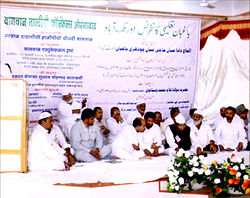
The Baghban community, primarily following the Sunni Hanafi tradition, integrates Islamic religious observance into their daily lives as agricultural workers and gardeners. They perform the five obligatory daily prayers () and observe Islamic festivals. A central practice is the giving of , the Islamic pillar of almsgiving. Under Hanafi jurisprudence, Zakat on agricultural produce is 10% for crops irrigated by natural rainfall and 5% for those irrigated artificially. Annual pilgrimages to nearby dargahs, or shrines of revered Sufi saints, are a communal ritual among the Baghban, where families seek (blessings) for fertile soils and abundant harvests. These visits often involve collective prayers, recitations, and offerings of fresh produce, underscoring the community's reverence for saintly alongside orthodox Islamic —a rooted in their understanding that saints can mediate divine favor for practical needs like crop success. Contemporary efforts to revitalize religious engagement include educational reforms blending faith and modernity. The 2007 Baghban Educational Conference in , , organized by community associations, advocated for curricula that combine Islamic teachings—such as Quranic studies and —with secular subjects like and vocational training, aiming to foster well-rounded Muslim youth capable of navigating both religious and professional spheres.

Notable Individuals

Prominent Figures in Politics and Arts

The Baghban community has been represented in governance in through organizations such as the Falah-e-Baghban Committee, which advocates for the socio-economic rights of its members as agriculturists and gardeners. Leaders like Islamuddin, who served as president of the committee, along with Samsam Ali as general secretary and Shafique Ahmad as secretary, appeared before the in 2002 to press for the inclusion of Baghban in the state's list of Other Backward Classes (OBCs), emphasizing their traditional roles in farming and the need for to address educational and disparities. This effort contributed to the community's recognition as an OBC in , enabling access to reservations that support farmer rights and minority welfare in post-independence .

Scholars and Activists

Members of the Baghban community have been involved in efforts to secure Other Backward Classes (OBC) status in , with modern educators and leaders highlighting the community's socio-economic challenges to gain access to benefits in and . These campaigns underscore the community's push for recognition as a backward class, noting low literacy rates and exclusion from state and central OBC lists as key issues. In the realm of , the Baghban are documented in comprehensive of Indian Muslim communities, such as the Global Encyclopaedic Ethnography of Indian Muslim, which details their historical origins, , and cultural practices as part of broader studies on 320 Muslim castes and tribes. This work contributes to by preserving ethnographic knowledge of occupational communities like the Baghban, traditionally associated with and .

References

Add your contribution
Related Hubs
User Avatar
No comments yet.