Recent from talks
Nothing was collected or created yet.
Bagshot
View on Wikipedia
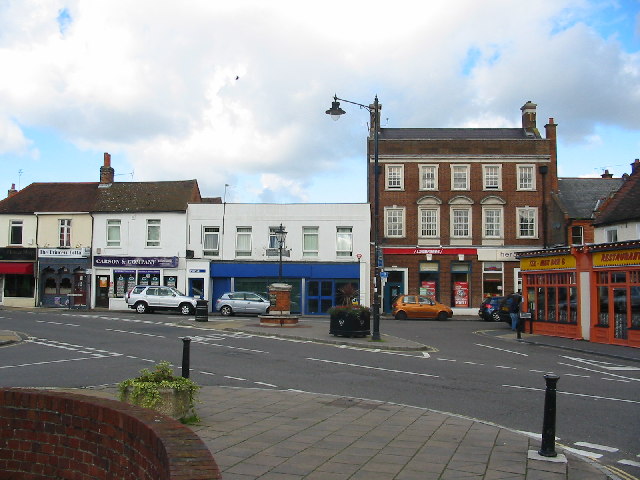
Bagshot is a large village in the Surrey Heath borough of Surrey, England,[2] approximately 27 miles (43 km) southwest of central London. In the past, Bagshot served as an important staging post between London, Southampton and the West Country, evidenced by the original coaching inns still present in the village today.
Key Information
Much of the land surrounding Bagshot is owned by the Ministry of Defence. The village is adjacent to junction 3 of the M3 motorway. Bagshot railway station is on the line between Ascot and Aldershot and train services are run by South Western Railway
Bagshot is part of the civil parish of Windlesham, which has a population of 17,000 and also includes the neighbouring village of Lightwater.[3]
History
[edit]
The place-name 'Bagshot' is first attested in the Pipe Rolls of 1165, where it appears as Bagsheta. It was the name of a wood, and may have meant 'Bacga's wood'.[4]
Recent excavations have shown that settlements of Bagshot date back as far as pre-Roman; before these excavations it was thought that the earliest settlements in Bagshot were late Saxon. Late Bronze Age settlements have been identified in the area, and iron smelting appears to have been a major 'industry' in the locality. Bagshot at one time included a Royal forest. It had a Royal hunting lodge certainly through Stuart and Tudor times, now called Bagshot Park, which is now the residence of Prince Edward, Duke of Edinburgh.
In Elizabethan times (late 16th century) Bagshot prospered due to its position on the main London to the West Country road (The Great South West Road, now classified as the A30). As with many villages on main coaching routes, Bagshot developed services, inns for the stagecoach passengers, and stables to provide the coaches with fresh horses. Ann Nelson's "Exeter Telegraph" would stop for 20 minutes at Bagshot on its 17 hour journey to Devon.[5]
The prosperity of the Great South West Road created its share of highwaymen, one of the most notorious being William Davis, a local farmer who lived near what is known locally as the Jolly Farmer roundabout in Camberley. He was eventually caught at the White Hart Inn in Bagshot and later was hanged at the gallows in Gibbets Lane in Camberley. Not one to avoid suspicion, he always paid his debts in gold! It was after him that the pub was called the Golden Farmer. The Golden Farmer (now Jolly Farmer), was eventually sold to American Golf Discount Store, who still use the old building.
Churches
[edit]Bagshot has four churches: Church of England (St. Anne's); Roman Catholic (Christ the King); Methodist, Evangelical (Brook Church).
St Anne's Church was built in 1884[6] in a Gothic Revival style under the patronage of Prince Arthur, Duke of Connaught[7] who lived in the nearby Bagshot Park. It is a building in red brick with stone detail under a slate roof. The east window was dedicated in memory of Prince Arthur's youngest brother Prince Leopold, Duke of Albany (d. 1884). There is a bell tower with a peal of eight bells. It is a grade II listed building and is situated in a conservation area.
Sport and leisure
[edit]Bagshot has two multi-purpose sports fields and a cricket field.
Curley Park Rangers, the youth football club, meet regularly and play on pitches in both Lightwater and Bagshot. The CPR clubhouse is located at the Bagshot pitch.
White Hart Royals, the football team of the White Hart pub in Bagshot village, compete in the Camberley & District Sunday Football League.
Bagshot Cricket Club runs a number of adult and under 16 teams and complete in the Thames Valley League, the Three Counties League and the West Surrey Youth League.
Bagshot Tennis Club has four floodlit courts and fields teams in the Woking League.
Swinley Forest, which borders Bagshot to the north, provides some of the best mountain biking in South-East England, with many off-road 'single-track' trails available as well as plenty of fire roads. Mountain biking and walking is free.[8] Swinley Woods was considered as a venue for the mountain biking event of the 2012 Summer Olympics.
Other clubs and organisations include Bagshot Concert Band, the Surrey Heath Archaeology and Heritage Trust, Bagshot Gymnastics Club, Camberley and Bagshot Metal Detecting Club and local branches of the Scouts, Royal Air Forces Association, Women's Institute and Camberley Rifle & Pistol Club. It is also a short distance from The National Clay Shooting Centre and the Bisley shooting ranges.
Bagshot Village Community Library is situated on the High Street and in addition to the usual library services provides Story and 'Rhymetimes' for the local toddler community.
Lightwater Country Park is accessible by crossing the M3 footbridge - an old footbridge was demolished in 2023, before a new replacement footbridge opened in August 2025 [9]
Today
[edit]Pennyhill Park Hotel located at the far western edge of Bagshot is where the England rugby team train.[10] Bagshot Park, home of Prince Edward, Duke of Edinburgh is located on the northern edge of the village. The A30 leaving Bagshot to the southwest for Camberley has a large roundabout on it called the Jolly Farmer after a public house that used to stand in its centre, now used as a Golfing Store.
The local borough, Surrey Heath, was mainly a Conservative area, and the council had been led by the Conservatives from its founding in 1974 until the Liberal Democrats captured a majority in the 2023 local election. Bagshot itself is, however, represented by one Liberal Democrat and two Conservative borough councillors. At the 2024 General election, the [Surrey Heath UK Parliamentary constituency] also voted for Professor Al Pinkerton of the Liberal Democrats who gained a majority of 5640 over the Conservatives.
Notable people
[edit]- Brian May (born 1947), English musician, lead guitarist of Queen, with a famous guitar store in Bagshot
- Steve Backshall (born 1973), English naturalist and television presenter
- Moiya Kelly (1934–2023), English actress
References
[edit]- ^ "Build a custom area profile - ONS".
- ^ "About Bagshot Village". Bagshotvillage.org.uk. Archived from the original on 23 September 2015. Retrieved 22 May 2015.
- ^ "Windlesham Parish Council". Archived from the original on 2 February 2019. Retrieved 17 June 2020.
- ^ Eilert Ekwall, The Concise Oxford Dictionary of English Place-names, pp. 23 and 407.
- ^ "The Project Gutenberg eBook of The Exeter Road, by Charles G. Harper". www.gutenberg.org. Archived from the original on 2 September 2018. Retrieved 2 September 2018.
- ^ "Bagshot Village – St Anne's Church". Bagshotvillage.org.uk. Archived from the original on 4 March 2016. Retrieved 22 May 2015.
- ^ "Bagshot Village – Duke of Connaught". Bagshotvillage.org.uk. Archived from the original on 3 March 2016. Retrieved 22 May 2015.
- ^ "Trails". Swinley Bike Hub. Retrieved 30 April 2024.
- ^ "M3 Bagshot Heath footbridge - National Highways". 16 October 2024.
- ^ "England choose Pennyhill Park" (PDF). Pennyhillpark.co.uk. 21 August 2008. Archived from the original (PDF) on 5 October 2011. Retrieved 22 May 2015.
External links
[edit]- About Bagshot Village
- The origins of Bagshot
- Bagshot Village
- Surrey County Council. "Bagshot". Exploring Surrey's Past. Retrieved 30 May 2017.
Bagshot
View on GrokipediaGeography and Environment
Location and Setting
Bagshot is a village in the Surrey Heath borough of Surrey, England, located approximately 27 miles (43 km) southwest of central London.[6] It lies along the A30 road, between Chobham to the west and Camberley approximately three miles to the east.[7][8] The village also connects via the A322 and is near junction 3 of the M3 motorway.[9] To the north, Bagshot borders the county of Berkshire.[10] It forms part of Bagshot Heath, an extensive heathland area covering about 50 square miles and extending into Berkshire.[6][11] The surrounding landscape consists of open heathland, woodland, and mires, characteristic of the region's natural environment.[12] The village's layout includes compact residential developments on the edge of the green belt, alongside Bagshot Park, which encompasses grounds serving as a royal residence.[1][11] Nearby landmarks feature Ascot Racecourse to the northeast in Berkshire and Wentworth Golf Club to the south within Surrey.[13][14]
Geology and Bagshot Heath
The Bagshot Formation underlies much of the Bagshot area, comprising Eocene-age (approximately 56–33.9 million years old) sands and subordinate clays deposited in shallow marine, estuarine, and deltaic environments.[15] These sediments overlie the finer-grained London Clay Formation along an erosional unconformity, forming elevated plateaus and gentle slopes that characterize the local terrain.[16] The formation's predominantly coarse, quartz-rich sands result in thin, acidic, nutrient-poor soils with low water-holding capacity, rendering them unsuitable for intensive agriculture or dense forest growth.[17] Bagshot Heath occupies outcrops of the Bagshot Formation, where the infertile sandy soils support lowland dry heath communities dominated by evergreen shrubs such as common heather (Calluna vulgaris), cross-leaved heath (Erica tetralix), and dwarf gorse (Ulex minor), interspersed with bracken (Pteridium aquilinum) and occasional pine or birch scrub.[18] These habitats arise from the substrate's low fertility and acidity (typically pH 3.5–5.0), which favor oligotrophic pioneer species over competitive grasses or trees, creating a mosaic of open heath, wet heath, and acid grassland.[19] The heath's persistence reflects both geological constraints and historical disturbance regimes, including grazing and periodic burning, which prevented succession to woodland.[20] Ecologically, Bagshot Heath contributes to the Thames Basin Heaths, a fragmented network of heathlands designated as a Special Protection Area (SPA) under EU-derived legislation for its role in supporting ground-nesting birds, including nightjar (Caprimulgus europaeus), woodlark (Lullula arborea), and Dartford warbler (Sylvia undata).[21] Invertebrates, reptiles like sand lizards (Lacerta agilis), and rare plants such as marsh gentian (Gentiana pneumonanthe) thrive in the varied microhabitats, with biodiversity enhanced by the soil's resistance to eutrophication.[22] Natural England oversees conservation, employing grazing by livestock, mechanical cutting, and controlled burns to maintain structural diversity and suppress invasive species, countering threats from nitrogen deposition and habitat fragmentation.[23] The heath's flammable vegetation—dominated by resinous shrubs—presents acute fire risks, exacerbated by dry summers and recreational activities, with historical wildfires capable of altering soil chemistry and vegetation composition through ash enrichment.[24] Management protocols include firebreaks, surveillance, and rapid response coordination with local fire services to mitigate uncontrolled burns, preserving the ecosystem's low-nutrient equilibrium essential for heathland persistence.[25]History
Prehistoric and Roman Periods
Archaeological evidence indicates sparse prehistoric human activity in the Bagshot area, primarily transient rather than settled, owing to the Bagshot Beds' sandy, acidic soils that hindered sustained agriculture and favored foraging or short-term exploitation. Mesolithic flints, including cores and flakes, have been recovered from trial excavations at sites such as 19-31 High Street and other locations in Bagshot, suggesting episodic flint-working and hunting by mobile groups around 9000–4000 BC.[26][27] Neolithic occupation, dated circa 3500–2000 BC, is evidenced by a sparse lithic assemblage of flint flakes, waste, and core fragments, alongside burnt and fire-cracked flints in circular hollows at 42 London Road, interpreted as temporary camping sites near the Windle Brook for tool-making and small-game hunting rather than permanent settlement. No structural remains from this period have been identified, aligning with the heathland's limited suitability for farming. Bronze Age activity appears absent or undocumented in Bagshot proper, with regional evidence elsewhere on Bagshot Heath limited to funerary monuments rather than habitation.[28] Later Iron Age presence, circa 100 BC–AD 40, is marked by iron-working residues including furnace linings and slags, plus pottery sherds at 42 London Road, pointing to small-scale industrial activity along watercourses without associated dwellings. This pre-Roman occupation underscores Bagshot's role in transient resource use amid infertile terrain. Roman-era evidence at Bagshot reveals more structured activity, particularly at 42 London Road, where early Romano-British features (circa AD 50–100) include a flint pebble-capped earthwork with ditch and truncated cremation burials containing Farnham Ware pottery, suggesting a possible ritual enclosure rather than domestic site. Mid-Roman phases (circa AD 150–300) yielded timber and stone structures, flint-cobbled surfaces, and pottery, indicating continued non-ritual occupation with pedestrian pathways. Late Roman burials (circa AD 380–450), including timber-lined graves with goods like a hone stone, perforated pebbles, fossils, and a jet finger ring engraved with a Chi-Rho (rho-cross) monogram, imply a small community possibly influenced by emerging Christianity, though claims of distinctly "Roman Christian" burials are contested due to irregular grave forms and ambiguous grave goods. Proximity to regional Roman routes, such as potential links to the Devil's Highway, may have facilitated this presence, but overall density remained low, consistent with the area's marginal agricultural viability.[28][29][30]Medieval to Early Modern Era
Bagshot emerged as a chapelry subordinate to the parish of Windlesham by the medieval period, referenced in early records as "Windlesham cum capella de Bagshot," indicating its role as a chapel of ease for local worship without full parochial independence.[31] The area's sandy soils and heathland, part of the Bagshot Formation, limited arable farming, resulting in sparse feudal records and a landscape dominated by commons where grazing and foraging rights were exercised by smallholders tied to nearby manors like Windlesham.[32] Ownership patterns reflected this marginality, with land held in fragmented customary tenures under manorial oversight, emphasizing common access over intensive cultivation.[33] Settlement growth accelerated in the Elizabethan era (late 16th century) owing to Bagshot's strategic position along the Great South West Road, a primary route from London to the West Country that later became the A30, fostering roadside inns and posting houses to serve travelers and mail coaches.[33] This location drove economic activity through hospitality and stabling, transforming the chapelry into a burgeoning wayside hamlet amid the heath's expansive commons. By the 17th and 18th centuries, Bagshot Heath gained infamy as a haunt for highwaymen preying on coaches bound for London, exploiting the isolated heath for ambushes on wealthy passengers.[4] Notable robbers included Claude Du Vall, active in the 1660s and celebrated for gallant thefts, and William Davis, the "Golden Farmer," executed in 1690 and displayed in chains on the heath as a deterrent.[34][35] A 1775 incident recorded by local justice Richard Wyatt involved a highwayman operating directly on the heath, underscoring persistent security threats that patrols and gibbeting failed to fully eradicate.[36] These robberies, often targeting mail and merchants, highlighted the heath's role as both economic corridor and criminal refuge until improved road policing diminished the menace.[35][36]Industrial and Modern Developments
During the first half of the 19th century, Bagshot's economy relied heavily on its position as a coaching stop on the London-to-West Country route, with up to 30 coaches from London passing through daily by 1829, sustaining numerous inns and related services along the high street.[37] This trade, combined with agriculture—particularly market gardening—drove village expansion, though industrial activity remained limited beyond local provisioning for travelers.[1] The arrival of the railway marked a infrastructural shift, with Bagshot station opening on 18 March 1878 as part of the Ascot to Aldershot line operated by the London and South Western Railway, enhancing connectivity to London and enabling modest boosts in trade for agricultural produce and goods.[38] Concurrently, Bagshot Park served as the primary residence from 1880 for Prince Arthur, Duke of Connaught and Strathearn, whose tenure as Inspector-General of the Forces (1904–1911) and later wartime roles underscored the area's alignment with military interests. The heathlands surrounding Bagshot, long suited to open-terrain maneuvers, saw increased military utilization in the 20th century, building on 18th-century precedents with army camps and training activities proximate to Aldershot; during World War I, the Duke's presence and oversight of forces highlighted Bagshot's strategic periphery.[39] World War II extended this, including requisition of Bagshot Park for the Auxiliary Territorial Service after the Duke's 1942 death and nearby prisoner-of-war camps on commons like Old Dean. [40] Postwar developments reflected Bagshot's integration into the London commuter belt, with suburban housing growth tied to rail links and heathland edges, transitioning the village from agrarian roots toward residential expansion by the mid-20th century.[39]Governance and Demographics
Administrative Structure
Bagshot is administered through a three-tier local government system typical of rural England. At the parish level, it constitutes the Bagshot ward of the Windlesham civil parish, governed by Windlesham Parish Council, which oversees amenities including allotments, footpaths, and community facilities across Bagshot, Lightwater, and Windlesham. Parish councillors for the Bagshot ward are elected to represent local priorities, with recent by-elections held on 6 February 2025 to fill vacancies.[41] The Surrey Heath Borough Council provides district-level governance, managing functions such as planning applications, environmental health, and leisure services. Bagshot aligns with the Bagshot borough ward, which elects councillors responsible for district-wide policies affecting the village, including refuse collection and council tax setting.[42][43] Upper-tier authority rests with Surrey County Council, which coordinates strategic services like road maintenance, libraries, and public transport. Bagshot's representation occurs via the Bagshot, Windlesham and Chobham county division, ensuring input into county-level decisions.[44][43] Historically, Bagshot originated as a chapelry and tithing within the ancient parish of Windlesham, with civil administration consolidated under Windlesham until the establishment of modern ward-based representation. An ecclesiastical district was formed in 1874 to separate church affairs, though civil parish boundaries persisted without independent status for Bagshot.[45][1] Decision-making on land use in Bagshot interfaces with central government through national planning frameworks, notably the Green Belt designation under the Town and Country Planning Act 1947, which curtails borough and parish powers to approve development in order to prevent urban sprawl. Proposals exceeding permitted development rights require scrutiny against these statutory protections, subordinating local discretion to policy aimed at safeguarding heathland and countryside.Population and Demographics
According to the 2021 United Kingdom Census, Bagshot ward had a population of 7,382 residents.[46] This marked an increase from approximately 6,800 residents in 2011, reflecting a modest annual growth rate of about 0.45% amid constrained development in the Surrey Heath district.[46] Population projections for the broader district suggest continued low growth, potentially reaching around 7,500 by mid-2025, driven by limited housing expansion and green belt protections rather than significant in-migration.[47] Demographically, Bagshot remains predominantly White, with 80.9% of residents identifying as such in the 2021 Census, higher than the Surrey Heath average and indicative of limited ethnic diversity in this rural commuter area. The median age is approximately 40 years, consistent with 2011 data showing an average age of 40, which aligns with patterns of family-oriented households and older professionals settling in affluent Surrey villages.[48] Commuting to nearby economic hubs like London and Guildford is common, supporting a stable, middle-class profile with above-average household incomes relative to national medians.[49] Socio-economic indicators underscore low deprivation, with Bagshot benefiting from Surrey Heath's overall high home ownership rate of 76.82% in recent assessments, exceeding the national average of 63.34%. The area features a high proportion of detached and semi-detached housing (over 70% district-wide), correlating with economic resilience and minimal reliance on social housing. These traits position Bagshot as a low-deprivation locality within Surrey, where indices of multiple deprivation rank favorably against regional and national benchmarks.[49]Economy and Infrastructure
Transport Links
Bagshot's primary road connection is the A30, known locally as London Road, which serves as the main east-west artery through the village and historically formed part of the Great South West Road linking London to the southwest of England.[9] The A30 intersects with the A322, providing access to Junction 3 of the M3 motorway approximately 2 miles (3.2 km) north of the village center, facilitating connectivity to London (about 30 miles east) and Southampton (about 50 miles southwest).[9] Rail services are available at Bagshot railway station, located on the Ascot to Guildford line (also serving Ash Vale and Aldershot), with trains operated by South Western Railway offering hourly services to London Waterloo via Ascot (journey time around 50 minutes) and to Guildford.[50] The station, which reopened in 2018 after a period of limited service, handles peak-hour commuter traffic but lacks full-time staffing outside early mornings on weekdays.[51] Pedestrian and cycling infrastructure includes paths traversing Bagshot Heath, part of the wider network promoting active travel in Surrey Heath borough, alongside a footbridge over the M3 opened in August 2025 connecting Bagshot to Lightwater and enhancing non-motorized access to adjacent areas.[52] Local traffic on the A30 through Bagshot experiences congestion during peak times, with average daily flows exceeding 20,000 vehicles based on nearby Department for Transport count points, contributing to calls for improved management.Local Economy and Businesses
Bagshot's economy is predominantly commuter-oriented, with residents largely engaged in professional, scientific, and technical services, reflecting Surrey's high-skilled workforce and proximity to London via major transport routes.[53] Key local retail includes Longacres Garden Centre, the largest independent garden centre in southern England, operating on 9 acres as the flagship of a family-run chain with six branches across Surrey, Kent, and Essex.[54][55] Light industry features innovative technology firms, exemplified by Steljes in Bagshot, which achieved nearly 90% profit growth from 2012 to 2015.[56] Hospitality supports the economy through hotels catering to visitors of nearby Wentworth Golf Club, a premier facility drawing golfers and events.[57] In the encompassing Surrey Heath borough, unemployment was 2.4% for the year ending December 2023, lower than the UK average, indicating robust local employment.[58] Tourism from Bagshot Heath's natural landscapes and regional golf attractions further bolsters retail and hospitality sectors.[53]Community and Culture
Religious Institutions
St Anne's Church serves as the primary Church of England parish church in Bagshot, originally established as a chapel of ease to Windlesham before becoming an independent ecclesiastical parish in 1874.[31][59] The current structure, designed in Gothic Revival style with red brick and stone, was consecrated in 1884 to replace an earlier building dating to around 1783.[60] It lacks a graveyard, with historical burial records held from 1838 to 1879, and features a church centre added in 2006 for community activities alongside worship.[61][60] Bagshot's Nonconformist traditions emerged in the 19th century, with a Primitive Methodist chapel documented by the 1860s and still noted in inventories as late as 1940, though the site later became a former Methodist church building auctioned in recent years.[62][63] The extant Bagshot Methodist Church on Jenkins Hill continues this lineage, offering services under Methodist oversight.[64] Historical records also reference Baptist and Independent worship sites from the Victorian era, reflecting the village's growth as a staging post with diverse religious communities.[65] Roman Catholic presence is represented by Christ the King Church, serving local adherents amid broader Anglican dominance.[66] The evangelical Brook Church operates centrally, emphasizing community engagement through modern services.[67] Religious affiliation in Bagshot ward has declined, with the 2021 census recording 3,862 Christians (approximately 50% of residents) against 2,712 reporting no religion, mirroring Surrey Heath borough's drop from 63.4% Christian in 2011 to 50% in 2021.[46][47] Non-Christian faiths remain minimal, with Muslims at 169, Hindus at 90, and smaller groups like Sikhs (79) and Buddhists (28), indicating limited interfaith activity.[46]Sports, Leisure, and Education
Bagshot Cricket Club, founded in 1867, fields five adult teams, including three Saturday XIs in local leagues, a Sunday friendly side, and midweek T20 team, alongside colts sections for youth development up to under-17s and inclusive options like ladies' and walking cricket.[68][69][70] Community sports at Bagshot Playing Fields include football and other activities on the multi-purpose grounds, supported by a pavilion accommodating up to 38 parked vehicles for events.[71] Residents enjoy proximity to elite golf facilities, with Wentworth Golf Club in adjacent Virginia Water offering three championship courses and Sunningdale Golf Club nearby in Berkshire, both renowned for hosting professional tournaments like the BMW PGA Championship.[72][73][74] Leisure options center on Bagshot Recreation Ground at Albert Road, featuring a children's play area, and the recently opened Whitmoor Road playground with jungle-themed equipment installed in June 2025.[75][76] Extensive heathland walks traverse Bagshot Heath, including a 3-mile route to Rapley Lake and a 4.5-mile circuit, with guided Surrey Heath health walks starting at 10 a.m. on weekdays to promote physical activity along local lanes and commons.[77][78][79] Primary education serves local children through Bagshot Infant School, accommodating 167 pupils aged 4-7 with a pupil-teacher ratio of 28:1 and rated Good in its October 2023 Ofsted inspection for inclusive provision and high expectations.[80][81][82] Connaught Junior School, for ages 7-11, earned an Outstanding Ofsted rating in May 2023 across quality of education, behavior, and leadership.[83][84] Adult learning draws on the nearby Camberley Adult Learning Centre, providing daytime, evening, and Saturday courses in skills like fitness and workshops for community residents.[85]Contemporary Issues and Developments
Housing and Green Belt Controversies
In March 2025, a planning inspector approved an outline application for up to 135 homes on green belt land in the Grove End area of Bagshot, Surrey Heath, overturning the local council's refusal from May 2024.[86][87] The site, adjacent to Bagshot Park and previously deemed unsuitable for development, was reclassified as "grey belt"—land that contributes weakly to green belt purposes such as preventing urban sprawl or safeguarding the countryside—under updates to the National Planning Policy Framework (NPPF) aligned with the Labour government's push for higher housing delivery.[88][89] This decision exemplified the central government's strategy to prioritize national housing targets over local objections, with the inspector ruling that the site's location near existing settlements justified development despite its green belt status.[90] Local residents and councillors expressed strong opposition, citing risks of infrastructure overload, including increased traffic on roads like the A30 and pressure on schools and GP services already at capacity in the village of approximately 6,000 people.[91] Community petitions and over 100 objections highlighted threats to Bagshot Heath's biodiversity, a protected heathland habitat supporting rare species, and fears of eroding the green belt's core protections established under the 1947 Town and Country Planning Act to curb post-war urban expansion around London.[87] Critics argued that reclassifying "grey belt" undermines the policy's effectiveness, as evidenced by Surrey Heath's own 2022 Green Belt Review, which identified limited exceptional circumstances for release, and noted that such overrides reduce democratic input from elected councils, with local surveys in similar cases showing resident opposition exceeding 70% in Surrey districts. Proponents, including developers and housing advocates, invoked Office for National Statistics (ONS) data indicating England's chronic housing shortage— with a shortfall of around 4.3 million homes relative to demand as of 2023— to justify releasing lower-quality green belt land to meet the government's 1.5 million homes target by 2029. However, empirical analysis of planning appeals reveals that central interventions often prioritize volume over local needs, as seen in Bagshot where the approval proceeded despite council evidence of inadequate infrastructure contributions from developers, potentially exacerbating coalescence between Bagshot and nearby Lightwater.[88][86] This case has fueled broader debates on balancing national imperatives against the green belt's proven role in preserving environmental buffers, with independent planning experts cautioning that grey belt designations could open the door to speculative applications on marginal sites nationwide.[89]Recent Infrastructure Changes
In response to capacity constraints during the COVID-19 pandemic, Surrey County Council repurposed its highways depot in Bagshot as an interim mortuary facility in 2021, accommodating excess bodies amid overwhelmed hospital morgues.[92] This temporary measure supported regional excess death storage protocols, with the site serving as a model for scalable body storage during crises.[93] Broadband infrastructure in Bagshot saw significant upgrades in the early 2020s, with Gigaclear initiating Fibre-to-the-Premises (FTTP) deployments in June 2021 to enhance rural connectivity.[94] Openreach incorporated Bagshot into its ultrafast full fibre build programme by July 2022, enabling access to gigabit-capable services for homes and businesses in Surrey Heath.[95] Road safety enhancements on the A30 through Bagshot included traffic light upgrades commencing in June 2025, which required three-week diversions to protect workers and users amid concerns over pedestrian and local traffic risks.[96] These works addressed longstanding issues with the route's configuration, building on prior calls for speed limit reductions following accidents reported in 2021.[97]Notable Residents and Associations
Prince Edward, Duke of Edinburgh, and his wife Sophie, Duchess of Edinburgh, have resided at Bagshot Park, a royal estate within the village, since their marriage in 1999.[98] The property, part of Windsor Great Park, previously served as the primary residence of Prince Arthur, Duke of Connaught and Strathearn—seventh child of Queen Victoria—from 1880 until his death in 1942.[99] Princess Margaret of Connaught, later Crown Princess of Sweden, was born at Bagshot Park on 15 January 1882. Television presenter and naturalist Steve Backshall was born in Bagshot on 21 April 1973 and raised locally, attending nearby Collingwood College in Camberley.[100] Queen guitarist Brian May maintains an association with the area through business interests, including sightings and reported connections to local establishments.[101] Journalist Lynn Barber, known for her biographical interviews, is among those listed with Bagshot origins, though specific residency details remain less documented in primary sources.[102] The village's proximity to London and its position on Bagshot Heath have historically attracted figures from media, royalty, and entertainment, contributing to its cultural associations.References
- https://commons.wikimedia.org/wiki/Category:Bagshot_railway_station
