


Community hub
Recent from talks
Contribute something
Nothing was collected or created yet.
Highwayman
View on Wikipedia

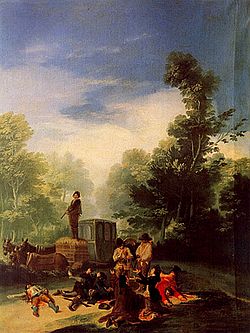
A highwayman was a robber who stole from travellers. This type of thief usually travelled and robbed by horse as compared to a footpad who travelled and robbed on foot; mounted highwaymen were widely considered to be socially superior to footpads.[1][2] Such criminals operated until the mid- or late 19th century. Highwaywomen, such as Katherine Ferrers, were said to also exist, often dressing as men, especially in fiction.[3]
The first attestation of the word highwayman is from 1617.[4] Euphemisms such as "knights of the road" and "gentlemen of the road" were sometimes used by people interested in romanticizing (with a Robin Hood–esque slant) what was often an especially violent form of stealing. In the 19th-century American West, highwaymen were sometimes known as road agents.[5] In Australia, they were known as bushrangers.
Robbing
[edit]The great age of highwaymen was the period from the Restoration in 1660 to the death of Queen Anne in 1714. Some are known to have been disbanded soldiers, and even officers, of the English Civil War and French wars. What favoured them most was the lack of governance and absence of a police force: parish constables were almost entirely ineffective, while detection and arrest were very difficult. Most of the highwaymen held up travellers and took their money. Some had channels by which they could dispose of bills of exchange. Others had a 'racket' on the road transport of an extensive district; carriers regularly paid them a ransom to go unmolested.[6]
They often attacked coaches for their lack of protection, including public stagecoaches; the postboys who carried the mail were also frequently held up.[7] The demand to "Stand and deliver!" (sometimes in forms such as "Stand and deliver your purse!" "Stand and deliver your money!") was in use from the 17th century to the 19th century:
A fellow of a good Name, but poor Condition, and worse Quality, was Convicted for laying an Embargo on a man whom he met on the Road, by bidding him Stand and Deliver, but to little purpose; for the Traveller had no more Money than a Capuchin, but told him, all the treasure he had was a pound of Tobacco, which he civilly surrendered.
— The Proceedings of the Old Bailey, 25 April 1677, [8]
The phrase "Your money or your life!" is mentioned in trial reports from the mid-18th century:
Evidence of John Mawson: "As I was coming home, in company with Mr. Andrews, within two fields of the new road that is by the gate-house of Lord Baltimore, we were met by two men; they attacked us both: the man who attacked me I have never seen since. He clapped a bayonet to my breast, and said, with an oath, Your money, or your life! He had on a soldier's waistcoat and breeches. I put the bayonet aside, and gave him my silver, about three or four shillings."
— The Proceedings of the Old Bailey, 12 September 1781, [9]
Victims of highwaymen included the Prime Minister Lord North, who wrote in 1774: "I was robbed last night as I expected, our loss was not great, but as the postilion did not stop immediately one of the two highwaymen fired at him (They had guns at the time) – It was at the end of Gunnersbury Lane." Horace Walpole, who was shot at in Hyde Park, wrote that "One is forced to travel, even at noon, as if one was going to battle." During this period, crime was rife and encounters with highwaymen or women could be bloody if the victim attempted to resist. The historian Roy Porter described the use of direct, physical action as a hallmark of public and political life: "From the rough-house of the crowd to the dragoons' musket volley, violence was as English as plum pudding. Force was used not just criminally, but as a matter of routine to achieve social and political goals, smudging hard-and-fast distinctions between the worlds of criminality and politics... Highwaymen were romanticized, with a hidden irony, as 'gentlemen of the road.'"[10]
Robbers as heroes
[edit]There is a long history of treating highway robbers as heroes. They were admired by many as bold men who confronted their victims face to face and were ready to fight for what they wanted.[11] Medieval outlaw Robin Hood is regarded as an English folk hero. Later robber heroes included the Cavalier highwayman James Hind; the French-born gentleman highwayman Claude Du Vall; John Nevison; Dick Turpin; Sixteen String Jack; William Plunkett and his partner, the "Gentleman Highwayman" James MacLaine; the Slovak Juraj Jánošík; and Indians including Kayamkulam Kochunni, Veerappan, and Phoolan Devi. In the same way, the Puerto Rican pirate Roberto Cofresí also came to be venerated as a hero.
In early modern Ireland, acts of robbery were often part of a tradition of Irish Catholic resistance to the Dublin Castle administration and Protestant Ascendancy. From the mid-17th century onwards, Catholic highwaymen who harassed the Crown and their supporters were known as 'tories' (from Irish tóraidhe, raider; tóraí in modern spelling). By the end of the century, they were also known as rapparees. Notable Irish highwaymen of the period included James Freney, Redmond O'Hanlon, Willy Brennan and Jeremiah Grant.[12][13]
Dangerous places
[edit]English highwaymen often laid in wait on the main roads radiating from London. They usually chose lonely areas of heathland or woodland. Hounslow Heath was a favourite haunt: it was crossed by the roads to Bath and Exeter.[14] Bagshot Heath in Surrey was another dangerous place on the road to Exeter. One of the most notorious places in England was Shooter's Hill on the Great Dover Road. Finchley Common, on the Great North Road, was nearly as bad.[15]
To the south of London, highwaymen sought to attack wealthy travellers on the roads leading to and from the Channel ports and aristocratic arenas like Epsom, which became a fashionable spa town in 1620, and Banstead Downs where horse races and sporting events became popular with the elite from 1625. Later in the 18th century, the road from London to Reigate and Brighton through Sutton attracted highwaymen. Commons and heaths considered to be dangerous included Blackheath, Putney Heath, Streatham Common, Mitcham Common, Thornton Heath – also the site of a gallows known as "Hangman's Acre" or "Gallows Green" – Sutton Common, Banstead Downs and Reigate Heath.[16]
During the late 17th and early 18th centuries, highwaymen in Hyde Park were sufficiently common for King William III to have the route between St James's Palace and Kensington Palace (Rotten Row) lit at night with oil lamps as a precaution against them. This made it the first artificially lit highway in Britain.[17]
Executions
[edit]
The penalty for robbery with violence was hanging, and most notorious English highwaymen ended on the gallows. The chief place of execution for London and Middlesex was Tyburn Tree. Highwaymen whose lives ended there include Claude Du Vall, James MacLaine, and Sixteen-string Jack. Highwaymen who went to the gallows laughing and joking, or at least showing no fear, are said to have been admired by many of the people who came to watch.[18]
Decline
[edit]During the 18th century, French rural roads were generally safer from highwaymen than those of England, an advantage credited by the historian Alexis de Tocqueville to the existence of a uniformed and disciplined mounted constabulary known as the Maréchaussée. In England this force was often confused with the regular army and as such cited as an instrument of royal tyranny not to be imitated.[19]
In England, the causes of the decline are more controversial. After about 1815, mounted robbers are recorded only rarely, the last recorded robbery by a mounted highwayman having occurred in 1831.[20] The decline in highwayman activity also occurred during the period in which repeating handguns, notably the pepper-box and the percussion revolver, became increasingly available and affordable to the average citizen. The development of the railways is sometimes cited as a factor, but highwaymen were already obsolete before the railway network was built. The expansion of the system of turnpikes, manned and gated toll-roads, made it all but impossible for a highwayman to escape notice while making his getaway, but he could easily avoid such systems and use other roads, almost all of which outside the cities were flanked by open country.
Cities such as London were becoming much better policed: in 1805 a body of mounted police began to patrol the districts around the city at night. London was growing rapidly, and some of the most dangerous open spaces near the city, such as Finchley Common, were being covered with buildings. However, this only moved the robbers' operating area further out, to the new exterior of an expanded city, and does not therefore explain decline. A greater use of banknotes, more traceable than gold coins, also made life more difficult for robbers,[21] but the Inclosure Act 1773[22] was followed by a sharp decline in highway robberies; stone walls falling over the open range like a net, confined the escaping highwaymen to the roads themselves, which now had walls on both sides and were better patrolled.[23] The dramatic population increase which began with the Industrial Revolution also meant, quite simply, that there were more eyes around, and the concept of remote place became a thing of the past in England.[24]
Outside Anglophone countries
[edit]Greece
[edit]The bandits in Greece under Ottoman rule were the Klephts (κλέφτες), Greeks who had taken refuge in the inaccessible mountains. The klephts, who acted as a guerilla force, were instrumental in the Greek War of Independence.
Kingdom of Hungary
[edit]The highwaymen of the 17th- to 19-century Kingdom of Hungary were the betyárs (Slovak: zbojník). Until the 1830s, they were mainly simply regarded as criminals but an increasing public appetite for betyar songs, ballads and stories gradually gave a romantic image to these armed and usually mounted robbers. Several of the betyárs have become legendary figures who in the public mind fought for social justice. Hungarian betyárs included Jóska Sobri, Márton Vidróczki, András Juhász, Bandi Angyal, Pista Sisa, Jóska Savanyú. Juraj Jánošík (Hungarian: Jánosik György), who was born and operated in Upper Hungary (now Slovakia), is still regarded as the Slovak version, and Sándor Rózsa the Hungarian version of Robin Hood in their regions.
The Hajduk (Hungarian: Hajdú) also originated in Hungary. They were formed from large numbers of Hungarians forced out of Syrmia and the Banates (Banate of Srebrenik, Banate of Nándorfehérvár, Banat of Macsó), moving upwards to central Hungary because of the Turkish attacks (they are replaced by the Serbs, Bosnians and Croats settling in the region). By the end of the 16th century, they had developed into a significant military force. They developed their own military organisation, separate from the ranks established in the country – they chose their own commanders, captains, lieutenants and corporals. Their rights were later taken away by the Austrians after the defeat of the Rákóczi's War of Independence, fearing their military power, they forced them into serfdom, so this was the end of the Hajduk golden age.[25]
India
[edit]The Indian Subcontinent has had a long and documented history of organised robbery for millennia. These included the Thuggees, a quasi-religious group that robbed travellers on Indian roads until the cult was systematically eradicated in the mid-1800s by British colonial administrators. Thugees would befriend large road caravans and gain their confidence, before strangling them to death and robbing their valuables. According to some estimates the Thuggees murdered a million people between 1740 and 1840.[26] More generally, armed bands known colloquially as "dacoits" have long wreaked havoc on many parts of the country. In recent times this has often served as a way to fund various regional and political insurgencies that includes the Maoist Naxalite movement. Kayamkulam Kochunni was also a famed highwayman who was active in Central Travancore in the early 19th century. Along with his close friend Ithikkarappkki from the nearby Ithikkara village, he is said to have stolen from the rich and given to the poor. With the help of an Ezhava warrior called Arattupuzha Velayudha Panicker, Kochunni was arrested and sent to Poojappura Central Jail. Legends of his works are compiled in folklore and are still read and heard today.
The Balkans and eastern Europe
[edit]The bandits in Serbia, Bosnia, Croatia and Bulgaria under Ottoman rule, and in Hungary were the Hajduks (Hajduci, Хајдуци, Хайдути) – rebels who opposed Ottoman rule and acted as a guerilla force, also instrumental in the many wars against the Ottomans, especially the Serbian revolution. Serbian and Croatian refugees in Austro-Hungarian (and Habsburg) lands were also part of the Uskoci. Notable freedom fighters include Starina Novak, a notable outlaw was Jovo Stanisavljević Čaruga. In medieval Wallachia, Moldavia, Transylvania and Ukraine, the Haiduks (Romanian – Haiduci, Ukrainian – Гайдуки, Haiduky) were bandits and deserters who lived in forests and robbed local Boyars or other travelers along roads. Sometimes they would help the poor peasants. In the 1800s, betyárs became common in Hungary.
Literature and popular culture
[edit]
In Shakespeare's Henry IV, Part 1 Falstaff is a highwayman, and part of the action of the play concerns a robbery committed by him and his companions. Another highwayman in English drama is Captain Macheath, hero of John Gay's 18th-century ballad opera The Beggar's Opera. The legend of Dick Turpin was significantly boosted by Rookwood (1834), in which a heavily fictionalised Turpin is one of the main characters.[27][28] Alfred Noyes's narrative poem "The Highwayman" has been immensely popular ever since its publication in 1906.
A number of traditional folk songs about highwaymen exist, both positive and negative, such as "Young Morgan", "Whiskey in the Jar", and "The Wild Colonial Boy".[29]
From the early 18th century, collections of short stories of highwaymen and other notorious criminals became very popular. The earliest of these is Captain Alexander Smith's Complete History of the Lives and Robberies of the Most Notorious Highwaymen (1714). Some later collections of this type had the words The Newgate Calendar in their titles and this has become a general name for this kind of publication.[30]
In the later 19th century, highwaymen such as Dick Turpin were the heroes of a number of penny dreadfuls, stories for boys published in serial form. In the 20th century the handsome highwayman became a stock character in historical love romances, including books by Baroness Orczy and Georgette Heyer.
Sir Walter Scott's romance The Heart of Midlothian (1818) recounts the heroine waylaid by highwaymen while travelling from Scotland to London.
Ronia, the Robber's Daughter (1981) is a children's fantasy book by Astrid Lindgren, which portrays the adventures of Ronia, the daughter of the leader of a gang of highwaymen.
Comics
[edit]The Belgian comics series Robin Dubois by Turk and De Groot is a gag-a-day series about Robin Hood's attempts at robbing travellers in the forest.
The Dutch comics series Gilles de Geus by Hanco Kolk and Peter de Wit was originally a gag-a-day about a failed highwayman called Gilles, but the character later evolved into a resistance fighter with the Geuzen against the Spanish army.
Ithikkara Pakki, a graphic children's story book about the Indian highwayman Ithikkara Pakki, was published in April 2010 in Malayalam.[31] The life of the Indian highwayman Kayamkulam Kochunni was adapted as a comic by Radha M. Nair in the 794th issue of the Indian comic book series, Amar Chitra Katha.[32]
Music
[edit]There were many broadsheet ballads about highwaymen; these were often written to be sold on the occasion of a famous robber's execution. A number of highwaymen ballads have remained current in oral tradition in England and Ireland.[33]
The traditional Irish song "Whiskey in the Jar" tells the story of an Irish highwayman who robs an army captain and includes the lines "I first produced me pistol, then I drew me rapier. Said 'Stand and deliver, for you are a bold deceiver'." The hit single version recorded in 1973 by Irish rock band Thin Lizzy renders this last line "I said 'Stand-oh and deliver, or the devil he may take ya'."
The traditional Irish song "The Newry Highwayman" recounts the deeds and death of a highwayman who robbed "the lords and ladies bright". The traditional Irish song "Brennan on the Moor" describes an escapade of the "bold, undaunted robber". Adam and the Ants had a number one song for five weeks in 1981 in the UK with "Stand and Deliver". The video featured Adam Ant as an English highwayman.
The contemporary folk song "On the Road to Fairfax County" by David Massengill, recorded by The Roches and by Joan Baez, recounts a romantic encounter between a highwayman and his female victim. In the end, the highwayman is hanged over the objections of his victim.
Musician Jimmy Webb penned and recorded a song entitled "Highwayman" in 1977 about a soul with incarnations in four different places in time and history, a highwayman, a sailor, a construction worker on the Hoover Dam, and finally as a star ship captain. Glen Campbell recorded a version of the song in 1978, but the most popular incarnation of the song was recorded by Willie Nelson, Kris Kristofferson, Waylon Jennings and Johnny Cash in 1984, who as a group called themselves The Highwaymen.
The Canadian singer Loreena McKennit adapted the narrative poem, "The Highwayman" written by Alfred Noyes, as a song by the same title in her 1997 album The Book of Secrets.
Cinema and television
[edit]The Carry On films included a highwayman spoof in Carry On Dick (1974). Monty Python sent up the highwayman legends in the Dennis Moore sketch in Episode 37 of Monty Python's Flying Circus, in which John Cleese played the titular criminal who stole only lupins.[34] In a linking sketch in an episode of Not the Nine O'Clock News a highwayman holds up a stagecoach with pistols – in order to wash the coach in exchange for small monies in the manner of a modern-day unsolicited car window washer in traffic. In Blackadder the Third, Mr. E. Blackadder turns highwayman in the episode "Amy and Amiability". In the British children's television series Dick Turpin, starring Richard O'Sullivan, the highwayman was depicted as an 18th-century Robin Hood figure. Additionally the actor Mathew Baynton played Dick Turpin in Horrible Histories. A singing highwayman appears in the fourth episode of the animated mini-series, Over the Garden Wall, Songs of the Dark Lantern.
The highwayman known as Juraj Jánošík (1688–1713) became a hero of many folk legends in the Slovak, Czech, and Polish cultures by the 19th century[35] and hundreds of literary works about him have since been published.[36] The first Slovak feature film was Jánošík, made in 1921, followed by seven more Slovak and Polish films about him.
Curro Jiménez, a Spanish TV series which aired from 1976 to 1979, starred a group of 19th-century highwaymen or bandoleros in the mountains of Ronda in the south of Spain.
Ronia, the Robber's Daughter (aka Ronja Robbersdaughter in the US) is a 1984 Swedish fantasy film, based on the 1981 novel of the same title by Astrid Lindgren, and narrating the adventures of Ronia, the daughter of the leader of a gang of highwaymen.
Ronja, the Robber's Daughter (Japanese: 山賊の娘ローニャ, Hepburn: Sanzoku no Musume Rōnya) is a Japanese animated television series, also based on Lindgren's novel Ronia, the Robber's Daughter, and directed and storyboarded by Gorō Miyazaki.
The lives of numerous Indian highwaymen including Arattupuzha Velayudha Panicker, Ithikkara Pakki, Jambulingam Nadar, Kayamkulam Kochunni and Papadu have been adapted for cinema and television multiple times.
Season two, episode 20, of Scooby-Doo! Mystery Incorporated, the main villain (voiced by James Marsters) disguises himself as a highwayman.
The animated series Over the Garden Wall features Jerron Paxton as a highwayman, including a short original song he composed in conjunction with The Blasting Company.[37]
Films
[edit]- The Mark of Zorro (1920)
- Dick Turpin (1925)
- Dick Turpin (1933)
- The Adventures of Robin Hood (1938)
- The Night Riders (1939)
- Frontier Marshal (1939)
- My Little Chickadee (1940)
- Virginia City (1940)
- The Mark of Zorro (1940)
- The Wicked Lady (1945)
- The Loves of Carmen (1948)
- The Lady and the Bandit (1951)
- Bend of the River (1952)
- Son of Paleface (1952)
- The King's Thief (1955)
- The Amorous Adventures of Moll Flanders (1965)
- Kayamkulam Kochunni (1966)
- Butch Cassidy and the Sundance Kid (1969)
- Robin Hood (1973)
- Carry On Dick (1974)
- The Mark of Zorro (1974)
- Barry Lyndon (1975)
- Kaayamkulam Kochunniyude Makan (1976)
- Joseph Andrews (1977)
- Vellayani Paramu (1979)
- Ronia, the Robber's Daughter (1981)
- Jambulingam (1982)
- The Wicked Lady (1983)
- The Deceivers (1988)
- The Lady and the Highwayman (1989)
- Plunkett & Macleane (1999)
- Kayamkulam Kochunni (2018)
- The Highwaymen (2019)
Video games
[edit]In Fable II, Highwaymen appear as an elite type of enemy which works alongside bandits and makes use of speed and agility over brute strength. It is also possible for players to dress as Highwaymen. There is an enemy type in The Elder Scrolls V: Skyrim called the "bandit highwayman" that acts as one of the higher-level bandit enemies. In World of Warcraft one can encounter the Defias Highwaymen, the strongest members of the Defias Brotherhood. In Darkest Dungeon the Highwayman is a class of hero who wields a dirk and flintlock to fight. In Runescape, highwaymen attack lower-leveled players on a route between two cities. In Bushido Blade 2 there is a playable character named Highwayman who is dressed in Victorian clothing and represents the hero archetype. In Bloodborne many articles of clothing obtained by "The Hunter" are inspired by Highwaymen attire.
See also
[edit]References
[edit]- ^ Rid, Samuel. "Martin Markall, Beadle of Bridewell," in The Elizabethan Underworld, A. V. Judges, ed. pp. 415–416. George Routledge, 1930. Online quotation.
- ^ Spraggs, pp. 107, 169, 190–191.
- ^ "Stand and Deliver, Your Money or Your Life: Female Highwaymen of the Seventeenth Century". Just History Posts. 9 March 2017. Retrieved 23 April 2025.
- ^ Fennor, William. "The Counter's Commonwealth," in The Elizabethan Underworld, p. 446.
- ^ Brewer, E. Cobham. Dictionary of Phrase and Fable, 1898, defines road-agent as "A highwayman in the mountain districts of North America," citing the generation earlier, W. Hepworth Dixon, New America, p. 14: "Road-agent is the name applied in the mountains to a ruffian who has given up honest work in the store, in the mine, in the ranch, for the perils and profits of the highway."
- ^ Clark, Sir George (1956). The Later Stuarts, 1660–1714. Oxford History of England: Oxford University Press. p. 259. ISBN 0-19-821702-1.
{{cite book}}: ISBN / Date incompatibility (help) - ^ Beattie, J. M.: Crime and the Courts in England, 1660–1800, pp. 149–158. Clarendon Press, 1986; Extracts from Wilson, Ralph: A Full and Impartial Account of all the Robberies Committed by John Hawkins, George Sympson (lately Executed for Robbing the Bristol Mails) and their Companions. 3rd edition, J. Peele, 1722.
- ^ "Browse – Central Criminal Court". www.oldbaileyonline.org.
- ^ Old Bailey Proceedings Online, Trial of John Buckley, Thomas Shenton. (t17810912-37, 12 September 1781).
- ^ Porter, Roy (1982). English Society in the Eighteenth Century. Pelican Social History of Britain: Pelican Books. pp. 31, 114–115. ISBN 0-14-022099-2.
- ^ Spraggs, pp. 2–3, 7–8, 255.
- ^ Dunford, Stephen. The Irish Highwaymen. Merlin Publishing, 2000
- ^ Seal, pp. 69–78.
- ^ Maxwell, Gordon S. : Highwayman's Heath: Story in Fact and Fiction of Hounslow Heath in Middlesex . Heritage Publications, Hounslow Leisure Services, 1994.
- ^ Beattie, J. M.: Crime and the Courts in England, 1660–1800, pp. 155–156. Clarendon Press, 1986; Spraggs, Gillian: Outlaws and Highwaymen: the Cult of the Robber in England from the Middle Ages to the Nineteenth Century, p. 93. Pimlico, 2001. Harper, Charles George: Half-hours with the Highwaymen: picturesque biographies and traditions of the "knights of the road", pp. 245–255. Chapman & Hall, 1908; Online edition of Half-hours with the Highwaymen. via Internet Archive.
- ^ Walford, Leslie (7 March 2011). "Stand and Deliver!". Time & Leisure. Archived from the original on 7 July 2018. Retrieved 27 December 2016.
- ^ Hibbert, Cristopher; Weinreb, Ben; Keay, John; Keay, Julia (2011). The London Encyclopaedia. Pan Macmillan. p. 424. ISBN 978-0230738782.
- ^ Spraggs, pp. 212–233.
- ^ Alexis de Tocqueville L'Ancien Régime et la Révolution
- ^ McLynn, Frank: Crime and punishment in eighteenth-century England, p. 81. Routledge, 1989.
- ^ Spraggs, p. 234.
- ^ 'The Enclosure Acts and the Industrial Revolution', Wendy McElroy, 2012
- ^ "SHP History B – Crime and Punishment 1750–1900, 3.3 Highwaymen" (PDF). Archived from the original (PDF) on 13 April 2016. Retrieved 31 March 2016.
- ^ "Impact of the Industrial Revolution". Ecology Global Network. 18 September 2011. Archived from the original on 8 January 2020. Retrieved 31 March 2016.
- ^ "hajdúk | Magyar néprajzi lexikon | Kézikönyvtár". www.arcanum.com (in Hungarian). Retrieved 2 October 2024.
- ^ Rubinstein, W. D. (2004). Genocide: A History. Pearson Education. pp. 82–83. ISBN 0-582-50601-8.
- ^ Sharpe, James: Dick Turpin: the Myth of the English Highwayman, Chapter 5: 'The Man from Manchester'. Profile Books, 2004
- ^ Spraggs, pp. 237–240.
- ^ Seal, Graham (1996). "Positive Highwayman Ballads". The Outlaw Legend. Cambridge University Press. pp. 31–37, 209.
- ^ The Newgate Calendar – Bibliographical Note
- ^ "'ഇത്തിക്കര പക്കി'യുടെ കഥ കടം കൊണ്ടു, കടപ്പാടുപോലുമില്ല" [Ithikkara Pakki's story adapted, without courtesy]. Janayugom (in Malayalam). 9 October 2018. Retrieved 2 July 2019.
- ^ Radha M. Nair (1971). Kochunni. Amar Chitra Katha Pvt Ltd. ISBN 9788184824940.
- ^ Seal, pp. 47–78.
- ^ Monty Python's Flying Circus Script – Episode 37
- ^ Votruba, Martin: "Hang Him High: The Elevation of Jánošík to an Ethnic Icon." Slavic Review, 65#1, pp. 24–44, 2006. Abstract. Archived 5 July 2008 at the Wayback Machine
- ^ Few in English, e.g.: Moore Coleman, Marion (1972). A brigand, two queens, and a prankster; stories of Janosik, Queen Bona, Queen Kinga and the Sowizdrzal. Cherry Hill Books. ISBN 978-0-910366-13-7
- ^ Over the Garden Wall (TV Mini Series 2014) - Jerron Paxton as Additional Voices, The Highway Man - IMDb. Retrieved 12 March 2025 – via www.imdb.com.
Sources / further reading
[edit]- Ash, Russell (1970). Highwaymen, Shire Publications, ISBN 978-0-85263-101-0; revised edition (1994) ISBN 978-0-7478-0260-0
- Billett, Michael (1997). Highwaymen and Outlaws, Weidenfeld Military, ISBN 978-1-85409-318-9
- Brandon, David (2004). Stand and Deliver! A History of Highway Robbery, Sutton Publishing, ISBN 978-0-7509-3528-9
- Dunford, Stephen (2000). The Irish Highwaymen, Merlin Publishing, ISBN 1-903582-02-4
- Evans, Hilary & Mary (1997). Hero on a Stolen Horse: Highwayman and His Brothers-in-arms – The Bandit and the Bushranger, Muller, ISBN 978-0-584-10340-3
- Haining, Peter (1991). The English Highwayman: A Legend Unmasked, Robert Hale, ISBN 978-0-7090-4426-0
- Harper, Charles George (1908). Half-hours with the Highwaymen: picturesque biographies and traditions of the "knights of the road", Chapman & Hall. Online edition, via Internet Archive.
- Hobsbawm, Eric (1969). Bandits, Delacorte Press; Revised edition (2000). ISBN 978-1-56584-619-7
- Koliopoulos, John S (1987). Brigands with a Cause, Brigandage and Irredentism in Modern Greece 1821–1912. Clarendon Press. ISBN 978-0-19-822863-9
- Liapi, Lena (2019). "Roguery in Print: Crime and Culture in Early Modern London" Boydell & Brewer. ISBN 9781783274406
- Maxwell, Gordon S (1994). Highwayman's Heath: Story in Fact and Fiction of Hounslow Heath in Middlesex , Heritage Publications, Hounslow Leisure Services, ISBN 978-1-899144-00-6
- Newark, Peter (1988). Crimson Book of Highwaymen, Olympic Marketing Corp, ISBN 9789997354792
- Pringle, Patrick (1951). Stand and Deliver: The Story of the Highwaymen, Museum Press, ASIN B0000CHVTK
- Seal, Graham (1996). The Outlaw Legend: a cultural tradition in Britain, America and Australia, Cambridge University Press, ISBN 0-521-55317-2 (hbk), ISBN 0-521-55740-2 (pbk)
- Sharpe, James (2005). Dick Turpin: The Myth of the English Highwayman, Profile Books, ISBN 978-1-86197-418-1
- Spraggs, Gillian (2001). Outlaws and Highwaymen: The Cult of the Robber in England from the Middle Ages to the Nineteenth Century, Pimlico, ISBN 978-0-7126-6479-0
- Sugden, John and Philip (2015). The Thief of Hearts: Claude Duval and the Gentleman Highwayman in Fact and Fiction, Forty Steps, ISBN 978-0-9934183-0-3
External links
[edit]
 Media related to Highwaymen at Wikimedia Commons
- The Heroic Outlaw in Irish Folklore and Popular Literature
- Primary source book from 1674 on aspects of Highwaymen, their customs and their crimes - Jackson's Recantation; or, the Life and Death of the Notorious Highwayman

Highwayman
View on GrokipediaA highwayman was a thief who robbed travelers on a road, typically operating on horseback to ambush coaches and riders for money and valuables.[1] This form of predation peaked in England during the 17th and 18th centuries, when dispossessed royalist officers after the English Civil War turned to highway robbery amid limited policing and vulnerable rural routes.[2] Highwaymen exploited major thoroughfares like those near Hounslow Heath, using pistols to halt victims with demands such as "stand and deliver," often basing operations from roadside inns.[3] Though some accounts portray them as chivalrous figures, empirical evidence from trials and executions underscores their brutality as common criminals preying on the unwary, with captured perpetrators facing hanging as a capital offense.[2] The practice declined sharply by the late 18th century due to turnpike improvements, mounted patrols, and enhanced rewards for informants, rendering mounted escapes less viable; the last recorded instance in England occurred in 1831.[2][3]
Definition and Characteristics
Etymology and Terminology
The term "highwayman" first appears in English in 1617, in the writings of William Fennor, denoting a robber who preys on travelers along public roads.[4] Its etymological roots trace to the combination of "highway," referring to principal roads suitable for mounted travel, and "man," yielding a descriptor for an individual who exploits these routes for robbery, often mounted on horseback to facilitate quick escapes.[5] Earlier 16th-century usages of related terms like "routier" from Old French connoted both highway robbers and seasoned soldiers, reflecting a historical overlap between military disbandment and roadside crime, though the specific "highwayman" sense solidified in the 17th century amid post-Civil War social upheaval in England.[5] Terminologically, a highwayman is defined as a thief who ambushes and robs passengers on highways, typically using firearms or threats while mounted, distinguishing the figure from pedestrian "footpads" who operated on foot in urban or less traversable areas.[1] This mounted emphasis underscores the era's reliance on horses for mobility on Britain's rudimentary road networks, where highwaymen targeted coaches, merchants, and lone riders carrying valuables.[6] Euphemistic phrases such as "gentlemen of the road" or "knights of the road" emerged in 18th-century literature and ballads to romanticize these criminals, portraying them as chivalric outlaws rather than mere bandits, though contemporary accounts emphasized their brutality and prevalence from the 1650s onward.[4] The term's usage peaked in Britain during the 17th and 18th centuries, fading with improved policing and road infrastructure by the early 19th century, after which it became largely historical.[1]Distinctions from Other Forms of Robbery
Highway robbery by mounted highwaymen differed from other forms of robbery in its specific locus on public roads or "the king's highway," where perpetrators targeted transient travelers—such as those in coaches, carriages, or on horseback—rather than stationary victims in homes, shops, or urban settings. This spatial distinction emphasized mobility and opportunism on intercity routes, often in rural or semi-rural areas approaching major cities like London, contrasting with burglary, which involved breaking into dwellings to steal goods without direct confrontation, or pickpocketing in crowded pedestrian zones.[7][8] A key operational variance lay in the highwayman's use of horses for approach, robbery, and evasion, granting superior speed and range compared to footpads—robbers who ambushed victims on foot in alleys, streets, or footpaths and were typically deemed lower-tier criminals due to their pedestrian limitations and urban focus. Highwaymen, often operating solo or in pairs, could cover greater distances to intercept wealthy merchants or gentry, whereas footpads preyed more indiscriminately on city dwellers, reflecting a hierarchy in criminal prestige where mounted robbers evoked a cavalier archetype. Legally, under English common law in the 18th century, highway robbery required the felonious taking of property from the person through force or threat while on or near a public highway, punishable by death as a capital felony distinct from mere theft or street assaults.[9][10] In contrast to organized banditry in wilderness or frontier regions—where larger gangs ambushed convoys in ungoverned territories—highwaymen adhered to individualized tactics on patrolled but vulnerable roads, sometimes employing ritualized demands like "stand and deliver" to minimize resistance, though violence with pistols remained common. This set them apart from maritime piracy, confined to seas and ships, or inland housebreaking, which evaded immediate pursuit by targeting private property; highway robbery's public nature heightened its perceived threat to commerce and travel, prompting specific legislative responses like enhanced rewards for capture by the 1690s.[11][12]Historical Overview
Origins and Early European Instances
The practice of highway robbery, characterized by armed individuals or groups ambushing travelers on established roads to seize valuables, emerged in Europe during the medieval period amid decentralized feudal authority, deteriorating Roman-era infrastructure, and limited centralized law enforcement. Following the collapse of Roman road networks and the fragmentation of political control after the 5th century, rural areas became rife with opportunistic predation, where local lords or independent bandits exploited vulnerable pilgrims, merchants, and nobility on trade routes. This form of predation differed from urban theft or siege warfare by targeting isolated wayfarers, often under cover of forests or remote paths, and relied on mobility via horse or foot rather than fortified positions.[13] In England, highway robbery intensified during the early 14th century under King Edward II (r. 1307–1327), evolving into a widespread crisis that undermined royal authority and commerce. Banditry surged following military failures against Scotland and internal baronial conflicts, with gangs preying on even high-ranking officials; for instance, members of the king's household and prominent courtiers fell victim to ambushes on roads approaching London and provincial highways. By the 1320s, the phenomenon had escalated to the point where parliamentary complaints documented hundreds of unresolved robberies annually, attributing the issue to demobilized soldiers, dispossessed yeomen, and corrupt clergy who formed predatory networks.[13][14] Notable early instances include the Folville gang, active in Leicestershire from approximately 1326 to 1332, led by Eustace Folville, a rogue rector, and his brothers. This group orchestrated the brazen murder of royal justice Roger Belers on June 15, 1326, near the River Welland, ostensibly in revenge for land disputes but involving plunder of travelers; they also robbed Nicholas Segrave, 1st Baron Segrave, and extorted the Bishop of Lincoln in 1330, demonstrating organized tactics like surprise attacks and demands for ransom. Similarly, Thomas Dun, operating around 1315–1327 during the Anglo-Scottish wars, combined piracy with highway robbery, ambushing merchants on northern roads before his execution in 1327. These cases highlight causal factors such as wartime displacement and ecclesiastical corruption enabling such crimes, with Folville evading capture for years due to local sympathies and inadequate pursuit.[15][16] Across continental Europe, analogous brigandage prevailed, with the term "brigand" deriving from Italian brigante (from Latin brigans, meaning fighter) by the early 14th century, denoting mounted robbers who infested Alpine passes and Tuscan routes. In the Holy Roman Empire and France, fragmented jurisdictions allowed gangs to operate trans-regionally, targeting spice and textile convoys; records from 13th-century Italian chronicles describe banditi ambushing papal envoys, while French routiers—mercenary remnants post-Crusades—extorted wayfarers in the 1350s amid the Hundred Years' War. These early European instances laid precedents for later refined highwaymanship, emphasizing horseback pursuit and intimidation over mere theft, though lacking the romanticized "gentleman of the road" ethos of subsequent eras.Peak Period in Britain (17th-18th Centuries)
The peak period for highwaymen in Britain spanned the 17th and 18th centuries, marking what historians term the "golden age" of these mounted robbers who targeted travelers on public roads.[17] This era saw highway robbery become endemic, particularly in England, where areas like Hounslow Heath near London were notorious danger zones for over a century, with ambushes frequent on routes such as the Bath Road.[3] The prevalence stemmed from expanding trade and commerce, which increased the number of affluent travelers carrying cash and valuables, making roads lucrative for opportunistic criminals.[17] Several structural factors fueled this surge. Poorly maintained roads, often muddy and rutted, limited travel speeds and isolated coaches, facilitating surprise attacks by horsemen who could outpace footpads or pursue fleeing victims.[18] The English Civil Wars (1642–1651) and subsequent conflicts displaced soldiers, many of whom, lacking employment, resorted to robbery as a means of survival, exacerbating the problem in the mid-17th century.[19] Inadequate policing, with no centralized force until later reforms, left highways largely unpoliced; constables were local and ineffective against mobile gangs, while rewards for captures often went unclaimed due to the risks involved.[20] Contemporary accounts described highwaymen as "common as crows," underscoring their ubiquity, with newspapers and diaries frequently reporting incidents, though exact statistics are scarce due to underreporting and inconsistent records.[21] Robberies targeted stagecoaches and wealthy merchants, peaking in the early 18th century before gradual improvements like turnpike trusts began enhancing road security around 1700.[22] Figures such as James Hind in the 1650s, who robbed Royalists during the Commonwealth, and later 18th-century operators exemplified the tactic of bold, armed confrontations demanding "stand and deliver."[23] This period's romanticized legacy in ballads belied the brutal reality, as victims faced violence or death, contributing to public outcry that eventually spurred countermeasures.[20]Decline and Factors Leading to Extinction
Highway robbery by mounted assailants in England declined sharply in the late 18th century, becoming rare after about 1815 and ceasing entirely by the early 19th century, with the last recorded instance occurring in 1831.[23][15] This extinction followed a peak in the mid-18th century, when such crimes were frequent on major routes like those near London. The reduction aligned with broader shifts in transportation, security, and enforcement, rendering the traditional highwayman's model—ambushing isolated travelers on horseback—unviable. A primary factor was the establishment and expansion of organized policing. The Bow Street Horse Patrol, initiated in 1763 under John Fielding's oversight of the Bow Street Runners (founded by Henry Fielding in 1749), actively pursued highwaymen on rural roads, leading to numerous captures and a measurable drop in incidents.[7][24] Rewards for apprehending robbers, increased to £100 by government decree in the mid-18th century, incentivized informants and thief-takers, further deterring operations.[24] Infrastructure developments compounded these efforts. From the 1760s, turnpike trusts transformed roads into surfaced highways with manned toll gates, enabling faster travel and quicker pursuit by authorities while limiting escape routes for robbers.[23][25] Urban expansion and population growth reduced secluded ambush sites, as isolated heaths like Hounslow Heath lost their strategic value amid encroaching settlements.[23][15] Defensive adaptations by victims eroded the highwayman's advantage. Stagecoaches and mail coaches, increasingly armed with guards from the 1780s onward, resisted attacks effectively; travelers also carried personal pistols, which became more affordable and widespread.[23][15] The introduction of banknotes in 1797 shifted wealth carriage toward traceable paper currency, diminishing the appeal of robbing gold or coins that could be easily laundered.[23] Justices of the peace further curtailed hideouts by denying licenses to alehouses suspected of harboring criminals.[7] These interlocking changes—rooted in empirical improvements in detection, mobility, and resistance—systematically undermined the causal conditions enabling highway robbery, without reliance on unproven narratives of moral reform.Operational Methods
Tactics, Weapons, and Strategies
Highwaymen relied on ambush tactics, concealing themselves along isolated rural roads, heaths, and approaches to London such as Hounslow Heath, where they could surprise travelers without witnesses. Operating primarily on horseback for superior mobility, they halted coaches or riders abruptly, often shouting "Stand and deliver!" or more explicit threats like "Your money directly, or I'll blow your brains out!" to compel compliance through intimidation rather than violence.[10][11] Groups of two to six used coordinated positioning, with lookouts to detect approaching patrols or reinforcements.[10] Their primary weapons were flintlock pistols, introduced in the early 17th century, valued for quick reloading and psychological deterrence even when unfired. Highwaymen commonly carried a pair to ensure firepower redundancy during encounters, occasionally augmented by short swords called hangers for close-quarters defense or disarming resistant victims. Blunderbusses appeared less frequently in their arsenal, as the pistols' accuracy and concealability suited hit-and-run operations better than the scattershot weapon's defensive role.[17][10] Strategies emphasized target selection via intelligence gathered from inn spies monitoring wealthy passengers and mail coaches, minimizing risk by avoiding armed guards when possible. Robberies concluded rapidly, with demands for cash, jewels, and watches, sometimes returning small sums to recipients as a gesture of faux courtesy to reduce pursuit incentives. Evasion involved immediate disguise changes into gentleman's clothing, leveraging false alibis or accomplices turning state's evidence to confound investigations; for instance, in 1721, Thomas Cross and William Spiggot's gang robbed over 100 passengers in a single night before dispersing.[10] Violence was rare if victims yielded valuables promptly, preserving the robber's mobility and reputation among potential informants.[11]Selection of Targets and Typical Robberies
Highwaymen in 17th- and 18th-century England primarily selected targets on isolated stretches of major highways, such as heaths and commons like Hounslow Heath or Finchley Common, where travelers were isolated from immediate help and law enforcement.[20] These locations facilitated ambushes on routes connecting London to provincial areas, exploiting the prevalence of road travel for commerce and personal business.[10] Victims were chosen based on apparent wealth and vulnerability, favoring solo riders, pedestrians, or occupants of stagecoaches and post-chaises carrying merchants, gentry, or passengers with portable valuables like coin, watches, and jewelry, while generally sparing the visibly poor to minimize resistance or moral justification in some accounts.[20][7] Typical robberies commenced with the highwayman, often mounted for swift approach and escape, emerging suddenly to halt the target by blocking the path or riding alongside.[23] Armed with one or more pistols—frequently only loaded with powder to intimidate rather than kill—the robber would level the weapon and issue the standardized demand: "Stand and deliver your purse!" or variations threatening life for non-compliance.[20][3] The encounter emphasized psychological coercion over physical violence; victims were instructed to relinquish possessions quickly, with robbers searching pockets or vehicles briefly for hidden items, but avoiding prolonged engagements that could attract pursuers or witnesses.[14] In cases involving guarded coaches or mail, highwaymen sometimes operated in small gangs to overwhelm escorts, as solo attempts risked failure against armed resistance.[10] For instance, in 1774, highwayman John Rann targeted a coach near London, exemplifying the focus on high-value transports despite increasing risks from mounted patrols.[7] Robberies concluded with the perpetrator fleeing on horseback, leveraging speed and knowledge of local terrain to evade capture, underscoring the operation's reliance on mobility and surprise rather than brute force.[20] This method yielded portable gains but declined in efficacy by the late 18th century due to improved road policing and traveler precautions.[2]Notable Highwaymen
Prominent British Examples
Captain James Hind (baptized 1616–1652), a Royalist sympathizer during the English Civil War, targeted Parliamentarian travelers on highways, amassing a reputation for robbing wealthy opponents of King Charles I while sparing poorer victims.[26] He reportedly attempted to rob Oliver Cromwell near Hungerford in 1648, disguising himself and his accomplice as women before fleeing after recognition.[26] Captured multiple times but escaping until his final arrest in 1651, Hind was tried for treason and highway robbery, then hanged, drawn, and quartered in Worcester on September 24, 1652.[26] Claude Du Vall (c. 1643–1670), a French immigrant who arrived in England around 1660, operated as a highwayman on routes into London, often employing charm to minimize resistance from female passengers during stagecoach robberies.[3] Known for courteous demeanor rather than overt violence, he was captured in a London tavern in 1669 after a tip-off and executed at Tyburn on January 21, 1670, for multiple robberies including one yielding £180 from a coach near Newbury in 1668.[3] Contemporary accounts romanticized his gallantry, such as dancing with a victim's wife before taking spoils, though records confirm his crimes involved armed hold-ups of merchants and travelers.[3] Richard "Dick" Turpin (baptized September 21, 1705–April 7, 1739), initially a butcher in Essex, turned to smuggling and poaching before joining the violent Gregory Gang around 1730, participating in house burglaries and the murder of at least two gamekeepers by mutilation in 1735.[27] As a solo highwayman from 1735, he robbed travelers on Essex and Yorkshire roads, using pistols and a black-eyed mare named Black Bess in folklore, though historical evidence shows him relying on accomplices and fleeing authorities across regions. Arrested in York in 1738 for horse theft under the alias John Palmer—identified by a former associate's testimony—Turpin was convicted and hanged on April 7, 1739, his body later dissected to deter grave robbers.[28] Far from the dashing rider of legend, trial records and gang confessions reveal Turpin as a brutal criminal who terrorized rural communities through extortion and killings.[27]Figures from Other Regions
In France during the early 18th century, Louis Dominique Cartouche (1693–1721), born Louis Dominique Garthausen to a Parisian wine merchant, emerged as a notorious gang leader specializing in urban and roadside robberies targeting the affluent. His group, numbering over 100 members drawn from Paris's criminal underclass, employed sophisticated evasion tactics, including hidden urban networks, to plunder coaches and merchants while avoiding capture for years. Betrayed by an associate in October 1721 after a tip from his mistress, Cartouche endured torture via the brodequins before being sentenced to death; he was executed on November 28, 1721, by breaking on the wheel at Place de Grève, a method involving systematic limb fractures followed by prolonged exposure.[29][30] Further south in the fragmented Holy Roman Empire, Johannes Bückler (c. 1778–1803), known as Schinderhannes, operated as a prolific robber in the Rhineland's Hunsrück and Taunus regions from the 1790s onward. Initially a cattle driver and occasional smuggler, Bückler assembled a gang of up to 93 accomplices by 1802, committing over 200 burglaries, extortions, and at least one murder, often preying on travelers and merchants amid post-French Revolutionary instability. Captured in Simmern after a betrayal, he faced trial in Mainz under French occupation; convicted of multiple felonies, Bückler was guillotined on November 21, 1803, alongside 19 gang members in a mass execution to deter banditry. Historical accounts emphasize his brutality rather than any chivalric code, though folklore later recast him as a folk anti-hero akin to a German Robin Hood.[31][32] In the Habsburg domains of Central Europe, Juraj Jánošík (1688–1713), a former imperial soldier from Terchová in present-day Slovakia, turned to highway robbery after deserting in 1711, ambushing noble carriages and estates in the Tatra Mountains while allegedly redistributing spoils to peasants. Operating briefly with a small band, Jánošík evaded Habsburg forces until his arrest on March 16, 1713, following a betrayal at an inn; interrogated and tortured, he was convicted of sedition and robbery, then executed the next day in Liptovský Mikuláš by impalement on a hook beneath the ribs, a standard penalty for such crimes. While 19th-century nationalist narratives elevated him to a symbol of class resistance, contemporary records portray a opportunistic bandit whose exploits involved violence against affluent targets, with limited verifiable evidence of altruistic motives.[33][34]Socio-Economic Drivers
Underlying Causes and Personal Motivations
The prevalence of highwaymen in Britain during the 17th and 18th centuries stemmed primarily from socio-economic disruptions following the English Civil War (1642–1651), which demobilized thousands of soldiers skilled in arms but lacking civilian employment opportunities, prompting many—particularly Royalists—to resort to robbery on highways as a means of survival.[35][18] This post-war instability exacerbated existing rural poverty and vagrancy, with isolated roads offering low-risk venues for ambushes amid minimal policing.[17] Concurrently, expanding domestic trade from the Restoration era onward (post-1660) increased the number of merchants and travelers carrying cash and valuables, creating lucrative targets without proportional improvements in security until turnpike roads and patrols emerged in the early 18th century.[35][20] Personal motivations among highwaymen varied but were predominantly driven by economic desperation or opportunism rather than ideological altruism, as evidenced by trial records showing many originated from trades like butchery or service roles before escalating to organized gangs for quick gains.[18] Ex-soldiers often cited unemployment as a trigger, leveraging military horsemanship and weaponry for robberies that yielded far higher returns than manual labor, such as the 1650s cases where Royalist veterans targeted Parliamentarian pay convoys carrying £4,000 in specie.[18] Others, including former servants or minor gentry offspring, pursued robbery to fund gambling debts or emulate elite lifestyles, adopting a self-styled "gentlemanly" code—demanding purses politely while avoiding overt violence—to distinguish themselves from footpads, though this facade masked underlying greed and recidivism.[18][20] While some accounts romanticize motivations as chivalric rebellion against authority, empirical evidence from Old Bailey proceedings (1674–1913) indicates most acts were pragmatic responses to personal insolvency or criminal apprenticeship, with few verifiable instances of wealth redistribution; instead, proceeds typically sustained personal extravagance or gang operations until capture.[8] Political animus occasionally factored in, as with Royalist highwaymen like James Hind (executed 1652) who selectively robbed opponents of the Commonwealth, blending revenge with profit.[20] Overall, these drivers reflected broader causal realities of uneven economic growth, where rising commerce amplified vulnerabilities without adequate institutional deterrents until the 1730s.[35]Societal and Economic Impacts
Highway robbery imposed notable societal costs by engendering pervasive fear among road users, particularly merchants, gentry, and stagecoach passengers traversing isolated stretches of major routes like those into London, where ambushes were frequent due to poor visibility and sparse policing. This apprehension prompted defensive measures such as arming oneself with pistols or traveling in convoys, which often escalated encounters into deadly shootouts rather than mere thefts, contributing to a broader cycle of rural violence in an era of expanding mobility.[11][14] The economic toll included direct thefts of cash, jewelry, and trade goods from vulnerable coaches, which targeted the growing circulation of wealth amid rising commerce; poorly guarded vehicles proved especially attractive, disrupting short-term flows of capital and merchandise between urban centers and countryside markets. Indirectly, the menace spurred investments in security, including the proliferation of turnpike trusts from the 1760s onward, whose tolls—such as 1½d per rider or higher for carriages—funded road improvements like surfacing and gates, enhancing long-term trade efficiency despite initial hikes in transport expenses. While precise aggregate losses remain unquantified in surviving records, the phenomenon's persistence until the early 19th century underscores its role in prompting infrastructural reforms that facilitated Britain's industrial-era economic surge, outweighing sporadic depredations in scale.[23][36][17]Legal Response and Punishment
Prosecutions, Trials, and Executions
Highway robbery in England during the 17th and 18th centuries was prosecuted as a capital felony under common law, punishable by death through public hanging, with trials emphasizing victim and witness testimony over formal evidence procedures. Proceedings occurred at county assizes or, for London and Middlesex cases, the Old Bailey sessions, where judges presided over rapid hearings often lasting mere minutes, during which defendants typically lacked legal representation and faced direct confrontation by prosecutors. Convictions hinged on identification and accounts of the robbery, such as the 1789 Old Bailey trial of Mary Wade and Jane Whiting for violently robbing a man on the highway, resulting in their death sentences.[37] Similarly, John and William Williams were tried and convicted in December 1789 at the Old Bailey for highway robbery, illustrating the reliance on prosecutorial oaths and circumstantial details like stolen goods recovery.[38] Captures often followed pursuits by constables, hue and cry from victims, or betrayals by accomplices offering evidence for clemency, as systemic rewards incentivized informants in an era when highwaymen evaded justice through mobility.[2] Post-conviction, the Court of Great Sessions or similar bodies confirmed sentences, leading to executions that served as deterrents, with Tyburn serving as London's primary site from the medieval period until 1783, hosting approximately 2,168 hangings between 1715 and that year, many for robbery offenses including highway crimes.[39] Notorious cases included Jack Addison, hanged at Tyburn in 1711 after confessing to 56 highway robberies, and John Austin, the last executed there on November 7, 1783, for footpad robbery akin to highwayman tactics.[14] These public spectacles drew massive crowds, underscoring the era's punitive spectacle while highlighting enforcement challenges, as survival rates for captured highwaymen remained low due to the offense's severity.[20] Regional variations existed, such as assize trials in places like Aylesbury, where William Maund was hanged in 1693 for highway robbery, and later Ferguson in 1800, reflecting persistent legal rigor into the early 19th century despite declining incidents.[40] Executions post-1783 shifted to Newgate Prison yards for London cases, reducing public disorder but maintaining the death penalty until broader criminal law reforms in the 1830s mitigated capital punishments for non-violent thefts, though violent highway robbery retained severe consequences.[2] Empirical records from trial transcripts confirm high conviction rates when witnesses testified credibly, countering any romanticized views by documenting the era's unyielding judicial response to road crimes that threatened commerce and travel security.Enforcement Innovations and Deterrence
In response to the proliferation of highway robbery in late 17th-century England, Parliament enacted the Act for the More Effectual Apprehending of Highway-Men and Others in 1692, which offered a £40 reward payable upon conviction to any individual aiding in the arrest of a highway robber, alongside provisions granting accomplices immunity if they testified against their fellows.[2] This legislation marked a shift from reliance on communal hue and cry systems to incentivized private enforcement, fostering the emergence of "thief-takers"—semi-professional operatives who tracked and captured suspects for bounties, often operating in London's underworld.[20] While this innovation increased apprehensions, it also encouraged perjury and frame-ups, as thief-takers sometimes manufactured evidence to claim rewards, highlighting the tension between deterrence and procedural integrity in pre-modern policing.[41] Post-conviction measures emphasized spectacular deterrence through public display. Highway robbery, classified as a capital felony without benefit of clergy, routinely resulted in hanging at sites like Tyburn, but authorities extended punishment via gibbeting: the executed criminal's body was encased in an iron cage and suspended from a post, often near the robbery location, to decompose visibly as a warning to travelers.[42] This practice, rooted in earlier customs but intensified in the 18th century, aimed to exploit the era's belief in exemplary terror; for instance, notorious highwayman Jerry Abershaw was gibbeted in 1795 after his execution for multiple robberies, with the display intended to instill fear in potential imitators.[43] Gibbets were sited for maximum visibility along highways, though their efficacy as deterrents remains debated, as contemporary accounts note public fascination sometimes undermined the intended horror, with crowds gathering as for spectacle rather than moral instruction.[44] These innovations contributed to the sharp decline in mounted highway robbery by the early 19th century, with documented incidents becoming rare after 1818 and the last recorded case in 1831.[2] Combined with broader legal expansions under the "Bloody Code"—which escalated capital offenses for property crimes—the reward system and gibbeting pressured robbers into riskier operations or retirement, though systemic factors like improving road networks via turnpike trusts from the 1720s onward likely amplified effects by reducing ambush opportunities through better surveillance at toll gates.[45] Empirical records from Old Bailey proceedings show conviction rates for highway robbery rising post-1692, underscoring the partial success of targeted enforcement over generalized punishment.[46]Myth Versus Reality
Romanticized Portrayals in Folklore
In English folklore, highwaymen were frequently romanticized as gallant "gentlemen of the road" or "knights of the road," evoking images of chivalrous outlaws who robbed the rich with flair and courtesy, often likened to Robin Hood figures. This portrayal emerged prominently in 17th- and 18th-century broadside ballads and criminal biographies, which emphasized daring exploits and personal charisma over brutality. For instance, Claude Duval (c. 1643–1670), a French-born robber active during the Restoration, was celebrated in legends for his refinement; accounts describe him pausing a robbery to dance a galliard with a lady in a coach, accepting only a kiss and a ring as spoils, which endeared him to contemporary women and fueled his mythic status as a courteous cavalier.[47] [3] Dick Turpin (baptized 1705–1739) exemplifies this folkloric ideal, transformed posthumously into a dashing hero through oral tales and printed narratives. Though historically a butcher-turned-smuggler and horse thief known for torturing victims, folklore recast him as a bold equestrian adventurer, most famously via the apocryphal 200-mile ride from London to York on his mare Black Bess—a invention popularized in William Harrison Ainsworth's 1834 novel Rookwood but rooted in earlier ballad traditions of defiant escapes.[48] [49] Similarly, James Hind (d. 1652), a saddler's son who targeted Parliamentarians while sparing Royalists during the English Civil War, was lauded in pamphlets as the epitome of the gentleman robber, returning stolen goods to Cavaliers and quipping wittily during holdups.[49] These romanticized depictions persisted in folk songs and stories, such as variants of "The Female Highwayman" (e.g., "Sovay"), where a disguised woman tests her lover's fidelity by demanding her ring, portraying robbery as a test of honor rather than mere predation. Yet, such folklore often derived from sensationalized "last dying speeches" and rogue literature sold at executions, which amplified allure to boost sales, diverging from empirical records of indiscriminate violence and economic desperation driving most highway robbery between 1650 and 1800.[50] [49]Historical Evidence of Brutality and Criminality
Contemporary accounts from newspapers and court records reveal that highwaymen routinely inflicted severe violence on victims, including beatings, bindings, and murders, contradicting later romanticized depictions. In February 1721, Thomas Cross and William Spiggot bound and arranged over 100 robbed passengers in a row on Hounslow Heath, demonstrating organized brutality to prevent resistance or pursuit.[10] Trial proceedings at the Old Bailey frequently documented highway robberies involving physical assault, with violence prominent in cases from 1780 to 1800, elevating the crime's terror through fear induced by threats and injuries.[51] Specific murders underscore the lethal nature of these crimes. In January 1730, five highwaymen near Stamford Hill shot a poor man dead with three or four slugs after robbing him of 20 shillings and receiving an insult, as reported in the Weekly Journal.[10] Similarly, in February 1761, William Darwell murdered a passenger by shooting him in the head during the robbery of the Warrington Coach, leading to a manslaughter conviction.[10] Richard "Dick" Turpin, executed in 1739, exemplified such criminality; his gang murdered servant Tom Morris in 1737 for recognizing Turpin as a robber, and in a 1735 raid on 70-year-old farmer Joseph Lawrence's home, they employed extreme violence including beatings and threats.[52][53] Turpin's associates also dragged victims by the hair, beat their scalps with pistol butts, and kicked them brutally when unable to pay demands.[54] These acts extended beyond mere theft to torture and homicide for compliance or silencing witnesses. Newspapers like the Public Advertiser published frequent reports of such brutal highway crimes, including shootings for refusing valuables, as in a 1763 case near Gloucester where an 18-year-old highwayman killed a man over a watch before attempting suicide upon arrest.[10][10] Jack Hawkins' gang similarly shot dead General Evans' footman during a robbery around 1720.[10] While some robbers avoided killing, the prevalence of violence in trial records and periodicals indicates highway robbery's inherent criminal ferocity, driven by the need to overpower armed or resistant travelers on isolated roads.[55]Global Variations
Highway Robbery in Continental Europe
Highway robbery persisted as a pervasive threat across continental Europe from the medieval period through the early 19th century, exacerbated by fragmented political authority, inadequate road infrastructure, and recurrent wars that displaced populations and eroded law enforcement. Unlike the more individualized, urban-adjacent operations often romanticized in English lore, continental variants frequently involved organized gangs exploiting rural ambushes, forests, and mountain passes, targeting merchants, coaches, and pilgrims. Historical records document spikes in such banditry during times of economic upheaval, such as the post-Thirty Years' War recovery in the Holy Roman Empire and the fiscal strains of absolutist regimes in France and Spain.[56] In France, Louis Dominique Bourguignon, known as Cartouche (c. 1693–1721), epitomized early 18th-century gang-led highway robbery near Paris, commanding a network of up to 2,000 thieves who specialized in holdups of wealthy travelers and burglaries disguised as street crimes. His operations relied on sophisticated intelligence and safe houses, amassing significant loot before a betrayal led to his arrest in 1721; he was tortured and executed by breaking on the wheel, a punishment reflecting the regime's emphasis on exemplary deterrence amid rising urban insecurity.[30] Contemporary accounts, including police memoirs, portray Cartouche's brutality, including the murder of accomplices to secure silence, countering later folkloric idealizations of him as a clever rogue.[57] German-speaking regions saw analogous figures like Johannes Bückler, alias Schinderhannes (1778–1803), who led a Rhineland gang committing over 200 offenses, including highway ambushes and extortion, from 1798 onward amid French Revolutionary disruptions. Operating in the lawless borderlands between French-occupied territories and principalities, his band preyed on river traffic and roads, often evading capture through local sympathies born of resentment toward distant authorities. Captured in 1802, Bückler and 19 associates faced mass trials in Mainz, culminating in guillotinings on November 21, 1803, which drew 30,000 spectators and underscored the era's shift toward centralized policing.[31][32] Further east and south, in Habsburg Slovakia, Juraj Jánošík (c. 1688–1713) conducted robberies in the Tatra Mountains post-Racká Rebellion, targeting noble convoys and reputedly redistributing spoils to peasants, though trial records emphasize violent holdups without clear evidence of altruism. Executed by impalement in 1713 after betrayal by a comrade, his legend as a proto-nationalist avenger emerged in 19th-century folklore, amplified by romantic nationalism despite sparse contemporary documentation limited to court proceedings. In Spain, 19th-century Andalusian bandoleros like Diego Corrientes (1757–1781) sustained highway traditions in Sierra Morena, ambushing diligences and inspiring corridos that blended defiance of Bourbon centralization with tales of chivalry, though archival cases reveal frequent resort to murder and ransom.[34][58] These patterns highlight how local terrains and grievances shaped robbery tactics, with executions serving as public spectacles to reassert state monopoly on violence.Instances in Asia, Africa, and Other Regions
In the Indian subcontinent, dacoity encompassed organized armed gang robberies targeting travelers, merchants, and villagers on highways and rural paths, often involving violence and intimidation as a hereditary criminal tradition. British colonial records document its prevalence, leading to the establishment of the Thuggee and Dacoity Department in 1835 under Captain William Sleeman, initially focused on suppressing Thuggee—ritualistic groups who deceived and strangled victims with scarves before looting—before expanding to broader dacoity operations by 1839.[59][60] Thugs operated in familial networks across regions, preying on caravans and pilgrims for generations, with Sleeman's campaigns claiming to have executed or imprisoned thousands by the 1840s through informant networks and legal reforms.[61] In the Ottoman Empire, highway robbery intensified along strategic eastern trade routes like the Trabzon-Bayezid road during the late 19th and early 20th centuries, where armed bands exploited weak state control, remote terrain, and economic disruptions to ambush merchants and officials transporting goods and taxes. Ottoman archival reports highlight recurring attacks that disrupted postal services and caravans, reflecting broader challenges to central authority amid modernization efforts such as road improvements and gendarme deployments, yet robbers often evaded capture through local complicity or tribal alliances.[62][63] Across ancient and medieval Asia, road banditry threatened overland trade corridors such as the Silk Road, where nomadic raiders and local gangs ambushed laden caravans in deserts and passes, prompting Chinese Han dynasty expansions of fortifications and the construction of caravanserais as defended waystations from the 2nd century BCE onward.[64][65] Historical accounts from travelers like Xuanzang in the 7th century CE describe frequent bandit encounters, mitigated by armed escorts and group travel but persisting due to vast ungoverned spaces and economic incentives from silk, spices, and precious metals.[66] In Australia, bushrangers—escaped convicts and frontiersmen on horseback—conducted highway-style robberies against mail coaches, gold transports, and isolated homesteads from the early 19th century, peaking during the 1850s-1860s gold rushes when poor policing and rugged bush terrain enabled evasion. Ben Hall's syndicate, active from 1862 to 1865, executed over 100 holdups across New South Wales, often bailing up dozens of victims at gunpoint for cash, watches, and horses before dispersing.[67][68] Authorities responded with martial law declarations and native police trackers, culminating in Hall's 1865 betrayal and execution, though romanticized folklore later elevated some as anti-authority figures despite their documented brutality.[69]Cultural and Media Representations
Literature, Ballads, and Early Print
Broadside ballads depicting highwaymen emerged in England during the 17th century, often printed as inexpensive single-sheet publications sold by peddlers following notable crimes or executions to capitalize on public interest. These ballads typically narrated the robber's exploits, capture, trial, and hanging in a rhythmic, rhymed format suitable for oral recitation, blending factual elements with dramatic embellishments to entertain while purporting moral instruction against crime. For instance, ballads about John Nevison, a highwayman executed in 1684 for robbery, circulated in versions recorded as early as the late 17th century, portraying his rides across England to establish alibis, though historical records confirm his conviction primarily for horse theft rather than the romanticized feats.[70] Such prints emphasized the robber's boldness on the king's highway, as in "The Highway Man" or "The Rambling Blade," variants of which described robbing lords while sparing the poor, reflecting a formulaic trope in street literature.[71] By the early 18th century, printed criminal biographies expanded the genre, compiling accounts of multiple highwaymen into bound volumes for broader readership. Captain Alexander Smith's A Compleat History of the Lives and Robberies of the Most Notorious Highway-Men, Foot-Pads, House-Breakers, Shop-Lifts, and Cheats, first issued around 1714 and revised in 1719, profiled figures like the royalist highwayman James Hind (executed 1652), who targeted Parliamentarians during the English Civil War, and later robbers such as Tom King, blending purported eyewitness details with sensational narratives of courteous robbery.[72] Smith's work, drawing from trial records and earlier pamphlets, sold well among the middling sorts, influencing perceptions by attributing chivalric codes to robbers who allegedly refused to harm women or the indigent, despite evidence from assize courts showing routine violence in highway felonies.[73] These texts often included woodcut illustrations of armed men halting coaches, mirroring the era's enforcement challenges on roads like Hounslow Heath.[74] Irish variants paralleled English ballads, with prints like "Brennan on the Moor" chronicling William Brennan, hanged in Cork in 1804 for highway robbery in the Kilworth Mountains during the late 18th century, depicting him as a defender against English landlords who shared spoils with the needy—a nationalist spin unsubstantiated by court documents listing him among common thieves.[75] Mid-18th-century "goodnight" ballads, such as "The Jolly Highwayman" or "Alan Tyne of Harrow," were sung or recited at executions, confessing sins while boasting of daring holds-ups, as in robbing coaches near Harrow on the Hill; these were printed post-hanging to warn against vice but fueled folklore by humanizing the condemned.[76] Overall, this early print culture documented over 200 recorded highway felonies in ballads and biographies from 1660 to 1730, per archival tallies, yet prioritized narrative appeal over empirical accuracy, often inflating escapes or loyalties to align with audience sympathies amid rising road patrols.[77] Post-1739 prints on Richard Turpin, executed for horse theft after a brief highway career, exemplify the genre's persistence, with chapbooks exaggerating his partnership with Tom King and York ride, printed in multiple editions within months of his death to meet demand. These materials, while rooted in Old Bailey proceedings, systematically omitted the brutality evidenced in victim testimonies, such as beatings during stops, to sustain a gallant archetype that later romantic literature amplified.[78]Modern Film, Music, and Popular Culture
In film, the highwayman figure has been reimagined in action-comedy formats emphasizing roguish charm over historical violence. The 1999 British film Plunkett & Macleane, directed by Jake Scott, portrays two opportunistic 18th-century robbers as anti-establishment heroes who target corrupt elites amid London's underworld, grossing over $1 million in limited release despite mixed reviews for its stylized violence. The 1983 remake of The Wicked Lady, starring Faye Dunaway, depicts a noblewoman turned highwaywoman in a tale of thrill-seeking and betrayal, drawing from the 1945 original but updating the erotic elements for 1980s audiences. Television has featured satirical takes on iconic highwaymen like Richard "Dick" Turpin. The 2024 Apple TV+ series The Completely Made-Up Adventures of Dick Turpin, created by Dick Clement and Ian La Frenais, follows Turpin (played by Noel Fielding) as the reluctant leader of a ragtag outlaw gang in 18th-century England, blending absurd humor with guest stars in episodes critiquing romanticized criminal lore through parody.[79] Earlier, the 1989 TV movie The Lady and the Highwayman adapts Rafael Sabatini's novel, starring Oliver Reed as a cavalier-era robber navigating intrigue and romance. In music, adaptations highlight poetic tragedy and reincarnation themes. Loreena McKennitt's 1997 track "The Highwayman" from the album The Book of Secrets musically renders Alfred Noyes' 1906 ballad, featuring Celtic instrumentation to evoke the doomed lover's spectral ride, achieving commercial success with over 3 million album sales worldwide.[80] Jimmy Webb's "Highwayman," first recorded by Glen Campbell in 1970 and popularized by the supergroup The Highwaymen (Johnny Cash, Waylon Jennings, Willie Nelson, Kris Kristofferson) in 1985, narrates a soul's lives starting as a stagecoach robber in the American West, topping country charts and earning platinum certification for its philosophical outlaw motif. Popular culture extends the archetype to interactive media, where highwaymen appear as agile bandit foes. In The Elder Scrolls IV: Oblivion (2006), highwaymen ambush travelers on roads, wielding swords and bows in a fantasy Tamriel setting, contributing to the game's open-world immersion praised in reviews for emergent encounters. Similar depictions occur in Fable II (2008) as swift, sword-proficient enemies and Elden Ring (2022) as societal outcasts preying on wanderers, reinforcing the trope of mounted or roadside predators in RPG mechanics.[81] These representations often amplify agility and evasion, diverging from empirical accounts of opportunistic brutality to fit narrative heroism.