Hubbry Logo
Bajazid DodaBajazid DodaMain
Open search
Bajazid Doda
Community hub
Bajazid Doda
logo
8 pages, 0 posts
0 subscribers
Be the first to start a discussion here.
Bajazid Doda
Bajazid Doda
from Wikipedia

Bajazid Elmaz Doda (1888 – 25 April 1933) was an Albanian ethnographic writer and photographer.[1] He is the author of the book Albanisches Bauerleben im oberen Rekatal bei Dibra (Makedonien) (Albanian Peasant Life in the Upper Reka Valley near Dibra (Macedonia)), written in Vienna in 1914, as well as of numerous rare early-20th-century photos of Albanian-inhabited lands during the period when they belonged to the Ottoman Empire, especially of Upper Reka, his birthplace region. The fossil turtle species Kallokibotion bajazidi was named after him by his lover Franz Nopcsa.

Key Information

Life

[edit]

Bajazid Doda was born in 1888 in Štirovica, an Albanian-inhabited village of the Upper Reka region of Macedonia in what was then the Ottoman Empire.[2] He went to Romania to work abroad, like many other Upper Reka inhabitants.[3] In Bucharest, Romania, in 1906, he met the Hungarian baron and scholar Franz Nopcsa (1877–1933), who hired him as his servant.[3] The two became lovers and began to live together.[3]

Nopcsa and Doda left Bucharest for the Nopcsa family mansion in Săcel, Transylvania, and thereafter spent some several months in London where Doda fell ill with influenza.[3] In mid-November 1907, the two traveled to Shkodër, where they maintained a house from 1907 to 1910 and again from October 1913.[3] They travelled around Mirditë and were kidnapped by a famous bandit Mustafa Lita.[3] After their release in Prizren, they travelled to Skopje and went to visit the home of Doda in Upper Reka.[3] Back in Shkodër, they went and visited the lands of tribes Hoti and Gruda.[3] Both traveled together and separately throughout the Albanian lands.[3] During the First World War in 1915–1916, Nopcsa took Doda with him while serving in the Austro-Hungarian army in Kosovo.[3] After the war, they lived mainly in Vienna where Nopcsa published several books and became known not only as an albanologist, but also as a paleontologist and geologist.[3] However, for about three years they went on a tour through Europe on a motorcycle, looking for fossils.[4][5] On April 25, 1933, suffering from depression, Nopcsa killed Doda in his sleep and then committed suicide.[3]

Photographic and literary works

[edit]

Doda is author of the book Albanisches Bauerleben im oberen Rekatal bei Dibra (Makedonien)(Albanian Peasant Life in the Upper Reka Valley near Dibra (Macedonia)), which was completed in Vienna in April 1914 and was published posthumously in Vienna 2007, after being rediscovered within the archives.[6][7] The publication is accompanied by original photographs taken by Doda during 1907 consisting mainly of village Štirovica and its surroundings, along with two accompanying photographs of Skopje. The book by Doda contains much valuable information about Upper Reka and its culture, customs, language and other facets of life.[7] The book's aim, according to the author was to describe the vanishing lifestyle of the Muslim element in Upper River and to refute claims by Spiridon Gopčević in his book Macedonia and Old Serbia (1889) about Upper Reka Albanians being albanicised Slavs.[6]

Robert Elsie stated that the original script, regarded as lost may have been translated into German by Nopcsa (and or with considerable input by him) from Albanian, due to the amount of Albanian vocabulary it contained.[7] Elsie has praised the book for its detailed information on Upper Reka and because it was composed at a time when little Albanian literature had been produced.[7] Elsie contends that the work was the first to employ the Upper Reka Albanian dialect in literature.[7] Other scholars like Andrea Pieroni describe the work as a "very detailed ethnographic account" that includes "important notes concerning local food and medicinal plant uses" about research of the Upper Reka region.[6]

[edit]

References

[edit]
Revisions and contributorsEdit on WikipediaRead on Wikipedia
from Grokipedia
Bajazid Elmaz Doda (c. 1888 – 25 April 1933) was an Albanian ethnographer, writer, and photographer who specialized in documenting the traditional rural and pastoral life of Albanian highland communities in the Upper Reka valley of . Born in the village of Shtirovica, Doda captured the customs, landscapes, and daily activities of shepherds and peasants through photographs taken primarily around 1907 and an ethnographic text detailing their seasonal migrations and herding practices. His seminal work, the 1914 typescript Albanisches Bauernleben im Oberen Rekatal bei Dibra (Makedonien)—later published in 2007—offers firsthand accounts of transhumant lifestyles extending from the Sharr Mountains to distant markets in the Aegean and Asia Minor. As the private secretary and lifelong domestic partner of Hungarian scholar Franz Nopcsa, whom he met in in 1906, Doda participated in expeditions across , , and Macedonia, including during the (1912–1913), a period marked by personal tragedy as his father and brother were killed by Serbian forces. Doda's photographic archive, preserved in the , and his writings serve as vital primary sources on pre-war Albanian society, preserving elements of a culture disrupted by conflict and depopulation, with Shtirovica itself abandoned around 1916. He and Nopcsa died by suicide together in in 1933.

Early Life and Background

Birth and Family Origins

Bajazid Elmaz Doda was born around 1888 in Štirovica, a remote Albanian-inhabited mountain village in the Upper Reka region of , then under Ottoman rule and now part of . The Upper Reka highlands were predominantly settled by Muslim Albanian communities, whose ethnic and linguistic continuity traced back to medieval migrations and Ottoman-era consolidations in the Dibra region. Doda's family belonged to this Muslim Albanian milieu, with his father, Elmaz Doda, embedded in the local pastoral economy centered on sheep herding and —seasonal migrations between highland pastures in summer and lowland valleys in winter, which sustained households amid the rugged terrain's limited . This subsistence pattern, typical of Upper Reka's semi-nomadic groups, involved around 200-300 sheep per family unit and reinforced clan-based social ties for mutual defense and resource sharing. The region's isolation, enforced by Ottoman administrative neglect and mountainous barriers distant from urban centers like or , preserved distinct Albanian customs, including patrilineal structures and oral traditions, while exposing inhabitants to intermittent tax burdens and under the empire's weakening grip in the late 19th century. Such conditions fostered a resilient ethnic identity tied to highland rather than integration into broader Ottoman urban networks.

Upbringing in Upper Reka

Bajazid Elmaz Doda was born in 1888 in the village of Štirovica, located in the Upper Reka region of within the . This remote highland area, inhabited primarily by Muslim , featured rugged terrain that supported a economy centered on sheep herding and . Local shepherds, including those from Upper Reka, undertook seasonal migrations, driving flocks from summer pastures in the Sharr Mountains southward to winter grazing lands along the Aegean coasts or even into Asia Minor, a practice integral to the region's survival and cultural identity. Doda's childhood unfolded amid these nomadic rhythms, exposing him to the hardships of highland life, including isolation from urban centers and reliance on communal self-sufficiency. He witnessed entrenched customs governed by the kanun, Albania's , which regulated social order through practices such as blood feuds (gjakmarrja) and honor codes, often perpetuating cycles of vendettas among clans. Oral traditions dominated knowledge transmission, preserving epic songs, genealogies, and moral precepts passed down verbally, reinforcing resistance to Ottoman administrative centralization efforts that threatened local autonomy. Formal education in Upper Reka was scarce, with Doda attending rudimentary schooling in nearby Dibra before becoming largely self-taught in , mastering Albanian script and possibly elements of Turkish for administrative purposes. This self-directed learning, amid a wary of external impositions, cultivated an early for and recording, laying groundwork for his later ethnographic pursuits by instilling a drive to document vanishing highland traditions against encroaching modernization.

Professional Collaboration with Franz Nopcsa

Initial Encounter and Role as Secretary

Baron Franz Nopcsa, a Hungarian nobleman and paleontologist focused on Balkan and , first encountered Bajazid Elmaz Doda on November 20, 1906, during a geological meeting in , . At the time, Doda was an 18-year-old Albanian from a remote shepherd's village in the Upper Reka mountains near . Nopcsa hired him immediately as his to support upcoming fieldwork in , recognizing his potential to bridge linguistic and cultural gaps in the region. In this initial role, Doda facilitated Nopcsa's navigation through Albania's rugged terrains by providing local knowledge and translation services between , Turkish, and European languages. He assisted with documenting geological samples, ethnographic observations, and linguistic data during early expeditions starting in 1907, handling note-taking and logistical arrangements in areas inaccessible to outsiders. This arrangement proved essential for overcoming barriers posed by the Ottoman Empire's administrative complexities and tribal customs, establishing Doda's long-term utility as Nopcsa's indispensable aide for over three decades.

Joint Expeditions and Field Assistance

In November 1907, Bajazid Doda accompanied Franz Nopcsa on an expedition from to Shkodra, proceeding into the mountains of toward Mirdita and , before extending into Ottoman Macedonia via , , and the Upper Reka valley near Dibra, including Doda's home village of Štirovica. During this journey, the pair faced severe challenges, including a hostage-taking by the bandit Lita in , who demanded 10,000 Turkish pounds in ransom amid widespread regional lawlessness; Doda assisted in negotiations and relayed messages to secure their release, leveraging local connections to navigate Ottoman administrative interference from figures like Husein Hilmi . Harsh weather, such as rain and snow blocking trails to Shtirovica and Mount Korab, compounded the risks of political instability in the pre-World War I , where Albanian tribal unrest and Ottoman decline heightened dangers from raids involving up to 200 armed men. Doda's logistical expertise proved essential in these uncharted terrains, where he provided guidance on routes through Dukagjin and Reka, negotiated safe passage with local tribes, and facilitated access to remote areas for data collection. He supported Nopcsa's geological surveys by identifying key sites and aiding in specimen gathering, while contributing practical intelligence on Albanian tribal and , which informed Nopcsa's analyses linking Albanian ethnolinguistic traits to ancient Illyrian origins. His role extended to rudimentary mapping, using photographs of landscapes and settlements to construct topographical records of poorly documented highland regions. Subsequent expeditions reinforced this pattern of field assistance, including a 1913 trip into the northern Albanian Alps and Kastrati region, where Doda scaled peaks like Mount Veleçik for vantage-point amid ongoing and mediated local disputes, such as a confrontation during surveys. In 1915–1916, amid Austro-Hungarian military operations in Kosova, Doda continued logistical support during , enduring and wartime disruptions while gathering ethnographic details on tribal structures. These efforts prioritized Doda's on-the-ground skills in translation, , and endurance over theoretical contributions, enabling Nopcsa to compile data for publications on Balkan and Albanian tribal dynamics despite the era's volatility.

Ethnographic Contributions

Literary Works on Albanian Rural Life

Bajazid Elmaz Doda's principal ethnographic text, Albanisches Bauernleben im oberen Rekatal bei Dibra (Makedonien), was completed as a typescript in Vienna in April 1914, with editorial assistance from Franz Baron Nopcsa. The work offers a firsthand account of Albanian highland society in the Upper Reka valley near Dibra (modern Debar), Macedonia, emphasizing pastoral economy, clan-based social organization, and customary practices derived from Doda's observations in his native Štirovica and surrounding villages. Published posthumously in full in 2007, it captures a pre-World War I world of isolation, where Ottoman-era taxation and seasonal migrations shaped daily existence without romanticization or external ideological framing. Central to the text are descriptions of , the seasonal herding of sheep and over long distances for winter . Shepherds, typically in groups of four per under a qehaj (herd owner), traversed routes along the River to Salonika (taking six weeks) or up to 800 kilometers to Asia Minor via , Serres, and , with faster hergele (horsemen) reaching Salonika in 8-10 days to secure provisions. Winter leases cost 100-200 Turkish pounds (equivalent to 2,200-4,400 Austrian crowns), while economic yields included 2 s of per sheep sold at 2 crowns per , lambs at 4-8 crowns each, and a of 1 crown per head. Temporary koliba huts and torla pens, constructed from rushes, served as bases, with shepherds flocks nocturnally to evade leased lands and guarding against wolves and using preserved sesdorn (dried beef) as sustenance. Social structures receive empirical treatment through the lens of clans, or fis, where patriarchal authority governed labor division and . Doda details the qehaj's oversight of teams, including a qehaja dhenet (provisioning horseman), underscoring communal reliance in a resistant to centralized modernization or agricultural diversification. Customs such as blood feuds (gjakmarrja) are portrayed as mechanisms enforcing honor and reciprocity among armed highlanders, rooted in observable disputes over resources or insults rather than abstract theory. These elements highlight a self-sustaining rural order, documented prior to the valley's depopulation following the and .

Photographic Documentation of Albanian Culture

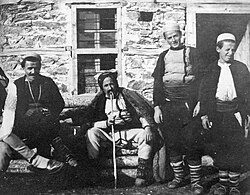
Bajazid Elmaz Doda created a collection of photographs in 1907 that serve as a visual record of Albanian Muslim life in the Upper Reka valley near , capturing pre-industrial rural existence in villages such as Shtirovica and Brodec. These images document shepherds in cloaks, processions in mountainous terrain, and men displaying traditional opingas footwear, highlighting elements of attire and social rituals specific to the region. Produced amid Ottoman decline and prior to the of 1912–1913, the photographs preserved cultural practices facing disruption from conflict and modernization. Doda employed early portable cameras to generate black-and-white glass plate negatives, prioritizing documentary precision over aesthetic arrangement to ethnographically represent subjects in natural settings. Compositions feature individuals and groups in everyday activities, such as conversing on hillsides or smoking in landscapes, providing of architectural forms like new stone houses and communal gatherings. The focus on factual depiction, including Turkish presence, underscores the archival value in illustrating socio-economic conditions under late Ottoman rule. This body of work, totaling dozens of exposures from expeditions in , offers unadorned insights into Albanian highland customs, distinct from posed studio portraits common in urban of the . By fixing transient scenes of and merchants or grooms post-marriage, Doda's images constitute a for reconstructing vanishing vernacular traditions amid geopolitical upheavals.

Personal Relationships and Private Life

Long-Term Companionship with Nopcsa

Bajazid Doda and Franz Nopcsa maintained a close personal association beginning in , when Nopcsa employed the then-18-year-old Doda as his secretary in , after which they undertook extensive travels together across the for over two decades. This partnership involved shared living arrangements, including prolonged residence in Vienna's Singerstrasse 12 following the First World War, where Nopcsa continued his scholarly pursuits with Doda's ongoing support. Nopcsa provided financial patronage to Doda, reflecting a dependency rooted in Doda's origins in a remote Albanian shepherding community and Nopcsa's aristocratic resources, which sustained their joint household amid Nopcsa's geopolitical engagements in Albanian affairs. Their bond, evidenced by Nopcsa's naming of the fossil turtle species Kallokibotion bajazidi in Doda's honor around 1912, underscored a profound personal attachment that persisted until Nopcsa's fatal actions in 1933. In April of that year, Nopcsa administered a sedative to Doda before shooting him and then himself in their apartment, leaving a note citing his decline and reluctance to abandon Doda to destitution, as their finances had deteriorated post-war. This incident, investigated by Viennese authorities, highlighted the depth of their interdependence, with Nopcsa's earlier correspondence and biographical accounts portraying Doda not merely as an employee but as an indispensable companion in both daily life and Nopcsa's advocacy for Albanian autonomy. The longevity of their association—spanning nearly 27 years—facilitated Nopcsa's immersion in Balkan cultural dynamics, where Doda's local ties offered practical leverage in volatile regions, though their dynamic was sustained by mutual reliance rather than formal ideology. Nopcsa's documented eccentricities, including ambitious schemes for Albanian statehood, intertwined with this companionship, yet primary evidence from their shared expeditions and domicile points to a pragmatic alliance forged in the necessities of fieldwork and exile.

Views on Cultural Preservation

Doda documented the vulnerability of Albanian highland customs in Upper Reka to erosion from recurrent warfare and population displacements following the Ottoman Empire's dissolution after the of 1912–1913. In his ethnographic accounts, he highlighted how such conflicts, culminating in the 1916 Bulgarian army's destruction of his birthplace Štirovica, accelerated the fragmentation of tribal communities and their associated traditions. Emigration driven by economic hardship and insecurity further imperiled these practices, as seasonal migrations evolved into permanent outflows amid territorial reallocations under emerging Balkan states. Doda postulated the imminent risk of Albanian disappearance in the region, including of their , attributing it to these pressures rather than inherent vitality deficits. His response emphasized empirical documentation of surviving tribal life—such as shepherding routines spanning 600–800 km annually to Aegean markets—to safeguard observable realities against assimilation into dominant state frameworks. Through works like his 1914 Albanisches Bauerleben im oberen Rekatal bei Dibra (Makedonien), Doda prioritized descriptive fidelity to rural social and economic structures over emotive or nationalistic interpretations, aiming to preserve causal patterns of highland existence for posterity. This approach implicitly critiqued detached external analyses by grounding insights in lived insider experience, underscoring the value of unadorned records amid accelerating modernization and administrative impositions.

Death and Circumstances

Murder in Vienna

On April 25, 1933, Bajazid Doda was shot and killed while sleeping in the apartment he shared with Franz Nopcsa. The fatal gunshot was fired by Nopcsa himself, who immediately afterward turned the weapon on himself in an act of . Nopcsa left a at the scene explicitly confessing to the killing, stating that he shot Doda "in his sleep without his suspecting at all" because he "did not wish to leave him behind alone" amid their shared financial destitution during the . The bodies were discovered later that day in the residence, confirming the sequence of events as a murder-suicide.

Investigation and Motives

The authorities promptly investigated the April 25, 1933, deaths of Bajazid Doda and Franz Nopcsa in their Singerstrasse apartment, confirming wounds to both men consistent with a murder-suicide scenario, as Nopcsa fired upon Doda while he slept before turning the weapon on himself. reports and ballistic evidence supported this determination, with no signs of forced entry or third-party involvement at the scene. Nopcsa's , addressed to the police, explicitly outlined his motives: a severe nervous breakdown prompted his self-killing, while he shot Doda to spare his long-term companion destitution and following Nopcsa's death, given their shared financial after the exhaustion of Nopcsa's and his unsuccessful job prospects. This personal rationale, corroborated by accounts of Nopcsa's mounting depression and economic hardship in , precluded the need for further pursuit of suspects, resulting in no arrests or convictions. Official inquiries uncovered no empirical links to external factors such as Balkan vendettas, despite Doda's ties to the Upper Reka region and potential for unresolved regional animosities; his documented isolation in , far from Albanian networks, and lack of reported enemies there rendered such scenarios implausible. Political motivations were similarly absent, as their joint endeavors centered on ethnographic and paleontological scholarship rather than partisan , contrasting with contemporaneous sensational reports framing the event as a dramatic lovers' quarrel without evidential basis.

Legacy and Scholarly Impact

Recognition in Albanian Studies

Bajazid Doda's 1914 publication Albanisches Bauerleben im Hochlande des Nordens provides one of the earliest systematic ethnographic accounts of Albanian peasant life in the northern highlands, focusing on the Upper Reka region's customs, routes from the Sharr Mountains to the Aegean, and daily material practices among Muslim Albanian communities. This work, based on his firsthand observations as a native of Štirovica, documents social structures, livestock management, and seasonal migrations that characterized pre-1912 Ottoman-era highland existence, offering empirical data on practices that began declining amid disruptions and post-independence urbanization. In Balkan , Doda's descriptions have been cited as a primary historical reference for reconstructing cultural continuity in isolated Albanian enclaves, particularly in ethno-botanical analyses of uses for , , and rituals. Peer-reviewed studies, such as those examining folk knowledge among remaining Reka Albanian descendants, utilize Doda's notes on wild edibles, forest resources, and herding techniques as a benchmark for assessing a century of ecological and sociocultural shifts, highlighting the rarity of such localized, pre-1920 . These references underscore his role in preserving of adaptive strategies in rugged terrains, where oral traditions and environmental interactions formed core elements of Albanian highland identity. Doda's fieldwork contributions extended to informing scholarly inquiries into Albanian ethnogenesis, supplying direct informant data on linguistic isolates, kinship systems, and archaic customs that aligned with hypotheses of descent from ancient Illyrian populations, as advanced by associates like Franz Nopcsa during joint expeditions in and Macedonia from 1906 onward. By capturing these elements before widespread assimilation or emigration eroded them, his outputs facilitated identity consolidation efforts in the , when Albanian intellectuals drew on highland to assert national distinctiveness against Ottoman and Slavic influences.

Modern Interpretations and Debates

In contemporary Albanian ethnography, Doda's documentation of Upper Reka highland customs, including ethnobotanical practices and rural , has been valued for preserving elements threatened by 20th-century migrations, wars, and state-driven modernization policies in the . A 2022 ethno-botanical study of Reka communities in draws directly on Doda's circa 1910s accounts of plant uses in daily life, such as remedies and , to highlight continuity and idiosyncratic adaptations amid assimilation pressures under Ottoman, Yugoslav, and post-communist regimes. This archival role aligns with broader scholarly recognition of his and Nopcsa's joint efforts as a bulwark against cultural erosion, particularly for Muslim Albanian highlanders facing ethnic homogenization in interwar and contexts. Critics, however, note limitations in scope, arguing that Doda's focus on Sunni Muslim communities in the remote Dibër region overlooked diverse Albanian subgroups, such as Orthodox or Bektashi populations in southern or coastal areas, potentially skewing representations toward archaic, patriarchal highland stereotypes. This selective emphasis, while empirically grounded in his native Štirovica origins, has drawn accusations of romanticization, with some analyses suggesting it reinforced exoticized views of as timeless "tribesmen" rather than dynamic societies adapting to Ottoman decline and emerging nation-states. Such critiques, often from post-1990s scholars, prioritize inclusive narratives encompassing urban or minority Albanian experiences, though they acknowledge the practical constraints of Doda's peripatetic life with Nopcsa. Debates surrounding Doda's long-term association with Nopcsa center on interpreting their Vienna-based companionship (post-1918), with factual evidence of professional collaboration—Doda as translator and co-author—contrasting against modern projections of ideological categories like " partnership." Scholarly accounts confirm a devoted, interdependent bond lasting over two decades, evidenced by shared residences, joint publications on Albanian linguistics and , and Nopcsa's 1933 suicide note citing mutual dependence amid his syphilis-induced decline, but without contemporaneous self-ascriptions of . Conservative-leaning interpretations emphasize cultural and intellectual synergy in preserving Albanian traditions against progressive erosion, viewing anachronistic "LGBTQ" framings—prevalent in popular media—as unsubstantiated overlays that dilute verifiable historical impacts, such as Doda's role in archiving highland dialects amid linguistic purges. Left-oriented views, conversely, highlight the relationship to advance identity-based narratives, yet these often rely on presumptive readings rather than primary documents, underscoring tensions between empirical fidelity and politicized reinterpretation in Balkan studies.

References

Add your contribution
Related Hubs
User Avatar
No comments yet.