Hubbry Logo
BakoolBakoolMain
Open search
Bakool
Community hub
Bakool
logo
8 pages, 0 posts
0 subscribers
Be the first to start a discussion here.
Bakool
Bakool
from Wikipedia

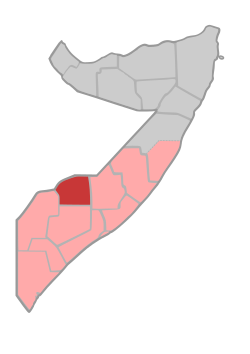
Bakool (Somali: Bakool, Maay: Bokool, Arabic: بكول) is a region (gobol) in southwestern Somalia.[4]

Key Information

Overview

[edit]

It is bordered by the Somali regions of Hiiraan, Bay and Gedo.

Bakool, like Gedo, Bay and most parts of the Jubbada Dhexe (Middle Juba) region, used to be a part of the old Upper Region, which was subdivided in the mid-1980s. The town of Hudur is the administrative capital of the region.

In March 2014, Somali Armed Forces assisted by an Ethiopian battalion with AMISOM re-captured the Bakool province's capital Hudur from the Al-Shabaab militant group.[5] The offensive was part of an intensified military operation by the allied forces to remove the insurgent group from the remaining areas in southern Somalia under its control.[6]

Districts

[edit]

Major towns

[edit]

Notes

[edit]

References

[edit]
[edit]
Revisions and contributorsEdit on WikipediaRead on Wikipedia
from Grokipedia
Bakool (Somali: Bakool) is a region (gobol) in southwestern , forming part of the . It borders to the northwest and consists of five districts with Hudur serving as the capital. The region covers an area of 26,962 square kilometers and had an estimated of 383,360 in 2019. Bakool is characterized by a mix of arid and semi-arid landscapes suitable for and rain-fed , including and production, making it part of Somalia's traditional alongside neighboring region. However, the area has endured recurrent humanitarian crises driven by droughts, food insecurity, and armed conflict. Al-Shabaab maintains operational control over significant portions, leading to clashes with Somali forces and Ethiopian paramilitaries along the . Local governance in Bakool has historically involved clan-based structures, with the Resistance Army establishing an administration in the region during the 1990s to counter warlord influence. Despite federal efforts, central authority remains weak, and districts like El Barde and Tiyeeglow experience ongoing instability. The five districts are Ceel Barde, Rab Dhuure, Tiyeeglow, Wajid, and Xudur.

Geography and Environment

Location and Borders

Bakool is a region situated in the southwestern part of Somalia, forming part of the South West State. It lies approximately 420 kilometers west of the national capital, Mogadishu, and encompasses an inland territory without direct access to the Indian Ocean coastline. The region's central coordinates are approximately 4°13′N 43°51′E. The Bakool region shares international borders with Ethiopia's Oromia Region to the northwest and is delimited domestically by the Hiiraan region to the northeast, the Bay region to the southeast, and the Gedo region to the southwest. This positioning places Bakool in a strategic transitional zone between Somalia's southern pastoral lowlands and the Ethiopian highlands, influencing its hydrological and conflict dynamics. The region comprises five administrative districts: Hudur (the capital), Tiyeglow, Wajid, El Barde, and Rabakawin.

Terrain and Hydrology

Bakool's terrain is characterized by flat to gently undulating plains and low plateaus, with elevations typically ranging from 133 meters to 746 meters above , averaging around 450 meters. The landscape includes scattered rocky outcrops and gravelly areas, which can impede travel and cultivation in certain . Dominant types are red, often sandy or loamy, with localized white soils and gravels contributing to variable agricultural potential influenced by drainage and patterns. Hydrologically, Bakool lacks perennial rivers, as the region's is limited to seasonal wadis that channel episodic rainfall runoff, primarily draining eastward toward the Shabelle River basin or southward influences from the system via transboundary flows from . These wadis activate mainly during the short Gu (April-June) and longer Deyr (October-December) rainy seasons but dry up rapidly in the arid intervals, exacerbating vulnerability to . forms the primary reliable resource, drawn from shallow to intermediate aquifers via hand-dug wells, berkads (traditional reservoirs), and mechanized boreholes, though and risks persist due to sparse recharge. Surface water availability is further constrained by the , with annual averaging 200-400 mm, leading to high rates and minimal sustained flow. Assessments indicate potential for improved water management through and aquifer mapping, but conflict and infrastructure deficits hinder development.

Climate and Drought Patterns

Bakool features a with bimodal rainfall regimes, consisting of the primary Gu season (April–June) and secondary Deyr season (October–December), interspersed by dry periods known as Jilal (December–March) and Hagaa (July–September). Annual in the South West region, including Bakool, typically ranges from 400 to 600 mm, though high spatial and temporal variability results in unreliable distribution, with potential evapotranspiration far exceeding rainfall at 1,500–2,100 mm per year. Temperatures remain warm to hot throughout the year, averaging 26.3°C annually in key settlements like Hudur, with daily maxima of 33–37.5°C and minima of 17–21°C. Drought patterns in Bakool are recurrent due to this inherent variability, occurring every 2–3 years during Deyr and every 8–10 years across consecutive Gu and Deyr failures, often triggering crop shortfalls in agropastoral zones. The 2010–2011 drought led to famine declaration in Bakool and adjacent southern areas, with over 250,000 excess deaths nationwide and widespread livestock mortality. Similarly, the 2016–2017 event—following three below-average rainy seasons—caused up to 60% livestock losses in Bakool's pastoral areas, classified the region at IPC Phase 4 (Emergency) through early 2018, and contributed to 141,087 people facing crisis or emergency hunger levels, a 31% rise from 2015 baselines. A prolonged from 2020 to 2023, marked by five consecutive failed rainy seasons, intensified food insecurity for millions and displaced populations, with erratic rainfall patterns linked to broader shifts including more persistent dry spells. In Bakool, these conditions have historically intersected with conflict, amplifying humanitarian impacts such as 6.4 million national livestock deaths in 2016–2017 and ongoing displacement into 2025 amid insecurity and crop failures.

Historical Development

Pre-Colonial and Clan Settlement

Prior to European colonization in the late 19th century, the Bakool region in southwestern was predominantly inhabited by of the confederation, encompassing the Digil and Mirifle subgroups, who practiced agro-pastoralism combining rain-fed agriculture with livestock herding. These groups settled in the area's semi-arid plains and wadis, exploiting seasonal rainfall for crops such as and alongside grazing for , camels, and goats, which supported semi-sedentary village-based communities tied to specific territories rather than nomadic . Territorial organization followed clan lineages, with Rahanweyn sub-clans delineating boundaries through customary agreements and controlling access to wells, grazing lands, and farmland, often mediated by collective diya (blood money) systems at higher lineage levels involving 4-7 jilib (sub-clans). Governance lacked centralized authority, relying instead on clan sultans and councils of elders to adjudicate disputes, allocate resources, and enforce xeer (traditional law), fostering relative stability in these agro-pastoral zones compared to more mobile northern pastoralist areas. This structure reflected broader pre-colonial Somali patterns of decentralized clan autonomy, where settlements clustered around productive ecological niches without formal state institutions. Archaeological and oral traditions indicate that Cushitic-speaking ancestors, later assimilated into Somali clan frameworks, formed the earliest settlements in southern Somalia's fertile inter-riverine extensions, with groups establishing dominance in Bakool through agricultural adaptation by at least the medieval period. intermarriage and alliances further solidified holdings, though conflicts over scarce resources occasionally arose, resolved via elder arbitration rather than conquest. These patterns persisted until colonial incursions disrupted local economies and boundaries in the 1880s-1890s.

Colonial Period and Independence

The Bakool region, situated in the arid interior of what is now southwestern , fell under Italian colonial administration as part of , established through a series of protectorates and territorial acquisitions beginning in the late . formalized its presence in the southern Somali territories via treaties with local Somali clans and agreements with Britain and , delineating boundaries between 1897 and 1908 that encompassed the area corresponding to modern Bakool. Italian control in interior regions like Bakool remained nominal, with administration focused on coastal trade routes and ports such as , while pastoralist clans in the hinterlands retained significant autonomy under . In 1936, , including the Bakool area, was integrated into the broader empire alongside and , intensifying exploitation of resources but yielding little infrastructural investment in remote inland districts. During , British forces occupied Italian Somaliland in 1941, administering the territory, including Bakool, until 1949 under a provisional Allied military government. Thereafter, the granted Italy a trusteeship over the region until scheduled , emphasizing preparation for democratic institutions amid ongoing clan-based social structures. The (former ) achieved independence on July 1, 1960, immediately uniting with the newly independent State of Somaliland (former , independent five days earlier on June 26) to form the . This merger preserved colonial-era boundaries, integrating Bakool into the unified nation's southern administrative framework without specific regional delineations at the time; early post-independence governance emphasized national unity over local autonomy, though clan influences persisted in areas like Bakool. The transition featured elections in 1956 for a in the trust territory, fostering Somali political participation prior to full sovereignty.

Civil War Era and Famine Impacts

The outbreak of the in January 1991, following the overthrow of President , led to widespread clan-based violence that severely impacted Bakool, a region predominantly inhabited by clans including the Digil and Mirifle subgroups. Warring militias from and clans repeatedly traversed territories in and Bakool between early 1991 and mid-1992, looting livestock, destroying farmland, and displacing communities, which exacerbated local food insecurity. By mid-1991, Digil and Mirifle militias assumed control over much of and Bakool, forming self-defense groups to counter incursions, though inter-clan skirmishes persisted amid the power vacuum. This phase of the war contributed to the collapse of customary governance and economic activity, with reports indicating near-total devastation in rural areas, particularly affecting women and children who bore the brunt of violence and displacement. The civil war's disruption compounded recurrent droughts, triggering the 1991–1992 famine, one of the deadliest in modern Somali history, which struck and Bakool hard due to prior agricultural sabotage and herd losses from militia raids. An estimated 300,000 Somalis perished nationwide, with southern regions like Bakool seeing acute rates soar as markets failed and was impeded by ongoing fighting. and Bakool, once Somalia's primary sorghum-producing areas, experienced total crop failure in 1991, forcing mass and long-term erosion of pastoral livelihoods. A second major hit Bakool in , declared by the on July 20 in southern Bakool and , where global acute exceeded 30% and mortality rates among children under five surpassed thresholds of 2 per 10,000 daily deaths. The crisis, killing approximately 260,000 people across —half of them children—stemmed from the worst in 60 years combined with Al-Shabaab restrictions on humanitarian access, as the group controlled much of Bakool and diverted aid or imposed taxes on farmers. In Bakool, agro-pastoralists faced livestock die-offs exceeding 50% in some districts, reduced harvests, and heightened vulnerability due to persistent low-level conflict, leading to over 1.5 million displaced within by late . These events underscored how dynamics, including jihadist failures, amplified mortality beyond climatic factors alone.

Recent Political and Conflict Dynamics

In Bakool, control remains contested between the (FGS) coalition forces and Al-Shabaab, with the militant group maintaining dominance over large rural expanses as of 2025, thereby restricting humanitarian access and local governance. The primary conflicts stem from armed confrontations involving improvised explosive devices, ambushes, and , often targeting (SNA) positions and supply lines. Federal and state security operations have aimed to degrade Al-Shabaab's infrastructure, such as the SNA's dismantling of militant trenches between Wajid and Baar districts in December 2024. Key incidents underscore the persistent volatility: Al-Shabaab ambushed SNA troops on the outskirts of Hudur, Bakool's administrative center, in a coordinated that highlighted vulnerabilities in forward bases. Such attacks align with broader Al-Shabaab tactics in South West State, including retaliatory strikes following government offensives, as reported in UN monitoring up to March 2025. Despite these efforts, Al-Shabaab's rural strongholds enable taxation, recruitment, and disruption of federal authority, complicating the transition from forces under the African Union Support and Stabilization Mission in Somalia (AUSSOM). Politically, Bakool's integration into the South West State framework has faced strains from insecurity and clan-based militias, exacerbating fragmentation within the federal system. Local administrations struggle with effective control, as Al-Shabaab's influence undermines initiatives, including stalled electoral processes and aid distribution. Tensions with neighboring entities, such as Ethiopia's interests in border areas, have indirectly heightened risks of proxy conflicts spilling into Bakool, though no major escalations were recorded by mid-2025. Overall, these dynamics reflect Somalia's national challenges, where military gains are offset by insurgent resilience and weak institutional capacity.

Demographics and Social Structure

Population Estimates and Distribution

Estimates for the population of Bakool region vary due to the absence of a comprehensive national since the 1970s, ongoing conflict, recurrent droughts, and significant internal displacement, which complicate and lead to projections rather than precise counts. A 2021 estimate by the Office for the Coordination of Humanitarian Affairs (UNOCHA) placed the region's population at 459,747. An assessment by the International Organization for Migration's Displacement Tracking Matrix (IOM DTM) reported a total of 492,492 inhabitants, with internally displaced persons (IDPs) comprising nearly 24% of that figure. Modeling efforts indicate minimal or negative in Bakool from 2013 to 2024, attributed to net out-migration and displacement, with a majority of the remaining population projected to be displaced by late 2024. The population is predominantly rural, with the majority engaged in agro-pastoral livelihoods across arid lowlands, though urban centers like Hudur (the regional capital, also known as Xudur) concentrate a notable portion, estimated at around 120,000 in older baselines. Distribution follows the region's five districts—El Barde, Hudur, Rab Dhuure, Tiyeglow, and Wajid—with denser settlements near water sources and administrative hubs rather than evenly spread, reflecting pastoral mobility and conflict-driven clustering. IDP movements, often southward or to neighboring region and urban areas like , further skew local distributions, exacerbating pressures on host communities in districts like Hudur and Wajid.

Ethnic and Clan Composition

Bakool's population is overwhelmingly Somali, with the vast majority affiliated with clans of the , comprising the Digil and Mirifle (also known as Rahaweyn) groups, who are traditionally agro-pastoralists inhabiting the interriverine regions of southern . These clans have historically dominated and Bakool since the late 1990s, following the displacement of other groups during the . Within Bakool, Mirifle sub-clans predominate, including the Hadama (or Hadamo), who constitute the largest segment and are concentrated in Hudur and Wajid districts, with an estimated regional population around 400,000 as of early 2000s assessments. Other Mirifle sub-clans include Jiron (primarily in Wajid), Laway (in Hudur), Leysan (in Hudur), and Gilible (in Tieglo). The Hadama themselves encompass further subdivisions such as , Gaalboore, and Shirmooge, reflecting the federated nature of clan structures. Smaller presences of non-Rahanweyn clans occur in peripheral areas, such as the Jajele sub-clan of and Aulihan of the /Darood in select locales, alongside Darood and elements in El Barde district. Marginal non-Somali or occupational minorities, including Bantu groups, are reported in limited pockets like El Barde, though they represent a negligible fraction compared to the Somali clan majority. Clan affiliations in Bakool underpin local social organization, resource access, and conflict dynamics, with dominance shaping regional stability post-1991.

Cultural Practices and Social Organization

The social organization of Bakool's population is predominantly structured around patrilineal clans, with the (particularly the Mirifle sub-clans) forming the majority demographic in the region. Clans serve as the primary units for social cohesion, resource allocation, and , operating through customary law known as , enforced by elders who mediate disputes via collective agreements such as diya payments for offenses. Unlike the more nomadic pastoralist clans dominant elsewhere in , Rahanweyn social structures emphasize inclusive lineages drawn from diverse origins, fostering a relatively accommodating communal framework adapted to settled communities. Historical perceptions position Rahanweyn clans as lower-status compared to "noble" nomadic groups, influencing inter-clan dynamics and access to power, though local alliances often prioritize territorial stability over rigid hierarchies. Cultural practices in Bakool revolve around an agro-pastoral economy, where communities engage in crop cultivation (such as sorghum and maize) alongside livestock herding of cattle, goats, and sheep, reflecting the Mirifle's traditional blend of farming and pastoralism rather than pure nomadism. Daily social rituals, including communal coffee gatherings, underscore the emphasis on interpersonal bonds and hospitality, with wood scarcity prompting efficient fuel-sharing norms. Islam shapes core customs, with adherence to Sunni practices and Sufi-influenced mysticism prominent, including prayer observances and seasonal festivals tied to the lunar calendar; however, clan endogamy reinforces marriages within sub-clans to preserve lineage integrity and social ties. Oral traditions, such as poetry recitation and folk storytelling, transmit clan histories and moral codes, while gender roles typically confine women to domestic and agricultural support tasks, with veiling and modest dress distinguishing social classes. These practices have persisted amid instability, adapting to famine cycles through clan-based mutual aid rather than state mechanisms.

Governance and Administration

Regional Status within Federal Somalia

Bakool is a (gobol) in southwestern , integrated into the federal structure as a constituent part of the South West State (Koofur Galbeed), one of the Federal Member States (FMS) of the . The South West State encompasses the regions of Bakool, Bay, and , operating under a devolved where FMS handle regional administration, including local and , while the (FGS) oversees national defense, foreign affairs, and monetary policy as per the 2012 Provisional Constitution. The regional capital is Hudur (Xudur), and Bakool comprises five districts: Hudur, Tiyeglow, Wajid, Yeed, and Rabak. Administrative coordination between the FGS and South West State involves joint security operations and development initiatives, though tensions arise over and electoral processes. As of October 2025, federal officials continue engagement in Bakool, such as promoting one-person-one-vote elections in districts like Wajid, indicating ongoing efforts to strengthen federal ties despite clan-based politics influencing FMS-FGS relations. Effective implementation of federal authority remains limited in Bakool due to Al-Shabaab's operational presence, particularly in rural areas, where the group imposes parallel and taxation, challenging the FGS and FMS control as evidenced by ongoing military operations killing militants in the region as recently as October 2025. EUAA assessments highlight that while urban centers like Hudur maintain some state presence supported by forces, broader territorial control by federal entities is inconsistent, reflecting the hybrid nature of authority in 's federal framework.

Districts and Local Authorities

Bakool is administratively subdivided into five districts: El Barde, Hudur, Rabdhure, Tiyeglow, and Wajid. These divisions, endorsed by the Somali government in 1986, form the basis of regional administration within the South West State. Hudur serves as the regional capital and administrative hub, hosting key offices for coordination with the state-level government in . Local authorities operate under the South West State's Ministry of Interior, Local Government, and Reconciliation, which appoints district commissioners and supporting officials to manage councils, security, and basic services. For instance, in March 2023, the ministry installed a in Qurcajoome District, a sub-area within Bakool, to oversee local affairs. District-level governance draws from clan elders and community representatives, reflecting Somalia's hybrid federal-local model, though elections for councils remain sporadic and clan-influenced. Federal efforts to bolster these structures include high-level visits, such as Somali Parliamentary Speaker Adan Mohamed Madobe's trip to Hudur in July 2025, aimed at enhancing anti-insurgent operations, administrations, and delivery through federal-state collaboration. Despite formal frameworks, local authority implementation is undermined by persistent insecurity, with non-state actors often exerting control in rural areas.

Challenges to Effective Administration

Al-Shabaab's dominance in rural Bakool severely constrains the reach of formal Somali federal and South West State administration, with the group exerting control over most non-urban areas through authoritarian governance, heavy taxation on and , and enforced compliance via and threats. This insurgent administration disrupts state authority by imposing collections exceeding 10-20% of harvests in some districts and blocking humanitarian access, exacerbating food insecurity and displacement of over 245,000 people in recent cycles. Persistent insecurity from ongoing clashes between Al-Shabaab and pro-government forces, including South West State troops and Ethiopian National Defense Forces, limits administrative operations to isolated urban enclaves like Hudur, while rural governance remains fragmented. Key supply routes, such as those linking Bakool to Bay region and , have been severed by Al-Shabaab blockades for nearly 15 years as of 2025, forcing regional officials to rely on for access and hindering revenue collection, service delivery, and troop movements. Local authorities face acute capacity deficits, including insufficient personnel, funding, and to manage rapid influxes of internally displaced persons—numbering in the hundreds of thousands amid recurrent droughts—leading to clan-based resource distribution rather than institutionalized administration. South West State leadership has drawn criticism for failing to restore road connectivity or bolster local governance since assuming office in , despite federal efforts like parliamentary visits to strengthen ties. Federalism-related tensions, including clan rivalries among Digil-Mirifle groups and disputes over power-sharing in the South West State, compound these issues by prioritizing factional loyalties over unified policy implementation, as evidenced by stalled district-level elections and overlapping claims to authority. These dynamics perpetuate a hybrid model where informal elders often mediate disputes in Al-Shabaab vacuums, sidelining state institutions and fostering in limited allocations.

Economy and Livelihoods

Agriculture, Pastoralism, and Trade

Bakool's economy centers on and , with limited constraining yields in its semi-arid environment. The region forms part of Somalia's "Sorghum Belt," where is the predominant , cultivated primarily during the Gu (April-June) rainy season on rainfed plots averaging 0.5-2 hectares per . and serve as secondary crops, with functioning as a in agropastoral zones, though production remains vulnerable to recurrent droughts that have reduced outputs by up to 50% in dry years like 2011 and 2017. Agricultural labor and sales contribute modestly to income, typically 10-20% in low-potential agropastoral areas, supplemented by on-farm consumption. Pastoralism dominates livelihoods, particularly in Bakool's arid interiors, where nomadic and transhumant of camels, goats, sheep, and provides the primary income source through sales and milk products, accounting for 40-60% of revenue in baseline years. Herd sizes vary by wealth group, with poor households maintaining 20-50 small ruminants versus 100+ for better-off pastoralists, enabling mobility across rangelands for during Deyr (October-December) rains. Bush product sales, such as gums and resins, offer supplementary earnings amid declining quality from and conflict-induced displacement. Trade networks link Bakool to regional markets, with sorghum surpluses from wetter years exported internally to urban centers like and via routes through Hudur, while moves northward to for export or southward for slaughter. Terms of trade favor cereals over during harvests but deteriorate in droughts, dropping -to-grain exchange ratios from 20-30 kg per to under 10 kg, exacerbating food insecurity. Cross-border informal trade in animals with persists, though Al-Shabaab taxation and checkpoints inflate transaction costs by 10-20%. Overall, these activities sustain 80% of the but yield low , with annual exports from exceeding 5 million head yet benefiting few Bakool producers directly due to intermediary dominance.

Resource Constraints and External Dependencies

Bakool's economy is severely constrained by its , characterized by erratic rainfall patterns averaging 200-400 mm annually and recurrent that have intensified due to , leading to frequent crop failures and livestock losses. The region experienced a prolonged from 2020 to 2023, which devastated rain-fed and , sectors that dominate local livelihoods, with estimated grain losses of 30-50% in southern including Bakool. Water scarcity exacerbates these challenges, as the region relies heavily on shallow wells, boreholes, and seasonal rivers like the Dawa, with limited and competition from pastoralist herds straining supplies during dry periods. is low across much of Bakool's terrain, affected by erosion rates of up to 10 tons of lost per acre annually from wind, water, , and , reducing arable land productivity for staples like and . These internal limitations foster heavy external dependencies, including reliance on imported foodstuffs and goods via overland trade routes from ports like Mogadishu or Bosaso, often extending to neighboring Ethiopia's Somali Region, which supplies essentials to western Bakool areas like Yeed. Humanitarian aid constitutes a critical lifeline, with Bay and Bakool regions receiving consistent external assistance for food security, though diversions and bans by groups like Al-Shabaab—such as the 2000s prohibition on U.S. aid—have historically undermined delivery and perpetuated vulnerability. Somalia's broader trade deficit, marked by import dependence for non-local produce, further ties Bakool's stability to fluctuating international aid flows and regional commerce, limiting self-sufficiency amid poor infrastructure and insecurity.

Security and Conflicts

Al-Shabaab Control and Operations

Al-Shabaab maintains significant control over rural areas in Bakool region, where it dominates much of the countryside and several peripheral towns, including Tayeeglow, Rab Dhuure, and Ceel Cali, while urban centers like Hudur and Ceel Barde remain contested or under nominal government influence. By November 2022, the group had seized additional towns such as Garasweyne, reinforcing its rural stronghold amid ongoing Somali National Army (SNA) and allied operations. This territorial hold enables Al-Shabaab to impose a harsh taxation regime on agriculture, pastoralism, and trade routes, exacerbating food insecurity in the region, which is a key breadbasket area for sorghum and livestock. The group's operations in Bakool include establishing checkpoints for , particularly in like Yeed and Tayeeglow, where vehicles and goods are taxed systematically to fund insurgent activities, mirroring broader Al-Shabaab revenue strategies estimated to generate millions annually from similar sites elsewhere in southern . During the 2022-2023 , Al-Shabaab selectively distributed aid to populations in Bakool and adjacent region under its influence, while blocking humanitarian access to government-held areas, thereby bolstering local support through coercive welfare tactics. Armed operations focus on guerrilla-style ambushes and assaults on district centers; for instance, in June 2020, clashes near Hudur killed at least 15 South West State forces, and in September 2023, Ethiopian troops engaged Al-Shabaab fighters near Rab Dhuure. Hudur, Bakool's administrative capital, serves as a recurrent target for Al-Shabaab incursions, with militants using rural bases to launch probes and plot urban attacks. On October 21, 2025, SNA forces conducted a targeted night raid approximately 8 kilometers from Hudur in the Ceel-Garas area, killing 10 Al-Shabaab fighters reportedly planning an assault on the town, highlighting the group's persistent operational capacity despite counteroffensives. These activities underscore Al-Shabaab's strategy of exploiting Bakool's porous borders with and weak state presence to sustain logistics, recruitment from local clans, and cross-border operations.

Clan-Based Violence and Inter-Group Tensions

Clan-based violence in Bakool primarily stems from competition among sub-clans, particularly the Mirifle and Digil, over limited resources such as pastureland, water sources, and farmland, intensified by recurrent droughts and agro-pastoral livelihood pressures. These tensions often manifest as skirmishes between pastoralist herders encroaching on cultivated areas and sedentary farming communities, leading to cycles of retaliation and displacement. Inter-clan clashes have persisted since the early amid , with local militias enforcing clan claims through checkpoints and ambushes. Specific incidents highlight the volatility: in May 2022, fighting broke out between Mirifle sub-clans in Bakool over farmland access, resulting in and temporary population movements. Clashes have also involved groups and adjacent clans disputing wells and grazing rights, as reported in regional assessments up to 2022. In June 2023, rival armed groups—often aligned with interests—engaged in Elbarde district, killing at least 10 individuals in a gun battle that underscored ongoing rivalries. While traditional elders have mediated some disputes, such as multiple settlements in Bakool and neighboring areas between late 2014 and early 2015, unresolved feuds contribute to broader insecurity, including sporadic violence against civilians. ACLED data from recent years records numerous battles in Bakool, some attributable to dynamics separate from Islamist insurgencies, though exact inter- attributions vary due to underreporting and militia overlaps. These tensions reflect deeper causal factors like resource scarcity and weak state , rather than ideological divides.

Government and International Countermeasures

The (SNA) has conducted multiple targeted security operations in Bakool region since early 2025 to dislodge Al-Shabaab militants and secure key areas. In January 2025, SNA units launched offensives in Wargolole, Hooyaley, and Abagbeday, north of Hudur district, as preparatory actions for broader campaigns against insurgent positions. By February 2025, the SNA's 9th Division completed specialized training under the regional commander, enabling deployments across Bakool districts to neutralize Al-Shabaab threats, with emphasis on integrated clan militias for local intelligence and support. Further SNA actions in June 2025 focused on rural strongholds, including consecutive raids in Lukugooraw, Xaaway-Heedaw, Dabgal, and Ceel- areas, resulting in reported militant casualties and seizure of weapons caches. In August 2025, the SNA coordinated with the 60th Division of the 9th Brigade to bolster defenses in Wajid district, adjacent to region, aiming to prevent Al-Shabaab incursions and facilitate civilian returns. These efforts, often involving local Raskamboni Brigade elements, have prioritized clearing supply routes but face challenges from Al-Shabaab's guerrilla tactics and terrain advantages, with incomplete territorial gains reported. International countermeasures include support from the African Union Transition Mission in Somalia (ATMIS), which maintains forward operating bases along Bakool's Ethiopian border to enable joint patrols with federal forces, though control remains contested in interior towns like Yeed. ATMIS troops, drawn from contributing nations such as Ethiopia and Kenya, provide logistical backing for SNA advances but are transitioning toward drawdown phases, with Phase 3 reductions completed by mid-2025 amid concerns over post-mission vacuums. In September 2025, a U.S.-Somalia security pact expanded advisory roles, including intelligence sharing and training for SNA units in southern regions like Bakool, to enhance precision strikes against Al-Shabaab leadership. For clan-based tensions, government initiatives emphasize reconciliation forums led by South West State authorities, integrating Digil-Mirifle clan elders into security councils to mediate disputes over grazing lands, though enforcement relies on ad hoc SNA interventions rather than sustained policing. International donors, via UN channels, fund community stabilization programs in Hudur and Rabakaw, focusing on disarmament incentives, but outcomes are limited by weak state presence and rival clan arming. Overall, these measures have disrupted Al-Shabaab operations sporadically but have not eradicated insurgent influence, as evidenced by persistent ambushes on federal convoys.

Major Settlements and Infrastructure

Hudur as Regional Capital

Hudur, also known as Xudur, functions as the administrative capital of the Bakool region in southwestern 's South West State, overseeing regional governance for its five districts: Hudur, El Barde, Rabak, Tiyeglow, and Yeed. It simultaneously serves as the capital of Hudur District, centralizing local authority structures endorsed under the 1986 boundaries set by the Somali government. As the regional hub, Hudur hosts key administrative offices, including those coordinating with federal and state entities, though effective control remains contested due to surrounding insurgent influence. The town, home to an estimated 11,000 residents primarily from clans, has historically operated as a nexus linking inland economies to broader markets. Liberated from Al-Shabaab control in March 2014 by African Union Mission in Somalia (AMISOM) forces, Hudur's recapture marked a pivotal shift, enabling limited restoration of state presence amid ongoing encirclement by militant-held rural areas. This status underscores its strategic role, yet persistent blockades on supply routes since approximately 2014 have isolated the capital, complicating administrative logistics and aid delivery, often restricted to airdrops or donkey carts. Infrastructure in Hudur reflects its administrative primacy but is severely constrained, with initiatives like solar-powered water systems and street lighting introduced by humanitarian organizations to bolster resilience and capacity. Recent engagements, such as the July 2025 visit by South West State President Abdiasis Hassan Mohamed to convene with Bakool officials and elders, highlight Hudur's continued function as a focal point for regional policy discussions and coordination. Despite these efforts, the town's role as capital is undermined by Al-Shabaab's dominance in peripheral zones, rendering Hudur an "island" of government influence in a volatile landscape.

Other Significant Towns and Rural Centers

Bakool's other significant towns primarily consist of the capitals of its four remaining districts—Wajid, Tiyeglow, El Barde, and Rab Dhuure—which function as administrative, market, and service centers amid predominantly rural landscapes dominated by agro- communities. These settlements support localized trade in , grains, and , while surrounding rural areas feature dispersed villages and nomadic encampments reliant on seasonal farming along riverine corridors and herding in arid grasslands. Wajid, the district capital in southern Bakool, serves as a key node for Mirifle clan-based commerce and relief distribution, with infrastructure including basic airstrips and markets handling and exchanges. Tiyeglow, located centrally, acts as a hub for similar rural economies, facilitating access to boreholes and veterinary services for and herds in its vicinity. El Barde, bordering , hosts periodic clan tensions and humanitarian operations, with its markets disrupted by armed clashes as recently as June 2023, when rival groups fought, resulting in at least 10 deaths. Rural centers around El Barde include small settlements like Baadikeen, emphasizing cross-border pastoral movements. Rab Dhuure, in the west, remains underserved and influenced by non-state armed groups, with needs assessments highlighting gaps in water, sanitation, and for its populations; nearby rural sites such as Horseed and Waberi support seasonal . These towns and centers collectively underpin Bakool's rural resilience, though insecurity limits development.

References

Add your contribution
Related Hubs
User Avatar
No comments yet.