Hubbry Logo
Balfron TowerBalfron TowerMain
Open search
Balfron Tower
Community hub
Balfron Tower
logo
8 pages, 0 posts
0 subscribers
Be the first to start a discussion here.
Balfron Tower
Balfron Tower
from Wikipedia

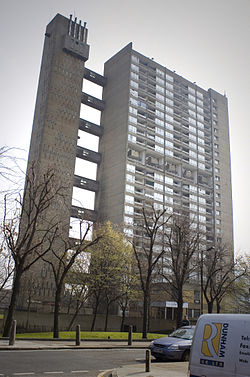
Balfron Tower is a 27-storey residential building in Poplar, located in the London Borough of Tower Hamlets, London. Built in a Brutalist style, it forms part of the Brownfield Estate, an area of social housing between Chrisp Street Market and the A12 northern approach to the Blackwall Tunnel. It was designed by Ernő Goldfinger in 1963 for the London County Council, built 1965–67 by the GLC, and has been a listed building since 1996 (Grade II*, originally Grade II).[1][2] Balfron Tower is stylistically similar to Goldfinger's later Trellick Tower in North Kensington, within West London.

Key Information

Design

[edit]

Balfron Tower is 84 metres (276 ft) high and contains 146 homes (136 flats and 10 maisonettes).[2] Lifts serve every third floor; thus, to reach a flat on the 11th, 12th, or 13th floors, residents or visitors would take a lift to the 12th. The lift shaft sits in a separate service tower, also containing laundry rooms and rubbish chutes, and joined to the residential tower by eight walkways.

The maisonettes are on floors 1 and 2, and 15 and 16, causing a break in the pattern of fenestration on the west side.[3]

The service tower is topped by a boiler room. In 1985, the original concrete boiler flues were replaced with metal, due to concrete decay.[4]

November 2005

Carradale House

[edit]
Carradale House, with Balfron Tower behind it

Carradale House (1967–70) is an adjacent, unique, modernist building, also designed by Ernő Goldfinger and Grade II listed. The two buildings appear to be natural extensions of each other, linked by style and design, with the long, low form of Carradale House complementing the height of Balfron Tower. All flats have dual window aspect and large south facing balconies, allowing plenty of natural light, and decorated with natural wood panels on the sides.[5] The block is 37 metres (121 ft) tall with 11 floors, and contains 88 flats.[6] The building has a similar podium to Balfron Tower, albeit more extensive with a large underground car park underneath. It too has sky bridges on the same principle of access at every third floor. After designing Balfron, Goldfinger identified all the possible improvements and incorporated them first in Carradale House and afterwards to Trellick Tower. Like Balfron Tower, the robust nature of the detailing to this building has helped it to weather the passage of time. Over the course of three years, Carradale underwent an extensive and careful renovation under the supervision of English Heritage and the direction of PRP Architects.[7]

The two blocks were known as Rowlett Street Phases I and II during development[4] before being named after the Scottish villages of Balfron and Carradale, a pattern followed in naming other locations on the nearby Aberfeldy and Teviot estates.

Brownfield Estate

[edit]

Owen Hatherley describes the surrounding Brownfield Estate as "all designed with an attention to detail and quality of materials unusual for the 60s or any other decade".[8]

History

[edit]
Balfron Tower lobby in 2008

Balfron Tower was designed by architect Ernő Goldfinger and is associated with the Brutalist style of 1960s architecture. Goldfinger himself was pleased with the design and moved into flat 130, on the 25th floor, for two months in 1968. He and his wife threw champagne parties to find out what the residents liked and disliked about his design.[9] He applied what he learnt to his design for the similar and more famous Trellick Tower in West London. Goldfinger's studio later added Glenkerry House on the same estate, complementing Balfron Tower and Carradale in style.

The building was given Grade II listed status in March 1996, (later changed to Grade II*)[1][2] followed by Carradale House in 2000.[5] to spare them from demolition. Carradale and Glenkerry Houses were also included in the Balfron Tower Conservation Area, designated in 1998.[4] The listing continues to attract comment, especially in view of the failure of another nearby Brutalist estate, Robin Hood Gardens, to obtain the same protection.[10] In recent years Balfron Tower has been popular with visitors during the annual Open House Weekend.[11]

In December 2007, following a ballot of residents in 2006, Tower Hamlets Council transferred its ownership of Balfron Tower, Carradale House and the surrounding Brownfield Estate to Poplar HARCA, a housing association.[12]

Refurbishment and sell-off

[edit]
Entrance door to the tower

HARCA began a full refurbishment of the buildings in 2011. The architectural firm PRP which took up this project looked to restore these Brutalist structures to their original form as required by English Heritage, and also to bring the buildings up to modern specifications and 21st century living standards. The refurbishment was technically challenging, due to the need to install new services without disturbing the listed exterior. The solid concrete design also suffers inherently from cold bridging, which had to be remedied by internal wall insulation.

Residents were to have the option to keep their flats in the blocks, or to move into new low-rise homes nearby, in which case the vacated flats would be sold to finance the works.[13][14] In October 2010, the residents of both blocks were sent notice that the refurbishment would require all residents to move out, due to fire safety and other risks, with no undertaking on whether they could return.[15]

The first phase of the refurbishment took place from 2011 to 2014 with the lower block, Carradale House. Key features of the refurbishment include:[7] replacement of existing windows with high-performance examples matching original pattern; upgrade of thermal performance using materials to provide insulation and vapour barriers; efficient gas-fired boilers for replacement communal heating system; and new wet services, incorporating water conservation measures. Internally, communal spaces and flats are sensitively refurbished in keeping and without altering Goldfinger's original layouts and heritage features. These embody key considerations related to restoring the key elements of the original scheme, undertaking repair and replacement on like-for-like basis, ensuring a lifespan of at least 30 years, taking advantage of a once in a lifetime opportunity to scaffold the entire building and upgrading as far as possible to accord with modern standards. This will ensure its future effectiveness and desirability as a place to live.

Work to refurbish Balfron Tower was undertaken through a joint partnership with Londonewcastle, a luxury residential developer.[16] Pending the works to Balfron Tower, some flats were temporarily occupied by artists, who contributed to the community and put on displays in "heritage flat" number 123.[17] A major photographic project was undertaken in November 2010.[18][19]

In September 2014, Wayne Hemingway restored Goldfinger's former flat number 130 to 1960s style as part of a National Trust exhibition on brutalism.[20]

As residents were decanted, a campaign formed in December 2014 in an attempt to save 50% of the Balfron as social housing.[21] In February 2015, residents and campaigners protested HARCA in February 2015 over fears that social tenants would be evicted.[22] Shortly afterwards, it was announced that no social housing would be retained, and that all of the flats would be sold.[23] Six "heritage" apartments have been retained with original layout and colour scheme, with fixtures matching the originals.[24]

The second phase refurbishment plans were strongly opposed by the Twentieth Century Society in 2015.[25] In particular they claim that the 'unsympathetic' replacement of the tower's windows has compromised the distinction and importance of the tower, reducing it from a 'genuinely iconic brutalist masterpiece' to an 'ersatz hybrid'.[25]

Rowland Atkinson from the University of Sheffield said: "The decision to convert two of the most symbolic tower blocks in London from local authority to private residences is a sign of how much the city has been set in service to the needs of capital and the rich."[26]

[edit]

Shots of the building are featured in music videos for "This Is Music" by The Verve, "Morning Glory" by Oasis, "Mortalhas" by ProfJam, "Ready to Go" by Republica, and “Money Talks” by Rubella Ballet.

Balfron Tower has appeared as a location in many British television programmes, often when an impression of urban deprivation was required.[14] Some that used it extensively are "Faking It", the second episode of the BBC series Hustle; the ITV series The Fixer; and Whitechapel, a three-part drama series produced by Carnival Films.

The tower is featured in the 1988 film For Queen and Country, starring Denzel Washington and was the filming location for Shopping, a 1994 film written and directed by Paul W. S. Anderson. It also features in Danny Boyle's post-apocalyptic horror film 28 Days Later[27][28] and the 2011 film Blitz.[29]

William Raban shot About Now MMX (2010) during his artist's residency in Balfron Tower.[30] In July 2014 artist Catherine Yass was refused permission to drop a piano from the Tower as part of a "community workshop to explore how sound travels".[31]

In 2014, the National Trust refurbished flat 130, where Goldfinger lived, to resemble its appearance in the 1960s. The work was designed by Tilly Hemmingway, with objects donated by the Land of Lost Content, a popular culture museum in Shropshire.[32]

UK grime artist Wiley used Balfron Tower and the Brownfield Estate as the location for the music video of his track "P Money" in 2015, which was then later featured in his 2017 album Godfather.

The tower is referenced in the song "Balfron" by the band John on their album God Speed in the National Limit.

Transport

[edit]

Buses

[edit]

The estate is served by London Buses routes 108 and 309. London Buses routes 15, 115 and D8 run nearby.

Canals

[edit]

The estate is adjacent to the junction of the Limehouse Cut canal and the River Lea Navigation at Bow Locks.

Docklands Light Railway

[edit]

The nearest stations are Langdon Park and All Saints for Docklands Light Railway services towards Canary Wharf and Stratford.

London Underground Station

[edit]

The nearest London Underground stations are Bromley-by-Bow tube station and Bow Road tube station on the District and Hammersmith & City lines in zone 2.[33]

See also

[edit]

References

[edit]
[edit]
Revisions and contributorsEdit on WikipediaRead on Wikipedia
from Grokipedia
Balfron Tower is a 26-storey residential block located on St Leonard's Road in Poplar, , designed by Hungarian-British architect Ernö Goldfinger and constructed between 1965 and 1967 as within the London County Council's Brownfield Estate. The structure stands 84 metres tall and originally housed 146 dwellings, comprising flats and maisonettes, connected by enclosed access galleries functioning as "streets in the sky" inspired by Le Corbusier's . Completed amid postwar efforts to rehouse populations displaced by bombing and , it exemplified modernist high-rise principles aimed at fostering community through elevated communal spaces. Recognized for its architectural merit, Balfron Tower received Grade II* listing in 1996 from , citing Goldfinger's authorship, innovative planning, construction with bush-hammered finishes, and its role in postwar social housing history. At the time of completion, the tower was among Europe's tallest residential buildings, dwarfing neighboring low-rise blocks in the estate and embodying Brutalist aesthetics through raw and sculptural massing. Goldfinger himself resided on the 25th floor for several months to evaluate living conditions, adjusting designs based on resident feedback for subsequent projects like . In later decades, the tower faced deterioration and shifting housing policies; transferred from council ownership to Poplar HARCA in 2007, it underwent refurbishment starting around 2011, during which social tenants were decanted to enable conversion into private market-rate flats by developer Telford Homes. This process sparked controversy, as many original residents were not permitted to return, and by 2023, a significant portion of the refurbished units remained unsold, attributed to alterations that compromised original features and market disconnects. Despite these challenges, the building's heritage status has preserved its core fabric, highlighting tensions between conservation, modernization, and socioeconomic displacement in urban regeneration.

Location and Context

Site and Urban Setting

Balfron Tower is situated on St Leonard's Road, Poplar, E14 0QT, in the London Borough of Tower Hamlets, marking the eastern boundary of the Brownfield Estate. The site, part of a initiative, replaced a grid of substandard 19th-century terraced on flat terrain, with land acquisition occurring in 1959 following identification for in 1951. Adjacent to the Northern Approach Road and East India Dock Road, the location integrates with the surrounding infrastructure while overlooking landscaped areas such as Jolly’s Green. The urban setting encompasses a cohesive ensemble of high-rise towers—including the 11-storey Carradale House and 14-storey Glenkerry House—and low-rise blocks, unified by a restricted palette of materials and pedestrian-oriented spaces along St Leonard’s Road. Positioned north-east of the Lansbury Estate and near Chrisp Street Market, the estate forms part of Poplar's regenerated East End landscape, characterized by mixed social housing amid proximity to modern developments like . Transport links, including stations at All Saints and Langdon Park, along with bus routes, enhance accessibility within this historically working-class district. Poplar's context reflects extensive bombing and , driving the Greater London Council's 1960s comprehensive planning to provide elevated living standards through vertical housing and community amenities. The Brownfield Estate's design responded to these challenges by creating a self-contained urban precinct with underground garages and green spaces, aiming to foster social cohesion in an area disrupted by earlier infrastructure projects like the tunnel approaches.

Relation to Brownfield Estate and Carradale House

Balfron Tower forms a central element of the Brownfield Estate, a post-war social housing development in Poplar, , designed by Ernö Goldfinger between 1963 and 1974. The estate comprises 622 dwellings across multiple blocks, with Balfron Tower and the adjacent Carradale House serving as flagship structures in its Brutalist composition. Carradale House, completed in 1968, is an 11-storey block containing 88 flats, arranged in a Y-shaped plan to optimize sunlight penetration and views for residents, reflecting Goldfinger's emphasis on communal living and environmental integration. Positioned directly beside Balfron Tower—finished two years earlier in 1967—Carradale functions as a low-rise to the 26-storey tower, enhancing the estate's dynamism while sharing material palettes of and modular flat layouts. Both buildings, commissioned by the London County Council (LCC) and its successor the (GLC), exemplify Goldfinger's vision for high-density that prioritized durability, community facilities, and urban regeneration in bombed-out postwar areas. Their proximity fosters a unified estate identity, with shared access routes, landscaping, and services like laundries and club spaces that encouraged social interaction among tenants. Balfron Tower holds Grade II* listed status for its pioneering scale and form, while Carradale House is Grade II listed, underscoring their collective architectural merit despite later critiques of maintenance challenges in such estates. Ownership of the Brownfield Estate, including Balfron Tower and Carradale House, transferred from the London Borough of Tower Hamlets to the Poplar HARCA in December 2007, enabling targeted refurbishments to address aging while preserving heritage features. This shift supported regeneration efforts, such as upgrading communal areas and ensuring compliance with modern standards, without altering the interdependent spatial relationship.

Architectural Design

Design Principles and Influences

Balfron Tower's design reflects Ernő Goldfinger's modernist influences, particularly from Le Corbusier and Auguste Perret, whom he encountered during his Paris studies in the 1920s. Goldfinger, a Hungarian émigré and advocate of socialist housing ideals, drew on Le Corbusier's principles of "Soleil, Espace, Verdure" (sun, space, greenery) to prioritize natural light, ventilation, and communal living in high-density urban settings. Perret's expertise in reinforced concrete informed Goldfinger's use of raw, structural materials, blending functional rationalism with Brutalist expressionism evident in the tower's bush-hammered concrete finish and monumental scale. Central to the design was the separation of residential and service functions to minimize noise and disruption while fostering social interaction. A detached 11-storey service tower, connected by skybridges, housed lifts, rubbish chutes, and a boiler room, allowing the main 26-storey block—containing 136 flats and 10 maisonettes—to prioritize quiet living spaces with full-height timber windows and balconies for views over east London. Access galleries every third floor functioned as "streets in the sky," promoting neighborly contact akin to Le Corbusier's communal corridors in Unité d'Habitation, while ground-level pedestrian precincts with underground parking emphasized greenery and separation from traffic. Goldfinger incorporated proportional systems derived from the Golden Section and modular grids, with crosswalls spaced at 22-foot centers and façades proportioned as double squares (108 feet 4 inches by 216 feet 8 inches), ensuring rhythmic harmony in the Brutalist form. Communal amenities, including a launderette, hobby room, music room, and play areas tailored to different age groups, embodied post-war welfare-state aspirations for self-sufficient vertical communities. To validate these principles, Goldfinger resided in a flat for eight weeks in 1968, gathering resident feedback that influenced minor adjustments.

Structural and Material Features

Balfron Tower employs an in-situ cross-wall structure for its 26-storey main residential block, providing lateral stability and load-bearing capacity through solid cross-walls that span the full height. This system is connected to an adjacent service tower—housing lifts, stairs, and refuse chutes—by bridges positioned at every third floor, allowing separated circulation and servicing while maintaining structural integrity. The dominant material is , cast in-situ for the core frame and walls, with an exposed bush-hammered finish that textures the surface for weather resistance and visual emphasis on the material's raw form. Precast components accelerate construction for intricate elements, including balcony parapets, stairs, and the curved profiles of access galleries, which project horizontally with radiused edges to articulate the facade. Balconies feature timber cladding for habitable outdoor space, contrasting the concrete's mass, while the flat roof utilizes asphalt waterproofing. The rigid concrete grid visibly frames individual residences on the exterior, aligning structural expression with functional divisions and underscoring the design's emphasis on material honesty over ornamentation.

Innovative Elements and Layout

Balfron Tower features a stacked maisonette layout, with 136 one- and two-bedroom flats arranged in interlocking pairs that span two floors each, supplemented by 10 dedicated two-storey maisonettes designed for families of up to six using proportions based on the Golden Section, such as rooms measuring 20 feet 8 inches by 12 feet 11.5 inches. This vertical stacking enabled efficient use of space in the 26-storey structure, exceeding contemporary Parker Morris space standards for social housing while providing dual- or triple-aspect orientations for and ventilation in each unit. Every flat includes a —full-width on the west façade and half-width elsewhere—clad in timber for aesthetic softening of the and functional benefits like child supervision and airflow. A key innovation was the skip-stop system, with two passenger lifts in a detached service tower stopping only every third floor, accessed via enclosed skybridges and nine galleries per landing that functioned as communal "" to foster neighborly interaction without extensive internal corridors. This maisonette-driven access minimized noise transmission from services and reduced building footprint for circulation, though it later highlighted limitations for residents with mobility aids or prams due to reliance on internal for intermediate floors. The galleries, storey-and-a-half high with marble-lined lobbies, integrated facilities like and hobby rooms at lower levels. Structurally, the tower employed crosswall construction using in-situ poured on-site, finished with bush-hammering for texture and durability against London's weather, with radiused corners and a modular 2-foot-9-inch grid for precise unit placement. This method supported the slab-like form, cantilevered service elements, and pre-cast features like flower boxes on balconies to encourage resident , aligning with modernist goals of elevating dwellers into light-filled, hygienic environments. The design's separation of services from living areas via the tower further innovated acoustic privacy in high-density housing.

Construction and Initial Development

Commissioning and Building Process

Balfron Tower was commissioned as phase 1 of the Brownfield Estate, a public housing scheme by the London County Council (LCC) to rehouse communities displaced by the approach roads, with initial site approval granted in 1959. The project was designed by Hungarian-born architect , whose proposals were finalized in 1963 and received detailed LCC approval in February 1964. This commissioning reflected post-war LCC efforts to provide modern, high-density social housing amid London's population pressures and slum clearances. Construction began in June 1965, following the LCC's transition to the (GLC) earlier that year, which assumed oversight as the primary builder. The process employed in-situ cross-wall techniques for the 26-storey tower, founded on 30-inch bored piles extending 60 feet deep, with external walls cast in waterproof later bush-hammered to expose aggregate. A separate service tower for lifts, refuse chutes, and utilities was linked to the main structure via bridges at every third floor, facilitating construction efficiency and minimizing noise transmission during building. The build progressed steadily, culminating in a symbolic final concrete pour on the roof on 7 1967, with overall completion in October 1967. A topping-out marked structural finish on 22 1968, after which initial occupancy commenced, yielding 136 flats and 10 for social housing tenants. No private contractors are prominently documented beyond GLC direct labor and , aligning with the era's public authority-led model for council estates.

Architect's Involvement and Early Occupancy

Ernő Goldfinger, the Hungarian-born British architect, was commissioned by the London County Council (LCC) in 1963 to design as part of a initiative in Poplar, overseeing its development from initial plans through to completion. commenced in 1965 and concluded in 1967, with Goldfinger emphasizing modular techniques and framing to achieve the 26-storey structure's scale efficiently. His involvement extended to ensuring the integration of innovative features like asymmetrical layouts and service cores, drawing from his earlier modernist experiments in high-density housing. Following official opening in 1968, Goldfinger and his wife Ursula relocated to flat 130 on the 25th floor for two months, allowing the architect to directly assess the building's livability and gather informal feedback from initial interactions with residents. This residency reflected Goldfinger's philosophy of designing as if for personal use, enabling him to evaluate acoustics, ventilation, and communal dynamics firsthand amid the tower's early operational phase. Early occupancy began in 1968 under LCC management, with 136 one- to three-bedroom flats allocated primarily to working-class families decanted from nearby slums, prioritizing the preservation of existing neighborhood ties by assigning units street-by-street. Initial resident accounts highlighted the apartments' generous proportions—up to 90 square meters for larger units—abundant natural light from floor-to-ceiling glazing, and novel amenities like and refuse chutes, which contrasted sharply with pre-war terraced housing conditions. Occupancy rates reached near-full capacity within the first year, fostering a through elevated "" walkways linking to the adjacent Carradale House, though some early dwellers noted challenges with noise propagation and lift reliability.

Operational History as Social Housing

Tenancy Patterns and Management

Balfron Tower's 146 units, comprising 136 flats and 10 maisonettes, were first let as social housing by the (GLC) starting in 1968 to approximately 160 families rehoused street-by-street from adjacent areas in Tower Hamlets, with tenants qualifying for subsidised rents. Initial occupancy reflected strong demand for the modern accommodations, evidenced by resident feedback collected during architect Ernő Goldfinger's two-month stay in flat 130 from February to April 1968, which highlighted appreciation for spacious layouts, natural light, and panoramic views despite minor early defects like heating inconsistencies. Management responsibility transferred from the GLC to the London Borough of Tower Hamlets in 1985, shifting tenants to council tenancies while the Housing Act 1980's provisions enabled some conversions to leasehold ownership. By November 2007, ahead of the stock transfer to Poplar HARCA—approved by a 78.8% —the building housed 99 social rented households, 36 leaseholders, and 11 vacant units, indicating a mix of secure tenancies amid emerging maintenance challenges such as unreliable lifts and structural wear. Poplar HARCA initiated decanting of social tenants in 2008 to facilitate comprehensive refurbishment, issuing formal notices in October 2010 on grounds of risks; of the 102 affected social households, 71 relocated within Poplar (E14 postcode), 18 to other Tower Hamlets areas, and 95% overall remained in the borough, with many offered new social rent homes elsewhere. Leaseholders retained options to return post-refurbishment if they funded necessary upgrades to their units. Refurbishment, executed via a between Poplar HARCA and Homes (later involving Londonewcastle), concluded with landscaping in summer 2021, converting all units to private market rentals without reinstating social housing allocations, a decision justified by the association as necessary to cross-subsidize repairs given the building's disrepair upon acquisition. From 2024, Way of Life Management Ltd assumed operational rental management of the 146 apartments, now offered as 1- to 4-bedroom private lets with enhanced communal facilities including a , , and studio. This transition ended decades of social tenancy, amid tenant reports of disrupted communities and unfulfilled return promises during decanting, though official records emphasize sustained borough retention rates.

Daily Life and Resident Experiences

Upon completion in 1968, early tenants of Balfron Tower, primarily working-class families relocated from clearances in Poplar, experienced a marked upgrade in living standards compared to pre-war terraced housing, with self-contained flats featuring fitted kitchens, bathrooms, and —amenities rare in social housing. These features fostered a sense of and , with residents noting the spacious layouts and good between units, which minimized disturbances in daily routines such as cooking or gatherings. The architect resided in flat 130 on the 25th floor for two months in 1968 alongside his wife, hosting parties for tenants and soliciting direct feedback on usability, which informed minor adjustments like additional storage in subsequent designs such as . Tenants reported appreciating the abundant natural light from full-height timber windows and panoramic views over , which residents described as creating an "incredible calm" and a "fairy land" at night, enhancing mental during everyday activities like reading or child-rearing. Pre-cast concrete flower boxes outside flats enabled small-scale gardening, such as growing tomatoes or marigolds, integrating outdoor elements into high-rise living. Deck-access corridors facilitated spontaneous community interactions, with long-term residents (some over 40 years) recalling mutual aid, such as helping with groceries or childcare, and a prevailing "friendliness" that contrasted with stereotypes of tower block isolation. However, practical challenges emerged early, including draughty full-height glazed screens that affected heating efficiency and unreliable lifts, which complicated routines for elderly tenants or those with young children navigating 26 storeys. By the 1970s and into the , as lagged under local authority management, daily life increasingly involved coping with damp conditions, pest infestations, and underused communal facilities like sealed rooms, eroding initial enthusiasm despite the enduring appeal of the views and neighborly bonds. Goldfinger's post-residency report to the dismissed resident complaints as "trivial," attributing issues to organizational rather than design flaws, though empirical feedback highlighted persistent functional strains in high-rise social housing.

Challenges and Criticisms

Architectural and Functional Shortcomings

The uninsulated structure of Balfron Tower, featuring large precast panels and exposed elements, resulted in significant cold bridging, where heat escaped through thermal discontinuities in the material, leading to inefficient performance and higher energy consumption for heating. This design choice, common in mid-20th-century brutalist , prioritized raw aesthetics over modern insulation standards, exacerbating drafts and in the 136 flats. Original frames, with gaskets, allowed wind ingress that produced resonant "trumpeting" noises during gales, compromising acoustic comfort despite 9-inch separating walls intended to mitigate transmission. Functional layout flaws included over-reliance on two passenger lifts serving all 26 storeys, creating vulnerabilities for residents with mobility impairments when breakdowns occurred, as evidenced by multiple outages stranding occupants without alternative stair access for extended periods. The high-rise configuration, while providing panoramic views, fostered isolation and impracticality for family living, with empirical post-occupancy feedback from the highlighting difficulties in child supervision, , and communal interaction due to vertical separation from ground-level amenities. These issues stemmed from the tower's point-block form, which, despite Ernő Goldfinger's on-site residency to assess , failed to fully address the causal challenges of density in a slender, service-core-dependent structure.

Social and Maintenance Issues

Balfron Tower has experienced persistent maintenance challenges, including corroded concrete, leaks, and the presence of , which contributed to structural deterioration prior to major refurbishments. These issues were exacerbated after the tower's transfer from the to local management in 1985, leading to criticisms of inadequate upkeep such as delayed repairs and poor response to resident reports. Lift failures have been a recurring problem, with both elevators in the 26-storey block out of service for over a week in May 2025, stranding residents—including those with disabilities—and prompting complaints of inadequate support from Poplar HARCA, the responsible for management. Residents described the situation as a "death trap," with management offering only £100 in compensation, which was rejected as insufficient. Social issues in Balfron Tower have included elevated levels of and , attributed in part to the building's fostering isolation among residents. By the late 1970s, reports highlighted a "keep yourself to yourself" culture that left the tower vulnerable to break-ins and , with individual residents experiencing multiple burglaries. Incidents of , such as a 27-year-old woman being assaulted after being dragged from a lift and an 11-year-old attacked in a chute room, underscored concerns in communal areas. extended to acts like opening fire hydrants to flood floors, further straining maintenance resources. Management practices under Poplar HARCA have drawn resident complaints regarding unresponsive repairs, infestations, and perceived pressure on tenants during efforts, contributing to tensions. Haphazard rehousing and inadequate oversight of high-rise operations have been cited as systemic factors amplifying both maintenance delays and . These problems reflect broader critiques of management, where initial design intentions clashed with operational realities, leading to declining resident satisfaction over decades.

Broader Critiques of High-Rise Housing

High-rise housing has faced criticism for fostering and weakening community ties, as residents experience reduced opportunities for casual interactions compared to low-rise or street-level dwellings. Empirical reviews indicate that high-rise environments correlate with lower levels of neighborly contact and , particularly affecting families with children who lack accessible play spaces and surveillance from ground-level activity. Architect Oscar Newman's 1972 theory of "defensible space" argued that the anonymity and lack of territorial control in high-rise structures—such as long corridors and elevator dependencies—erode residents' sense of ownership, enabling higher crime rates; data from U.S. projects showed crime incidents up to 604% higher in interior high-rise spaces versus surrounding areas. In the UK, post-war tower blocks like those built in the often replicated these issues, leading to elevated antisocial behavior, , and maintenance neglect due to diffused responsibility among distant landlords and isolated tenants. Geographer Alice Coleman's 1985 analysis in Utopia on Trial examined British estates, finding that modernist high-rise designs violated principles of natural surveillance and defensible space, correlating with statistically higher rates of , family breakdown, and ; for instance, estates with fragmented layouts showed management costs 2-3 times higher than traditional terrace . Critics of Coleman's work attribute some problems to socioeconomic factors like rather than design alone, yet her regression-based comparisons across 1960s Land Use Survey data underscored causal links between poor spatial organization and behavioral outcomes, influencing policies that demolished over half of UK's 1960s-1970s towers by the 1990s. Mental health impacts further compound these critiques, with studies linking high-rise residency to elevated stress, depression, and poorer self-rated , especially on upper floors where residents report greater oppressiveness from blocked views and detachment from street life. A 2016 Korean study of over 25,000 residents found high-rise dwellers 10-20% more likely to report fair or poor , adjusting for confounders like income. Children in such buildings exhibit higher behavioral issues, including , tied to inadequate vertical structures that hinder parental oversight. Economic analyses reveal high-rises' long-term viability challenges, with social housing towers incurring disproportionate repair costs—often exceeding initial build savings—due to systemic failures like and fire risks, as evidenced by widespread retrofits post-2017 Grenfell inquiry findings on cladding vulnerabilities. Despite proponents arguing well-maintained examples can succeed, aggregate evidence from decades of data prioritizes low-rise alternatives for fostering stable, low-crime communities.

Refurbishment and Ownership Changes

Planning and Refurbishment Works

In 2007, management of Balfron Tower transferred to Poplar HARCA, which initiated a broader refurbishment program for the Brownfield Estate, including initial upgrades to the tower's communal areas and envelope as part of a £50 million announced by 2008. By October 2010, Poplar HARCA escalated plans for comprehensive refurbishment of the 26-story structure and adjacent Carradale House, notifying remaining residents to vacate to facilitate works aimed at addressing long-term maintenance needs and enabling partial privatization to fund estate-wide improvements. Detailed planning applications for the tower's transformation were submitted to the London Borough of Tower Hamlets in 2014, focusing on heritage-compliant interventions for the Grade II*-listed building, such as external cleaning of concrete facades, installation of high-performance insulation, replacement of single-glazed windows with double-glazed units, and upgrades to mechanical and electrical systems to enhance energy efficiency and reduce carbon emissions. In December 2015, Tower Hamlets approved these plans, permitting Poplar HARCA to partner with private developers Homes (later involving Ballymore and Londonewcastle) for a £57 million project that refurbished all 146 apartments, modernized lobbies and entrances, and included extensive of surrounding public realms to reinstate original estate character. The refurbishment, led by Studio Egret West with interiors by Brody Associates, preserved Ernő Goldfinger's brutalist design elements—including the exposed concrete structure and service tower—while introducing contemporary amenities like underfloor heating, integrated appliances, and improved soundproofing. Works proceeded in phases, with decanting of tenants completed by 2014, and full project completion achieved in August 2023, marking the tower's shift from social housing to market-rate residences. Despite heritage advocacy concerns over potential alterations, the approved scheme emphasized reversible modifications to maintain the building's architectural integrity.

Tenant Displacement and Privatization

In October 2010, Poplar HARCA, the housing association responsible for Balfron Tower, issued notices to all residents requiring them to vacate the premises for refurbishment works, citing fire safety risks, structural deficiencies, and the need for comprehensive upgrades that precluded occupancy during the process. Tenants were offered relocation ("decanting") to alternative social housing properties managed by Poplar HARCA or Tower Hamlets Council in the vicinity, with initial assurances of a possible but uncertain return post-refurbishment. However, delays in commencing works—extending several years without significant progress—eroded prospects of reinstatement, as administrative and financial planning shifted priorities. By 2014, Poplar HARCA determined that refurbishing the 146 flats while retaining social housing tenancies was economically unviable, opting instead for full privatization through partnership with developers U+I and Manchester & Whitney. This decision eliminated the return option for original social tenants, converting the tower entirely to market-rate private sales, resulting in the permanent loss of approximately 99 affordable units. Campaigners and displaced residents protested the process, alleging coercive tactics such as prolonged uncertainty and inadequate compensation to secure vacant possession, framing it as "social cleansing" amid broader pressures in Tower Hamlets. Poplar HARCA defended the strategy as necessary to fund neighborhood-wide improvements, arguing that concentrating sales revenue from the high-value tower minimized disruptions to social housing elsewhere. Refurbishment finally advanced in the late under Studio Egret West, with completion around 2019, but by then, the tenant base had been fully displaced, and no provisions remained for social re-occupancy. Ownership transferred to private entities, enabling sales as luxury apartments targeted at affluent buyers, though market uptake proved slow, with 139 units withdrawn unsold by 2023 due to pricing and economic factors. The episode highlighted tensions between heritage preservation, fiscal constraints on housing associations, and urban redevelopment models favoring private investment over sustained public tenancy.

Market Outcomes and Recent Developments

Following the completion of refurbishment works in 2021, developers attempted to market 139 private flats in Balfron Tower for sale, targeting buyers interested in luxury conversions of landmark. Despite promotional efforts emphasizing upgraded amenities and views, not a single flat was sold by mid-2023, leading to the withdrawal of all units from the . Refurbishment costs for the tower escalated to approximately £57 million, exceeding initial estimates and contributing to the financial viability challenges of the scheme. In response to weak sales demand, the partners, including Homes, pivoted in 2024 to a build-to-rent model, converting the unsold units for long-term leasing rather than outright purchase. As of 2024, rental listings in Balfron Tower include one-bedroom apartments starting at £2,025 per month, two-bedroom units from £2,225 per month, and higher-end options reaching £2,335 per month or more for premium configurations. This shift reflects broader market trends in , where rental demand has outpaced sales for refurbished social housing conversions amid high build costs and buyer hesitation toward brutalist aesthetics.

Legacy and Significance

Architectural and Cultural Impact

Balfron Tower exemplifies Brutalist principles through its exposed frame, sculptural asymmetry, and functional separation of services from living spaces via skybridges that evoke "." Completed in 1967 as a 26-storey block 146 and , the design incorporated vertical ribbon windows for natural light and horizontal glazing to emphasize human circulation, aligning with Ernő Goldfinger's vision of high-density that fostered community in post-Blitz . These features represented an innovative of layouts to vertical form, aiming to mitigate the isolation of traditional high-rises by integrating communal areas like sky gardens. Goldfinger's brief residency in a 24th-floor flat in 1968 enabled direct incorporation of tenant feedback, refining elements like sliding doors and operable windows for later works such as (1972), thus influencing the evolution of British typology. Its Grade II listing in 1996 recognized this structural honesty and spatial ambition, preserving it amid broader skepticism toward Brutalist estates and affirming its role in mid-century modernist experimentation. Despite functional challenges, the tower's sophisticated detailing and urban scale have cemented its status as an icon of post-war reconstruction, contributing to Brutalism's legacy of raw materiality and social intent. Culturally, Balfron Tower has symbolized the tensions between utopian vertical living and dystopian isolation, inspiring J.G. Ballard's 1975 novel High-Rise, which drew from Goldfinger's own experiences in the building to depict in self-contained towers. This narrative resonated in Ben Wheatley's 2015 film adaptation, where Balfron and Trellick served as visual references for Brutalist high-rises embodying class strife and architectural hubris. The structure has appeared in artistic interventions, including Simon Terrill's 2010 photographic series framing its silhouette against London's skyline, highlighting its monumental presence in cultural memory. As a preserved artifact of social housing policy, Balfron has fueled discourse on Brutalism's revival, with exhibitions and media portrayals underscoring its aesthetic endurance over initial welfare-state ideals, though critiques note its transformation into luxury assets as emblematic of gentrification's erasure of original intent. Its influence extends to contemporary appreciation of concrete modernism, informing preservation campaigns and reflections on high-rise urbanism's causal links to community dynamics.

Influence on Brutalism and Urban Policy

Balfron Tower served as a pivotal in Brutalist residential design, directly informing Ernő Goldfinger's subsequent through its experimentation with elevated service cores, maisonette configurations, and communal amenities aimed at replicating street-level social dynamics in a vertical form. Completed in 1967 as part of the Council's post-war housing initiatives, the 26-storey structure embodied Brutalism's emphasis on raw concrete, modular repetition, and functional expressionism, influencing the style's proliferation in social housing estates during the late . Its bold silhouette and integration with low-rise blocks set a template for mixed-height developments, though the aesthetic's uncompromising massing drew early critiques for alienating residents from the urban fabric. The tower's operational realities—such as persistent lift failures, of exposed surfaces, and difficulties in fostering intergenerational communities—exemplified systemic flaws in Brutalist high-rises, amplifying broader disillusionment with the style by the 1970s. Maintenance costs escalated due to the material's and the challenges of accessing elevated facades, contributing to a policy and architectural shift away from monolithic megastructures toward lighter, more adaptable forms influenced by postmodern critiques of modernism's rigidity. Goldfinger's own residency in a top-floor flat from to underscored initial optimism, yet long-term tenant feedback on isolation and upkeep issues fueled narratives of Brutalism's failure to deliver humane scale, hastening its marginalization until a heritage-led revival in the , when Balfron's Grade II* listing in 1996 helped legitimize preservation over demolition. On urban policy, Balfron epitomized the LCC's strategy of high-density vertical to maximize amid acute shortages, 136 families in a equivalent to traditional terraced blocks while incorporating shops, a , and play areas to mitigate monotony. However, documented social outcomes, including , family unsuitability for upper floors, and inadequate servicing, aligned with national reevaluations post-Ronan Point collapse in 1968, prompting the 1970 Housing Act's incentives for low-rise alternatives and curbs on system-built towers. By highlighting causal links between isolation and erosion—evident in Poplar's demographic shifts—the tower informed a pivot to decentralized, pedestrian-oriented , as seen in later estates favoring ground-level access over podium slabs. Its 2014 transfer to private ownership and subsequent refurbishment, yielding luxury units amid stalled sales, illustrates contemporary policy tensions between heritage retention, market , and mandates, underscoring failures in sustaining original social intents.

References

Add your contribution
Related Hubs
User Avatar
No comments yet.