


Community hub
Recent from talks
Contribute something
Nothing was collected or created yet.
Barbara of Cilli
View on Wikipedia
Barbara of Cilli or Barbara of Celje (Hungarian: Cillei Borbála, German: Barbara von Cilli, Slovenian and Croatian: Barbara Celjska, 1392 – 11 July 1451), was the Holy Roman Empress and Queen of Hungary and Bohemia by marriage to Holy Roman Emperor Sigismund. She was actively involved in politics and economy of her times, independently administering large feudal fiefdoms and taxes, and was instrumental in creating the famous royal Order of the Dragon. She served as the regent of Hungarian kingdom in the absence of her husband four times: in 1412, 1414, 1416, and 1418.
Key Information


Biography
[edit]Barbara was born in Celje, in the Duchy of Styria (today Slovenia), as the daughter and youngest child of Herman II, Count of Celje, and his wife, Countess Anna of Schaunberg.
Barbara was engaged in 1405 to Sigismund of Bohemia, King of Hungary, the youngest son of Charles IV, Holy Roman Emperor. The marriage likely took place in December 1405.[1]
Queen and empress
[edit]
Sigismund succeeded to the rule in Germany (1410), Bohemia (1419) and was crowned Holy Roman Emperor himself in 1433, giving her the equivalent titles.
She spent most of her time on her Hungarian fiefdoms, while her spouse devoted his time elsewhere. She served as the regent of Hungary during his absences in 1412, 1414, 1416 and 1418. In 1429, she participated at the congress of Łuck. She was crowned Queen of Hungary in 1408, Queen of Germany in 1414 (being the last consort to be crowned in Aachen[2]), Holy Roman Empress in 1433 and Queen of Bohemia in 1437, shortly before her husband's death. In 1409, Barbara gave birth to a daughter, Elizabeth, Sigismund's only surviving issue and heiress, who married King Albert II of Germany.
Barbara was richer than any precedent queen. In 1409, the former estates of the Ban of Slavonia was bestowed upon Barbara. She had a difficult phase though, when in 1419, rumours reached Sigismund that she had an affair with a German knight during his stay at Konstanz. The king took away the queen's possessions, dissolved her entourage and exiled her to Oradea. During the Christmas of 1419, Bishop George of Passau and Hofmeister Louis of Oettingen tried to arrange a reconciliation. Barbara fell on her knees begging for the king's forgiveness but Sigismund refused to listen, until the 10-year-old Elizabeth intervened on behalf of her mother. She was allowed to hold her own court again in 1423 only. In 1424, her husband lavishly compensated her for her lost estates. Barbara was given, among others, the counties of Zvolen and Trenčín, as well as the revenues of Kremnica. The northern estates mortgaged to her included: Diósgyőr in 1427, Liptov in 1430, part of the Stibor inheritance in 1434. Her household became slightly more modest than her previous one. A notable feature was that the highest offices were now occupied by simple knights, instead of illustrious barons, like what had happened in the time of the Angevin rulers and Mary.[3][4]
She was an energetic regent who also functioned as the head military commander in the case the country was attacked. In 1431, Hungary was beleaguered by Hussite forces twice. During the second one, they even infringed on Barbara's fiefs, notably Liptov. In October, at her castle in Old Buda, she learned of the situation in Liptov and possibly also the occupation of the Likava Castle by the Hussites. She immediately instructed Kremnica to follow the lead of Hanns Wallenroth and sent a large force to relieve Liptov. In October, she moved to Vígľaš, where she organized the defence against the Hussites led by Messenpek and planned the reconquest of Likava Castle. On 13 October 1431, Barbara sent a letter to the city of Košice, in which she informed them about loss of Likava and gave the order that their military divisions should be incorporated to her army as soon as possible. After this under the command of her military commander and main chronicler Stefan Poharnok ("Stefan the Cupbearer"), the army undertook the reconquering of Likava Castle. According to Dvořáková, "the lack of sources do not permit us to determine when Barbara got Likava back, and whether a Hussite garrison operated for several years at Likava, as some historians assume.", but "It is possible that Barbara's energetic interventions allowed her to send a strong force to the Liptov region in a short time, causing the Hussites to leave the Liptov and return to the Turiec region and then head down the Nitra valley to the city of Nitra." On 24 October, again she wrote to Košice, procuring from them crossbows and arrows (that would be paid by one-thirtieth tax from her collectors) as well as asking them for gunpowder or at least sulphur in the case they did not have it.[5]
Barbara took an ambivalent position towards the Hussites. At first she attacked them vigorously in a manifesto published in July 1427 and in another published in October 1431. But in her later days, she worked behind the scenes to support the Hussite champion George Podiebrad.[6]
There are about 250 extant charters issued in her name between 1406 and 1438 and now kept at The Hungarian National Archives preserved.[7]
Mark Whelan notes that as the Roman queen, Barbara, through correspondence with Vienna or the Teutonic Order, was able to secure construction expertise (that she needed for her fortresses) from her German subjects, who provided a "far richer base of skills" than what she could find in the Hungarian kingdom. This seemed to be the result of what she saw in a travel to Vienna (she likely accompanied Sigismund to a Reichstag held in Vienna).[8] She also accompanied Sigismund to the imperial diets held in Breslau (1420), Nuremberg (1422) and to Pressburg (1429).[9] She took on her role as the first lady of Europe in the Council of Constance (1414), performing ceremonial duties. She is remembered by many contemporaries as the emperor's young, vital and beautiful consort. Her liberal behaviours, encouraged by her husband, provoked protests from moralists though. Jean de Montreuil, secretary of the French King (who hated Sigismund), wrote that, "Nowhere in the world is a more indulgent husband (than Sigismund), who not only lets his wife do anything she wants, but ultimately even encourages her to take part in public dances, speak with everyone and relate to people in such a friendly way that it is said that those who do not know her (personally) would not consider her as a queen but as a woman of some low trade." He was especially shocked that "merchant's wives, various bawds, and people without important positions" came to see the queen and left her apartment freely, in a way impossible in the French court.[10]
Founding of the Order of the Dragon
[edit]On 12 December 1408, the ruling couple together with twenty-two of the leading barons founded the Order of the Dragon. Barbara was the co-publisher of the founding charter, in which she appeared as an equal partner to Sigismund and other founders. The proclaimed purpose of the Order was to support the ruling couple, elevate the dignity of the Hungarian king as well as to combat pagans. According to Dvořáková, "members of the order were bound to defend the queen and her children of both sexes in their domain and properties, even in the event of the king's death. Several of Barbara's relatives were among the founding members of the order: aside from her father Hermann, also her brother Frederick of Cilli, her brother-in-law Nicholas of Gara with his son John, who had an interest in keeping power in the hands of Barbara and her potential offspring even after the death of Sigismund."[11]
Conflict with Albert II
[edit]Days before the death of her gravely ill husband on 9 December 1437 at Znojmo, as a pretext to confiscate her large fiefdoms in the Hungarian kingdom (where she rivaled the king himself in number of fiefdoms and castles), she was quickly accused by her son-in-law Albert II of Germany of the Habsburg dynasty and his chancellor Kaspar Schlick of plotting against Sigismund, for which she was swiftly transported to prison in Bratislava castle and later forced to relinquish most of her possessions, including her dower. Conflict with the new king was inevitable, and Barbara soon decided to find shelter in the Polish royal court, where she was in exile from 1438 to 1441. The King of Poland decided to give her financial support by granting her Sandomierz as a fief, according to the chronicle of Jan Długosz.[12]
Later life
[edit]In 1441, two years after the death of her arch-rival King Albert II of Germany, she moved to Mělník in Bohemia – a fiefdom given to her by her deceased husband. All her Hungarian fiefdoms were already lost; some of them belonged to her daughter, Queen Elisabeth. Later she reconciled with her daughter and renounced her rights to Hungarian possessions (1441). She spent the rest of her life as dowager queen in Bohemia. She seems to have retreated from political life, although the Habsburg court saw her as dangerous and tried to accuse her of heresy, alchemy, and immoral and agnostic behavior, for which she received the sobriquet "Messalina of Germany".[13] She died of the plague epidemic in Mělník and was buried in St. Andrew's chapel of St. Vitus Cathedral in Prague.
Cultural depictions
[edit]Recently, scholarly interest in Barbara's life and career has been increasing. Modern portrayals tend to show the late medieval ruler in a much more positive light than medieval writings. Historians pay more attention to her independent character, her notable political achievements, her shrewd administrative of her property, her versatile nature (she spoke several languages and was a practicing alchemist).[14][15]
Historiography
[edit]
Barbara's personality
[edit]Late medieval and early modern scholars often presented the empress in a bad light, highlighting her sexual deviancy. Daniela Dvořáková opines that the major creator of this negative image was Aeneas Silvius Piccolomini, later Pope Pius II, who hated the Cillis and also worked for Holy Roman Emperor Frederick III, who also harboured enmity towards the Cillis (in 1436, Sigismund raised the Cillis, who had been vassals to the Habsburgs, to princes, without the consent of Frederick, who was at that time Duke Frederick V of Austria).[16] Later, the historian Johannes Cuspinian (1473–1529) further developed the sensual, negative image created by Piccolomini. Cuspinian was the first author who compared Barbara with the Roman empress Messalina. Later, Johann Jakob Fugger (1516–1575) associated Barbara with the enduring label "the German Messalina" (Teutsche Messalina)[17]
Barbara returned as the focus of biographical research through two early Leipzig dissertation in 1755 and 1759. In 1908, Hans von Chilian, again in Leipzig, published the dissertation Barbara von Cilli, in which the queen-empress was recognized as a brilliantly gifted individual.[14] Recently, together with the extraordinary development of research on Sigismund, more attention has also been paid to Barbara.[14][18]
Recent research, such as those of Rolanda Fugger Germadnik ("the leading Slovene expert on Barbara of Cilli") or Daniela Dvořáková, aims at clearing the queen's name of the old disreputable accusations. She is now presented as an early emancipated, energetic, self-confident woman of profound education, who has been demonized unfairly.[19][20]
Barbara as a politician
[edit]
Dvořáková opines that Barbara "ranks among the most fascinating female historical figures of the first half of the 15th century", although until now she has been in the shadow of her more celebrated husband.[21] According to the researcher, "The cohabitation of Sigismund and Barbara was built not only on affection or even love, but also on their mutually beneficial cooperation. Thanks to her wealth, multiplied by good management, a well-thought-through financial policy, as well as the choice of capable people, the queen always had money available, which her husband always needed. Due to his absolute occupation in politics, he did not have the capacity to devote himself to the administration of his own properties."[22] By the end of her husband's reign, she held 30 castles, equal to the number held by the king, while the Cilli counts held 17. Dvořáková opines that Barbara's imprisonment after or shortly before the death of Sigismund was either without her husband's knowledge or manipulation of the dying Sigismund, likely on behalf of her son-in-law, King Albert of Austria.[23] Dvořáková points out that it was the inevitable fate of self-confident queens, without the protection of their husbands, to end up badly in that era – which can be seen in the cases of Elizabeth of Bosnia, widow of Louis I the Great; Barbara's daughter Elizabeth of Luxembourg or Beatrice of Naples, widow of Matthias Corvinus.[24] Machilek praises Dvořáková's work for successfully portraying Barbara as a gifted, self-confident ruler who displayed a non-conformist attitude in her widowhood.[14]
Sandra B. Weiss notes that Barbara relied especially upon her mountain (mining) estates (in 1427, Sigismund gave up on his rights on the mining tax for gold, silver, iron, and lead – except copper – in all mining towns, in exchange for the thirtieth tariff) to build her authority and even oppose Sigismund's will, which led to her eventual imprisonment.[25]
According Philip J. Potter, Barbara was instrumental in the founding of the Order of the Dragon. She used her dynasty's prestige to promote the Order's standing.[26]
Ansgar Frenken remarks that the queen is now "expressly honored as an independent political subject and her political role as Hungarian regent as well as administrator of her own properties is emphasized."[27]
Kondor notes that Barbara's organizational skills are now widely recognized by scholars. Jörg K. Hoensch though does point out that during the period of 1416–1419, when Barbara was forced to govern alone without the other two members (Garai and Kanizsai) of the regency council (Regentschaftsrat) that Sigismund appointed when he left Hungary, she was unable to cope with the situation. Chilian also notes the various problems with the defense against the Ottomans, other border incidents and armed robberies Hungary had in this period. Fößel argues though that these incidents were either not indicators of success in ruling the country or not acute problems during that period.[28] Martin Uhrmacher praises Amalie Fößel's article Barbara von Cilli. Gemahlin Sigismunds und ungarische Königin for an updated portrait, in which the author defends the queen from clichés but does not leave the ruling couple's action uncriticized.[29]
On the turbulent events happened before and after Sigismund's death, Roitner opines that it is hard to determine who was the person that ordered Barbara's arrest as well as her specific ambitions during that period.[9]
Barbara and the occult
[edit]Barbara is recognized as a practicing alchemist and astrologer. Her involvement in the occult has also contributed to her reputation as a godless, dangerous woman.[30] Hermann Schelenz's 1904 Geschichte der Pharmazie ("History of pharmacy") describes the queen-empress as a fraudulent alchemist.[31] According to Stanislav Južnič, Barbara – the richest female alchemist of all times – used very expensive but easily breakable tools for her experiments, thus today there is not much hope of obtaining a preserved specimen.[32]
Books and articles
[edit]- Chilian, Hans (1908). Barbara von Cilli (in German). Noske. p. 74. Retrieved 1 December 2022.
- Dvořáková, Daniela (2021). Barbara of Cilli (1392–1451) : a Hungarian, Holy Roman, and Bohemian queen. Leiden. ISBN 978-90-04-49916-4. Retrieved 13 October 2022.
{{cite book}}: CS1 maint: location missing publisher (link)
- Kraljević, Sara Katanec (2014). The Perquisite of a Medieval Wedding: Barbara of Cilli's Acquisition of Wealth, Power, and Lands (MA). Budapest: Central European University. Retrieved 6 December 2022.
- Krzenck, Thomas (1991). "Barbara von Cilli – eine "deutsche Messalina"" (PDF). Mitteilungen der Gesellschaft für Salzburger Landeskunde (131): 45–67. Retrieved 13 December 2022.
- Roitner, Ingrid (2016). "Barbara von Cilli; Königin von Ungarn, römisch-deutsche Königin und Königin von Böhmen". BiografiA: Lexikon österreichischer Frauen (1. Aufl ed.). Wien. pp. 199–203. doi:10.7767/9783205793489-003. ISBN 978-3-205-79348-9. Retrieved 13 December 2022.
{{cite encyclopedia}}: CS1 maint: location missing publisher (link) - McNally, Raymond T. (2001). "In Search of the Lesbian Vampire: Barbara von Cilli, Le Fanu's "Carmilla" and the Dragon Order" (PDF). Journal of Dracula Studies. 3. doi:10.70013/d5e9w3x2. Retrieved 13 October 2022.
- Amalie Fößel: Die Korrespondenz der Königin Barbara im ungarischen Staatsarchiv zu Budapest. In: Karel Hruza, Alexandra Kaar (Hrsg.): Kaiser Sigismund (1368–1437). Zur Herrschaftspraxis eines europäischen Monarchen (Forschungen zur Kaiser- und Papstgeschichte des Mittelalters; Bd. 31). Böhlau Verlag, Wien (u.a) 2012, ISBN 978-3-205-78755-6, S. 245–254. Digitalisat Archived 28 August 2013 at the Wayback Machine
- Ennen, Edith (1994). Frauen im Mittelalter (in German). C.H.Beck. ISBN 978-3-406-37799-0. Retrieved 22 August 2022.
- Foerster, Anne (2018). Die Witwe des Königs zu Vorstellung, Anspruch und Performanz im englischen und deutschen Hochmittelalter. Ostfildern. ISBN 978-3799543767.
{{cite book}}: CS1 maint: location missing publisher (link) - Schelenz, Hermann (1904). Geschichte der Pharmazie (in German). J. Springer. Retrieved 1 December 2022.
- Paušek-Baždar, Snježana (1 October 2008). "Königin Barbara zu Cilli als Alchimistin in Samobor". Godišnjak Njemačke narodnosne zajednice ... (in Croatian). 15 (1): 275–280. ISSN 1331-7172.
- Heinz Quirin (1953). "Barbara von Cilly". Neue Deutsche Biographie (in German). Vol. 1. Berlin: Duncker & Humblot. p. 581. (full text online).
- Franz von Krones (1875). . Allgemeine Deutsche Biographie (in German). Vol. 2. Leipzig: Duncker & Humblot. pp. 48–49.
Legends and anecdotes
[edit]
In Croatian folklore, Barbara is often identified with the figure of the Black Queen.[34] The black queen is described as a lady with long black hair, who dressed herself in black.[35] There are dark legends about Black Queen-Barbara that are still widely known today, including:
- The queen had many lovers. When she did not like them anymore, she had them thrown over the wall of her castle.[36]
- She was a bird-whisperer who kept a pet black raven that would attack people on her command.[36]
- She asked the Devil to protect Medvedgrad against invading Turks, offering her own life to him. Later she tried to trick the devil but failed. A version recounts that she offered 12 buckets of gold to anyone who could bring her around the fortress of Medvedgrad twelve times. But nobody managed to do this due to all the hidden traps around the fortress. She was turned into a snake. But once every hundred years, on a certain day, it is possible for a man who, if he encounters her in the form of a snake, to remove the curse by a kiss.[37]
Barbara supposedly had many lovers. Dvořáková says that these adultery stories are based on very shaky ground. For example, the German knight Johannes de Wallenroth (whose involvement with Barbara is written down by the Bavarian historian Enoch Widmann, who lived two centuries after Barbara) actually served in her court and possibly later boasted about the queen's favour when he retired to Germany, but it is hard to imagine that Sigismund would tolerate him to the degree that he could continue to work for her many years after the alleged uncovering of infidelity.[38]
She has even been portrayed as a lesbian vampire – a beautiful (one of the traits older chroniclers and historians agreed about her) but nefarious creature. She allegedly kept a female harem during her exile in Melnyk and had orgies with young girls. The vampiristic stories originated at least partly from Piccolomini's account, which claims that, after the death of Albrecht, Barbara (who did not believe in the afterlife according to Piccolomini) and Elizabeth used to desecrate the Holy Communion by drinking real human blood. This would, even by modern medical standards, qualify Barbara as a "living vampire" (a person who drinks human blood). McNally comments that, "So, how can one evaluate the role of Barbara von Cilli? During a time when royalty in both western and eastern Europe could barely sign their names, Barbara knew German, Hungarian, Czech, Latin, and even a little Polish. She lived a comparatively free life in the manner of the Italian Renaissance with emphasis upon individual freedom. In fact, Barbara appears to have been an early example of an emancipated woman, who probably frightened her male contemporaries and led to her nefarious reputation as a lesbian vampire."[6]
Depictions in arts
[edit]Contemporary arts
[edit]


- She was present in the Reminiscences of Helene Kottanner, a lady-in-waiting to Barbara's daughter Queen Elizabeth and one of the first known female memoirist.[40]
Later depictions
[edit]Visual art
[edit]- Slovenian artist Rudolf Španzel created a depiction of hers.[41]
- In 2020, Renáta Fučíková pays tribute to Barbara with an illustration in a series about Czech heroines.[42]
Prose
[edit]- In 1941, Ján Greža wrote the novel Barbora Cellská about Barbara.[43]
- She is a character in Das Lächeln der Imperia by Antje Windgassen. The main character is Gabriella Cognati, a courtesan who calls herself Imperia and is the mistress of Sigismund. The relationship between Barbara and Gabriella is friendly. The story is tied to the 1414 Council of Constance.[44]
- Mircalla, Countess Karnstein (the female vampire Carmilla), the title character of Carmilla, a 1872 Gothic novella by Sheridan Le Fanu, is likely based on the legendary image of Barbara as a vampire.[6]
- Barbara is featured as the main character in the wraparound narrative of the story collection Waggish Tales of the Czechs. Referred to as "Queen Barbota," Barbara is portrayed as a somewhat ribald character who, bedridden and bored during her pregnancy, engages her women-in-waiting in telling her moral tales. According to the book's foreword, these are "lusty, uproarious, sometimes cruelly brutal yarns, recited with the coarse gusto and abounding virility of a healthy outdoor people". Queen Barbota takes great delight in them.[45]
- In August 2023, the German horror fiction author Markus Heitz will publish the novel Die Schwarze Königin. The story is about a young man named Len (a Drăculești and the last descendant of Vlad II Dracul) going to Prague and Banat, assisted by his friend Klara (an ex-history professor) via the internet. He comes into contact with the world of the past, in which Barbara von Cilli and Vlad II fought against vampires living underground in Transylvania and Wallachia.[46][47]
- Barbara of Cili is one of the main characters in The Whirlwind of Time, book one of The Whirlwind Trilogy, by the Croatian author of historical fiction, Ivana Julius.[48][49]
Theatre
[edit]- Václav Renč wrote the 1944 four-act drama Barbora Celská.[50]
Films
[edit]- In the 1986 Czechoslovak television film Zikmund řecený Šelma rysavá, the queen-empress is portrayed by Milena Dvorská.[51]
Commemoration
[edit]In 2014 (the 600th Anniversary of the Council of Constance and Barbara's coronation as Queen of Germany), the Provincial Museum of Celje organized the Year of Barbara of Cilli.[41] Also in 2014, a €2 commemorative coin depicting the queen hold a sceptre was issued on behalf of Slovenia, designed by Matej Ramšak.[52]
On 19 November and 10 December 2022, Konstanz will organize the event Barbara von Cilli – Kaiserin, Alchemistin, Vampir.[53]
Gallery
[edit]-
![Barbara of Cilli as Venus, "Liber de septem signis", in Konrad Kyeser's Bellifortis (around first half of the fifteenth century)[54]](//upload.wikimedia.org/wikipedia/commons/thumb/f/f3/BarboraBellifortis.jpg/120px-BarboraBellifortis.jpg)
-
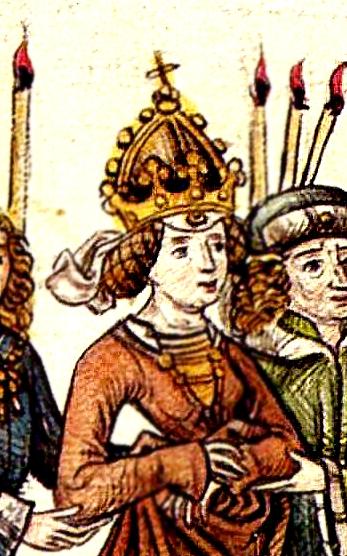
 Barbara at the Council of Constance
 -
 Woodcut from the Nuremberg Chronicle (Latin copy in São Paulo)
 -
 Master of the Council of Constance Chronicle – ceremonial entry of emperor Sigismund and empress Barbara.
![Barbara of Cilli as Venus, "Liber de septem signis", in Konrad Kyeser's Bellifortis (around first half of the fifteenth century)[54]](https://en.wikipedia.org/wiki/File:BarboraBellifortis.jpg)

.jpg)

References
[edit]- ^ Amalie Fößel: "Barbara von Cilli. Ihre frühen Jahre als Gemahlin Sigismunds und ungarische Königin." In: Michel Pauly & François Reinert (eds.): Sigismund von Luxemburg. Ein Kaiser in Europa (Tagungsband des internationalen historischen und kunsthistorischen Kongresses in Luxemburg, 8.–10. Juni 2005). Mainz am Rhein: Philipp von Zabern.
- ^ Claudia Zey: Imperatrix, si venerit Romam ... Zu den Krönungen von Kaiserinnen im Mittelalter. In: Deutsches Archiv für Erforschung des Mittelalters, vol. 60 (2004), pp. 3–51, p. 39.
- ^ Engal, Pal; Engel, Pal; Ayton, Andrew; Engel, Pál (23 February 2001). The Realm of St Stephen: A History of Medieval Hungary, 895-1526. Bloomsbury Publishing. p. 389. ISBN 978-0-85773-173-9. Retrieved 6 December 2022.
- ^ Dvořáková 2021, pp. 77, 78.
- ^ Dvořáková 2021, pp. 127, 128.
- ^ a b c McNally 2001.
- ^ Kondor, Márta (2017). The Ginger Fox's Two Crowns. Central Administration and Government in Sigismund of Luxemburg's Realms 1410-1419 (PhD Thesis). p. 84. Retrieved 8 December 2022.
- ^ Whelan, Mark (2014). Sigismund of Luxemburg and the Imperial Response to the Ottoman Turkish Threat, c. 1410-1437 (PDF) (Thesis). p. 159. Retrieved 13 December 2022.
- ^ a b Roitner 2016, p. 201.
- ^ Dvořáková 2021, pp. 72, 73.
- ^ Dvořáková 2021, pp. 41, 42.
- ^ Jan Długosz (1415–1480) – ANNALS OR CHRONICLES
- ^ Duggan, Anne J. (2002). Queens and Queenship in Medieval Europe: Proceedings of a Conference Held at King's College London, April 1995. Boydell Press. ISBN 0-85115-881-1.
- ^ a b c d Machilek, Franz (2019). "Daniela Dvořáková: Barbara von Cilli – Die schwarze Königin (1392–1451). Die Lebensgeschichte einer ungarischen, römisch-deutschen und böhmischen Königin (reviewed by Franz Machilek)". Jahrbücher für Geschichte Osteuropas / Jgo.e-reviews, jgo.e-reviews (4): 4–12. Retrieved 1 December 2022.
- ^ Kraljević 2014, p. 2,10,11.
- ^ Dvořáková 2021, pp. 154.
- ^ Dvořáková 2021, pp. 228.
- ^ Kraljević 2014.
- ^ Kraljević 2014, p. 11.
- ^ Dvořáková 2021, pp. 2, 3, 125.
- ^ Dvořáková 2021, p. 1.
- ^ Dvořáková 2021, pp. 118.
- ^ Dvořáková 2021, pp. 176–178.
- ^ a b c Dvořáková 2021, pp. 232.
- ^ Weiss, Sandra B. (2017). "Barbara von Cilli und die niederungarischen Bergwerke als Witwengut" (PDF). Berichte der Geologischen Bundesanstalt. Band 123: 118–119. ISSN 1017-8880.
- ^ Potter, Philip J. (10 January 2014). Monarchs of the Renaissance: The Lives and Reigns of 42 European Kings and Queens. McFarland. p. 301. ISBN 978-0-7864-9103-2. Retrieved 6 December 2022.
- ^ Pauly, Michel; Reinert, François (2006). Sigismund von Luxemburg. Philipp von Zabern Verlag. ISBN 9783805336253. Retrieved 6 December 2022.
- ^ Kondor 2017, p. 84.
- ^ "Sigismund von Luxemburg, König von Ungarn und Kaiser, 1387-1437 | H-Soz-Kult. Kommunikation und Fachinformation für die Geschichtswissenschaften | Geschichte im Netz | History in the web". H-Soz-Kult. Kommunikation und Fachinformation für die Geschichtswissenschaften (in German). 6 December 2022. Retrieved 6 December 2022.
- ^ Kalčić, Miodrag (27 December 2018). "Science and the New Age. Pseudo-Pulaʼs alchemists in Croatian New Age trans- mutation into gold: about the book Croatian Alchemists through the Centuries by Snježana Paušek-Baždar". Histria: The Istrian Historical Society Review (in Croatian) (8): 114. doi:10.32728/h2018.02. ISSN 1849-5699. S2CID 203312820. Retrieved 1 December 2022.
- ^ Schelenz 1904, p. 234.
- ^ Južnič, S (June 2017). "[Chemical Laboratory of Celje Queen (at 580th Anniversary of Bohemian coronation of Queen Barbara of Celje)]". Acta Chimica Slovenica. 64 (2): S67–S75. doi:10.17344/acsi.2017.3550 (inactive 11 July 2025). PMID 28621390. S2CID 102848956.
{{cite journal}}: CS1 maint: DOI inactive as of July 2025 (link) - ^ Tamás, Pál. "A Sárkány-rend és a Báthoriak". kozterkep.hu (in Hungarian). Retrieved 13 October 2022.
- ^ Kraljević 2014, p. 9.
- ^ "The Croatian legend of the Black Queen's downfall | Croatia.hr". Croatian National Tourist Board. Retrieved 13 December 2022.
- ^ a b P., Sara (4 July 2018). "4 Interesting Legends of Zagreb". Slavorum. Retrieved 7 December 2022.
- ^ "Legend of The Black Queen – published by Rabbit of Caerbannog on day 4,369 – page 1 of 1". erepublik.com. Retrieved 7 December 2022.
- ^ Dvořáková 2021, pp. 78.
- ^ Dvořáková 2021, pp. 231.
- ^ Rocha, Alvaro; Isaeva, Ekaterina (2022). Science and Global Challenges of the 21st Century – Science and Technology: Proceedings of the International Perm Forum "Science and Global Challenges of the 21st Century". Springer Nature. p. 738. ISBN 978-3-030-89477-1. Retrieved 7 December 2022.
- ^ a b Celje.info, Uredništvo (21 January 2014). "Leto Barbare Celjske v Pokrajinskem muzeju Celje". Celje.info (in Slovenian). Retrieved 6 December 2022.
- ^ Urban, Tereza. "Oslava rovnoprávnosti žen. Ilustrátorka Renáta Fučíková vzdává hold slavným hrdinkám české minulosti". Retrieved 13 October 2022.
- ^ Avion, Antikvariát. 📗 Barbora Cellská: historický román | Ján Greža 1941 (in Czech). Retrieved 13 October 2022.
- ^ Windgassen, Antje (2022). Das Lächeln der Imperia Roman (1. Auflage ed.). Konstanz. ISBN 978-3878001522.
{{cite book}}: CS1 maint: location missing publisher (link) - ^ Lockridge, Norman (1947). Waggish Tales of the Czechs The Candide Press, New York.
- ^ Heitz, Markus (2023). Die Schwarze Königin (1. Auflage ed.). München: Knaur. ISBN 978-3426227817.
- ^ "Die Schwarze Königin Heitz, Markus". Lesestoff (in Swiss High German). Retrieved 2 August 2023.
- ^ Pocrnić Mlakar, Sandra (28 April 2024). "Ivana Julius | Moja junakinja Jelena osvaja publiku svojom ženskom snagom, tihom ali moćnom". Časopis Kvaka. Udruga za promicanje kulture "Kvaka". Retrieved 20 February 2026.
U svom romanu „U Vrtlogu vremena" bavite se legendom o Crnoj kraljici, tj. Barbari Celjskoj u Medvedgradu. (translated: "In your novel The Whirlwind of Time, you examine the legend of the Black Queen, specifically Barbara of Cilli at Medvedgrad.")
- ^ Bonev, Stjepan (15 July 2025). "AUDIO Kako je Ivana Julius spojila fantaziju, povijest i Medvednicu". Radio Banovina. Retrieved 20 February 2026.
U vrtlogu vremena, u kojem se isprepliću sadašnjost i srednji vijek, stvarnost i legenda, kroz oči mlade Jelene koja putuje kroz vrijeme i susreće Barbaru Celjsku – Crnu kraljicu. (translated: "...The Whirlwind of Time, where the present and the Middle Ages, reality and legend intertwine through the eyes of young Jelena, who travels through time and encounters Barbara of Cilli - the Black Queen.")
- ^ "Barbora Celská – Václav Renč". Databáze knih (in Czech). Retrieved 13 October 2022.
- ^ "Milena Dvorská – Lidé" (in Czech). Czech Television. Retrieved 7 December 2022.
- ^ "2 Euro, Slovenia". en.numista.com. Retrieved 7 December 2022.
- ^ "NEU: Barbara von Cilli – Kaiserin, Alchemistin, Vampir". konstanz-info.com (in German). Retrieved 13 October 2022.
- ^ Kraljević 2014, p. 4.
Further reading
[edit]- Hungarian
- Szathmáry, László: Alkémisták a magyar királyi udvarban, Természettudományi Közlöny, 60. kötet, 1928. február 1.
- Pálosfalvi, Tamás: Borbála és a Cilleiek, História, 2006
- Engel, Pál – C. Tóth Norbert: Borbála királyné itineráriuma (1405–1438), Itineraria Regum et Reginarum (1382–1438), MTA Támogatott Kutatóhelyek Irodája, Budapest, 169–187, 2005
- Slovak
- Dvořáková, Daniela (2013). Čierna kráľovná. Barbora Celjská (1392–1451): Životný príbeh uhorskej, rímsko-nemeckej a českej kráľovnej [Black Queen. Barbara of Cilli (1392–1451): A Life Story of the Hungarian, Holy Roman and Bohemian Queen] (in Slovak). Budmerice-Bratislava: Vydavateľstvo Rak, HIÚ SAV. ISBN 978-80-85501-60-5.
- Slovenian
- Sitar, Sandi (1987). "8. Barbara Celjska: astrologinja in alkimistka (ok. 1387–1451)" [Chapter 8. Barbara of Cilli: An Astrologer and Alchemist (c. 1387–1451)]. Sto slovenskih znanstvenikov, zdravnikov in tehnikov [Hundred Slovenian Scientists, Doctors and Technicians] (in Slovenian). Ljubljana: Prešernova družba. pp. 76–77.
External links
[edit]

| Přemyslid |  | ||
|---|---|---|---|
| Non-dynastic |
| ||
| Luxembourg |
| ||
| Habsburg |
| ||
| Non-dynastic |
| ||
| Jagiellonian |
| ||
| Habsburg | |||
| Habsburg-Lorraine |
| ||
| |||
| International | |
|---|---|
| National | |
| People | |
| Other | |


Barbara of Cilli
View on GrokipediaBarbara of Cilli (1392 – 11 July 1451), also known as Barbara of Celje, was a noblewoman from the County of Celje in what is now Slovenia, who ascended to prominence as queen consort of Hungary through her marriage to Sigismund of Luxembourg on 16 November 1405, and later as queen of the Romans from 1411, queen of Bohemia, and Holy Roman Empress following Sigismund's imperial coronation in 1433.[1][2]
As Sigismund's consort, she exercised considerable influence in Central European politics, serving as regent of Hungary during his absences in 1412, 1414, 1416, and 1418, a role that underscored her administrative capabilities amid ongoing regional conflicts and the Hussite Wars.[1] She secured an unprecedented dower of vast estates, including properties in Slavonia yielding an estimated 28,000 florins annually, which enhanced her personal wealth and political leverage in a manner distinctive among Hungarian queens of the era.[2][3]
Barbara's tenure was marked by strategic alliances, such as the establishment of the Order of the Dragon in 1408 alongside Sigismund to counter Ottoman threats, and her patronage of arts and diplomacy at courts in Buda and Prague.[1] The marriage produced one surviving child, Elisabeth of Luxembourg, whose betrothal and subsequent lineage perpetuated dynastic claims across Hungary, Bohemia, and the Empire.[1]
Despite her substantive contributions, Barbara's historical image has been tainted by contemporary polemics and later folklore, which accused her of poisoning rivals, engaging in necromancy, and extramarital affairs—charges often amplified in Croatian traditions dubbing her the "Black Queen" and echoed in modern sensationalism linking her to vampiric myths, though primary evidence for such claims remains scant and likely rooted in political rivalries rather than verified acts.[1][4] She died of the plague in Mělník and was interred in St. Vitus Cathedral, Prague, her legacy reevaluated in recent scholarship as that of a resilient power broker navigating patriarchal constraints and familial ambitions.[1]
Early Life and Origins
Birth and Family Background
Barbara of Cilli was born circa 1392 in Celje, within the County of Cilli (modern-day Slovenia), as the youngest of six children to Herman II, Count of Celje (c. early 1360s–1435), and Anna of Schaunberg (c. 1358/1370–c. 1396).[5][6] Herman II, son of Herman I of Celje and Catherine of Bosnia, inherited and expanded the family's holdings through calculated diplomacy and military engagements in the fractious Styrian and Slovene territories of the Holy Roman Empire.[7] Anna, from the Schaunberg (or Schaunberger) lineage of Lower Austrian nobility, brought connections to regional counts, bolstering the Celje alliance network amid tensions with dominant houses like the Habsburgs.[8] The House of Celje, originating as Frankish settlers in the 11th century, achieved its zenith under Herman II's stewardship in the late 14th century, amassing estates in Styria, Carinthia, and Carniola via inheritances, purchases, and marriages that challenged Habsburg hegemony in the southeastern Empire.[7][9] By the 1390s, the family's strategic positioning—evident in control over key trade routes and fortified castles like Celje—enabled Herman II to negotiate autonomy, including bans from Habsburg overlords and pacts with emerging powers such as the Luxembourgs.[10] Barbara's siblings underscored the dynasty's internal vitality and matrimonial potential: elder brothers Frederick II (c. 1379–1454) and Hermann III (c. 1380–1426) spearheaded territorial gains and military campaigns, while a third brother, Louis (c. 1387–after 1414), was fostered to kin for political leverage; sisters Elizabeth (c. 1382–?) and Anna (c. 1384–1414) facilitated ties to other nobles.[5] This robust progeny, raised amid the socio-political volatility of post-Black Death recovery and imperial fragmentation, positioned the Celje as de facto princes in Slovene lands, with Herman II's longevity ensuring continuity until his death in 1435.[7]Upbringing in the County of Celje
Barbara was born around 1392 as the youngest daughter of Hermann II, Count of Celje, and his wife Anna of Schaunberg, within the fortified stronghold of Celje Castle, the ancestral seat of the Counts of Celje in what is now Slovenia.[11][12] The County of Celje represented a burgeoning power center in the late 14th century, where the comital family expanded influence through strategic marriages and territorial acquisitions, fostering a household environment centered on feudal consolidation and noble lineage preservation.[10] Hermann II, as a key figure in this ascent, prioritized alliances that enhanced the family's autonomy, including ties with regional potentates amid the fragmented politics of the Holy Roman Empire's periphery.[9] Her formative years unfolded in a milieu marked by the Counts of Celje's intensifying rivalries, particularly with the Habsburgs, who viewed the family's growing holdings in Styria and Carinthia as encroachments on their dominion; these tensions, simmering from the 1330s onward, escalated into open hostilities by the early 15th century, though proxy conflicts and diplomatic maneuvering dominated the 1390s.[13] Broader regional instability, including Ottoman incursions into the Balkans following the 1389 Battle of Kosovo and culminating in the 1396 Crusade of Nicopolis, indirectly heightened awareness of external threats within noble circles like Celje, where defensive fortifications and military readiness were emphasized. Family dynamics reflected this precarious ascent, with Hermann II navigating inheritance disputes and vassal obligations to maintain the county's semi-independent status under nominal Habsburg overlordship established in 1308.[14] Primary sources on Barbara's personal education remain scarce, but as a high noblewoman in 14th-century Central Europe, she would have undergone practical training typical of her station, supervised by maternal figures or household tutors, encompassing literacy in vernacular languages such as Slovene or German, basic administrative competencies for estate oversight, and religious instruction aligned with Catholic piety.[15][16] Such preparation, often conducted within the castle's insular setting rather than external courts or convents, equipped daughters of rising comital houses for roles in diplomacy and alliance-building, without formal scholastic pursuits reserved for clergy or urban elites.[17] This upbringing instilled familiarity with martial household routines and the imperatives of feudal loyalty, amid the Celje counts' efforts to elevate their status toward princely equivalence.[18]Marriage to Sigismund of Luxembourg
Betrothal and Wedding in 1408
The betrothal of Barbara, daughter of Count Hermann II of Celje, to Sigismund of Luxembourg was orchestrated as a diplomatic maneuver to reinforce Sigismund's precarious hold on the Hungarian throne amid challenges from rival magnates such as the Garai and Lackfi families. Hermann II's control over strategic territories in Slavonia and Styria offered Sigismund military reinforcements and financial resources essential for countering internal dissent following the turbulent years after his first wife Mary's death in 1395.[19] [2] This union also leveraged Barbara's maternal descent from the Bosnian Kotromanić dynasty to substantiate Sigismund's territorial ambitions in Bosnia.[19] The wedding occurred in late 1405, likely around mid-November, at Krapina Castle in Slavonia, a stronghold owned by Hermann II, transitioning Barbara from her status as a county heiress to queen consort of Hungary.[2] The ceremony preceded Barbara's coronation on 6 December 1405 in Székesfehérvár, after which the couple proceeded to Buda, solidifying her integration into the royal household.[19] In conjunction with the marriage, Barbara received control over extensive Slavonian estates yielding an estimated annual income of 28,000 florins, while Sigismund conferred additional land grants and privileges on the Celje family to cement the alliance.[20] The pact's prestige was elevated in December 1408 through Sigismund's foundation of the Order of the Dragon, which enrolled Hermann II and other Celje affiliates among its inaugural knights, symbolizing mutual loyalty and chivalric commitment.[21]Initial Integration into Royal Court
Following her marriage to Sigismund on November 16, 1405, in Krapina, Barbara was crowned Queen of Hungary on December 6, 1405, facilitating her entry into the royal milieu.[21] She adapted to Sigismund's itinerant court, which shifted between principal seats like Buda and incorporated a multi-ethnic composition drawn from Hungary's German, Magyar, and Slavic populations, as well as imperial retainers.[21] Her Slovenian noble origins from the Counts of Celje, whose prior military support for Sigismund against Ottoman incursions had forged strong ties, enabled her to cultivate alliances and assert influence amid this diverse, peripatetic environment.[2] The union yielded a single child, daughter Elizabeth, born circa 1409, with no sons to secure direct male succession, thereby heightening reliance on female lineage for dynastic continuity.[21] Early in her court role, Barbara oversaw queenly domains including Slavonian holdings like Kapronca and Verőce, which produced approximately 28,000 florins in annual revenue from castles and lands, augmenting her autonomy and familial leverage.[2] These marital gains underscored her strategic positioning through Celje connections, laying groundwork for targeted patronage without immediate broad distributions.[2]Queenship and Imperial Role
Queenship of Hungary and Bohemia
Barbara was crowned Queen of Hungary on 6 December 1405 by the Archbishop of Esztergom in Székesfehérvár, marking her formal assumption of the consort role alongside Sigismund, who had been king since 1387 but faced ongoing challenges to his authority.[3] This coronation occurred prior to their marriage ceremony, which took place in late 1408, underscoring the political expediency of securing her position amid Sigismund's alliances with the Counts of Cilli.[22] As queen consort, she participated in public ceremonies, including accompanying Sigismund to the Council of Constance in 1414, where she resided until mid-1415 and engaged in courtly representations that bolstered the royal image during the conciliar proceedings.[23] Upon Sigismund's election as King of Bohemia on 28 July 1419 following the death of his half-brother Wenceslaus IV, Barbara assumed the role of Queen consort of Bohemia, though a formal coronation for her in Prague did not occur until later years.[24] Her duties emphasized ceremonial functions, such as hosting royal events and symbolizing continuity amid Bohemia’s internal religious and political strife, including the emerging Hussite movement, which Sigismund sought to counter through crusading efforts.[21] Evidence of her advisory influence remains indirect, primarily through her presence at key diplomatic gatherings and correspondence networks tied to Sigismund’s campaigns, but no primary documents detail specific counsel on military strategies against the Hussites or Ottomans prior to 1433.[23] Barbara secured economic independence via dower arrangements and perquisites of her queenship, acquiring estates in Slavonia and other Hungarian territories that yielded an estimated annual income of 28,000 florins, including castles and lands managed with administrative acumen.[2] These holdings, granted as marital guarantees and expanded through royal concessions, provided her with resources for patronage and personal diplomacy, distinct from crown domains and enhancing her leverage within the court.[20] Such acquisitions reflected standard medieval consort practices but were notably substantial due to the Cilli family's strategic ties to Sigismund's consolidation of power.[22]Elevation to Holy Roman Empress in 1433
Sigismund of Luxembourg had been elected King of the Romans on 20 September 1410, positioning him as the designated successor to the imperial throne, though the full coronation as Holy Roman Emperor necessitated papal involvement and was deferred amid prolonged conflicts, including the aftermath of the Western Schism and regional upheavals.[25] In the interim, he secured the Lombard crown on 25 November 1431 in Milan, a traditional precursor to imperial status.[25] The decisive elevation occurred on 31 May 1433, when Pope Eugenius IV crowned Sigismund Holy Roman Emperor in Rome, marking the first such papal coronation since Frederick II in 1220 and underscoring a symbolic reaffirmation of imperial authority following the Council of Constance.[26][25] As Sigismund's consort since 1408, Barbara of Cilli automatically attained the title of Holy Roman Empress upon his coronation, entitling her to the ceremonial precedence and dignities associated with the role, such as participation in imperial rituals and courtly representation.[6][11] This status derived solely from her marital union, without conferring independent executive powers or regalian rights, consistent with the constitutional conventions of the Holy Roman Empire where empress consorts served symbolic functions rather than administrative ones.[6] The imperial elevation bolstered the prestige of Barbara's natal House of Celje, elevating the county's counts from regional nobility to kin of Europe's paramount secular authority, though it yielded no formal territorial or jurisdictional gains for the family.[11] The Roman ceremony, conducted amid tightened security due to local unrest, highlighted the event's exceptional nature, as Sigismund navigated papal demands for concessions on church reforms while affirming the emperor's universal Christian overlordship.[25][26]Involvement in the Order of the Dragon
Barbara served as a co-founder of the Order of the Dragon (Societas Draconistarum), established by Sigismund on December 12, 1408, to unite select nobility in defense of Christianity against Ottoman expansion and to organize crusading efforts in the Balkans.[27] The founding charter, issued at Sigismund's court, outlined members' oaths to combat infidels, protect the faith, and uphold monarchical loyalty, with initial recruits including 21-24 high aristocrats such as Barbara's father, Hermann II, Count of Celje.[28] [29] Her involvement extended beyond ceremonial participation; leveraging the Celje dynasty's regional influence in Styria, Austria, and Slovenia, Barbara helped promote the order's recruitment among Central European nobility, enhancing its legitimacy as a bulwark against both Ottoman incursions and emerging internal threats like Hussitism.[30] Founding members swore to defend the Catholic Church's doctrines, which Sigismund later invoked to rally the order against Hussite rebels in Bohemia following the 1415 execution of Jan Hus, aligning with Celje family's staunch anti-heretical stance.[31] The order's emblem—a green dragon coiled in a circle, tail around its neck, bearing a red cross on its back—symbolized the triumph over Satan and pagan forces, drawn from apocalyptic imagery in Revelation 12 and St. George's legend, and was mandated for members' attire and seals to signify their vow.[31] This insignia influenced heraldry across over 30 noble lineages in Hungary and Croatia, though its adoption predated direct ties to Celje arms, which featured azure fields with golden stars.[31] Surviving documents, including charter copies and member seals, confirm the emblem's consistent use from 1408 onward.[28]Political Engagements and Conflicts
Alliances and Patronage during Sigismund's Reign
During Sigismund's absences from Hungary, particularly between 1412 and 1419, Barbara acted as a key administrative figure, issuing charters and collaborating with prelates and barons to maintain royal authority, which indirectly supported diplomatic stability amid foreign pressures.[21] In 1413, she received correspondence from Ragusa detailing Balkan political developments, positioning her as a recipient of intelligence crucial for Sigismund's regional strategies against Ottoman advances.[21] Similarly, Bosnian noble Hrvoje Vukčić appealed to her alongside Hungarian barons for support, underscoring her role in leveraging noble networks for alliance-building in the Balkans.[21] Barbara facilitated alliances through her presence in major diplomatic forums, accompanying Sigismund to Aachen for his 1414 imperial coronation and to the Council of Constance from 1415 to 1418, where she contributed to negotiations aimed at Christian unity against Ottoman threats.[21] At Constance, her ceremonial participation helped bolster Sigismund's legitimacy, aiding efforts to secure papal and imperial backing for Hungarian interests in eastern defenses.[32] The Teutonic Order's pledge in May 1413 to repay 15,000 florins in debts to her further tied her to Sigismund's broader anti-Polish-Lithuanian diplomacy, as such financial ties reinforced ties with anti-Jagellonian forces.[21] Economically, Barbara's Slavonian estates generated approximately 28,000 florins annually, which she directed toward sustaining royal finances and Sigismund's campaigns, as evidenced by post-1408 charters documenting her estate management.[2] This revenue stream provided material patronage for courtly events and diplomatic hosting, enhancing Sigismund's prestige without relying on contested minting rights.[33] Her financial acumen complemented Celje family connections in Styria and Slovenia, which indirectly countered Habsburg and eastern influences threatening Sigismund's domains, though direct archival links to anti-Polish-Lithuanian pacts remain limited to supportive roles.[2]Family Feuds and the Celje Dynasty
Barbara's marriage to Sigismund elevated the status of her natal Celje family, enabling Hermann II to pursue ambitious matrimonial alliances that intensified internal dynastic tensions. In the early 1420s, these efforts culminated in a severe family rift when Hermann II opposed his son Frederick II's marriage to Veronika of Desenice, a noblewoman deemed insufficiently prestigious for securing advantageous lands and ties. Hermann accused Veronika of witchcraft and poisoning, leading to her trial and drowning in the Sava River on an unspecified date in 1425, an act rooted in strategic control over Frederick's inheritance and alliances rather than mere personal discord.[34][9] Frederick, imprisoned by his father during the ordeal, fled to Venice in 1425, claiming that Hermann and elements of the Hungarian court sought his death to consolidate power within the lineage. This episode fractured Celje unity, as Frederick's defiance threatened Hermann's plans for territorial expansion through elite marriages, such as those linking to Bavarian and Bosnian nobility for claims in Styria and beyond. While Barbara's direct role remains unrecorded in contemporary accounts, her position as queen facilitated the family's broader access to royal patronage, heightening the stakes of such intra-dynastic power struggles over fiefdoms and successions.[35] Externally, Barbara's influence contributed to escalating rivalries with the Habsburgs, whose overlordship in Styria clashed with Celje ambitions for autonomy and land consolidation. The 1436 elevation of Frederick II and his son Ulrich II—Barbara's nephew—to princes of the Holy Roman Empire by Sigismund granted the Celje line parity with Habsburg dukes, undermining feudal hierarchies and prompting retaliatory Habsburg campaigns over disputed Styrian estates. These tensions erupted into open warfare in the early 1440s, driven by competing claims to holdings in Styria, Carinthia, and Carniola, with skirmishes involving local nobles and mercenaries until a 1443 peace treaty established mutual inheritance rights, temporarily averting escalation while preserving Celje gains.[10][36] Sigismund's protections extended to Ulrich II amid these conflicts, shielding him from Habsburg incursions and reinforcing Celje holdings through imperial decrees, a dynamic enabled by Barbara's courtly advocacy for her relatives. Empirical analysis of the feuds, as reflected in period records of alliances and land grants, indicates they stemmed primarily from causal competition for regional dominance—evident in Hermann II's earlier pacts with Bavaria against Habsburg influence—rather than isolated vendettas, with the Celje pursuit of princely status amplifying zero-sum territorial pressures.[18][10]Regency Efforts and Opposition to Albert II
Following Sigismund's death on 9 December 1437, Barbara sought to exercise regency authority in Hungary on behalf of her daughter Elizabeth of Luxembourg, who claimed the throne as heiress and was pregnant with her successor. Elizabeth was proclaimed queen and crowned on 21 January 1438 in Székesfehérvár, with Barbara providing political support during this transitional period amid noble divisions. [11] [6] This brief regency-like role aimed to preserve Luxembourg influence against external claimants, leveraging Barbara's prior experience administering royal domains during Sigismund's absences. Albert II of Habsburg, Elizabeth's husband, arrived in Hungary in May 1438 and secured election by the diet on 18 June, followed by his coronation on 26 June, sidelining Elizabeth's sole rule. Barbara opposed Albert's ascension, viewing it as a threat to her family's position and resenting Habsburg encroachment, which she had anticipated even before Sigismund's death—prompting Sigismund to briefly imprison her on suspicion of intrigue. [11] [37] She conspired to undermine his claims, including efforts to rally support for alternative succession paths tied to her Celje kin. [38] Barbara backed her nephew Ulrich II of Celje, a prominent magnate and ban of Slavonia, providing him resources to counter Habsburg consolidation in Hungary and adjacent territories. Ulrich, leveraging family ties and military capacity, received her aid in maintaining Celje autonomy against Albert's centralizing moves, though initial alliances masked deeper tensions. [39] She also appealed to papal authorities, contesting Albert's legitimacy and seeking ecclesiastical leverage to bolster anti-Habsburg factions, reflecting her strategy of multinational diplomacy rooted in Luxembourg-Celje interests. [40] Facing military pressure, Barbara withdrew to fortified estates near Miskolc, including Diósgyőr castle, where she oversaw renovations to establish resistance bases against Albert's forces. This relocation in late 1438 underscored her anti-Habsburg stance, prioritizing defense of personal holdings and family claims over reconciliation. Efforts culminated in a 1440 compromise following Albert's death on 27 October 1439, allowing partial recovery of assets amid shifting alliances toward Polish candidates like Władysław III for Bohemia. [11] [6]Later Life and Decline
Post-Sigismund Residences and Activities
Following Sigismund's death on 9 December 1437, Barbara secured her rights to dower properties, including Bohemian estates granted by her husband earlier that year following her coronation as Queen of Bohemia. These holdings encompassed key towns such as Mělník and Hradec Králové, which she administered independently as dowager queen.[40] By 1440, amid political instability in Hungary, Barbara relocated to Bohemia, establishing her primary residence in Mělník and focusing on the governance of her assigned dowry lands. She pursued restitution of these properties after initial challenges from rival claimants and expressed interest in recovering Hungarian estates lost during succession disputes, though her efforts centered on Bohemian administration.[40][6] During this phase of relative diplomatic withdrawal, Barbara avoided entanglement in major conflicts like the Hussite Wars, prioritizing estate management, tax collection, and feudal oversight over her domains. She maintained connections to her Celje kin, providing indirect support to family interests without active military or regency involvement.[40][4]Final Years in Bohemia
Following the death of her son-in-law Albert II of Habsburg in October 1439 and the subsequent political turmoil in Hungary, including disputes over the throne between local nobles and foreign claimants, Barbara relocated to Mělník in the Kingdom of Bohemia during the early 1440s.[11][40] There, she maintained a low-profile existence amid ongoing regional conflicts, focusing on personal affairs rather than active political involvement.[41] A severe plague outbreak swept through the Czech lands in 1451, claiming Barbara's life on 11 July at Mělník Castle.[40][11] Her burial was modest, conducted without elaborate ceremony in the local church at Mělník, reflecting her diminished status and resources in exile.[40][11] In her final years, Barbara arranged for the disposal of her remaining estates and claims, transferring them to Habsburg interests, which helped settle prior familial and dynastic disputes stemming from the extinction of the Celje line and inheritance tensions.[20] This act aligned with Habsburg consolidation of power in Central Europe following Albert II's death, ensuring no further challenges from her holdings.[4]Controversies and Accusations
Claims of Political Intrigue and Familicide
Barbara of Cilli was accused by contemporaries of manipulating Emperor Sigismund to prioritize the Celje family's interests, granting them extensive lands, privileges, and the princely title for her father Hermann II in 1436, which alienated rival nobles including the Habsburgs and contributed to broader political instability in the Holy Roman Empire's eastern domains.[42] These maneuvers allegedly consolidated Celje power temporarily, enabling the dynasty's expansion until the assassination of her nephew Ulrich II on November 9, 1456, after which Habsburg forces seized Celje territories through inheritance claims and military action.[43] Specific claims of familicide centered on unverified allegations that Barbara orchestrated poisonings or assassinations of Celje relatives during the 1430s to eliminate internal rivals and secure her influence over family estates and Sigismund's patronage.[40] No primary documents confirm such purges, and these accusations appear rooted in rival chronicles portraying her as a ruthless intriguer, potentially exaggerated to justify subsequent Habsburg encroachments on Celje holdings.[24] Further suspicion fell on Barbara following the abrupt death of Albert II of Habsburg on October 27, 1439, from what medical accounts describe as dysentery or fever but contemporaries rumored as poisoning; as Albert had displaced her regency ambitions in Hungary and Bohemia after Sigismund's death in December 1437, detractors explicitly implicated her in the act to restore Celje-aligned rule.[40] Such imputations, lacking forensic or eyewitness substantiation, reflect causal tensions from her documented opposition to Albert's coronation rather than empirical proof of orchestration.[40]Allegations of Infidelity and Immorality
Barbara of Celje faced accusations of sexual infidelity primarily through unverified rumors and later chronicler accounts, which portrayed her as promiscuous and morally corrupt. A notable instance occurred in 1419 during the Council of Constance, when Sigismund received reports—recorded by his chronicler Eberhard Windeck—of her alleged affair with a German knight while he was absent.[4] These claims prompted Sigismund's return and a confrontation, yet the couple reconciled without public scandal or legal repercussions, suggesting the allegations lacked sufficient evidence to disrupt their marriage permanently.[6] Posthumous narratives amplified these smears, with 17th-century writers labeling her a "German Messalina"—evoking the Roman empress notorious for debauchery—and describing her as driven by "insatiable appetite for lust."[20] Such characterizations emerged in contexts opposing her political ambitions, particularly her efforts to secure regency for her daughter Elisabeth after Sigismund's death in 1437, amid succession rivalries with Habsburg claimant Albert II.[37] The absence of male heirs—despite the birth of their daughter Elisabeth in 1409—may have indirectly fueled suspicions of infidelity, as it contrasted with expectations for royal fertility, though no contemporary documents confirm extramarital relations or attribute childlessness to misconduct.[44] Historians interpret these allegations as tools of rival propaganda, a recurrent strategy in medieval dynastic conflicts to delegitimize influential women by impugning their personal virtue rather than engaging substantive political critiques.[4] Chroniclers like Windeck, tied to Sigismund's court, provide the earliest references, but their accounts reflect potential biases from factional interests, with later embellishments indicating legendary exaggeration over empirical fact. No primary evidence, such as witness testimonies or ecclesiastical investigations, substantiates ongoing immorality, underscoring the claims' role in causal chains of power struggles rather than verified biography.[45]Accusations of Occult Practices and Alchemy
Barbara of Celje's purported involvement in occult practices surfaced mainly in later folklore traditions rather than verifiable contemporary evidence, with no records of formal witchcraft trials or inquisitorial investigations during her lifetime (1392–1451). Accusations of sorcery, including claims of demonic alliances and malevolent magic, appear predominantly in 16th- and 17th-century Croatian and Slovenian legends, where she is depicted as a diabolical figure wielding evil spells. These narratives, often tied to her political adversaries' enmity—such as Habsburg rivals who viewed the Celje family as upstarts—lack empirical substantiation and reflect anecdotal embellishments rather than causal proof of illicit rites. Her documented alchemical pursuits, by contrast, involved patronage of practitioners and hands-on experimentation, a common endeavor among medieval elites seeking economic gain through proto-chemical means like metal transmutation. Bohemian alchemist Johann von Laaz recorded visiting her around the early 15th century at Samobor Castle in Croatia, where she allegedly conducted trials in the cellar using copper from local mines to produce silver and gold via the philosopher's stone. Laaz's account, excerpted in later compilations such as Basilius Valentinus's Chymische Schriften (1740), describes her methods as yielding fire-resistant alloys but failing genuine transmutation, portraying her efforts as technically flawed rather than supernaturally empowered. Such alchemy was normative in royal courts, driven by scholarly curiosity and fiscal motives, distinct from the maleficium (harmful magic) central to witchcraft indictments elsewhere in Europe. The epithet "Black Queen," emblematic of these occult associations, derives from folklore emphasizing her black robes and reputed malevolence, but likely originated from ethnic and political biases against her Slovenian Celje lineage amid regional power struggles. Hostile chroniclers like Aeneas Sylvius Piccolomini (later Pope Pius II), who harbored antipathy toward the Celje dynasty, amplified negative portrayals without substantiating sorcery claims. Empirical analysis dismisses these as legendary constructs, unsupported by court documents or eyewitness testimonies of occult rituals, underscoring how adversarial propaganda conflated alchemical patronage with witchcraft in retrospective narratives.Historiography and Assessment
Medieval Chroniclers and Contemporary Views
In pro-Sigismund accounts, such as Eberhard Windecke's Denkwürdigkeiten zur Geschichte des Zeitalters Kaiser Sigmunds (composed circa 1440s), Barbara is portrayed as a devoted consort who traveled with the emperor, including during campaigns in the mid-1420s, and contributed to initiatives like the co-founding of the Order of the Dragon on December 12, 1408, which aimed to rally support for anti-Ottoman crusading efforts under the patronage of Saint George.[2][46] Hungarian charters from the Zsigmondkori oklevéltár (1387–1437) further depict her as an ambitious administrator securing estates and diplomatic alliances, reflecting biases favoring her role in stabilizing Sigismund's rule amid noble opposition.[2] Bohemian and Hussite-influenced sources, by contrast, emphasized her foreign (Slovenian-German) origins and perceived meddling, framing her as an enforcer of orthodox policies that fueled religious conflict; she issued condemnatory manifestos against Hussite "heretics" in July 1427 and again in 1431, actions that aligned with Sigismund's crusades against the movement but alienated local reformers.[47] Czech annals of 1437 briefly noted her as a "beautiful woman" (krásná paní), yet overall critiques in these records highlighted her influence as exacerbating Bohemia’s instability under Sigismund’s absentee rule, with biases rooted in resistance to imperial centralization and Catholic suppression.[47] These era-specific portrayals lack unified narratives of immorality or occultism, focusing instead on political agency and dynastic utility; such demonizing tropes, often amplified by misogynistic lenses in later retellings, are absent from primary charters, annals, or court diaries like the Cilli family chronicle (spanning 1341–1461), which prioritize factual events over character assassination.[47][37] The scarcity of neutral eyewitness accounts underscores how chroniclers' allegiances—pro- or anti-Luxembourg—shaped reconstructions, privileging causal roles in Sigismund's multilevel kingships over personal scandals.[2]Early Modern and Nationalist Interpretations
In the early modern period, Habsburg-aligned chroniclers and propagandists systematically tarnished Barbara's reputation to legitimize the 1456 annexation of Celje territories by Emperor Frederick III, portraying her as a scheming adulteress and familial betrayer whose actions invalidated her lineage's claims to the lands. These narratives, emerging shortly after her 1451 death amid ongoing disputes over inheritance following the extinction of the Celje male line with Ulrich II's assassination, conflated contemporary political rivalries—particularly the Celje counts' longstanding competition with the Habsburgs for dominance in Styria and adjacent regions—with amplified accusations of her infidelity and ambition. Such depictions, including comparisons to the Roman Messalina for lustful intrigue, served Habsburg interests by retroactively discrediting the family's princely status and facilitating the absorption of their estates without broader imperial contest.[37][2] Parallel to elite historiography, early modern folklore in Croatian and Slovenian borderlands transformed Barbara into the "Black Queen" (Crna kraljica), a malevolent archetype blending her historical dark-haired appearance and rumored alchemical pursuits with indigenous myths of vengeful noblewomen and undead revenants. Regional tales, circulating orally from the 16th century onward, depicted her as a eternally wandering sorceress who haunted castles like Medvedgrad, inflicting plagues or draining life from subjects, often without direct evidence tying these embellishments to verifiable events but drawing on post-Reformation anxieties about female autonomy and heresy. This folk demonization, while rooted in medieval chronicler biases against her regency exertions, exaggerated her into a vampire-like figure to embody fears of foreign (German-Slavic) elite overreach in local communities.[48][11] By the 19th century, amid Slovenian and Croatian national revivals under Habsburg rule, interpretations shifted toward romantic appropriation, with some intellectuals recasting Barbara as a defiant emblem of indigenous nobility resisting centralizing empires, despite scant primary evidence for her proactive ethnic advocacy. Writers in emerging Slavic historiography, influenced by Herderian nationalism, amplified unverified anecdotes of her diplomatic maneuvers and land acquisitions as assertions of proto-national sovereignty, often sidelining Habsburg-sourced critiques while ignoring the transactional nature of her alliances, which prioritized dynastic over cultural solidarity. These agenda-driven re-evaluations, while countering earlier vilifications, projected modern identity politics onto a figure whose documented actions aligned more with universal monarchical pragmatism than emergent nationalism.[37]Modern Scholarship and Empirical Re-evaluations
Twentieth-century scholarship began reassessing Barbara of Cilli's role by emphasizing her strategic management of marital perquisites and dowry lands, portraying her as a calculated actor in medieval power dynamics rather than a mere intriguer. Historians like those analyzing her 1408 marriage to Sigismund highlight how she secured extensive Slavonian estates, including castles and revenues estimated at 28,000 florins annually, through customary bridal gifts and post-wedding grants that exceeded norms for consorts.[2] [3] This approach, grounded in charter evidence and estate inventories, underscores causal mechanisms of wealth accumulation—such as leveraging her family's County of Celje influence—over narrative-driven vilification, revealing her as a pragmatic estate administrator who expanded holdings amid Sigismund's fiscal strains.[24] Empirical re-evaluations in the late twentieth and early twenty-first centuries have systematically dismantled occult and heresy accusations, attributing them to politically motivated chronicles rather than verifiable practices. Analyses of contemporary sources, including council records from Constance (1414–1418), find no substantive evidence for alchemy or sorcery claims, instead linking them to factional rivalries post-Sigismund's death in 1437, where Bohemian and Hungarian nobles invoked such tropes to contest her regency and property claims.[37] While gender-biased historiography amplified these as smears against female agency, data-driven studies prioritize causal realism: the allegations aligned with inheritance disputes, as seen in her 1440s forfeiture of Hungarian domains under Albert II's regime, without corroborating trial documents or alchemical artifacts.[2] Recent works, including monographs from the 2020s, balance her documented achievements—such as promoting chivalric orders like the Order of the Dragon for dynastic stability—with acknowledged political maneuvering, avoiding unsubstantiated redemption narratives. For instance, examinations of her Bohemian tenure (post-1437) credit her with sustaining court patronage amid Hussite conflicts, evidenced by diplomatic correspondence and land grants, while critiquing self-interested estate defenses as standard elite behavior.[24] A 2025 historical analysis reframes her as a resilient consort navigating male-dominated succession crises, supported by archival tallies of her regencies (1412, 1414, 1416, 1418), though it notes persistent source gaps due to destroyed Celje records.[4] These efforts, drawing from multilingual primary materials, counter earlier nationalist distortions by privileging quantifiable fiscal and diplomatic outcomes over anecdotal moralism.[49]Legacy and Cultural Impact
Architectural and Institutional Contributions
Barbara, alongside her husband Sigismund, co-founded the Order of the Dragon on December 12, 1408, issuing its statutes as an equal partner in the foundational charter to unite select nobility against Ottoman expansion and internal heresies.[3] The order's membership, limited to high aristocracy and monarchs, enforced oaths of fidelity, crusading duty, and mutual defense, thereby reinforcing chivalric norms of loyalty and martial piety across Central European courts into the mid-15th century.[27] Its dragon emblem and anti-infidel mandate influenced later heraldic traditions and knightly alliances in Hungary, Bohemia, and the Holy Roman Empire, as seen in the affiliations of figures like Vlad II Dracul.[50] During her tenure as queen, particularly in the 1430s, Barbara oversaw adaptations to royal residences, including conversions at Diósgyőr Castle near Miskolc—transforming it into a late Gothic fortified seat with enhanced defensive and residential features reflective of contemporary Hungarian architecture—and Zvolen Castle, aligning them with her preferences for comfort and security amid Sigismund's campaigns.[51] These modifications, documented in royal itineraries and estate records, elevated Diósgyőr as a model for blended defensive and palatial design, incorporating elements like reinforced walls and interior suites that persisted in regional castle-building practices post her era. Her strategic acquisition of dower estates, encompassing over two dozen castles and towns yielding annual revenues exceeding 28,000 florins, established enduring administrative frameworks in Slavonia, Hungary, and Bohemia that sustained local economies through tax exemptions, labor obligations, and fortified infrastructure long after her death in 1451.[2] These properties, retained as queen's dowry precedents, facilitated regional stability by funding garrisons and trade routes, with charters confirming their role in bolstering Habsburg successors' fiscal bases.[3]Folklore, Legends, and Artistic Depictions
In Croatian folklore, Barbara of Cilli is depicted as the Crna Kraljica (Black Queen), a malevolent figure haunting Medvedgrad Castle near Zagreb, where she is said to have ruled tyrannically, walled up a peasant girl named Veronika alive, and transformed into a witch-vampire after a curse, guarding hidden treasures in the surrounding woods.[52] [53] These tales portray her as bloodthirsty, with villagers north of Zagreb fearing her as a vampire who preyed on the living, a narrative amplified by her dark attire and reputed cruelty rather than historical evidence of such acts.[54] Slovenian legends similarly cast her in occult roles, including black magic practices and vampiric exploits during the 1414–1418 Council of Constance, where she allegedly sustained herself by draining blood from victims, diverging sharply from contemporary records of her diplomatic presence there.[55] Such stories, emerging in post-medieval oral traditions amid regional fears of disease and unrest, exaggerate her political influence into supernatural malevolence, with no empirical basis in primary sources like council chronicles.[56] Artistic depictions contrast these myths with more factual regal portrayals; a contemporary illustration from the Chronik des Konzils von Konstanz shows her in imperial finery beside Emperor Sigismund during a ceremonial entry, emphasizing her status over any dark attributes.[57] Later works, such as a woodcut in the 1493 Nuremberg Chronicle, render her as a noble consort in profile, clad in period attire with a hennin headdress, reflecting humanistic ideals rather than folklore's horrors.[58] Nineteenth-century romantic paintings, influenced by nationalist revival, often dramatized her life with intrigue-laden scenes, portraying her amid courtly splendor or shadowy alliances, as seen in Slovenian historical canvases that blend biography with embellished drama.[38] Local museums perpetuate these narratives through exhibits; Celje Castle displays artifacts tied to the Counts of Celje, including legendary items evoking Barbara's mystique, such as family relics interpreted through folkloric lenses in guided tours.[59] The Celje Regional Museum's permanent exhibition on the Counts features her effigy and documents, juxtaposing historical facts against popularized vampire motifs to highlight the legend-reality gap.[10] Enduring Historical Debates
Historians continue to debate the effectiveness of Barbara's regency after Sigismund's death on December 9, 1437, weighing her success in personal and familial survival against the ultimate failure to sustain the Luxemburg dynasty's direct succession. While she maneuvered through alliances and financial leverage to protect her daughter Elisabeth's claims until her abdication in 1443, ensuing civil conflicts and the Habsburg consolidation underscored the constraints of regency in a fragmented feudal landscape dominated by male nobility and elective monarchies.[2] [6] This evaluation prioritizes causal outcomes—such as her retention of estates like Celje—over narrative glorification, revealing how power derived from land acquisition and loans to Sigismund enabled short-term stability but faltered against broader dynastic imperatives.[20] Gendered lenses in historiography have amplified disputes over Barbara's agency, with some modern analyses portraying her as an emblem of female autonomy in acquiring wealth and advising on diplomacy during the 1420s–1430s, yet this risks projecting contemporary ideals onto medieval noble constraints like arranged marriages and ecclesiastical oversight.[2] Realist assessments emphasize that her influence stemmed from pragmatic financial management—lending to Sigismund amid his debts—rather than unfettered independence, as noblewomen's roles hinged on familial alliances and survival amid rival claims, not ideological empowerment.[60] Overreliance on "strong woman" tropes, often in queenship studies, can obscure these dynamics, where agency was bounded by causal realities of inheritance laws and military dependencies. Claims of alchemical pursuits remain empirically unverified, fueling calls for deeper archival scrutiny beyond biased chronicler accounts like those attributing occult interests to her post-regency isolation.[61] While legends persist of her engaging astrologers or seeking transmutation, primary evidence from estate records or correspondence yields no direct corroboration, suggesting these arose from political smear to delegitimize her influence after 1437.[60] Systematic examination of untapped Central European archives, such as those in Slovenia or Hungary, is advocated to test these against material traces like laboratory artifacts, prioritizing verifiable data over interpretive folklore.[2]References
- https://commons.wikimedia.org/wiki/File:Barbara-von-Cilli.jpg