Hubbry Logo
HemmaHemmaMain
Open search
Hemma
Community hub
Hemma
logo
8 pages, 0 posts
0 subscribers
Be the first to start a discussion here.
Hemma
Hemma
from Wikipedia

Emma of Altdorf, also known as Hemma (c. 803 – 31 January 876), a member of the Elder House of Welf, was Queen consort of East Francia by marriage to King Louis the German, from 843 until her death.[1]

Key Information

Life

[edit]

Her father was Welf I (d. 825), Count of Altorf in Alamannia; her mother was Hedwig (Heilwig; c. 775 – after 833), a daughter of the Saxon count Isambart. Emma's elder sister was Judith, who in February 819 married the Carolingian emperor Louis the Pious, and thereby became Queen consort of the Franks and Holy Roman Empress. The marriage marked a crucial step forward in the rise of the Welf dynasty.

In 827, probably at the instigation of Judith, Hemma married Louis the German, the youngest son of Emperor Louis the Pious from his first marriage with Ermengarde of Hesbaye, and stepson of Hemma's sister Judith. The wedding ceremony possibly[clarification needed] took place in Regensburg, where Louis the German resided as King of Bavaria subordinate to his father. In 833, Hemma received Obermünster Abbey in Regensburg from her husband.

Emperor Louis died in 840. After severe innerdynastic struggles, the Carolingian Empire eventually was divided according to the Treaty of Verdun in 843. The Kingdom of Bavaria was merged with Louis the German's Kingdom of East Francia (the predecessor of the Kingdom of Germany), and his wife Hemma became the first East Frankish queen.

Hemma is rarely mentioned in contemporary sources; she does not seem to have had much influence on her husband's rule. The Annales Bertiniani written by Archbishop Hincmar of Reims however reproach her for a pride which displeased the people of Italy. She is also said to have inordinately favoured her son Carloman, designated heir of his father in Bavaria, which led to a revolt by his brothers.

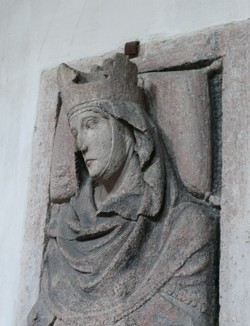
Hemma suffered a stroke in 874 and subsequently became paralyzed and speechless; King Louis visited her the last time in 875. She died on 31 January 876, a few months before her husband, and was buried in St. Emmeram's Abbey, Regensburg. Her tomb, erected around 1300, is considered a masterpiece of medieval sculpture.[2]

Family

[edit]

By Louis, she had eight children:

Her sons became Kings; three of her daughters became nuns.

References

[edit]
[edit]
Revisions and contributorsEdit on WikipediaRead on Wikipedia
from Grokipedia
Hemma, also known as Emma of Altdorf (c. 808 – 31 January 876), was a noblewoman of the who served as of through her marriage to King around 827. Daughter of Welf I, Count of Altdorf, and sister to Judith, the second wife of Emperor , Hemma strengthened ties between the Welf and Carolingian dynasties. She bore at least eight children, three of whom—, , and —succeeded their father as kings of and contributed to the continuation of Carolingian rule in the region. Notable for her involvement in pious benefactions, Hemma collaborated with Bishop Witgar of Augsburg on charitable initiatives, including the commissioning of a belt associated with Witgar that symbolized royal piety and during her lifetime. Her activities reflect the role of Carolingian queens in fostering ecclesiastical alliances and distributing royal resources to support the church and the realm's stability amid dynastic divisions following the in 843.

Origins and Early Life

Ancestry and Welf Dynasty

Hemma was born into the , a Frankish noble lineage documented from the early , with her father identified as Welf, the first historically attested member of the dynasty and count (comes) in the Altdorf region of (modern ). Welf's obscurity in contemporary records is notable; he appears primarily in the context of his daughter Judith's marriage to Emperor on 13 or 14 February 819 at , an event that elevated the family's visibility through Carolingian alliance rather than independent prominence. No primary evidence confirms Welf holding formal titles in proper, though the dynasty's later extensions into Bavarian politics stemmed from such marital ties, positioning the Welfs as regional elites navigating Frankish expansion without direct evidence of opposition to Carolingian authority in this era. Her mother, Heilwig (also Hedwig or Eigilwi), originated from Saxon nobility as the daughter of the count , a figure attested in limited annals for his role among East Frankish subdued during Charlemagne's campaigns. Thegan's Vita Hludowici imperatoris, a near-contemporary biography of composed around 836–837, explicitly describes Heilwig as "de natione Saxonum" (of Saxon nation), underscoring her ethnic and regional Saxon roots amid Frankish integration efforts post-conquest. Heilwig later entered religious life as of Chelles near , documented in charters from circa 825 to after 833, reflecting the era's pattern of noblewomen transitioning to ecclesiastical roles after widowhood or family elevation. While speculative links to Agilolfing ducal lines or direct Carolingian blood have circulated in secondary genealogies, primary sources yield no verifiable maternal connections beyond Saxon comital stock, emphasizing instead strategic inter-dynastic marriages that bound the Welfs to Carolingian power structures. The Elder Welfs' early political weight derived from these unions rather than autonomous resistance to Carolingian centralization, as evidenced by Judith's empress consort and the absence of recorded conflicts or exiles for Welf himself around 819; the dynasty's influence manifested in comital holdings and alliances that facilitated expansion into and by the mid-9th century. This positioning amid Frankish periphery elites—Alamannic counts with Saxon ties—underscored the Welfs' in stabilizing regions under Carolingian oversight, with Hemma's lineage exemplifying how such families leveraged to embed within imperial networks.

Birth and Upbringing in Bavaria

Hemma, also known as Emma, was born around 808 in Altdorf, a fortified estate in the associated with her family's holdings. She was the daughter of Count Welf, a noble from the with roots in who expanded influence in through service to the Carolingian rulers, and his wife, whose identity remains uncertain in surviving records. No contemporary chronicle records her precise birth date, with the estimate derived from her marriage to , born in 806, likely occurring around 827. Her formative years unfolded in a recently subdued by , following the deposition of the last independent Agilolfing duke, Tassilo III, in , an event detailed in the Annales Regni Francorum as marking the duchy's full incorporation into the Frankish realm. The Welfs benefited from this shift, receiving grants of land and offices that positioned them amid ongoing efforts to pacify local elites and integrate Bavarian customs with Frankish administration, including resistance from figures like the deposed duke's kin. Direct evidence on Hemma's personal upbringing is absent from primary sources, which prioritize royal and affairs over the daily lives of noble daughters; reliance thus falls on indirect dynastic contexts from charters and later Welf traditions. As a Welf woman in this era, she would have been raised in a emphasizing loyalty to the Carolingian court, Christian devotion amid the empire's missionary expansions, and skills in estate management suited to potential alliances through marriage.

Marriage and Queenship

Union with Louis the German

Hemma, daughter of Welf I, count in Swabia and Bavaria, married Louis, third son of Emperor Louis the Pious, in 827. This union linked Louis, who had been designated king of Bavaria in 817 under the Ordinatio Imperii, to the influential Welf family, whose estates spanned Bavaria, Alsace, and Swabia. The arrangement, likely instigated by Empress Judith—Hemma's sister and Louis the Pious's second wife since 819—served to deepen dynastic ties forged by Judith's own marriage, thereby countering potential factional oppositions within the Carolingian realm and bolstering imperial control over peripheral regions like Bavaria. The political calculus emphasized reconciliation and stability amid inheritance disputes outlined in the 817 Ordinatio, which allocated subkingdoms to Louis's elder sons while affirming his oversight. By wedding his son to a Welf , Louis the Pious aimed to align Bavarian nobility with Carolingian authority, mitigating risks from local power centers that had challenged central rule, such as the earlier deposition of Bavarian Tassilo III in 788. This dynastic reflected broader Carolingian practices of using marriage to forge alliances, particularly as tensions simmered over potential revisions to the succession favoring Judith's son , born in 823. The wedding occurred amid Louis the Pious's itinerant court movements, with —the administrative center of Louis's Bavarian domain—as the probable location, inferred from contemporary royal charters and annals placing the couple there shortly after. This timing preceded the 828 Treaty of Worms, where convened his sons to reaffirm territorial divisions, underscoring the marriage's role in preempting discord by embedding Welf interests within the Bavarian subkingdom's governance. The alliance thus contributed causally to short-term imperial cohesion, though underlying fraternal rivalries persisted into the 830s.

Role in the East Frankish Court

Hemma's role as in the East Frankish court, formalized after the in 843 divided the Carolingian realm, centered on traditional functions of piety, intercession, and ecclesiastical patronage rather than direct political authority. She frequently appeared in Louis the German's diplomata as "Hemma supplex regina," a formula denoting her formal consent to royal grants, which underscores her supportive yet subordinate position in court proceedings. This participation is attested in over a dozen surviving charters from the 840s and 850s, where she endorsed donations to religious houses, reflecting her influence in directing royal resources toward monastic foundations amid the kingdom's consolidation. A key aspect of her patronage involved the area, where Louis granted her oversight of Obermünster Abbey in 833, allowing her to manage its estates and promote its development as a community for noblewomen during her lifetime. This endowment aligned with Carolingian norms of queens administering churches and monasteries, enabling Hemma to exercise practical authority over lands and revenues while reinforcing the court's religious legitimacy. Her , later idealized in sources as "regina nitens sanctissima Hemma" (shining and most holy queen), manifested in such acts, including associations with liturgical artifacts like the Witgar-belt linked to Augsburg's bishopric, which symbolized her role in fostering episcopal ties and courtly devotion. During Louis's subkingship under prior to 843 and amid subsequent factional tensions in the East Frankish realm, Hemma's documented intercessions were limited to contexts, such as advocating for monastic privileges in charters, rather than overt factional maneuvering. Primary attestations, drawn from diplomata rather than narrative chronicles, reveal no of her engaging in the male-dominated assemblies or councils, consistent with the era's gendered division of royal duties where facilitated spiritual and charitable dimensions of rule. This charter-based visibility counters assumptions of marginal agency, highlighting instead her integral, if conventional, contributions to the court's stability through pious endowments and consensual endorsements up to Louis's death in 876.

Family and Dynastic Role

Children and Immediate Family

Hemma and had three sons who survived to adulthood and played key roles in the Carolingian succession: Carloman, born around 828 and died in 880; , born around 830 and died in 882; and , born 13 June 839 and died 13 January 888. In 865, apportioned among these sons, granting Carloman the southeastern territories including and the , the northeastern regions encompassing and , and Charles the southwestern areas of Alemannia () and Rhaetia; this division was reaffirmed in an assembly at in 872 following disputes over inheritance. The couple also had at least three daughters documented in contemporary necrologies and charters: , born around 828 and died 23 December 856, who served as of the in from approximately 850; Irmengard, active between 857 and 866, who became abbess of ; and a third daughter, sometimes identified as Gisela or in genealogical , who likewise entered religious life. These daughters did not marry, contrary to occasional unsubstantiated claims in secondary genealogies linking them to regional nobles; primary evidence from royal annals and abbey indicates they were dedicated to ecclesiastical roles, reflecting Carolingian practices of placing royal women in convents to consolidate spiritual and dynastic influence without territorial alliances. No verifiable support additional offspring beyond these six children.

Involvement in Family Affairs

Emma's documented participation in family-related diplomatic activities is evidenced by her appearance in a charter dated 29 863, wherein she is jointly named with her husband and their daughter in a donation to the monastery of St. in Zurich, reflecting her consent to acts that reinforced dynastic ties and central to Carolingian family strategy. Such endorsements, though not independent issuances, indicate her advisory influence within the household during periods of territorial consolidation following the 843 , which partitioned the and secured for Louis, thereby positioning Emma's sons—Carloman, , and —as potential inheritors amid fraternal rivalries with uncles and . Contemporary , including the Annales Fuldenses, provide no explicit records of Emma mediating specific familial disputes or directly advocating for her sons during Louis's absences, such as his 858 invasion of , suggesting her roles were primarily facilitative rather than publicly assertive in resolving kin tensions arising from the Verdun divisions.

Later Years and Death

Widowhood and Regency Attempts

Hemma succumbed to following a suffered in 874, dying on 31 876 at . Her husband, , followed seven months later on 28 August 876 at , rendering any period of widowhood impossible. This chronology negates claims in certain secondary accounts suggesting her survival into widowhood, as contemporary records align on the preceding date. In the lead-up to her death, Hemma directed estate dispositions toward institutions, reflecting her documented and , including generous charitable acts memorialized in hagiographic traditions. Such preparations prioritized religious foundations over dynastic maneuvering, consistent with Carolingian elite women's roles in fostering church alliances rather than asserting political regency. No evidence exists of Hemma attempting to position herself or allies for influence over the impending succession, limited further by her physical incapacity in 874–876. Louis's realm passed directly to his three adult sons—Carloman in , in , and in Alemannia—under Carolingian male , which empirically sidelined queens from formal regency even when surviving spouses. Unlike later medieval dynasties where widowed consorts occasionally served as regents for minors (e.g., in Capetian ), Frankish norms evidenced in partition treaties and confined queens' influence to intercession and family advocacy, not governance amid capable male heirs. Hemma's predecease thus reinforced these constraints, with no recorded bids for advisory or custodial authority post-Louis.

Death and Burial Arrangements

Hemma died on 31 January 876 in , at approximately 68 years of age. Her death occurred several months before that of her husband, , who succumbed to a on 28 August 876. No contemporary annals specify a cause beyond the context of advanced age, with no evidence of violence or epidemic involvement recorded in primary sources such as the Annales Fuldenses. She was interred at St. Emmeram's Abbey in , a Benedictine where several Carolingian figures were buried, reflecting its status as a favored dynastic site. Medieval necrologies and abbey records confirm her sepulcher there, alongside relics of saints like Emmeram, though no inscriptions or relics directly attributed to Hemma survive in archaeological reports. The abbey's crypt tradition preserved high-status burials, but post-medieval renovations, including its conversion to a princely residence, have obscured precise locational details. Immediate family arrangements followed standard Frankish practices, with her sons—Carloman, , and —managing succession amid ongoing partitions, but no specific commemorative acts or endowments tied solely to her death are documented in charters from 876.

Legacy and Historical Evaluation

Dynastic Impact

Hemma's Welf heritage intertwined with the Carolingian line through her marriage to , providing her sons—Carloman, , and —with maternal ties to influential Bavarian and Swabian nobility, which supported the kingdom's internal cohesion amid frequent partitions. Upon Louis's death on 28 August 876, these heirs implemented a tripartite division of , with Carloman assuming and the eastern marches, receiving Franconia, , and , and inheriting Alemannia and Rhaetia. This arrangement, adhering to established Carolingian practices of subdividing realms among male heirs to mitigate succession disputes, preserved administrative structures and enabled coordinated responses to invasions for over a decade, culminating in Charles's temporary reunification of the realm by 882 before its fragmentation accelerated after 887. The daughters of Hemma and Louis—Hildegard, Gisela, and possibly others—contributed indirectly to dynastic stability by embedding royal connections into regional elites, fostering loyalties that reinforced defenses against Viking raids penetrating the and eastern frontiers during the 860s and 870s. Although specific marital alliances for these daughters remain sparsely documented, their status as royal likely secured affiliations with local counts and marchiones, paralleling broader Carolingian strategies to bind peripheral territories through networks, thereby aiding the sons' ability to mobilize resources against Scandinavian incursions without immediate internal revolts. Over the longer term, Hemma's Welf lineage exerted subtle influence on East Frankish by embedding elements of her family's bases—particularly in —into the ruling stratum, which outlasted the direct Carolingian male line ending with Charles the Fat's death in 888. This maternal heritage facilitated Welf nobles' continued roles in ducal offices and councils, contributing to the transitional noble coalitions that bridged the Carolingian collapse and the rise of Ottonian kingship in 919, even as Saxon interests predominated. Hemma's agency in these outcomes was inherently limited to and familial positioning, yet the resulting hybrid descent patterns underscored causal links between elite intermarriage and the of Frankish institutional frameworks.

Depictions in Medieval Sources

Hemma receives sparse attention in contemporary Carolingian sources, typically in ancillary roles tied to her husband Louis the German's reign. The Annales Xantenses record her marriage to Louis in 827, identifying her explicitly as the sister of Empress Judith, which underscores her Welf familial connections as a factor in the union rather than independent agency. Similarly, she appears in a royal dated 29 863, wherein Louis donates property to the monastery of St. in , naming Hemma alongside the king in a formulaic context that highlights her status as without detailing personal involvement. These mentions, embedded within documents focused on male royal , exemplify the diplomatic convention of acknowledging queens in intercessory or confirmatory capacities, though explicit phrases like supplicante regina Hemma are not attested in surviving East Frankish charters for her. The Annales Fuldenses, a key East Frankish , omit Hemma from narratives of political and military events spanning her marriage through widowhood, reflecting the ' emphasis on kings, battles, and disputes over domestic or familial roles. Her sole entry occurs in 874, noting her paralysis (paralysi percussa), followed by her death on 31 January 876 in and burial at St. Emmeram's Abbey, presented factually without or elaboration on prior influence. This lacuna aligns with broader Carolingian historiographical patterns, where queens' activities—often confined to courtly or —are elided unless directly impacting , a causal outcome of monastic authorship prioritizing dynastic continuity through male lines and verifiable public acts over private exertions. Such selectivity does not fabricate absence of agency but stems from source priorities shaped by hierarchies and archival survival, as evidenced by parallel underrepresentation of other consorts in annals like the Annales Bertiniani. Post-contemporary medieval necrologies preserve her memory in pious terms, listing her death on 31 January (or variably 30 January) as Hemma imperatrix or queen, in institutions like St. Emmeram, Augia Major, and , suggesting localized tied to her and Welf affiliations. Later genealogical compilations, drawing from these, occasionally amplify devotional attributes—such as epithets like sanctissima in episcopal contexts linked to figures like Bishop Witgar of —but these introduce hagiographic conventions absent from ninth-century originals, likely to normalize Carolingian forebears within emerging saintly paradigms for dynastic or ecclesiastical legitimacy. Primary records lack such tropes, indicating retrospective embellishment rather than empirical basis, with credibility diminished by distance from events and alignment with monastic agendas favoring edifying narratives.

References

Add your contribution
Related Hubs
User Avatar
No comments yet.