Hubbry Logo
HM Prison BarlinnieHM Prison BarlinnieMain
Open search
HM Prison Barlinnie
Community hub
HM Prison Barlinnie
logo
8 pages, 0 posts
0 subscribers
Be the first to start a discussion here.
HM Prison Barlinnie
HM Prison Barlinnie
from Wikipedia

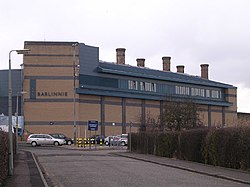
HM Prison Barlinnie is the largest prison in Scotland. It is operated by the Scottish Prison Service and is located in the residential suburb of Riddrie, in the northeast of Glasgow, Scotland. It is informally known locally as The Big Hoose, Bar and Bar-L.[1][2] In 2018, plans for its closure were announced.

Key Information

History

[edit]
Aerial view of the prison (2018) showing its proximity to Smithycroft Secondary School and housing

Barlinnie was designed by Major General Thomas Bernard Collinson, architect and engineer to the Scottish Prison Department, and it was built in the then rural area of Riddrie adjacent to the Monkland Canal (now the route of the M8 motorway), first opening with the commissioning of A hall in July 1882.

Barlinnie prison's five accommodation halls: A, B, C, D and E, were built in stages between 1882 and 1897, with each holding approximately 69 inmates.

There was a major extension to the perimeter in 1967 to create an industrial compound. From 1973 till 1994, the world-famous "Special Unit" placed emphasis on rehabilitation, the best known success story being that of reformed Glasgow gangster Jimmy Boyle. Cultural output associated with the Special Unit included Boyle's autobiography, A Sense of Freedom (1977); The Hardman (1977), the play Boyle wrote with Tom McGrath; a body of sculpture; and The Silent Scream (1979), a book of prose and poems by Larry Winters, who committed suicide in 1977.[3]

Capital punishment

[edit]

A total of 10 judicial executions by hanging took place at HMP Barlinnie between 1946 and 1960, replacing the gallows at Duke Street Prison before the final abolition of capital punishment in the United Kingdom for murder in 1969:[4]

Date Name Age (years) Executioner
8 February 1946 John Lyon 21 Thomas Pierrepoint
6 April 1946 Patrick Carraher 39 Thomas Pierrepoint
10 August 1946 John Caldwell 20 Albert Pierrepoint
30 October 1950 Christopher Harris 28 Albert Pierrepoint
16 December 1950 James Robertson 33 Albert Pierrepoint
12 April 1952 James Smith 22 Albert Pierrepoint
29 May 1952 Patrick Gallagher Deveney 42 Albert Pierrepoint
26 January 1953 George Francis Shaw 25 Albert Pierrepoint
11 July 1958 Peter Manuel 31 Harry Allen
22 December 1960 Anthony Miller 19 Harry Allen

Each of the condemned men had been convicted of murder. All the executions took place at 8.00 am. As was the custom, the remains of all executed prisoners were the property of the state, and were therefore buried in unmarked graves within the walls of the prison. During the D hall renovations of 1997, the prison gallows cell (built into D-hall) was finally demolished and the remains of all the executed prisoners were exhumed for reburial elsewhere.

Escapes

[edit]

The first man to escape from Barlinnie was John Dobbie, three days after being sentenced to 15 years for a violent robbery in 1985. Dobbie escaped inside a laundry van; he was captured by armed police five days later and was sentenced to a further five years.[5]

Current use

[edit]

Today Barlinnie is the largest prison in Scotland, holding just under 1,400 prisoners although it has a design capacity of 987.[6] The prison currently receives prisoners from the courts in the West of Scotland as well as retaining male remand prisoners and prisoners serving less than 4-year sentences. It also allocates suitable prisoners from its convicted population to lower security prisons, including HMP Low Moss and HMP Greenock, as well as holding long-term prisoners in the initial phase of their sentence prior to transfer to long-term prisons such as HMP Glenochil, HMP Shotts, HMP Kilmarnock or HMP Grampian.

Barlinnie prison still consists of five accommodation halls with each holding approximately 200 inmates and an additional National Top End Facility (Letham Hall) housing long term prisoners nearing the end of their incarceration. All five accommodation halls were refurbished between 1997 and 2004. There is also a hospital unit with accommodation for 18 prisoners, which includes eight cells specially designed for suicide supervision. A new administration and visiting block was completed in 1999.

The in-cell bucket-as-toilet routine known as slopping out was still in practice there as late as 2003. Since 2001, refurbishment has taken place after critical reports by the Scottish Chief Inspector of Prisons.[7]

In October 2018, it was announced that HMP Barlinnie is to be sold and replaced with a new superjail within Glasgow or its outskirts.[8]

In 2019, local MP Paul Sweeney proposed that the historic prison buildings be saved from demolition and converted into a prison museum after it is decommissioned.[9]

In January 2020, the Prison Service announced that the proposed site for the replacement prison was a 22-hectare (54-acre) site formerly occupied by Provan Gas Works.[6]

As at February 2025 the prison was operating at 140% capacity with 1,400 prisoners, and was scheduled to have additional prisoner releases to relieve over-crowding.[10]

Research

[edit]

Cooperation between the prison authorities, the prisoners and third parties has resulted in the production of research materials suggesting the following conclusions:

(2010) Alcohol is blamed by the majority of youths (av age 18.5 years) for their committing serious harm to others (base study 172 persons) by the use of weapons (mostly knives). 90% of the study group were in Barlinnie for committing serious harm to others (i.e. not crimes of dishonesty). Most were gang members.[11]

Notable former inmates

[edit]

Further reading

[edit]

References

[edit]
[edit]
Revisions and contributorsEdit on WikipediaRead on Wikipedia
from Grokipedia
HM Prison Barlinnie is Scotland's largest , located in the Riddrie of , operational since the commissioning of its first hall in 1882, and serving as the main reception center for adult male remand and sentenced prisoners from western Scottish courts. The facility, managed by the , accommodates a diverse population including untried remand inmates and those convicted of various offenses, with accommodations spread across multiple Victorian-era halls built progressively through the late . Despite a design capacity of 987, it consistently holds over 1,300 prisoners, operating at more than 130% occupancy, which exacerbates challenges in an aging infrastructure featuring narrow walkways and steep stairs ill-suited to modern custodial demands. Notable for its historical role in Scottish incarceration and past experiments like the Barlinnie Special Unit—a short-lived approach to rehabilitation that polarized views before its 1996 closure— the prison faces ongoing scrutiny over , resource strains, and physical deterioration. The has committed to replacing Barlinnie with the new HMP Glasgow by 2028 to address these systemic risks and modernize the estate, though delays and escalating costs have marked the project's progress.

Location and Facilities

Physical Layout and Infrastructure

HM Prison Barlinnie occupies a site in Riddrie, northeast , originally developed as a purpose-built complex in 1880 and opened in 1882, with expansions continuing until 1908. The layout follows late 19th-century penal architecture principles, featuring a secure perimeter boundary wall, , chapel, former infirmary, work sheds, and five main accommodation halls (A to E) arranged to separate prisoner categories into distinct wings with individual cells. These halls employ a Victorian gallery-style , characterized by multi-level landings providing oversight of cells, though the overall site lacks a strict radial or configuration. The core residential structure comprises Halls A through E, each housing approximately 200 prisoners and featuring around 110 cells per hall in the main Victorian blocks, designed originally for single occupancy but routinely doubled up due to chronic overcrowding exceeding the official capacity of 1,021 by over 45% as of 2019. Hall D serves as a high-dependency unit, while Hall E accommodates protection prisoners and those under special security measures, with restrictions on lone female staff. Letham Hall, a semi-permanent modular addition functioning as the National Top End facility for long-term prisoners, supplements the main halls but exhibits external and internal disrepair, including substandard showers and no accessible cells. Cells measure approximately 8.8 m² (7.98 m² excluding toilet), falling short of standards for shared use, with limited ventilation on upper landings, inadequate storage, and only five designated disabled cells across the site lacking full adaptations like grab rails or emergency call systems. Infrastructure challenges stem from the aging Victorian fabric, resulting in high maintenance costs, fragile building integrity, and operational inefficiencies. Reception holding cells, described as cramped "dog-boxes" condemned for 25 years, remain in use despite concerns, while healthcare facilities suffer from damaged walls, exposed insulation, and undecorated spaces since 2011, compromising infection control. Ancillary areas include two equipped gyms with showers, an outdoor , a communications hub housing the , and work sheds for projects, though the learning centre and visits area are undersized with poor and . Pest infestations, such as rats in the grounds, and a repairs backlog further strain the estate, which has prompted interim refurbishments like prisoner reception upgrades but underscores the need for broader replacement amid planned closure.

Operational Capacity and Daily Regime


HM Prison Barlinnie has a design capacity of 987 single-occupancy cells but operates well above this limit due to systemic in the Scottish estate. As of the November 2024 HM Inspectorate of Prisons for (HMIPS) inspection, the population exceeded 1,300 inmates, with nearly 66% required to share cells, many below the recommended 4 square meters per prisoner. By April 2025, numbers approached 1,400, equating to 140% of design capacity and prompting descriptions of the facility as operating in a "wretchedly poor state."
The daily regime at Barlinnie is markedly restricted, particularly in halls A and B, where most prisoners experience 22 to 23 hours of cell confinement per day for non-working individuals. , combined with the prison's Victorian-era design, limits access to services, exacerbating inconsistencies in entitlements like daily showers (reported by only 26% of prisoners) and association time. standards mandate a minimum of two hours out of cell daily, including one hour in open air, yet these are frequently unmet due to staffing pressures and . Exercise and purposeful activity remain available but constrained. All prisoners are entitled to one hour of daily open-air exercise, with approximately 300 accessing fitness facilities each day, though inadequate and impede participation. Work opportunities span catering (45 prisoners), cleaning parties (18), , and community placements, while and offense-focused programs exist but face long waiting lists—such as 200 for initial assessments—limiting engagement to small numbers. Association is further curtailed by hall configurations, contributing to tensions, as evidenced by 55% of surveyed prisoners reporting staff abuse. HMIPS recommends reducing levels and expanding program spaces to mitigate these regime shortfalls.

Historical Development

Establishment and Early Operations (1880s–1940s)

HM Prison Barlinnie was established on a 33-acre site in Riddrie, Glasgow, following the purchase of farmland in 1879 for £9,750, with construction commencing in 1880 under the design of Major General Thomas Bernard Collinson. The prison opened in August 1882 as the first new facility built in Scotland after the nationalization of prisons via the Prisons (Scotland) Act 1877, serving as a central institution to alleviate overcrowding in smaller local jails such as those at Duke Street and Glasgow Green. It initially commissioned A Hall in 1882, followed by B Hall in 1883 and C Hall in 1887, with a link corridor connecting these blocks completed in 1890; D Hall opened in 1892 and E Hall in 1896 to accommodate growing numbers, eventually housing up to 800 inmates across five blocks by the late 1890s. Early operations emphasized a regime blending punitive hard labour—such as breaking rocks from a local —with rehabilitative elements including vocational classes in and blacksmithing, individual cells for segregation, a dedicated , gymnasium, and completed in 1893 for Roman Catholic and Presbyterian services. Staffed by 62 officers (including 19 women), three teachers, and support for families in married quarters, the prison admitted around 180,000 individuals between 1882 and 1899, reflecting high turnover primarily among short-term local prisoners alongside longer-term convicts from western . A chaplain's and doctor's house was built outside the gate in 1888, and perimeter walls were extended in 1893, underscoring its role as a model of Victorian penal focused on and improvement through employment and . By the interwar period, expansions included old sheds in 1908, alterations to E and D Halls in the 1930s, a new office block in 1933, and a gymnasium with in 1939, yet persistent strained the aging , culminating in a in 1934 that highlighted emerging operational challenges. The facility maintained its reputation as a demanding environment, with routines enforcing strict separation, labour, and limited , though records indicate no major structural shifts in core operations through the 1940s.

Capital Punishment Period (1947–1960)

During this period, HM Prison Barlinnie became the primary site for judicial executions in the Glasgow region after capital punishment cases were transferred from the aging Duke Street Prison, with a total of 10 men hanged for murder between February 1946 and December 1960. All executions occurred in a purpose-built hanging shed within the prison grounds, conducted at 8:00 a.m. using the long-drop method to ensure instantaneous death via spinal severance; professional executioners, including Thomas Pierrepoint (for the initial hangings), his nephew Albert Pierrepoint, and later Harry Allen, calculated drop distances based on the prisoner's weight and physique. The bodies of the executed were interred in unmarked graves on prison property, with the exact number and locations remaining uncertain due to incomplete records. The following table enumerates the executions from 1947 onward, focusing on the specified timeframe while noting the transitional cases in early 1946 that established Barlinnie's role:
DateNameAgeCrime Summary
30 October 1950Christopher Harris28Stabbed and killed Martin Dunleavy during a street altercation in .
16 December 1950James Robertson31Ran over and murdered his mistress, Catherine McCluskey, in ; notable as the only serving Scottish police officer executed post-1929.
12 April 1952James Smith21Stabbed Martin Joseph Malone to death in a pub brawl.
29 May 1952Patrick Gallagher Deveney42Bludgeoned his wife, Jeannie Deveney, in their Kinning Park home amid .
26 January 1953George Francis Shaw25Beat elderly farmhand Michael Connolly to death during a at Huntlygate Farm.
11 July 195831 convicted of seven murders, including the Watt family, Anne Knielands, and Isabelle Cooke; execution took 66 seconds due to his 13-stone weight requiring a 5-foot-8-inch drop.
22 December 1960Anthony Miller19Stabbed John Cremin during a in Queen's Park; youngest executed at Barlinnie, despite a with 30,000 signatures for reprieve.
These hangings reflected broader trends in post-war Scotland, where murder convictions routinely led to death sentences under the system, though reprieves were occasionally granted by ; public notices were posted on Barlinnie's gates post-execution to confirm the event, maintaining transparency in the judicial process. The period ended with Miller's execution, after which no further hangings occurred at Barlinnie, though persisted nationally until its suspension in 1965.

Post-Abolition Expansion and Challenges (1960s–1980s)

Following the suspension of in the in 1965, which applied to and resulted in more inmates serving indefinite or extended sentences, HM Prison Barlinnie experienced pressure to expand its facilities to manage the shifting demographics of its prisoner population, particularly long-term offenders. Throughout the and , Scottish authorities grappled with containing this growing cohort, adopting dispersal strategies akin to those in to distribute high-security prisoners across multiple sites rather than concentrating them, though Barlinnie remained a central hub for such individuals. Construction efforts at Barlinnie increased its operational capacity to approximately 1,000 inmates, with prisoners from existing halls repurposed as laborers to construct additional accommodations and reduce expenses. Despite these adaptations, Barlinnie faced chronic , as Scotland's overall rose steadily amid broader penal trends emphasizing incarceration over alternatives. By the mid-1980s, the daily average across Scottish prisons had climbed to over 5,000, exacerbating strains on and management at facilities like Barlinnie, where disciplinary controls and segregation were heavily relied upon to maintain order. This environment fostered tensions, with inmates protesting perceived brutality by officers and inadequate conditions, contributing to a pattern of unrest documented in official accounts of the era. The decade culminated in significant disturbances, including a major in January , when inmates seized control of B Hall, taking three officers and occupying the rooftop for five days in what became Scotland's longest-running standoff. This incident, part of a wave of riots and events across Scottish prisons in the late , highlighted systemic failures in handling long-term prisoner dynamics and sparked scrutiny of overcrowding's role in escalating violence. Such challenges underscored the limitations of post-abolition expansions, as physical growth outpaced effective reforms in and inmate management.

Security and Incidents

Escapes and Breaches

In its 142-year , HM Prison Barlinnie has experienced a relatively small number of successful escapes, with only a handful documented amid stringent measures. Early incidents often exploited lapses in supervision or smuggled tools, while later ones involved external movements or hospital transfers. Modern electronic surveillance and protocols have rendered physical breakouts from the facility itself rare, though absconding during off-site activities persists as a vulnerability. One of the earliest mass escapes occurred in 1934, involving 12 prisoners across four separate breakouts; 11 were recaptured, while one may have drowned during the attempt. In August 1943, Leonard Wilson, a 23-year-old convicted housebreaker and former , along with four unnamed accomplices, escaped during unsupervised painting work at the governor's by stealing the governor's , braces, , , and watch; Wilson was recaptured two days later on a tramcar by an off-duty officer after stealing additional clothes and an identity card, receiving an extra three months for . In the summer of 1959, Sammy "Dandy" McKay sawed through his cell bars using a smuggled , descended via knotted bedsheets, crossed a turnip field, and entered a waiting car; he evaded capture for 11 months across New York, , , and using proceeds from a prior before being arrested in upon returning for family, leading to a 10-year sentence in 1961. John Steele escaped in 1980 by scaling a shaft and 90 feet to a drying green, but was recaptured and received an additional three years. That same decade, John Duggan removed cell bars, climbed the roof using telephone wires, and waited for a getaway car that never arrived; after five days on the run, he surrendered via a call from his wife in . John Dobbie, sentenced to 15 years for violent robbery, became the first recorded escapee from Barlinnie's in 1985 by fleeing in a prison laundry van just three days after conviction, though he was later recaptured. More recently, in August 2017, remand prisoner Jamie Roy, 24, absconded from during medical treatment by slipping a slackened handcuff, securing the escorting officer to a toilet handrail with the chain, and fleeing; he was recaptured after three days. Later that year, convicted killer Walter Bett, 39, absconded from an external work placement near Muirhead and was detained by police after four days. Security breaches facilitating or attempting escapes have included smuggled tools like hacksaws in the mid-20th century and exploitable external routines, but contemporary threats involve non-escape incidents such as drone incursions for drugs and mobiles, which undermine perimeter integrity without direct breakout attempts. In May 2024, a scaled the , prompting a , though no escape resulted.

Riots and Internal Disorders

On January 5, 1987, a major erupted in B Hall at HM Prison Barlinnie, marking the prison's most significant internal disorder. Approximately 20 inmates seized control of the wing, initially trapping around 41 prison officers, most of whom escaped, while taking three officers . The rioters demolished cell doors and furniture, ignited fires, and occupied the rooftop, pelting rescuers with slates, bottles, and debris that injured several officers and a . Inmates attributed the violence to alleged brutality and inhumane treatment by staff, including specific claims of against prisoner Sammy Ralston involving beatings and gagging; banners hung from the hall proclaimed messages such as "Slasher Gallagher" and "Gallagher is brutality," targeting named officers. This incident formed part of a series of riots and hostage-takings across Scottish prisons in the late , amid rising tensions over conditions and management. The resulting siege lasted 110 hours until January 11, 1987, the longest in Scottish penal history, with hostages released progressively—one early, the others by the final day—and 13 of 16 key protesters surrendering over four days. No deaths or serious injuries occurred, though extensive damage was inflicted on the facility. Nine inmates faced trial; three, including Allan McLeish, William Marshall, and Hugh Twigg, received additional sentences totaling 22 years. Scottish Home Affairs Minister Ian Lang defended the prison system, while investigations by and the Glasgow fiscal probed assault allegations, and local MP Hugh Brown advocated for a broader review of penal practices.

Reforms and Programs

The Special Unit Experiment

The Barlinnie Special Unit (BSU) opened in February 1973 as an experimental facility within HM Prison Barlinnie, designed to manage a small cohort of long-term prisoners, particularly those deemed violent or unmanageable in conventional prison settings. It accommodated up to 10 inmates, though typically fewer, such as seven at the time of a parliamentary review, including five lifers and two on determinate sentences. The unit's creation stemmed from efforts to address escalating violence among high-security prisoners, drawing on principles to foster self-regulation rather than punitive isolation. The regime emphasized mutual trust and shared responsibility between staff and inmates, with specially selected officers—described as firm but fair, with psychological training—maintaining a high supervision ratio, such as 14 officers for the unit's capacity. Prisoners managed their daily programs, wore personal clothing, retained unlimited mail and phone access via a , and engaged in creative pursuits like , writing, and , supported by visiting professionals. Family visits were generous, and decision-making involved communal input, challenging traditional hierarchical discipline. This approach, influenced by figures like Dr. Bob Johnson, who advocated for humane treatment of violent offenders, aimed to reduce aggression through autonomy and rehabilitation rather than coercion. Evaluations indicated success in curbing in-prison : by , only one serious had occurred among 16 prisoners who had passed through since its , with four released into the community and two transferred back to standard conditions. Broader assessments noted moderated among difficult inmates and post-release non-offending lives for some, contributing to lower tension across Scottish prisons. Independent reviews, such as those by Bottomley, Liebling, and Sparks in , affirmed its efficacy in containing without routine segregation, though scalability was limited by costs and selection challenges. The unit closed in 1994 after 21 years, amid mounting criticisms of perceived leniency, including media reports of alcohol- and drug-influenced gatherings that fueled public outrage over privileges for high-risk offenders. Institutional pressures, including staff departures and policy shifts toward stricter regimes, compounded societal backlash, despite evidence of behavioral improvements; no equivalent therapeutic unit has since operated in Scotland.

Rehabilitation and Research Efforts

HM Prison Barlinnie offers a range of rehabilitation programs aimed at addressing offending behaviors, ties, and skill development. The Family Contact Team provides family inductions, courses, play-and-share visits, and family events to strengthen prisoner-family relationships and support reintegration. Children's visits occur in a dedicated with facilities, limited to groups of 10 for one session per month per . The Healthy Dads, Healthy Kids (HDHK) program, adapted from an Australian model, was piloted at Barlinnie in as the first such initiative in a Scottish , targeting fathers of children aged 5-12 to improve parent-child bonds, health behaviors, and reduce risks. Involving 14 families, sessions included shared meals, play, and exercises, yielding reports of enhanced family connections and positive prisoner feedback on reconnection efforts. Creative arts initiatives form a core component, with programs like hip-hop music production enabling inmates to record tracks in a studio setup to foster self-expression and emotional processing. Theatre Nemo has delivered artistic workshops for mentally ill and vulnerable prisoners since 2004, while partnerships support podcast production and drama groups, engaging over 200 participants annually across multiple sites including Barlinnie to aid rehabilitation through creative outlets. Education and vocational efforts include approaches developed across seven Scottish prisons, including Barlinnie, emphasizing practical, collaborative projects to build , , and skills. Additional offerings encompass therapeutic arts, , distance learning, self-improvement courses, and modules, alongside workshops like those from focusing on essential . Drug recovery includes the Peer training scheme, where prisoners volunteer to learn overdose reversal techniques, operating at Barlinnie since at least 2022 to combat substance misuse. Research efforts have evaluated these programs' impacts. The HDHK pilot incorporates a two-year feasibility study by the Universities of , , and Newcastle, assessing father-child relationship improvements and potential recidivism reductions through qualitative and quantitative measures. A study on project-based learning in Scottish prisons, including Barlinnie, analyzed its efficacy in enhancing engagement and skill acquisition, arguing for its superiority over traditional methods in motivating adult learners with low prior education. Case studies on arts interventions, such as those in 2010's Inspiring Change program at Barlinnie, have examined their role in boosting and rehabilitation outcomes via qualitative interviews.

Controversies and Criticisms

Overcrowding and Physical Conditions

HM Prison Barlinnie has persistently operated beyond its operational capacity, exacerbating strains on resources and inmate management. During a November 2024 inspection by HM Inspectorate of Prisons for (HMIPS), the facility housed nearly 1,400 prisoners against a certified normal accommodation of 987, resulting in approximately 30% . This level of excess population has compelled nearly two-thirds of inmates to share cells originally designed for single occupancy, limiting access to purposeful activity and contributing to extended lock-up periods. Physical infrastructure at the 143-year-old prison remains in a "wretchedly poor state" in multiple areas, with HMIPS inspectors highlighting severe disrepair that hinders daily operations and maintenance. Victorian-era buildings, including outdated cell blocks lacking modern in some sections, have led to persistent issues such as inadequate ventilation, pest infestations, and structural decay, as noted in prior evaluations. Overcrowding compounds these deficiencies by accelerating wear on facilities, reducing hygiene standards, and increasing health risks, with inspectors deeming the conditions unsafe and in potential breach of standards under UN conventions. HMIPS reports from 2020 onward have repeatedly flagged these intertwined problems, recommending urgent interventions like population caps or accelerated replacement, though implementation has lagged amid delays in constructing HMP Glasgow. The warned in August 2023 of imminent "catastrophic failure" risks due to the infrastructure's inability to sustain 500 excess prisoners, underscoring causal links between chronic and deteriorating physical conditions. Despite some refurbishments in select halls, core challenges persist, with the 2024 inspection affirming the "overwhelming and urgent" need for wholesale replacement to address these systemic failings.

Violence, Drugs, and Recidivism Rates

Barlinnie has recorded nearly 3,000 assaults since 2015/16, comprising 2,601 incidents of prisoners attacking fellow inmates and 365 assaults on staff. Between 2021 and 2024, assaults included 1,062 prisoner-on-prisoner attacks and 173 on personnel, contributing to broader concerns over unchecked violence amid overcrowding and limited segregation options. A pre-inspection prisoner survey found 33% of respondents reporting abuse, threats, bullying, or assault by another inmate, with violence often linked to gang affiliations, drug debts, and inadequate staff-prisoner ratios. Substance misuse exacerbates violence and health risks, with high prevalence rates on admission; Scottish prison studies indicate 40-75% of entrants positive for or dependencies, a evident at Barlinnie where early mandatory testing yielded 15% positives in its initial eight months. Inspectors have noted very high numbers of prisoners requiring support, alongside recent spikes in overdoses prompting calls, though recovery programs and clinical interventions received positive assessments for addressing withdrawal and prevention. Illicit supply persists via drones and internal networks, fueling debts that trigger assaults, with official strategies emphasizing testing and treatment but struggling against entrenched demand. Recidivism perpetuates Barlinnie's intake of repeat short-sentence offenders, aligning with Scotland's national reconviction rate of 26.9% for the 2020-21 cohort, which rises for custodial releases. The prison's focus on high-turnover populations—often with substance issues and limited program access—mirrors systemic patterns where custody correlates with nearly double the reoffending risk compared to community sentences (47% versus 25%). The has projected a 20% reoffending drop post-relocation to HMP , citing improved conditions for rehabilitation, though current data underscores causal links between poor physical infrastructure, drug access, and cycle-reinforcing violence.

Effectiveness of Management and Policy Failures

Management at HM Prison Barlinnie has faced persistent criticism for inadequate mitigation of , which reached over 30% above design capacity during the November 2024 inspection, accommodating more than 1,300 prisoners in intended for fewer, resulting in 66% sharing cells designed for single occupancy. This —operating at up to 140% capacity as of early 2025—has led to severe operational strains, including only 26% of prisoners accessing daily showers, lock-up periods of 22-23 hours for many, and reduced access to purposeful activities, exacerbating tensions and hindering rehabilitation efforts. HMIPS reports describe the prison's physical state as "wretchedly poor," with unaddressed disrepair from prior inspections, including £19,000 in cell damage year-to-date in 2024, underscoring failures in maintenance policy implementation. Policy shortcomings at the (SPS) level have compounded these issues, particularly the prolonged delay in replacing Barlinnie with HMP Glasgow, originally planned but years behind schedule as of 2025, leaving the Victorian-era facility vulnerable to "catastrophic failure" as warned by Governor Michael Stoney in 2023 and echoed by HMIPS. Critics, including prison officers' unions and opposition politicians, attribute this to governmental mismanagement under the , citing a decade of inaction on capacity expansion despite rising remand and sentenced populations. Drug control policies have proven ineffective, with illicit substances dominating operations—no drone detection system installed despite recommendations—and high Management of Overdose Risk Scheme (MORS) caseloads suspending healthcare services and overwhelming staff, reflecting non-compliance with national standards. Staffing and relational management exhibit gaps, with a pre-inspection survey revealing 55% of prisoners witnessing staff abuse or and 42% experiencing it personally, alongside inconsistent application of the personal officer scheme and underutilization of the Think Twice anti- lacking formal monitoring. While senior leadership shows visibility and some progress in areas like Integrated Case Management, frontline inconsistencies—such as uneven Rule 95(1) enforcement for segregation and staffing shortages in addictions teams (80% vacancy until late 2024)—undermine effectiveness. Outgoing Wendy Sinclair-Gieben described Scotland's prison system as "broken" in 2024, arguing it sets inmates up to by releasing them "bored and angry" without adequate progression, a systemic evident in Barlinnie's limited regime delivery amid . These deficiencies persist despite HMIPS recommendations across multiple inspections, indicating insufficient SPS adaptation to causal pressures like and resource constraints.

Notable Inmates and Impacts

High-Profile Prisoners

, a responsible for at least seven murders between January 1956 and January 1958, was convicted in 1958 and subsequently hanged at Barlinnie Prison on July 11 of that year, marking one of the facility's most notorious executions. His victims included families and individuals killed with various weapons across and southern , with Manuel confessing to additional killings before his death. Jimmy Boyle, convicted of murdering gangland figure William "Babs" Rooney in in 1967, served a 14-year sentence at Barlinnie, during which he gained a reputation for extreme violence, including assaults on prison staff. Transferred to the prison's Special Unit in the 1970s, Boyle underwent rehabilitation that led to his development as a sculptor and author, culminating in his release in 1982 and subsequent literary success with works like . Abdelbaset al-Megrahi, convicted in 2001 for the 1988 bombing of over , which killed 270 people, began his life sentence at Barlinnie Prison upon arrival in via from the . He served approximately three years there before transfer to HM Prison in 2005, was released on compassionate grounds in 2009 due to terminal cancer, and died in in 2012 while maintaining his innocence. Other notable inmates include Dominic Devine, a who targeted five women in Glasgow's Ibrox area between 1979 and 1987 and died in custody at Barlinnie in 2023 at age 66; Anthony Joseph Miller, convicted of murdering John Cremin in 1960 and hanged at the prison on December 22 of that year as the last teenager executed in the ; and Hugh Collins, who murdered Willie Mooney and served 16 years at Barlinnie, achieving rehabilitation through the Special Unit before release in 1992. These cases highlight Barlinnie's role in detaining individuals involved in high-impact violent crimes, often under maximum-security conditions.

Societal and Judicial Influence

The Barlinnie Special Unit, operational from 1973 to 1995, represented a pioneering rehabilitation model within the Scottish system, emphasizing therapeutic communities, engagement, and creative expression over punitive isolation, which influenced subsequent debates on imprisonment philosophy. By integrating artists and allowing prisoners greater autonomy, the unit challenged entrenched disciplinarian approaches and demonstrated potential for reduced through personal transformation, as evidenced by cases like that of Jimmy Boyle, who credited his incarceration and artistic pursuits there with personal redemption despite initial violence. Its closure in 1995, amid public and political backlash over perceived leniency, prompted academic analyses labeling it a "failed success," yet its legacy persists in informing contemporary Scottish policy discussions on alternatives to custody, including diffuse targets like ending short sentences and enhancing liaison to curb reoffending. Barlinnie's chronic overcrowding, reaching 140% capacity by 2023 with nearly 1,400 inmates in facilities designed for 987, has exerted pressure on 's judicial framework, catalyzing emergency measures such as the 2024 Prisoners (Early Release) (Scotland) Bill, which adjusted release points to 40% of sentences for certain short-term prisoners to alleviate systemic strain. This crisis, positioning Barlinnie as an "" for the national estate, underscored causal links between rising remand populations and infrastructure failures, driving governmental commitments to replace it with HMP Glasgow by 2028 and injecting £450 million in economic activity, while highlighting judicial reliance on incarceration amid limited community alternatives. Architecturally and historically, Barlinnie's design evolution from 1880s radial blocks to linear halls mirrored broader shifts in Scottish penal attitudes toward and , influencing public consultations on heritage listing and revealing tensions between preservation and modernization in justice infrastructure. Societally, its role in housing over a million offenders since has amplified awareness of familial impacts, spurring initiatives like the Croft Visitor Centre for families, which address and emotional distress to mitigate intergenerational cycles. These dynamics have reinforced causal realism in , prioritizing evidence-based mitigation over ideological expansions of custody.

Current Operations and Future Prospects

Recent Inspections and Conditions (2010s–2025)

A full inspection of HMP Barlinnie by HM Inspectorate of Prisons for (HMIPS) from 26 to 6 2019, with findings reported in May 2020, determined the prison was not fit for purpose due to deteriorating infrastructure and operational strains. Inspectors emphasized the need for urgent enhancements in living conditions, safety protocols, and resource allocation, while noting the facility's scheduled replacement by HMP Glasgow in 2025 would not occur soon enough to avert ongoing risks. Overcrowding remained a core issue across the and into the , with numbers consistently surpassing design capacity, as documented in successive HMIPS reviews; this led to compressed cell space, reduced out-of-cell time, and heightened tensions. By early 2025, the prison operated at 30% over capacity, accommodating over 1,400 inmates in facilities built for fewer, exacerbating physical deterioration and limiting access to education, work, and healthcare. The HMIPS full inspection from 3 to 7 June 2024, reported in March 2025, described significant portions of the prison as in a "wretchedly poor state," with aging buildings hindering safe and humane operations. Key deficiencies included inadequate , poor ventilation, and sanitation failures in communal areas, alongside prisoner surveys indicating widespread perceptions of staff bullying and —findings that inspectors deemed unexpectedly high. Violence persisted, with 222 assaults on staff and 776 on recorded between January 2020 and December 2024, causally linked by officials to density pressures rather than isolated incidents. In September 2025, a senior official characterized Barlinnie's conditions as "shameful," citing chronic overcrowding across Scotland's estate as the primary driver of breakdowns in order, support, and rehabilitation opportunities. HMIPS recommendations consistently urged upgrades and population management, though implementation lagged amid delays to the replacement .

Closure and Replacement by HMP Glasgow

In October 2018, the Scottish Government announced plans to close HM Prison Barlinnie and replace it with a new facility, HMP Glasgow, due to the aging infrastructure of the 143-year-old Victorian-era prison being deemed unfit for modern correctional needs. The decision followed assessments highlighting Barlinnie's inability to meet contemporary standards for prisoner safety, rehabilitation, and operational efficiency, with the new prison intended to consolidate functions previously split across multiple sites in Glasgow. HMP Glasgow is sited in Provanhill, Glasgow, and designed with a capacity of 1,344 inmates, focusing on improved security, healthcare, and vocational training spaces to address longstanding deficiencies at Barlinnie. Construction of HMP Glasgow faced significant delays and cost overruns, with the projected opening pushed back to 2028—three years later than initial timelines—and total expenses escalating to nearly £1 billion, more than double the original estimate. Early site works began in October 2023, but full-scale development accelerated after Kier Infrastructure and Overseas Limited was awarded a £683.8 million contract by the in February 2025. These increases were attributed to inflation, supply chain issues, and enhanced design requirements for resilience and sustainability, though critics have questioned the management of the project timeline amid ongoing at Barlinnie, which operated at 30% over capacity as of April 2025. The emphasized that the replacement would deliver £450 million in economic benefits through local s and job creation during . Barlinnie's closure is scheduled to coincide with HMP Glasgow's operational readiness in 2028, allowing for a phased transfer of inmates and staff to minimize disruption. Post-closure, the Barlinnie site faces potential redevelopment or preservation; launched a in December 2024 on listing the buildings for their historical significance as Scotland's first post-Pentagon plan facility, with the consultation extended to 2025. This process evaluates the site's architectural and penal history value, potentially influencing future uses such as partial demolition for housing or retention of key structures like the Special Unit. The transition aims to resolve Barlinnie's chronic issues, including physical decay and inadequate facilities, by relocating operations to a purpose-built environment better suited to reducing through evidence-based programming.

References

Add your contribution
Related Hubs
User Avatar
No comments yet.