Hubbry Logo
BarueriBarueriMain
Open search
Barueri
Community hub
Barueri
logo
8 pages, 0 posts
0 subscribers
Be the first to start a discussion here.
Barueri
Barueri
from Wikipedia

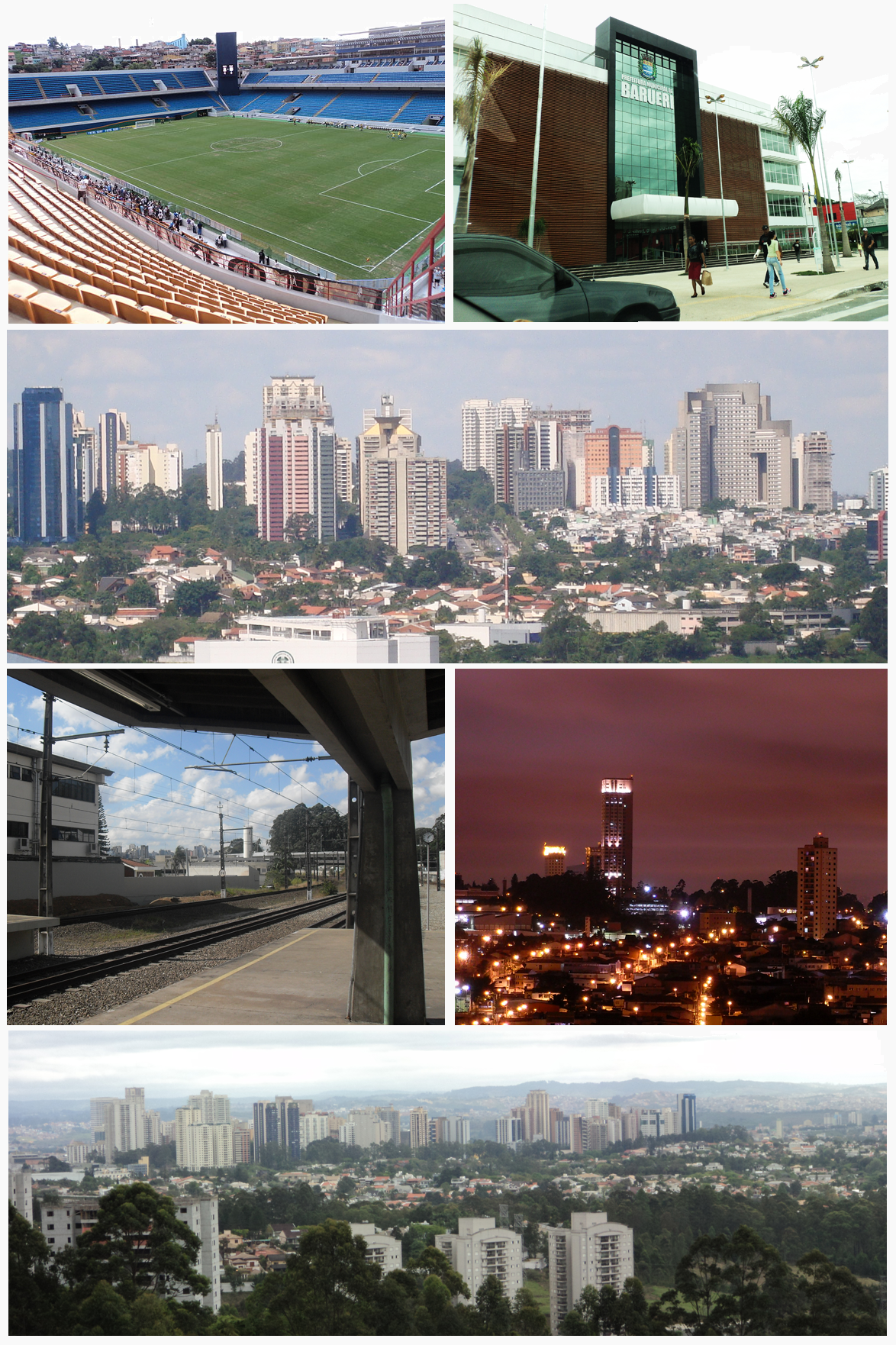
Barueri (Portuguese pronunciation: [bɐˌɾu.eˈɾi] or [baɾweˈɾi]) is a Brazilian municipality in the State of São Paulo located in the northwestern part of the Metropolitan Region of São Paulo.[2] The population is 276,982 (2020 est.) in an area of 65.70 km2 (25.37 sq mi).[3]

Key Information

Its boundaries are Santana de Parnaíba to the north, Osasco in the east, Carapicuíba in the Southeast, Jandira to the south and southwest, and Itapevi the west. The city is served by the trains of line 8 of the Companhia Paulista de Trens Metropolitanos (literally São Paulo Metropolitan Railway Company), (CPTM).

History

[edit]
Centro area of Barueri in 1920

Barueri means "Red flower that amazes" in a Tupi–Guarani language. According to historians, the history of Barueri dates back to November 11, 1560 with the establishment of Nossa Senhora Da Escada Chapel by jesuit missionary José de Anchieta and his further settlement. The hamlet grew to the point of the construction, in 1870 of the Sorocabana Railway that initiated its duties in 1875 turning Barueri into an important point of connection between São Paulo, Santana de Parnaíba and Pirapora do Bom Jesus.

Still belonging to the city of Santana de Parnaíba, Barueri was established as an independent city on December 24, 1948 due to its growth.[4]

Map of the state of São Paulo (1948).

In 1964, the city's territory shrank to two thirds of its original size when Carapicuíba emancipated from it.

Demographics

[edit]
Historical population of municipality
Year Population
195010,447
196031,562202.1%
197037,80819.8%
198075,33899.3%
1991130,79973.6%
2000208,28159.2%
2010240,74915.6%
2022316,47331.5%
[5][6][7]

Economy

[edit]

Companies like Azul Brazilian Airlines, Enel, Cielo, Redecard, DASA, Walmart Brasil and others have their headquarters in Barueri.[citation needed]

Media

[edit]

In telecommunications, the city was served by Companhia Telefônica Brasileira until 1973, when it began to be served by Telecomunicações de São Paulo.[8] In July 1998, this company was acquired by Telefónica, which adopted the Vivo brand in 2012.[9]

The company is currently an operator of cell phones, fixed lines, internet (fiber optics/4G) and television (satellite and cable).[9]

Sports

[edit]

The most notable football (soccer) club in the city is Grêmio Barueri, which plays at Arena Barueri, in 2009 played in the Brazilian top league. In February 2010 the team was moved to Presidente Prudente, a city that is located in western São Paulo (state). After moving to Presidente Prudente the team's new home stadium was Estádio Eduardo José Farah, which has a maximum capacity of 44,414 people.

Also in 2010, Campinas Futebol Clube, relocated to Barueri and became Sport Club Barueri.[citation needed] In 2017, Oeste FC also moved to Barueri.

In 2006, some 2006 FIBA World Championship for Women basketball matches were hosted at the city's Barueri Arena, which is an indoor sporting arena.

Notable people

[edit]

See also

[edit]

References

[edit]
[edit]
Revisions and contributorsEdit on WikipediaRead on Wikipedia
from Grokipedia

Barueri is a in the state of , , forming part of the metropolitan region approximately 25 kilometers northwest of the city center. As of the , it has a resident population of 316,473 across an area of 65.7 square kilometers, resulting in a high demographic density of 4,817 inhabitants per square kilometer.
Emancipated as an independent on March 26, 1949, Barueri experienced significant population and economic growth following industrialization in the mid-20th century, attracting migrants seeking employment opportunities. The local economy thrives on services and industry, contributing to a GDP per capita of 207,461 Brazilian reais in 2021—one of the highest among São Paulo's larger cities—and supporting a municipal of 0.786 as measured in 2010. Key features include the upscale of Alphaville, which hosts business centers and residential areas, and the Arena Barueri stadium, a venue for football matches and events.

Geography

Location and Boundaries


Barueri is situated in the western region of the metropolitan area within the state of , . The municipality lies approximately 26.5 kilometers from the Praça da Sé, the central reference point of city. Its geographical coordinates are 23°30'38" S and 46°52'34" W .
The total territorial area of Barueri measures 65.701 square kilometers. It forms part of the densely populated Região Metropolitana de , which encompasses 39 municipalities surrounding the state capital. Barueri's boundaries adjoin Santana de Parnaíba to the north, to the east, Carapicuíba to the south, and Jandira and Itapevi to the west. These limits reflect its position amid interconnected urban centers in the metropolitan northwest, facilitating economic and infrastructural ties with neighboring areas.

Topography and Environment

Barueri exhibits an undulating topography characterized by slopes and elevated hilltops, typical of the Plateau region, with an average of 740 meters above . The terrain ranges from 713 to 1074 meters in localized areas, reflecting gentle variations suited to urban development but prone to in undeveloped slopes. The municipality's integrates into the Alto Tietê River Basin, featuring several rivers and streams that drain toward the , which borders parts of Barueri and supports ecological restoration efforts. The climate is humid subtropical, with an annual average temperature of 18°C, moderate rainfall distribution, and no pronounced , influencing local water availability and vegetation patterns. Native vegetation consists primarily of remnants, covering 18.6% of Barueri's 65.7 km² area (approximately 1,189 hectares) as of 2020, amid extensive urbanization that has reduced original forest cover. Environmental management includes protected green spaces like the Tietê Ecological Park, which preserves riparian habitats along the riverbanks and promotes conservation through municipal initiatives such as wildlife rehabilitation at CETAS Barueri. Despite these efforts, proximity to the metropolitan area exposes the region to pressures from and .

History

Pre-Colonial and Colonial Origins

The territory of present-day Barueri, located on the São Paulo Plateau, was inhabited by indigenous peoples belonging to the Tupi linguistic family, including groups such as the Guaianazes and Guaicurus, who established villages along rivers like the Tietê for subsistence based on hunting, fishing, and shifting cultivation prior to European contact in the 16th century. The region's name originates from the Tupi-Guarani term mbaruery, denoting a river characterized by rapids or waterfalls, reflecting the local hydrology of the Tietê River and its tributaries. Colonial settlement began amid Jesuit efforts to evangelize and concentrate indigenous populations in the Captaincy of São Vicente, countering the dispersive effects of Portuguese bandeirante expeditions. In 1557, Jerônimo Leitão donated the Fazenda Baruery to the , facilitating the establishment of a mission; on November 11, 1560, Father José de Anchieta founded the aldeamento de Barueri on the right bank of the near its confluence with the Rio Barueri Mirim, erecting the Capela de Nossa Senhora da Escada as a focal point for . This aldeamento rapidly expanded into one of the largest indigenous settlements in the region, aggregating populations from multiple local tribes under Jesuit administration to provide labor and resist enslavement raids, though it faced ongoing conflicts with settlers seeking land and resources. By 1656, a sesmaria grant formalized land possession for the aldeamento's indigenous residents, amid disputes that highlighted tensions between missionary protections and colonial expansionist pressures. The settlement evolved into a povoado and was elevated to status by , marking its integration into the administrative framework.

Industrialization and 20th-Century Growth

Barueri's economic transformation in the 20th century was closely linked to its position within the Greater São Paulo metropolitan region, where Brazil's industrialization accelerated following World War II. The municipality's railway station, established along the Estrada de Ferro Sorocabana line inaugurated in sections from 1875, served as a vital cargo hub connecting São Paulo to surrounding areas, facilitating agricultural exports and initial trade that laid groundwork for later industrial activity. Emancipation as a municipality in 1948, via Law No. 233 signed by Governor Adhemar de Barros, enabled localized governance and policies conducive to development, coinciding with broader regional shifts from agrarian to manufacturing economies. Mid-century urbanization in Barueri mirrored São Paulo's explosive industrial growth, driven by migration and expansion, transforming the area from rural settlements to burgeoning suburbs with emerging . The proximity to São Paulo's industrial core attracted early factories and workers, contributing to influx and economic diversification beyond . By the , improved connectivity via rail and emerging highways supported logistics and , though systematic industrial planning remained limited until later decades. The pivotal advancement occurred in 1973, when the Municipal Chamber approved the Zoning Law, designating areas for industrial use in regions such as Alphaville, Tamboré, and Jardim Califórnia, which spurred the establishment of , , and firms. This policy directly catalyzed industrial parks, job creation, and sustained economic momentum, positioning Barueri as a key node in the industrial axis alongside neighbors like . Throughout the century, these developments shifted the local economy toward industry and services, with intense growth along the railway corridor fostering a robust base by century's end.

Post-1980s Urban and Economic Expansion

Following Brazil's economic stabilization in the mid-1990s, Barueri experienced accelerated urban expansion, driven by its proximity to and the development of master-planned communities like Alphaville, which began in 1973 but saw significant growth in residential, commercial, and industrial zones after 1980. This period marked a shift from agricultural roots to a service- and technology-oriented economy, with the municipality attracting multinational corporations and startups to areas such as Alphaville and Tamboré, fostering decentralized business hubs away from 's congested core. Population growth reflected this , rising from 75,338 residents in the 1980 to 130,799 by 1991, a 73.6% increase, as migration from rural areas and suburbs fueled residential expansion. By 2010, the recorded 240,749 inhabitants, and the 2022 reported 316,473, representing a 31.45% decadal gain from 2010, with density reaching 4,816.87 inhabitants per km² amid controlled suburban sprawl balanced by green zones. This demographic surge correlated with infrastructure investments, including improved roadways and utilities, enabling the absorption of a floating estimated at 170,000 daily commuters by the . Economically, Barueri's per capita climbed to R$207,460.98 by 2021, ranking 8th among São Paulo municipalities and reflecting a pivot to high-value sectors like , , and , with over 30,000 registered companies—exceeding the resident in economic activity. The establishment of business parks in Alphaville drew firms seeking lower taxes and modern facilities, contributing to low and positioning Barueri as Brazil's top municipality for in national rankings by 2019. emphasized , with maps integrating commercial expansion and environmental preservation, averting haphazard growth seen in neighboring areas. Key drivers included fiscal policies attracting relocations and the Plano Diretor's focus on vectored growth, which by the 2000s integrated residential high-rises with corporate campuses, boosting municipal revenue and service sector dominance over traditional . This expansion, while elevating to levels rivaling Latin American leaders, also prompted mobility plans to manage traffic from the influx of 170,000 daily workers.

Government and Administration

Municipal Governance

Barueri operates under Brazil's , with executive power vested in an elected (prefeito) serving a four-year term, renewable once consecutively, and assisted by a vice-mayor (vice-prefeita). The holds authority over policy implementation, budget execution, and administrative appointments, subject to oversight by the legislative branch and . The legislative branch is the unicameral Câmara Municipal de Barueri, comprising 21 vereadores (city councilors) elected by proportional representation every four years to approve laws, budgets, and fiscal oversight of the executive. The council elects its president biennially to manage internal proceedings and represent the body. As of January 2025, Wilson Zuffa of the Republicanos party serves as president for the 2025–2026 term, following an internal election on January 8, 2025. In the 2024 municipal elections, José Roberto Piteri, known as Beto Piteri of the Republicanos party, was elected mayor on October 27, 2024, securing 56.48% of valid votes in the second round against challenger Pablo Marçal's supported candidate; he assumed office on January 1, 2025, with Cláudia Aparecida Afonso Marques of the PSB as vice-mayor. The council election on October 6, 2024, resulted in 21 members, with Ornedo Neves of Republicanos receiving the highest votes, and a one-third renewal featuring seven new councilors for the 2025–2028 legislature. Piteri's mandate followed legal challenges, including a temporary cassation by the TRE-SP in April 2025 for alleged misuse of media, which was overturned in August 2025 after appeals.

Fiscal and Policy Achievements

Barueri has achieved exemplary fiscal management, earning the maximum A+ rating from Brazil's National Treasury (Tesouro Nacional) in both fiscal and the quality of and fiscal information disclosures as of September 2025, which enhances municipal autonomy in resource allocation and borrowing capacity. This recognition stems from consistent compliance with federal fiscal responsibility laws, including timely reporting via the SICONFI system and maintenance of balanced budgets without reliance on extraordinary credits. In the 2025 Ranking of Municipal Competitiveness by the Centro de Liderança Pública (CLP), Barueri ranked 7th nationally in fiscal sustainability, reflecting low debt levels relative to revenue and high investment rates exceeding 20% of net current revenue. Municipal tax collection performance underscores these strengths, with Barueri securing 3rd place among São Paulo state municipalities and 10th nationally in per capita revenue from own-source taxes as of November 2024, driven by ISS (service tax) and IPTU (property tax) yields surpassing R$ 1 billion annually. This revenue growth, averaging 15% year-over-year from 2020 to 2024, results from expanded tax base via business influx rather than rate hikes, maintaining competitive rates such as a 2% ISS alíquota—among the lowest in the metropolitan region—to incentivize service sector expansion. Policy initiatives emphasize investment attraction through targeted fiscal incentives and regulatory streamlining, including exemptions or reductions in ISS for high-value projects and simplified licensing processes that reduced approval times from months to weeks since 2021. These measures have correlated with over 500 new relocations between 2018 and 2025, bolstering GDP to approximately R$ 120,000—triple the national average—and positioning Barueri 6th in the CLP's pillar for 2025. Such policies prioritize causal links between low fiscal burdens and private sector dynamism, avoiding debt-financed spending and instead leveraging revenue multipliers from induced economic activity.

Demographics

Population Dynamics

The population of Barueri has undergone rapid expansion since the mid-20th century, transitioning from a modest rural-urban mix to a densely populated suburban hub within the metropolitan region. This growth accelerated with post-1970s industrialization and the development of upscale residential enclaves like Alphaville, drawing internal migrants seeking economic prospects in industry and services. In 1970, the municipality recorded approximately 37,000 residents, with over 97% already urbanized. Census data from the Instituto Brasileiro de Geografia e Estatística (IBGE) illustrate this trajectory: the 2010 census tallied 240,749 inhabitants, surging to 316,473 by the 2022 census—a 31.45% decadal increase, or roughly 2.2% annually. This pace outstripped many neighboring municipalities, positioning Barueri as the 23rd most populous in São Paulo state. The resulting density reached 4,816.87 inhabitants per square kilometer in 2022, reflecting constrained land use amid vertical urban expansion. Key drivers include elevated natural increase, at 13.1 births per 1,000 residents—one of the highest in São Paulo state—and net positive migration fueled by employment in the service and tech sectors. Regional analyses indicate inflows primarily from other Brazilian states, alongside intraregional commuting; Barueri sustains a floating population of about 170,000 daily workers, who reside elsewhere but contribute to effective daytime demographics exceeding 480,000. These patterns underscore Barueri's role as a commuter destination, with pendular migration rates higher than adjacent areas like Osasco.
Census YearPopulationDecadal Growth (%)
2010240,749-
2022316,47331.45
Projections suggest continued moderate growth, with IBGE estimates nearing 330,000 by 2024, though constrained by infrastructure limits and regional sprawl.

Socioeconomic Composition

Barueri displays a socioeconomic profile characterized by above-average prosperity within , driven by its role as a hub for and industry in the metropolitan area. The municipality's GDP reached R$207,460.98 in 2021, substantially higher than the national figure of approximately R$45,000 for the same period, reflecting concentration of high-value economic activities among residents and commuters. This affluence supports a composition skewed toward middle- and upper-income households, with limited data indicating persistent but relatively low extreme deprivation compared to broader Brazilian norms. Educational attainment contributes to this profile, with a schooling rate of 98.81% for children aged 6-14 years in 2022, signaling effective access to and low dropout risks. The Municipal (IDHM), which integrates income, , and dimensions, was 0.786 in 2010—categorized as high development—though updated aggregates remain unavailable; components historically emphasize strong enrollment and progression rates. Adult literacy and higher education participation likely align with this, fostering a oriented toward skilled services rather than manual labor. Income distribution reveals underlying inequality typical of Brazilian urban peripheries, with 34.5% of the population reporting monthly earnings at or below half the (approximately R$330 in 2010 terms) as of the 2010 ; more recent details on brackets post-2022 remain pending full release, but overall incidence appears moderated by local growth, estimated below state averages of 17.5% in 2022. No municipal is published, but the disparity between GDP and lower-end income shares underscores a bimodal structure: a professional elite in and tech contrasting with service-sector dependents, without evidence of widespread destitution.

Economy

Industrial and Service Sectors

Barueri's economy features a robust service sector alongside light industry, contributing to its status as one of the wealthiest municipalities in São Paulo state, with a GDP per capita of R$207,460.98 in 2021. The services sector has historically driven economic expansion, increasing the city's share of Brazil's national GDP between 2002 and 2005 through growth in commerce, finance, and professional activities. Key service industries include information technology, financial services, and logistics, supported by business parks such as Alphaville Technology Park, which hosts multinational firms like IBM, Hewlett-Packard, and Bradesco Bank. The Tamboré Business Park further bolsters the service economy with facilities like SP4, Latin America's primary , and Scala Data Centers, catering to technology and data processing needs. In (SaaS), Barueri-based companies reported combined revenues of $105.9 million and employed 401 workers as of 2025. services thrive in areas like the Barueri Logistic Park, a 1.1 million cross-docking facility pre-leased to major operators, reflecting demand for distribution and operations. Industrial activities focus on specialized rather than heavy production, exemplified by Ecolab's facility producing cleaning and disinfection chemicals for industrial use. Employment growth in services and technology has been evident, with initiatives like job fairs offering over 600 vacancies in 2025 from employers including Mercado Livre, emphasizing roles in , operations, and IT. The municipality's Secretariat of Industry, Commerce, and Labor facilitates these sectors through fiscal services, business registration, and workforce matching programs.

Recent Developments and Growth Drivers

In September 2025, Barueri secured the 9th position in Brazil's Ranking de Competitividade dos Municípios, surpassing larger cities and highlighting its economic dynamism, with top rankings in per capita GDP (9th) at R$207,500 and formal worker average income (8th). The municipality, with a population of 330,339, recorded over 270,000 formal job creations between and according to Novo Caged data, driven by expansions in services and . In October 2024, it ranked 1st in economic performance within the Connected Smart Cities index, reflecting an 11.4% GDP growth and a 21% increase in formal worker income. The services sector dominates Barueri's economy, accounting for 81.9% of its GDP, followed by industry at 13%, with recent sectoral growth fueled by and hubs attracting multinationals and startups. Key drivers include competitive regimes, advanced investments, and public-private partnerships that enhance appeal, positioning Barueri as a regional pole despite its modest size. Franchise networks expanded by 20.85% in Barueri from the first half of 2023 to 2024, generating over R$730 million in revenue, underscoring commerce's role in sustained expansion.

Infrastructure

Transportation Networks

Barueri benefits from its strategic location in the western metropolitan region of São Paulo, providing access to key regional highways that facilitate freight and commuter traffic. The primary artery is Rodovia Presidente Castelo Branco (SP-280), a tolled highway opened on November 10, 1968, which traverses the municipality and connects it directly to downtown São Paulo approximately 25 kilometers away, while extending westward toward the interior of São Paulo state. This route handles high volumes of traffic due to its proximity to industrial and commercial hubs, with ongoing expansions including new interchanges in the Alphaville-Barueri area to alleviate congestion. Complementing this, Rodovia Anhanguera (SP-330) offers additional connectivity southward, supporting logistics for Barueri's AlphaVille business district and nearby manufacturing zones. Rail infrastructure centers on Estação Barueri, part of CPTM Line 8-Diamante operated by ViaMobilidade, which spans 41.6 kilometers from Estação Júlio Prestes in central São Paulo to Estação Amador Bueno in Itapevi, serving 22 stations including Barueri in the city center. The line transports thousands of daily commuters, with trains running at intervals of 5-15 minutes during peak hours, and underwent reforms starting in March 2024 to add a new access tunnel on Rua Anguera and platform upgrades, temporarily closing one platform for 90 days to enhance and capacity. This rail link integrates with São Paulo's broader metropolitan network, enabling transfers to metro lines for further citywide mobility. Public bus services are managed primarily through the EMTU (Empresa Metropolitana de Transportes Urbanos), operating intermunicipal routes such as Line 134 from Barueri (Parque Viana) to Osasco (Centro) and Line 360 within Barueri to Alphaville, with fares ranging from R$6.15 to R$7.35 as of 2024 and real-time tracking available. In June 2024, 17 new air-conditioned buses with automatic transmissions were deployed on lines serving Barueri and Osasco, benefiting around 15,000 daily passengers by reducing emissions and improving comfort. Local intracity buses complement these, integrated under Barueri's 2022 Plano Municipal de Mobilidade Urbana, which diagnoses transport demands and prioritizes sustainable expansions like bus priority lanes amid growing vehicular reliance—over 70% of trips in the plan's survey were by private car. Access to major airports, including Congonhas (about 30 km east) and Guarulhos International (55 km northeast), relies on these highways, with no dedicated local rail or shuttle services.

Utilities and Urban Services

Barueri's is managed by the Companhia de Saneamento Básico do Estado de (Sabesp), providing 100% coverage to the municipality's population of approximately 316,473 residents as of 2022 data from the Sistema Nacional de Informações sobre Saneamento (SNIS). In March 2025, Sabesp launched structural works investing over R$630 million to expand water provision and related infrastructure, targeting enhanced reliability amid metropolitan 's demands. Sewage collection and treatment, also under Sabesp's concession, reach 94.93% of the for collection, though only 40.39% of generated receives treatment per SNIS 2022 figures; Sabesp's ongoing modernization of the Estação de Tratamento de Esgoto (ETE) Barueri, including facility upgrades completed in phases through 2025, supports progressive improvements toward 95% treatment coverage by 2027. Electricity distribution serves Barueri via Distribuição São Paulo, which covers 24 municipalities in the , including the city, ensuring grid access for residential, commercial, and industrial users. Solid waste management achieves 100% domiciliary collection coverage through a municipally contracted private firm, with vehicles and workers identifiable by official markings; comprises just 2.69% of collected volume, but the URE Barueri facility, commissioned in 2024 by Orizon, diverts 300,000 tonnes annually from landfills via thermal valorization. Urban services, coordinated by the Secretaria de Serviços Municipais, encompass street cleaning, "cata-cacarecos" bulk pickup operations, and public lighting maintenance, the latter earning a maximum satisfaction score of 800 points in a February 2023 survey, classifying it as "Grau de Excelência" among municipal sectors. Routine interventions include lamp replacements and fixture repairs to sustain visibility and safety across public spaces.

Culture and Education

Educational Institutions

Barueri's educational system comprises municipal, state, and private institutions serving primary through higher education, with the municipal network emphasizing quality and expansion. In 2024, the public sector included 134 schools enrolling 63,127 students supported by 3,157 teachers, drawing from official census data. The municipality's public education achieved top national standing in the Desenvolvimento pela Gestão Municipal index, attaining an IDEB score of 6.4 for early fundamental years in 2023, surpassing state and national averages. This performance stems from investments in infrastructure, teacher training, and programs like the Alfabetiza Juntos initiative with São Paulo state. Municipal schools, designated as EMEFs for fundamental education, number over 100 and cover through basic levels, with enrollment exceeding 70,000 students network-wide by early 2025. State schools, such as Escola Estadual Alayde Domingues Couto Macedo and Aldeia de Barueri, complement this by providing under state oversight. Recent expansions include full-time integral education in seven fundamental schools slated for 2026 implementation, aiming to extend instructional hours and enhance outcomes in core subjects. Higher education features public and private options, including the Faculdade de Tecnologia de Barueri (Fatec Barueri), a state institution under the Centro Paula Souza offering technical degrees in fields like , , and environmental control since its establishment. Private providers include the Universidade Presbiteriana Mackenzie's Alphaville campus, delivering undergraduate programs in , , and alongside postgraduate studies. Additional poles from Universidade Paulista (UNIP) and Universidade Anhanguera support distance and in-person courses in administration and related disciplines. Private K-12 institutions, such as Escola Internacional de Alphaville, provide bilingual curricula incorporating the for ages 1-18, catering to expatriate and local families seeking global standards.

Cultural and Social Life

The Secretariat of Culture and Tourism in Barueri organizes a range of public events focused on theater, , , and , utilizing municipal spaces to engage residents. These initiatives emphasize accessibility, with programming designed to involve the local population directly in cultural production. Key annual festivals and awards include the Festival de (FEMUPO), held in early October and featuring Brazilian music performances; the Festival Barueri de ; the Festival de Teatro; the Prêmio Barueri de ; and the Prêmio Barueri de Literatura, which recognize local artistic talent across disciplines. Complementing these, the Programa Educação pela Arte provides free workshops in , circus, , and , fostering development among participants of various ages. The monthly Guia Cultural de Barueri lists ongoing events, promoting family-oriented activities that blend cultural expression with interaction. Social life in Barueri revolves around inclusive public gatherings, such as park-based festivals combining , sports, and , exemplified by the Festival + Saúde Barueri, which encourages healthier lifestyles through experiential activities on specific dates like December 1. These events underscore a municipal emphasis on well-being and cultural participation over individualized pursuits.

Sports

Major Teams and Events

Oeste Futebol Clube, established in Barueri in 1921, is the city's primary professional football club, having achieved promotion to Série B in 2012 after winning the that year with a 1-0 victory over Chapecoense in the final. The club plays home matches at Arena Barueri, a 32,500-capacity stadium, and currently competes in the and , with recent participation including a 2024 Copa Paulista campaign that advanced to knockout stages. Grêmio Barueri Futebol Ltda., founded on March 26, 1989, represents the municipality in lower-tier national competitions such as Série D, utilizing Arena Barueri as its home venue since inception. The , nicknamed the "Abelha" (), focuses on regional Paulista leagues alongside national play, maintaining a squad averaging under 25 years old in recent seasons. In , Barueri Volleyball Club (also known as Paulistano/Barueri or Hinode Barueri) fields a competitive women's in the Superliga Brasileira de Voleibol Feminino, founded in and recognized for developing talent, including a notable 2021 upset victory over SESC RJ Flamengo by scores of 3-2 in the league phase. The club operates from local facilities like Ginásio José Correa and emphasizes youth formation, contributing over 20 players to national teams historically. Key annual events include the Corrida São Silveira, a road race held since 1985 that attracts over 5,000 participants, including elite national and international runners, over a 10 km course starting from the municipal stadium, positioning it among state's premier pedestrian competitions. Arena Barueri has hosted significant fixtures beyond local teams, such as the 2016 Sevens rugby tournament where defended its title across 34 matches, and ongoing women's Paulista league games for clubs like Palmeiras and Santos. The Ginásio José Correa stages events like the 2025 Festival das Estrelas celebrity football match on May 10, broadcast nationally, alongside the Campeonato Sul-Americano de Jiu-Jitsu IBJJF in early 2025, drawing competitors from across .

Facilities and Achievements

Arena Barueri, officially known as Estádio Municipal Prefeito José Furlan, serves as the primary sports facility in Barueri, primarily for football matches. Constructed between June 2006 and May 2007, the has a maximum capacity of 31,452 spectators and features modern infrastructure including 36 skyboxes accommodating 420 people and 37 media cabins. Owned by the municipal , it has hosted games for prominent clubs such as Sociedade Esportiva Palmeiras during renovations of their home stadium, as well as matches involving , Corinthians, Santos, and . The Ginásio Poliesportivo José Corrêa is another key venue, designed for indoor sports like , , and , with a of approximately 5,000. This facility supports community and competitive events, contributing to Barueri's broader sports infrastructure. Between 2018 and 2021, the city expanded its sports facilities significantly, increasing from 5.53 per 100,000 inhabitants to 33.61 per 100,000, reflecting investments in public access to athletic amenities. Achievements tied to these facilities include Arena Barueri's role in regional football, where it has hosted state-level competitions and served as a temporary home for elite teams, enhancing Barueri's profile in Brazilian sports. Local club Grêmio Barueri Futebol Ltda., established in 1989 and professionalized in 2001, has utilized the stadium to compete in national lower divisions, achieving promotions such as entry into Série B of the Campeonato Brasileiro in the mid-2000s before facing relegations. The arena is scheduled to host the 2025 edition of The Women's Cup, an international women's football tournament, underscoring its growing international relevance.

Media

Local Media Landscape

The local media landscape in Barueri features a mix of independent digital news portals, weekly print editions, stations, and limited local television outlets, primarily serving the municipality's residents with coverage of municipal , in the Alphaville district, public safety, and cultural events. These outlets often emphasize hyper-local reporting, supplemented by regional coverage from nearby metropolitan sources, though independent verification of claims in smaller portals can vary due to resource constraints typical of . Key digital and print publications include the Jornal de Barueri, established as a for daily on , , and local , with a focus on verifiable events like and city council decisions. Similarly, Gazeta Barueri delivers updates on , , and , including specific reports on opportunities and initiatives as of 2025. Complementary regional sites such as Folha de Alphaville extend coverage to Barueri, addressing issues like utility services and environmental concerns in the affluent Alphaville area, while Diario Barueri highlights projects, such as facilities. These platforms rely on from local businesses and lack the editorial oversight of national media, potentially introducing variability in sourcing depth. Radio broadcasting is anchored by community-oriented stations like Rádio Alphaville 87.7 FM, which airs segments, music, and talk shows tailored to Barueri's demographics, including updates and event promotions. Other outlets, such as Regional FM on the same frequency, provide similar eclectic programming with a emphasis on regional connectivity. These stations, often web-streamed, fill gaps in real-time information but may prioritize listener-driven content over . Television options are sparse and community-focused, with Alpha Channel TV (TV Alphaville) operating on local cable channel 22 and channel 32, producing content on entertainment, retail, and journalism relevant to Barueri and Alphaville. TV Barueri Live streams events like holiday festivals and interviews with local figures, such as health officials, via online platforms. Broader access to national networks via over-the-air or cable dominates, but these local channels offer niche visibility for municipal announcements without the scale of São Paulo-based broadcasters. Overall, Barueri's media reflects its status as a suburban hub, with digital shift reducing print dominance but sustaining community engagement amid limited funding for in-depth reporting.

Notable Residents

Key Figures and Contributions

Gil Arantes, born in Barueri on March 12, 1952, served as for three terms, including a reelection in 2000 with 90.4% of the vote, and as a state deputy for two terms, contributing to local and sports development during his tenure starting from his entry into public service in 1985 as sports director. Rubens Furlan, of Barueri since 2005 with reelections including 85.19% in 2020, oversaw programs like "Barueri, Smart and Sustainable City" launched in 2021, aligning municipal policies with global sustainability goals and supporting the city's high GDP per capita among São Paulo municipalities. Bilquis Evely, raised in Barueri, emerged as a prominent artist, becoming the first Brazilian woman to win the Eisner Award for best penciller/inker at the 2025 for her work on titles like and . Bruno Caboclo, who began his career with Grêmio Recreativo Barueri as a youth, developed into a professional player representing internationally, including in the AmeriCup, after training in Barueri facilities from age 16.

References

  1. https://en.wikivoyage.org/wiki/Barueri
Add your contribution
Related Hubs
User Avatar
No comments yet.