



Community hub
Recent from talks
Contribute something
Nothing was collected or created yet.
Bayes factor
View on Wikipedia| Part of a series on |
| Bayesian statistics |
|---|
 |
| Posterior = Likelihood × Prior ÷ Evidence |
| Background |
| Model building |
| Posterior approximation |
| Estimators |
| Evidence approximation |
| Model evaluation |

The Bayes factor is a ratio of two competing statistical models represented by their evidence, and is used to quantify the support for one model over the other.[1] The models in question can have a common set of parameters, such as a null hypothesis and an alternative, but this is not necessary; for instance, it could also be a non-linear model compared to its linear approximation. The Bayes factor can be thought of as a Bayesian analog to the likelihood-ratio test, although it uses the integrated (i.e., marginal) likelihood rather than the maximized likelihood. As such, both quantities only coincide under simple hypotheses (e.g., two specific parameter values).[2] Also, in contrast with null hypothesis significance testing, Bayes factors support evaluation of evidence in favor of a null hypothesis, rather than only allowing the null to be rejected or not rejected.[3]
Although conceptually simple, the computation of the Bayes factor can be challenging depending on the complexity of the model and the hypotheses.[4] Since closed-form expressions of the marginal likelihood are generally not available, numerical approximations based on MCMC samples have been suggested.[5] For certain special cases, simplified algebraic expressions can be derived; for instance, the Savage–Dickey density ratio in the case of a precise (equality constrained) hypothesis against an unrestricted alternative.[6][7] Another approximation, derived by applying Laplace's approximation to the integrated likelihoods, is known as the Bayesian information criterion (BIC);[8] in large data sets the Bayes factor will approach the BIC as the influence of the priors wanes. In small data sets, priors generally matter and must not be improper since the Bayes factor will be undefined if either of the two integrals in its ratio is not finite.
Definition
[edit]The Bayes factor is the ratio of two marginal likelihoods; that is, the likelihoods of two statistical models integrated over the prior probabilities of their parameters.[9]
The posterior probability of a model M given data D is given by Bayes' theorem:

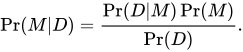
The key data-dependent term represents the probability that some data are produced under the assumption of the model M; evaluating it correctly is the key to Bayesian model comparison.

Given a model selection problem in which one wishes to choose between two models on the basis of observed data D, the plausibility of the two different models M1 and M2, parametrised by model parameter vectors and , is assessed by the Bayes factor K given by



When the two models have equal prior probability, so that , the Bayes factor is equal to the ratio of the posterior probabilities of M1 and M2. If instead of the Bayes factor integral, the likelihood corresponding to the maximum likelihood estimate of the parameter for each statistical model is used, then the test becomes a classical likelihood-ratio test. Unlike a likelihood-ratio test, this Bayesian model comparison does not depend on any single set of parameters, as it integrates over all parameters in each model (with respect to the respective priors). An advantage of the use of Bayes factors is that it automatically, and quite naturally, includes a penalty for including too much model structure.[10] It thus guards against overfitting. For models where an explicit version of the likelihood is not available or too costly to evaluate numerically, approximate Bayesian computation can be used for model selection in a Bayesian framework,[11] with the caveat that approximate-Bayesian estimates of Bayes factors are often biased.[12]

Other approaches are:
- to treat model comparison as a decision problem, computing the expected value or cost of each model choice;
- to use minimum message length (MML).
- to use minimum description length (MDL).
Interpretation
[edit]A value of K > 1 means that M1 is more strongly supported by the data under consideration than M2. Note that classical hypothesis testing gives one hypothesis (or model) preferred status (the 'null hypothesis'), and only considers evidence against it. The fact that a Bayes factor can produce evidence for and not just against a null hypothesis is one of the key advantages of this analysis method.[13]
Harold Jeffreys gave a scale (Jeffreys' scale) for interpretation of :[14]

| K | dHart | bits | Strength of evidence |
|---|---|---|---|
| < 100 | < 0 | < 0 | Negative (supports M2) |
| 100 to 101/2 | 0 to 5 | 0 to 1.6 | Barely worth mentioning |
| 101/2 to 101 | 5 to 10 | 1.6 to 3.3 | Substantial |
| 101 to 103/2 | 10 to 15 | 3.3 to 5.0 | Strong |
| 103/2 to 102 | 15 to 20 | 5.0 to 6.6 | Very strong |
| > 102 | > 20 | > 6.6 | Decisive |
The second column gives the corresponding weights of evidence in decihartleys (also known as decibans); bits are added in the third column for clarity. The table continues in the other direction, so that, for example, is decisive evidence for .


An alternative table, widely cited, is provided by Kass and Raftery (1995):[10]
| log10 K | K | Strength of evidence |
|---|---|---|
| 0 to 1/2 | 1 to 3.2 | Not worth more than a bare mention |
| 1/2 to 1 | 3.2 to 10 | Substantial |
| 1 to 2 | 10 to 100 | Strong |
| > 2 | > 100 | Decisive |
According to I. J. Good, the just-noticeable difference of humans in their everyday life, when it comes to a change degree of belief in a hypothesis, is about a factor of 1.3x, or 1 deciban, or 1/3 of a bit, or from 1:1 to 5:4 in odds ratio.[15]
Example
[edit]Suppose we have a random variable that produces either a success or a failure. We want to compare a model where the probability of success is q = 1⁄2, and another model where q is unknown and we take a prior distribution for q that is uniform on [0,1]. We take a sample of 200, and find 115 successes and 85 failures. The likelihood can be calculated according to the binomial distribution:

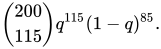
Thus we have for

whereas for we have

The ratio is then 1.2, which is "barely worth mentioning" even if it points very slightly towards .
A frequentist hypothesis test of (here considered as a null hypothesis) would have produced a very different result. Such a test says that should be rejected at the 5% significance level, since the probability of getting 115 or more successes from a sample of 200 if q = 1⁄2 is 0.02, and as a two-tailed test of getting a figure as extreme as or more extreme than 115 is 0.04. Note that 115 is more than two standard deviations away from 100. Thus, whereas a frequentist hypothesis test would yield significant results at the 5% significance level, the Bayes factor hardly considers this to be an extreme result. Note, however, that a non-uniform prior (for example one that reflects that you expect the number of success and failures to be of the same order of magnitude) could result in a Bayes factor that is more in agreement with the frequentist hypothesis test.
A classical likelihood-ratio test would have found the maximum likelihood estimate for q, namely , whence
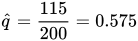

(rather than averaging over all possible q). That gives a likelihood ratio of 0.1 and points towards M2.
is a more complex model than because it has a free parameter which allows it to model the data more closely. The ability of Bayes factors to take this into account is a reason why Bayesian inference has been put forward as a theoretical justification for and generalisation of Occam's razor, reducing Type I errors.[16]
On the other hand, the modern method of relative likelihood takes into account the number of free parameters in the models, unlike the classical likelihood ratio. The relative likelihood method could be applied as follows. Model M1 has 0 parameters, and so its Akaike information criterion (AIC) value is . Model M2 has 1 parameter, and so its AIC value is . Hence M1 is about times as probable as M2 to minimize the information loss. Thus M2 is slightly preferred, but M1 cannot be excluded.



See also
[edit]- Akaike information criterion
- Approximate Bayesian computation
- Bayesian information criterion
- Deviance information criterion
- Lindley's paradox
- Minimum message length
- Model selection
- E-Value
- Statistical ratios
References
[edit]- ^ Morey, Richard D.; Romeijn, Jan-Willem; Rouder, Jeffrey N. (2016). "The philosophy of Bayes factors and the quantification of statistical evidence". Journal of Mathematical Psychology. 72: 6–18. doi:10.1016/j.jmp.2015.11.001.
- ^ Lesaffre, Emmanuel; Lawson, Andrew B. (2012). "Bayesian hypothesis testing". Bayesian Biostatistics. Somerset: John Wiley & Sons. pp. 72–78. doi:10.1002/9781119942412.ch3. ISBN 978-0-470-01823-1.
- ^ Ly, Alexander; et al. (2020). "The Bayesian Methodology of Sir Harold Jeffreys as a Practical Alternative to the P Value Hypothesis Test". Computational Brain & Behavior. 3 (2): 153–161. doi:10.1007/s42113-019-00070-x. hdl:2066/226717.
- ^ Llorente, Fernando; et al. (2023). "Marginal likelihood computation for model selection and hypothesis testing: an extensive review". SIAM Review. to appear: 3–58. arXiv:2005.08334. doi:10.1137/20M1310849. S2CID 210156537.
- ^ Congdon, Peter (2014). "Estimating model probabilities or marginal likelihoods in practice". Applied Bayesian Modelling (2nd ed.). Wiley. pp. 38–40. ISBN 978-1-119-95151-3. A widely used approach is the method proposed by Chib, Siddhartha (1995). "Marginal Likelihood from the Gibbs Output". Journal of the American Statistical Association. 90 (432): 1313–1321. doi:10.2307/2291521. This method was later extended to handle cases where Metropolis-Hastings samplers are used, Chib, Siddhartha; Jeliazkov, Ivan (2001). "Marginal Likelihood from the Metropolis–Hastings Output". Journal of the American Statistical Association. 96 (453): 270–281. doi:10.1198/016214501750332848.
- ^ Koop, Gary (2003). "Model Comparison: The Savage–Dickey Density Ratio". Bayesian Econometrics. Somerset: John Wiley & Sons. pp. 69–71. ISBN 0-470-84567-8.
- ^ Wagenmakers, Eric-Jan; Lodewyckx, Tom; Kuriyal, Himanshu; Grasman, Raoul (2010). "Bayesian hypothesis testing for psychologists: A tutorial on the Savage–Dickey method" (PDF). Cognitive Psychology. 60 (3): 158–189. doi:10.1016/j.cogpsych.2009.12.001. PMID 20064637. S2CID 206867662.
- ^ Ibrahim, Joseph G.; Chen, Ming-Hui; Sinha, Debajyoti (2001). "Model Comparison". Bayesian Survival Analysis. Springer Series in Statistics. New York: Springer. pp. 246–254. doi:10.1007/978-1-4757-3447-8_6. ISBN 0-387-95277-2.
- ^ Gill, Jeff (2002). "Bayesian Hypothesis Testing and the Bayes Factor". Bayesian Methods : A Social and Behavioral Sciences Approach. Chapman & Hall. pp. 199–237. ISBN 1-58488-288-3.
- ^ a b Robert E. Kass & Adrian E. Raftery (1995). "Bayes Factors" (PDF). Journal of the American Statistical Association. 90 (430): 791. doi:10.2307/2291091. JSTOR 2291091.
- ^ Toni, T.; Stumpf, M.P.H. (2009). "Simulation-based model selection for dynamical systems in systems and population biology". Bioinformatics. 26 (1): 104–10. arXiv:0911.1705. doi:10.1093/bioinformatics/btp619. PMC 2796821. PMID 19880371.
- ^ Robert, C.P.; J. Cornuet; J. Marin & N.S. Pillai (2011). "Lack of confidence in approximate Bayesian computation model choice". Proceedings of the National Academy of Sciences. 108 (37): 15112–15117. Bibcode:2011PNAS..10815112R. doi:10.1073/pnas.1102900108. PMC 3174657. PMID 21876135.
- ^ Williams, Matt; Bååth, Rasmus; Philipp, Michael (2017). "Using Bayes Factors to Test Hypotheses in Developmental Research". Research in Human Development. 14 (4): 321–337. doi:10.1080/15427609.2017.1370964.
- ^ Jeffreys, Harold (1998) [1961]. The Theory of Probability (3rd ed.). Oxford, England. p. 432. ISBN 9780191589676.
{{cite book}}: CS1 maint: location missing publisher (link) - ^ Good, I.J. (1979). "Studies in the History of Probability and Statistics. XXXVII A. M. Turing's statistical work in World War II". Biometrika. 66 (2): 393–396. doi:10.1093/biomet/66.2.393. MR 0548210.
- ^ Sharpening Ockham's Razor On a Bayesian Strop
Further reading
[edit]- Bernardo, J.; Smith, A. F. M. (1994). Bayesian Theory. John Wiley. ISBN 0-471-92416-4.
- Denison, D. G. T.; Holmes, C. C.; Mallick, B. K.; Smith, A. F. M. (2002). Bayesian Methods for Nonlinear Classification and Regression. John Wiley. ISBN 0-471-49036-9.
- Dienes, Z. (2019). How do I know what my theory predicts? Advances in Methods and Practices in Psychological Science doi:10.1177/2515245919876960
- Duda, Richard O.; Hart, Peter E.; Stork, David G. (2000). "Section 9.6.5". Pattern classification (2nd ed.). Wiley. pp. 487–489. ISBN 0-471-05669-3.
- Gelman, A.; Carlin, J.; Stern, H.; Rubin, D. (1995). Bayesian Data Analysis. London: Chapman & Hall. ISBN 0-412-03991-5.
- Jaynes, E. T. (1994), Probability Theory: the logic of science Archived 2018-10-24 at the Wayback Machine, chapter 24.
- Kadane, Joseph B.; Dickey, James M. (1980). "Bayesian Decision Theory and the Simplification of Models". In Kmenta, Jan; Ramsey, James B. (eds.). Evaluation of Econometric Models. New York: Academic Press. pp. 245–268. ISBN 0-12-416550-8.
- Lee, P. M. (2012). Bayesian Statistics: an introduction. Wiley. ISBN 9781118332573.
- Richard, Mark; Vecer, Jan (2021). "Efficiency Testing of Prediction Markets: Martingale Approach, Likelihood Ratio and Bayes Factor Analysis". Risks. 9 (2): 31. doi:10.3390/risks9020031. hdl:10419/258120.
- Winkler, Robert (2003). Introduction to Bayesian Inference and Decision (2nd ed.). Probabilistic. ISBN 0-9647938-4-9.
External links
[edit]- BayesFactor —an R package for computing Bayes factors in common research designs
- Bayes factor calculator — Online calculator for informed Bayes factors
- Bayes Factor Calculators Archived 2015-05-07 at the Wayback Machine —web-based version of much of the BayesFactor package
Bayes factor
View on GrokipediaMathematical Foundations
Definition
The Bayes factor is a statistical measure used in Bayesian inference to quantify the relative evidence provided by observed data for one model over another competing model. It was introduced by Harold Jeffreys as a tool for objective hypothesis testing within a Bayesian framework.[2] Mathematically, the Bayes factor in favor of model over model given data , denoted , is defined as the ratio of the marginal likelihoods under each model: The marginal likelihood for a model with parameters is obtained by integrating the likelihood over the prior distribution of the parameters: This integration averages the model's predictive performance across all plausible parameter values weighted by the prior, providing a summary of the model's overall fit to the data independent of specific parameter estimates.[2] A common notation convention is , which reverses the comparison to favor (often the null model) over . The Bayes factor plays a central role in Bayesian model comparison by directly comparing the predictive adequacy of competing models based on the observed data, facilitating decisions about model selection without relying on point estimates or frequentist criteria.[2]Relationship to Bayes' Theorem
The Bayes factor emerges directly from Bayes' theorem as a key component in updating the probabilities of competing models based on observed data. Bayes' theorem states that the posterior probability of a model given data is , where is the marginal likelihood under the model and is the prior probability. For two models and , the ratio of posterior model probabilities, known as the posterior odds, is therefore with the second factor on the right-hand side defining the Bayes factor .[2] This formulation demonstrates that the Bayes factor serves as a multiplier that adjusts the prior odds to yield the posterior odds, encapsulating how the data shifts belief between models.[2] By isolating , the Bayes factor measures the relative support for each model provided solely by the data, disentangling this evidential contribution from subjective prior beliefs about the models' plausibility.[2] This separation allows the Bayes factor to function as an objective summary of the data's evidential value within the Bayesian updating process, applicable across diverse modeling contexts.[2] The derivation of the Bayes factor highlights a fundamental distinction in handling point-null hypotheses versus composite models. Under a point-null hypothesis, such as , the marginal likelihood simplifies to the likelihood evaluated directly at the fixed parameter value, as there is no parameter uncertainty to integrate over.[2] In contrast, for a composite model with parameters varying over a continuous space, requires integrating the likelihood over a prior distribution on the parameters to average out uncertainty, as previously outlined in the definition of marginal likelihood.[2] This difference affects the computational form of the Bayes factor but preserves its role in the posterior odds equation.[2] Harold Jeffreys pioneered the application of the Bayes factor within this framework of Bayes' theorem in his 1939 monograph Theory of Probability (first edition).[3][2]Interpretation
Evidence Scales
The interpretation of the Bayes factor (BF) relies on standardized scales that categorize its magnitude into qualitative levels of evidence for one model (say, the alternative ) over another (say, the null ). These scales provide a heuristic framework for assessing evidential strength, though they are not universally fixed.[4] A seminal scale was proposed by Harold Jeffreys, which divides BF values into grades based on orders of magnitude, emphasizing decisive evidence for large values. Jeffreys' scale, as commonly referenced, is as follows:| BF | Evidence against |
|---|---|
| > 100 | Decisive |
| 30–100 | Very strong |
| 10–30 | Strong |
| 3–10 | Substantial |
| 1–3 | Barely worth mentioning |
| BF | 2 ln(BF) | Evidence against |
|---|---|---|
| > 150 | > 10 | Very strong |
| 20–150 | 6–10 | Strong |
| 3–20 | 2–6 | Positive |
| 1–3 | 0–2 | Barely worth mentioning |