


Community hub
Recent from talks
Contribute something
Nothing was collected or created yet.
Bebra
View on WikipediaBebra (German pronunciation: [ˈbeːbʁa] ⓘ) is a small town in Hersfeld-Rotenburg district in northeastern Hesse, Germany.
Key Information


Geography
[edit]Location
[edit]Bebra lies some 45 km (28 mi) south of Kassel on the Fulda. The town is easy to find on most maps thanks to its prominent location on the Fuldaknie ("Fulda Knee"). Ranges surrounding the town are the Stölzinger Gebirge (range) in the north, the Richelsdorf Hills in the east, the Seulingswald in the southeast and the Knüllin the southwest. The biggest neighbouring places are Rotenburg and Bad Hersfeld. Frankfurt is about 150 km (93 mi) southwest of Bebra.
Within Bebra's town limits, the Bebra, Solz, Lüder and Ulfe empty into the Fulda, while the Iba empties into the Ulfe.
Neighbouring communities
[edit]Clockwise from the north, these are Cornberg, Nentershausen, Ronshausen, Ludwigsau and Rotenburg.

Constituent communities
[edit]Bebra's 11 Stadtteile are, in alphabetical order, Asmushausen, Blankenheim, Braunhausen, Breitenbach, Gilfershausen, Iba, Imshausen, Lüdersdorf, Rautenhausen, Solz and Weiterode. Imshausen and Solz are the Trott zu Solz family's seat.
History
[edit]The name Bebra came from Biberaho (“Village on the Beaver River”; Biber still means “beaver” in German today). Later this became first Bibera, and then today's name Bebra.
In 786, the town had its first documentary mention in an estate directory of the Hersfeld Abbey, which is confirmed as having been built in 769. The reason for the mention was that Bebra was donated to the Abbey to cover food demands, thus leading to the conclusion that the directory itself, and thereby Bebra's existence as well, go back a few years further than that.
For the next several centuries the settlement was mainly a big farming village, even though important, heavily used roads already met at this spot quite early on. For one, there was the road to the east leading by way of Eisenach to Halle. For another, there was the postal road running along the Fulda valley linking the region with southern Germany. Nevertheless, at that time the area was dominated by Rotenburg, lying 6 km (4 mi) away, which enjoyed status as a small residence town.
An upswing came Bebra's way when the railway network in Germany was expanded, reaching even this region by the mid 19th century. Towards the end of the century, the town was one of Germany's most important railway junctions. On the one hand, the town's population thereby grew over about 70 years from some 1,300 to 5,063 by 1946. On the other hand, the town lost its formerly exclusively rural character with trade and businesses settling in town, among which the old Deutsche Reichsbahn was the biggest employer. Town rights were granted Bebra on 20 September 1935 by the Chief President (Oberpräsident) of the Province of Hesse-Nassau, Philipp, Prince of Hesse.
The town's growth kept up – interrupted only by the Second World War – into the 1970s. Given the good transport connections, a large industrial area arose in town. During the time of the division of Germany, there was a border checkpoint in Bebra to handle both people and goods crossing between the postwar occupational zones and, later, between West and East Germany. Before the fall of the Berlin Wall, Bebra was the largest border checkpoint for rail transportation across East German territory between West Germany and Berlin.
As of the mid-1980s, Bebra was gradually losing importance as a railway junction, which led to a noticeable decline in goods traffic and thereby to fewer jobs at Deutsche Bahn.
Religion
[edit]
In Bebra's main town and its outlying centres stand 12 Evangelical churches, one Catholic church, one Evangelical Methodist church and one Syriac Orthodox church, with Free Evangelical and State Church communities represented in town.
Amalgamations
[edit]All constituent communities named above were amalgamated with municipal reform in 1972.
Population development
[edit]| Year | 1821 | 1830 | 1849 | 1858 | 1880 | 1900 | 1925 | 1939 | 1946 | 1965 | 1968 |
| Inhabitants | 987 | 1,066 | 1,488 | 1,164 | 1,369 | 2,037 | 2,740 | 4,830 | 6,985 | 7,780 | 7,912 |
| Year | 1971 | 1972 ¹ | 1975 | 1977 | 1982 | 1988 | 1999 | 2002 | |||
| Inhabitants | 8,155 | 15,614 | 15,740 | 15,583 | 16,638 | 16,485 | 15,799 | 15,105 |
(¹ after amalgamation of 11 outlying centres)
Politics
[edit]Town council
[edit] | This section needs to be updated. (July 2021) |

The municipal election held on 26 March 2006 yielded the following results:
| Parties and voter communities | % 2006 |
Seats 2006 |
% 2001 |
Seats 2001 | |
| CDU | Christian Democratic Union of Germany | 49.0 | 18 | 53.8 | 20 |
| SPD | Social Democratic Party of Germany | 38.3 | 14 | 41.0 | 15 |
| FWG | Freie Wählergemeinschaft Bebra | 3.5 | 1 | 5.2 | 2 |
| Gemeinsam | Gemeinsam für Bebra | 9.2 | 4 | – | – |
| Total | 100.0 | 37 | 100.0 | 37 | |
| Voter turnout in % | 52.0 | 59.1 | |||
The town executive (Magistrat) is made up of 8 councillors, with 5 seats allotted to the CDU and three to the SPD.
Mayor
[edit]- 1995–2013: Horst Groß (CDU)
- 2013–2019: Uwe Hassl
- 2019–incumbent: Stefan Knoche
Coat of arms
[edit]The town's arms might be described thus: Gules a beaver rampant, in the base two bendlets, thereover two bendlets sinister, the whole argent.
Bebra's arms symbolize the town's change from a village to an important railway junction. The tinctures recall the Hersfeld Abbey’s coat of arms, Bebra having belonged to the Abbey’s oldest holding. The crossed bendlets (thin diagonal bars, and more aptly described as such than as “a saltire voided”, given the way they are meant to be shown) are an heraldic way of representing a railway junction, which was the town's main function when the arms were conferred in 1930, and had been since the middle of the foregoing century.
Town partnerships
[edit] Friedrichroda, Thuringia since the early 1990s
 Knaresborough, North Yorkshire, England, United Kingdom since 1970


Culture and sightseeing
[edit]Museums
[edit]
The railway museum in the historic watertower shows the railway history that was so important to Bebra. Right next door is found a 600 mm (1 ft 11+5⁄8 in) narrow-gauge railway that runs on some days from April to September. The toy museum in the outlying centre of Solz offers a glimpse of toys from almost forgotten times.
Buildings
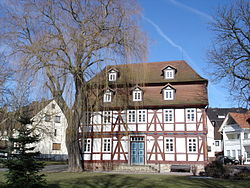
[edit]Besides the old town hall, various timber-frame houses, the town's parks and the Friedrichshütte are worthy of mention. There are a Catholic and an Evangelical church as well, the latter of which was thoroughly restored after the Second World War.
-

-
 Reciprocating waterpump
 -


Regular events
[edit]Early in the year there is an Easter Market, and in autumn there is a harvest and homeland festival. A Christmas Market is held not long before Christmas. Besides the town festival (Stadtfest), a fishermen's festival (Fischerfest) and a kite festival (Drachenfest) are held in the summer. Every other year there is also a trade show.
Economy and infrastructure
[edit]In the late 1980s, Bebra was losing its importance as a railway junction as German reunification loomed and the town lost cross-border traffic. This led to widespread job loss among the inhabitants, as the railway had long been the town's biggest employer. An anecdote in Bebra has it that in the years after the war, people did not ask “Where do you work?” but rather “Where on the railway do you work?”.
From the turn of the millennium, local politicians and Members of the Bundestag from the Hersfeld-Rotenburg district strove to have Bebra's railway station expanded into a marshalling yard.
Transport
[edit]Bebra is a classic railway town at a junction of the Bebra–Fulda, Bebra–Göttingen, Thuringian and Bebra–Kassel lines. Its station, besides a passenger station, includes a marshalling yard, making reaching the town by rail problem-free. The town belongs to the Nordhessischer Verkehrsverbund (“North Hesse Transport Association”, NVV). As a stop on the InterCityExpress east–west line, it has connections to the Ruhr area, Leipzig, Dresden and Berlin.
In the west of town, Bundesstraße 27 from the north and south meets Bundesstraße 83 coming from the west. The B 27 runs beyond town southwards reaching the A 4 (Aachen–Görlitz) and A 7 (Flensburg–Füssen) near Bad Hersfeld after some 15 km (9 mi). Bebra can also be reached from the east over the L 3251 state road.
Established businesses
[edit]- Siemens VDO Automotive AG
- Plustec
Sons and daughters of the town
[edit]- August Vilmar (1800–1868), theologian, professor, Staatsrat (“State Councillor”) and literary historian
- August von Trott zu Solz (1855–1938), politician, 1909–1917 education minister, cofounder of the Kaiser Wilhelm Institute
People connected to Bebra
[edit]- Otmar Freiherr von Verschuer (1896–1969), physician, human geneticist, twin researcher and leading eugenicist in the Third Reich.
- Adam von Trott zu Solz (1909–1944), jurist, diplomat and resistance fighter against Nazism.
- Annika Becker (born 1981), pole vaulter
- Shkodran Mustafi (born 1992), professional football player and world champion in 2014
Twin towns – sister cities
[edit]Bebra is twinned with:
 Vrútky in Slovakia
- Knaresborough in the United Kingdom

References
[edit]- ^ "Ergebnisse der letzten Direktwahl aller hessischen Landkreise und Gemeinden" (XLS) (in German). Hessisches Statistisches Landesamt. 5 September 2022.
- ^ "Alle politisch selbständigen Gemeinden mit ausgewählten Merkmalen am 31.12.2023" (in German). Federal Statistical Office of Germany. 28 October 2024. Retrieved 16 November 2024.
External links
[edit](in German)
- Town’s official webpage (in German)
Towns and municipalities in Hersfeld-Rotenburg district | ||
|---|---|---|
 | ||

| International | |
|---|---|
| National | |
| Geographic | |
| Other | |

Bebra
View on GrokipediaBebra is a town in the Hersfeld-Rotenburg district of northeastern Hesse, Germany, situated on the Fulda River.[1][2] With a population of 12,945 as of 2024, it functions as a regional center for transportation and administration.[2] Bebra gained prominence in the 19th century as a major railway junction, developing into what is known as the archetypal "Eisenbahnerstadt" (railway town) due to its strategic rail infrastructure.[3] During the Cold War division of Germany, the town served as a critical checkpoint for rail traffic crossing into East Germany, handling significant cross-border operations until reunification diminished its role.[4] The local economy and identity remain tied to this rail heritage, supported by landmarks such as the historic water tower and ongoing railway-related museums and facilities.[5]
Geography
Location and Topography
Bebra is situated in the northeastern part of the German state of Hesse, within the Hersfeld-Rotenburg district and the Kassel government district. The town is positioned approximately 60 km south of Kassel and 60 km north of Fulda, at a bend in the Fulda River known as the Fuldaknie.[6] The municipality lies in a basin-shaped widening of the Fulda Valley, at the points where the northern tributaries Bebrabach and Solz enter the main river, forming a tripartite urban layout. Bebra's central elevation stands at 195 meters above sea level, with the surrounding terrain rising to higher elevations in adjacent hills and low mountains.[7][8] The local topography is characterized by a lush, hilly landscape enclosing the valley, with the Stölzinger Gebirge bordering to the north, the Richelsdorfer Gebirge to the east, the Seulingswald forest to the southeast, and the Knüll range to the southwest. This setting places Bebra amid the transitional zone of the East Hessian highlands, featuring dense forests, rolling hills, and riverine features that contribute to its scenic and agriculturally viable environment.[6]Constituent Communities
Bebra consists of a core town and eleven constituent communities incorporated on 31 December 1971 as part of the Hessian territorial reform, which consolidated smaller municipalities to improve administrative efficiency. The incorporated communities are Asmushausen, Blankenheim, Braunhausen, Breitenbach, Gilfershausen, Iba, Imshausen, Lüdersdorf, Rautenhausen, Solz, and Weiterode.[9] These communities retain distinct local identities and are represented by advisory local councils (Ortsbeiräte), which advise the municipal administration on matters specific to their areas while maintaining the town's overall rural character.[10] The reform integrated these areas into Bebra without altering their historical settlement patterns, many of which trace back to medieval origins in the Fulda Valley region.[9]Climate and Natural Environment
Bebra lies in the East Hesse Highlands, a natural region within the Central Uplands characterized by rolling hills, forested plateaus, and the Rhine-Weser watershed, at an elevation of approximately 195 meters above sea level.[11] The surrounding landscape features lush mixed forests, agricultural fields, and serene river valleys, with the town positioned on the edge of the Meißner-Kaufunger Wald nature park, offering access to hiking trails amid picturesque scenery.[12] Nearby natural features include the Forbachsee, a protected lake area supporting local biodiversity.[13] The climate is classified as humid continental with oceanic influences, featuring cold, snowy winters and comfortable, partly cloudy summers, with temperatures typically ranging from -3°C to 23°C annually and rarely falling below -13°C or exceeding 29°C.[14] In January, the coldest month, average highs reach 2°C and lows -2°C, while July, the warmest, sees highs of 22°C and lows of 12°C.[14] Precipitation averages 600–700 mm yearly, with the wettest months in summer (up to 53 mm in July) and the driest in winter (around 28 mm in February); snowfall peaks at about 4 cm in January, contributing to a snow season from late November to early March.[14] Humidity remains low throughout the year, with muggy conditions rare (less than 1% of the time), and winds are strongest in winter at around 19 km/h from the west or south.[14] Cloud cover is highest in winter (up to 74% overcast in December) and lowest in summer (55% clear skies in July), supporting a landscape where deciduous and coniferous forests thrive alongside meadows adapted to moderate seasonal variations.[14]Demographics
Population Development
The population of Bebra experienced steady growth from the mid-19th century onward, driven primarily by its emergence as a major railway junction following the opening of key lines in the 1840s and 1850s. In 1842, the town recorded 1,281 inhabitants.[7] By 1885, this had increased to 2,303 residents, reflecting influxes associated with rail infrastructure and employment.[7] Expansion continued into the 20th century, with the population reaching 7,549 by 1961 amid post-war recovery and industrial activity.[7] Federal census data indicate a peak of 15,456 in 1987, followed by gradual decline linked to broader regional depopulation trends in rural Hesse.[15]| Year | Population | Source Type |
|---|---|---|
| 1987 | 15,456 | Census |
| 2011 | 13,758 | Census |
| 2022 | 13,262 | Census |
Ethnic Composition and Migration Patterns
Bebra's population remains predominantly ethnic German, reflecting the town's location in rural northeastern Hesse where historical settlement patterns favored Germanic groups. As of 2022, foreign nationals constituted 15.4% of the resident population, a figure drawn from regional statistical reporting that aligns with broader trends in small German towns experiencing post-2000s inflows.[18] Detailed breakdowns by specific nationalities or ethnic origins at the municipal level are not routinely published in official aggregates, though national patterns suggest common presences of Turkish, Polish, and more recently Syrian or other Middle Eastern origins among non-citizens in similar locales. Migration patterns in Bebra have been shaped by its role as a railway hub, attracting labor migrants during industrial expansions in the 19th and 20th centuries, followed by episodic surges in asylum seekers. In the early 1990s, the foreign population share was notably higher—twice that of neighboring communities—due to asylum facilities and initial post-Cold War resettlements, though it stabilized before rising again with the 2015-2016 European migrant crisis, which funneled refugees into smaller towns via distribution quotas.[19] By recent estimates, over half of Bebra's inhabitants have some migration history, encompassing both foreign-born individuals and descendants, with 15.4% lacking German citizenship as of 2023 data referenced in studies on small-town integration.[20] This elevated migration background relative to purely native demographics underscores causal links to national policies on asylum allocation and labor needs, rather than organic ethnic diversification.[21] Net inflows have contributed to population growth, countering rural depopulation trends elsewhere in Hesse.Religious Demographics
As of the 2022 German Census conducted by the Federal Statistical Office, Bebra's population of 13,262 included 6,833 Protestants (51.5%), reflecting the town's location in the historically Protestant region of northern Hesse.[22] Roman Catholics numbered 916 (6.9%), supported by local parishes within the Diocese of Fulda.[22] The remaining 5,508 residents (41.6%) identified with other religions, no affiliation, or did not disclose, indicative of widespread secularization trends in Germany.[22] Smaller religious communities include Syriac-Orthodox Christians, primarily immigrants from the Tur Abdin region of southeastern Turkey who settled in Bebra over several decades, though their exact numbers are subsumed within the "other" census category.[19] Historical records indicate a once-dominant Protestant majority, with Catholic presence growing modestly post-World War II due to internal migration, but both groups have declined in relative share amid rising unaffiliation.[22] No significant Jewish community remains, following pre-20th century emigration and Holocaust-era losses documented in regional archives.History
Origins and Early Development
Bebra's name originates from the Old High German term Biberaho, denoting a "settlement on the beaver stream," reflecting the presence of beavers along the local Bebra River in early times; this evolved into Bibera before becoming the modern form.[23] The settlement received its first documentary mention in 786 AD within the Breviarium Sancti Lulli, an inventory of properties belonging to Hersfeld Abbey, a powerful ecclesiastical institution founded around 769 AD and endowed with extensive lands in the region.[23] As one of the abbey’s early possessions, Bebra functioned primarily as a rural agrarian community, supporting the monastic economy through farming and resource extraction from surrounding woodlands and waterways.[6] The Hersfeld Abbey's influence shaped local governance and land use, with the village remaining under its jurisdiction for centuries, fostering a stable but modest feudal structure typical of medieval Hessian estates. By the late Middle Ages, infrastructural developments emerged, such as water mills powered by local streams; the Grimm-Mühle, later known as Nagels Mühle, was documented as early as 1478, indicating reliance on Solz-Bach for grain processing and underscoring the settlement's integration into broader milling networks.[24] Population and economic growth stayed limited, with Bebra consisting of scattered farms and basic ecclesiastical ties until industrialization altered its trajectory in the 19th century.Railway Era and Industrial Growth
The railway era in Bebra commenced in 1848 with the construction of a modest station for the Friedrich-Wilhelms-Nordbahn, marking the initial integration of the locality into Germany's expanding rail network.[25][26] Subsequent expansions connected Bebra to multiple trunk lines, including north-south routes toward Göttingen and Fulda, and east-west corridors via the Thüringer Bahn, establishing it as a vital interchange for freight and passenger services across central Europe.[26] By the early 20th century, particularly around 1907, the junction had matured into one of the German Empire's principal transport nodes, handling substantial volumes of goods traffic that necessitated further infrastructure development, such as enlarged marshalling yards.[26] This railway prominence drove industrial expansion, with the station complex and ancillary operations employing roughly 3,500 workers in roles spanning maintenance, signaling, and logistics prior to World War I, thereby shifting Bebra's economy from agrarian roots toward rail-dependent industry.[25] The concentration of railway activities fostered ancillary enterprises in engineering, supply services, and worker housing, elevating Bebra's status as a logistical center and prompting population influx to support these operations.[6] Reflecting this transformation, Bebra's municipal coat of arms, approved in 1930, incorporated crossed railway tracks alongside its traditional beaver emblem, symbolizing the sector's centrality to local identity and prosperity.[6]World Wars, Division, and Reunification Impacts
During World War I, Bebra's railway station served as a critical node in the German transportation network, employing around 3,500 personnel immediately prior to the conflict's escalation.[27] The town contributed to the war effort through mobilization of local residents, with the first Bebra casualty, Salli Rothfels, reported killed three weeks after the war's onset on August 22, 1914.[28] Jewish community members also suffered losses, including Lieutenant Albert Apfel and Sally Lindau, reflecting broader participation from the town's approximately 4,000 inhabitants at the time.[29] World War II amplified Bebra's vulnerability due to its status as a major marshalling yard handling north-south and east-west freight traffic essential to German logistics.[30] On December 4, 1944, the United States Army Air Forces executed the town's only air raid, with 199 B-24 Liberator bombers targeting the Rangierbahnhof over a 13-minute window from 12:43 to 12:56 under overcast conditions.[31] The assault involved 1,863 explosive bombs and 39,160 stick incendiary bombs, severely disrupting 19 railway tracks, destroying a munitions-laden freight train, burning locomotive sheds, and damaging repair workshops by up to 50%. Civilian infrastructure sustained heavy losses, including three churches, roughly 40 houses, one school, and 10 barns fully destroyed, alongside lighter damage to about 400 additional structures.[31] Postwar reconstruction in Bebra recommenced amid Allied occupation, with the town integrated into the U.S. zone in Hesse and experiencing renewed settlement expansion northward and along the Solztal valley slopes by the late 1940s.[7] From 1949 to 1990, as part of the Federal Republic of Germany, Bebra avoided the physical and economic barriers of the inner German border approximately 50 kilometers eastward near Fulda, instead leveraging its rail infrastructure for West Germany's Wirtschaftswunder, which sustained industrial and population growth into the 1970s despite the national division's broader geopolitical tensions. Reunification on October 3, 1990, integrated eastern rail lines into the unified network, modestly enhancing Bebra's connectivity without local upheaval, though the town shared in the Federal Republic's fiscal burdens via the Solidarity Surcharge funding eastern reconstruction, totaling over €2 trillion in transfers by 2020.[32]Administrative Changes and Recent History
During the Hessian territorial reform (Gebietsreform Hessen), launched in 1970 to enhance municipal efficiency through consolidation, Bebra was restructured into a larger city municipality on December 31, 1971, via the voluntary incorporation of surrounding communities.[7] This process integrated areas such as Iba, which had previously been independent, into Bebra's administrative framework. Weiterode followed as a district in 1972, contributing to the town's expanded territorial scope and population base.[33] Concurrently, the broader regional administration evolved with the creation of Hersfeld-Rotenburg district on August 1, 1972, merging the former Hersfeld and Rotenburg districts under the reform's mandate to streamline higher-level governance.[34] These changes reduced the number of Hessian municipalities from over 2,200 in 1968 to about 420 by 1977, fostering larger units capable of handling modern administrative demands like infrastructure and services.[35] Post-reform, Bebra's administrative boundaries have seen no major alterations, maintaining stability amid Germany's federal structure. Recent developments emphasize operational enhancements, such as waste management collaborations via the Müllabhol-Zweckverband Rotenburg with Bebra's integration in 1972, and regional economic initiatives without territorial shifts.[36] The town's governance has prioritized internal modernization and inter-municipal partnerships over further consolidations.Politics and Administration
Local Governance Structure
Bebra's local governance operates under the framework of the Hessian Municipal Code (Hessische Gemeindeordnung), which delineates the responsibilities of municipal bodies in the state of Hesse. The primary legislative and supervisory organ is the Stadtverordnetenversammlung, the town council, consisting of 37 elected members who deliberate and decide on local policies, budget, and administrative oversight.[37] These councilors are elected by residents every five years through proportional representation, with the most recent election held on March 14, 2021, resulting in representation from five political groups including CDU, SPD, and others.[38] The executive branch is led by the Bürgermeister, directly elected by the populace for a six-year term, who serves as the chief administrative officer and represents the town externally. The Bürgermeister chairs the Magistrat, an executive committee comprising the mayor and nine honorary Stadträte selected by the council to assist in administrative decisions and policy implementation.[39] This structure ensures a balance between elected representation and professional administration, with the Magistrat handling day-to-day governance while accountable to the council.[40] The town administration, headquartered at Rathausmarkt 1, supports these bodies through specialized departments covering areas such as building, social services, and finance, staffed by professional civil servants under the Bürgermeister's direction. Local ordinances and the Hauptsatzung further define procedural rules, including committee formations and public participation mechanisms.[41]Mayoral Leadership and Elections
The mayor of Bebra serves as the chief executive of the municipal administration, representing the town in official capacities and chairing the local council, with duties outlined under Hessian communal law including direct election by eligible voters for a six-year term via absolute majority vote, potentially requiring a runoff if no candidate secures over 50% in the first round.[42] Elections occur every six years, with the current cycle culminating in a vote scheduled for November 9, 2025, alongside a possible runoff on November 23, 2025.[43] Stefan Knoche, a non-partisan candidate, has held the office since March 1, 2020, following his uncontested election on September 8, 2019, where he garnered the requisite absolute majority as the sole nominee after incumbent Uwe Hassl withdrew due to health concerns.[44][45] Knoche, previously involved in local administration, assumed duties amid ongoing municipal projects, and as of October 2025, he is campaigning for a second term emphasizing fiscal stability and infrastructure development.[46] Preceding Knoche, Uwe Hassl (non-partisan) served from March 1, 2014, to February 2020, elected in a 2013 runoff on September 22 against Volkmar Hanf of the Gemeinsam für Bebra group, securing 65.5% of votes cast after leading the first round on September 8 with 34.8%.[47] Hassl's tenure focused on inter-municipal cooperation and local economic initiatives but ended prematurely in pursuit of re-election due to personal health limitations.[48] Prior to Hassl, Horst Groß of the CDU held the position from 1996 to February 28, 2014, spanning 18 years marked by administrative restructuring and community engagement, declining re-election in 2013 at age 66.[49][50] These elections reflect Bebra's pattern of competitive yet often decisive local contests, with voter turnout varying but historically supporting experienced candidates in this mid-sized Hessian town of approximately 14,000 residents.Heraldry and Symbolic Traditions
The coat of arms of Bebra consists of a red shield (gules) bearing a silver beaver (argent) in a rampant posture with a black tail (sable), positioned above two pairs of crossed silver railway rails represented as bendlets.[51][6] The design was approved on an unspecified date in 1930 by the Prussian State Ministry and received a minor update in 1967, which included rendering the beaver's tail black.[51] The beaver serves as a canting element, alluding to the town's name derived from "Biberahe" or "Biberwasser," meaning "beaver water" or "beaver stream," reflecting historical associations with the animal in the local landscape.[51] The crossed rails symbolize Bebra's transformation into a major railway junction in the mid-19th century, highlighting the infrastructure's role in the town's economic and demographic growth.[6][51] The red and silver tinctures derive from the arms of Hersfeld Abbey, which governed the region for centuries until its secularization in 1803.[51] Bebra's coat of arms is accompanied by a motto: "Bebra, im Hessenlande – die Stadt, im roten Feld einen Biber hat, dazu ein gekreuztes Schienenpaar, im Leben mutig, im Streben wahr," which translates to "Bebra, in the land of Hesse – the town that has a beaver in the red field, plus a crossed pair of rails, brave in life, true in striving."[6] This inscription encapsulates the heraldic elements while invoking virtues of courage and authenticity, aligning with the town's identity as a resilient Hessian community shaped by industrial progress. The arms appear on official seals, flags, and public buildings, maintaining continuity in civic symbolism without documented unique traditions beyond standard German municipal heraldry practices.[6]Town Partnerships and International Ties
Bebra has established formal town partnerships with two municipalities: Knaresborough in North Yorkshire, United Kingdom, since 1969, and Friedrichroda in Thuringia, Germany, since January 12, 1990.[52][53] The partnership with Knaresborough originated in 1968 amid efforts to promote European unity through cross-border friendships, with official twinning formalized the following year to encourage cultural and social exchanges.[52] This relationship is actively maintained by the Partnerschaftsverein Bebra-Knaresborough e.V., led by longtime chair Nortrud Hoffmeister, who has coordinated delegations and events for decades.[54] Activities include reciprocal visits, such as a 22-member Bebra delegation to Knaresborough from June 6 to 11, 2024, hosted by local families, and a Knaresborough group attending Bebra's Kirmes harvest festival in October 2024; school exchanges between Bebra's Brüder Grimm Gesamtschule and Knaresborough's King James's School have occurred biennially since 1974.[55][56][57] The domestic partnership with Friedrichroda emphasizes regional cooperation, particularly post-reunification, with joint events marking milestones like the 30th anniversary planned for 2020 but delayed to 2021 due to the COVID-19 pandemic.[58] Exchanges have included cultural initiatives, such as Bebra acquiring artwork from Friedrichroda for its town hall in 2021 and collaborative celebrations for Friedrichroda's 125th anniversary in 2013.[59][60] These ties facilitate knowledge-sharing on tourism and local governance, reflecting Bebra's commitment to sustaining interpersonal and institutional links despite geographical proximity.[61]Economy and Infrastructure
Economic Sectors and Major Employers
Bebra's economy features a dominant manufacturing sector, with a high proportion of employment in processing industries, particularly automotive suppliers. Small and medium-sized enterprises predominate, supported by the town's industrial areas equipped with rail sidings for efficient logistics. Key subsectors include drive technology, railway logistics, LED lighting, textile conveyor belts, and uniform production, reflecting a mix of traditional and specialized manufacturing strengths.[62] Vitesco Technologies GmbH, specializing in electrification and powertrain components for sustainable mobility, operates a major production and development site in Bebra, employing around 700 workers as of 2024. This facility, with over 50 years of history, underscores the automotive supply chain's centrality to local employment. Deutsche Bahn Cargo maintains a presence with approximately 160 employees focused on freight operations, leveraging Bebra's role as a rail junction. Public utilities like Stadtwerke Bebra GmbH also contribute, though manufacturing remains the primary employer base amid roughly 5,958 insured workplace positions overall.[63][64][65][66] Services and trade supplement manufacturing, but the economy's structure emphasizes industrial resilience, with automotive and transport-related firms driving job stability despite national sector fluctuations.[62]Transportation Networks and Historical Shifts
Bebra's primary transportation network centers on its railway station, opened on September 18, 1848, as the initial stop for the Friedrich-Wilhelms-Nordbahn, the first railway line in the Electorate of Hesse, connecting Bebra to Cassel with steam locomotives operating at speeds up to 30 kilometers per hour.[67] By the 1860s, additional lines such as the Halle–Bebra and Göttingen–Bebra routes integrated the town into the expanding German rail system, transforming Bebra into a key junction with multiple locomotive sheds constructed by 1890 and a reception building erected in 1869–1870.[68] This development positioned Bebra as a classic railway town, handling significant freight and passenger traffic that spurred industrial growth.[69] Post-World War II, the station's role shifted dramatically due to Germany's division, becoming a critical border facility near the inner-German border for interzonal trains to the German Democratic Republic, transit services, and Western Allied military convoys to West Berlin, necessitating locomotive exchanges between Deutsche Bundesbahn and Deutsche Reichsbahn operations.[70] The Cold War era emphasized its strategic function, with heightened security and specialized handling of cross-border movements until reunification in 1990 restored direct east-west connections and diminished border controls.[71] Following reunification, infrastructure investments modernized the station, culminating in a comprehensive overhaul by 2022 that integrated rail with urban redevelopment, enhancing accessibility and multimodal options under the Nordhessen Verkehrsverbund for regional buses.[72] Road enhancements complemented this, including the June 2022 completion of a new bridge on Bundesstraße 83 linking Bebra to Rotenburg an der Fulda after 3.5 years of construction to improve local connectivity.[73] These changes mark Bebra's evolution from a 19th-century rail nexus and Cold War frontier post to a contemporary regional transport hub focused on efficiency and integration.[26]Labor Market Dynamics and Challenges
The labor market in Bebra, situated within the Hersfeld-Rotenburg district, exhibits relative stability with an unemployment rate averaging 4.3% in 2024, consistent with the prior year despite national economic pressures.[74] This figure rose slightly to 4.5% by August 2025, reflecting seasonal increases among youth and foreigners but remaining below Hesse's median of around 6.1%.[75] [76] Employment dynamics have shown resilience, with a 7.8% increase in jobs from 2011 to 2017 following the post-reunification decline in railway-related positions, which once peaked at 3,000–4,000 workers.[21] The local economy is dominated by manufacturing, particularly automotive suppliers, which account for a high proportion of employment, supplemented by services and smaller-scale agriculture amid ongoing demographic shifts.[62] Major employers include firms like Vitesco Technologies, contributing to a commuter-oriented workforce linked to regional hubs such as Kassel and Fulda.[77] This structure has buffered against broader crises, maintaining job absorption capacity even as national vacancy rates fluctuate.[78] Challenges persist due to skilled labor shortages exacerbated by an aging population and outmigration of younger residents, mirroring rural Hessian trends where demographic decline strains sectors like manufacturing and care services.[79] Migrant integration offers partial mitigation, with non-Germans comprising 13.3% of the population in 2019 and contributing to factories and construction, though early barriers like wage competition and shift work have historically complicated participation.[21] Projections indicate rising unemployment pressures from structural transformations, including automation in automotive supply chains, necessitating targeted vocational training and retention strategies.[74]Culture and Heritage
Architectural and Historical Sites
The Bahnhof Bebra, established as a small station in 1848 for the Friedrich-Wilhelms-Nordbahn, developed into a major railway junction with its reception building constructed between 1869 and 1870 in an island position between the tracks.[26] This structure, measuring 124 meters in length and over 2,000 square meters in usable area, served as a critical node during the German Empire and later as a border station for interzonal and transit trains to West Berlin during the Cold War division of Germany.[80] Renovated and repurposed, it now houses the Bahnhof Bebra Museum, featuring exhibits and model railways illustrating its historical significance as an industrial monument.[25] The Altes Rathaus, a historic half-timbered building in Bebra's town center, originated as the Bitzenhof manor and served various functions including as a town hall, with records indicating its use for commercial and administrative purposes from the early 20th century onward.[81] Post-World War II, it briefly operated as a clothing factory before housing vocational schools from 1950 to 1982; restored in recent years, it exemplifies traditional regional architecture and now functions as a restaurant.[81] [82] Bebra's Auferstehungskirche, the central evangelical church, is a protected monument reflecting the town's Protestant heritage, though specific construction dates for its current form remain tied to post-medieval developments amid the region's religious history.[83] In the Blankenheim district, the Blankenheim Kapelle preserves elements of a former Augustinian nunnery church, including its choir and transept, dating to medieval monastic foundations dissolved during the Reformation.[84] Additional historical structures include Fachwerkhäuser like the one at Asmusstraße 43, a three-part residential building from circa 1650–1700 featuring a scissor-hipped roof, representative of Bebra's vernacular timber-frame tradition.[85] The town's historical core, as outlined in local walking tours, integrates these buildings around the modern Rathaus erected between 1980 and 1982, which incorporates a preserved coat-of-arms stone from earlier civic architecture.[24]Cultural Institutions and Museums
The primary cultural institution in Bebra dedicated to preserving and exhibiting local history is the Bahnhof Bebra Museum, housed in the historic railway station building opened on May 1, 1848.[27] This facility features a permanent exhibition titled "Knotenpunkt im Kaiserreich - Grenzstation im Kalten Krieg," which chronicles the station's evolution from a central rail junction in the German Empire to a key border post during the Cold War division of Germany, emphasizing stories of travelers, railway workers, and operational professions through interactive modern media displays.[25] The museum operates Wednesday through Sunday from 10:00 to 17:00, with adult admission at 5 euros.[86] Adjacent to the main station, the Eisenbahnfreunde Bebra e.V. maintains a smaller railway museum focused on regional rail history, including technical exhibits near the preserved water tower, a remnant of Bebra's infrastructure as a major 19th-century transport node.[87] This volunteer-run site highlights operational aspects of historical locomotives and tracks, underscoring the town's enduring rail heritage amid modern high-speed services.[88] Bebra's Stadt- und Schulbücherei serves as a key cultural hub, functioning as both a public and school library with over 10,000 media items, hosting reading events, and promoting literacy in the Fuldatal region; it relocated to expanded facilities at Luisenstraße 22 in 2016.[89] [90] The Lokschuppen Bebra, a repurposed locomotive shed, functions as a multi-purpose venue for cultural programming, including concerts, theater performances, and exhibitions, accommodating up to 500 visitors for events tied to the town's industrial past.[91] Historically, the Spielzeugmuseum Solz in Bebra's Solz district showcased traditional wooden toys from the Ore Mountains and other regions in a restored half-timbered building dating to the 17th century, but it closed permanently in 2014 due to operational challenges.[92] No other dedicated museums, such as a local history or art gallery, operate within Bebra as of 2025, reflecting the town's modest scale and emphasis on rail-themed heritage over broader cultural collections.[93]Local Traditions and Events
Bebra's most prominent annual event is the Bäwersche Kirmes, a traditional folk festival held over five to six days in early October, typically from October 2 to 6 or 7. This volksfest transforms the town's multi-purpose square and inner city areas into a hub of amusement rides, live music performances, food stalls, fireworks displays, and communal gatherings that emphasize local pride and social bonding.[94][95] Organized by the town's development company, the event draws residents and visitors for its blend of high-energy parties and heartfelt Heimatgefühl, or sense of homeland.[96] Rooted in the historical German custom of Kirmessen—originally church consecration fairs dating to the Middle Ages—the Bäwersche Kirmes has evolved into a secular celebration while preserving communal rituals like shared meals and evening fireworks, which occur on the final night to mark closure.[97] In 2024, for instance, the festival concluded with robust attendance amid favorable weather, underscoring its role in sustaining regional folk traditions amid modern entertainment.[98] Other recurring local events include seasonal gatherings such as summer Wednesday evenings with live music and beer gardens in the town center, promoting casual social traditions tied to warmer months.[99] The town also features the Backofenfest, an annual baking-related festival highlighting culinary customs in surrounding districts, though specifics vary by year and focus on community-prepared goods.[100] These activities, often centered around historical sites like the railway station, reinforce Bebra's heritage without overt commercialization, distinguishing them from larger regional spectacles.Notable Individuals
Natives of Bebra
Jakob Oppenheim (April 27, 1874 – March 5, 1947) was born in Bebra and later relocated to Tübingen in 1905 before emigrating to the United States, where he resided in Cleveland, Ohio, until his death.[29] [101] Beyond such individuals from the town's Jewish community, historical records do not highlight natives of Bebra achieving broader prominence in fields like politics, science, or arts, with most documented figures instead associated through residence or activity rather than birth in the town.Figures Associated with Bebra
Erich Braun, a key Nazi functionary, founded and led the local NSDAP group (Ortsgruppe) in Bebra, serving as Ortsgruppenleiter, Kreisleiter, and later as a Reichstag deputy representing the party in the region. He was instrumental in organizing local party activities, including antisemitic measures such as public announcements and actions during the November 1938 pogroms against Jewish residents.[102] Ferdinand Seyfarth (1818–1901), an agriculturalist and land tax reformer, operated an independent farm in Friedrichshütte near Bebra from 1843 to 1879, contributing to regional efforts in agricultural management and Grundsteuer (land tax) regulation in Hesse.References
- https://commons.wikimedia.org/wiki/File:Blankenheim_Kapelle.jpg