Hubbry Logo
search
logo

Bent (structural)

logo
Community Hub0 Subscribers
Read side by side
from Wikipedia

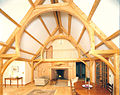
A bent in American English is a transverse rigid frame (or similar structures such as three-hinged arches). Historically, bents were a common way of making a timber frame; they are still often used for such, and are also seen in small steel-frame buildings, where the term portal frame is more commonly used.

The word "bent" is also used for the horizontal element of a two-pier bridge support, which is a support consisting of two vertical piers, each approximately at the outer edge of the bridge deck, and a single horizontal element connecting the tops of the two piers. In British English this assembly is called a "cross frame". An "outrigger bent" is one where the vertical piers are located outside the bridge's deck, hence the horizontal bent is wider than the bridge deck.

The term bent is probably an archaic past tense of the verb to bind, referring to the way the timbers of a bent are joined together. The Dutch word is bint (past participle gebint),[1] the West Frisian is bynt, and the German is bind. Compare this with the term bend for a class of knots.

Bents are the building blocks that define the overall shape and character of a structure. They do not have any sort of pre-defined configuration in the way that a Pratt truss does. Rather, bents are simply cross-sectional templates of structural members, i.e., rafters, joists, posts, pilings, etc., that repeat on parallel planes along the length of the structure. The term bent is not restricted to any particular material. Bents may be formed of wooden piles, timber framing,[2] steel framing, or even concrete.[3]

Construction

[edit]

Traditional timber frame bents were one component of a braced frame in timber framing. Historically, mortise and tenon joints were used to joint bents to posts and beams due to the unavailability of nails.[4]

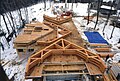
Bents are generally pre-assembled, either at the timber framing company's shop or at the construction site. After the basic post and beam structure of the frame has been set in place, the bents are then lifted and simply lowered into place one by one by the crane. Next, the workers bring in additional members, purlins, which tie them together and give the frame a more rigid structure. This process is very safe and efficient, as it allows a crew to assemble a large portion of the frame without ever stepping off the ground. This, in turn, minimizes the amount of time that the crew must spend several stories in the air clambering along beams not much wider than their own feet.[citation needed]

[edit]

See also

[edit]

Notes

[edit]

References

[edit]
[edit]
Revisions and contributorsEdit on WikipediaRead on Wikipedia
from Grokipedia
In structural engineering and construction, a bent is a transverse framework designed to support both vertical and horizontal loads, typically consisting of vertical posts or columns connected by horizontal caps or beams that transfer forces to the foundation.[1] This basic structural unit forms a cross-section of the overall framework, often spaced at regular intervals to provide stability and rigidity in various applications.[2] Bents are fundamental in post-and-beam construction for timber-framed buildings, where they serve as the primary load-bearing elements spaced 12 to 16 feet apart and connected by joists and purlins to define the building's form and support roofs or floors.[2] In bridge engineering, bents function as intermediate substructure units between the bridge ends and abutments, minimizing obstruction to traffic or water flow while supporting the superstructure; they differ from piers primarily in having two or more columns, each on individual footings.[3] Common types include pile bents, which use driven piles under a cap for support in softer soils, and column bents for highway overpasses, constructed from materials such as reinforced concrete, steel, or timber to withstand environmental and seismic forces.[4] The design of bents emphasizes load distribution, material durability, and site-specific factors like soil conditions to ensure long-term structural integrity across diverse projects, from residential homes to large-scale infrastructure.[5]

Definition and Terminology

Core Definition

In structural engineering, a bent is defined as a transverse rigid frame consisting of vertical and horizontal members, such as posts, beams, and braces, that provides lateral stability and supports vertical loads across the length of a building or bridge.[6] These frames are repeated at regular intervals along the structure's longitudinal axis to create a complete framework, distinguishing them from longitudinal elements like girders or trusses, which span between supports rather than crossing them.[6] Originating in timber framing as the basic cross-sectional unit, bents can be constructed from various materials without a fixed configuration, emphasizing their role as modular building blocks.[6] In bridge engineering, a bent functions as an intermediate substructure unit supporting the superstructure, typically comprising two or more piers connected by a horizontal cap beam positioned under the deck to transfer and resist vertical loads, as well as lateral forces from traffic and environmental conditions.[4] This setup ensures efficient load distribution between spans.[4] A common variant is the outrigger bent, in which columns extend beyond the edges of the bridge deck to provide additional support.[7] Overall, the defining characteristic of a bent lies in its repetitive cross-sectional arrangement, allowing adaptability to diverse structural demands.[6] The term "bent" in structural engineering is probably derived from an archaic past tense of the verb "to bind," referring to the joining of timbers in rigid assemblies, with roots in Old English bindan meaning "to bind" or "to tie." Influences from continental European languages include the Dutch bint, denoting a bound division or partition, and the German Binde, referring to a tie beam.[8] Regional variations highlight differences in terminology across English-speaking contexts. In British English, particularly for bridge structures, the equivalent of an American "bent" is often termed a "cross frame," describing the transverse assembly without the binding connotation. Conversely, "bent" remains prevalent in American usage for timber and framed supports. The modern steel counterpart to the timber bent is the "portal frame," a rigid configuration of columns and rafters connected by moment-resisting joints to span clear distances, adapting the bound transverse principle to metal fabrication.[9][10] Related terms distinguish "bent" within broader framing vocabulary. While "frame" encompasses the overall structural skeleton, a "bent" specifically denotes a repeating transverse section, such as a row of posts capped by a beam. This contrasts with "bay," which refers to the longitudinal space or interval between consecutive bents, defining the building's modular rhythm. The evolution of this terminology appears in early engineering literature, where texts like Crandall and Barnes' Railroad Construction (1913) employed "bent" to describe transverse supports in timber trestle bridges for railroads, standardizing its application in civil engineering contexts.[11][12]

Historical Development

Origins in Timber Framing

The bent, as a fundamental structural unit in timber framing, emerged prominently during the medieval period in Europe, particularly in Germanic and English traditions, where it served as a repeating transverse frame in barns, halls, and houses. These early bents typically took the form of post-and-beam or A-frame configurations, consisting of vertical posts supporting horizontal beams and rafters to create modular bays that spanned the building's width. In regions like Essex, England, bents formed the backbone of large agricultural structures, such as the late 12th- to 13th-century barns at Cressing Temple, where six transverse frames divided the interior into functional spaces of approximately 500 square feet each, demonstrating their role in efficient load-bearing design imported via monastic orders from continental Europe.[13] A key technique enabling the rigidity and scalability of these bents was the mortise-and-tenon joint, which created strong, interlocking connections without the need for nails, relying instead on wooden pegs for assembly. This joinery allowed for precise pre-assembly of entire bent units on the ground, facilitating community-raised erection and minimizing errors during construction, a practice evident in medieval English carpentry where open laps and tenons were notched into massive timbers to withstand seasonal wood movement. In cruck-framed variants, pairs of curved blades formed A-frame bents, half-lapped at the apex and pegged with up to four wooden dowels, supporting roofs independently of infill walls and enabling prefabrication before lifting with ropes.[14][15][13][16] Specific examples highlight the bent's practical application, such as English cruck-framed buildings from the 12th to 16th centuries, including the 1262 Royal George in Northamptonshire and structures like Brockworth Manor in Gloucestershire with six bents forming thatched-roof barns for grain storage. In North America, colonial adaptations appeared in 18th-century barns, where German immigrants employed bents in post-and-beam assemblies for rapid erection, as seen in Pennsylvania-style structures that evolved into multi-bay agricultural buildings by the 19th century. These designs prioritized modular construction, with bents spaced 12 to 16 feet apart to optimize material use and erection speed.[16][17][18][19][2] In terms of load distribution, vertical posts within bents primarily bore gravity loads from roofs and upper floors, channeling them to the foundation, while horizontal tie-beams and braces countered lateral forces, preventing racking or sway under wind or uneven settling. This configuration, reinforced by arch-braces and wind-braces in cruck examples, ensured stability in open-span halls like Prior’s Hall at Widdington, where seven free-standing bents resisted roof thrust without intermediate supports. The cultural spread of bent-based framing originated in southern Germanic house-barn traditions, migrating via 17th- and 18th-century settlers to North American adaptations in the 18th-19th centuries, particularly for agricultural barns in Pennsylvania and the Midwest, where it supported expanding farmsteads with durable, expandable frames.[13][16][13][19]

Transition to Steel and Concrete

The transition from timber to steel in bent structures began in the late 19th century, driven by the rapid expansion of U.S. railroads, where riveted steel I-beams and built-up sections replaced wooden posts and braces in bridge bents to provide greater durability, fire resistance, and load capacity for heavier trains.[20] By the 1880s, metal bents with complex bracing systems became standard for elevated railroad structures, enabling taller and more stable supports over challenging terrains during the post-Civil War rail boom.[21] In the early 20th century, reinforced concrete emerged as a viable material for bent configurations, particularly in portal frame designs for industrial warehouses and multi-story buildings, offering economical alternatives to steel amid rising material costs.[22] These frames, consisting of rigid concrete beams and columns monolithically cast, were widely adopted for their compressive strength and reduced maintenance needs in fire-prone environments like factories.[23] Key milestones included the standardization of steel bent designs in bridge engineering through early textbooks and specifications, such as those influencing American practice around 1910–1920, and the post-World War II prefabrication surge, which facilitated modular concrete bents for high-rise construction by streamlining on-site assembly.[24] Engineering advancements further refined bent performance: the widespread adoption of welding in the 1930s enhanced steel rigidity by replacing rivets with continuous joints, reducing weight while maintaining stiffness in frame assemblies.[25] Similarly, prestressed concrete techniques in the 1950s allowed longer spans in bent configurations by counteracting tensile stresses, making it suitable for expansive viaducts and industrial portals.[26] Globally, European engineers integrated steel bents into early 20th-century skyscrapers, as seen in Berlin's turn-of-the-century office towers where steel skeletons supported multi-story elevations amid urban density constraints.[27] In contrast, the U.S. favored reinforced concrete bents for large-scale infrastructure like dams and viaducts, exemplified by 1930s projects such as the Colorado River Aqueduct, where concrete frames provided seismic stability and longevity in expansive spans.[28]

Components and Configurations

Basic Structural Elements

A bent in structural engineering primarily consists of vertical columns, also known as posts or piers, which serve to transfer axial loads from the superstructure to the foundation. These columns are typically arranged in a transverse plane to form the primary load-bearing skeleton of the frame. In timber constructions, posts are often hewn or sawn lumber members, while in concrete or steel bents, they may be reinforced columns or built-up sections designed to resist compression and minor bending.[29][30] The horizontal cap beams or girders crown the columns, providing a spanning element that distributes loads across the bent and supports the longitudinal members of the overall structure. Cap beams in concrete bents, for instance, are designed to resist bending and shear forces from the superstructure, often cast monolithically with the columns for enhanced rigidity. In steel portal frames, these girders are welded or bolted rafters that complete the rigid frame, enabling moment transfer.[30][31] Secondary elements include bracing, such as diagonal cross-bracing or knee braces, which provide resistance to shear and lateral forces, preventing buckling or racking of the frame. At the base, sills or footings connect the columns to the foundation, anchoring the bent and distributing loads to the ground; in timber setups, sills may be treated lumber plates, while concrete footings often integrate piles or spread footings.[29][32] Interconnections between elements vary by material and design intent: rigid, moment-resisting joints, common in steel portal bents, allow for frame action where moments are transferred at column-to-cap connections via welding or high-strength bolting. In contrast, simpler timber bents often employ pinned or semi-rigid joints using traditional mortise-and-tenon or pegged connections, which prioritize axial load paths over moment resistance.[29][31] Bents can scale from single-bay configurations, supporting one span between adjacent bents, to multi-bay setups with multiple columns for wider transverse coverage in larger structures. In integration with the overall frame, bents are typically spaced 12 to 16 feet apart longitudinally, connected by purlins (for roofs) or girts (for walls) to form a continuous building envelope and distribute loads uniformly.[29][33]

Common Variations

Common variations of bent designs adapt the standard frame to meet specific loading conditions, span requirements, and site constraints across buildings and bridges. The portal bent represents a fully rigid frame variation, featuring moment-resisting connections at all beam-column and rafter-column joints to enhance lateral stability and load distribution. This configuration is widely used in steel warehouses and industrial buildings, enabling unbraced spans up to approximately 50 meters (164 feet) without intermediate supports, with typical efficient spans of 25 to 35 meters (82 to 115 feet), which optimizes open floor space for storage and operations.[10] The A-frame bent modifies the traditional bent by incorporating inclined rafters that converge at an apex, creating a triangular profile ideal for roof structures in timber or metal buildings. This geometry promotes efficient snow load shedding by allowing accumulation to slide off the sloped surfaces, reducing the risk of overload in snowy climates while maintaining structural integrity under vertical loads.[34] In bridge applications, outrigger and inrigger bents provide specialized support configurations to accommodate cantilever spans and navigational clearances. Outrigger bents extend piers beyond the deck edges, supporting overhanging sections and distributing loads for cantilever designs that extend bridge spans over obstacles. In contrast, inrigger bents position piers inward from the deck edges, enhancing vertical clearance for underlying traffic or waterways while maintaining stability. These variations are particularly useful in urban or riverine settings where space and clearance are limited.[35][36] The hammerhead bent is a single-column variation with a flared cap beam resembling a hammerhead, which minimizes the number of piers required and reduces foundation demands in highway overpasses. This design efficiently transfers loads from the superstructure to a solitary shaft, allowing for wider spans and fewer obstructions below the bridge deck, commonly applied where aesthetics or right-of-way constraints favor streamlined substructures.[37][38] Seismic variations of bents incorporate energy dissipation elements such as dampers or base isolators, particularly in high-risk zones following the evolution of building codes after the 1970s. These additions, often placed at the base of columns or within the bent frame, decouple the structure from ground motions, reducing transmitted forces and preventing collapse during earthquakes; base isolators, for instance, use flexible bearings to allow horizontal movement while dampers absorb vibrational energy. Such modifications have become standard in modern bridge and building designs per updated seismic provisions.[39][40][41]

Construction Techniques

Traditional Assembly Methods

Traditional assembly methods for structural bents emphasized manual labor and on-site fabrication, particularly in timber construction, where bents were pre-assembled flat on the ground to allow precise fitting of components before erection. Posts, beams, and braces were shaped using hand tools such as axes, adzes, chisels, and augers, then joined via mortise-and-tenon connections secured with wooden pegs (treenails) driven into pre-drilled holes for a tight fit without metal fasteners. Scaffolding supported the assembly process, enabling workers to position and align elements safely at ground level, a practice rooted in 18th- and 19th-century timber framing techniques. Erection began with lifting the completed bent using gin poles—tall spars rigged with ropes and pulleys, powered by teams of workers or draft animals—to hoist the frame vertically onto prepared foundations such as driven piles or stone footings. Once positioned, multiple bents were aligned in sequence along the span, with adjustments made using mallets and levers to ensure plumb and level placement; this sequential raising was common in 19th-century railroad trestle construction, as seen in the Alaska Railroad's Loop District bridges built around 1915, where timber bents supported multi-tiered spans over challenging terrain.[42] For longer spans, early 20th-century methods occasionally employed steam-powered pile drivers or basic cranes to assist in hoisting, though manual gin poles remained prevalent for efficiency in remote sites. Securing the raised bents involved installing horizontal purlins along the roofline and girts along the walls to tie adjacent frames together, forming a rigid structural system; temporary bracing, often using diagonal struts or rope guys, was applied during setup to prevent lateral movement until permanent connections were complete. In timber applications, additional pegs or drift pins reinforced joints post-erection, while early steel bents—emerging in the late 19th century—adapted similar processes but used bolts or hot-driven rivets instead of pegs, with frames assembled flat and raised using gin poles or derricks before riveting in place. Rivet guns, introduced before the 1930s, facilitated on-site fastening of steel plates and angles in railroad bridge bents, ensuring durable connections under load. These methods prioritized safety by limiting high-elevation work to supervised lifting and alignment phases, reducing fall risks compared to fully elevated assembly; the ground-level pre-fabrication and sequential erection also enhanced efficiency, allowing rapid progress in bridge spans, as evidenced by Sewall's Bridge over the York River in 1761, where pile-driven bents were raised using attached ropes and human power.[43] Overall, traditional bent assembly minimized material waste and tooling needs, relying on skilled carpenters for hand-hewing and pegging in timber or riveters for early steel, a labor-intensive approach that dominated construction until industrialized techniques emerged.[42]

Modern Fabrication and Erection

Modern fabrication of structural bents emphasizes industrialized processes to enhance precision, speed, and quality control, primarily using steel and precast concrete. In steel bent production, computer numerical control (CNC) machines and laser cutters are employed for accurate cutting of beams and columns, followed by automated welding to assemble rigid frames off-site.[44][45] For precast concrete bents, fabrication involves constructing reusable formwork to shape the units, with reinforcing bars (rebar) precisely cut, bent, and placed into cages within the forms before concrete pouring and curing.[46] These shop-based methods allow for controlled environments that minimize on-site labor and weather-related delays. Transportation of modular bents typically utilizes specialized flatbed trucks or trailers to deliver pre-assembled units to the construction site, ensuring components remain protected during transit.[47] Erection begins with mobile hydraulic cranes lifting the bents into position, capable of handling loads up to 650 tons for medium-scale structures.[48] For precise alignment, particularly in bridge applications, hydraulic jacks are synchronized via manifolds to adjust elevations and ensure level placement without differential settlement.[47][49] Following erection, post-erection procedures secure the connections and integrate the bents into the overall structure. In concrete bents, high-strength grout is injected into joints to fill voids, bond segments, and transfer loads effectively, often using methods like pump-assisted placement to avoid air entrapment.[50] For steel bents, high-strength bolts are tightened to snug-tight or pretensioned conditions in moment-resisting or shear connections, providing reliable anchorage without on-site welding.[51] Since the early 2000s, Building Information Modeling (BIM) has been integrated into sequencing to simulate erection paths, clash detection, and coordination, leading to significant reductions in errors and rework in complex assemblies, such as up to 90% fewer field-generated RFIs in some projects.[52] Advancements in the 2010s introduced robotic welding systems in steel fabrication shops, automating fillet and butt welds to achieve consistent quality while cutting labor needs by 30-50% compared to manual processes.[53][54] Sustainable practices have also gained traction, with recycled steel comprising at least 25% of input materials in bent fabrication, often exceeding 90% in structural applications, lowering embodied carbon by approximately 1.5 kg CO2 per kg recycled versus virgin steel.[55][56][57] As of 2025, emerging practices include the use of low-carbon concrete mixes in precast bents, reducing emissions by up to 70% compared to traditional Portland cement.[58] A representative case involves prefabricated steel portal bents for quick-erect warehouses, where modular frames are shop-assembled and bolted on-site; representative cases show construction times 40-60% faster than traditional cast-in-place methods due to minimized field connections.[59][60]

Applications and Examples

Use in Bridges

In bridge engineering, bents serve as critical intermediate supports in the substructure of multi-span bridges, positioned between the end abutments to distribute the vertical and horizontal loads from the superstructure, such as the deck and traffic, down to the foundations. This configuration allows for longer overall bridge lengths by dividing the total span into manageable segments, enhancing structural efficiency while minimizing foundation requirements compared to continuous single-span designs.[36] Common types of bents used in bridges include stub bents, which are short, rigid supports suitable for short to medium spans where minimal height is needed, often employed in integral abutment configurations to reduce joint maintenance.[61] Another prevalent type is the spill-through bent, featuring open designs with sloped embankments and sometimes V-shaped piers that permit water flow beneath the structure, thereby improving hydraulic performance and providing resistance to scour by reducing flow constriction around the supports.[62] V-shaped piers in such bents, as seen in certain seismic zones, further enhance stability by distributing lateral forces more evenly. Historically, timber bents were widely used in 19th-century covered bridges in the United States, particularly in Pennsylvania, where they formed the transverse frames supporting the truss and deck in multi-span designs to span streams and valleys cost-effectively with locally available wood.[63] For instance, bridges along what is now U.S. Route 30, such as those in Lancaster County, incorporated timber bents with vertical posts and horizontal caps to bear the loads of horse-drawn traffic.[64] In the early 20th century, steel bents became common in rail viaducts, replacing timber for greater durability and load capacity; the rebuilt Kinzua Bridge in Pennsylvania (1900) exemplifies this transition, using steel-framed bents spaced at regular intervals to support heavy train loads over deep valleys. In modern bridge construction, concrete hammerhead bents—characterized by a single column widening into a T-shaped cap—are frequently utilized in interstate overpasses for their simplicity and efficiency in supporting precast girders.[30] Following the 1994 Northridge earthquake, many California bridges underwent seismic retrofitting that incorporated or upgraded hammerhead bents with steel jackets and enlarged footings to improve ductility and energy dissipation; examples include the I-5/I-405 separation and spans on Interstate 5.[65] Bents offer significant advantages in bridge design for medium spans of 50 to 200 feet, where they provide a cost-effective means to achieve multi-span continuity without excessive material use.[36] Additionally, their modular design facilitates seamless integration with expansion joints, allowing controlled movement to accommodate thermal expansion and contraction while maintaining structural integrity.[30]

Use in Buildings and Other Structures

In buildings, portal bents—rigid structural frames consisting of columns and rafters connected by moment-resisting joints—serve as the primary skeleton for low-rise industrial sheds, barns, and warehouses, efficiently supporting roofs and walls while creating unobstructed interior spaces for storage and operations.[10] These frames are particularly suited to applications requiring clear spans of 25 to 35 meters, allowing for flexible layouts without intermediate supports.[10] Historically, timber bents formed the core of Great American barns in the 1800s Midwest, where German immigrant builders constructed transverse post-and-beam frames using mortise-and-tenon joinery to support expansive agricultural structures, often spaced 16 to 20 feet apart to accommodate livestock and hay storage.[66] Following World War II, steel portal bents gained prominence in prefabricated industrial buildings, evolving from military designs to enable rapid erection in low-rise facilities like factories and storage units.[10] Contemporary implementations feature pre-engineered metal buildings with rigid bents for large-scale warehouses, exemplified by Amazon distribution centers that utilize these frames to achieve wide, column-free bays up to 35 meters for logistics efficiency.[67][10] Reinforced concrete portal bents are also common in multi-level parking garages, providing durable support for elevated decks under vehicular loads.[68] Beyond enclosed buildings, bents appear in supporting roles within other structures, such as gantry crane portals in industrial settings for handling heavy loads up to 20 tonnes and temporary staging for construction sites.[10] In earthquake-prone regions like Japan, structural bents combined with base isolation systems—such as rubber bearings at the foundation—enhance seismic resilience in both low-rise and taller buildings by decoupling the superstructure from ground motion.[69] Overall, bent applications span single-story agricultural outbuildings to multi-story commercial facilities, with frame spacing typically ranging from 20 to 40 feet to balance economy and stability.[10][66]

Design Considerations

Material Selection

Material selection for structural bents involves evaluating performance characteristics such as strength, durability, and span capability alongside economic and environmental considerations, including initial costs, lifecycle expenses, and sustainability. Bents, which serve as transverse support frames in bridges and buildings, must withstand vertical loads, environmental exposures, and site-specific conditions while complying with regulatory standards. Common materials include timber, steel, and concrete, each offering distinct advantages and limitations that influence their suitability for different applications. Timber remains a viable option for bents in low- to medium-load scenarios due to its renewability as a resource derived from managed forests and ease of on-site fabrication without specialized heavy machinery. It allows for straightforward joining via bolts or lag screws, facilitating rapid assembly by general labor. However, timber is inherently fire-prone, as it burns and forms a char layer under exposure, necessitating fire-retardant treatments that can reduce bending strength by 10-25%. Span limitations restrict sawn lumber bents to under 30 feet, making them unsuitable for longer crossings. To enhance durability in humid or marine climates, pressure treatments such as creosote (at 12 lb/ft³) or chromated copper arsenate (CCA at 0.60 lb/ft³) are applied, extending service life to 40 years for treated lumber, though untreated heartwood decays rapidly from moisture, fungi, and insects.[70] Steel provides superior strength-to-weight ratios, enabling bents to support spans up to 100 feet while minimizing substructure mass and foundation demands. Its high tensile capacity and ductility make it ideal for dynamic load environments, and full recyclability—often incorporating 93% recycled content—supports circular economy principles. Corrosion protection is achieved through galvanizing or coatings, preventing degradation from deicing salts or soil chemicals and ensuring longevity in aggressive settings. Despite these benefits, steel production is energy-intensive, contributing to higher embodied carbon compared to alternatives. Lifecycle analyses often favor steel for reusability, as components can be relocated or repurposed, reducing long-term replacement costs over 75-100 year service lives.[71][72] Concrete excels in compression, making it a preferred choice for pier elements within bents where axial loads predominate, with compressive strengths reaching 3.6-8.5 ksi depending on mix class. Prestressing techniques, using high-strength strands (e.g., 0.6-inch diameter at 270 ksi), counteract tensile stresses, minimizing cracking and enhancing overall tension resistance in beam or cap components. This material offers excellent durability in harsh environments, such as seismic zones or corrosive soils, due to low permeability and crack closure under cyclic loads. However, concrete's high self-weight complicates transportation and erection of precast elements, and curing times—typically 4 days of moist curing followed by 28-day strength development—increase construction schedules.[73] Hybrid systems combine materials to leverage complementary properties, such as steel-reinforced concrete bents for bridges, where embedded steel bars enhance tensile capacity in concrete piers and caps, improving seismic performance and longevity. Composite timber-steel configurations are increasingly adopted in sustainable buildings, integrating mass timber panels with steel frames to achieve carbon sequestration (e.g., 1,600-8,000 metric tons CO₂ per project) while enabling taller structures up to 73 meters. These hybrids reduce embodied carbon by 51% compared to all-concrete designs and support modular construction for efficiency.[74] Selection is further guided by building codes and lifecycle assessments; for instance, AASHTO LRFD specifications for U.S. bridges mandate materials with adequate ductility for seismic zones, such as low-yield-strength steel or confined reinforced concrete to ensure plastic hinge formation without brittle failure. Lifecycle cost analyses highlight steel's reusability advantage, often yielding 20-30% lower 75-year costs than concrete due to easier maintenance and adaptability, though initial material expenses vary by project scale.[75][72]

Load-Bearing and Stability Analysis

Structural bents primarily resist vertical loads consisting of dead loads from the weight of decks or roofs and live loads from traffic or occupancy, which are transferred through the bent cap to the columns or posts. Lateral loads, including wind and seismic forces, are also imposed on bents, where these forces are transferred as shear to diagonal braces or other lateral force-resisting elements within the frame.[76] Stability in bents is maintained through moment resistance provided by rigid joints, which help prevent sidesway deformation under lateral loading by distributing forces across the frame. In taller bents, P-delta effects become significant, where axial compressive loads acting on the deflected geometry amplify moments, necessitating the use of amplification factors in design to account for second-order effects and ensure overall frame stability.[77][78] Analysis of bents typically employs first-order elastic methods for simple, non-sway configurations to determine internal forces and deformations under applied loads. For sway-prone frames, such as those in seismic regions, second-order analysis is required to capture geometric nonlinearities, often performed using structural software like SAP2000 that incorporates P-delta effects and substructure stiffness.[79][76] Design of steel bents involves calculating the nominal moment capacity as $ M_n = F_y Z $, where $ F_y $ is the yield strength and $ Z $ is the plastic section modulus, applicable for compact sections in flexure. For shear, the nominal strength is given by $ V_n = 0.6 F_y A_w $, with $ A_w $ as the web area, assuming no shear buckling governs.[80] In the United States, steel bents are designed according to the AISC 360 Specification, which provides provisions for frame stability and member capacities. For seismic detailing, Eurocode 3 (EN 1993-1-1) requires verification of second-order effects and imperfections in frames, with resistance factors ensuring a target reliability equivalent to factors of safety ranging from 1.5 to 2.0 against ultimate loads.[77]

References

User Avatar
No comments yet.