Hubbry Logo
Ring binderRing binderMain
Open search
Ring binder
Community hub
Ring binder
logo
8 pages, 0 posts
0 subscribers
Be the first to start a discussion here.
Ring binder
Ring binder
from Wikipedia
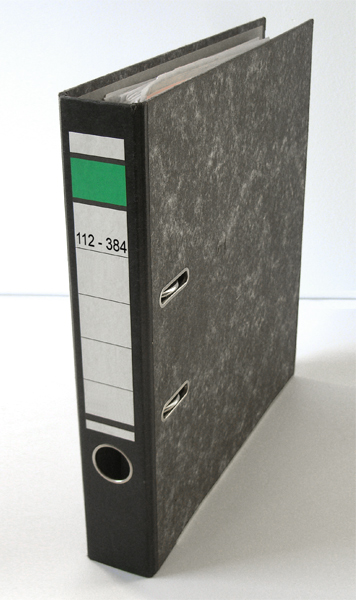
A ring binder, folded

Ring binders (loose leaf binders, looseleaf binders, or sometimes called files in Britain) are large folders that contain file folders or hole punched papers (called loose leaves). These binders come in various sizes and can accommodate an array of paper sizes. These are held in the binder by circular or D-shaped retainers, onto which the contents are threaded. In North America, the rings themselves come in a variety of sizes, including 0.5, 1, 1.5, and 2 inches (13, 25, 38, and 51 mm), though other sizes are also available. The rings may be secured by lever arch[1] mechanisms or other securing systems. The binders themselves are typically made from plastic with metal rings. Early designs were patented during the late 19th century.

History

[edit]

American Henry Tillinghast Sisson invented a "new and useful improvement in portfolios and paper files" he called a "temporary binder." It used a spring inside a tube to hold papers securely. He received patent no. 23506 on April 5, 1859.

German Friedrich Soennecken invented ring binders in 1886 in Bonn.[2][3] He also registered a patent on 14 November 1886 for his Papierlocher für Sammelmappen ("paper punch for binders", or hole punch).[3] German Louis Leitz, founder of Leitz, later made some important changes to the development of ring binders in Stuttgart.[4] Leitz created the lever arch file, a standing binder with a riveted lever arch mechanism (the lever can be easily opened, closed and locked) and space-saving slots into the cover, thereby introducing the modern ring binder.[4][5]

Another design for ring binders was invented in 1889 by Andreas Tengwall in Helsingborg, Sweden, and patented in 1890 under the name "Trio binder", named after a business consortium of Tengwall and two associates. Tengwall's design uses four rings, in two paired sets. The hole placement of Tengwall's trio binder is still used as a de facto standard for hole punching in Sweden under the name triohålning. These holes are 21 millimetres (0.83 in), 70 millimetres (2.8 in), and 21 millimetres (0.83 in) apart.

William P. Pitt obtained patent no. 778070 on December 20, 1904 for a 3-ring binder that became a standard in the United States. The North American de facto standard spacing is 4.25 inches (108 mm) between holes.

Variations

[edit]
Two ring binder lever arch mechanism

Binders come in many standard sizes with respect to both capacity and paper size. Countries that use ISO paper sizes (as specified by ISO 216), which is most countries, use a two- or four-hole system for holding A4 sheets[citation needed]. The ISO standard two holes are 80 millimetres (3.1 in) apart, according to ISO 838. The four-hole version has no ISO standard[citation needed]. The distances between holes are 80 millimetres (3.1 in) (3 × 8).

The most common type in Canada and the United States is a three-ring system for letter size pages (8+12 by 11 inches or 220 mm × 280 mm), whose size is similar to ISO 216-based A4 size. A standard 8+12 by 11 inches (220 mm × 280 mm) sheet of paper has three holes with spacing of 4+14 inches (110 mm). There is a variant for half-letter size pages (8+12 by 5+12 inches or 220 mm × 140 mm), whose three rings are 2+34 inches (70 mm) apart. "Ledger" size binders hold 11-by-17-inch (28 by 43 cm) paper, and may use standard 3-ring spacing or multiple additional rings.

The distance from the punched holes to the nearest edge of the paper is less critical, since small differences do not affect the compatibility of paper and binder. Typical distance from the paper edge to the center of the hole is 0.5 inches (13 mm), and typical diameter of the hole ranges from 0.25 inches (6.4 mm) to 0.31 inches (7.9 mm) in North American usage.

Three ring binder sprung clip mechanism

Japan uses a unique system, referred to as J-Binder. This system is compatible with A4 and B5 paper with different products. The A4 version uses 30 closely spaced rings, while the B5 one uses 26. Less common variants such as a 20 ring A5 version also exist.[6]

Personal organizer with metallic ring binder

Many personal organizers and memorandum books use a six- or seven-hole system, including Filofax and FranklinCovey. Most systems have the rings on the left side of the papers as one opens the binder, but there are also binders that have the rings (concealed by the binder cover) at the top edge of the paper, reminiscent of a clipboard.

There are also various options of binder types such as the commonly used vinyl binders or customizable poly binders, turned edge binders, and sewn binders.

Most binder covers are made of three pieces, in the fashion of a hardback book, with three pieces of board held together with sheets of vinyl or other materials and hinges. Materials vary widely. Some vinyl binders have a clear pocket on the outside for cover pages, and many have pockets in the inner cover for loose papers, business cards, compact discs, etc. There are also zipper binders, which zip the binder up and keep papers from falling out. Some binders are stored in matching slipcases for greater protection; either with one slipcase per each binder, or one slipcase holding several binders.

It is also possible to insert the sheet of paper into a polypropylene sheet protector. The sheet protector has pre-punched holes, so the document can be kept untouched and unwrinkled.

[edit]

See also

[edit]

References

[edit]
[edit]
Revisions and contributorsEdit on WikipediaRead on Wikipedia
from Grokipedia
A ring binder is a loose-leaf binder consisting of a stiff cover with one or more split metal rings attached to the spine, designed to hold perforated sheets of by passing the rings through evenly spaced holes along the 's edge, enabling the easy insertion, removal, and reorganization of pages. These binders typically feature mechanisms that allow the rings to open and close securely, often via levers or triggers, and come in various ring counts—such as two, three, or four—to accommodate different regional standards and paper capacities. The invention of the ring binder emerged in the late amid growing needs for efficient document organization in offices and education. In the 1880s, German entrepreneur Friedrich Soennecken developed an early ring-style binder in , , alongside his innovations in office supplies like the , which standardized paper perforation for such systems. In the United States, precursors appeared with Henry T. Sisson's 1859 for a temporary binder mechanism, though it used rings secured by a spring clamp rather than the split rings of modern designs; the modern three-ring binder, optimized for standard letter-size paper, received its first U.S. in 1904 from William P. Pitt of the Irving-Pitt Manufacturing Company in . This design quickly gained popularity, with commercial production ramping up by companies like Chicago Binder and File Co. in the 1890s, evolving into a staple for binding reports, notebooks, and archival materials. Ring binders vary widely in construction to suit diverse applications, with covers made from durable materials like vinyl, , or over a rigid or chipboard base, often reinforced with metal edges for longevity. Capacities range from small 0.5-inch rings holding about 100 sheets to heavy-duty 3-inch versions accommodating over 500 pages, while features such as clear pockets, dividers, and label holders enhance functionality for students, professionals, and archivists. Today, they remain a versatile, cost-effective tool despite digital alternatives, with global standards differing—such as the two-ring A4 format in versus the three-ring setup in .

Overview

Definition and Purpose

A ring binder is a type of folder featuring a stiff cover and one or more split metal rings mounted on the spine or inside back, designed to secure punched loose-leaf by threading the openable rings through pre-punched holes in the sheets. This mechanism enables the binding of multiple pages while maintaining flexibility for handling. The primary purpose of a ring binder is to facilitate the storage, , and of documents in a modular, reusable manner, allowing pages to be added, removed, or rearranged without altering the overall structure or requiring specialized tools. Unlike permanent binding methods such as stapling, which affixes pages immovably and limits modifications, or perfect binding, which glues pages into a fixed format, ring binders support ongoing editing and customization to suit evolving needs. Known simply as a "binder" in American English and often as a "file" or "loose-leaf binder" in British English, the term "ring binder" emerged in the early 1900s and has since become a universally recognized staple in offices, schools, and homes worldwide for efficient document management.

Basic Components

A ring binder consists of several essential physical elements that work together to organize and secure loose-leaf . The core components include the rings, which are typically made of metal such as nickel-plated and come in configurations of two to four rings per binder, though three rings is the most common standard for US letter-size paper. The spine, the narrow panel along the binding edge, connects the rings to the binder's covers and provides , often mounting round rings directly onto it. Front and back covers, usually constructed from durable materials like , vinyl, or heavy , encase the contents and protect the pages from wear. The mechanism, integrated into the spine or back cover, includes a trigger, , or booster system that allows the rings to open and close securely, preventing accidental detachment of pages. These components interact to hold through a of pre-punched holes aligned with the rings. For standard letter-size (8.5 by 11 inches), sheets must have three holes punched with centers spaced 4.25 inches apart (108 ), matching the ring positions to ensure a secure fit without tearing. The rings pass through these holes when closed, binding the pages firmly to the spine while the covers fold over to enclose everything. In designs with D-shaped or slant-D rings mounted on the back cover, this configuration further reduces stress on the edges during use. In basic operation, the binder's mechanism enables easy access to contents: pressing the trigger or lever opens the rings, allowing users to add or remove pages by sliding them onto or off the rings, after which the rings snap shut to lock the paper in place. This design also permits the binder to lie completely flat when opened, facilitating writing, photocopying, or viewing across both covers without the pages bunching or lifting.

History

Early Inventions

The earliest known precursor to the ring binder was the temporary binder patented by American inventor Henry T. Sisson of , on April 5, 1859, under U.S. Patent No. 23,506. This device was designed as a portable apparatus for securely holding loose sheets such as music, pamphlets, or documents, functioning as an improved portfolio or file. It featured a cylindrical barrel with coiled springs and a rotating shaft that clamped papers using a lapping edge and pointed hooks or teeth inserted through pre-punched holes in the sheets, allowing for easy insertion and removal without permanent binding. The modern ring binder emerged in Germany with the invention of Friedrich Soennecken, a Bonn-based office supplies manufacturer, in 1886. Soennecken's design utilized hinged metal rings mounted on a spine, enabling loose-leaf papers to be punched and inserted or removed as needed, which marked a significant advancement over earlier clamping systems by providing more flexible organization. On November 14, 1886, he filed a German patent (DRP No. 36,089) for a "Papierlöcher für Sammelmappen" (paper punch for collecting folders) to standardize paper perforation for use with the binder. Early ring binders faced challenges related to inconsistent paper punching, as there was no universal standard for hole size, spacing, or number, leading to compatibility issues across different binders and regions. Soennecken's development of the hole punch helped address this by promoting a two-hole European standard, facilitating broader use in offices and schools. Adoption began primarily in Europe, particularly Germany, where Soennecken's company produced and marketed the binders for business and educational purposes starting in the late 1880s, before spreading to other continents.

Key Developments and Patents

In 1889, Swedish inventor Andreas Tengwall developed a ring binder design featuring four rings arranged in two paired sets within a rectangular layout, which he patented in under the name "Trio binder" after a business involving himself and two associates. This configuration, with hole spacing that became a in , remains in use today for its compatibility with local paper formats. Around the turn of the century, German entrepreneur introduced the lever arch file in 1896, a durable standing binder equipped with a riveted mechanism that allows easy opening, closing, and locking while providing space for spine labels. Designed specifically for long-term archiving in offices and libraries, Leitz's innovation emphasized robustness and efficient , influencing European filing systems. In the United States, William P. Pitt of , secured U.S. Patent No. 778070 on December 20, 1904, for a loose-leaf binder featuring three interlocking segmental hooks mounted on plates, secured to a cover back with a spring mechanism to prevent accidental opening. This three-ring design, with standard spacing of 4.25 inches (108 mm) between rings, established the North American norm for school and office use due to its secure hold on letter-sized paper. Following these patents, ring binder production expanded rapidly in the early through mass manufacturing techniques, enabling widespread adoption as a standard office supply. Regional variations persisted, with North America's three-ring system contrasting Europe's preference for two- or four-ring formats adapted to A4 paper dimensions, reflecting localized standards in hole punching and binder compatibility.

Design and Mechanism

Ring Mechanisms

Ring mechanisms in binders consist of hinged metal prongs that form circular or shaped loops to secure punched sheets of , allowing easy insertion and removal while maintaining . These mechanisms are typically mounted on a metal spine within the binder's cover, with the prongs connected to plates that pivot to open and close the rings simultaneously. The design ensures that all rings operate in unison, preventing misalignment of pages. Common types include round rings, also known as O-rings, which feature a fully circular for flexibility and even distribution of pages but may cause slight sagging in heavier loads. D-rings have a flat, straight side along the spine, providing a straighter backbone that allows pages to lie flatter and increases capacity by up to 25% compared to round rings of the same diameter, reducing wear on sheet edges during page turns. Slant D-rings, a variation of D-rings, incorporate a slight angle on the curved side for enhanced page alignment and further minimized damage from bending or tearing. Prong mechanisms refer to the individual hinged prongs that compose these rings, often made of nickel-plated for durability and smooth operation. Opening mechanisms vary by design to facilitate user access. The trigger mechanism, common in North American binders, uses a or connected to a booster bar that lifts the prong plates when activated, allowing rings to snap open quickly without excessive force. Lever arch mechanisms, prevalent in European styles, employ a sliding metal bar or finger hole on the spine that pivots the entire assembly to open the rings, offering robust locking for high-capacity use. These systems are engineered to open smoothly, minimizing stress on punched holes to prevent tearing or deformation of pages. Capacity is determined primarily by ring diameter, with standard ranges from 0.5 to 3 inches. A 0.5-inch diameter typically holds about 100 sheets of 20-pound , while a 1-inch ring accommodates around 200-250 sheets; larger 2-inch rings manage 400-500 sheets, and 3-inch rings up to 600 sheets, depending on paper thickness and ring type—D-rings generally support more due to their . The design of these mechanisms, particularly the rounded prong ends and aligned closure, distributes weight evenly to avoid hole elongation or page creasing, with D-rings excelling by keeping sheets flat against the spine to further protect against damage from repeated handling.

Cover and Binding Structures

The cover of a ring binder serves as the protective outer shell that encloses the internal components and provides structural integrity for organizing loose-leaf papers. Common cover types include those made from , also known as chipboard, which consists of a compressed wood fiber core often overlaid with vinyl for added protection and durability. Flexible poly covers, constructed from or similar plastics, offer lightweight and water-resistant properties suitable for everyday use. Rigid leatherette covers, featuring a faux finish with case-made, turned-edge construction, provide a premium appearance and enhanced rigidity for professional applications. Binding structures in ring binders typically involve the method by which the cover panels are joined and the ring mechanism is integrated, ensuring stability during repeated opening and closing. Spine-mounted rings are the most prevalent style, where the ring mechanism is affixed directly to the spine of the binder for centralized support and even distribution of weight. In contrast, edge-bound configurations position the rings along the inner edge of the back cover, allowing for a flatter spine profile and improved page alignment when the binder is fully loaded. Durability in these structures is often enhanced through hinges, such as scored or Euro-style hinges that create a flexible fold line along the spine, reducing stress on the cover material during use. Some high-end binders incorporate sewn edges, where the cover seams are hand-stitched to prevent fraying and extend the lifespan under heavy handling. Additional structural features contribute to the functionality and longevity of ring binders. Reinforced edges, typically made with metal or tear-resistant materials along the spine and outer borders, protect against splitting and wear from frequent access. Spine labels, often in the form of clear pockets or holders integrated into the spine, allow for easy identification and customization of binder contents without altering the cover. These elements collectively ensure that the cover and binding maintain their form while accommodating the ring mechanism's operation.

Types and Variations

By Size and Capacity

Ring binders vary significantly by regional standards, which dictate sizes, hole configurations, and ring spacings to ensure compatibility with local printing norms. , the predominant standard is the 3-ring binder designed for letter-size measuring 8.5 by 11 inches, with rings spaced 4.25 inches apart to align with standard 3-hole punched sheets. In regions adhering to ISO standards, such as much of , A4-size binders (210 by 297 mm) typically feature 2-ring or 4-ring mechanisms with an 80 mm spacing between rings, accommodating 2-hole or 4-hole punched for enhanced stability. employs a unique 30-ring system for A4 loose-leaf , allowing for finer page adjustments and compatibility with specialized punched sheets that feature closely spaced holes. Capacity in ring binders is primarily determined by ring diameter, which influences the number of sheets that can be securely held without excessive strain on the mechanism. Small binders with 0.5-inch rings typically accommodate around 100 sheets of standard 20 lb , making them suitable for lightweight, everyday use. In contrast, heavy-duty models with 3-inch rings can hold 600 or more sheets, ideal for archival or bulk document storage. Variations extend to non-standard formats, such as half-letter (5.5 by 8.5 inches) for compact notes or (8.5 by 14 inches) for oversized legal documents, where capacities scale proportionally but prioritize specialized punching. Hole punching compatibility is inherently tied to these size standards, requiring precise alignment to prevent tearing or misalignment during insertion. 3-hole punches are incompatible with ISO 80 mm spacing without adapters or elongated holes, while Japanese 30-hole demands binders with matching fine-ring arrays, limiting cross-regional use unless universal punches are employed. This specificity ensures secure binding but necessitates region-appropriate tools for optimal functionality. Binder size directly impacts the balance between portability and storage efficiency, with smaller dimensions favoring on-the-go use at the expense of capacity. Compact half-letter or 0.5-inch ring binders enhance mobility for students or professionals carrying daily notes, weighing less and fitting into bags easily, whereas larger 3-inch letter or A4 models prioritize extensive storage for office archives, though their bulk reduces handheld convenience.

By Style and Features

Ring binders vary in style to accommodate different organizational needs, with ring mechanisms being a primary differentiator. Round ring binders feature circular metal or plastic rings mounted along the spine, allowing pages to lie flat when open but typically holding fewer sheets due to their shape. In contrast, angled binders have one straight side aligned with the spine's edge, providing greater stability by preventing pages from slipping and enabling up to 25-30% more sheet capacity compared to round rings of the same diameter, making them suitable for heavier documents. Zipper binders incorporate a full-zip around the cover, offering enhanced protection against spills, dust, and loss of loose items during transport, often combined with round or D-rings for standard 3-hole punched . These styles frequently include additional compartments like pockets for pens and notes, ideal for mobile use in educational or settings. View binders, meanwhile, feature transparent overlays on the front, back, and spine, permitting users to insert custom-printed covers or labels for personalized presentations without altering the binder's structure. Functional features extend beyond the rings to include interior elements that enhance . Many binders integrate clear inner pockets on the covers for storing unpunched sheets or handouts, while optional dividers—often tabbed and customizable—allow sectioning of contents for quick reference. Sheet protectors, thin sleeves that fit over the rings, safeguard documents from , and expandable spines, which or flex to accommodate varying thicknesses, prevent bulging and maintain a neat appearance as contents grow. Specialized custom ring binders are available from dedicated manufacturers for professional and field applications, such as construction job logs or business notes. These binders often feature printed job notes templates as inserts or sheets for recording job details, vinyl or custom covers, interior lining, built-in pockets, chipboard board construction with reinforced or metal corners, and metal ring mechanisms or hardware. They provide options for custom printing, various ring sizes, and durable materials to meet specific usage requirements. Regional specialties highlight stylistic adaptations for specific purposes. personal organizers employ a 6-ring system in compact sizes like A6 or personal (95 mm wide), with rings arranged in two sets of three spaced 19 mm apart within sets and 51 mm between sets, designed for portability with faux-leather or covers, suiting daily and rather than letter-sized archiving. Similarly, compact 6-ring mini binders are commonly designed specifically for 3x5 index cards (oriented as 3" x 5" or 5" x 3"), with pre-punched refills, dividers, and organizers available for uses such as flashcards, notes, or planning. Standard 3x5 cards may require hole punching for compatibility. This illustrates a specialized variation in ring count and size for small-format document organization. Lever arch binders, prevalent in and countries, use a 2-hole mechanism with a spring-loaded lever for easy insertion and removal of A4 sheets without disturbing others, supporting capacities over 500 sheets and favored for long-term archival storage in offices.

Materials and Construction

Common Materials

Ring binders are commonly constructed using a variety of materials for their covers and rings, selected for , cost-effectiveness, and functionality in binding documents. The cover materials provide and structural integrity, while the rings ensure secure paper retention. is a widely used cover material due to its and water resistance, making it suitable for everyday use in educational and office settings. It offers good tear resistance and flexibility, allowing the binder to lie flat when open, and is often archival-safe as it does not absorb humidity or degrade documents over time. Vinyl serves as another prevalent cover material, prized for its affordability and flexibility compared to more rigid options, though it is typically less flexible than . It provides effective protection against water, dirt, and grease, with strong tear resistance that supports longevity in high-volume applications like legal or files. Vinyl binders often incorporate a chipboard core for added rigidity, enhancing overall stability without significantly increasing cost. Custom vinyl or other custom-printed covers are common in professional applications, and may include interior lining for improved aesthetics and protection, as well as built-in pockets for storing loose sheets or documents. Leather is used for premium ring binders, offering a professional appearance and high durability, though it is more expensive and less water-resistant than synthetic options unless treated. Chipboard functions primarily as a rigid base layer in many binders, particularly those with vinyl or fabric overlays, offering a sturdy foundation that resists bending under load. This material contributes to cost efficiency while maintaining structural integrity, though it is less water-resistant on its own and thus often paired with protective coverings. In custom and heavy-duty ring binders, chipboard construction is frequently reinforced with metal corners to protect against wear and impact at the edges, enhancing longevity in demanding professional or field work environments. For the ring mechanisms, nickel-plated is the standard choice, valued for its strength and resistance, which prevents in humid environments and ensures reliable opening and closing over repeated use. These metal ring mechanisms and hardware provide high load-bearing capacity without or splitting, integrating seamlessly with the binder's cover structure for smooth operation. Plastic rings, while lightweight and cheaper, are less common in traditional ring binders and are more typically found in specialty or low-cost loose-leaf applications.

Manufacturing Processes

The manufacturing of ring binders begins with the preparation of the cover components. Chipboard or is cut into precise shapes using die-cutting machines to form the front, back, and spine sections, often from a single sheet for efficiency. These sections are then laminated with outer materials such as (PVC), , or fabric, which are bonded to the core using and processes to create a durable exterior while trimming away excess material. For custom binders, additional features like interior pockets or linings may be added during this stage or through separate assembly steps. Next, the ring mechanism is attached to the spine. This involves riveting or the metal rings—typically made from high-quality wire—to a base plate, which is then secured to the spine via rivets or screws for stability. Mechanisms like D-shaped rings or lever-arch types may include additional components such as triggers or boosters, added during automated assembly to enable smooth opening and closing. For polypropylene binders, the single-piece construction simplifies this step by integrating the mechanism directly without extensive riveting. In custom constructions, metal hardware for corners or other reinforcements may be attached similarly. In modern factories, supports high-volume production through assembly machines, die-cutting, laminating lines, and riveting systems that ensure precision and consistency. These systems process thousands of units daily, ensuring consistency in for insertion and overall assembly. is embedded throughout the process to verify performance. Ring durability is tested through cycle simulations, where mechanisms undergo thousands of open-and-close operations to assess tension and resistance, often meeting industry standards for at least 5,000 cycles without failure. Cover is evaluated via peel strength tests to confirm the bond between the laminate and core withstands bending and environmental stress, preventing . In-process inspections, including dimensional checks and material integrity scans, ensure compliance before final packaging.

Applications and Usage

In Education and Business

Ring binders have been a staple in American since the early , following their starting in 1899, and remain prevalent for organizing student materials across K-12 and higher education settings. Estimates indicate that 50 to 60 million ring binders are sold annually in the United States alone, underscoring their widespread adoption in schools. In educational contexts, ring binders function as versatile student notebooks and project folders, accommodating loose-leaf paper for handwritten notes, printed assignments, worksheets, and reference materials. Their design supports modular organization through the use of dividers, tabs, and pocket inserts, allowing students to categorize content by subject, unit, or topic for quick access during class or study sessions. This flexibility enables easy updates, such as adding new pages, removing completed work, or rearranging sections to reflect evolving curricula or project requirements, promoting better retention and efficiency in academic workflows. Business rely on ring binders for compiling reports, preparing client presentations, and developing manuals, where their capacity to hold substantial volumes of documents with sectional dividers ensures structured and delivery. For instance, manuals often incorporate ring binders to allow incremental additions or revisions to modules, such as policy updates or procedural guides, without reprinting entire volumes. In presentations, customizable covers and interior pockets facilitate the inclusion of handouts, charts, or samples, enhancing clarity and impact during meetings or pitches.

Specialized Applications

Ring binders are widely utilized in personal organization for creating customizable planners, photo albums, and recipe collections. Individuals often employ three-ring binders with clear page protectors to assemble personal planners, allowing for the insertion of calendars, to-do lists, and notes that can be easily rearranged or updated. For photo albums, archival-quality binders with acid-free sleeves protect printed photographs from degradation, enabling users to organize images chronologically or thematically while maintaining accessibility for viewing. Recipe binders, typically featuring sheet protectors and dividers, consolidate printed recipes, clippings, and handwritten notes into a single, spill-resistant volume that facilitates meal planning and cooking. Mini 6-ring binders are specifically designed for organizing 3x5 index cards in a compact and highly portable format. These mini binders accommodate standard 3x5 index cards (often oriented as 3" x 5" or 5" x 3"), with many products including pre-punched refills, dividers, and organizers. They are commonly used for educational flashcards, personal note-taking, address books, small recipe collections, and planning purposes, offering convenient on-the-go access and easy reorganization. Standard 3x5 cards may require punching if not pre-punched. In creative applications, ring binders support scrapbooking by providing a flexible structure for mounting memorabilia, patterned papers, and embellishments within protective sleeves, allowing pages to lie flat for detailed layouts. Art portfolios benefit from durable binders with heavyweight covers and non-glare sleeves, which safeguard drawings, paintings, and sketches during transport and presentation to galleries or clients. For DIY storage of collectibles, such as trading cards or ephemera, binders with nine-pocket pages offer an organized, expandable system that prevents damage from bending or exposure, often customized with thematic dividers for categorization. Niche professional uses include medical record management, where heavy-duty, top- or side-opening binders with reinforced rings hold charts, logs, and forms in healthcare settings, ensuring quick access and compliance with standards. In legal fields, arch binders with locking mechanisms organize case files, contracts, and documents, accommodating thick volumes without ring misalignment during frequent reference. Libraries and archives favor arch or archival-grade ring binders for preserving , manuscripts, and periodicals, as their robust construction and acid-free materials support long-term storage while allowing non-destructive page turning. In specialized professional and field applications, particularly in construction and similar on-site work, custom ring binders serve as practical tools for recording job details and maintaining business notes. These binders frequently incorporate job notes templates, either as printed inserts or dedicated sheets, to systematically log project information such as daily activities, observations, materials used, and progress updates. Common features include vinyl or custom-printed covers for branding and protection, interior lining, built-in pockets for loose documents or small items, chipboard board construction reinforced with metal corners for durability, and high-quality metal ring mechanisms or hardware to securely hold pages. Specialized manufacturers provide customization options such as custom printing, various ring sizes to accommodate different capacities, and selection of durable materials suited to rugged field environments. These binders support efficient, organized record-keeping in demanding professional contexts where portability and quick reference are essential.

Advantages and Limitations

Benefits

Ring binders offer significant flexibility in document management, allowing users to easily insert, remove, or rearrange pages without the need for specialized tools or adhesives. This adaptability makes them ideal for ongoing projects where content frequently changes, enabling quick updates and customization to suit evolving needs. Additionally, their reusable design supports multiple applications over time, reducing the need for frequent replacements and promoting efficient resource use across various tasks. In terms of , ring binders facilitate structured storage through the integration of dividers, tabs, and indexing systems, which enable rapid location and access to specific documents. The ring mechanism allows the binder to lie completely flat when open, facilitating comfortable reading, note-taking, or photocopying without the pages curling or shifting. This setup minimizes clutter and enhances productivity by grouping related materials thematically or by priority. Ring binders provide effective protection for enclosed pages, safeguarding them from everyday wear, dust accumulation, and physical damage that loose sheets might otherwise sustain. Their durable covers and secure ring closure help preserve document integrity over extended periods, particularly in educational or professional environments where binders are handled regularly. Compared to unbound papers, this containment reduces the risk of loss or deterioration, ensuring long-term usability.

Drawbacks

Ring binders, particularly those with larger capacities, occupy significantly more physical space than digital storage solutions or permanently bound alternatives, making them less convenient for portability and shelf organization. For instance, reports submitted in three-ring binders are often considered bulky and require removal from the binder for processing due to their cumbersome nature. This bulkiness becomes especially pronounced when accommodating high volumes of pages, as the added thickness and weight can hinder easy handling in office or educational settings. Durability issues are common with ring binders, where the metal rings can snag or tear pages during insertion or removal if not gap-free, leading to damage in frequently used environments. Additionally, the rings themselves may become misaligned or break under repeated stress, compromising the binder's functionality over time. Vinyl covers, a standard material, are prone to cracking—particularly in cold temperatures—due to the material's tendency to shrink and become brittle, resulting in splits along edges or hinges. From an environmental perspective, ring binders contribute to plastic waste, with an estimated 50 to 60 million units sold annually in the United States, many featuring non-biodegradable vinyl that ends up in landfills. The combination of covers, metal rings, and sometimes components complicates , as most curbside programs reject them due to contamination risks, and PVC variants are especially challenging to process without specialized facilities. While recyclable options made from or post-consumer materials are available, the prevalence of disposable vinyl models exacerbates if not properly managed.

References

Add your contribution
Related Hubs
User Avatar
No comments yet.