


Community hub
Recent from talks
Contribute something
Nothing was collected or created yet.
Vernonia amygdalina
View on Wikipedia
| Vernonia amygdalina | |
|---|---|

| |
Scientific classification 
| |
| Kingdom: | Plantae |
| Clade: | Tracheophytes |
| Clade: | Angiosperms |
| Clade: | Eudicots |
| Clade: | Asterids |
| Order: | Asterales |
| Family: | Asteraceae |
| Genus: | Vernonia |
| Species: | V. amygdalina
|
| Binomial name | |
| Vernonia amygdalina | |
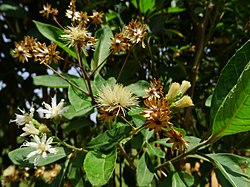
Vernonia amygdalina, a member of the daisy family, is a small to medium-sized shrub that grows in tropical Africa. V. amygdalina typically grows to a height of 2–5 m (6.6–16.4 ft). The leaves are elliptical and up to 20 cm (7.9 in) long. Its bark is rough.[1]
V. amygdalina is commonly called bitter leaf in English because of its bitter taste.[2][3][4]
Uses
[edit]Food
[edit]

The leaves are a major ingredient in preparation of ofe onugbu (bitter leaf soup) popular and culturally relevant amongst the Igbo people of Eastern Nigeria. They are dried to reduce breakage before washing to reduce bitterness. In Eastern Nigeria, the water also serves as a stomachache remedy, and leaves are also used in place of hops to brew beer.[5]
In Cameroon the leaves are used to cook Ndole one of its national dishes.
Other
[edit]In Nigeria, twigs and sticks from this plant are used as a chewing stick for dental hygiene and the stems are used for soap in Uganda. In Ghana, the young leaves rather than the old, has gained credence for its potent anti-diabetic and anti-inflammatory activity; and have been proven using animal models.[6][7]
In the Northern part of Nigeria, it has been added to horse feed to provide a strengthening or fattening tonic called 'Chusar Doki' in Hausa.[citation needed]
Zoopharmacognosy
[edit]In the wild, chimpanzees have been observed to ingest the leaves when suffering from parasitic infections.[8]
References
[edit]- ^ Ijeh II; Ejike CECC (2011). "Current perspectives on the medicinal potential of Vernonia amygdalina Del". J Med Plant Res. 5 (7): 1051–1061.
- ^ Farombi, E. O.; Owoeye, O. (2011). "Bitter leaf". International Journal of Environmental Research and Public Health. 8 (6): 2533–2555. doi:10.3390/ijerph8062533. PMC 3138040. PMID 21776245.
- ^ Kokwaro, John (2009). Medicinal Plants of East Africa (3rd ed.). Nairobi, Kenya: University of Nairobi Press. ISBN 978-9966-846-84-6.
- ^ Appiah, Kwame (2018). "Medicinal Plants Used in the Ejisu-Juaben Municipality, Southern Ghana: An Ethnobotanical Study". Medicines. 6 (1): 1–27. doi:10.3390/medicines6010001. PMC 6473417. PMID 30577439.
- ^ Pieroni, Andrea (2005). Prance, Ghillean; Nesbitt, Mark (eds.). The Cultural History of Plants. Routledge. p. 31. ISBN 0-415-92746-3.
- ^ Asante, Du-Bois; et al. (2016). "Antidiabetic Effect of Young and Old Ethanolic Leaf Extracts of Vernonia amygdalina: A Comparative Study". Journal of Diabetes Research. 8252741 8252741. doi:10.1155/2016/8252741. PMC 4884890. PMID 27294153.
- ^ Asante, Du-Bois; et al. (2019). "Anti-inflammatory, anti-nociceptive and antipyretic activity of young and old leaves of Vernonia amygdalina". Biomedicine & Pharmacotherapy. 111: 1187–1203. doi:10.1016/j.biopha.2018.12.147. PMID 30841432.
- ^ Huffman, M.A.; Seifu, M. (1989). "Observations on the illness and consumption of a possibly medicinal plant Vernonia amygdalina (Del.), by a wild chimpanzee in the Mahale Mountains National Park, Tanzania". Primates. 30: 51–63. doi:10.1007/BF02381210. S2CID 12090279.
External links
[edit]Vernonia amygdalina
View on GrokipediaTaxonomy
Classification
Vernonia amygdalina Delile, currently treated as a synonym of Gymnanthemum amygdalinum (Delile) Sch. Bip. ex Walp. by some taxonomic authorities such as Plants of the World Online (POWO),[6] though Vernonia amygdalina remains widely used, is classified within the kingdom Plantae, phylum Tracheophyta, class Magnoliopsida, order Asterales, family Asteraceae, tribe Vernonieae, genus Gymnanthemum, and species G. amygdalinum. Despite the reclassification, the name Vernonia amygdalina continues to be the most commonly used in scientific and popular literature due to its widespread recognition. The species was first described by Alire Raffeneau-Delile as Vernonia amygdalina in 1826, based on specimens from the Nile Valley during the French expedition to Egypt.[7] It was subsequently transferred to the genus Gymnanthemum by Karl Heinrich Schmidt (Schultz Bip.), as published in Walpers' Repertorium Botanices Systematicae in 1843, reflecting revisions in the delimitation of genera within the tribe Vernonieae.[6][8] The genus Gymnanthemum belongs to the tribe Vernonieae, one of the largest tribes in the Asteraceae family, encompassing approximately 1,500 species distributed primarily in tropical and subtropical regions.[9] Historically, V. amygdalina was placed in the genus Vernonia, which historically comprised around 1,000 species, many of which are tropical shrubs or herbs, but now includes approximately 350 species following phylogenetic revisions, but phylogenetic studies have supported its reclassification into Gymnanthemum based on morphological and molecular evidence.[10] Notable synonyms include Gymnanthemum amygdalinum, Vernonia sylvestris Oliv. & Hiern, and Vernonia randii S. Moore, arising from regional floras and earlier taxonomic treatments.[6][11]Nomenclature
The binomial name Vernonia amygdalina was established by the French botanist Alire Raffeneau-Delile and first validly published in 1826 in Centuriae Plantarum Africae from the voyage to Méroé.[7] Although some early descriptions appeared in works associated with the Description de l'Égypte around 1813, the formal nomenclatural publication occurred in 1826. Note that V. amygdalina is currently treated as a synonym of Gymnanthemum amygdalinum (Delile) Sch. Bip. ex Walp. in some taxonomic systems, reflecting revisions within the Asteraceae family.[6] The genus name Vernonia honors William Vernon (died 1711), an English botanist and plant collector who explored regions including North America in the late 17th century.[12] The specific epithet amygdalina derives from the Latin amygdala, meaning "almond," in reference to the almond-like shape and appearance of the plant's leaves.[13] Common names for Vernonia amygdalina vary across its native African range, often reflecting its characteristic bitter taste. In English, it is widely known as bitter leaf. Regional names include ewuro among the Yoruba people of Nigeria, onugbu in Igbo, shiwaka or chusar-doki in Hausa, ndolé in French-speaking Cameroon, and other variations such as grawa in Amharic (Ethiopia) and mululuza in Luganda (Uganda).[14]Description
Morphology
Vernonia amygdalina is a perennial shrub or small tree that typically grows to a height of 2–5 meters, occasionally reaching up to 7–10 meters under favorable conditions, with a bushy habit featuring multiple stems arising from the base.[15][2][16] The plant exhibits a woody structure at the base, with slender, erect, and highly branched stems that become rough and longitudinally fissured with age.[16][15] Young stems are green, while mature ones develop grayish to brown bark that is flaky and rough.[2][15] The leaves are simple, arranged alternately on the stems, and are elliptic to lanceolate or oblong in shape, measuring 6–20 cm in length and 1.5–7 cm in width.[2][15] They are medium to dark green, glabrous or slightly pubescent, with a short petiole of 1–2 cm, tapering at both apex and base, and margins that are entire or finely toothed; prominent red veining is often visible.[2] The characteristic bitterness of the leaves is attributed to sesquiterpene lactones such as vernolide, vernodalol, and vernomygdin.[17][18] The root system is fibrous and shallow, aiding nutrient uptake from surface soils in its native tropical habitats.[19]Phenology
Vernonia amygdalina, a perennial shrub native to tropical Africa, displays a phenological cycle adapted to seasonal rainfall patterns, with rapid vegetative growth occurring primarily during the rainy season when high yields of new shoots and leaves are produced. This vigorous expansion supports the plant's establishment and maintenance, enabling it to reach reproductive maturity within 6-12 months under optimal humid conditions.[20] Flowering takes place year-round in tropical environments but peaks during the dry season, typically from November to February in West African regions such as Benin, with additional blooming possible in May to July during the rainy period.[21] The flowers are small, measuring 5-7 mm in diameter, and range from creamy white to slightly purplish or mauve, often emitting a sweet scent especially at night; they form in dense, terminal or axillary panicles 10-20 cm long.[22] Each inflorescence comprises discoid capitula containing 10-24 bisexual florets, with tubular corollas that are 5-lobed, 5.3-8.2 mm long, and strongly exserted. Post-anthesis, these develop into cypselae in the form of achenes, which are 1.5-3.5 mm long, 10-ribbed, pubescent, glandular, and brown to black, topped by a pappus of numerous white bristles longer than the achene itself to aid anemochorous dispersal.[23] The seeds exhibit short-term viability, typically remaining germinable for 1-2 years before gradual loss of potency under storage.[22]Distribution and habitat
Geographic range
Vernonia amygdalina is native to tropical and subtropical Africa, where it occurs widely across the continent from Senegal and Gambia in the west, extending eastward to Ethiopia and Somalia, and southward to Angola, Zimbabwe, and northeastern South Africa, and in Yemen. This distribution spans humid and sub-humid zones, with the plant commonly found in wild populations throughout sub-Saharan countries. The species likely originated in West Africa, serving as a center of diversity for the genus in the region.[24] The plant has been introduced and cultivated outside its native range through human activities, including migration and trade dating back to pre-colonial periods. In Asia, it is grown in countries such as India and Indonesia for medicinal and culinary purposes. In the Americas, introductions include eastern Brazil, where it is naturalized in some areas, and the United States, primarily for ethnobotanical research and small-scale cultivation. In Europe, V. amygdalina is maintained in controlled environments like greenhouses due to climatic limitations, supporting scientific studies on its properties. These introduced distributions reflect the plant's adaptability and cultural significance beyond Africa, though it remains most prevalent in its native habitats.Ecological preferences
Vernonia amygdalina thrives in humid tropical lowlands, including forest edges, secondary bushlands, riverine areas, and disturbed sites, typically at altitudes ranging from 0 to 2,800 meters.[2] It is commonly found along rivers and lakes, in woodland, grassland, and forest margins, where it benefits from partial shade to full sun exposure.[25] This species exhibits adaptability to various disturbed habitats, contributing to its widespread occurrence in tropical African ecosystems.[25] The plant prefers well-drained loamy or humus-rich soils with a pH range of 5.5 to 7.5, though it can tolerate a broader spectrum of soil types, including those with moderate fertility.[26] Climatically, it flourishes in regions with annual rainfall between 750 and 2,000 mm and mean temperatures of 20–30°C, showing some drought tolerance once established.[25][27] These conditions support its growth in warm, moist environments typical of sub-Saharan Africa. Ecologically, Vernonia amygdalina is primarily pollinated by insects, including bees from the family Apidae, which facilitate cross-pollination through entomophilous mechanisms.[28] It serves as a nectar source and host plant for butterflies, enhancing biodiversity in its habitats.[29] The plant exhibits allelopathic effects, where its leaf extracts inhibit seed germination and seedling growth of nearby weeds, such as Sesamum indicum, thereby reducing competition.[30] It is browsed by herbivores, but its characteristic bitterness, due to sesquiterpene lactones and steroid glucosides, deters excessive grazing.[24] Regarding conservation, local populations may decline due to deforestation and habitat loss in parts of its range. Its resilience and wide distribution support stable populations in suitable ecosystems.[31]Cultivation
Propagation methods
Vernonia amygdalina can be propagated through both sexual and vegetative methods, with both approaches commonly used despite challenges associated with seed viability and germination.[32][21] Seed propagation involves sowing fresh seeds directly in nursery beds or trays prepared with well-drained, humus-rich soil. Seeds should be planted as soon as possible after collection to maximize viability, as they lose germination potential rapidly if stored. Germination typically occurs within 8-10 days under suitable conditions, though rates are often low, particularly for seeds harvested during the rainy season. Seedlings are ready for transplanting to the field 4-6 weeks after emergence, once they have developed 4-6 true leaves.[32][33][21][25] Vegetative propagation is more reliable for clonal reproduction and commonly used, primarily through stem cuttings taken from mature plants. Cuttings of 10-15 cm in length, including 4-5 nodes from the middle portion of healthy branches, are harvested and planted directly in prepared beds or pots filled with sandy or loamy soil under partial shade to promote rooting. These cuttings establish roots within 2-4 weeks and achieve high establishment rates.[34][35][36] Key challenges in propagation include the rapid loss of seed viability, which limits large-scale seed-based production, and variable success with cuttings in humid environments where fungal infections can occur. To mitigate these, propagators often prioritize dry-season seeds and ensure good drainage and ventilation for cuttings. These methods align with the plant's natural reproductive cycles but are adapted for controlled agricultural settings.[33][21][36]Growing conditions
Vernonia amygdalina thrives in tropical and subtropical climates, where it is sensitive to frost and requires full sunlight for optimal growth, though it can tolerate partial shade. It prefers humid environments but demonstrates notable drought tolerance once established, making it suitable for regions with annual rainfall between 750 and 2000 mm. It grows well in soils with pH 6.0–7.5 and temperatures of 20–30°C.[37][2][38][39][40] The plant performs best in fertile, well-drained soils rich in humus, but it adapts to a variety of soil types, including poor and sandy conditions, with improved yields when supplemented with organic manure. For cultivation as hedges or crops, spacing of 1-2 meters between plants is recommended to allow for proper growth and air circulation.[14][2][41] Effective management involves regular pruning of stems to promote bushiness and increase leaf production, alongside irrigation during extended dry periods to support establishment. Common pests such as aphids, caterpillars, and leaf miners require monitoring and control measures, often using natural extracts to minimize damage. In well-managed plots, annual leaf yields can reach 5-10 tons per hectare of fresh leaves.[42][43][44] Commercial production remains primarily small-scale in African countries like Nigeria and Cameroon, where it is cultivated for local vegetable and herbal markets, with emerging interest in Asia for export of medicinal products. Harvesting occurs in cycles every 4-6 weeks to sustain yields from perennial plants.[21][15][45]Traditional uses
Culinary applications
Vernonia amygdalina, commonly known as bitter leaf, is a staple green vegetable in various African cuisines, particularly in West and Central Africa, where its leaves are prepared to mitigate their inherent bitterness before incorporation into meals. The leaves are typically washed repeatedly—often 10 or more times—by soaking in warm water, squeezing, and draining to reduce the bitter taste, a process sometimes enhanced with salt or hot water abrasion. Alternatively, the leaves may be boiled, blanched, pounded into a paste, or fermented for several days at room temperature to further soften the flavor and improve palatability. These preparations allow the plant to be consumed fresh, dried, or rehydrated, making it versatile for both daily cooking and preservation in regions with seasonal availability. In West African cuisine, particularly in Nigeria, the prepared leaves serve as a key ingredient in hearty soups and stews, such as the traditional bitter leaf soup (ofe onugbu), which combines them with palm oil, meat, fish, and seasonings, often served alongside fufu or garri. Bitter leaf is also incorporated into egusi soup, a popular Yoruba dish featuring ground melon seeds, where it adds a distinctive tangy depth to the thick, nutty broth. In Cameroon, a neighboring Central African country, the leaves feature prominently in ndolé, the national stew made with ground peanuts, bitter leaf, shrimp or beef, and spices, typically paired with plantains or bobolo. These dishes highlight the plant's role in nutrient-dense, communal meals that form the backbone of regional diets. Regional variations reflect local culinary traditions, with West Africa emphasizing soups and stews for their comforting, one-pot nature, while East African uses are more limited but include the leaves as a green vegetable in Kenyan side dishes or as a bittering agent in Ethiopian fermented beverages like tej (honey wine) and tella (beer). In broader East African contexts, such as Ethiopia, the plant contributes to vegetable-based accompaniments that complement staples like injera. As a dietary component, Vernonia amygdalina provides essential vitamins (A, C, E) and dietary fiber when consumed fresh or dried, contributing to the nutritional balance in traditional African meals and supporting food security in rural communities. Its integration into everyday and celebratory foods underscores its cultural importance as a resilient, locally sourced ingredient.Medicinal applications
Vernonia amygdalina, commonly known as bitter leaf, has been integral to traditional healing practices across sub-Saharan Africa for centuries, particularly in ethnomedical systems where it serves as a versatile remedy for various ailments.[46] Ethnobotanical records document its longstanding use in Nigerian and Central African communities for treating fevers and digestive disorders through oral and topical applications.[2] In these traditions, the plant's leaves, stems, and roots are harvested fresh or dried, reflecting a deep cultural reliance on its perceived therapeutic potency derived from bioactive compounds.[1] Traditional preparations primarily involve decoctions and infusions of the leaves, which are boiled in water to extract active principles, while poultices are made by crushing fresh leaves for direct application to affected areas.[47] These methods are employed for treating malaria as an antipyretic, diabetes to aid blood sugar control, hypertension, and digestive issues including as a laxative and antihelminthic agent.[48] Topical poultices address skin infections, such as fungal and bacterial conditions, by applying the paste to wounds or inflamed areas.[3] In cultural contexts, Vernonia amygdalina holds specific significance among Nigerian ethnic groups; in Yoruba traditions (southwest Nigeria), it is used to promote fertility through infusions believed to enhance reproductive health.[1] Among the Igbo (southeast Nigeria), it features in detoxification rituals for cleansing the body and liver, often as part of broader purification ceremonies.[49] Additionally, the plant extends to veterinary applications, where farmers in Nigeria and other African regions administer leaf extracts to livestock to control gastrointestinal parasites, serving as a natural anthelmintic alternative.[50] These uses underscore its multifaceted role in sustaining community health without delving into underlying mechanisms.Phytochemical composition
Major compound classes
Vernonia amygdalina contains a diverse array of phytochemicals, predominantly secondary metabolites that contribute to its medicinal properties. The primary compound classes include sesquiterpene lactones, flavonoids, alkaloids, saponins, tannins, steroids, and phenolic acids, primarily isolated from the leaves, which serve as the main source of bioactive constituents.[1][51] Sesquiterpene lactones represent one of the most prominent classes in Vernonia amygdalina, characterized by their α-methylene-γ-lactone functionality. Key examples include vernodalin (C₁₉H₂₀O₇), vernomygdin, and hydroxyvernodalin, which were first isolated from the leaves through solvent extraction and chromatographic separation techniques. These compounds exhibit anti-inflammatory and cytotoxic activities, contributing to the plant's traditional uses.[52][53][54] Flavonoids, another major group, are abundant in the leaf extracts and include luteolin and its glycosylated derivative, luteolin-7-O-glucoside (also known as luteolin 7-O-β-glucoside). These flavones have been quantified in methanol extracts using high-performance liquid chromatography (HPLC), highlighting their antioxidant potential. Luteolin and luteolin-7-O-glucoside are typically isolated via ethanol or methanol extraction followed by purification.[55][1][56] Additional compound classes encompass alkaloids such as vernonioside (a steroid alkaloid-like glycoside), saponins, tannins, steroids like β-sitosterol, and phenolic acids including chlorogenic acid. Vernoniosides A₁–A₃, for instance, are bitter steroid glucosides isolated from leaf ethanol extracts, while β-sitosterol and chlorogenic acid have been identified in various solvent fractions. Saponins and tannins are present as polyphenolic and glycosidic compounds, contributing to the plant's astringent qualities.[57][58][59] Phytochemical extraction from Vernonia amygdalina leaves is commonly achieved using polar solvents such as methanol or ethanol, often at 70–80% concentrations, to yield crude extracts rich in these classes. Yields from methanol extraction can reach 13.3% of dry leaf weight, with sesquiterpene lactones and flavonoids concentrating highest in leaves at levels up to 1–5% dry weight for sesquiterpenes in optimized extractions. Ethanol extracts similarly provide high recoveries of saponins (up to 27 mg/g) and other metabolites, facilitating isolation through techniques like liquid-liquid partitioning and chromatography.[60][61][2]Nutritional profile
Vernonia amygdalina leaves provide a modest caloric content, with approximately 20-52 kcal per 100 g of fresh weight, primarily derived from carbohydrates and protein. The macronutrient profile includes 3-5.2 g of protein, 0.4-0.62 g of fat, 4-6 g of carbohydrates, and 1.6-3 g of dietary fiber per 100 g fresh leaves.[17][62] The leaves are notably rich in vitamins, particularly provitamin A from β-carotene, ranging from 5,000-23,500 IU per 100 g fresh weight, supporting visual and immune health. Vitamin C content is high at 50-337 mg per 100 g, contributing to antioxidant protection, while B vitamins such as thiamine (0.16 mg/100 g) and riboflavin (0.22 mg/100 g) are present in moderate amounts.[63][64][2] Mineral composition enhances the dietary value, with iron at 2.4-8 mg per 100 g fresh leaves, calcium at 67-200 mg, potassium at 300-950 mg, and magnesium at 48-163 mg. These levels position Vernonia amygdalina as a valuable source of bioavailable minerals in traditional diets.[62][2] Nutrient concentrations are generally higher in young leaves compared to mature ones, reflecting greater accumulation during early growth stages. Traditional debittering processes, such as washing or boiling, can reduce water-soluble vitamins like C and certain B vitamins by 20-50%, though macronutrients and minerals remain relatively stable. In culinary applications, this profile underscores its role as a nutrient-dense leafy green.[2][65]| Nutrient | Content per 100 g Fresh Leaves (Range) | Key Source |
|---|---|---|
| Energy | 20-52 kcal | Omicsonline (2015) |
| Protein | 3-5.2 g | Omicsonline (2015) |
| Fat | 0.4-0.62 g | Omicsonline (2015); Taylor & Francis (2019) |
| Carbohydrates | 4-6 g | Derived from proximate analyses |
| Fiber | 1.6-3 g | Taylor & Francis (2019) |
| Vitamin A (as β-carotene) | 5,000-23,500 IU | Taylor & Francis (2019) |
| Vitamin C | 50-337 mg | Scholars Research Library (2014) |
| Iron | 2.4-8 mg | Taylor & Francis (2019); Frontiers (2024) |
| Calcium | 67-200 mg | Taylor & Francis (2019); Frontiers (2024) |
| Potassium | 300-950 mg | Frontiers (2024) |
| Magnesium | 48-163 mg | Taylor & Francis (2019); Frontiers (2024) |