


Community hub
Recent from talks
Contribute something
Nothing was collected or created yet.
Bougival
View on WikipediaBougival (French pronunciation: [buʒival] ⓘ) is a suburban commune in the Yvelines department in the Île-de-France region in Northern France. It is located 15.3 km (9.5 mi) west from the centre of Paris, on the left bank of the River Seine, on the departmental border with Hauts-de-Seine. In 2019, Bougival had a population of 8,790.
Key Information


.svg)


As the site where many of the Impressionists (including Claude Monet, Alfred Sisley, Berthe Morisot and Auguste Renoir) painted country scenes along the Seine, the town today hosts a series of six historical placards, known as the "Impressionists Walk", at locations from which the noted painters depicted the scenes of Bougival.[3]
Bougival is also noted as the site of the Machine de Marly, a sprawling, complicated[4] hydraulic pumping device that began supplying the massive quantity of water required by the fountains at Palace of Versailles in the late 17th century. Considered one of the foremost engineering accomplishments of its era, the cacophonous, breakdown-prone[4] apparatus comprised fourteen waterwheels (approximately 38 feet in diameter) driven by the current of the Seine — in turn powering more than 250 pumps, delivering water up a 500-foot vertical rise through a series of pumping stations, holding tanks, reservoirs, pipes and mechanical linkages. In use until 1817, the machine was subsequently updated, replaced with another pumping building in 1858 and finally replaced by an electrical generator in 1963. The building itself remained until 1968. Remnants are visible today at the riverbank.[4]
In Bougival, Georges Bizet composed the opera Carmen at his home on Rue Ivan Tourguenievf on the Seine,[3] close to where Russian novelist and playwright Ivan Turgenev had a dacha built, named Les Frênes (current-day Villa Viardot). A local monument commemorates the Montgolfier brothers, pioneers of flight;[3] the commune hosts the annual Festival of Bougival et des Coteaux de Seine.
History
[edit]In the 19th century, Bougival emerged as a fashionable suburb of Paris. Pauline Viardot had a villa there, as did her paramour Ivan Turgenev, who died in the town in 1883. Bougival was also known as the "Cradle of Impressionism" during the Belle Époque. Painters Monet, Pierre-Auguste Renoir, and Sisley among others painted the light, sky, and water of this area. Alexandre Dumas, fils set parts of his novel The Lady of the Camellias in Bougival.
The Junior division of the British School of Paris (formerly the English School of Paris) was located in Bougival up until 2008. Prior to the English School, it was a Catholic all-girls school called Marymount in the 1960s. It was reported that the Germans occupied the estate during World War II, along with the nuns that lived there, due to the estate's vantage point of the Seine River. Rennequin Sualem
Demographics
[edit]| Year | Pop. | ±% p.a. |
|---|---|---|
| 1968 | 8,444 | — |
| 1975 | 8,599 | +0.26% |
| 1982 | 8,473 | −0.21% |
| 1990 | 8,552 | +0.12% |
| 1999 | 8,432 | −0.16% |
| 2007 | 8,416 | −0.02% |
| 2012 | 8,498 | +0.19% |
| 2017 | 8,699 | +0.47% |
| Source: INSEE[5] | ||
Transport
[edit]Bougival is served by Bougival station on the Transilien Paris-Saint-Lazare suburban rail line. This station is located at the border between the commune of Bougival and the commune of La Celle-Saint-Cloud, on the La Celle-Saint-Cloud side of the border.
Two multiple locks on the River Seine are located in Bougival.
Education
[edit]Schools in Bougival include:[6]
Public preschools:
Public elementary schools:
- Ecole élémentaire Claude Monet
- Ecole élémentaire Auguste Renoir
There is a private school, Ecole privée Sainte-Thérèse/Collège privée Sainte Thérèse, that goes from preschool through junior high school level 3e.[6]
Nearby public secondary schools:[7]
Junior high schools:
- Collège Jean Moulin – Croissy-sur-Seine
- Collège Victor Hugo – La Celle-Saint-Cloud
- Collège Pasteur – La Celle-Saint-Cloud
- Collège Pierre et Marie Curie – Le Pecq
Senior high schools/sixth form colleges:
- Lycée Corneille (La Celle Saint Cloud)
The Bibliothèque Emile Richebourg is the community's public library.[8]
Notable residents
[edit]Rennequin Sualem, inventor of the Marly Machine, died in Bougival in 1708. Ivan Turgenev died in Bougival in 1883, as well as Georges Bizet in 1875. Pauline Viardot made Bougival her home. Gabrielle d'Estrées had a château there (destroyed in the 19th century).
The town has since been home to noted residents including Guillaume Depardieu, Jean-Louis Aubert, Michel Rocard, Laurent Garnier, Jean-Marie Hullot, Jean Michel Jarre, Benjamin Castaldi, Neymar, Charles-Louis Havas and Gilbert Montagné have been residents of Bougival.
-
 The locks of the River Seine at Bougival
 -
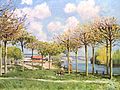 The Seine at Bougival, painted by Alfred Sisley in 1876
 -
 Dance at Bougival, painted by Pierre-Auguste Renoir in 1882–1883


See also
[edit]References
[edit]- ^ "Répertoire national des élus: les maires". data.gouv.fr, Plateforme ouverte des données publiques françaises (in French). 2 December 2020.
- ^ "Populations de référence 2022" (in French). National Institute of Statistics and Economic Studies. 19 December 2024.
- ^ a b c "Plan Bougival Version Anglais" (PDF). Office du Tourisme, Bougival. Archived from the original (PDF) on 2013-05-14.
- ^ a b c Pendery, David (2014). "La Machine de Marly". machinedemarly.org. Retrieved 2020-07-29.
- ^ Population en historique depuis 1968, INSEE
- ^ a b "Les écoles maternelles et élémentaires." Bougival. Retrieved on September 2, 2016.
- ^ "L'enseignement secondaire." Bougival. Retrieved on September 2, 2016.
- ^ "La Bibliothèque Emile Richebourg." Bougival. Retrieved on September 2, 2016.
External links
[edit]
- 360 panoramas (in French)
- esamisdebizet.com
- Town website


| International | |
|---|---|
| National | |
| Geographic | |

Bougival
View on GrokipediaGeography and Environment
Location and Topography
Bougival is a suburban commune situated in the Yvelines department within the Île-de-France region of northern France, approximately 15 kilometers west of central Paris.[1] Positioned on the left bank of the Seine River along the departmental border with Hauts-de-Seine, it occupies a strategic location in the western suburbs of the capital.[9] The commune's geographical coordinates are 48°52′N 2°08′E, encompassing an area of 2.76 square kilometers.[10][11] The topography of Bougival features undulating hills typical of the Seine valley, with elevations ranging from a low of 23 meters near the river to a high of 166 meters in its more elevated areas.[12] This varied terrain includes slopes overlooking the river and proximity to the expansive Forêt de Saint-Germain-en-Laye, which lies adjacent to the north and influences the local landscape.[13] Bougival shares borders with several neighboring communes: Croissy-sur-Seine to the north across the Seine, Rueil-Malmaison to the east, La Celle-Saint-Cloud to the south, and Louveciennes to the west.[14] Hydrographically, the Seine River defines much of Bougival's western and northern boundaries, forming a meander that shapes the commune's outline.[13] Key features include islands such as the Île de la Loge, located within the river's course, and historical infrastructure like the Écluses de Bougival, a system of locks constructed in the 19th century to manage navigation and water flow, with the old lock measuring 113 meters long and 12 meters wide.[15] These elements highlight the river's integral role in the commune's physical geography.[15]Climate and Ecology
Bougival experiences an oceanic climate classified as Cfb under the Köppen system, characterized by mild winters, cool summers, and relatively even precipitation throughout the year. The average annual temperature is approximately 11.5°C, with highs around 15°C and lows near 8°C, reflecting the temperate conditions typical of the Paris basin. Annual precipitation totals about 691 mm, distributed across roughly 112 rainy days, contributing to lush vegetation in the surrounding areas.[16] Summers in Bougival are mild, with average highs reaching 25°C in July, while winters remain above freezing, with lows averaging 2°C in January.[16] The proximity to the Seine River moderates local temperatures, creating a slightly warmer microclimate along the riverbanks compared to inland areas, which helps sustain year-round greenery.[17] Ecologically, Bougival features urban green spaces such as the Parc de la Mairie and initiatives on Île de la Chaussée, where biodiversity projects like keyhole gardens promote sustainable planting and habitat restoration.[18][19] The Seine's wetlands support diverse flora and fauna, including aquatic plants, fish species, and bird populations, serving as critical habitats amid suburban development.[20] Air quality in the area aligns with Île-de-France trends, showing moderate levels with ongoing improvements in nitrogen dioxide and particulate matter concentrations, though still exceeding World Health Organization guidelines.[21] Environmental efforts include sustainable waste management, such as recycling green waste for local agriculture, and participation in regional river conservation programs to enhance wetland biodiversity.[22][23] Key challenges include flood risks from the Seine, regulated by the Plan de Prévention des Risques d'Inondation (PPRI), which zones areas for potential submersion during high-water events and integrates risk considerations into urban planning.[24][25] Urban sprawl in the Paris suburbs pressures local ecosystems, leading to habitat fragmentation and reduced biodiversity in Seine-adjacent zones, though mitigation through protected wetlands helps preserve ecological connectivity.[9][26]History
Early Settlement and Medieval Era
Evidence of early human activity in the Bougival area dates to prehistoric times, with archaeological finds of carved flints at Saint-Michel de la Houssaye suggesting habitation on the hills along the Seine valley.[27] These artifacts indicate that the region's elevated terrain and proximity to the river supported initial settlements by ancient communities engaged in tool-making and resource gathering.[27] During the Gallo-Roman period, Bougival's location facilitated connectivity and development, as the Via Nova—a key Roman road linking Paris (Lutetia) to Rouen—passed through the hamlet of La Chaussée.[27] This infrastructure spurred a small settlement at the Seine's edge, where the largest regional leper house, Sainte-Madeleine de Charlevanne, was established to care for those afflicted with leprosy, remaining operational until the late 18th century.[27] The area's strategic position near the river also supported early economic activities, laying the groundwork for later medieval expansion. The name Bougival traces its origins to the Merovingian era (5th–8th centuries AD), evolving from "Beudechisilo," likely referencing the local Drionne rivulet that flows into the Seine.[27] By the 11th century, the village had formalized its Christian presence, with the first documented mention of a church occurring in 1070.[27] In the mid-12th century, the domain shifted from the Lords of Marly to the Lords of Poussy, integrating Bougival into broader feudal networks in the Île-de-France region.[27] A papal bull from 1142 confirms that the Abbey of Saint-Florent de Saumur held ownership of thirteen churches, including the parish church of Sainte-Marie in Bougival, highlighting the abbey's influence on local ecclesiastical structures.[28][27] Medieval growth in Bougival centered on the Seine, which powered mills and sustained fisheries vital to the village economy; one such fishery, associated with Charles Martel in the 8th century, contributed to the toponym "Charlevanne" (from "Charles' sluice gate").[27] Key routes like the Chemin du Hariel and the rue du Chef de Ville (now rue du Maréchal Joffre) emerged as essential pathways, supporting trade and feudal administration.[27] The Hundred Years' War disrupted this progress in the 14th century, when English forces burned the Sainte-Marie church during their campaigns in France.[27] Despite such setbacks, ties to nearby abbeys and the river's resources fostered resilience, with parish development reinforcing Bougival's role in the medieval rural landscape of Yvelines.[27]19th-Century Development and Impressionism
During the 19th century, Bougival emerged as a fashionable suburban retreat for Parisians, facilitated by its proximity to the capital and improved transportation infrastructure. The construction of the Machine de Marly in 1681–1684, a monumental hydraulic pumping station located in Bougival on the Seine River, symbolized early industrial ambition by elevating water 163 meters to supply the fountains of Versailles and Marly; operational until 1817, its remnants, including the pumphouse and aqueduct arches, remain visible today as historical landmarks. The opening of the Paris–Le Pecq railway line in 1837, with connections via horse-drawn omnibuses to Bougival, spurred residential and leisure development, transforming the area into a resort town characterized by villas, promenades, guingettes (riverside dance halls), and boating facilities that attracted urban visitors seeking respite from city life.[29][30] Bougival's scenic Seine River banks and shifting light made it a cradle of Impressionism, where artists pioneered en plein air painting to capture everyday landscapes and leisure scenes. In 1869, Claude Monet and Pierre-Auguste Renoir painted at La Grenouillère, a popular boating and bathing resort near Bougival, producing works like Monet's Bathers at La Grenouillère that emphasized loose brushwork, vibrant colors, and transient atmospheric effects, marking a foundational moment in the movement. Alfred Sisley and Camille Pissarro also frequented the area, with Sisley depicting the Seine at Bougival in oils such as The Seine at Bougival (1872), highlighting the river's reflective surfaces and surrounding foliage.[31][32][33] In the 1870s, Bougival hosted informal artist colonies amid the aftermath of the Franco-Prussian War (1870–1871), as painters like Sisley, who resided there from 1872 to 1877, and Pissarro recovered from personal and financial losses to continue plein air experimentation along the river. Berthe Morisot spent several summers in the early 1870s painting local scenes, such as On the Banks of the Seine at Bougival. The town's post-war resurgence as a leisure destination, bolstered by annual regattas and expanding villa developments, sustained this artistic vitality into the early 20th century, when rail electrification on the Paris–Saint-Lazare line (completed by 1900) further enhanced accessibility and suburban growth.[32][34][35]Administration and Demographics
Local Government and Politics
Bougival functions as a commune within the Yvelines department of the Île-de-France region, situated in the arrondissement of Saint-Germain-en-Laye and the canton of Le Chesnay-Rocquencourt.[36] It participates in intercommunal governance through the Communauté d'agglomération Versailles Grand Parc (CAVGP), an establishment public de coopération intercommunale encompassing 18 municipalities and focusing on shared competencies such as urban planning, waste management, and economic development.[37] The municipal council comprises 29 members, elected for a six-year term, with the mayor and deputies drawn from their ranks to handle executive responsibilities including policy implementation and administrative oversight. Luc Wattelle has served as mayor since 2013, securing re-election in the 2020 municipal elections with his list "Bien vivre notre ville," which garnered 73.30% of the votes in the first round, reflecting strong local support for its centrist, independent-leaning platform (Divers droite).[38] The council's composition includes seven deputies, such as First Deputy Nathalie Jaquemet (responsible for education and early childhood) and Second Deputy Thierry Augier (in charge of finance and heritage), alongside 21 councilors supporting Wattelle's administration.[39] Prior to Wattelle, the mayoralty saw longer tenures, including Patrice Vieljeux (1963–1994, affiliated with centrist groups), François Cafaro (1994–2001, right-wing), and Aline Pascal (2001–2013, Divers droite), indicating a historical pattern of stable, moderate-right governance amid France's broader municipal framework.[40] Bougival's heraldic symbols include a coat of arms featuring a silver plum tree with golden fruit on a red field, topped by a gold chief bearing a black crescent moon, symbolizing local agricultural heritage and historical ties to the region.[41] The commune's motto, "Toujours de mesme" (Always the same), underscores continuity and steadfastness, adopted during its medieval origins and retained in official emblems. No distinct municipal flag is documented; the French tricolor serves as the standard. Within the Île-de-France governance structure, Bougival contributes to regional policies via the CAVGP and departmental council, influencing decisions on infrastructure and public services.[42] Recent municipal policies emphasize sustainable urban planning and environmental stewardship. The Plan Local d'Urbanisme (PLU), approved by council deliberation on February 11, 2021, delineates zoning for residential, commercial, and natural areas to preserve Bougival's topography along the Seine while accommodating controlled development.[43] Environmentally, initiatives include the promotion of permaculture at the Ferme sur l'Île community farm, anti-food waste programs in schools, and composting solutions like keyhole gardens to enhance organic recycling. The commune also advances energy transition efforts, such as energy-saving measures in public buildings, in alignment with the CAVGP's adopted Climate-Air-Energy Plan (PCAET) that targets reduced emissions and biodiversity protection across member territories.[22][44]Population and Socioeconomic Trends
As of the 2025 population légale, Bougival has a population of 9,214 residents, reflecting a population density of 3,339 inhabitants per square kilometer across its 2.76 square kilometers of land area.[45] This figure marks a modest increase from 9,083 in the 2022 census and 8,749 in 2016, continuing a pattern of gradual suburban expansion.[46][47] The demographic composition of Bougival shows a balanced age distribution, with 19.9% of residents aged 0-14, 16.3% aged 15-29, 21.4% aged 30-44, 21.6% aged 45-59, 13.6% aged 60-74, and 7.2% aged 75 and over, yielding a median age of around 40 years.[46] The gender ratio slightly favors women, with 4,742 females to 4,341 males, comprising about 52% of the total population.[46] Migration patterns indicate low internal mobility, with only 6.8% of residents having moved from another commune in the prior year, though the commune's proximity to Paris supports a notable influx of commuters from the capital seeking more affordable suburban living.[46] Socioeconomic indicators highlight Bougival's relative affluence within the Yvelines department. The median disposable income per consumption unit stood at €31,630 in 2021, surpassing the national median of €22,250 and reflecting higher earning potential due to the area's integration into the Paris metropolitan economy.[2] Employment rates are robust, with 74.8% of the 15-64 age group active in the labor market, supported by professional and intermediate occupations dominant among residents.[46] Education attainment is elevated, with 34.3% of individuals aged 15 and over holding a baccalauréat plus five years of higher education or equivalent, a level well above the French average of 20.5%.[46] Historical trends reveal post-World War II growth, with the population rising from 8,444 in 1968 to a peak before stabilizing in the late 20th century, followed by recent annual increases of about 0.6% since 2016 amid controlled suburban development.[46] Socioeconomic stability is evident in a low poverty rate of 7% in 2021, compared to the national 14%, and a moderate inequality measure with an inter-decile ratio of 4.4 for disposable incomes.[48] These patterns underscore Bougival's role as a prosperous commuter enclave, with limited internal disparities but ongoing adjustments to metropolitan pressures.| Year | Population | Density (hab/km²) |
|---|---|---|
| 1968 | 8,444 | 3,059 |
| 1975 | 8,599 | 3,115 |
| 1982 | 8,473 | 3,069 |
| 1990 | 8,552 | 3,098 |
| 1999 | 8,432 | 3,054 |
| 2006 | 8,418 | 3,049 |
| 2011 | 8,472 | 3,070 |
| 2016 | 8,749 | 3,170 |
| 2022 | 9,083 | 3,291 |