Hubbry Logo
British VogueBritish VogueMain
Open search
British Vogue
Community hub
British Vogue
logo
8 pages, 0 posts
0 subscribers
Be the first to start a discussion here.
Contribute something
British Vogue
British Vogue
from Wikipedia

Vogue
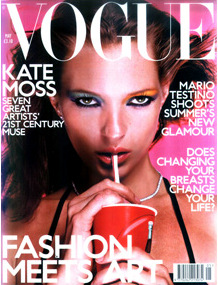
Cover of the May 2000 issue, featuring Kate Moss
Head of Editorial ContentChioma Nnadi
CategoriesFashion
FrequencyMonthly
Circulation1.8 million
First issueSeptember 1916
CompanyCondé Nast Publications
CountryUnited Kingdom
Based inLondon
LanguageEnglish
Websitevogue.co.uk

British Vogue (stylised in all caps) is the British edition of the American fashion magazine Vogue. The magazine was launched in 1916 by Condé Nast, linking together fashion and high society.[1]

British Vogue is the third most profitable edition of Vogue worldwide (other than the American and Chinese editions).[2][3]

Background

[edit]

British Vogue is the British edition of the American fashion magazine Vogue. The magazine is published monthly twelve times per year. Within the United Kingdom copies of the magazine come without the 'British' in the 'O' in the publications logo.

Circulation

[edit]
Total print circulation (United Kingdom and international)[4]
Year 2020 2022 2024
Circulation 682,709[note 1] 1,764,164 1,821,693

Editors

[edit]
Editor Start year End year Ref.
Vogue (1916–present)
Elspeth Champcommunal 1916 1922 [5]
Dorothy Todd 1923 1926 [6]
Alison Settle 1926 1934 [7]
Elizabeth Penrose 1935 1939 [7]
Audrey Withers 1940 1961 [7]
Ailsa Garland 1961 1964
Beatrix Miller 1964 1984 [7]
Anna Wintour 1985 1987 [8]
Liz Tilberis 1988 1992
Alexandra Shulman 1992 2017 [7]
Edward Enninful 2017 2023 [9]
Chioma Nnadi 2023 present [10]

History

[edit]

Early years under Chapcommunal, Todd, and Settle (1916–1934)

[edit]

During the World War I, Condé Nast (publisher of Vogue) dealt with restritions on overseas shipping and paper shortages in the United States. To answer the problem the decision was made to launch a British edition providing Vogue coverage across the British Isles, with the American edition unable to be shipped to Britain.

Under the editor Elspeth Champcommunal, articles included 'society and sporting news ... Health and beauty advice ... travelogues ... and editorials', making a 'skilfully mixed cocktail'.[11]

Dorothy Todd became editor in 1923 and was renowned for her boldness, especially blending the arts and fashion. Under her leadership the magazine shifted its focus from fashion to literature, featuring articles from Clive Bell, Virginia Woolf, Aldous Huxley, and more.[12] However, the magazine also lost much of its audience due to these changes and she was replaced by Alison Settle in 1926.

Pre and post-war under Penrose and Withers (1935–1960)

[edit]

Audrey Withers became editor of the magazine in 1940 (replacing Elizabeth Penrose Howkins who edited the publication from 1935 to 1939). During the World War II the magazine reported on events of the war. In 1944, Lee Miller was sent to Normandy by Withers to produce an article on wartime nursing; then following the Allied advance through Europe reporting on the liberation of Paris and Buchenwald concentration camp.[13]

Under Anna Wintour and Liz Tilberis (1985–1992)

[edit]

Anna Wintour served as editor-in-chief from 1985 to 1987 before taking over House & Garden, editing the magazine for only ten months before becoming editor-in-chief of American Vogue, a position she is still in.

Liz Tilberis then took over the magazine running the publication until 1992 when she joined Vogue's rival Harper's Bazaar in New York City as editor-in-chief.

Under Alexandra Shuman (1992–2017)

[edit]

Under Alexandra Shulman the magazine drew over a million readers. Shulman developed collectors issues of the magazine such as the 'Gold Millennium Issue'. Shulman was also praised for her use of up and coming photographers like Mario Testino.[citation needed] Shulman pushed designers to stop using 'size-zero' models and attempted to 'change the face of fashion'.[citation needed]

In 2016, Shulman collaborated with photographer Josh Olins to shoot Catherine, Duchess of Cambridge on the cover of Vogue's centenary issue. The photographs were subsequently featured in the National Portrait Gallery, London[14] The magazine under Shulman was the subject of Richard Macer's behind-the-scenes BBC documentary, Absolutely Fashion: Inside British Vogue (2016).[citation needed]

Current era under Enninful and Nnandi (2017–present)

[edit]

Edward Enninful was confirmed as the new editor-in-chief of British Vogue on 10 April 2017.[15] Condé Nast International chairman and CEO Jonathan Newhouse announced him as the successor to Alexandra Shulman, calling Enninful "an influential figure in the communities of fashion, Hollywood and music which shape the cultural zeitgeist", adding that "by virtue of his talent and experience, Edward is supremely prepared to assume the responsibility of British Vogue".

Enninful's first issue as editor-in-chief was 2017's December issue, featuring British model and activist Adwoa Aboah on the cover.[16]

The magazine's September 2020 triple gatefold cover featured pictures of 20 activists often associated with the Black Lives Matter movement, including Marcus Rashford and Adwoa Aboah. The Activism Now edition was photographed by Misan Harriman and was the first British Vogue cover taken by a black man in the magazine's 104-year history (Nadine Ijewere was the first black female to take a cover photograph).[17]

Actress Dame Judi Dench became the oldest person at age 85 to be featured on the June 2020 cover.[18] In 2022, actor Timothée Chalamet became the first, solo male print cover star in the magazine's history.

In June 2023, Enninful announced his departure from the magazine and his last cover was the March 2024 issue.[19]

Chioma Nnadi succeeded Enninful as editor, and was the first black woman to be head of editorial content at the publication.[20]

See also

[edit]

Notes

[edit]

References

[edit]
[edit]
Revisions and contributorsEdit on WikipediaRead on Wikipedia
from Grokipedia

British Vogue is the edition of the and magazine Vogue, launched in November 1916 by as the first international version of the American title, with Elspeth Champcommunal serving as its founding editor.
Over its more than century-long run, the publication has exerted significant influence on British by documenting and promoting key designers, photographers, and cultural shifts, from wartime to modern global trends, as evidenced in archival exhibitions of its imagery. Its editorial direction has evolved through notable leaders, including Alexandra Shulman's 25-year tenure emphasizing commercial viability and Edward Enninful's seven years prioritizing broader representation in modeling and features. The magazine has marked achievements such as co-hosting the annual British Fashion Awards, which recognize industry innovators, and adapting to digital platforms amid print declines. However, it has faced pointed criticisms, including backlash over a 2022 cover featuring nine African models for alleged poor lighting and editing that distorted appearances, and earlier shoots glamorizing emaciated "" aesthetics. Since 2024, has led as head of editorial content, overseeing content amid ongoing debates on diversity reversals in fashion.

Background

Founding and Initial Launch

British Vogue was established in 1916 by Condé Montrose Nast, the American publisher and founder of Condé Nast Publications, as the first international edition of the U.S.-based Vogue magazine. The inaugural issue hit newsstands on 15 September 1916, initially published weekly before transitioning to bi-weekly and eventually monthly formats. This launch occurred during World War I, when import restrictions on American periodicals prompted Nast—an Anglophile—to adapt the title for the British market, thereby sustaining access to its content amid wartime disruptions. The magazine's founding editor was Elspeth Champcommunal, a British designer who held the role from 1916 to 1922 and emphasized elevating British designers alongside imported influences. Under her direction, early issues focused on high-society , events, and practical wartime adaptations, such as simplified silhouettes and resource-conscious styling, while maintaining the parent publication's aspirational tone. Champcommunal's background in informed a approach that bridged couture with everyday wear, positioning British Vogue as a tastemaker for an elite readership. From inception, the publication linked to broader cultural and social spheres, targeting affluent women interested in and trends despite global conflict. Initial circulation figures were modest, reflecting the era's economic constraints and paper shortages, but the title quickly established itself as a key voice in British style . British Vogue's average monthly circulation, as audited by the Audit Bureau of Circulations (ABC), stood at 200,058 copies in 2016, reflecting relative stability amid broader magazine industry challenges. By 2020, this figure had dipped slightly to 192,242 copies, with total print and digital circulation holding steady year-over-year according to publisher reports. The publication maintained its position as a market leader, outperforming rivals in the sector despite early signs of erosion driven by the shift toward consumption. Circulation continued to contract in subsequent years, aligning with an industry-wide print decline of 8.6% in 2024. From 2023 to 2024, British Vogue recorded a 5% drop, falling from 190,333 to 180,036 monthly copies across print and digital editions. This positioned it as the top-circulating title in the UK but underscored ongoing pressures from reduced print sales, with digital growth insufficient to offset losses; the overall UK magazine sector saw combined circulation fall 7.3% in the same period.
YearAverage Monthly CirculationYear-over-Year Change
2016200,058Stable
2020192,242Slight decline
2023190,333-
2024180,036-5%
Commercially, British Vogue derives significant revenue from , leading glossy magazines in for ad pages at 8.51% among top monthly titles in early 2023 analyses. It topped inaugural rankings for in Q1 2023, surpassing U.S. and Italian editions in attracting fashion brand expenditures. Parent company UK reported overall turnover declining to £89 million in the latest audited period, reflecting cost pressures and a strategic pivot toward digital and event revenues, with goals to equalize print and digital (excluding events) within a year. Specific title-level figures remain proprietary, though April 2024 marked a record for 's highest print revenue in that month historically, boosted by premium editions.

Overview of Editorial Leadership

The editorial leadership of British Vogue resides primarily with the or equivalent head of editorial content, who shapes the magazine's , visual identity, and engagement with , . Since its founding in 1916, the role has involved navigating commercial pressures alongside creative directives from parent company , which acquired full control in 1952 and coordinates global editions under figures like as worldwide artistic director. Editors have typically reported to 's U.K. leadership, with decisions influenced by from luxury brands and reader demographics skewed toward affluent women. Early editors established the title's foundation amid interwar cultural flux. Elspeth Champcommunal, the inaugural editor from 1916 to 1922, broadened scope to encompass beauty, travel, and health alongside fashion, though circulation declined by her exit amid post-World War I economic strains. Her successor, Dorothy Todd, held the position from 1922 to 1926 and infused modernist art and literature, pioneering such coverage in British magazines but facing dismissal for perceived overly intellectual direction that alienated advertisers. Mid-century leaders like Audrey Withers (1941–1960) prioritized pragmatic wartime adaptations, such as features compliant with government rationing, sustaining readership through utility-focused editorials that emphasized resourcefulness over extravagance. Later tenures emphasized stability and innovation. Beatrix Miller edited from 1964 to 1984, promoting nascent British designers during economic recovery and youth-driven trends. Alexandra Shulman assumed the role in June 1992, serving 25 years until December 2017—the longest in the magazine's history—and overseeing digital expansion while maintaining print prestige amid declining physical sales industry-wide. Edward Enninful, appointed in 2017 as the 11th editor and the first man in the position, shifted toward inclusivity with diverse cover stars, culminating in his March 2024 exit to a global editorial role at Condé Nast. Chioma Nnadi, previously U.S. Vogue.com editor, became head of editorial content on October 9, 2023, focusing on narrative-driven storytelling amid ongoing print-to-digital transitions. These shifts reflect Condé Nast's broader emphasis on demographic representation, though critics in fashion trade publications have questioned whether such priorities occasionally overshadowed traditional merit-based selections in modeling and features.

Historical Periods

Early Establishment (1916–1926)

British Vogue was established on September 15, 1916, by American publisher Condé Montrose Nast as the first international edition of the magazine, driven by import restrictions and escalating paper costs that disrupted shipments of the U.S. version to the . The launch occurred amid wartime , yet the debut issue highlighted practical autumn fashions, street styles with longer skirts suited to the era's constraints, and emerging trends like the color green, reflecting continuity in women's interest in apparel despite rationing. Elspeth Champcommunal served as the inaugural from 1916 to 1922, expanding the publication's purview beyond apparel to encompass broader cultural influences and champion British , thereby forging ties between fashion, design innovation, and elite society. A former herself, Champcommunal's tenure emphasized the magazine's role in elevating domestic talent during and immediately after the , when economic pressures limited foreign influences. In 1922, Dorothy Todd assumed editorship, partnering with fashion editor Madge Garland to redirect British Vogue toward modernist aesthetics until Todd's abrupt dismissal in late 1926. This era introduced content, including contributions from affiliates and emphasis on , literature, and experimental design, which broadened readership among intellectuals but provoked advertiser backlash over perceived dilution of commercial fashion focus, prompting Nast to revert to a more traditional format. Todd's innovations, while culturally ambitious, underscored tensions between editorial vision and profitability in the publication's formative decade.

Interwar and World War II Era (1927–1945)

Alison Settle served as editor of British Vogue from 1926 to 1935, emphasizing British design talent and practical elegance in response to the interwar economic constraints following the 1929 stock market crash. Under her leadership, the magazine promoted homegrown couturiers and highlighted adaptable wardrobes suited to the era's social shifts, including the rise of working women, while featuring international influences like the streamlined silhouettes of designers such as . Settle's tenure marked a return to commercial viability after the avant-garde pivot of her predecessor, prioritizing accessible over experimental . Elizabeth Penrose Howkins succeeded Settle in 1935, guiding the publication through the late amid escalating geopolitical tensions. The magazine covered the evolving European fashion landscape, including surrealist elements from and the bias-cut gowns that defined the decade, while increasingly addressing measures and the approach of . Circulation stabilized as advertising from British textile industries supported content on durable, versatile attire, reflecting broader societal preparations for uncertainty. Audrey Withers assumed editorship in September 1940, coinciding with the intensification of , and led British Vogue through by integrating fashion with wartime utility and morale-boosting narratives. Facing severe paper shortages that reduced issue sizes and frequency, Withers collaborated with the British government to promote women's participation in the war effort, featuring articles on "" techniques, utility clothing schemes introduced under regulations in 1941, and adaptive styling for factory work and evacuation. The magazine maintained its visual appeal through photographers like , who captured ration-compliant ensembles, and , whose assignments evolved from Blitz documentation to frontline reporting in after her 1942 accreditation as a war correspondent. Withers' editorial direction positioned Vogue as a tool for subtle , encouraging resourcefulness without abandoning aesthetic standards; for instance, a 1941 feature depicted women in utilitarian yet attire to underscore that "you cannot ration a sense of style." Miller's contributions included shoots amid bombed landscapes and later exposures of concentration camp horrors in the June 1945 Victory issue, marking one of the first British publications to depict such imagery. This era solidified Vogue's role in sustaining cultural continuity, with Withers' forward-thinking approach—blending , , and practicality—ensuring the magazine's survival and influence despite wartime disruptions.

Post-War to Mid-Century (1946–1963)

Following the end of , British Vogue under editor emphasized reconstruction and the reintegration of women into peacetime society, with the October 1945 issue dedicated to "Peace and Reconstruction," featuring a cover evoking optimism amid lingering austerity. , who had assumed the editorship in , navigated ongoing clothes rationing—lifted only in —by promoting designs, patterns, and practical adaptations of pre-war elegance, while commissioning photographers like to document Europe's liberation and post-war recovery, including features on liberated cities such as St. Malo and . The magazine adapted to emerging international trends, notably Christian Dior's 1947 "New Look," which emphasized feminine silhouettes with full skirts and nipped waists, contrasting wartime practicality; showcased adaptations by local designers like and , balancing imported luxury with domestic production amid economic constraints. In the , coverage shifted toward affluence-driven styles, including dresses, slim sheath gowns, and early youth-oriented fashions, reflecting Britain's gradual recovery and the influence of Hollywood glamour, with increased page counts—from 84 pages in Withers' 1940 Christmas issue to 299 by December 1960—signaling expanded advertising and reader interest. Withers retired in 1960, succeeded by Ailsa Garland, who had previously served as Vogue's export ; under Garland through 1963, the publication began incorporating nascent mod influences and youth subcultures, foreshadowing the decade's social shifts, though maintaining a focus on high and sophistication amid rising from mass-market titles.

Modernization and Transition (1964–1991)

Beatrix Miller assumed the role of of British Vogue in 1964, succeeding Ailsa Garland, and held the position until 1986. Under her leadership, the magazine adapted to the cultural dynamism of the by prioritizing youth-driven aesthetics, including mod styles, mini-skirts, and space-age influences pioneered by designers like and . Miller's editorial vision emphasized high standards of creativity, collaborating with photographers such as and Terence Donovan to produce imagery that reflected London's emerging fashion scene, often featuring slim, androgynous models like and . In the 1970s, British Vogue under Miller shifted toward more eclectic and experimental content, incorporating bohemian elements, ethnic prints, and expansions amid economic challenges like the oil crisis, while maintaining a focus on luxury craftsmanship from British houses such as . The magazine's pages highlighted transitional trends, including flared trousers and platform shoes, alongside features on emerging talents like , signaling a move away from post-war austerity toward global influences. Miller's approach fostered a collaborative environment, nurturing contributors who would later define the industry, though circulation figures remained niche, appealing primarily to affluent readers rather than mass markets. By the early 1980s, British Vogue grappled with broader industry shifts, including the rise of designer and power suiting amid Thatcher-era , which addressed through covers emphasizing structured silhouettes and bold accessories. Her retirement in 1986 marked the end of a 22-year era, during which the publication solidified its reputation for authoritative commentary without succumbing to overt commercialization. Elizabeth Tilberis, who had joined British as an intern in the late and risen through editorial ranks under , became in 1987 (effective from 1988 in some accounts). Tilberis introduced a more accessible tone, launching columns like "More Dash Than Cash" to blend high fashion with affordable styling, reflecting 1980s trends in corporate dressing and emergence with figures like . Her tenure emphasized dynamic layouts and international collaborations, such as with Spanish photographer Javier Vallhonrat, to modernize visuals amid competition from glossies like . By 1991, as Tilberis prepared to depart for in 1992, British had transitioned toward a sleek, globalized identity, setting the stage for further commercialization in the .

Shulman Era of Stability (1992–2017)

was appointed editor-in-chief of British Vogue in June 1992, becoming the first editor without a traditional pedigree, having previously edited features at Vogue and led . Her 25-year tenure, the longest in the magazine's international history, emphasized commercial sustainability, elevation of British design talent, and adaptation to shifting reader demographics amid print media challenges. Under Shulman's leadership, British Vogue's circulation grew from approximately 150,000 copies per issue in the early 1990s to around 200,000 by the mid-2000s, with monthly readership exceeding one million by the , supported by innovations like annual collector's editions such as the high-profile issues featuring luxury portfolios. She prioritized accessible content, including features on relatable women's issues and practical fashion, while maintaining the magazine's aspirational aesthetic, which helped sustain profitability for during digital disruptions. Shulman actively promoted British designers, providing early platforms for figures like , whose debut collections gained prominence through Vogue features starting in the mid-, and supported the "" wave including and . In 1997, she publicly challenged international designers like and via an open letter advocating for samples in UK size 12-14 to better reflect average British women, sparking debate on industry sizing but underscoring her focus on realism over abstraction. Her covers shifted toward celebrity-driven imagery from the late , featuring supermodels like alongside stars such as and , which boosted sales but drew later critiques for limited ethnic diversity in representation. The era saw British Vogue navigate controversies, including a 2009 backlash over a feature perceived as promoting unhealthy thinness, though Shulman defended and reader engagement metrics. Stability was evident in consistent awards, including Shulman's OBE in 2004 for services to the fashion industry, and the magazine's role as a for British cultural exports during economic booms like the and post-2008 recovery. Shulman announced her departure on January 25, 2017, citing a desire for new challenges after steering the title through globalization and online competition without major overhauls.

Enninful Period and Diversity Emphasis (2017–2023)

Edward Enninful assumed the role of editor-in-chief of British Vogue on August 1, 2017, becoming the first male and first Black individual to lead the publication. His appointment followed Alexandra Shulman's 25-year tenure, with Enninful's debut issue released in November 2017, featuring a cover ensemble of diverse women including , , and to signal a shift toward inclusivity. Enninful, previously creative and fashion director at and , emphasized reflecting contemporary society through broader representation in editorial content, stating his vision for a magazine that showcased "different women, different body shapes" and inclusivity across genders, ages, and abilities. Under Enninful's leadership, British Vogue prioritized diversity in covers and features, including non-traditional models, disabled individuals, and figures from varied ethnic backgrounds, such as the 2019 highlighting activists like and the 2020 edition focusing on changemakers amid social movements. This approach extended to staff diversification and content addressing , transgender visibility, and racial equity, with Enninful crediting it for reinvigorating the 105-year-old title as a "Fashion " in the UK. The magazine achieved record advertising sales growth during this period, alongside stable around 190,000-191,000 copies monthly by 2021, though critics noted a narrower focus on luxury alongside the inclusivity push. Enninful's diversity emphasis drew praise for broadening cultural narratives, with features incorporating octogenarians, plus-size models, and non-binary representations to challenge conventional standards. However, some observers argued it introduced that selectively emphasized certain identities while potentially sidelining others, questioning the editorial merit of such curation in a commercial context. His final issue in February 2024 assembled 40 icons—including models, actors, and activists—for a collective cover, underscoring the era's thematic focus before his transition to a global advisory role at . Enninful departed after six years, announced on June 2, 2023, amid reports of internal dynamics but with the publication positioned as more inclusive and digitally expansive.

Nnadi Era and Recent Shifts (2024–present)

, previously editor of Vogue.com for the U.S. edition, assumed the role of head of editorial content at British Vogue in October 2023, marking the first time a Black woman held the position in the magazine's history. Her tenure from 2024 onward has emphasized British creativity and cultural figures with multidisciplinary appeal, drawing from her background in . Nnadi's debut issue as head of editorial content, the April 2024 edition, featured singer on the cover, photographed by Harley Weir, with twigs described by Nnadi as a "shape-shifter" embodying in music and style. This choice signaled a focus on performers who bridge and artistry, contrasting with prior emphases on high-profile . Subsequent issues, including the September 2024 edition, continued to highlight emerging British talents and festive themes by December 2024, with Nnadi curating content around seasonal narratives and UK designers. Under Nnadi, British Vogue's average circulation declined by 5% in 2024, falling to 180,036 copies per issue from 190,333 the previous year, amid broader print media challenges. In November 2024, Nnadi expressed concern over an industry-wide reversion to thinner models on runways and covers, warning that it undermined prior gains in body diversity representation. This stance reflects ongoing tensions between commercial pressures and editorial ideals of inclusivity, though specific magazine metrics on digital engagement or sales shifts remain undisclosed in public reports. Criticism of Nnadi's styling choices has emerged in some outlets, including accusations of mismatched aesthetics in features like the August 2025 shoot, which detractors labeled as diminishing the publication's former prestige. However, such views stem largely from opinion-driven commentary rather than aggregated data, with Nnadi maintaining a vision prioritizing personal style icons like Sambas in her own wardrobe, as noted in profiles. Overall, the era has seen continuity in Vogue's aspirational tone but with subtle pivots toward cultural hybridity, pending further assessment of long-term impact as of October 2025.

Content and Editorial Style

Core Features and Formats

British Vogue maintains a consistent monthly print format, issued 12 times annually, with each edition comprising approximately 200-400 pages of glossy, large-format paper optimized for high-resolution and detailed visual layouts. The physical structure emphasizes image-driven content, including full-page spreads and multi-page editorials that dominate the magazine's core, often allocating 10 or more pages per major feature to display seasonal collections, innovations, and thematic shoots. Covers typically feature a single prominent model, , or in couture, accompanied by bold and minimal text to prioritize visual impact. Standard sections begin with an editor's letter outlining the issue's thematic focus, followed by front-of-book material such as concise news briefs on runway shows, trend forecasts, and emerging designers, often illustrated with catwalk imagery from events like . Central features include in-depth profiles and interviews with key industry figures—such as models, actors, and creatives—exploring their professional trajectories and influences, as seen in recurring formats like extended Q&As or narrative essays. Fashion and jewellery editorials form the backbone, presenting curated portfolios that blend with accessories, supported by analytical commentary on craftsmanship and market dynamics. Beauty and wellness segments provide empirical evaluations of products, skincare regimens, and health-related trends, frequently citing clinical or user-tested outcomes rather than unsubstantiated claims. Lifestyle and cultural content extends to travel destinations, home design, art critiques, and literary excerpts, integrating British-specific narratives with global perspectives to reflect societal shifts. These elements are interspersed with advertiser-supported inserts, though editorial independence is maintained through Condé Nast's oversight, prioritizing verifiable trends over promotional hype. Complementing print, digital formats via vogue.co.uk replicate core sections with expanded , including videos of fashion weeks, interactive galleries, and real-time updates, while preserving the magazine's emphasis on authoritative, image-led storytelling. Special issues or supplements, such as those tied to major events like Forces of Fashion, occasionally augment the standard format but do not alter the monthly template's focus on aspirational yet grounded .

Evolution of Photography and Visuals

British Vogue, launched in 1916 by Condé Nast, emphasized high-quality photography from its inception, distinguishing it from competitors through superior paper, typography, and visual innovation that captured fashion in aspirational settings. Early issues incorporated pictorialist influences, transitioning from illustrations to photographic covers and editorials that highlighted couture with elegant, staged compositions. In the interwar period, the magazine's visuals evolved toward artistic experimentation, blending classical forms with emerging surrealist elements under editors like Dorothy Todd from 1922. Photographers such as George Hoyningen-Huene produced images like the 1930 "Divers" shoot, featuring models in swimwear on a Paris rooftop with innovative natural lighting and props to evoke everyday elegance integrated with high fashion. Horst P. Horst's 1939 "Mainbocher Corset" exemplified dramatic backlighting and emotional depth, signaling a shift from mere documentation to sculptural, emotionally resonant portrayals amid pre-war tensions. Cecil Beaton contributed society portraits and whimsical sets, while wartime rationing in the 1940s prompted Norman Parkinson to document resilience through dynamic outdoor shots of models in utilitarian attire. The 1960s marked a pivotal rupture with the "Swinging London" era, as British Vogue hired to overhaul the "Young Idea" section, introducing a raw, documentary style that prioritized candid energy over studio polish. Bailey's work with models like and captured youthful liberation, exotic patterns, and street-level vitality, contrasting prior formality and aligning visuals with cultural upheaval. Contemporaries Terence Donovan and Brian Duffy amplified this with gritty urban backdrops and high-contrast black-and-white aesthetics, reducing reliance on props for more direct, personality-driven narratives. By the 1990s, under editor , visuals incorporated "" rawness, as seen in Corinne Day's 1993 editorial, which favored unretouched, intimate grit over glamour to reflect influences and authenticity debates. This era sustained high-fashion precision via photographers like and , who blended poise with narrative depth. Subsequent decades saw digital enhancements and inclusivity pushes, yet core visual continuity persisted in strong cover imagery and elegant layouts since the , adapting to cultural demands without abandoning aspirational polish.

Signature Columns and Contributors

British Vogue has maintained the Editor's Letter as a longstanding signature feature, typically authored by the editor-in-chief to contextualize each issue's themes, editorial choices, and cultural observations; for instance, used it in his final March 2024 issue to reflect on his 76 editions and 153 cover stars, emphasizing diverse representation in . This column has historically served as a of the magazine's evolving priorities, from wartime resilience in the to post-2017 focuses on inclusivity under Enninful. In the modern era, particularly from 2017 onward, British Vogue expanded recurring columns to address personal and social topics, reflecting a shift toward and content. Nell Frizzell's parenting column, launched during Enninful's tenure, has produced over 130 pieces dissecting dynamics, motherhood challenges, and societal expectations, drawing on empirical observations of work-life imbalances in professional women's lives. Annie Lord's dating column examines contemporary romantic patterns, including post-pandemic shifts in intimacy and gender roles, with essays like her 2024 recap of relational trends amid economic pressures. These additions prioritize from contributor experiences over broad surveys, though they align with rising public interest in and relational data from sources like UK reports on marriage declines. Other specialized columns include Paris Lees's contributions as the magazine's first openly columnist starting in 2018, focusing on identity and visibility in fashion, positioned as activism through narrative rather than quantitative advocacy metrics. Adwoa Aboah's Gurls Talk column, introduced in 2017, centers on dialogues, leveraging her personal advocacy to highlight youth vulnerability statistics, such as youth suicide rates exceeding 1,000 annually per NHS data. Earlier historical features, like fashion advice segments in the , evolved into these opinion-driven formats, but lacked the identity-focused emphasis of recent decades. Key contributors have included photographers whose imagery defined the magazine's aesthetic, such as and , who captured over 100 covers and editorials from the to 1990s, emphasizing stark realism over idealized glamour in line with causal influences like post-war austerity. Stylists like , a from the onward, shaped visual narratives through meticulous sourcing of archival and contemporary pieces, influencing trends via her collaborations on over 500 shoots. Writers such as , during her 1992–2017 editorship, contributed through editorial oversight and external columns that critiqued industry commercialization, though her Vogue output focused more on curating than personal bylines. Recent masthead figures like , since 2024, continue this tradition by commissioning voices tied to verifiable expertise, prioritizing empirical trend data over unsubstantiated narratives.

Cultural and Industry Impact

British Vogue has shaped fashion trends by selectively amplifying designers and aesthetics that align with cultural shifts, often through pivotal covers and editorials that garner widespread emulation. In the early 1960s, the magazine spotlighted Mary Quant's boutique in a July 1962 feature, showcasing her geometric prints, mini-skirts, and colored tights, which embodied the mod subculture's rejection of post-war austerity in favor of playful, youth-oriented ; this coverage helped propel Quant's designs from London's to international wardrobes, with mini-skirts becoming a staple by 1965 as evidenced by their ubiquity in and sales data from retailers like outlets. Under Alexandra Shulman's editorship from 1992 to 2017, British Vogue drove the 1990s transition to "" and minimalism by debuting on its March 1993 cover, captured by in a gritty, makeup-free aesthetic that contrasted with the era's curvaceous supermodels like ; this image, featuring Moss in amid a sparse bedroom, sparked debate over promoting underweight ideals but undeniably influenced designers such as and to adopt waifish proportions, with Moss appearing on 42 British Vogue covers during Shulman's tenure—more than any other model—and her style informing global trends in low-slung jeans and cropped tops by mid-decade. Shulman's approach prioritized marketable British exports, fostering a leaner that dominated collections from to Helmut Lang. The publication has bolstered individual designers' trajectories through consistent runway coverage and profiles; for , British Vogue's reporting on his debut 1992 Highland Rape collection and subsequent spectacles, including the 1999 No. 13 show described as tapping "a whole new range of emotions and psychoses," elevated his reputation for theatrical narratives blending with historical subversion, contributing to his brand's commercial breakthrough with sales rising from £1 million in 1997 to over £20 million by 2000. Edward Enninful's tenure from 2017 to 2023 extended this influence toward inclusivity, with covers featuring diverse ensembles like the September 2019 issue uniting 10 women of varying ethnicities and abilities, which correlated with industry-wide upticks in non-white model bookings—from 13.7% in 2013 to 27.5% by 2019 per The Fashion Spot data—and encouraged designers such as to integrate adaptive sizing, though critics noted the persistence of high-end limiting .

Role in British Cultural Narratives

British Vogue has chronicled and influenced British cultural narratives by intertwining fashion with national identity, portraying societal shifts from wartime resilience to youth-driven modernity while maintaining an aspirational lens on class and tradition. Launched in 1916 amid , the magazine positioned itself as a bridge between high society and emerging cultural currents, featuring contributions from figures like to underscore Britain's intellectual and stylistic heritage. During , under editor Audrey Withers, it received special government paper allocations to sustain publication, emphasizing morale-boosting content that depicted women in utilitarian yet elegant attire, such as Lee Miller's photographs of factory workers and ration-adapted styles, thereby framing fashion as a tool for national endurance and adaptation. In the 1960s, British Vogue played a central role in narrating the "Swinging London" phenomenon, elevating from subcultural fringes to mainstream British identity. Editor Ailsa Garland championed emerging talents like photographers , Terence Donovan, and Brian Duffy—the so-called "Black Trinity"—who captured the mod aesthetic, mini-skirts popularized by , and Vidal Sassoon's geometric haircuts, with Bailey alone shooting 96 covers between 1961 and 1976. This coverage democratized fashion narratives, spotlighting affordable, street-inspired trends and supermodels like as symbols of post-austerity liberation, thus embedding a narrative of youthful rebellion and British innovation in global perceptions of the era. The magazine has consistently woven royal narratives into Britain's cultural fabric, presenting the as an enduring emblem of continuity amid change. Princess Elizabeth first appeared in 1927 as an infant alongside her mother, with subsequent features like Cecil Beaton's 1945 Buckingham Palace shoot of the princesses highlighting wartime stoicism and the 1948 color image with young Prince Charles marking Vogue's first royal color spread. Coverage extended to jubilees, coronations, and special editions, such as the purple cover following Queen Elizabeth II's death, reinforcing monarchical majesty while blending it with accessible modernity to sustain public affinity. Under Alexandra Shulman's editorship from 1992 to , British Vogue reinforced narratives of British cultural resilience and global influence, advocating for domestic designers and critiquing industry excesses like debates, which positioned the magazine as a steward of pragmatic aspiration over fleeting trends. This era sustained an elitist yet inclusive tone, featuring diverse figures from to to reflect , though rooted in high-fashion exclusivity that mirrored Britain's class-infused cultural storytelling. Overall, British Vogue's narratives prioritize stylistic evolution as a proxy for national character, often idealizing tradition and innovation without deeply interrogating underlying socioeconomic structures.

Achievements and Recognitions

In the 2020 Professional Publishers Association (PPA) Awards, British Vogue was awarded Diversity Initiative of the Year for its editorial efforts under editor , while Enninful himself received Editor of the Year, recognizing the magazine's influence on industry standards during that period. These honors highlighted the publication's role in shaping discourse on representation, though such recognitions from bodies have faced for prioritizing alignment over empirical diversity metrics in fashion media. Enninful's tenure also garnered broader industry acclaim tied to British Vogue, including the Trailblazer Award at the 2023 British Fashion Awards for advancing creative leadership at the magazine, and the Global VOICES Award from The Business of Fashion for elevating underrepresented voices through its pages. Earlier, in 2018, Enninful was honored with a CFDA Founders Award in recognition of his inaugural impact on British Vogue's direction. Sales milestones underscore commercial achievements, with the September 2019 issue identified as the fastest-selling in British Vogue's history and the 2024 edition achieving the highest print revenue for an April issue, reflecting sustained reader demand amid digital shifts. Circulation has demonstrated resilience, maintaining approximately 180,000 copies per issue as audited by ABC in recent years, outperforming some competitors despite broader print declines.

Criticisms and Controversies

Body Image Standards and Health Implications

Throughout its history, British has predominantly featured slender models, aligning with the industry's emphasis on a thin aesthetic that intensified during the controversy of the mid-2000s, when models with UK size 0 (US size 00) proportions became normalized on catwalks and in editorial spreads. In 2009, then-editor publicly criticized designers for supplying sample garments in sizes too small for average models, arguing that this forced the use of unnaturally thin figures to fit clothing, resulting in images of "14-year-old boys" rather than women. Critics contended that such portrayals reinforced an unattainable slimness ideal, potentially exacerbating pressures, though Shulman later asserted in 2015 that thin models do not directly cause eating disorders or low , attributing these issues instead to broader societal and individual factors. Empirical research on thin-ideal media exposure, including fashion magazines like Vogue, indicates associations with heightened body dissatisfaction. A 1992 experimental study found that college women exposed to fashion magazine images reported lower body satisfaction, a stronger desire to lose weight, and greater weight-related frustration compared to those viewing neutral content. Similarly, a 2013 study of adolescents linked frequent thin-ideal to increased body dissatisfaction and symptoms, mediated by internalization of the slim standard. These effects stem from sociocultural pressures where repeated depiction of low-body-fat figures prompts upward social comparisons, though causation is not isolated to magazines alone, as genetic predispositions, peer influences, and family dynamics also contribute to vulnerability. Health implications include elevated risks for eating disorders such as and bulimia, with body dissatisfaction serving as a proximal . Longitudinal data suggest that internalization of thin ideals from media correlates with behaviors that can escalate into clinical disorders, particularly among adolescent girls, where rates of eating disorders rose alongside intensified media thinness promotion in the and . However, direct attribution to British Vogue specifically remains correlational rather than proven causal, with some industry insiders, including Shulman, dismissing media blame as oversimplified, noting that eating disorder rates predate modern fashion imagery and persist across demographics. In response to criticisms, joined a 2012 international Vogue editors' pledge to feature only "healthy" models—defined as those not appearing or under 16—and to disclose post-production image alterations, aiming to mitigate promotion of unhealthy thinness. Despite this, ongoing scrutiny persists; a 2024 analysis of fashion campaigns found 95% of models in UK size 6 or smaller, with plus-size representation under 1%, suggesting limited empirical shift in standards. Recent editorial commentary has highlighted concerns over a potential resurgence of , possibly fueled by weight-loss drugs like (Ozempic), underscoring unresolved tensions between commercial imperatives and health considerations.

Diversity Initiatives: Empirical Outcomes and Debates

British Vogue introduced diversity initiatives prominently under , who assumed the role in 2017 and emphasized representation across race, ethnicity, , and body types in covers, features, and contributors. The magazine's Vogue Values platform, launched in December 2019, committed to amplifying underrepresented voices through content and partnerships, coinciding with broader industry responses to racial movements. Empirical data on cover diversity shows a marked shift: prior to Enninful's tenure, only 9.3% of covers across major British glossies in 2017 featured people of color, whereas his editorship included high-profile diverse groupings, such as the May 2018 issue with nine models representing varied racial, size, and socioeconomic backgrounds. Industry-wide, magazine covers in 2020 recorded 48.8% models of color, up from prior years, with British Vogue contributing through issues like the guest-edited "Forces for Change" September 2020 edition focused on activists. Outcomes in circulation and readership provide mixed indicators of impact. Enninful reported in that diverse, "colorful" covers drove strong sales performance, countering internal skepticism at that such choices would dilute prestige or revenue. Under his , print stabilized amid declining industry trends, while digital subscriptions grew, though specific attribution to diversity remains anecdotal rather than causally isolated. Broader fashion sector data from the 2024 British Fashion Council census reveals persistent gaps, with only 9% of executive roles held by people of color, suggesting that visible changes like British Vogue's 2023 disability-themed covers—featuring five disabled activists and models—may not translate to structural shifts in staffing or . Debates center on the depth and sustainability of these efforts, with proponents crediting Enninful for proving diversity enhances cultural relevance without commercial harm, as evidenced by awards like the 2020 PPA Diversity Initiative of the Year. Critics, however, argue initiatives often veer into , prioritizing symbolic gestures over systemic reform; for instance, the 2023 disability issue faced accusations of performative inclusion despite lacking evidence of ongoing policy changes in hiring or supplier diversity. The 2020 "Forces for Change" issue, while awarded for diversity, drew backlash for its all-non-white cover collective, highlighting tensions between exclusionary representation and balanced appeal. By 2025, Enninful himself warned of industry backsliding amid rising anti-diversity sentiments, pointing to resurgent narrow beauty standards and reduced emphasis on inclusivity post-2020 reckonings, which raises questions about whether initial gains were driven more by external pressures than enduring merit-based integration. UK-wide model diversity at improved to 50% ethnic minorities by 2022 from 14% a earlier, but executive underrepresentation persists, underscoring debates on whether Vogue's visible efforts mask underlying causal barriers like biased recruitment networks.

Ethical Issues in Fashion Promotion and Industry Practices

In , British Vogue drew criticism for its use of unpaid month-long internships, which were argued to perpetuate class barriers and undermine the publication's diversity pledges under incoming editor , as such opportunities disproportionately exclude candidates from lower socioeconomic backgrounds who cannot afford to work without compensation. This practice reflects broader ethical concerns in media operations, where unpaid labor has historically subsidized entry-level roles amid high-profile editorial demands. British Vogue's promotion of luxury brands has intersected with industry-wide scrutiny over , including inadequate measures to eradicate forced labor and ensure worker rights transparency, as luxury sectors lag behind environmental commitments in auditing global suppliers. For instance, garment workers in regions supplying featured brands have faced documented exploitation, such as irregular pay and unsafe conditions exacerbated by pandemic disruptions, issues British Vogue has reported on domestically via exposés on sweatshops in employing migrant labor under substandard terms. Critics contend that editorial endorsements amplify demand for products tied to these practices without sufficient onus on advertisers for verifiable reforms. Sustainability in promotion remains contentious, with British Vogue's trendsetting influence accused of fueling overconsumption despite internal pushes like sustainability-focused series and collaborations, such as the 2022 Tencel T-shirt initiative. The publication's coverage of fast fashion critiques highlights ethical dilemmas—like environmental degradation and labor vulnerabilities in global south supply chains—but its high-fashion spotlights continue to prioritize aspirational excess over systemic change, mirroring industry greenwashing where transparency tools like the Higg Index have faced accusations of inflating progress metrics. In 2024, British Vogue addressed exotic leathers' ethical sourcing challenges amid animal welfare concerns driving their phase-out, yet promotion of non-vegan materials persists in legacy content.

References

Add your contribution
Related Hubs
Contribute something
User Avatar
No comments yet.